

When Nicky Hager published Dirty Politics a decade ago, he exposed a political ecosystem in which government insiders supposedly used independent bloggers to wage smear campaigns, break stories, and launder political attacks through channels that looked organic. Hager argued that politicians fed attack lines to bloggers like Cameron Slater. Slater published the hit jobs and ministers kept their hands clean.
In light of yesterday’s reporting by the NZ Herald that Jordan Rivers has been employed by the Labour Party since January 2025 while continuing to present himself as an independent political commentator, it’s impossible to ignore how uncomfortably familiar this setup feels. The cast and tech has changed. But the model, and the structure of the trick, is the same. In 2025, Dirty Politics doesn’t have a blogger; it has an influencer.
But there is one way this version of Dirty Politics is worse: In this case taxpayers are funding it. We pay Jordan River’s salary in the Leader of the Opposition’s office. We are paying for him to do Labour’s dirty work.
There are thousands of people who work in and around the political machinery of New Zealand. Staffers, advisors, lobbyists, contractors, researchers, analysts, electorate agents, party organisers, and volunteers who drift between campaigns and Parliament. Most of them hold their own political views, philosophies, and loyalties. That’s normal. What matters is not whether people in politics have opinions, but whether they understand the responsibility that comes with being paid, directly or indirectly, by the taxpayer to serve an elected leader. When you step inside the parliamentary ecosystem, the normal rules of online life stop applying. The standards are different, the expectations are higher, and your independence narrows whether you like it or not.
When I worked in Parliament, I learned this first-hand. I shut down my podcast. I stopped posting political commentary on social media. I withdrew from public debates I had previously taken part in. It was made clear to me, and rightly so, that anything I said online would reflect on the Leader of the Opposition, and that she would be the one dragged into the media firing line if I slipped up. I did my time in the National Party Leader’s Office, and even though I held plenty of my own views, I recognised that the moment you are on a leader’s payroll, your voice is no longer just your own. You are part of their public reputation whether you intend to be or not.
Many New Zealanders have passed through the political system in one way or another, but when you are being paid by the taxpayer to work in the Leader’s Office, Labour, National, whoever, you cannot credibly claim to be an “independent commentator.” You are inextricably tied to the fate, judgement, and public standing of the leader you serve. It is the most intimate and politically sensitive employment relationship in the country. What you say in public becomes what they are assumed to believe, endorse, or encourage. That is why staffers traditionally keep a low profile; because the line between personal opinions and the leader’s reputation simply does not exist. If the media give Chris Hipkins and Labour a pass on this it will be a complete abandonment of duty in the name of bias.
Jordan Rivers, a former Shortland Street actor turned social-media influencer, has built a large social media audience. He has more than 200,000 TikTok followers, 72,000 Instagram followers, and 38,000 on Facebook.
Rivers produces a steady stream of hyper-aggressive, highly partisan political content that blends mockery, abuse, and crude insults with slick, fast-paced influencer aesthetics. His videos routinely target politicians Labour opposes, especially Christopher Luxon, Nicola Willis, and David Seymour, using name-calling, humiliation, personal derision and, at times, insinuations so defamatory no elected MP could ever utter them without detonating their career. Wrapped in jokes, memes, and rage-monologues, his posts function as viral attack ads disguised as entertainment from an unattached observer.
He repackages Labour Party policies, talking points, and announcements into digestible, emotional, youth-friendly clips, effectively laundering official political messaging through the façade of an independent creator. But behind the ring lights and rage bait sits the fact that Labour never meaningfully disclosed that Jordan Rivers is employed inside the Labour leader’s office, paid by Parliamentary Service supposedly as a social media adviser to Labour’s Māori caucus.
This is not disclosed on any of his social media accounts nor on any of his content. A clear breach of multiple laws and safeguards. It breaches the rules of the Advertising Standards Authority, Electoral Law, and the policies of the social media platforms.
I’m not holding my breath for Nicky Hager to dust off his typewriter though. So I have done my own analysis. Last night, I ran Rivers’ social media accounts through AI comparing his 2025 content to the accounts of Chris Hipkins and the Labour Party. I also cross-referenced his content against Labour Party announcements and press releases.
Overall, the accessible evidence paints a consistent picture that Jordan Rivers is overwhelmingly acting as a message amplifier and ‘attack dog’ for the Labour Party, not as an independent political commentator or agenda-setter. Across all major 2025 political issues visible in the public record, for example public-sector job cuts, Māori issues, cost-of-living, power-price messaging, pay equity, and health policies, Rivers’ videos and captions reliably echo the core framing, statistics, and talking points used by Chris Hipkins and the Labour Party’s official channels.
In every issue cluster where precise dates can be compared, Labour or Hipkins establishes the line first through a press release, conference speech or media appearance, followed by Labour’s official social channels, and only then does Rivers begin circulating the same message in influencer-friendly, comedic or aggressive formats.
An example of direct linguistic mirroring comes from Labour’s core attack line on employment. On 7 October 2025, Chris Hipkins told RNZ:
“Thirty-six thousand jobs have disappeared under their leadership.”
That exact phrasing of “jobs have disappeared under their leadership” was then amplified across the media and Labour’s official social channels in the days that followed.
Shortly afterwards, Jordan Rivers began releasing multiple videos centred on the same framing, using lines such as:
“36,000 jobs disappeared under their Government…”
Labour’s 2025 conference messaging leaned heavily on its branded narrative:
“Jobs, Health, Homes is not just a slogan — it’s our plan to create good jobs, back local businesses, and keep talent in New Zealand.”
This three-part sequence of Jobs → Health → Homes was repeated across Labour’s reels, speeches, and website materials, forming the backbone of the party’s economic argument for the year.
Rivers’ content also utilises and repeats this political rhetoric creating content built on the exact same trio of issues and the same narrative structure. He simply flips the direction from “Labour will fix this” to “National is destroying this.” That is because it is clearly his job to enact the negative politics and attacks that it would not be expedient for Labour and Hipkins accounts to engage in.
Labour’s economic attack line on Nicola Willis has been consistent throughout 2025:
“Nicola Willis is responsible for cuts and job destruction.”
Their reels and captions hammer a tightly controlled set of verbs, like “cutting jobs”, “destroying livelihoods”, “undermining the economy”, “hurting families”, forming the backbone of Labour’s critique of the Government’s fiscal programme.
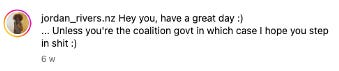
Rivers’ content mirrors this almost perfectly. However, his posts routinely take on a snarkier tone.
Click to view
His attacks on the Finance Minister are relentless, mocking her as incapable of doing math, saying Luxon is “almost as horrific as Nicola trying to do maths without a calculator,” and repeatedly implying she is fundamentally unqualified for her role. These are attacks Labour cannot make directly without appearing sexist, petty, or unprofessional, but Rivers can. His videos blend Labour’s core economic criticism with layers of personal ridicule, turning a policy attack into a character assassination wrapped in meme content.
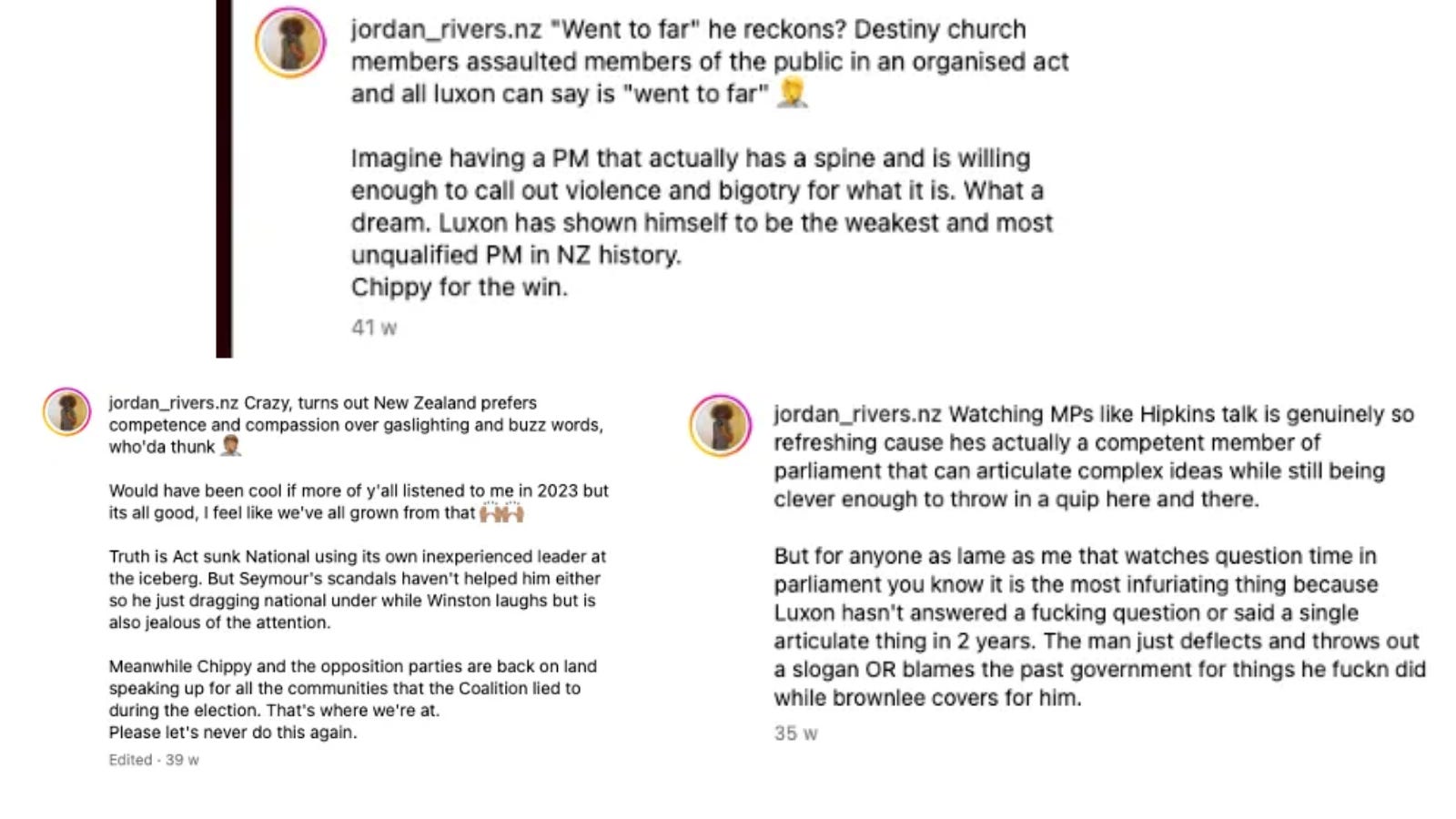
One of the more telling features of Rivers’ output is the way he consistently elevates Chris Hipkins as the superior alternative to Christopher Luxon. Rivers enthusiastically posts lines like “Chippy for the win”, celebrates Hipkins’ performances in the House, and presents him as the steady, competent counterweight to a Government he portrays as chaotic or cruel. To his followers, this looks like organic admiration from an everyday commentator, a fan of “Chippy” speaking his mind. Really Hipkins is his boss and the audience is never told that the praise comes from an employee, not an outsider.
Click to view
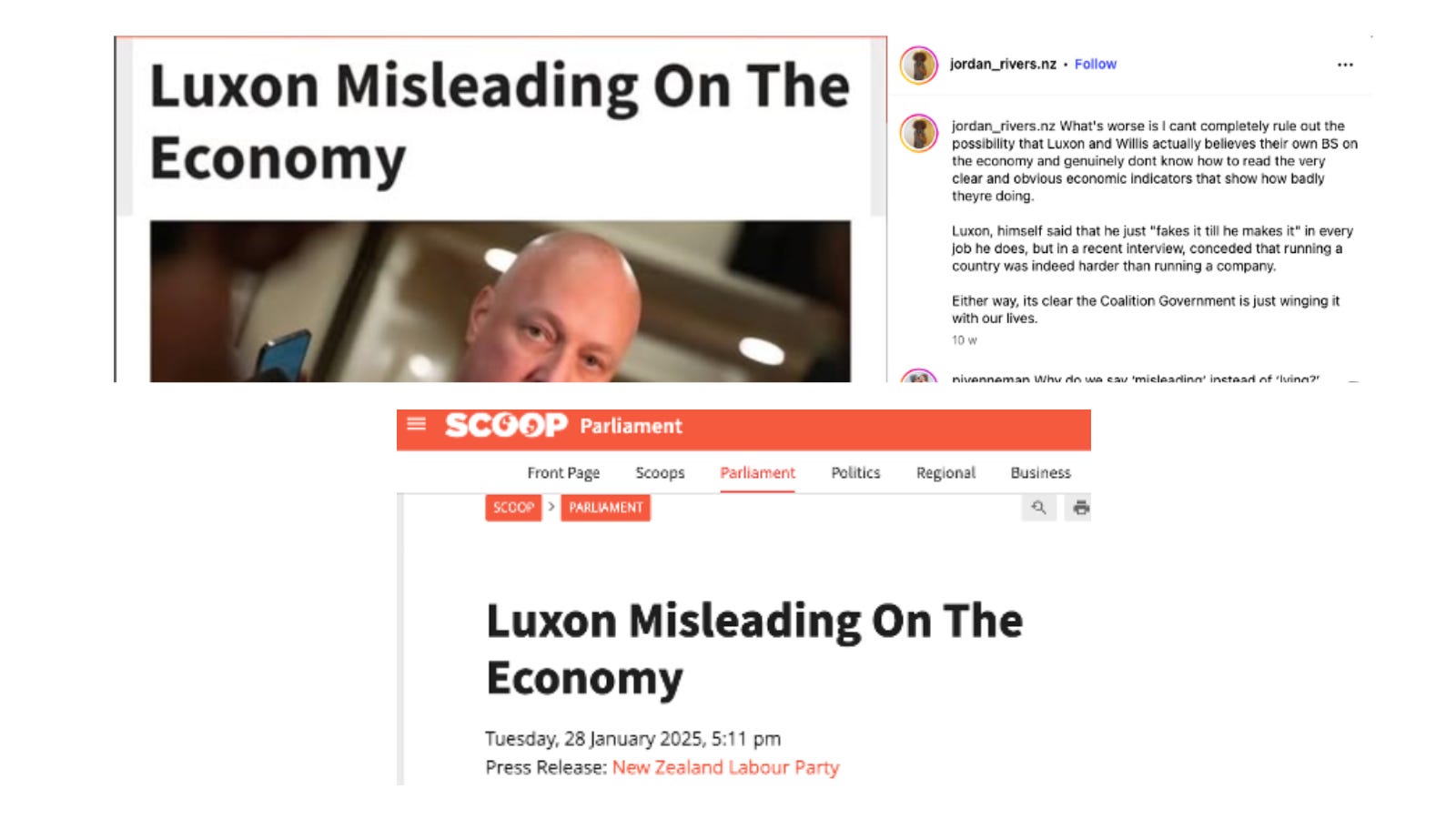
In some cases he literally uses Labour press releases in his content:
He has also engaged in electioneering, telling his audience how to vote in local elections in order to “get rid of this government”. No disclosure, no promoter statement.

Click to view
Because platform restrictions hide timestamps on many posts, I cannot calculate average time gaps in hours, but the directional pattern is unmistakable: Labour leads and Rivers follows. His role is stylistic, rather than substantive. Where he diverges is in tone only by using crude humour, personal mockery and more extreme rhetorical attacks.
On the issues where Labour has a defined position, Rivers does not contradict or challenge it. Where he posts unrelated lifestyle, humour or personal-brand content, that material appears independent, but his political posts consistently reinforce Labour’s messaging. The result is a strong pattern of message dependency and Rivers’ content is most plausibly derived from Labour speeches, press releases and internal talking points.
Taken together, the available evidence shows Rivers is operating as a Labour-aligned influencer translating Labour talking points into viral, high-emotion video content, not an independent voice setting the agenda. His employment by the Labour leader’s office confirms that his political content is not meaningfully separate from Labour’s communications machinery and his output, where visible, consistently reflects Labour’s lines rather than shaping them.
In the process of analysing Rivers’ content several other influencers were flagged as using similar tactics to launder Labour messages almost verbatim and attack Government politicians. These include Brie Elliott, Sean Ackland, Tania Waikato, 1termgovt, rt.hon.notmyprimeminister, and _the_bike_shed. These accounts frequently “collaborate”, tag each other, and reshare each others’ content. It would be entirely fair for New Zealanders to ask Labour what ties they have to these accounts also.

Click to view
Most of Rivers’ political output is not commentary in any meaningful sense. It is not analysis, nor is it an attempt to persuade through ideas. It is attack content which uses degrading insults and personalised derision to tear into political opponents. He mocks sitting Ministers with schoolyard-style nicknames, uses juvenile humour like fart sound effects, and accuse MPs of lying without having to substantiate his claims. And crucially, it is content that Chris Hipkins and Labour’s official channels cannot produce without destroying their credibility.
Some of his content enters right into defamatory territory, straying far beyond the boundaries of respectable political discourse. He insinuates and directly associates Deputy Prime Minister David Seymour with pedophilia with manipulations and baseless accusations. Given it is now public knowledge that he is employed in the Leaders’ office it would be appropriate for media to ask Hipkins if he stands by these accusations and innuendo.


Click to view
This is precisely the sort of material Labour wants circulating, but only if they can keep their fingerprints off it. It is exactly why political actors have long relied on third-party messengers. John Key’s office is alleged to have used Cameron Slater for the same structural reason: to run lines and attacks that he could never publicly own. In 2025, Labour appears to have found its equivalent in an influencer with a large, loyal audience and no requirement to obey the norms that bind elected officials.
Rivers presence at key events which he features in his content raises further questions. For example, who paid for his trip to Waitangi in February, during which he produced a flurry of content attacking Government MPs while presenting himself as an independent commentator? If any part of that travel including flights or car hire/petrol, accommodation, per diems, equipment, or logistical support, was funded from taxpayer resources attached to his role in the Labour leader’s office, then the public deserves clarity. Were taxpayers unknowingly subsidising political attack content disguised as influencer commentary? Did Parliamentary Service funds support a trip that produced partisan messaging without disclosure? Labour should answer these questions.
Rivers’ content has come to the attention of the Speaker and this was revealed when it was reported that he had been working at the Labour Party conference over the weekend. It turns out Brownlee has previously scolded Rivers and Labour for an attack video on Finance Minister Nicola Willis using heavily edited parliamentary footage. This breached Parliament’s rules on the use of official footage. Brownlee expressed zero tolerance for Parliamentary footage being used dishonestly:
“Standing orders make it very clear that no one can use or take footage from a parliamentary feed and then manipulate it to give a message contrary to that of the person who is speaking, or in support of a different proposition that they might like to advance.”
In response, Labour tried to claim that Rivers was acting in a personal capacity. But how can New Zealand taxpayers be confident of that when we are paying for him to work in the Labour Leader’s office? How do we differentiate which content is effectively paid for by his salary and what is him being “independent”? It simply is not possible.
“Jordan removed one piece of social media content that was posted on his personal social media account, outside of work hours and not in an official capacity, using footage in the public domain.” - Labour Party spokesman.
Labour has spent a decade decrying Dirty Politics and warning the country about shadow messengers, outsourced attacks, and the use of intermediaries to say what politicians cannot. Yet the arrangement they now appear to be benefiting from follows the exact same pipeline Nicky Hager mapped in 2014. The only difference is scale. Instead of a blogger with maybe tens of thousands of readers, the intermediary is now a performer with hundreds of thousands of followers, embedded in the dopamine economy of TikTok and Instagram, and reaching a vastly younger audience that mainstream parties struggle to reach on their own.
This new ecosystem supercharges the very dynamics Labour once condemned. But the risk-reward structure has changed so the attacks go further, spread faster, and land harder. Labour knows this.
They built their moral authority over years by insisting that politics should not descend into personal abuse, secret coordination, and outsourced smear campaigns. And yet here we are, with a taxpayer-funded staffer operating as a high-reach attack channel; not formally “paid per post,” but rewarded with a position inside the Leader’s Office. Labour once condemned this model as corrosive to democracy. Now, they appear to be relying on it.
The unavoidable question now hangs in the air: if Labour is paying one influencer to run this kind of outsourced attack operation, why should anyone believe he’s the only one? Political parties don’t typically make strategic communications decisions in isolation. They build systems, replicate what works, and scale what delivers results. So the idea that Labour would stumble into hiring one of the country’s most aggressive political performers, place him inside the Leader’s Office, and then simply stop there stretches credibility.
In that context, the question isn’t just how Jordan Rivers was hired. It’s whether he is the first confirmed node in a wider, unofficial network of aligned voices, creators who can say the unfiltered, undignified, and damaging things Labour cannot attach to its official brand. Because if Labour has built or encouraged a system of covert digital surrogates, the country isn’t just dealing with hypocrisy. It’s dealing with the evolution of the corruption of political discourse.
For the public to trust Labour’s digital communications, and to have confidence that New Zealand’s election laws are being respected, the party must answer several important questions beyond whether Rivers is the only influencer they are working with.
First, are Labour staff or MPs coordinating content pipelines with influencers in the same way Dirty Politics alleged the Prime Minister’s Office once supplied Cameron Slater with hacked data and attack lines? A modern version of that relationship operating through DMs, shared folders, or friendly off-the-record chats would fundamentally alter the transparency Labour claims to respect.
Second, are these influencer outputs being declared as campaign expenses, or is Labour categorising them as “personal content” to avoid promoter-statement requirements and Electoral Act obligations? This matters, because political advertising rules don’t disappear just because the medium is TikTok rather than a billboard.
Third, has the party sought advice from the Electoral Commission or the Advertising Standards Authority? Political content requires disclosure, and influencer advertising is not exempt. Youth-oriented channels cannot be treated as regulatory blind spots.
Finally, are youth-targeted social channels being used as unregulated political advertising streams? If a Labour staffer with 200,000 followers is pushing Labour messaging without declaring the financial relationship, that is not a grey area, it is a regulatory black hole.
Until Labour provides clear, detailed answers to these questions, voters have no way to distinguish between organic commentary and taxpayer-funded partisan propaganda.
Ani O'Brien comes from a digital marketing background, she has been heavily involved in women's rights advocacy and is a founding council member of the Free Speech Union. This article was originally published on Ani's Substack Site and is published here with kind permission.
7 comments:
Propaganda dressed as 'news'.
Oh dear, he's been found out. Something tells me he won't care....the far left never do.
Great work again Ani, thank you! Most interested to see what comes of this, but not holding my breath. Never heard of Jordan Rivers before but what a dirty dog..
Never heard of him either, but thanks for exposing the Labour party's association with such a loathsome human being.
Makes you think evading paying tax is OK , when so much of the tax collection is spent on rogues like this and other dishonest causes.
Can the untrustworthy Hipkins sink any lower in his quest to regain power? (Alas, probably - yes.)
Once again, Parliamentary Services have been found lacking in not being aware of what is happening behind the scenes in Parliament. No wonder so much taxpayer money is being wasted
Post a Comment
Thank you for joining the discussion. Breaking Views welcomes respectful contributions that enrich the debate. Please ensure your comments are not defamatory, derogatory or disruptive. We appreciate your cooperation.