

This is a trade deal with interesting political ramifications more so back home in New Zealand than between the two countries, though as usual there are plenty there too. Despite negotiations with India being a real longterm challenge for successive governments, the real story here is not tariffs, schedules, or annexes. It is coalition disagreement, parliamentary arithmetic, and two-thirds of the Coalition Government discovering that its biggest foreign-policy trophy may only survive if the opposition decides to carry it across the line.
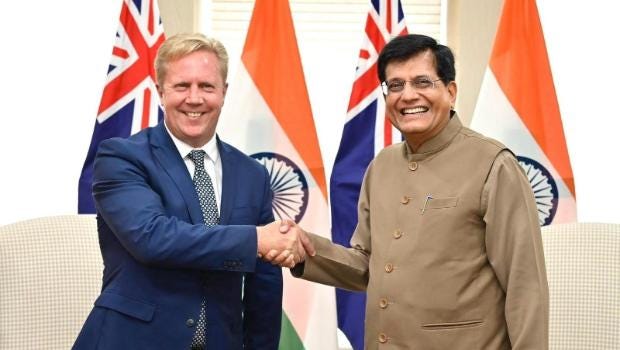
Trade Minister Todd McClay with Indian Trade Minister
Piyush Goyal. Source: NZ govt.
New Zealand’s pursuit of a trade deal with India has been long, often frustrating, and has repeatedly stalled. Formal negotiations began in 2010 amid the excitement of “Asian century” thinking, when policymakers across the Western world convinced themselves that India would follow the same arc as China with rapid growth that would inevitably require market opening for global trade. If India wanted to be a true global power, they said, it would have to open up and countries like New Zealand simply needed to be patient and ready.
What that analysis underestimated was just how politically sensitive trade liberalisation is within India, particularly when it touches food security, smallholder farmers, and domestic employment. Unlike China, India’s democracy has made agricultural reform electoral kryptonite. Tariffs and quotas are more than mere economic tools; they are necessary for political survival. Indian negotiators were never negotiating toward New Zealand’s vision of liberalisation, but toward India’s own carefully managed model of growth, one that prioritised internal stability over external access. The result was a decade of polite engagement punctuated by stalled talks, quiet resets, and periodic rediscovery that goodwill and growth rhetoric are not substitutes for leverage.
New Zealand’s pursuit of a trade deal with India has been long, often frustrating, and has repeatedly stalled. Formal negotiations began in 2010 amid the excitement of “Asian century” thinking, when policymakers across the Western world convinced themselves that India would follow the same arc as China with rapid growth that would inevitably require market opening for global trade. If India wanted to be a true global power, they said, it would have to open up and countries like New Zealand simply needed to be patient and ready.
What that analysis underestimated was just how politically sensitive trade liberalisation is within India, particularly when it touches food security, smallholder farmers, and domestic employment. Unlike China, India’s democracy has made agricultural reform electoral kryptonite. Tariffs and quotas are more than mere economic tools; they are necessary for political survival. Indian negotiators were never negotiating toward New Zealand’s vision of liberalisation, but toward India’s own carefully managed model of growth, one that prioritised internal stability over external access. The result was a decade of polite engagement punctuated by stalled talks, quiet resets, and periodic rediscovery that goodwill and growth rhetoric are not substitutes for leverage.
What do we know about the proposed FTA so far?
The proposed agreement eliminates or reduces tariffs on 95% of New Zealand’s current exports to India. This is an unusually high level of coverage by Indian standards. Around 57% of exports would become duty-free from day one, rising to 82% once the agreement is fully phased in, with the remainder subject to tariff reductions over time. On current trade levels, officials estimate immediate tariff savings of roughly $43million a year, rising to more than $60million as implementation progresses and these figures would be likely to grow if trade volumes expand as anticipated.
The biggest immediate winners would be in sectors where New Zealand already exports meaningfully to India but has long faced steep tariff barriers. Sheep meat, wool, coal, and more than 95% of forestry and wood exports would gain duty-free access straight away. Most seafood products, including mussels and salmon, would move to zero tariffs over seven years, while iron, steel, scrap aluminium, and a wide range of industrial products are phased down to duty-free access over 5-10 years. These are core export earners, particularly for regional New Zealand.
Horticulture features prominently too. Apples would receive a 50% tariff cut within a quota that is almost double recent export volumes, while kiwifruit secures duty-free access within a quota nearly 4x the size of current exports. Cherries, avocados, persimmons, and blueberries gain duty-free access over a 10 year period. These provisions are explicitly designed to target India’s rapidly expanding middle class, a consumer base projected within 5 years to exceed the entire population of the EU or ASEAN.
Wine and mānuka honey, two of New Zealand’s most recognisable premium exports, also feature prominently. Wine tariffs are cut from 150% to either 25% or 50% over 10 years, depending on value bands. This is accompanied by a Most Favoured Nation (MFN) commitment that automatically passes on any better treatment India offers future partners. Mānuka honey tariffs are reduced from 66% to 16.5% over 5 years.
Dairy is where the deal becomes more politically sensitive. Contrary to some claims, dairy is not entirely excluded, but access is narrow, indirect, and careful. The agreement provides immediate duty-free access for dairy and other food ingredients for re-export, bulk infant formula and high-value dairy preparations over 7 years, and a 50% tariff cut for high-value milk albumins within a New Zealand-specific quota aligned to current export volumes. What it does not do is open the Indian market to core consumer dairy products such as milk, cheese, or butter. Instead, the agreement includes consultation and “right to negotiate” mechanisms that are triggered if India grants better dairy access to comparable economies in future; effectively future-proofing New Zealand’s position without delivering access today.
Services are a major, and often under-appreciated, component of the agreement. The proposed FTA significantly expands on India’s World Trade Organisation commitments which would provide New Zealand service exporters with improved market access in areas such as financial services, e-payments, fintech, education, professional services, and environmental services. Under the WTO, India allows limited foreign participation in many services sectors and retains wide discretion to favour domestic firms through regulatory hurdles. By expanding on those commitments, the FTA would give New Zealand service exporters clearer and more secure rights to enter and operate in key sectors. Most importantly, it would guarantee “national treatment,” meaning New Zealand firms must be treated no worse than Indian competitors once operating in the market. This reduces the risk of discriminatory regulation, informal barriers, or policy shifts that quietly disadvantage foreign providers.
These service gains would be locked in with more MFN clauses, that ensure any more favourable terms India offers future partners must automatically be extended to New Zealand. For a services-heavy economy like New Zealand’s, this reflects where much of the long-term growth potential actually sits.
Beyond tariffs, the agreement focuses heavily on reducing difficulties at the border with customs processes to be streamlined and technical barriers to trade minimised by limiting the use of regulatory processes as de facto trade barriers, a persistent frustration for exporters dealing with India.
Now. Although immigration and labour mobility provisions are tightly circumscribed, this is where things get most politically charged. The agreement would establish a process for up to an average of 1,667 three-year skilled work visas per year, focused on occupations on New Zealand’s Green List, including doctors, nurses, teachers, engineers, and ICT specialists. These visas would be non-renewable, all existing screening and qualification requirements remain intact, and the government retains the ability to amend the Green List in response to labour-market conditions. In addition, New Zealand’s Working Holiday Scheme would be aligned with Australia’s Indian FTA, offering up to 1,000 places annually. This is explicitly framed as supporting tourism and rural labour needs.
Institutionally, the agreement follows familiar New Zealand trade architecture. It includes a Treaty of Waitangi clause protecting the Crown’s ability to meet its obligations to Māori, alongside a dedicated Cultural, Trade, Traditional Knowledge and Economic Cooperation chapter. A built-in review after one year provides a formal mechanism to pursue upgrades and improvements also.
Taken altogether as a sum of its parts, the agreement is best understood as a layered, future-oriented bargain. It delivers real gains across goods, services, and border processes, locks New Zealand into India’s future liberalisation through MFN clauses, and positions exporters to grow with India’s middle class. At the same time, it leaves glaring absences, particularly in dairy, that explain the insistence by its defenders that this is a beginning, not an end.
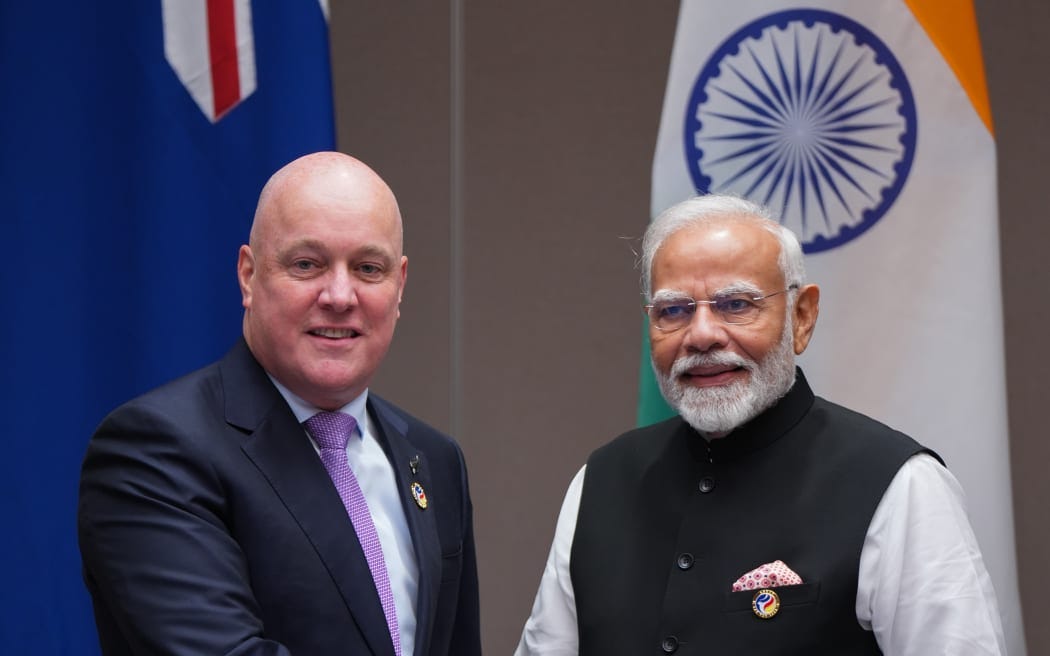
Christopher Luxon with Indian PM Narendra Modi|Photo:
Prime Minister's office
Politics though
National and ACT are firmly aligned in support of the agreement. For National, the deal fits neatly into its self-image as the party of competent economic management and outward-looking diplomacy. For ACT, it aligns with ideological commitments to trade liberalisation and labour mobility. The problem is that the third coalition partner, NZ First, has invoked the “agree to disagree” provision.
The party’s opposition has been explicit and comprehensive. Winston Peters has described the agreement as “neither free nor fair,” arguing that New Zealand has given away too much for too little in return. Central to his critique is dairy. The India agreement would be New Zealand’s first trade deal to exclude major dairy products such as milk, cheese, and butter, products that make up roughly 30% of New Zealand’s total goods exports, valued at around $24billion in the year to November 2025. Peters argues that while New Zealand fully opens its market to Indian products, India retains significant tariff barriers against New Zealand dairy.

Click to view
Immigration settings are the second major sticking point for NZ First. Peters has warned that, on a per capita basis, the deal offers India greater access to New Zealand’s labour market than Australia or the United Kingdom granted in their own FTAs. In a labour market already under strain, with unemployment rising and households feeling the squeeze, he argues this is economically and politically reckless. Layered on top of that is concern about future governments’ ability to respond to changing conditions. Provisions relating to student work rights and post-study employment, NZ First argues, risk tying the hands of future parliaments and locking in settings that may prove unsustainable.
Notably, Peters has been careful to frame his opposition as a disagreement within the government on the details, not an attack on India or its negotiators. NZ First does not want to poison the broader diplomatic relationship. Peters says he has never been ideologically opposed to trade agreements. And he is correct to point out his party did support the South Korea Free Trade Agreement in 2007 and played a pragmatic role during the CPTPP negotiations. At the same time, NZ First opposed the China FTA when they judged the concessions too great and the long-term consequences insufficiently considered. Peters says he backs trade when he considers it will deliver tangible returns and resists it when sovereignty, domestic industries, or future policy flexibility are compromised.
Strategically, however, the case for engaging India in a FTA remains compelling. India is the world’s fastest-growing major economy, a rising geopolitical power, and a country New Zealand has spent decades trying to draw closer without much success. At a time when dependence on China has become a genuine vulnerability, India represents diversification, scale, and long-term alignment in the Indo-Pacific. A trade agreement with India is about exports and it is also about positioning New Zealand as an active participant in a rapidly shifting regional order. That is why National and ACT will be determined to get this across the line.
Without NZ First’s support, National and ACT do not have the votes required to pass the implementing legislation. That leaves them in the unusual position of needing opposition support to enact the flagship trade agreement. In practical terms, this means Labour now holds the balance of power on one of the most consequential economic decisions of the parliamentary term.
Labour’s response so far has been carefully calibrated. Labour has described the agreement as “a good step forward,” while refusing to commit to supporting it in Parliament. Chris Hipkins’ ambiguity will not be a reflection of any indecision, rather he will be acutely aware of how much leverage he holds. Hipkins faces a stark political calculation as supporting the deal would reinforce Labour’s claim to a long-standing pro-trade stance and avoid accusations of political obstruction against New Zealand’s interests. It would also preserve New Zealand’s diplomatic credibility with India which is a relationship Labour would undoubtedly want to inherit intact if it returns to government.
At the same time, bailing out a coalition government on its signature achievement carries obvious risks. It hands National a win, gives credence to “uniparty” accusations, and exposes Labour to criticism from voters concerned about immigration, labour market pressures, or the exclusion of dairy. However, with such leverage, it is a moment that also presents opportunity. Labour can demand concessions, clarifications, or safeguards in exchange for its support, shaping the final outcome while demonstrating relevance and responsibility from opposition.
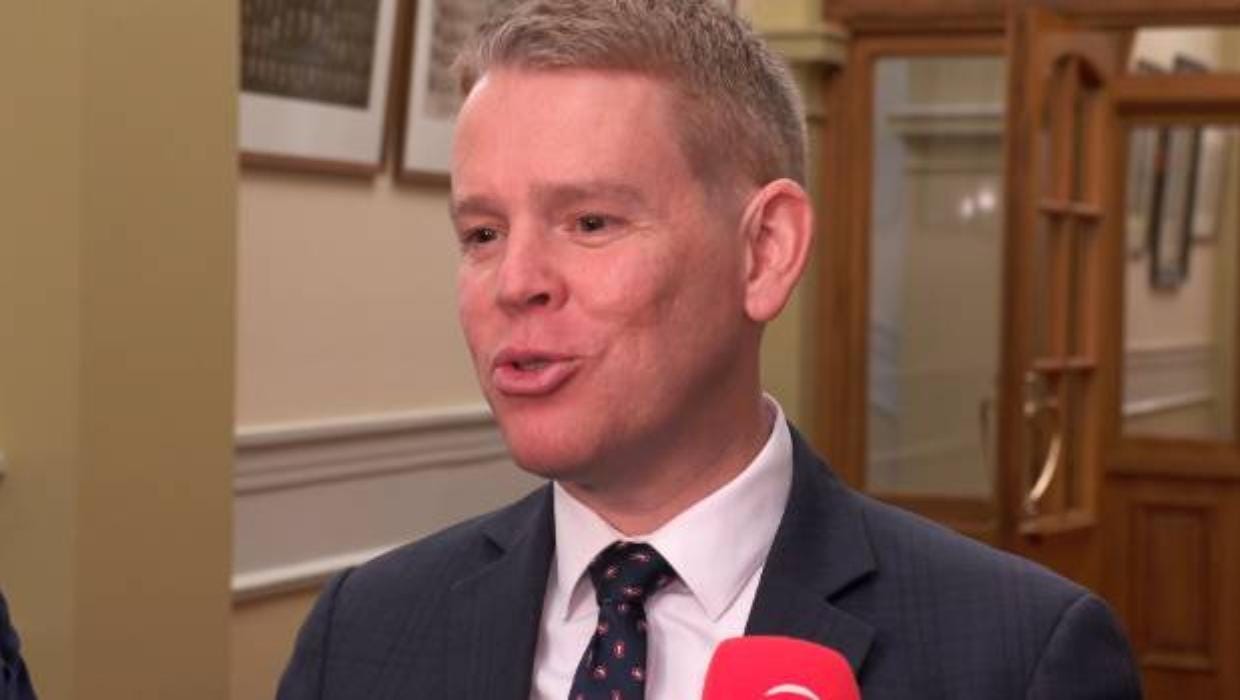
Chris Hipkins
The hard work has been done by the Government, but unfortunately for Trade Minister Todd McClay, their landmark trade deal may become one of MMP’s victims. Or this deal may pass without the support of one of the coalition partners, but with the support of an opposition which decides that it is in our national interest for them to vote with the other two government parties. That is MMP functioning as designed, ultimately. Love it or hate it, it slows haste, exposes trade-offs, and forces transparency about who benefits, who concedes, and who carries the political cost.
Right now, the fate of New Zealand’s most ambitious trade agreement in years does not rest in New Delhi. It rests in Wellington, with a handful of votes and an opposition leader with a rough decision making record.
Sources:
https://www.mfat.govt.nz/assets/Trade-agreements/NZ-India-FTA/New-Zealand-India-Free-Trade-Agreement-Summary.pdf
https://www.mfat.govt.nz/assets/Trade-agreements/NZ-India-FTA/NZ-India-FTA-Benefits.pdf
https://www.mfat.govt.nz/assets/Trade-agreements/NZ-India-FTA/NZ-India-FTA-Key-Tariff-Outcomes.pdf
https://www.beehive.govt.nz/release/new-zealand-secures-landmark-free-trade-agreement-india
Ani O'Brien comes from a digital marketing background, she has been heavily involved in women's rights advocacy and is a founding council member of the Free Speech Union. This article was originally published on Ani's Substack Site and is published here with kind permission.
7 comments:
The immigration component is totally unacceptable and should never be negotiated in FTA's.
Immigration is a sovereignty issue and gutless politicians will never discuss it with voters.
This FTA along with others undermines and dilutes NZ culture .
I agree with anonymous @8.19 except for the assertion that NZ culture is 'undermined and diluted' by immigration. If you (Anonymous @8.19) and we/us other New Zealanders have deep knowledge of where we come from, who our ancestors are and what we have brought to this country, then pride in those facts should be a shield against anything that other 'cultures' bring. Be a cultural/ethnic chauvinist and hold firm to the belief that NZers with a European ancestry have something to be proud of. Once that idea is fixed, nothing can undermine or dilute it. That only happens if you lose the sense of your own standing and importance. Finally, 'culture' as a term and idea is actually very difficult to define and grasp as it comprises so many ideas, actions, principles and historical components. Thus. I would argue there is no such thing as 'NZ culture' (others may disagree), just a feeling as to what it means to be a NZer of whatever ethnic/genetic origin, and hold fast to that without needing to resort to xenophobia.
This FTA is going to be benefiting New Zealand long after Peters is pushing up daisies. Having actually read O'Brien's analysis of the immigration provisions I am confident we can manage the process to benefit New Zealand. Peters is simply practicing the ancient art of cutting off his nose to spite his face.
Allen
"I would argue there is no such thing as 'NZ culture' (others may disagree), just a feeling as to what it means to be a NZer of whatever ethnic/genetic origin, and hold fast to that without needing to resort to xenophobia."
Then you may as well go and live in India, and keep your "feeling" as to being a NZer close to your heart. It shouldn't matter that you live among 1 billion plus Indians, so long as you still "feel" like a NZer among all the Indians who don't share your feeling and never will, and instead feel like Indians.
If anyone can be a NZer, then nobody is a NZer, and the idea means nothing.
How does Ani find time to produce so much thoughtful comment? None of the msm approach.
I. C. Clairly (or not so clairly perhaps?). It is possible my thoughts weren't expressed as they could have been or, you are wilfully misunderstanding them; I intended my comments to mean that one is a NZer if one has citizenship and especially if one has been brought up here and is fully cognisant of ones heritage, and no amount of foreign influence (or immigration) changes that. Furthermore, if I moved to India I would remain a NZer and your opinion in that regard is nonsensical.
Again with any NZ FTA, I see 'dairy' being the lead element as an export requirement.
India, when people read the informative article, above, and the following comments, can I put before you, that NZ has previously 'tried' to export dairy to India, only to have the Indian Govt of the day say "no".
I believe the reason was related to the approach the People of India have to cattle/cows - that is considering them as being "sacred" in that any product (such as dairy) would NOT be an acceptable food item.
I do recall that, the then NZ Dairy Board, shipped Ghee (clarified NZ butter) to India, which was "considered" an acceptable food item, Ghee being used in cooking of food.
It is also interesting, that the Indian Govt has sought to place Immigration as a critical factor, when we already have that association in place at this point in time.
Post a Comment
Thank you for joining the discussion. Breaking Views welcomes respectful contributions that enrich the debate. Please ensure your comments are not defamatory, derogatory or disruptive. We appreciate your cooperation.