

Disclosure: It has been an awful week of being tied to people, actions, and narratives that I have absolutely nothing to do with. I am feeling pretty beat up to be honest.
Media, bloggers, and the social media mob have decided I am somehow “pulling strings” behind the scenes in relation to Jade Paul’s Facebook post. I am not.
Jade is a friend of mine and has been for several years, well before she and Chris separated. I have been aware of some of the personal difficulties she has experienced, but as a friend I have always considered those experiences to be hers to share (or not) on her own terms.
I did not know she intended to make that post before it appeared online, and I had no involvement in media obtaining.
Despite that, I have spent the past week being dragged into speculation, with organisations I am associated with also being accused, without evidence, of involvement. The apparent “crime” here is that I am friends with Jade and have a public profile as a political commentator.
I have cautioned her about how brutal the media environment can be when private matters become public, particularly for women. It is not something I wanted to see a friend go through. Unfortunately, I am copping the blowback too.
Yes, I write about politics and comment publicly. But there seems to be a persistent and increasingly conspiratorial assumption that anyone with political views must therefore be acting as some kind of shadowy operative, pulling levers behind the scenes. I am not.
I am not asserting the truth of any current allegations in this piece. I am commenting on how those allegations are being treated by media.
Beyond that, I would simply ask people to take a breath and to extend some basic empathy and humanity to Jade, who is at the centre of all of this.
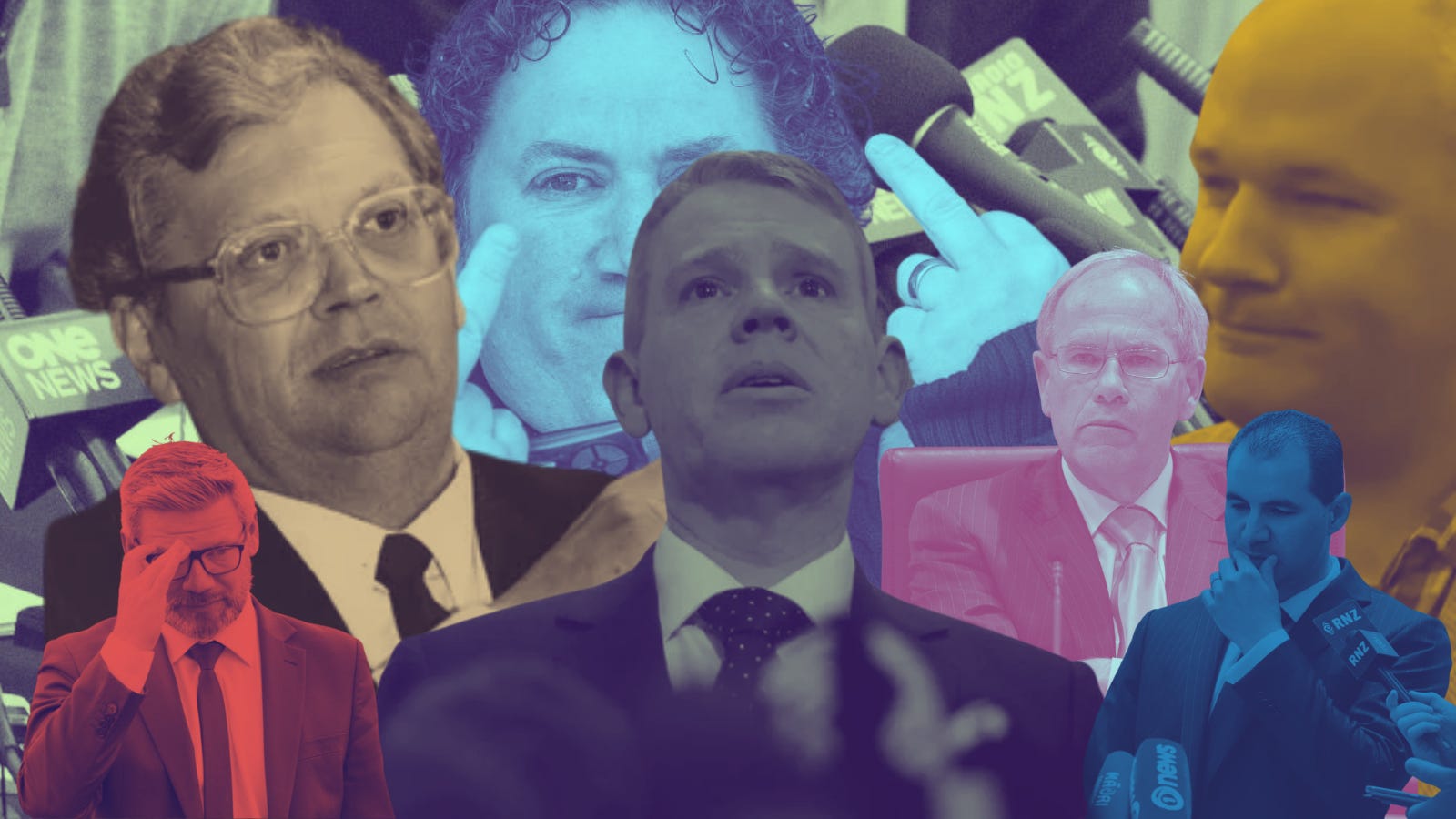
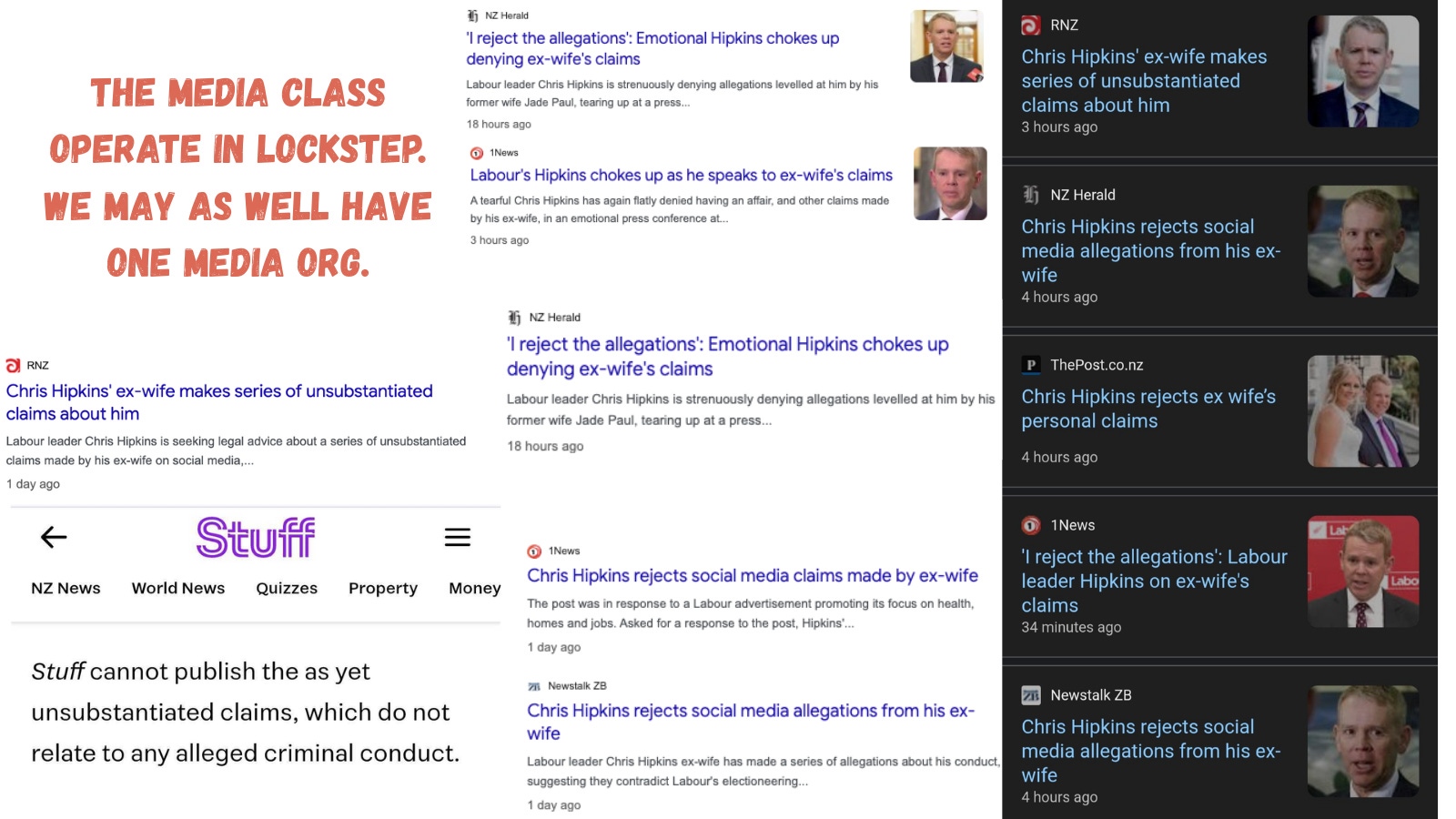
The New Zealand media have reacted to the allegations involving Chris Hipkins as though they are confronting an entirely new ethical dilemma. As if the situation is a sudden, unprecedented intrusion into the private lives of politicians, driven by the unruly forces of social media. News platforms have lined up to solemnly declare that they will not publish “unsubstantiated” claims, positioning themselves as the last line of defence against rumour, gossip, and digital mob justice. Cool story, but complete nonsense.
The idea that this represents some kind of novel departure from past practice is both ahistorical and deeply hypocritical. Forever, journalists in this country and elsewhere, have made editorial judgments about when private conduct becomes a matter of public interest and those judgments have not always erred on the side of caution. Quite the opposite, in fact. Allegations, insinuations, and personal details have frequently been aired, amplified, and litigated in the court of public opinion long before anything resembling “substantiation” was established.
Click to view
However, the same institutions that have previously, in the not so distant past, justified publishing deeply personal material on the basis of public interest are now retreating behind a newly discovered caution, while framing social media as the problem. But social media has not changed the underlying dynamics; it has simply removed the media’s monopoly on what gets discussed, when, and by whom.
If you want to understand how flimsy this sudden restraint is, you don’t have to dig very far. A search bar and an internet connection are all you need. I utilised both and took a little trip down memory lane.
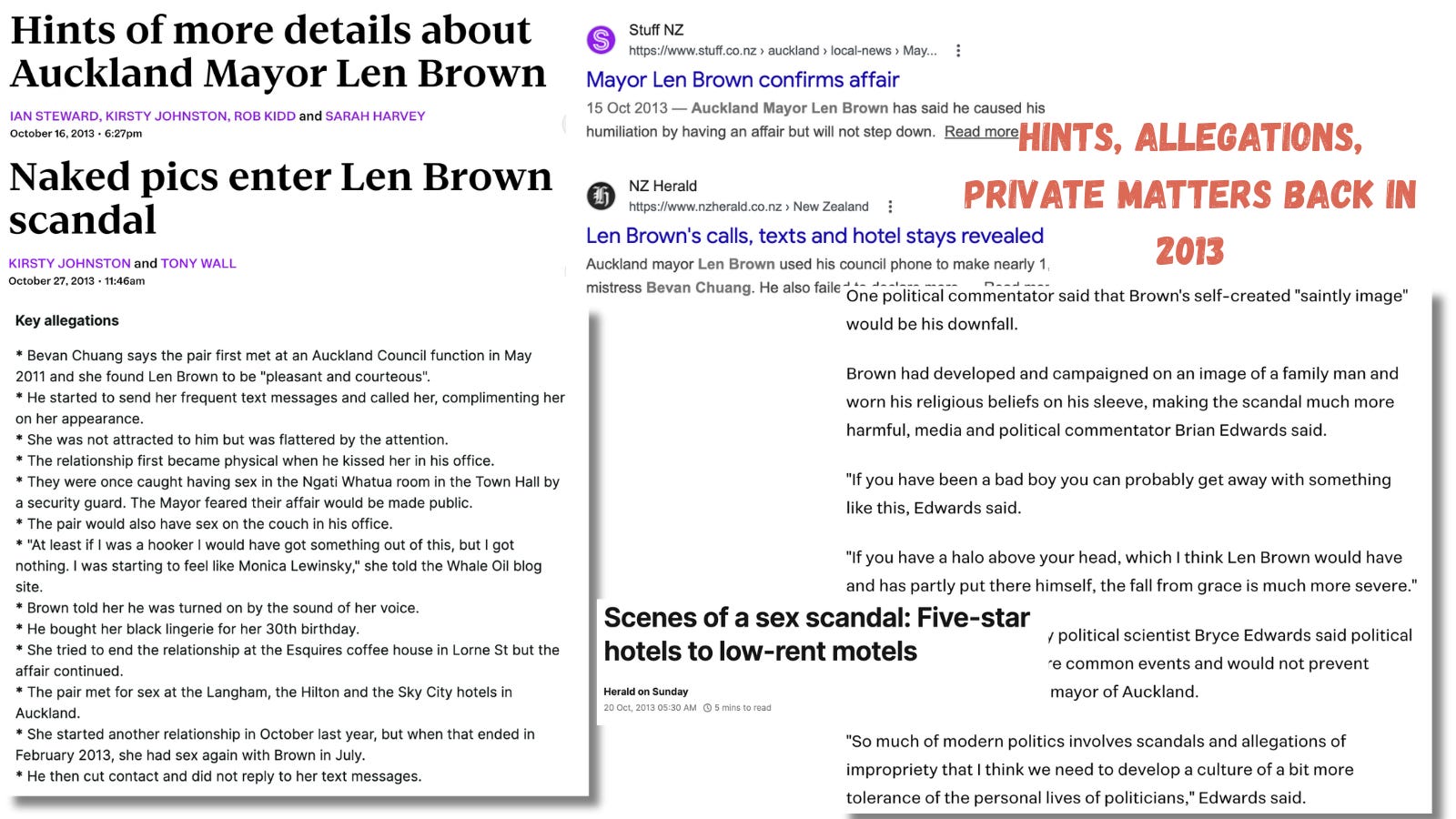
In 2013, Auckland Mayor Len Brown’s affair was forensically documented by New Zealand’s journalists. Text messages, hotel rooms, intimate encounters, commentary on character and hypocrisy. The level of detail went well beyond “public interest” into something much closer to voyeurism, justified after the fact because it made for juicy gossip.
Click to view
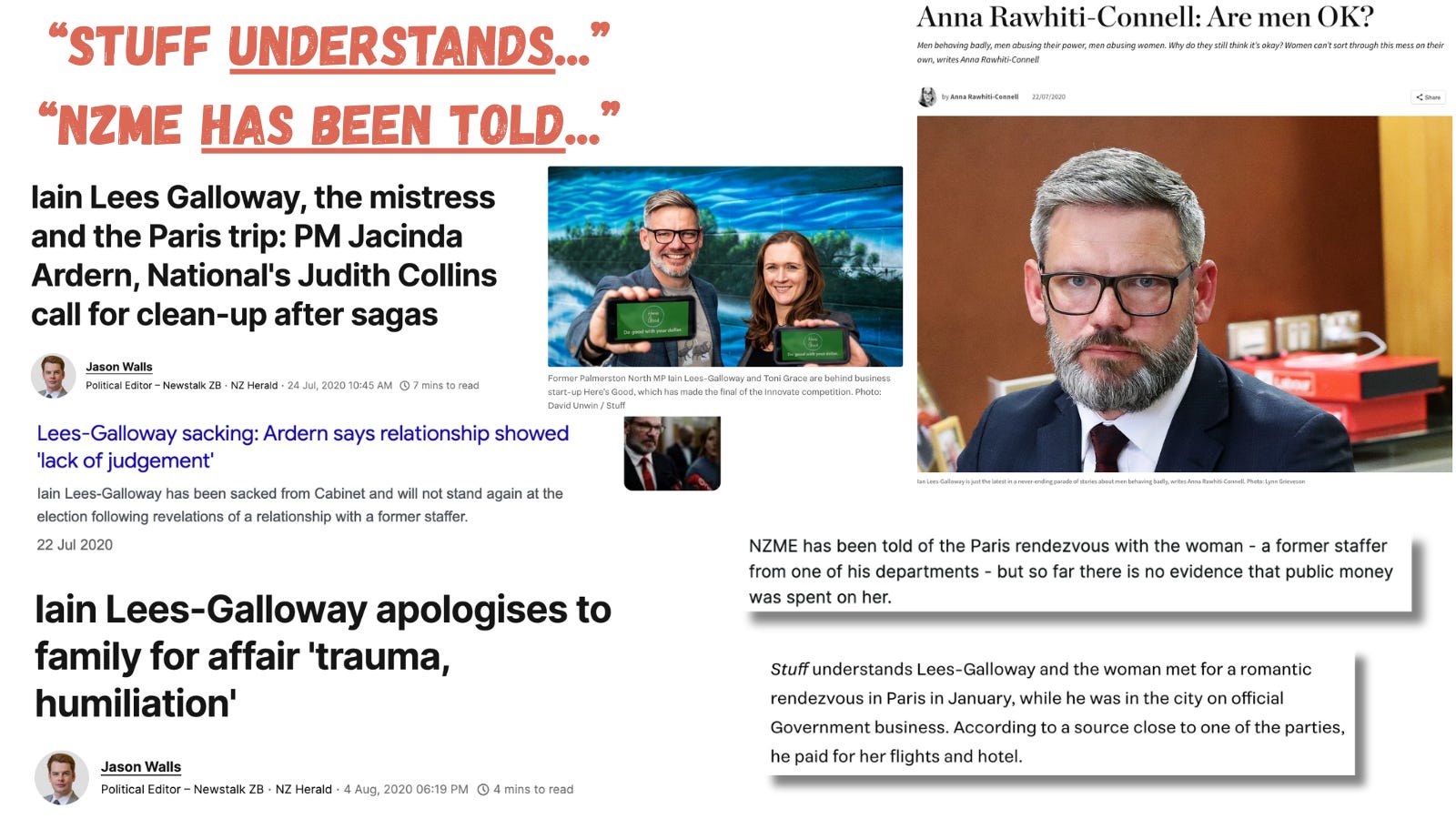
In 2020, Labour Minister Iain Lees-Galloway was sacked from Cabinet by Jacinda Ardern after his affair with a staffer came to light. The media jumped on the story quickly with “Stuff understands…” and “NZME has been told…” so they could report on details that were yet to be substantiated. That was enough to run with claims about a relationship, a Paris trip, and questions of judgment. They did not vaguely allude to allegations, but refuse to print them. They did not act like they required Moses himself to descend from the Mount with the truth etched in stone. They simply verified enough to publish and used language to convey it was a story still unfolding.
Click to view
Then there was chaos in human form: Jami-Lee Ross. He is perhaps New Zealand’s most outrageous case of a politician with
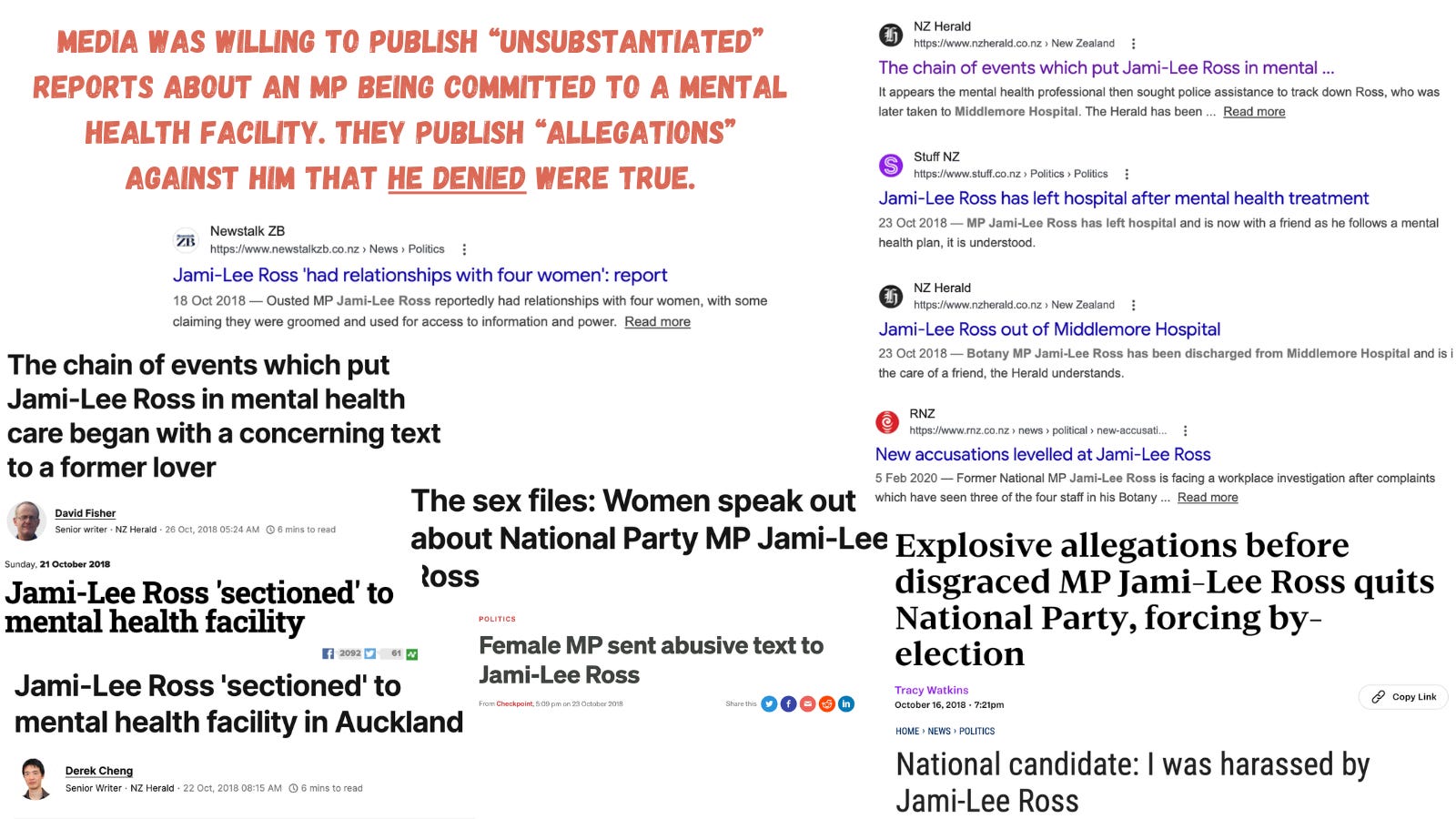
Click to view
The downfall of Andrew Falloon followed a similar pattern with lots of “alleged”, “understood”, screenshots, and victim accounts all reported in real time, before any formal process had concluded. The allegations were later proven true and I consider that the media were right to report as they did on it.
Sam Uffindell has more reason than most to resent the cavalier way the media treated his personal life though. They took an incident from when he was at school decades earlier and blew it up in such fashion that it almost blew up his career before it had even begun. Then, not content that they had dragged him enough, the media reported on claims about him while at university sourced from a former acquaintance who he noted had fallen out with the rest of his flat. He denied these university allegations, just like Chris Hipkins has denied Jade’s allegations, and yet the media ran with them.
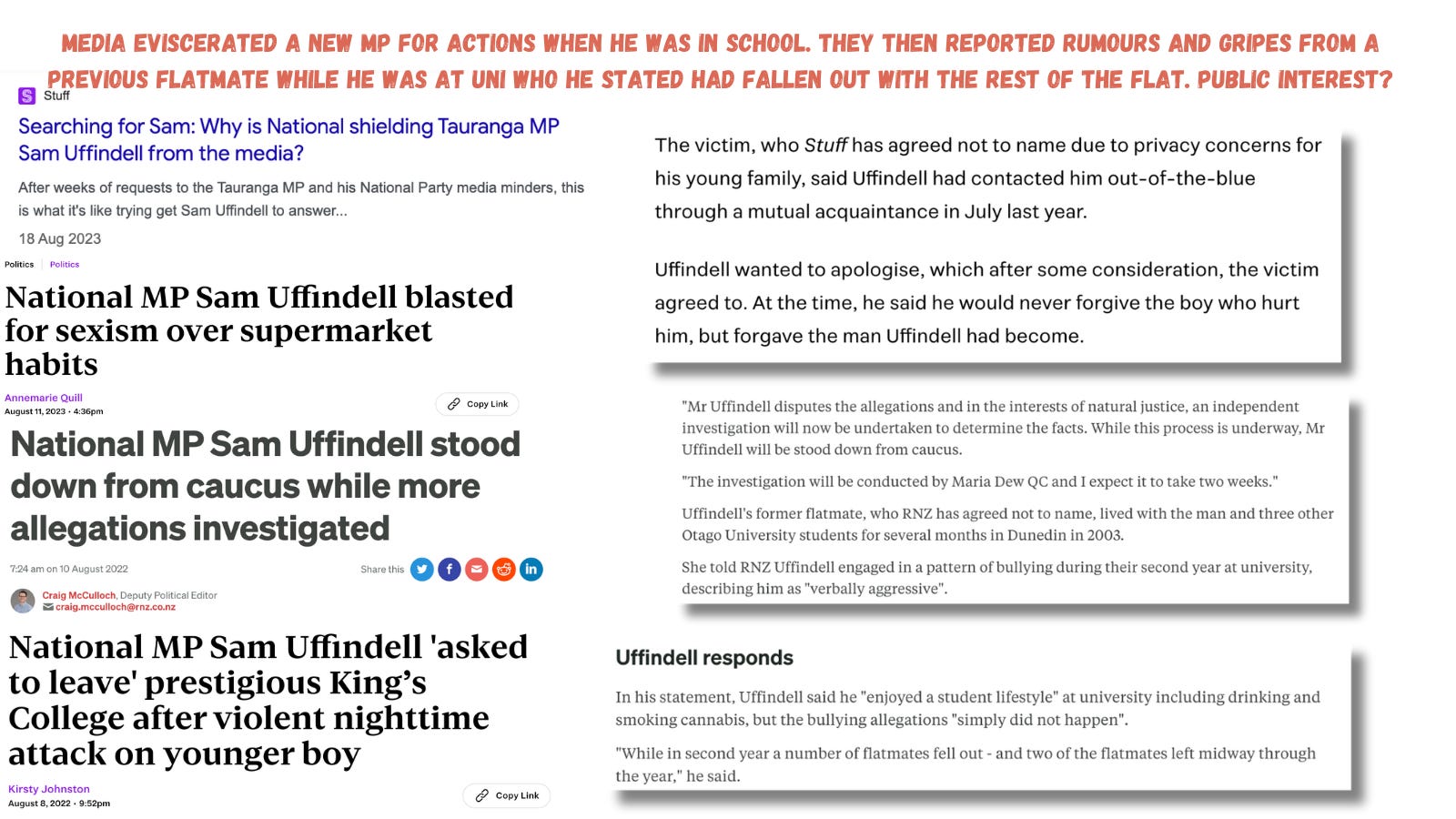
Click to view
Aaron Gilmore’s restaurant incident was effectively built on the account of strangers claiming to have sat near him but the media ran it and it became a defining political story. It turns out that Aaron was actually behaving like a tosser, but the media ran the story before the lawyer he was dining with corroborated the account of the night.
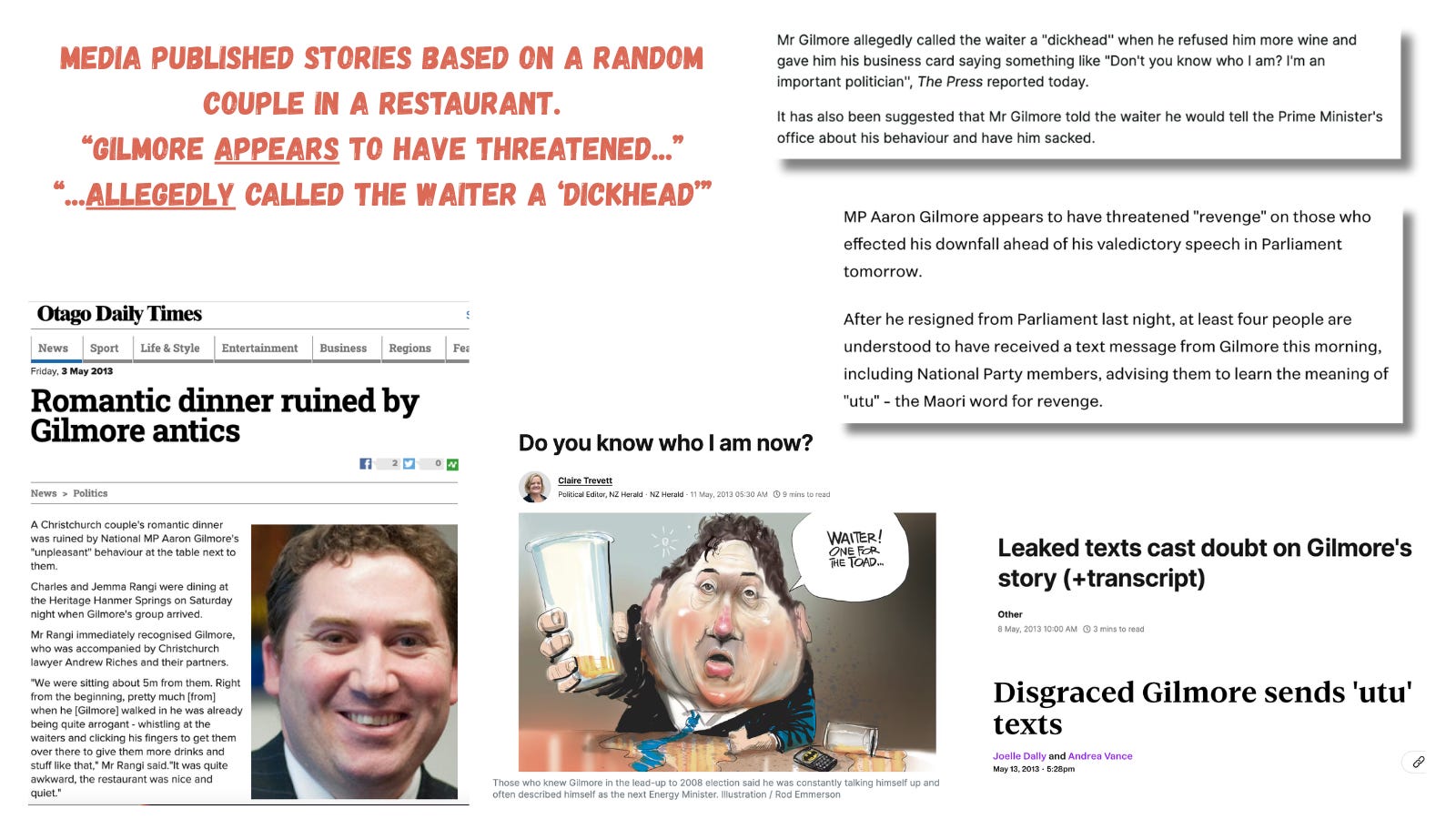
Click to view
Todd Muller’s shortlived and beleaguered leadership was engulfed in days of coverage over a hat. A MAGA hat. The existence of a piece of memorabilia from a trip to the USA was sufficient to trigger commentary about his judgment, his politics, and eventually his fitness for office. Never mind that he also had a piece of Hillary Clinton merchandise displayed too, the media piled in and entirely created the political drama out of nothing. They then devoured his mental health crisis.
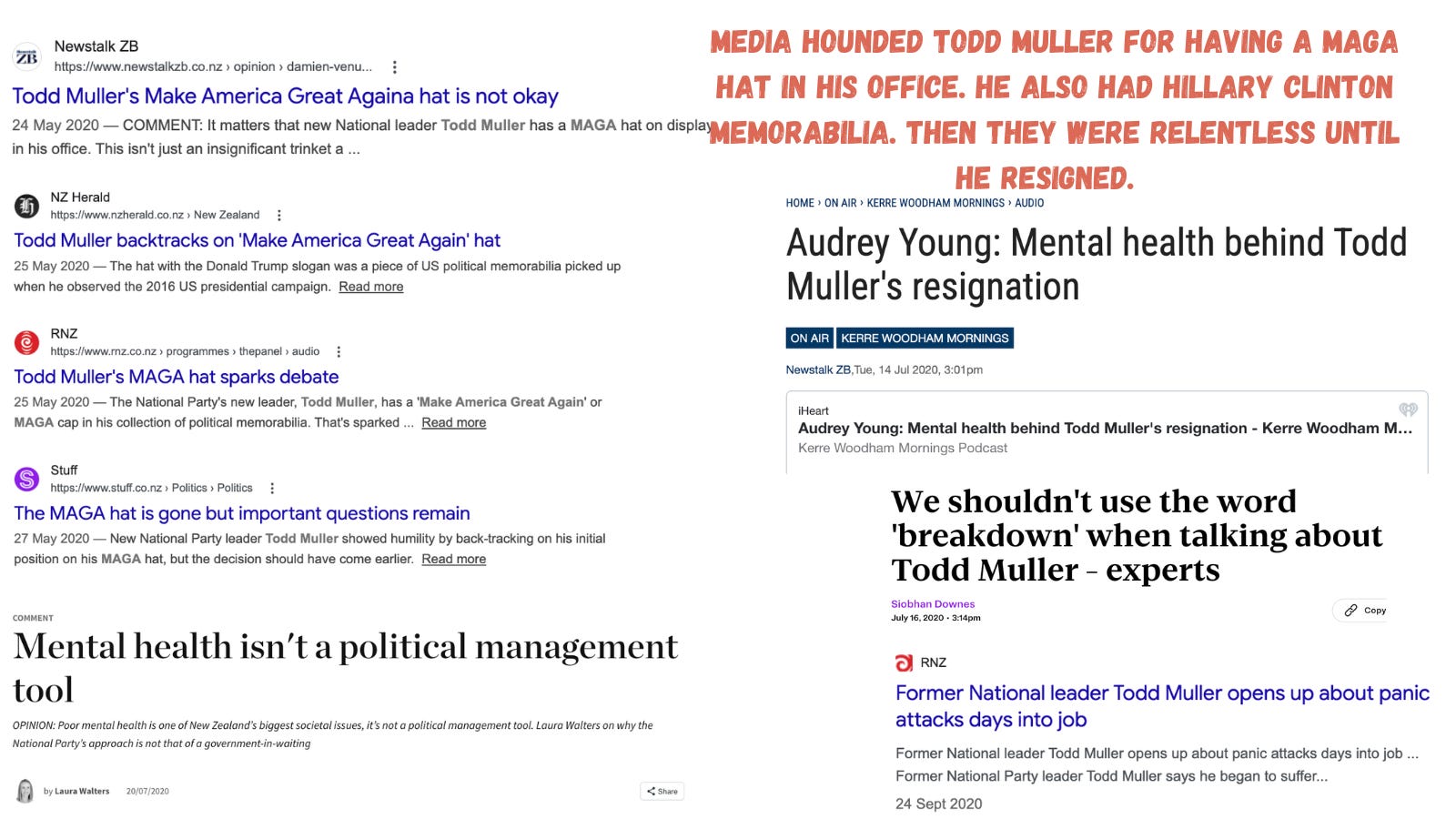
Click to view
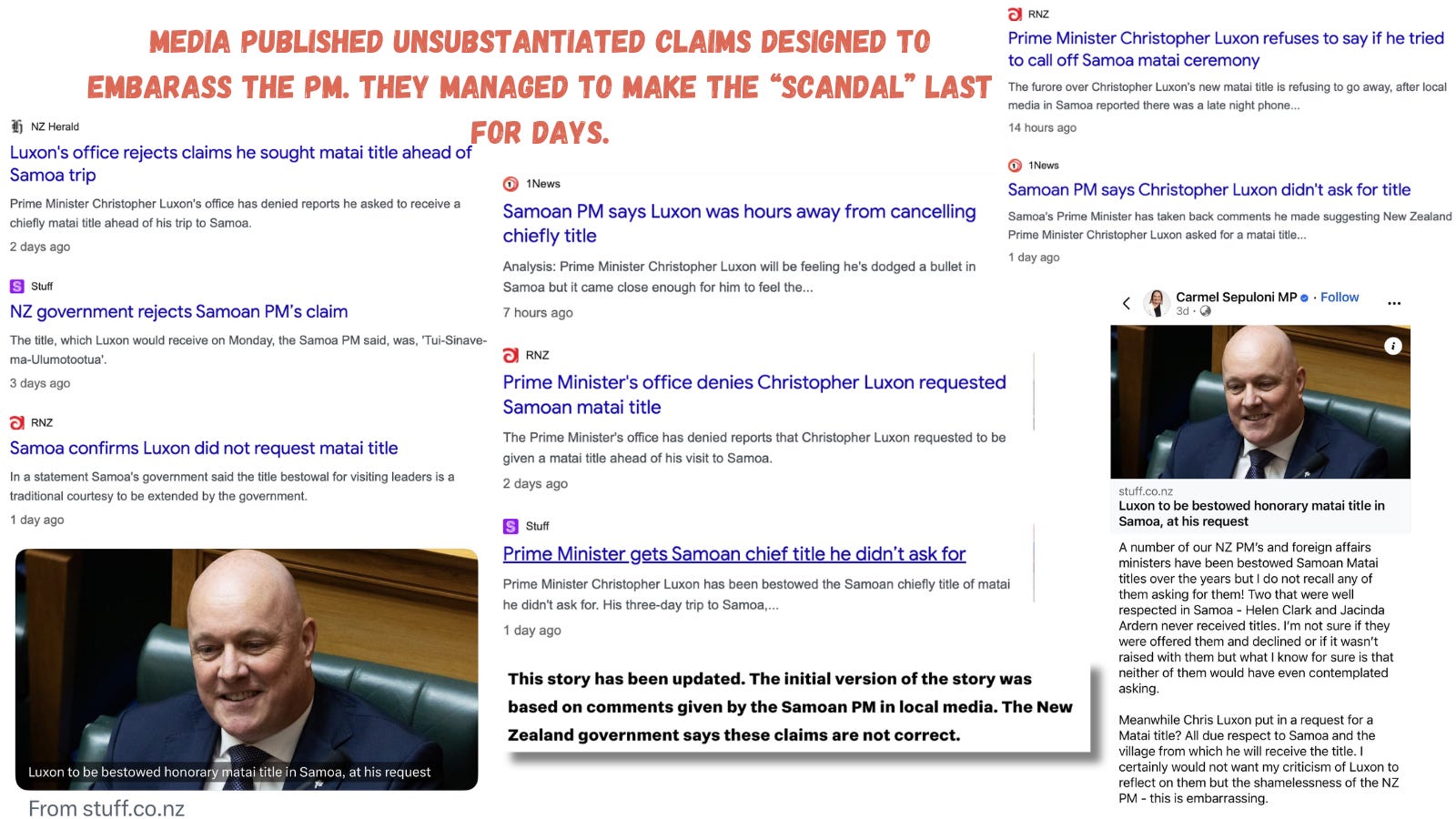
If you need an example that shows that nothing has changed since these incidents, I can give you an utterly ridiculous example from this week. The same week that Stuff (and every other media outlet) dutifully recited that they would not publish “unsubstantiated” claims, they published some other “unsubstantiated” claims. But it was okay, because the other claims were about Prime Minister Christopher Luxon and the media have decided that he is entitled to no benefit-of-the-doubt, no empathy, no due process. Luxon is fair game, in their eyes, for a kicking whenever they like.
So while they sought to protect Chris Hipkins from his ex-wife’s allegations, or to protect themselves from legal threats, they were happy to publish rumour when it embarrassed the Prime Minister.
You could practically read the sneers in the black and white print. Our loser Prime Minister is so desperate that he begged Samoa to give him a special title! Their desperation to portray him as a totally inept bumbling buffoon had them eagerly hitting publish.
Click to view
Article after article aiming to humiliate Luxon hit the news apps. And then Stuff quietly amended one with an almost-retraction with heavy insinuations that although the “New Zealand Government says these claims are not correct” they were sceptical. I wonder where the New Zealand Government can find some of the grace and benefit-of-the-doubt that Hipkins seems to be given in spades. Because in this case, the original allegation didn’t need to be proven to be published.
My argument is not that the media shouldn’t have published these stories. I have opinions about how they went about it in some cases, but I fundamentally believe that politics is somewhere between a battlefield and a jungle. A battle in the jungle? Those brave souls who sign up to join the fray do so knowing that they are exposing themselves to an immense amount of scrutiny.
It is quite paradoxical that a profession which requires a decent degree of ruthlessness, hunger for power, and frankly psychopathy, also holds its members to high standards of behaviour and character that are inevitably not met. The character, judgment, and behaviour of those in power are legitimate matters of scrutiny. Especially if their behaviour and character do not match the persona they are portraying to the public. Many a pious and pure politician has been taken down over an affair, a dalliance, a dabble, simply because the public cannot stomach the hypocrisy of it.
The matter of whether something is “in the public interest” is entirely subjective, of course. NZ Herald’s Audrey Young argues that because Chris Hipkins is neck and neck with Christopher Luxon there should be a higher bar for public interest. I argue the opposite. If we are to decide which party to vote for, and therefore which Chris will be Prime Minister, we should have access to every possible bit of information that relates to their behaviour and character. If that information damages their chances then surely it was in the public interest because it has altered opinions. The only reason to want to prevent the public from having the information is if you see this altered opinion as a negative thing. A neutral and balanced media would not take it into account.
Instead it appears that visceral dislike for anything social media related has caused some bizarre conclusions to be drawn by journalists. For example, Young compares the experiences, thoughts, and feelings of Hipkins’ ex-wife to the nasty and false rumours about Clarke Gayford by people on the internet. Jade is a much more credible source on the topic of her own marriage than any faceless keyboard warrior dropping reckons about Clarke. That these situations are being compared is concerning.
What is most odd about the media’s behaviour this week is not that they have at times crossed into the personal. It’s that they are pretending that they never have before. There have been far far more stories published this week in which they tut at social media and interrogate those they have decided have agendas than any stories on whether the allegations have any truth to them. It is easier to lift unsubstantiated conspiracies off X than to leave one’s desk to do some journalism.
They have convinced themselves that they have always exercised restraint and social media has killed a golden age where journalists politely averted their eyes from anything not fully proven and neatly packaged.
The Golden Age did not exist. Long before X threads and TikTok tell-alls, scandal travelled just fine without them. The court of Henry VIII functioned as a kind of proto-media ecosystem, where gossip was currency and reputation could rise or collapse on whispered allegations. His relationships, with his six wives and many other women, were not private matters contained within the palace walls. Their every move was dissected, speculated on, and weaponised by courtiers with political agendas. Rumour became accusation, accusation became charge, and in some cases, as with Anne Boleyn, it ended in execution.
In ancient Rome, figures like Julius Caesar and Mark Antony were the subject of relentless satire and character attacks, with rivals spreading stories about sexual conduct and moral failings to undermine their legitimacy. The 18th century British press thrived on scandal sheets and caricatures, publishing salacious details about the aristocracy and political class for mass consumption.
It is safe to say there was no social media around back then corrupting morals and ruining the media landscape. None of it was “substantiated” in the modern sense. They didn’t wait for verification thresholds or careful editorial restraint. It was messy, partisan, often unfair, and ultimately just like our current media environment. The instinct to pry into the personal lives of those in power, and to turn rumour into narrative, is not some social media invention. It has been a constant of political life.
Intrusion into politicians’ private lives did not begin with Facebook, Twitter, Instagram, or Substack. Gossip, scandal, and intrigue are not innovations of the digital age. Or the industrial age. Nor a product of the invention of the printing press. They are features and bugs of political journalism as it has long been practiced. I highly suspect that the rudimentary scratchings on cave walls also contained an element of social drama.
Furthermore, the media seem to have memory-holed their own trawling of social media and dredging up of old posts and comments in order to land political hits. If we look at just the previous election in 2023, several candidates were taken out by media hits leveraging previous social media content. According to this RNZ article, due to the relentless work of New Zealand’s media “five candidates have so far resigned from the [ACT] party”. Elaine-Naidu-Franz had to resign after media reported that she made comments “likening vaccine mandates to concentration camps”. Anto Coates’ social media crimes were also COVID-19 related. Additionally, ACT’s Dunedin candidate, Tim Newman, had to apologise for commenting that a post about “extremist Māori” was “hilarious”.
In 2023, RNZ and Stuff reported, of now-MP for Hamilton East Ryan Hamilton:
“In 2013, he posted a comment on a Facebook post by TVNZ's Seven Sharp about fluoride…In another post, Hamilton praised 'Fluoride Free Hamilton & NZ'… In 2016, he said he was "with the minority" in opposition to fluoride and had been for 22 years.”
Media used social media to hunt down ‘thought criminals’ and candidates who had opinions different from what they considered acceptable. If it is deplorable for people to share and discuss a post made by the ex-wife of the leader of the opposition, then what does that make rummaging around in the comment sections looking for mud to sling?
So what is the problem? Why are the media so keen to charge social media with the crime of poisoning the hitherto good name of journalism?
In my opinion, the problem lies not in that social media created the behaviours, but in the fact that it has democratised them. It has broken the media’s monopoly on what gets aired and when. Stories that would once have been filtered, shaped, or strategically released through traditional outlets can now surface instantly, publicly, and beyond the control of editors and producers. Media are in effect not identifying a new phenomenon, but reacting to a loss of control over an old one. They never consistently applied the standards they now invoke, but they were once the sole arbiters of when those standards could be bent. Not so in 2026.
Ani O'Brien comes from a digital marketing background, she has been heavily involved in women's rights advocacy and is a founding council member of the Free Speech Union. This article was originally published on Ani's Substack Site and is published here with kind permission.
15 comments:
Not sure about those deep historical examples, exaggeration lengthens as time lengthens (due to an increasing lack of sources). One could start with Gary Hart 1987 for a 'modern' reference.
It isn’t a political scandal, it’s muck-raking. If the public can see this, why can’t Ani?
To anon 11:06 - I don't see it as muckraking. Ani is simply highlighting how the msm has covered previous incidents involving MPs and comparing them with the "nothing to see here" approach to Hipkins. In her FB post, Hipkins' ex pointed out how certain Labour policies are at odds with her experience of living with a Labour politician and cited as-yet unproven examples. Simple as that. Her allegations and his denials make it a draw so far. If either party can provide proof then we can draw conclusions about the suitability or otherwise of Hipkins as potentially the leader of this country.
Well if media wanted to protect Hopkins from further digging into his personal traits, then they did a very bad job of it. Now may people who would have not had a second glance at seen social media posts are asking themselves: “what has this guy actually done?!”
Ani, you keep posting commentary that continues to illustrate how abjectly dysfunctional our political system actually is. Well done. No wonder anyone of probity, discernment and integrity might be very reluctant to advertise their willingness to join a political party and volunteer to be an MP. And might that be the reason that our government processes over the last few decades have become increasingly unhinged? If grown adults in vitally important appointments cannot define a woman what hope do we have for sound national management? Ah well, I guess all is fine if we can only get our pronouns right! And perhaps another lengthy lockdown might aid in our future selections for political leadership?
Almost nothing is new in the internet generated noise that Chris Hipkins has generated. He uses the media to portray what a wholesome caring family guy he is, children included when it suits, and that in turn generates into votes. It was once a calculated exercise when the traditional media had your back like Hipkins has. The problem here is...the internet. It is like sunlight on a hypocrite or a vampire, I cannot tell the difference.
I'm guessing his ex was rightly bitter over their fallen relationship as she was once the cover page girl promoting Hipkins wholesomeness. She did her part and look where it got her. But I can imagine the sheer gall of the topics he now promotes were just one step too far just once too often.
I didn't need that however, to know he's full of shit. His bonfire of policies were a calculated lie from start to finish. In 2023 I went from thinking (insanely) Hipkins was a good sort under a leader who had lost the plot, to realising him, Ardern and others were clones from the same pods. Deeply cynical deeply delusional professional politicians who were actually quite dangerous.
Like you say, the actual story is the media no longer control the narrative and oh my god, don't they hate it. The harder they try, the worse it gets and the more us mere mortals turn off them. It's them and their ilk who want hate speech aka blasphemy laws and social media controls. They want their control back.
But the even weirder thing is the way they beat up on a weakling like Luxon. He's one of them, can't they see it? If they were more like Hosking, more complimentary, they'd stand a better chance of progressive - dying to be liked National passing their blasphemy laws. But that horse has long since bolted. National are withering by the day. Just like them.
Nicky Hager’s investigation exposed the whole dirty politics playbook. Ani knows exactly how this stuff works, and she dutifully contributing her portion of the gutter. It is sooo transparent what you’re doing, Ani.
A 'finger pointed at the MSM' over an issue they have created, and whilst gaining the attention of the 'public' have decided to add to the 'pile on' with further - fact/fiction/misinformation/disinformation - hang I can hear Jacinda Ardern speaking to the UN about this very subject.
Would it be pertinent to add, that of any social media postings, how many of them emanate from a female's cell phone?
If one casts one eyes across the world, and the 'affairs of people' that have surfaced, it is a recorded or noted fact that much of the pile on, once such data becomes public knowledge, (and this covers a range of subjects & people, who have raised their heads and others take a dislike to them, not uncommon for it to be female vs female [or towards men] - ask any female over 'fat shamming' ) - comes from the female of society and the "re-tweets" that occur have been found to be largely inaccurate, and is some cases with changes to original data, to enhance the issues at hand, whilst being proven to be incorrect - just look at how many 'postings get withdrawn', when such false data is challenged.
Mine you there are others, who "pile" on just for "shits &giggles" which does not help the situation at the time.
I wonder what the NZ MSM would have done, if Chris Hipkins had advised the
media - 'no comment' and closed the door, till such time as he could resolve the issue, then make a more positive statement.
"Silence is golden" till there is a time to speak.
Ani, you are not the only media personality, here in NZ that has had "social media stones thrown at them", for their comments on this issue.
Stones, anon? Ani is throwing muck, and she is getting called out. Rightly so. We used to have principles against this kind of imported nonsense.
It is hard to comment without refering to the allegations. It is up to Muriel if she wants to put them up as Sean Plunker has done.
I believe you are on the right side of history, Ani.
Also what Ani highlights is the bias of our far left media. They are toxic low lifes without a doubt. Defund. Put them on the dole where they belong.
I didn't find Ani 's well researched article to be gutter journalism but a determination to present the bias of the media.
It's like the Royal Family who welcomed the media into their lives for favourable publicity but no longer wanted them when the family's behaviour turned sleazy and more like a soap opera.
It’s weird Chippie’s unsubstantiated denials can be published but his ex’s can’t. He hasn’t provided anything to prove they’re false
Dreadnought007, Check on The Platform.
Post a Comment
Thank you for joining the discussion. Breaking Views welcomes respectful contributions that enrich the debate. Please ensure your comments are not defamatory, derogatory or disruptive. We appreciate your cooperation.