


Marc Daalder. Source: Chris Lynch
The word “overrode” does a lot of heavy lifting too; like hauling an entire moral judgement up the hill before the evidence has even put its shoes on. It implies recklessness, defiance, tyranny, when the action is a common part of everyday government process. It frames up a moral verdict before you have read a single word and even seen what the “advice” actually was and what it was based on.
And in any case, the first problem for Daalder, and his headline, is that the Ministry’s own Regulatory Impact Statement (RIS) actually repeatedly concedes the evidence base is unclear. Daalder even acknowledges that officials themselves said there was no “definitive” option.
And if there is no definitive option, then the advice from the Ministry is not “the science says X.” It is “we prefer X.” Those are very different things. A claim about evidence versus a judgement call under uncertainty. And we should expect our politicians to weigh up this kind of thing even more carefully against the political and ideological mindset of their advisors.
Beyond applying a more critical eye to what the ideologically-captured ministry spits out, Daalder needs to remember that it is Cabinet’s job to take all available evidence and make decisions. It is not to bow to the Ministry’s preferred option like it’s gospel.
A Regulatory Impact Statement is not a declaration of scientific truth, a hierarchy of moral legitimacy, nor a binding instruction to Cabinet. It is not written in stone on Mount Sinai. It is a policy tool written by officials weighing trade-offs, risks, implementation concerns, and institutional comfort explicitly shaped by objectives defined by the agency itself.
Treating an RIS as sacred medical edict is a category error and Daalder builds his entire article on that error.
We elect a Government to make decisions for us in accordance with our values, priorities, and beliefs. One important factor is that most of us want decisions around health and medicine to be based on science, evidence, and fact. The problem is that a sizeable portion of the population now does not trust our expert class to provide that. They do not trust that our health bureaucrats and institutions aren’t utterly politically compromised and more concerned about what their friends online think than delivering healthcare free of ideology. Covid-19 dropped a nuclear bomb on trust in our health systems and then insisted we all applaud the blast radius, but identity politics had already waged a battle on the ground.
Democracy and politicians are our only defence against self-important, untrustworthy, moralising public servants. And only when the politicians we vote in are bold enough to remind these public servants that they do not set the agenda and are there to serve the will of New Zealanders as enacted by the people voted in to represent us. Simeon Brown did just that with the puberty blockers ban and now the media acolytes of the politicised public service are swooping in to punish him.
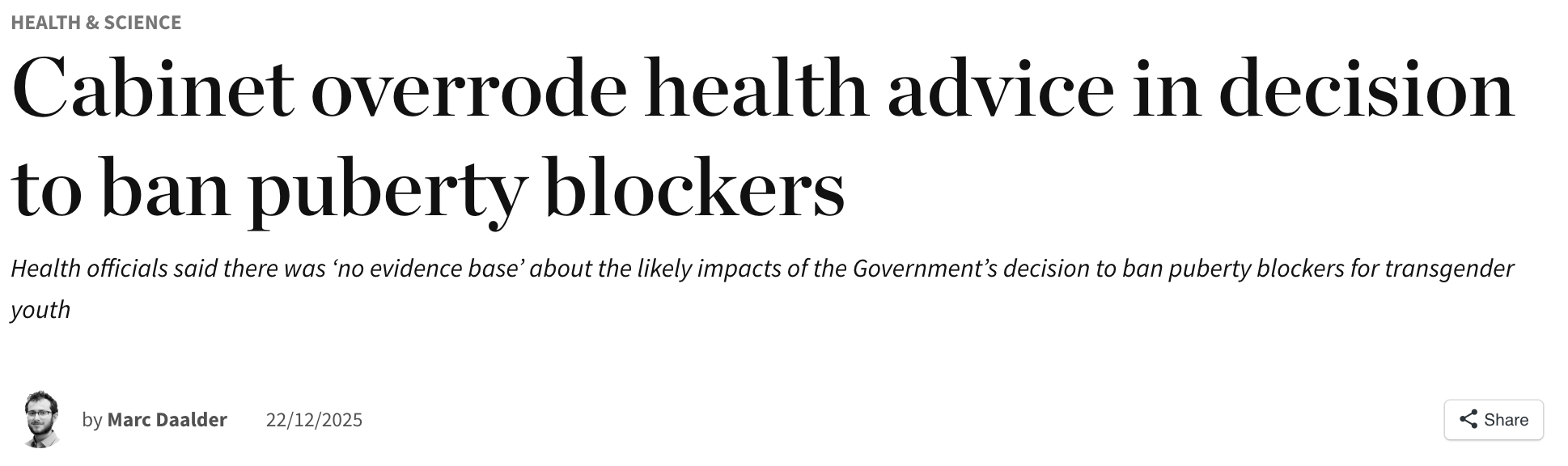
So let’s “unpack” Marc Daalder’s wee hit job.
Subheading:
“Health officials said there was ‘no evidence base’ about the likely impacts of the Government’s decision to ban puberty blockers for transgender youth”.
The subheading repeats the trick of framing the Government as the reckless ideologues. Positioned the way it is, the phrase “no evidence base” invites the reader to conclude that the Government is acting blindly or irresponsibly. But if read without Daalder’s favoured political lens we can see that what is actually being said is that officials cannot confidently predict the downstream impacts of a regulatory change. That is a statement about policy modelling, not a declaration that there is no evidence relevant to medical risk.
If the Ministry’s own documents say the evidential basis is unclear, and that long-term benefits and harms are not well established, then the honest journalistic question is not “why did Cabinet intervene?” It is: “why are these drugs being prescribed to minors outside controlled trials in the first place?”
Opening paragraph:
“Ministers rejected the advice… newly released documents reveal… prompted the High Court to say the decision appeared to be politically motivated.”
Daalder’s opening paragraph is a masterclass in how to bake a conclusion into a faux-journalistic narrative structure.
Each of his clauses carries enough weight to sink a battle ship. “Rejected the advice” creates a negative impression in emotive language where “chose a different policy option” would be more accurate. “Newly released documents reveal” suggests secrecy or exposure, when in reality the Ministry proactively released the material. And then the allegation is laundered through the equally captured High Court with “appeared politically motivated”.
But courts are not arbiters of medical truth. They are not there to determine whether a policy decision is clinically optimal or scientifically correct. Their role in this circumstance is to assess administrative process, legality, and statutory interpretation. Judicial discomfort with perceived divergence from an RIS is not a finding that a policy is ideological or anti-science. Treating it as such is a mistake and a convenient one when it satisfies the ideological worldview of those making these sweeping declarations.
Paragraph about the High Court order:
“Although the ban went into effect on Friday… the High Court… preventing it from being enforced…”
Daalder describes the High Court’s interim order as though the Government were slapped down for moral wrongdoing. The prose invites the reader to see the pause as a rebuke. Like Simeon Brown is some kind of Scooby Doo villain who “would have got away with it” if not for the pesky court. In reality, enforcement of the puberty blocker ‘ban’ is paused pending a judicial review. That is a procedural effect, not a scientific judgement. This High Court decision should say nothing about whether the underlying policy is sensible, reckless, or evidence-aligned, although Justice Wilkinson-Smith definitely stomped into the territory.
Paragraph on the illusion of a neutral status quo:
“health officials effectively said there were no good options but the status quo was the least bad one.”
If there are truly no good options, then the status quo is not morally privileged. It is simply the option that avoids disruption, avoids precedent, and avoids forcing institutions to reckon with past poor practice. Bureaucracies are structurally inclined toward continuity. Delay, monitoring, position statements, and incrementalism are how institutional risk is managed. Not risk to patients nor risk to ruining the lives of young people. Risk to the institution.
As I have said, the RIS frames the evidence as unclear and discusses unintended harm risks. Yet Daalder’s article treats “keep doing what we’ve been doing” as though it were a medically grounded conclusion rather than interrogating if it might be an institutional comfort zone. What he repeatedly labels “health advice” is actually nothing more than a preference for not changing course.
Paragraph taking weak evidence and making strong assumptions:
“Evidence review found little robust proof… for either benefits or negative impacts”
Repeating his argument for the continuation of the use of puberty blockers, Daalder again accepts, without scrutiny, the Ministry’s conclusion that the appropriate response to a lack of evidence is to continue prescribing.
But if there were any journalistic instincts and principles in the building, he might have followed the logic all the way through. If evidence of benefit is weak, if information on long-term harms is not well established, and if the intervention is being given to minors for a contested, psychosocially complex condition, then continuation is not the neutral baseline. In many other areas of medicine, that combination would lead to restriction to trials or exceptional protocols until better evidence emerged… basically what our Government is trying to do.
It is the direction taken by NHS England and several European health systems. Of course, Daalder does not seriously engage with that context. These are inconvenient facts to be manoeuvred around. No matter that many of the countries would be the same ones he is happy to follow on climate policy.
Instead, he treats continuation as default, while restriction is framed as an extraordinary and suspicious departure. This is not value-free reporting. He is explicitly promoting a policy direction and demonising another.
Paragraphs of cherry-picked official quotes:
Daalder devotes considerable space to the menu of options officials put before Cabinet, as though the mere existence of multiple pathways somehow proves that Cabinet’s eventual choice of the third option was aberrant. They were offered four options, but Daalder treats all but one as a moral failing.
Officials presented four options:
1. The status quo;
2. enhanced monitoring;
3. regulation to block new prescriptions paired with expanded services;
4. and a legislated ban.
The Health Minister chose not to advocate for a preferred option, leaving Cabinet to eventually chose the third one; a precautionary restriction on new prescribing, explicitly framed as subject to review following the UK trial. That is not even close to evidence of ministers barging past experts. Cabinet chose one of the options proffered. In Daalder’s view, that they chose an option not favoured by bureaucrats and himself, is proof they were audaciously and wickedly acting in defiance. I see evidence of a government choosing a middle-ground option in an environment where officials themselves admitted there was no clear evidentiary winner.
Of course, the Ministry did pick a winner themselves after conceding that there isn’t one:
“There is no option that we can definitively say advances our objectives… Option One is the best fit overall.”
That sentence alone should have reset the entire framing of journalistic reporting, but it didn’t because it fits with Daalder’s expressed worldview.
The RIS repeatedly refers to “our objectives”.
The policy objective is to help ensure puberty blockers, when considered in gender-affirming care in New Zealand, lead to: a) positive health and wellbeing outcomes that are safe for young people with gender incongruence/dysphoria over the long-term; b) health equity for young people presenting with gender incongruence/dysphoria.
While there is mention of a policy objective (above), an RIS exists to inform ministers about policy trade-offs using cost/benefit analysis frameworks. They use Ministry-defined objectives, not parliamentary ones. These prioritise things like maintaining clinician discretion, minimising system disruption, avoiding precedent-setting regulation, and maintaining trust/confidence in the health system. They must ignore that last one regularly…
These are important things for a ministry to concern themselves with and it is their role to do so. However, in the context of making policy decisions about the use of medication in treating children for a psychological issue that is highly contested there are other objectives that must be considered. You know, like long-term iatrogenic1 risk, irreversible physical outcomes, fertility, sexual function, neurodevelopment, and the ethics of medicalising adolescent distress without robust evidence of efficacy.
Bureaucracies naturally optimise for continuity. Daalder never interrogates this. He treats “objectives” as neutral.
But, in another time, place, universe, a journalist might reflect on the fact that once officials concede they cannot definitively identify an option that advances the objectives of the government, the decision necessarily moves out of the realm of technical or expert advice and into the realm of judgement. Understanding this makes it clear that this particular RIS is not communicating medical truth, but institutional preference.
This is demonstrated clearly when in describing ‘Option Four’ (legislative ban) the RIS criticises that it “offers less benefit” because “it puts safety and caution first”. This concedes that the regulated ban prioritises safety and caution and that this is justified by lack of evidence of safety or benefit. God forbid a government place great importance on safety and caution in relation to children’s medical care.
The Ministry declares the status quo “the best fit overall,” not because evidence shows it is safest or most effective, but because it preserves clinician discretion, avoids precedent-setting regulation, and allows time for existing practices to “embed.” Officials argue that the status quo is “effective and responsive” and this is a restatement of trust in professional judgement as a substitute for data. This same way of thinking was applied to the use of lobotomies, surgical mesh, and thalidomide.
Here’s a tip, Daalder, how about you look into what the majority of the patients affected by lobotomies, surgical mesh, thalidomide, and puberty blockers have in common. Here, I’ll help: most of them are female. There’s a story for you!
Anyway.
The assumption that clinician discretion can safely outweigh the problem of evidentiary uncertainty is precisely what is being challenged internationally, as health systems have moved toward restriction and controlled research. There has been a recognition that this field is ideologically-charged, rapidly expanding, and weakly standardised. Our Ministry of Health’s objections to regulation reinforce the same pattern. Regulation is criticised not because it is unsafe, but because it would reduce practitioner autonomy, fail to improve “trust and confidence,” and >shock horror< regulate a medicine for a particular condition “for the first time.”
Presented this way, the fact something has not been done before becomes a reason not to act. But first times happen when standards change or evidence collapses. Framed honestly, this objection reads as anxiety about setting a precedent that might imply earlier practice was flawed. Or absolutely outrageous.
The logical incoherence deepens when officials assert that a regulated ban carries a “high risk of adverse health outcomes,” particularly mental health harms, while also stating that there is “no evidence base to know the likely impact of other options.” Either the impacts are unknown, or they are known well enough to justify claims of high risk.
Officials also warned some young people may turn to ordering puberty blockers online, potentially receiving low-quality or dangerous medications.
The same rhetorical move appears in warnings that young people might order puberty blockers online if access is restricted, a speculative hostage note that could be deployed against virtually any form of health regulation. We better make alcohol and cigarettes legal for all ages immediately! If we don’t the little buggers will find a way to get them illegally. After all, prohibition has never worked, and children are famously excellent at risk assessment.
Finally, the child impact assessment is presented as authoritative when it is in fact a values document: it defines “negative impact” narrowly as distress and reduced access to desired intervention pathways, while excluding long-term physical, developmental, and ethical considerations from equal weight.
Daalder is happy to include reference to the “possible negative impacts on mental health” of banning puberty blockers. But he does not list the possible risks of prescribing these drugs like loss of sexual function, infertility, issues with bone and brain development, and various other side effects. How odd.
He also quotes that options other than the status quo are not supported “from a child-centred perspective.” But the Ministry, and Daalder, are not making patient-centred medical arguments. Rather, they are communicating expressions of institutional discomfort with change and with the implications of admitting that past practice may have run ahead of evidence.
Paragraph with gotchas that aren’t gotchas:
“In the paper Brown took to Cabinet, the Ministry of Health’s opposition to the other options was not made clear (although the Regulatory Impact Statement was attached as an appendix). In addition, the paper did not make clear that the UK scientific trial will last until 2031 at the earliest, meaning the ban would not be transitory.”
How terribly sneaky of the Health Minister to attach the Ministry of Health’s advice without so much as a neon sign, catchy jingle, or foghorn to alert Cabinet to its contents. How dare he assume that ministers would actually read the documents!
And, what’s more, sneaky ol’ Simeon did not explicitly explain that clinical trials tend to take several years due to the necessary rigour of the research and so the silly old Cabinet ministers were probably bamboozled by not knowing the UK trials aren’t due to conclude until 2031.
But seriously, this was not hidden information. It has been reported on publicly.
The closing:
“Brown did not directly answer when asked why the Government had overridden ministry health advice or whether the decision was political instead of clinical in nature.”
That might be because, and I draw my own inferences here, Simeon Brown found the questions to be patently ridiculous. Perhaps he was so busy with other matters pertaining to our health system in the week before Christmas that he had not the energy nor the will to deal with Daalder’s bullsh*t. I imagine that constantly being squeezed between the derangement of trans activism in the public service, the media, and the judiciary is quite exhausting when you are just trying to do the right thing by Kiwi children.
We have a systemic problem in which our key institutions have in them an embedded ideology that is incompatible with a lot of what we would call the will of the people. For politicians like Simeon Brown, enacting the will of the people is an almost impossible task because all cultural institutions are captured and controlled by forces determined to thwart that agenda. It is a wonder our politicians talk to our captured media at all.

Health Minister Simeon Brown. Source: Newsroom.
What neutral journalism might have looked like:
Marc Daalder’s article was not neutral and it was not good journalism. Neither is this piece, coincidentally. The difference is I am not masquerading as a journalist as I write this. This is an explicitly annoyed analysis of an article by a man frequently described as a journalist, but who appears to write only on matters to which he is so ideologically wedded he may as well have tattooed them on his forehead. Perhaps Newsroom should just label his work as exclusively opinion.
A genuinely straight report would have conveyed that despite finding a lack of evidence to support harms and benefits, the Ministry prefers the status quo. Meanwhile Cabinet chose the option of precautionary restriction on new prescribing pending further evidence, aligning with international moves toward tighter controls and research-only pathways.
Instead, readers were given a morality play about brave, morally-upstanding experts versus grubby, duplicitous politicians. Daalder’s article ultimately rests on several binaries, the most central one being that if a decision is political, it is illegitimate and if it is clinical, it is legitimate. This is, I hope I have made clear, a false binary.
When evidence is uncertain, values must guide our decisions. Things like how much risk is acceptable? Who bears the brunt of any consequences? Does caution outweigh autonomy? How do we safeguard children?
These are inherently political questions.
1 refers to any adverse condition, illness, injury, or disorder caused by medical examination, diagnosis, treatment, or intervention.
Ani O'Brien comes from a digital marketing background, she has been heavily involved in women's rights advocacy and is a founding council member of the Free Speech Union. This article was originally published on Ani's Substack Site and is published here with kind permission.
9 comments:
The only good thing about newsroom is the crossword. Other than that its full on greenie bias is so overt in its writers and commenters it makes me nauseous.
Marc Daalder is a typical Amherst graduate, complete with the requisite hipster-doofus short beard. Come on Ani, he has The Look! And he is Marc with a ‘c’!
Daalder’s presence in New Zealand media follows a now-familiar pattern — not the traditional reporting grind, but a carefully credentialed trajectory shaped well before his first local byline.
He is a History graduate with Honours from Amherst College, class of 2018. Amherst is one of the United States’ elite liberal arts colleges, intellectually serious but politically homogeneous. Its culture strongly favours progressive interpretations of power, identity, colonialism, and resistance — particularly when filtered through moralised historical narratives.
Daalder’s honours work, Pacifism from the Pacific: Pai Mārire and the Māori Roots of Nonviolent Resistance, sits squarely within that tradition: re-framing a contested Māori religious–political movement through the sanctified progressive lens of “nonviolent resistance.” Even without the full text, the framing signals values-first interpretation rather than dispassionate historical inquiry.
In 2017, Daalder spent a semester studying at Victoria University of Wellington, a key node in New Zealand’s policy–media–bureaucratic ecosystem. Victoria is not just an academic institution; it is a finishing school for Wellington’s governing worldview, where Treaty maximalism, technocratic authority, and identity-based policy are treated as professional common sense rather than contested ideas.
Before arriving in New Zealand media, Daalder interned at explicitly left-aligned American outlets including In These Times, alongside mainstream titles such as the Detroit Free Press and Chicago Reader. He was also Editor-in-Chief of AC Voice, Amherst’s online student publication — another early signal that his path lay in commentary and interpretation rather than traditional reporting.
From 2018 to August 2019, he worked for the Holocaust Centre of New Zealand as a blogger and social media manager, running its Twitter account and writing posts linking Holocaust history to contemporary political and moral questions. This is relevant not as criticism, but as further evidence of a career consistently oriented toward moral narrative construction, institutional advocacy, and present-day relevance rather than detached observation.
By 2019, Daalder had moved into New Zealand’s media space and soon emerged at Newsroom as a “senior political reporter,” based in Wellington. His own profile states that he covers climate change, Covid-19, energy, technology and the far-right — a beat list that itself reflects a worldview: threats, crises, and ideological enemies, rather than the exercise of power by the bureaucratic state.
He has since written for outlets including the Financial Times, The Spinoff, and the Jewish Daily Forward, moving fluidly between reported pieces and commentary. That fluidity is key. Daalder’s work routinely blends factual reporting with moral framing, treating bureaucratic advice as neutral truth, regulatory documents as authoritative, and democratic intervention as inherently suspect.
In this sense, Daalder is not an aberration but an exemplar of the credentialed narrative class now dominant in political journalism. Authority is derived not from adversarial reporting or institutional scepticism, but from having passed through the right educational, ideological, and professional gateways. Power is understood to flow from institutions downward, not from voters upward.
Ani’s critique landed because it named this dynamic plainly. When evidence is uncertain, decisions inevitably become political — but for journalists formed within this ecosystem, politics itself is treated as contamination, while technocracy is assumed to be virtue.
Daalder’s article on puberty blockers was not a lapse in judgement. It was the logical outcome of a career shaped to interpret the world in precisely that way.
—PB
A quite splendid and enlightening fisking.
A very good article and in my mind when there is a physical risk taking drugs for a mental issue, then to do that to what is basically children is not acceptable. The argument that the effects are reversible seems debatable and should not form part of the equation. Leave the children alone and let them make their own decisions when they are adults
The Cass Report in the UK took several years to compile and provided clear recommendations. Unfortunately in the culturally Marxist stronghold of New Zealand this report has been either ignored or attacked.
Newsroom publishes pieces on climate change that align with a particular narrative. To a point, it reflects well on our media and on certain of our political parties that they seek to protect our environment for future generations. However, new research from physicists suggests that carbon dioxide is not such a pernicious greenhouse gas as had been thought, and that anthropogenic emissions are much less critical than had been thought; for example, Coe et al.(2021); Lindzen and Happer (2025) and from Dieter Schildknecht (2020).
Unfortunately, Newsroom refuses to publish pieces that reference such authors and that go against the dominant climate change narrative, instead preferring to publish articles written by non-scientists. Newsroom does not even acknowledge receipt of such submissions. Thus, articles from Professor John Raine, Bryan Leyland, Professor Michael Kelly and myself are ignored completely.
For the record, apart from my career in education, I have indeed worked in climate change and agricultural and forestry production and land use, hold degrees in physics, geophysics, statistics and both pure and applied mathematics, and have taken advanced postgraduate studies in atmospheric physics and physical oceanography. These experiences do not make a world expert, but do enable a person to understand very complex technical and scientific papers on climate change physics. The others – Professor Raine, Mr. Leyland and Professor Kelly are much more expert than myself. However - Newsroom is not interested.
David Lillis
I'm a leftie, but my late father was a Liberal/National voter in Oz. He subscribed to the (Murdoch Press) 'Australian', but eventually he got fed up with their commentators, as he always knew in advance what they were going to say about everything, even if he might have agreed with much of it. I know that Ani O'Brien is a gender-critical activist, so I knew in advance what she'd say about the Daalder piece. So I couldn't finish it. Despite agreeing with the govt's decision on puberty blockers. Something to be said for writing more coolly?
It’s important to remember how many (most?) journalists (and academics) operate: they begin with a predetermined view, and then look for evidence to support that view or opinion. They ignore counter-evidence. So, they are not advancing an argument as, by definition, an argument requires a plausible counter-argument. They simply assert, not argue—‘argument by assertion’ or ‘proof by assertion’ or Assertion Fallacy.
Post a Comment
Thank you for joining the discussion. Breaking Views welcomes respectful contributions that enrich the debate. Please ensure your comments are not defamatory, derogatory or disruptive. We appreciate your cooperation.