

The Government’s unveiling of the twin laws to replace the universally loathed Resource Management Act: Planning Bill and Natural Environment Bill, could end up being the defining policy legacy of this term.
The Government itself is calling “the single largest economic reform in a generation.” And they may well be right as they take a fractured patchwork of over 1,000 land-use zones and collapse them into 17 Regional Combined Plans, standardising rules, reducing consenting hell and potentially cutting nearly half of all consents each year.
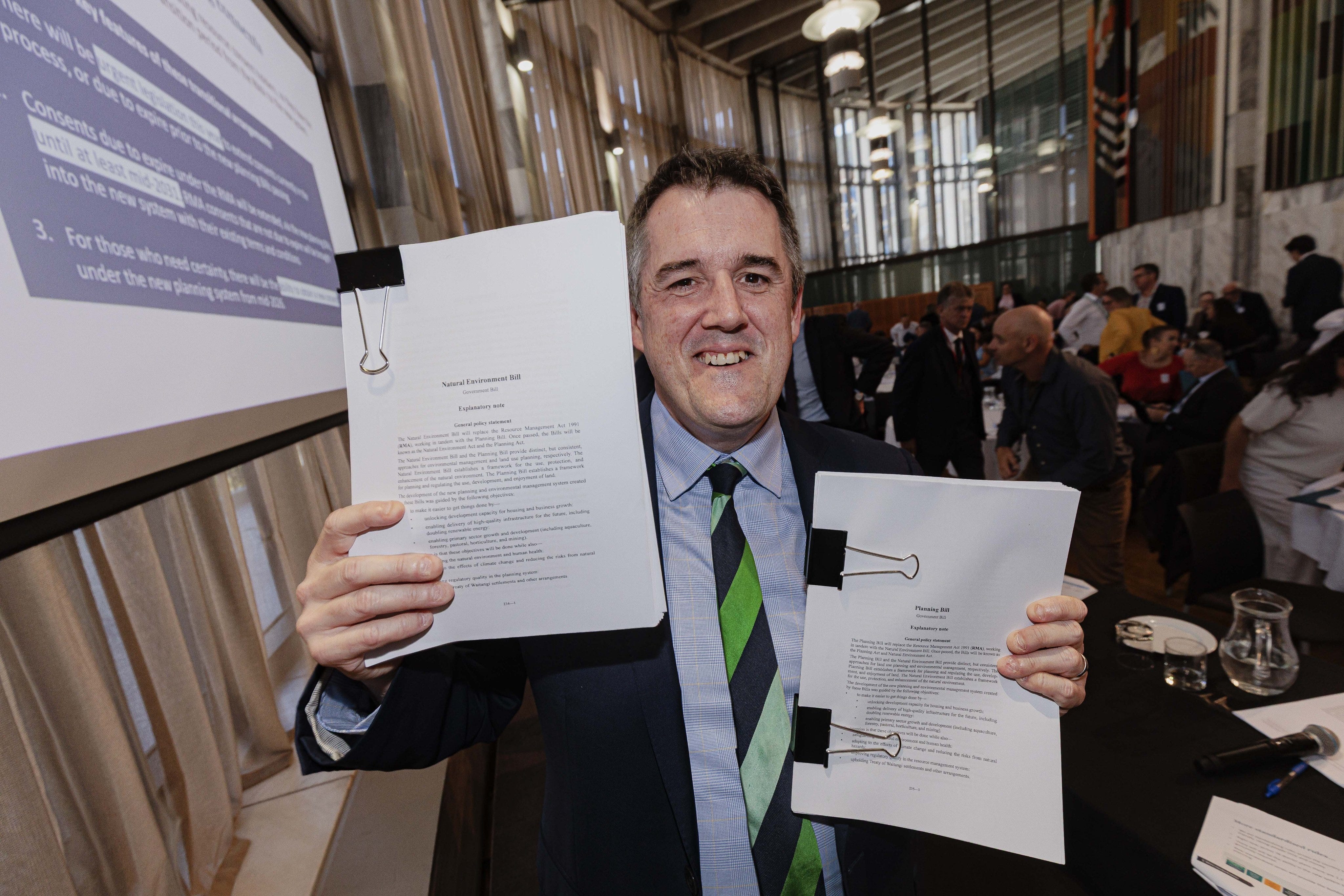
Chris Bishop holds up the new bills. Photo credit: Henry Cooke X
Minister Chris Bishop has leaned into the rhetoric of deregulation and abundance, promising simpler processes, fewer bureaucratic choke points, and a system that stops giving every neighbour and NIMBY objector a veto over progress.
In my substantive piece on the reforms this week, I highlight that this isn’t just an economic reform, it’s a philosophical one. The new laws tilt the balance sharply toward property rights and national consistency over local control and granular environmental scrutiny, and introduces mechanisms like compensation for “regulatory takings.”
This has been a mammoth piece of work and Chris Bishop and his Act Party Associate Minister Simon Court should be applauded. When historians look back on this term, we should all have our fingers crossed they see RMA reform as the moment this Government truly changed New Zealand’s economic and regulatory trajectory.
Nicola’s Fudge and the ‘Mother of all Debates’
Disclosure: The company I work for assisted the Taxpayers’ Union with elements of this campaign.
This week saw the much anticipated Taxpayers’ Union’s campaign, Nicola’s Fudge. Journalists and MPs have been sent gift boxes of fudge. Each ‘flavour’ corresponds to a specific accusation: that Willis has invented a dodgy surplus measure (OBEGALx), barely trimmed the bureaucracy, is still borrowing around $75m a day, is spending more than Grant Robertson did, has presided over a fall in real GDP per capita, and is flirting with bond-market alarm bells. The underlying charge the Union lay is this government campaigned on fiscal discipline and smaller government, but spending and debt are still higher than when Labour left office

Nicola Willis herself amplified the campaign (perhaps unwisely) by personalising the campaign as an attack from Taxpayers’ Union chair, and former National Finance Minister, Ruth Richardson, challenging her to a debate “anytime, anywhere”.
Richardson promptly accepted the challenge and the Union pitched a post-Half-Year-Economic-Fiscal-Update (HYEFU) debate on Newstalk ZB. In a move that I certainly did not see coming, Willis did not want the debate to take place on the usually more centre-right-friendly and highest-ranking radio station. Instead she said she had secured hard-left Spinoff to host it at Parliament.
The Union then accused her of “fudging” the “anytime, any place” promise and proposed instead a Wellington round-table moderated by former ANZ chief economist Cameron Bagrie, live-streamed with a clean feed for all media.
Willis’ counter-narrative if the debate goes ahead will be that she inherited Labour’s structural deficit, has made significant savings, and is trying to balance fiscal realism with political reality and coalition constraints. This is all very fair, but when she starts talking about how deeper cuts would mean “human misery”, she drifts into Labour-style emotional blackmail about austerity. Economist Michael Reddell noted she is starting to sound like a Labour finance minister when she implies any genuine consolidation equals cruelty.
The Public Service Association has jumped the shark and created a conspiracy where they reckon the Taxpayers’ Union is attacking Willis to paint her as moderate. I can assure you this is 100% bullsh*t.
Politically, this is a win for the Taxpayers’ Union. They’ve proved they’re “non-partisan” by criticising a National minister, dominated a news cycle, and shifted the Overton window from “is National cutting too hard?” to “is National cutting at all?”
For Willis, it’s not been great. Matthew Hooton is right that whoever told her to throw down a public challenge to the architect of the Mother of All Budgets during RMA reform week should be nowhere near political strategy. Instead of basking in reform praise, she’s arguing with a lobby group.
Principals taking the piss with our taxes
Haeata Community Campus principal Peggy Burrows is back and it ain’t good. She is one of the principals named in the Auditor-General’s school audit naughty list. Burrows was in the headlines last week accusing the Government’s school lunch programme of serving mouldy meals. Investigations now show that her school was at fault because the old lunches were stored improperly and mixed with fresh ones.
The AG’s audit revealed that Haeata spent $18,500 of coaching and wellbeing funds on a senior leadership team trip to Queenstown. About $10,000 went on accommodation and $6000 on meals, drinks, and tourism activities. Auditors say the school failed to show a clear business purpose for the expenses.
The audit reveals a pattern of financial misuse that is concerning. Some principals have been dipping into “professional coaching” and “wellbeing” funds to bankroll overseas holidays, luxury domestic getaways, and even family trips. Education Minister Erica Stanford has confirmed that more than 100 principals have been pulled up for inappropriate spending. Meanwhile, teachers are buying their own classroom supplies and parents are doing sausage sizzles for sports equipment.
One kura used $6000 of “wellbeing support funding” to send its principal to Turkey. Other schools funded trips to Rarotonga, Fiji, French Polynesia, and even Las Vegas, often with spouses and family members tagging along. One principal racked up nearly $16,000 for a partner-included jaunt to Vegas, padded out with stopovers and tourist activities. This is junket culture paid for by taxpayers.
Court documents provide peek behind the scenes of Te Pāti Māori’s schism
The High Court injunction brought by Mariameno Kapa Kingi has blown open a window into Te Pāti Māori that, according to hundreds of pages of court documents, is rigidly controlled, obsessed with media perception, and deeply fractured.
Sworn affidavits allege Tamihere threatened “utu” (revenge), recount furious caucus meetings chaired by Tamihere even though he’s not an MP, include accusations of lying, and tell of one meeting where Kapa Kingi allegedly called Tamihere a “f***in’ c***”. One of the most striking revelations is TPM’s caucus manual, which bans MPs from drinking with journalists or MPs from other parties, and requires all media requests to go through the co-leaders’ office.
The party’s National Council’s handling of the eventual suspension and expulsion was messy with Kapa Kingi’s electorate committee asking for tikanga training and raising concerns about the Council, only to receive a “fact sheet” containing explosive claims about her son Eru Kapa Kingi. As we know, TPM then expelled Mariameno Kapa Kingi, but the High Court has now reinstated her on an interim basis.
Whether she wins in February, in the full substantive High Court hearing, is hard to predict. Parties usually have wide authority to expel members, but only when done properly.
ASB is optimistic, but does Westpac know something we don’t?
There’s a strange divide in the banking sector right now. On one hand, ASB Bank’s economists are upbeat about the New Zealand economy’s prospects for 2026 with their chief economist saying consumer spending is strengthening, exports are holding up, and the benefit of falling interest rates is feeding through as more households refinance at lower costs. ASB forecasts that annual economic growth will average around 2–3% next year, inflation will edge back toward the mid-point of the Reserve Bank’s target band, and the jobs market will begin to stabilise. The bank sees the worst of the downturn in the rear-view mirror and a turn-around gathering pace.
On the other hand, Westpac last week bucked the broader trend by lifting some fixed mortgage rates by 30 basis points, even after the official cash rate (OCR) had been cut.
That divergence raises a legitimate question: does Westpac’s action signal caution or are they seeing something others aren’t? Even though the consensus is that the economy improving, Westpac may be pricing in risk that inflationary pressures, wholesale costs, or global conditions don’t play out as smoothly as hoped.
Finance Minister Nicola Willis and Prime Minister Christopher Luxon have urged mortgage holders to “shop around”.
Gerry Brownlee is done with the public in 2025
The Speaker of the House, Gerry Brownlee, has effectively declared he’s had enough of drama in the House for 2025. After a group of pro-Palestine protesters disrupted Question Time by chanting, throwing leaflets, and refusing to leave, Brownlee has moved to shut the public gallery for the rest of the year. It’s a rarely taken step and speaks to the frustrations of the political class with disruptive tactics of today’s activists.
Brownlee insisted it was a necessary decision after the protesters signalled the action wasn’t a one-off. His justification was that if a protester had fallen into the chamber while being removed, it could have been “catastrophic.” Security guards had to drag at least one protester across the seats during Tuesday’s disruption.
Only people with parliamentary swipe cards will be permitted into the gallery until MPs return in late January. The protesters have also been trespassed for two years, and Brownlee has launched an inquiry into whether any MPs or staff were meeting with them beforehand.
Te Pāti Māori co-leader Debbie Ngarewa-Packer breached House rules by filming the protest from her seat and posting it online with a message of solidarity. Brownlee called this “totally inappropriate,” and the video has since been removed.
Is summer too long? And another media distortion
The question of whether our summer holidays are too long was a fluff narrative in the news cycle this week. The answer is obviously dependent on the lens you cast over it. On the one hand, unrealistically, the summer holidays are not long enough. In a utopia we would all love to take the entire summer off and not become broke and lose our homes. On the more practical side, yes, it is a drag on our productivity that the country effectively shuts down from Christmas to mid-February.
But I bring this up, not because I think it was particularly notable as a story, but because it was a stark example of how the media determinedly manipulate us into hating Christopher Luxon. He was asked for his take on the matter and replied that his Government have too much to do and will be back at work in early January. The media took this and made it look like he had said this about New Zealanders in general and was threatening the much loved summer break.
Stuff then contrasted this with a story about a relaxed and happy Chris Hipkins supporting the long holiday.
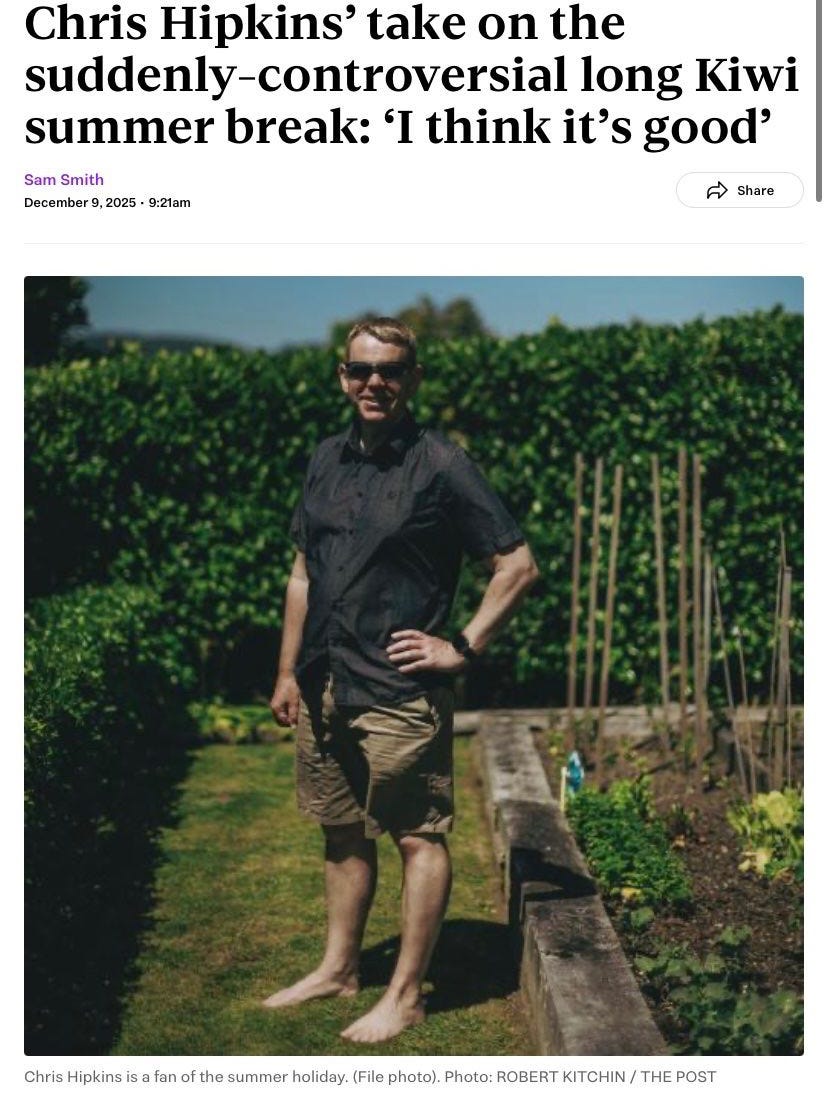
I am generally a cynical reader of the news, and yet this still made me pause. How much of my opinion of our Prime Minister is coloured by these kinds of distortions and how much is based on fair assessments of who he is and what he does?
Rents continue to get cheaper providing cost-of-living relief
Data shows a genuine cooling of the rental market. In several regions, including Auckland, Wellington, and parts of the South Island, median asking rents have flattened or fallen, reflecting more supply, slower population growth, and shifting market dynamics. Compared with the rest of the country, Auckland has become relatively more affordable than many assume, after years of being the poster child for high housing costs.
Furthermore, average residential property values nationwide have flattened, and Auckland’s remain about 20% below their peak. That drop has improved overall affordability and taken upward pressure off rents.
Is this the end of the housing crisis? Of course not. But in a year dominated by grim economic indicators, these are bright spots. For lower-income households, students, young professionals, and families trying to rebuild budgets after the inflation shock, this represents real and immediate cost-of-living relief.
The story that still doesn’t exist according to legacy media
No one in the mainstream media has reported on the Willie Jackson/MUMA story. I am working on a piece which I hope to get out this weekend.
Why are cancer diagnoses going through the roof?
New Zealand is bracing for a dramatic rise in cancer diagnoses, with Te Aho o Te Kahu (Cancer Control Agency) projecting that annual cases will jump from about 30,000 today to more than 45,000 by 2044, an increase of roughly 50%. This surge isn’t the result of a sudden explosion in cancer across all ages, but the consequence of several overlapping trends that together create a perfect storm.
The biggest factor is demographic. As New Zealand’s population both grows and ages, more people are entering the age brackets where cancer risk is highest. This mirrors global trends as high-income countries are seeing the same patterns.
At the same time, more cancers are being detected earlier, and more people are living longer after diagnosis. Five year survival rates in New Zealand have improved significantly, from about 58% to 68% over the past two decades, thanks to better treatment and screening. But earlier and more frequent detection also increases the number of diagnosed cases, pushing incidence figures higher even when mortality improves.
Lifestyle factors are also playing a major role. Smoking rates have fallen, which is a success story, but other risk factors have grown. New Zealand’s high rates of obesity, harmful alcohol consumption, and low physical activity all contribute to increased cancer risk. Cancer agencies estimate that up to half of all cancers are preventable through changes in lifestyle and environmental exposure.
Cancer is also rising among younger adults in certain categories, notably bowel cancer, prompting debates about whether screening ages need to be lowered. International evidence shows similar patterns, but New Zealand has one of the higher age-standardised cancer incidence rates among OECD nations.
Looking ahead, some epidemiological models suggest the increase could be even steeper, potentially up to 76% more cases by 2044, if current trends continue. That would place immense pressure on screening programmes, diagnostic capacity, oncology services and the broader health workforce.
Bipartisan ceasefire ends scalp hunting, and an update on McSkimming
What started as an explosive back-and-forth between opposition and Government has, in recent days, quietened after both sides appeared to rapidly back off and even begin to defend each other.
Labour leader Chris Hipkins has now made three public statements emphasising that he was “absolutely certain” he wasn’t told about the McSkimming issue, and describing the suggestion that he was aware of them as unfounded. A very credible source informs me that is a complete lie as he told them and others about it at the time. But it was Hipkins’ assertion that it is “absolutely feasible” Police Minister Mark Mitchell did not see the emails that piqued my interest. Especially when Mitchell and Christopher Luxon also accepted Hipkins’ narrative that he did not know.
I am reliably informed that there was no handshake between parties to deescalate the situation mutually. However, the independent decisions not to go after each other are pragmatic. No matter that evidence shows Mitchell is telling the truth about emails being diverted to the former Police Commissioner Andrew Coster, it was clear that the media were after his scalp and backing up Hipkins supports the view that Coster is a straight up liar. And he has proven himself to be in some pretty crucial instances.
Incidentally, I am told that one of the journalists most aggressively attacking the Minister and government on this is a close relative of one of the police executives who was a key disgraced figure in the IPCA report and has been stood down from his current role. New Zealand, huh?
The force has also pressed on with a prosecution of Ms Z under the Harmful Digital Communications Act related to a different police officer. They are adamant this is the right decision, but given how the HDCA has been weaponised against her it seems like a bizarre decision. In my view, the law needs to be reformed ASAP.
🇬🇧 UK Judge either makes up quotes in judgment or had an AI fail
The employment tribunal case of Sandie Peggie v NHS Fife in which the Scottish nurse challenged her treatment after objecting to sharing a women’s changing room with a male colleague has taken an unusual and deeply embarrassing turn for the judiciary.
The court partly upheld her harassment claim against NHS Fife but dismissed other allegations, including discrimination and victimisation. However, shortly after publication, the tribunal had to issue a “certificate of correction” amending part of its 312-page ruling because it had included a fabricated quote from the Maya Forstater case. The original judgment cited a passage from Forstater v CDG Europe to support a point about protected characteristics under the Equality Act 2010, but the quote does not exist in the Forstater judgment. It has now been removed and replaced with a different passage after Maya Forstater herself pointed out the error and said she was “astonished” it happened.
Campaigners and legal commentators noted that a false quotation attributed to a real precedent undermines confidence in the tribunal’s reasoning. Forstater and others have highlighted several instances where the ruling originally cited cases in ways that didn’t reflect actual legal language or logic, prompting broader criticism and calls that for the judiciary to explain how such mistakes occurred.
There is speculation that AI tools or automated research aids may have been used without sufficient human checks.
Peggie’s legal team has confirmed plans to appeal the decision, not least because factual and procedural integrity is fundamental to any fair judgment.
Chart of the Week
These are from the excellent X account Charted Daily and I couldn’t choose just one.
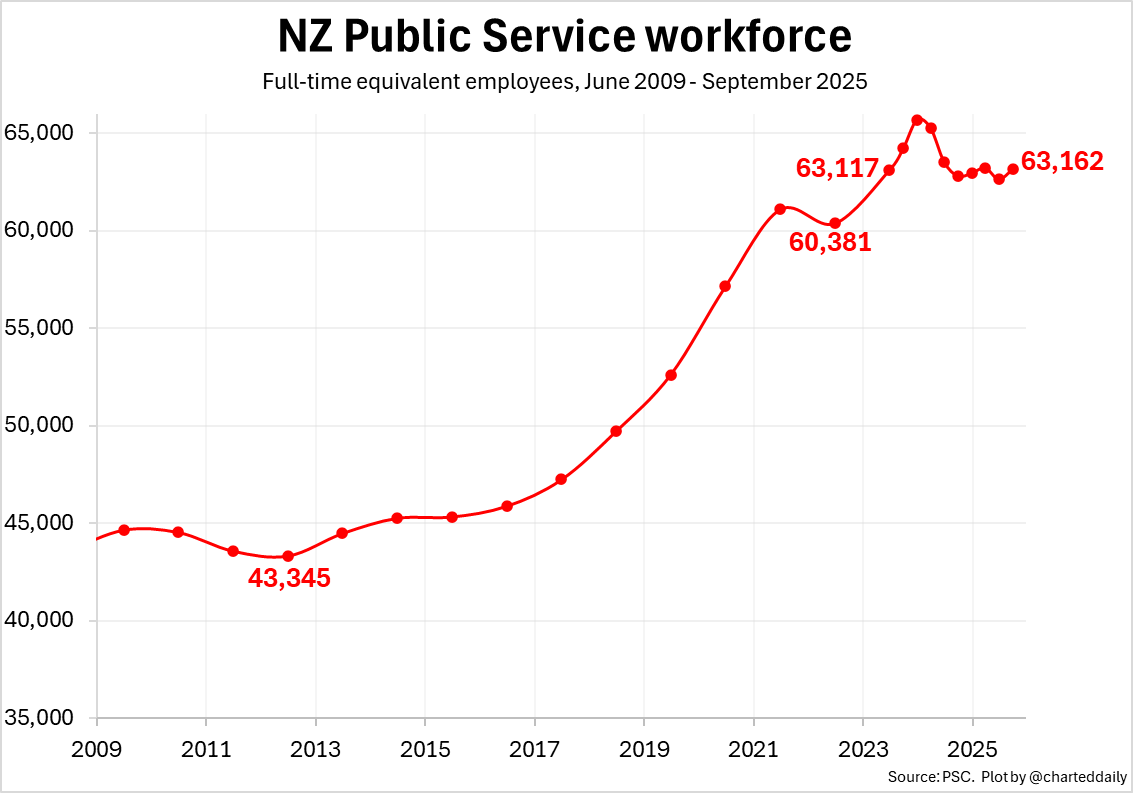
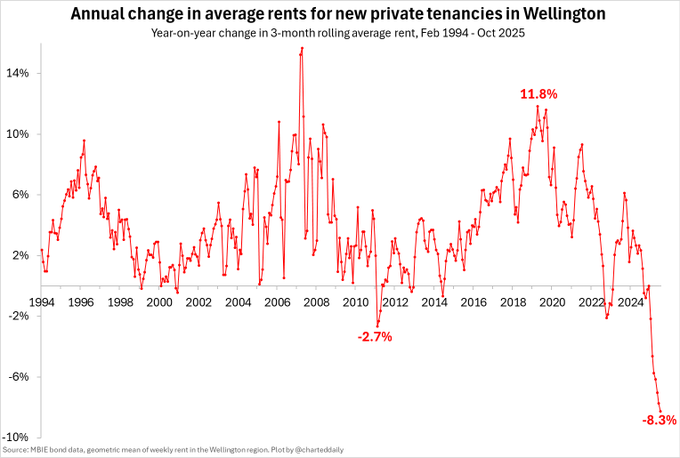
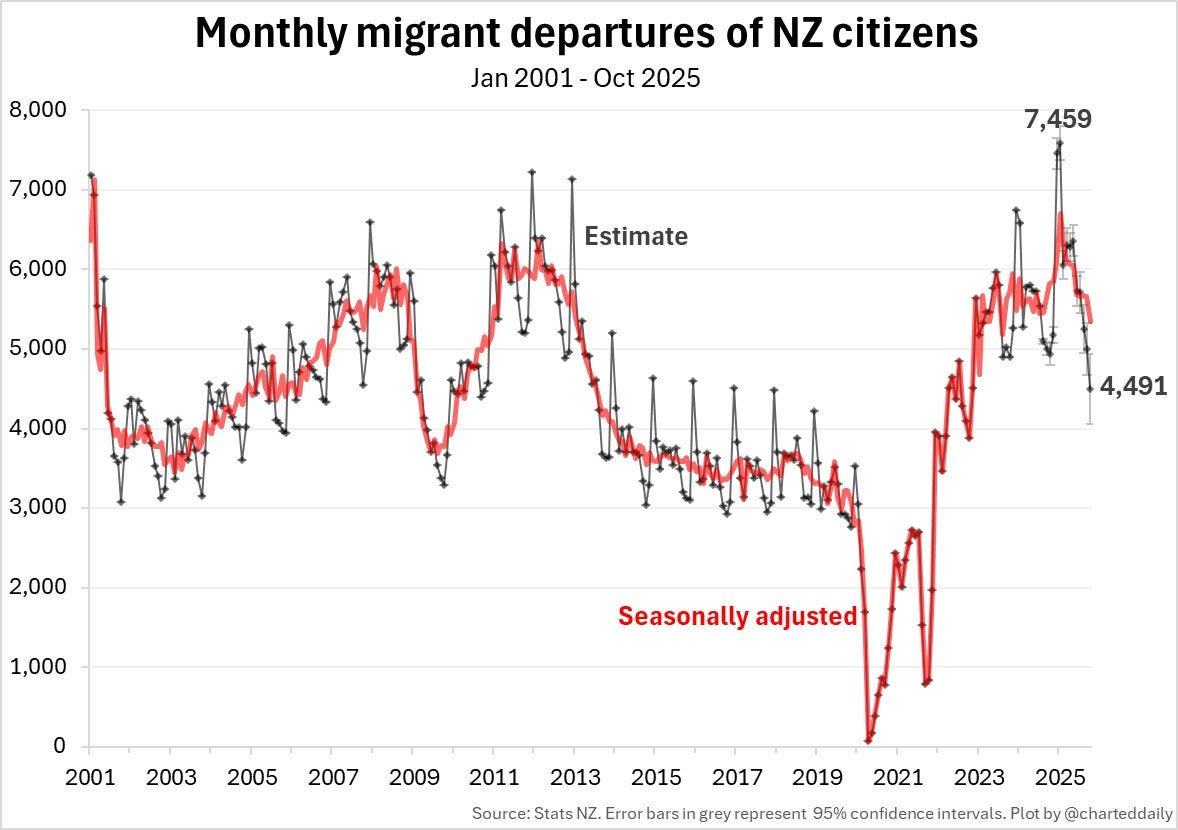
Click charts to view
In short - other stuff that happened:
- Financial controller Ilaisaane Mosiana Fifita (36) has been found guilty of stealing $289,000 from Kāhui Tū Kaha, a Māori community social services agency. She spent it on luxury travel, Uber Eats, and personal expenses, but has been sentenced to home detention after repaying some funds and expressing remorse.
- Chris Bishop’s Lower Hutt electorate office was smashed open by an unknown offender, leaving staff shaken but uninjured. Bishop has attributed the attack to “some dickhead”.
- ACC has backed down on plans to require staff to work in the office three days a week after legal threats and pressure from the Public Service Association.
- Waikato-Tainui has purchased 18 ex-state houses in South Auckland and Waikato worth more than $10 million to provide affordable pathways into homeownership. The homes will be sold at cost to iwi members.
- 🇬🇧 The NHS has commissioned the Pathways trial into puberty blockers, which is to begin in January 2026. Critics argue this effectively repackages the discredited Tavistock model under the guise of research. Women’s groups, clinicians, politicians, and parents have condemned the trial as unethical and dangerous.
- The body of a homeless man was found outside the Tepid Baths in Auckland City. He was well-known to Auckland City Mission and outreach programmes. Police are not treating the death as suspicious.
- A review found that only 37% of sampled formal warnings issued by NZ Police between 2019 and 2024 were lawful, meaning thousands of warnings have been improperly recorded. Police have already wiped 296 unlawful warnings and halted the use of warnings for vetting, while compulsory retraining is being rolled out nationwide.
- The Reserve Bank appears not to have heard of telephones nor Zoom as it spent $850,000 of our taxes on staff flights between Wellington and Auckland, saying the travel was unavoidable during refurbishment of its Wellington headquarters.
- A man was stabbed to death and another left in a critical condition after stabbings on a bus in Glen Innes. Police have a charged a man and he has been held on remand. Due to suppression orders I cannot share more about him at this time.
- 🇦🇺 Monash University in Australia has introduced three days of paid “colonial load leave” annually for Aboriginal staff to recognise the ongoing impacts of colonisation.
- An Auckland entertainer has been charged with sexually abusing three girls. Media have not named him but they haven’t mentioned name suppression either so I will say that the details of his case match earlier reports about Cole Johnston.
- A Wellington 14 year old who raped a 10 year old boy in a Lower Hutt public toilet may be detained indefinitely under a Preventative Detention order. He was deemed a high risk of reoffending as he has global developmental delay, ADHD and Fetal Alcohol Syndrome Disorder.
- Financial backers behind Wellington mayor Andrew Little’s campaign have been revealed and include former National minister Chris Finlayson, former Labour minister Dame Annette King, multimillionaire developer Ian Cassels, former city councillor and art patron Chris Parkin, The Maritime Union, Amalgamated Workers Union, E Tū Union, and Dairy Workers Union.
- 🇺🇸 Florida Attorney General James Uthmeier announced legal action against major medical organisations, alleging they consistently misled parents about the risks and uncertainties of “gender-affirming care” for children. These include the World Professional Association for Transgender Health (WPATH), the American Academy of Pediatrics (AAP), and the Endocrine Society.
- 🇬🇧 Roy Marsh, 86, was fined £150 by council officers in Skegness after he spat out a leaf which blew into his mouth.
- Tory Whanau continues to dodge responsibility for her behaviour while Wellington mayor. She was blaming David Seymour when he happened to walk past…
This Spiked Article argues that the corporate world is turning against diversity, equity and inclusion (DEI) roles and budgets, as companies reassess internal spending and move away from what it describes as “performative allyship.” If you’re interested in the shifting cultural and workplace trends in how businesses approach identity politics this article offers a provocative discussion.
Ani O'Brien comes from a digital marketing background, she has been heavily involved in women's rights advocacy and is a founding council member of the Free Speech Union. This article was originally published on Ani's Substack Site and is published here with kind permission.
No comments:
Post a Comment
Thank you for joining the discussion. Breaking Views welcomes respectful contributions that enrich the debate. Please ensure your comments are not defamatory, derogatory or disruptive. We appreciate your cooperation.