

After five days of anti-regime protests in Iran, the New Zealand media is still not reporting meaningfully on the significant events besides a handful of earlier articles. What concerns me is that New Zealanders who aren’t on X likely think they are still being served up to date news by our news media. However, the 24 hour news cycle has been dead here for some time and New Zealanders don’t even know what stories they are missing out on.
I’m sure there is a reason we have wall-to-wall coverage of an accidental fire in Switzerland, but little on potential revolution in Iran. I’m not sure there is a good reason though.
On New Years Day, I received several messages on X asking me what was going on and why the media wasn’t reporting on it. While answering the latter is increasingly difficult, I decided to gather up info from international sources, add a bit of my own historical knowledge for context and attempt to answer the former.
Iran has broken out in nationwide unrest, driven not by a single social flashpoint but by economic collapse that has pushed large parts of the population past a breaking point. The protests escalated sharply in the latter part of December 2025 and have continued into early January 2026.
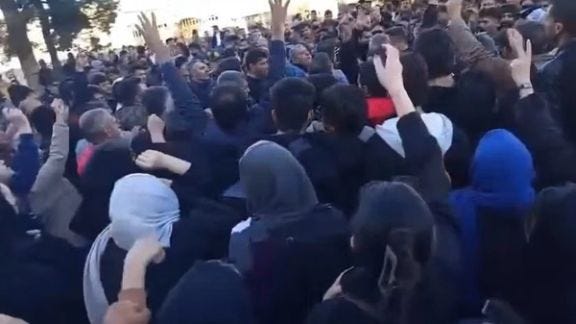
Protestors in Tehran.
First there were strikes and demonstrations against the effective “dollarization” of the economy following the collapse of the national currency.1 The immediate trigger was the Iranian rial’s plunge to a historic low of roughly 1.45 million to the US dollar, a collapse that wiped out purchasing power almost overnight. On December 28, shopkeepers in Tehran’s Grand Bazaar and mobile phone vendors at the Alaeddin complex shut their businesses in protest, an unusual move from the traditionally conservative bazaari class, long considered a pillar of the Islamic regime.
Preceding this, Iranian President Masoud Pezeshkian had formally submitted a draft 2026/27 budget bill to Iran’s Parliament on December 23, 2025 which included steep tax increases. With food inflation climbing toward an estimated 72% the people of Iran are suffering and it is unsurprising that the tinderbox has caught fire.
On December 30, 2025, university students in Tehran, Isfahan, Shiraz, Mashhad, Kermanshah, Yazd and other provincial cities joined the demonstrations, transforming the protest into a broader political movement. Student participation injected new energy and more overtly political messaging, with crowds chanting anti-government slogans that went beyond demands for currency stabilisation.
Authorities have responded with arrests, internet restrictions, and the use of live ammunition against civilians in some provinces. And, as pressure mounted, the government has signalled that it was willing to enter dialogue with protest representatives, a rare concession that reflects the seriousness of the crisis and the authorities’ concern over the protests’ expanding social and geographic reach, according to Reuters.
On the fourth consecutive day of protests, they were widely being described as the largest wave of unrest since 2022. In several locations, demonstrations escalated beyond marches and strikes, with protesters in some cities, most notably Fasa, attempting to storm local government buildings before being repelled by security forces. In an effort to restore confidence, the government moved to appoint a new central bank governor. However, this failed to quell the protests.
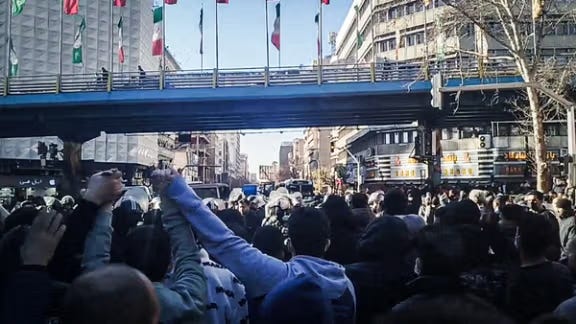
On January 1, 2026, unrest showed little sign of abating, with strikes, shop closures, and street marches continuing across major urban centres, according to Reuters and other international news outlets.
Overnight, New Zealand time, protests have grown more widespread and violent with multiple fatalities reported as clashes with security forces intensify.
Reuters reports:
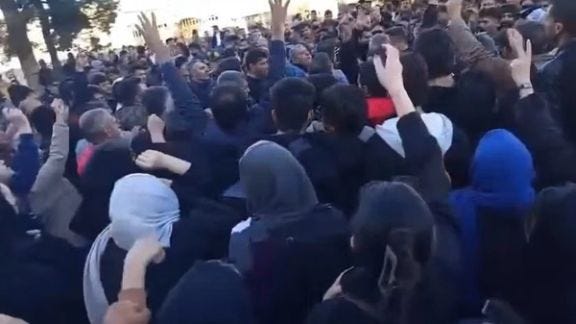
Protestors in Tehran.
First there were strikes and demonstrations against the effective “dollarization” of the economy following the collapse of the national currency.1 The immediate trigger was the Iranian rial’s plunge to a historic low of roughly 1.45 million to the US dollar, a collapse that wiped out purchasing power almost overnight. On December 28, shopkeepers in Tehran’s Grand Bazaar and mobile phone vendors at the Alaeddin complex shut their businesses in protest, an unusual move from the traditionally conservative bazaari class, long considered a pillar of the Islamic regime.
Preceding this, Iranian President Masoud Pezeshkian had formally submitted a draft 2026/27 budget bill to Iran’s Parliament on December 23, 2025 which included steep tax increases. With food inflation climbing toward an estimated 72% the people of Iran are suffering and it is unsurprising that the tinderbox has caught fire.
On December 30, 2025, university students in Tehran, Isfahan, Shiraz, Mashhad, Kermanshah, Yazd and other provincial cities joined the demonstrations, transforming the protest into a broader political movement. Student participation injected new energy and more overtly political messaging, with crowds chanting anti-government slogans that went beyond demands for currency stabilisation.
Authorities have responded with arrests, internet restrictions, and the use of live ammunition against civilians in some provinces. And, as pressure mounted, the government has signalled that it was willing to enter dialogue with protest representatives, a rare concession that reflects the seriousness of the crisis and the authorities’ concern over the protests’ expanding social and geographic reach, according to Reuters.
On the fourth consecutive day of protests, they were widely being described as the largest wave of unrest since 2022. In several locations, demonstrations escalated beyond marches and strikes, with protesters in some cities, most notably Fasa, attempting to storm local government buildings before being repelled by security forces. In an effort to restore confidence, the government moved to appoint a new central bank governor. However, this failed to quell the protests.
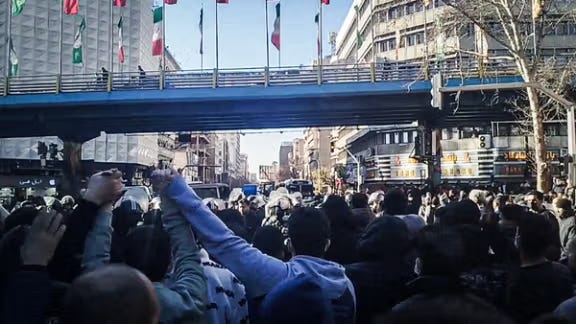
On January 1, 2026, unrest showed little sign of abating, with strikes, shop closures, and street marches continuing across major urban centres, according to Reuters and other international news outlets.
Overnight, New Zealand time, protests have grown more widespread and violent with multiple fatalities reported as clashes with security forces intensify.
Reuters reports:
The semi-official Fars news agency reported that three protesters were killed and 17 were injured during an attack on a police station in Iran’s western province of Lorestan.
“The rioters entered the police headquarters around 1800 (local time) on Thursday ... they clashed with police forces and set fire to several police cars,” Fars reported.
Earlier, Fars and rights group Hengaw reported deaths in Lordegan city in the country’s Charmahal and Bakhtiari province. Authorities confirmed one death in the western city of Kuhdasht, and Hengaw reported another death in the central province of Isfahan.
The clashes between protesters and security forces mark a significant escalation in the unrest that has spread across the country since shopkeepers began protesting on Sunday over the government’s handling of a sharp currency slide and rapidly rising prices.
Security forces maintain a heavy presence in key locations as authorities seek to halt further escalation, while state media and senior officials are issuing repeated warnings against violence (while allegedly firing on civilians) and alleging foreign interference, framing the protests as a threat to national stability.
Opposition figures and exiled political leaders, including members of Iran’s former royal family, voiced symbolic support for the demonstrators from abroad, highlighting the wider political currents surrounding the unrest and the extent to which the protests had become a focal point for long-standing opposition to the Islamic Republic.
The United States has publicly expressed support for the Iranian people with US State Department statements and Persian-language social media accounts framing the protests as a legitimate response to collapsing living standards and governance failures. However, the US has been careful to distance itself from any suggestion of direct involvement.
The European Union and the United Kingdom have issued statements calling for restraint, protection of civilians, and respect for the right to peaceful protest, but they have also acknowledged the severity of Iran’s economic situation. European governments likely prefer containment rather than transformation, seeking to avoid refugee flows, regional destabilisation, or a nuclear escalation.
Regional rivals such as Saudi Arabia and the United Arab Emirates have largely kept public commentary restrained, reflecting a preference for watching events unfold rather than inflaming tensions.
Russia and China are emphasising state sovereignty, non-interference, and stability in response to external pressures on Iran. The Kremlin has urged restraint and diplomacy and warned against escalation or external military actions that could destabilise the region. While Beijing has not issued frequent direct comments about the current protests, in June 2025, a Chinese foreign ministry spokesperson clearly stated that China opposes any infringement on Iran’s sovereignty, security and territorial integrity and favours diplomatic solutions to regional disputes.
Historical context
About six months ago I wrote about the threat of Iran and its history. You can read it here.
Iran’s current crisis sits at the intersection of long-standing political tensions and structural economic vulnerability. It cannot be divorced from its history of revolution. Iran pursued rapid modernisation under Mohammad Reza Shah Pahlavi, who ruled from 1941 until his overthrow in 1979. Backed by the United States and the United Kingdom, the Shah positioned Iran as a key Western ally during the Cold War, using oil revenues to fund industrial expansion, military buildup, and ambitious social reforms.
These efforts, however, were accompanied by authoritarian governance. Political opposition was crushed, elections hollowed out, and dissent policed by SAVAK2, whose reputation for repression became a focal point of public anger. Economic growth was uneven, and many Iranians felt alienated from a state perceived as culturally detached, corrupt, and overly dependent on foreign powers.
Opposition grew in the 1970s around a broad coalition that included secular leftists, nationalists, and Islamic conservatives. The unifying figure was Ayatollah Ruhollah Khomeini, whose critique of monarchy fused Shi’a theology3 with anti-imperialist rhetoric. The 1979 Islamic Revolution dismantled the monarchy and replaced it with the Islamic Republic of Iran, built around the doctrine of velayat-e faqih4, granting ultimate authority to a supreme leader.

Life in Iran before the Islamic Revolution in 1979.
The new system promised justice, independence, and moral governance. Yet over time, the new Islamic government rolled out strict religious laws, reshaping everything from women’s rights to public behaviour. Gone were the secular policies of the Shah. Arts and entertainment faced heavy restrictions, and personal freedoms shrank. Women were forced to adopt the hijab, and a rigid Islamic code dictated everyday life. For many, this was a far cry from the freedoms they had once enjoyed under the monarchy.
Khomeini and his followers quickly consolidated power, sidelining the left-wing activists who played a pivotal role in overthrowing the Shah’s autocratic rule. Despite promising a broad coalition government that would represent various political factions, Khomeini’s vision was rooted in theocracy, which clashed head-on with the secular and Marxist ideologies of the left. As the Islamist leadership took control of key institutions, tensions escalated. Leftists, who pushed for secular reforms, found themselves at odds with Khomeini’s agenda of instituting Islamic law (Sharia).
The Islamists soon viewed the leftists as a threat to their vision of an Islamic state and in 1981, the Islamic regime launched a violent purge, arresting, torturing, and executing thousands of left-wing activists, intellectuals, and political dissidents.
Ayatollah Ali Khamenei has ruled over Iran since 1989 and under his leadership, Iran has seen significant suffering, repression, and conflict. He has overseen many violent repressions of his people, ruling with fear. Khamenei’s rule has been marked by continued use of the death penalty, particularly for political dissidents, activists, and those deemed to be “enemies of the state.” Thanks to him, Iran has one of the highest execution rates in the world.
Khamenei has been the most significant force behind many of the worst terrorist groups in the Middle East including Hamas, Hezbollah, and the Houthis. He has provided financial, military, and logistical support to these groups, which have carried out numerous attacks on civilians and military targets in Israel, Syria, Iraq, and beyond.
Repeated protest movements over several decades have reflected growing opposition to the regime. While the 2022 protests were triggered by social repression, particularly around women’s rights, the current uprising is rooted in material survival which can be seen as an echo of pre-revolutionary grievances that once undermined the Shah.
Who stands to gain from regime change
A fundamental transformation of Iran’s political system would reshape domestic power relations and regional geopolitics. Within Iran, the most immediate beneficiaries would be ordinary citizens whose livelihoods have been hollowed out by inflation, currency collapse, and unemployment. It would be a moment like the fall of the Berlin Wall in freeing the people of a country who had lived under repression for so long.
Women and young people would also stand to gain disproportionately. While this uprising is economically driven, women have remained highly visible participants, linking economic injustice to broader restrictions on personal autonomy. Women have been oppressed, discriminated against, and demeaned under the Shi’a rule. Iran’s youth are also facing dwindling job prospects, emigration pressures, and declining living standards and so see systemic change as increasingly necessary.
Iranian opposition groups, both inside the country and within the diaspora, view the unrest as an opportunity to realign the political order toward a freer, more accountable and economically rational system. While fragmented and lacking unified leadership, these groups would benefit from any weakening of the current power structure.
Regionally, Iran’s rivals have clear strategic incentives. Saudi Arabia, Israel, and the United Arab Emirates have long opposed Tehran’s regional ambitions. A regime consumed by domestic instability, or replaced by one less committed to revolutionary Islamic dominance, would likely scale back support for allied militias, altering the regional balance of power and potentially allowing for a much more stable Middle East.
For the United States and European states, political change in Iran could open pathways to renegotiating sanctions, reducing nuclear tensions, and reintegrating Iran into the global economy, though such outcomes would depend heavily on the nature of any successor system.
Who stands to lose
The most obvious losers from regime change would be Iran’s clerical elite and the Islamic Revolutionary Guard Corps, whose political authority and economic privileges are inseparable from the current system. The IRGC’s extensive business empire is built in large part through sanctions-era monopolies and would likely crumble under transparency, liberalisation, or civilian oversight.
Iran’s regional allies face significant risk as well. Groups such as Hamas, Hezbollah, along with the Syrian government and aligned factions in Iraq, depend heavily on Iranian financial and military backing. A regime forced to prioritise domestic stability, or replaced outright, could sharply curtail this support.
Major global powers also have stakes in Iran’s continuity. Russia and China have expanded economic and strategic ties with Tehran, viewing it as a counterweight to Western influence. Sudden regime change could disrupt energy deals, arms cooperation, and broader geopolitical alignments.
Finally, conservative religious constituencies inside Iran fear that systemic change would erode moral authority and social cohesion. For these groups, the current unrest represents not reform but existential uncertainty for their Islamist aspirations for the world.
History cautions against simple conclusions of victory and vanquish, however. The Islamic Republic itself was born from a convergence of economic grievances, political repression, and ideological mobilisation. Today’s unrest echoes those dynamics while unfolding in a vastly more complex regional and global environment, shaped by sanctions, war, and geopolitical rivalry.
Whether the current crisis results in reform, repression, or deeper transformation remains uncertain, but Iran’s political economy is under unprecedented strain. As economic survival replaces abstract ideology as the primary driver of protest, the stakes for the Iranian state, its citizens, and the wider international system have rarely been higher.
1 “Dollarisation” describes what happens when a country’s own currency becomes so unstable that it effectively stops working as money. In Iran’s case, the rapid collapse of the rial meant prices were changing daily or even hourly. Shopkeepers could no longer set prices in rials without risking huge losses, so many began pricing goods informally in US dollars or pegging prices to the dollar exchange rate, even though using foreign currency is officially illegal. Ordinary people, however, are paid in rials, not dollars, so their wages suddenly became almost worthless in real terms.
2 SAVAK was Iran’s secret police and intelligence service under the Shah.
3 Shi’a Islam carries a belief in the return of the Mahdi, the Twelfth Imam, who they believe will lead the Muslim world to triumph over injustice. Iran’s leadership aligns its actions with this eschatological narrative, portraying itself as an instrument in preparing for the Mahdi’s return. Shi’a and Sunni are the two largest branches of Islam and the divide between them is centuries old, dating back to the dispute over who should succeed the Prophet Muhammad after his death in 632 CE. Today, Sunni Muslims make up roughly 85-90% of the Muslim world, while Shi’a Muslims account for around 10-15%.
4 The doctrine of velayat-e faqih translates to “guardianship of the Islamic jurist” and is the political theory that underpins Iran’s current system of government. It holds that in the absence of the hidden Twelfth Imam (a core belief in Shi’a Islam), a senior Islamic jurist should have ultimate authority over the state to ensure that governance remains in accordance with Islamic law. This is the Supreme Leader.
Ani O'Brien comes from a digital marketing background, she has been heavily involved in women's rights advocacy and is a founding council member of the Free Speech Union. This article was originally published on Ani's Substack Site and is published here with kind permission.
9 comments:
"The Islamists soon viewed the leftists as a threat to their vision of an Islamic state and in 1981, the Islamic regime launched a violent purge, arresting, torturing, and executing thousands of left-wing activists..."
So, they weren't all bad then.
I think you should have also mentioned the overthrow of a democratically elected Prime Minister in 1951 and his eventual ousting by USA and British Intelligence in 1953. All in the name of democracy of course but really to keep a stong grip on Iran's oil supplies.
Very good question Ani O’Brien regarding the absence of meaningful reporting of the anti protests in Iran by our corrupt MSM. Those that are married to these shapers of pubic opinion remain blissfully ignorant of world events. Why this Govt feels duty bound to continue funding these propagandists masquerading as news rooms is beyond me.
In your intro to the article, Ani, you have summed up so well, the abysmal , biased quality of our mainstream media.
Thankfully we have excellent true journalists like yourself.
Thank you, Ani !
msm... pfft
>"However, the US has been careful to distance itself from any suggestion of direct involvement."
But Trump is on record as warning on Friday that, “If Iran shoots and violently kills peaceful protesters, which is their custom, the United States of America will come to their rescue. We are locked and loaded and ready to go."
I suspect the Iranian people will soon find themselves 'between a rock and a hard place'.
How wonderful if the historic Persian peoples could get out from under the yoke of iniquitous Islam.
Yes, Ani, serious question: how many subjects/stories can the MSM ignore and get away with it???? When will Goldsmith pull funding??? What will it actually take?????
Ani made a simple but unsettling observation: most New Zealanders still believe they are being kept up to date by the mainstream news media — not because the coverage is strong, but because it looks busy. Constantly refreshed homepages and a steady churn of “new” but lightweight international stories create the illusion of vigilance.
In reality, major events can unfold largely unnoticed while Kardashian-style fillers take priority.
The recent unrest in Iran illustrates the problem. After days of anti-regime protests and mounting international concern, New Zealand media coverage has been thin to non-existent. Those not on X or following international outlets would reasonably assume little was happening. The system gives no signal that anything is missing.
At the core of this failure is something more basic than budgets or end-of-year summer holiday staffing: newsrooms have lost their nose for a good story. Journalism’s most valuable skill was never speed or volume, but judgment — the instinct to recognise significance through noise, and to sense when scattered developments are coalescing into something consequential. That instinct was once mentored and enforced. It has largely gone.
Skeleton holiday crews now operate inside newsrooms already hollowed out by years of cuts. Many of the journalists who once covered — or even studied — Vietnam, the Gulf Wars, the Balkans, 9/11, or Afghanistan are gone. With them has disappeared historical literacy and pattern recognition.
Absence is now concealed by volume. In outlets such as Stuff, scarce resources are increasingly spent scraping and repackaging lifestyle, entertainment, and social-media filler to keep the site looking busy.
This is not laziness; it is the economic model. Content that is fast, safe, and algorithm-friendly reliably displaces complex, uncertain international stories.
Risk aversion completes the picture. Uncertainty is treated as a reason not to report, rather than something to explain. Editorial judgment is outsourced to wire services and foreign mastheads.
Ani’s insight cuts through the excuses.
New Zealanders aren’t uninformed because nothing is happening. They’re uninformed because the msm resources have been watered down — like asking a modern newsroom to spot a revolution with the instincts of a sheep dog that’s been bred for compliance instead of smell.
—PB
Post a Comment
Thank you for joining the discussion. Breaking Views welcomes respectful contributions that enrich the debate. Please ensure your comments are not defamatory, derogatory or disruptive. We appreciate your cooperation.