

Waitangi Day is an annual time of remembrance, renewal, grievance, self-flagellation, and competing narratives. The summer ritual at the Treaty Grounds is part civic commemoration, part political theatre, and part family reunion. It is also, the ultimate testing ground for the mettle of centre-right politicians. There is a difference between demonstrating respect and grovelling, and often leaders fall into the trap of the latter.
Waitangi is where speeches are met with heckling and iwi remind the Crown of nearly 200 years of promises as well as issue new demands. This year’s commemorations were charged with protest, apology and juicy gossip, yet they also contained glimmers of hope and common sense.
Unfortunately, New Zealanders are routinely served a flattened version of what happens at Waitangi. One that erases internal Māori politics, overstates activist mandate, and treats disruption as synonymous with consensus.. They are told that the Government is loathed by all at the event and the left bloc loved. This is far too simplistic and driven by persistent disruption by professional activists whose motives are never questioned.
Despite all of this, it was a relatively calm affair compared to the past two years. The Treaty Principles Bill ignited protest previously and with Eru Kapa Kingi still in the early days of re-branding Toitū Te Tiriti to Toitū Te Aroha there was no momentum for any proper organised action this year. Although the deeply unserious and chronically cringe grifters at Aotearoa Liberation League did attempt to arrange a blockade to prevent government MPs from entering by forming a human chain across the entrance to the pōwhiri. This grand attempt at attention seeking was thwarted not by the government but when haukāinga (local people of marae) and iwi leaders met the protesters and advised them that a blockade would breach tikanga. Having been pulled in line by kaumatua (elders), organisers scaled back their plans, opting instead for a “peaceful rally” using haka and kōrero.
The Aotearoa Liberation League is a small group and Te Ao noted that its original plan for a human chain only drew roughly twenty people. They claim to represent all Māori, but should be wary of overstating their mandate. A lot of the legitimacy they have received is due to the heavy media coverage by reporters desperate to amplify opposition to the government.
Before the Waitangi formal events a closed hui between Prime Minister Christopher Luxon and the National Iwi Chairs Forum was held. Luxon met iwi leaders in a private meeting at Te Whare Rūnanga, where the emphasis is said to have been on localism and devolution in public services. The meeting also covered the unresolved Ngāpuhi settlement and government rhetoric of empowerment rather than separation. Luxon told iwi chairs he wanted “alignment” on localism and lifting outcomes in health, education and law and order.
Luxon’s presence at Waitangi was significant in itself after his unprecedented decision to spend last year’s commemorations down south with Ngāi Tahu. The South Island iwi returned to the Northland celebrations for the first time in years as well.
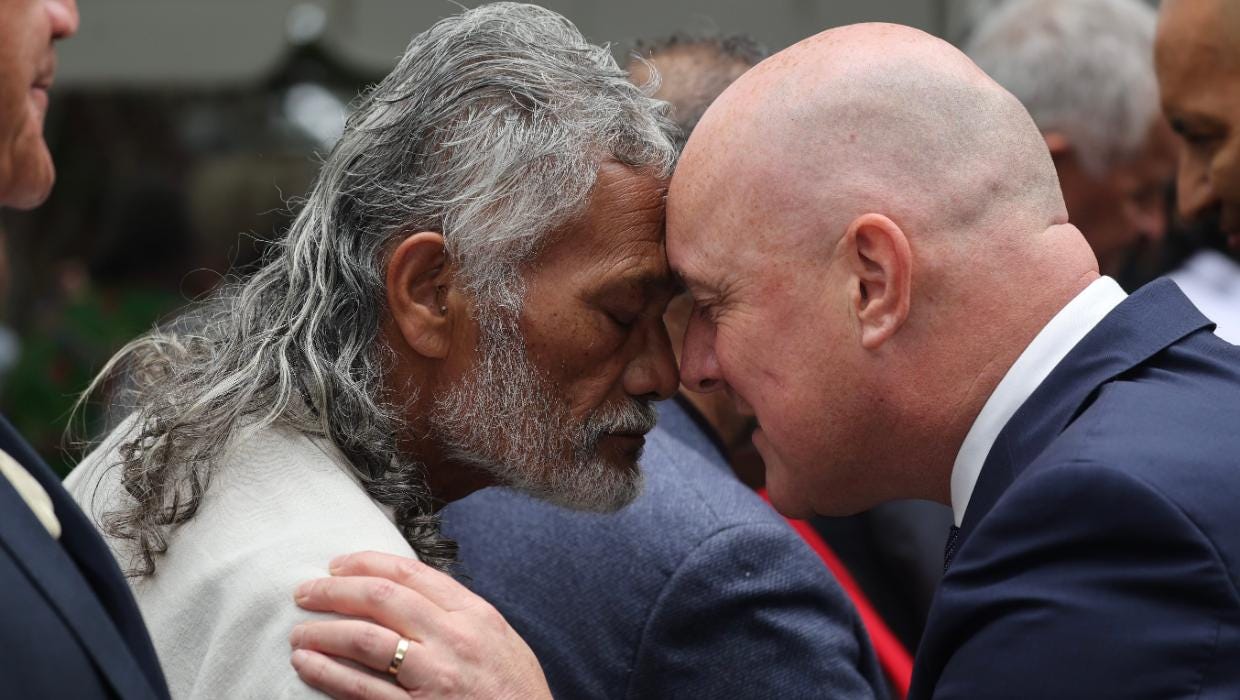
Photo: Iain McGregor / The Press
Unusually, but as I have alluded to, the most explosive undercurrent at Waitangi 2026 was not between the government and protesters, but within the Māori political world itself. Throughout 2024 and 2025, Te Pāti Māori have experienced rolling controversies involving former vice‑president and activist Eru Kapa Kingi, MP Mariameno Kapa Kingi (his mother), and the John Tamihere faction. The party’s woes began in May 2024 during a budget day hīkoi when Eru Kapa‑Kingi allegedly tailgated through Parliament’s security gates and verbally abused staff; he was later trespassed. By July 2025, party co‑leaders were alleging “major overspending issues” linked to Mariameno Kapa‑Kingi’s contracting arrangements with her son. However, this overspend has been challenged and seems to be an accounting schmozzle rather than the straight up theft the party insinuated.
Late last year Mariameno Kapa Kingi lodged a judicial review into her expulsion from Te Pāti Māori and last week a second hearing was held to much fanfare and drama that the party can ill afford.
The pōwhiri on the 5th February drew thousands of people despite grey skies threatening to rain. A group of protesters led by Wikatana Popata greeted coalition politicians with haka and chants of “the enemy”. The same protest slogans would appear later that day when Eru Kapa Kingi took his turn to speak.
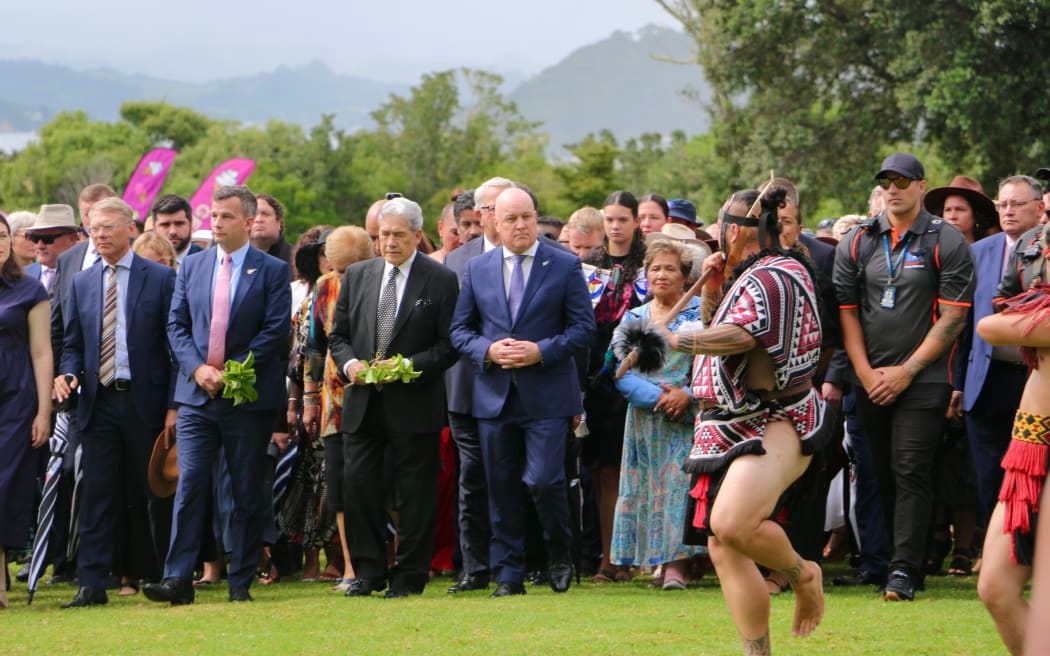
Photo: Layla Bailey-McDowell / RNZ
Eru Kapa Kingi is a charismatic orator with a penchant for mixing religious imagery with political critique. He surprised Labour when his whaikōrero (formal speech) targeted both the government and Labour. He revived an old saying that National, or in this case the coalition, stabs Māori in the front while Labour stabs them in the back. He likened the coalition to a “spider” invited into the house and asked why Māori continue to extend hospitality to those who do not love them. Kapa Kingi challenged politicians to “sort yourselves out,” pointing his criticism at his former party’s leaders as much as at their opponents.
Despite being expelled from Te Pāti Māori he clearly retains the support of many. Remarkably, his reputation has survived the allegations about his abuse of parliamentary staff and trespass from Parliament; no doubt aided by puff pieces like the one written by Audrey Young this week. And yet at Waitangi he framed himself as the victim of internal bullying and financial scapegoating. Kapa Kingi also took the opportunity to address his mother’s removal from Te Pāti Māori. He described the party leadership as a “dictatorship” and said his mother had been “stabbed” by her own colleagues.
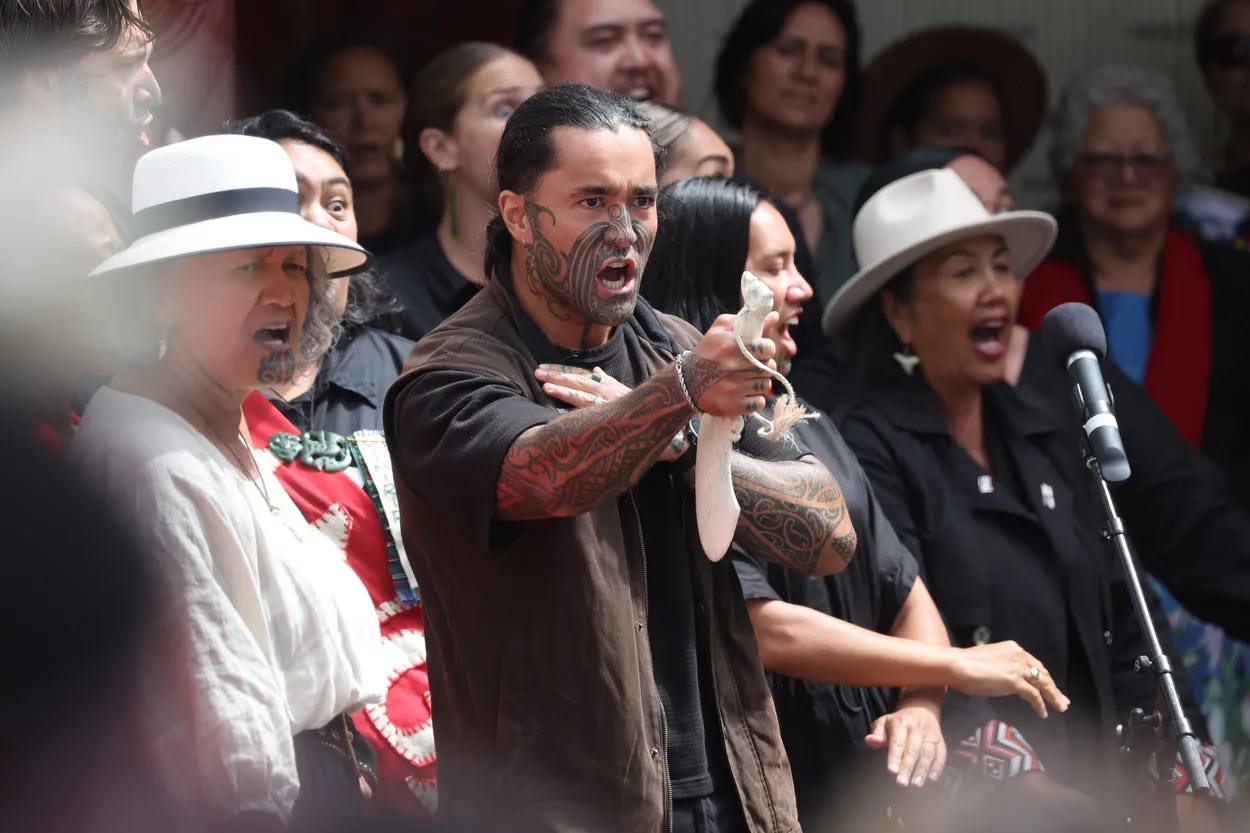
Photo: Ricky Wilson/Stuff
Te Pāti Māori co-leader Rawiri Waititi thanked Kapa Kingi for using the correct forum to air his grievances but reminded him that the real enemy was not within. Even so Waititi’s whānau performed a haka that crossed the marae space to confront Kapa Kingi which resulted in Mariameno Kapa Kingi shouting “hoki atu” (go back).
In some uncharacteristic moments of humble humility, Rawiri Waititi acknowledged the pain caused by his party’s refusal to meet Ngāpuhi late last year and publicly apologised for declining the invitation, calling for a new meeting. For a man known for fiery rhetoric, this was a significant concession and arguably the most conciliatory moment of the day. But, this magnanimous dignity did not extend to the government towards which he directed defiant language, accusing the coalition of “nibbling like a sandfly” at the Treaty. He pledged that Te Pāti Māori would continue to fight for tino rangatiratanga (self determination, autonomy) and suggested that the only enemy before them is the state, not their own people.
Waititi’s apologies weren’t received all that warmly, however. His claim that the party declined the original hui on advice from Te Tai Tokerau leaders was challenged by local elders. Mane Tahere described the explanation as inconsistent and argued that showing up to a hui is a basic sign of respect. Moana Tuwhare said Te Pāti Māori’s refusal signalled that “whakapapa Māori was worthless” if party processes overrode iwi consultation. Waititi’s apology may be an olive branch, but the deeper question is whether the party will submit to an external process or continue to insist on resolving issues internally.
As usual, Waitangi prompted a deluge of opinion pieces and hot takes from politicians, journalists, and anyone with a keyboard.
For some commentators the events have become emblematic of a politics that feels frozen in grievance and ritualised confrontation. Others framed the same scenes as evidence that Waitangi remains one of the few places where unresolved constitutional tensions are still aired honestly, rather than managed behind closed doors.
On talkback, Mike Hosking argued that the repeated heckling of prime ministers risks turning Waitangi into a stage-managed hostility exercise that alienates the wider public. This line of commentary resonated strongly with his listeners who see Waitangi Day less as a constitutional forum and more as a national holiday that should, at minimum, not feel as permanently adversarial as it does.
Commentators such as Audrey Young and Vernon Small focused less on the noise and more on the underlying recalibration taking place. Instead of headline constitutional battles, they pointed to the Government advancing narrower administrative and funding decisions that cumulatively reshape how the Treaty is recognised in practice.
NZ Herald Now’s Ryan Bridge wrote that protest “lances society’s boils and keeps powerful people in check,” but warned that the moment fists or shoving replace kōrero, “you lose the room”. Bridge argued that most New Zealanders, regardless of colour or ancestry, are hardworking people who look after each other, and that this unity is worth celebrating on Waitangi Day.
The Spinoff and Newsroom, commentary leaned heavily into the idea of political dissonance. Writers argued that the Government’s language of unity sits uneasily alongside policy retrenchment, especially in health, co-governance, and Māori institutional autonomy. The recurring phrase was not “division” but “disconnect”.
As The Spinoff’s Liam Rātana noted, every year politicians descend on Waitangi seeking to be perceived as principled or misunderstood. It is all a carefully and anxiously choreographed dance of narratives from all involved. Parties were successful in their narrative control to various degrees. The government parties for the most part succeeded in presenting themselves in accordance with their brands and approach to the election year.
National spent a lot of time positioning itself to the centre by ruling out and tutting at its coalition partners’ policy proposals. ACT sought to lay the groundwork for a kind of Treaty Principles 2.0 and NZ First blasted everyone with their characteristic defiance and fearlessness. Meanwhile, Labour and Te Pāti Māori competed over who could have the most internal drama. Labour lost control of its narrative altogether with a handful of disastrous media stand ups that saw Chris Hipkins stutter and stumble while Peeni Henare gave him a metaphoric middle finger. And the Greens struggled for relevancy failing to get traction for their Treaty messages nor critical minerals mining talking points.
Interestingly, there was little patience across the spectrum for Labour’s positioning. Several columnists noted that Chris Hipkins’ reception at Waitangi was warmer than that afforded to government ministers, but warned that Labour’s strength at Waitangi remains tonal rather than substantive. Careful language, but uncertainty about what the party would actually do if returned to power. As one commentator put it, Labour is currently benefiting from being the least threatening option in the room, not the most compelling. A more polite version of Eru Kapa Kingi’s accusation of stabbing in the back.
Prime Minister Christopher Luxon delivered a somewhat familiar speech, but to be fair there is only so many ways you can argue for self-evident and popular concepts of unity knowing you’ll get beat up in the media regardless. Luxon’s framing was sound and classic National. It anchored the Treaty in devolution rather than co‑governance, acknowledging iwi authority while maintaining national sovereignty.
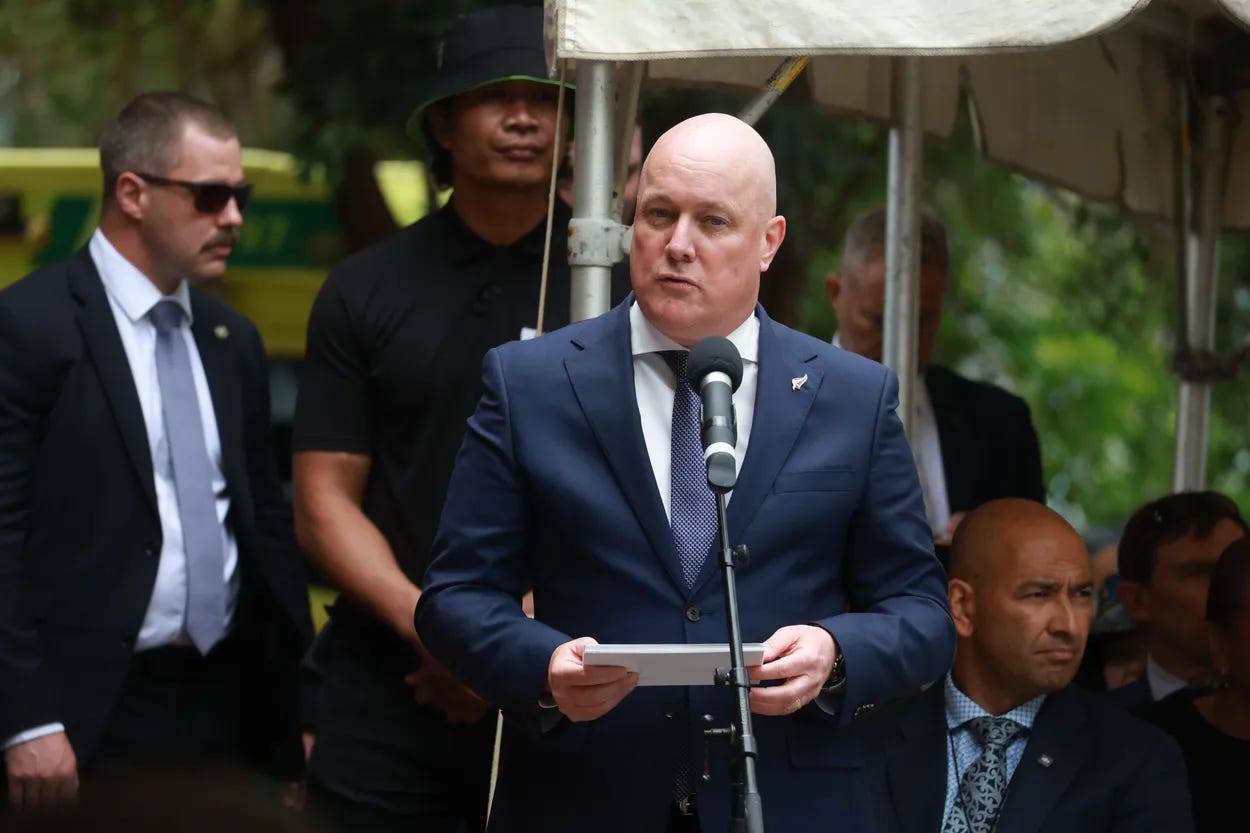
Photo: Ricky Wilson/Stuff
He framed the three articles of the Treaty as principles that empower iwi and guarantee equal citizenship. He interpreted Article One as the Crown’s right to govern for all, Article Two as affirming iwi and hapū authority over their resources, and Article Three as bestowing equal rights and responsibilities on all New Zealanders. Crucially, he argued that Article Two requires devolution and property rights, not separate systems:
Despite all of this, it was a relatively calm affair compared to the past two years. The Treaty Principles Bill ignited protest previously and with Eru Kapa Kingi still in the early days of re-branding Toitū Te Tiriti to Toitū Te Aroha there was no momentum for any proper organised action this year. Although the deeply unserious and chronically cringe grifters at Aotearoa Liberation League did attempt to arrange a blockade to prevent government MPs from entering by forming a human chain across the entrance to the pōwhiri. This grand attempt at attention seeking was thwarted not by the government but when haukāinga (local people of marae) and iwi leaders met the protesters and advised them that a blockade would breach tikanga. Having been pulled in line by kaumatua (elders), organisers scaled back their plans, opting instead for a “peaceful rally” using haka and kōrero.
The Aotearoa Liberation League is a small group and Te Ao noted that its original plan for a human chain only drew roughly twenty people. They claim to represent all Māori, but should be wary of overstating their mandate. A lot of the legitimacy they have received is due to the heavy media coverage by reporters desperate to amplify opposition to the government.
Before the Waitangi formal events a closed hui between Prime Minister Christopher Luxon and the National Iwi Chairs Forum was held. Luxon met iwi leaders in a private meeting at Te Whare Rūnanga, where the emphasis is said to have been on localism and devolution in public services. The meeting also covered the unresolved Ngāpuhi settlement and government rhetoric of empowerment rather than separation. Luxon told iwi chairs he wanted “alignment” on localism and lifting outcomes in health, education and law and order.
Luxon’s presence at Waitangi was significant in itself after his unprecedented decision to spend last year’s commemorations down south with Ngāi Tahu. The South Island iwi returned to the Northland celebrations for the first time in years as well.
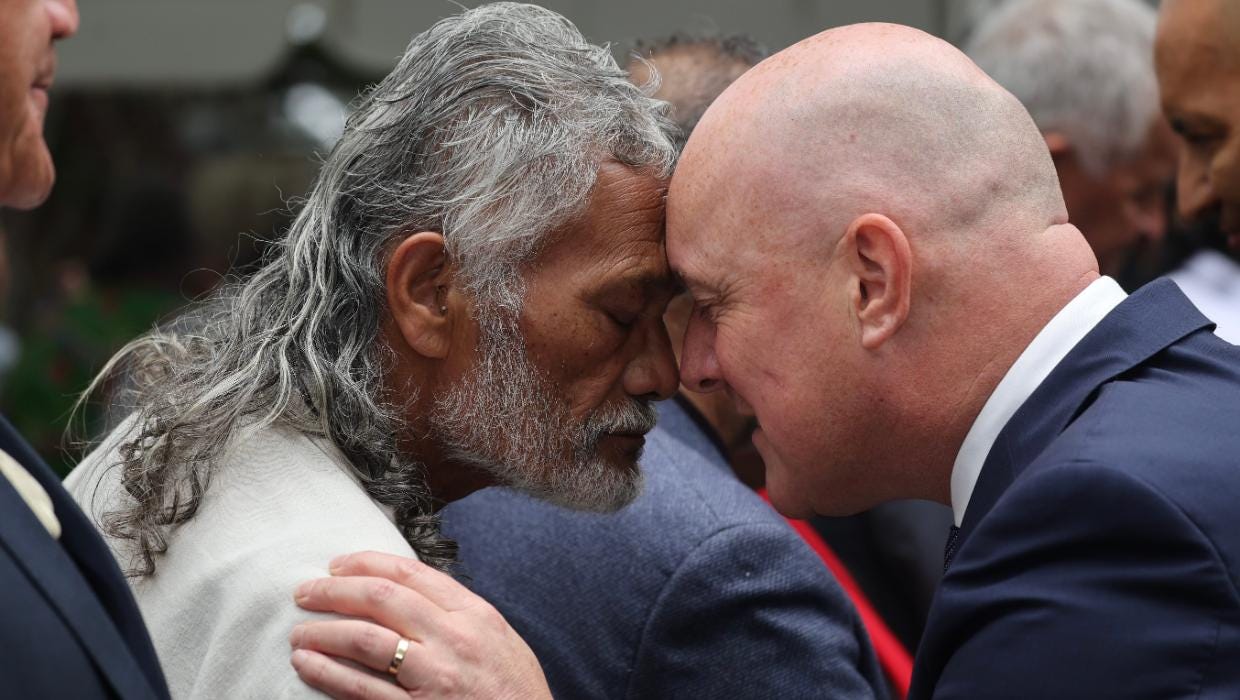
Photo: Iain McGregor / The Press
Unusually, but as I have alluded to, the most explosive undercurrent at Waitangi 2026 was not between the government and protesters, but within the Māori political world itself. Throughout 2024 and 2025, Te Pāti Māori have experienced rolling controversies involving former vice‑president and activist Eru Kapa Kingi, MP Mariameno Kapa Kingi (his mother), and the John Tamihere faction. The party’s woes began in May 2024 during a budget day hīkoi when Eru Kapa‑Kingi allegedly tailgated through Parliament’s security gates and verbally abused staff; he was later trespassed. By July 2025, party co‑leaders were alleging “major overspending issues” linked to Mariameno Kapa‑Kingi’s contracting arrangements with her son. However, this overspend has been challenged and seems to be an accounting schmozzle rather than the straight up theft the party insinuated.
Late last year Mariameno Kapa Kingi lodged a judicial review into her expulsion from Te Pāti Māori and last week a second hearing was held to much fanfare and drama that the party can ill afford.
The pōwhiri on the 5th February drew thousands of people despite grey skies threatening to rain. A group of protesters led by Wikatana Popata greeted coalition politicians with haka and chants of “the enemy”. The same protest slogans would appear later that day when Eru Kapa Kingi took his turn to speak.
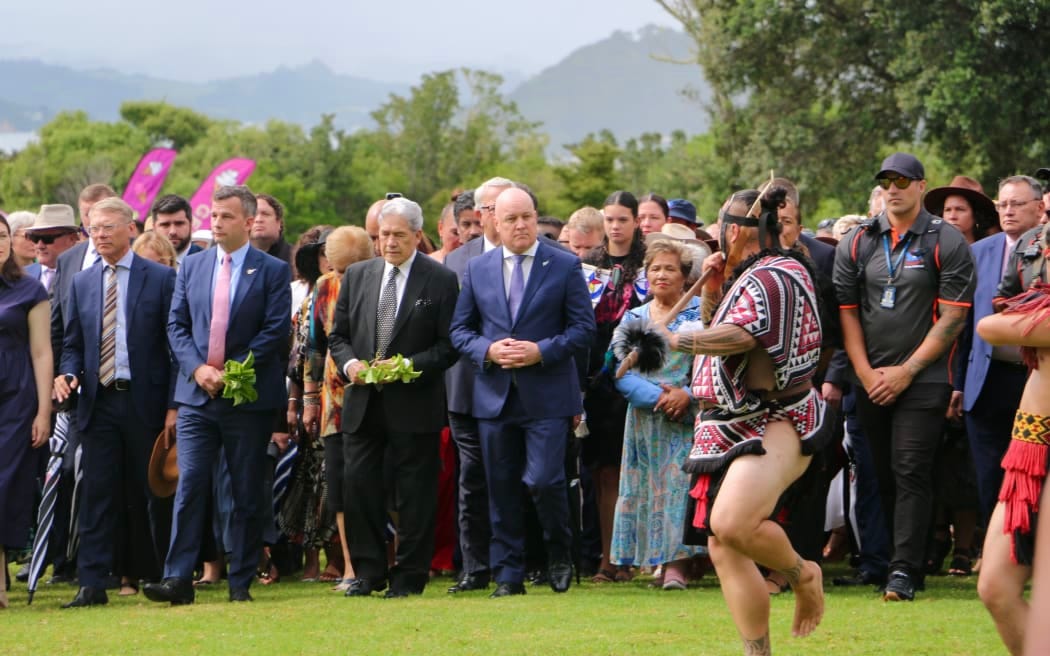
Photo: Layla Bailey-McDowell / RNZ
Eru Kapa Kingi is a charismatic orator with a penchant for mixing religious imagery with political critique. He surprised Labour when his whaikōrero (formal speech) targeted both the government and Labour. He revived an old saying that National, or in this case the coalition, stabs Māori in the front while Labour stabs them in the back. He likened the coalition to a “spider” invited into the house and asked why Māori continue to extend hospitality to those who do not love them. Kapa Kingi challenged politicians to “sort yourselves out,” pointing his criticism at his former party’s leaders as much as at their opponents.
Despite being expelled from Te Pāti Māori he clearly retains the support of many. Remarkably, his reputation has survived the allegations about his abuse of parliamentary staff and trespass from Parliament; no doubt aided by puff pieces like the one written by Audrey Young this week. And yet at Waitangi he framed himself as the victim of internal bullying and financial scapegoating. Kapa Kingi also took the opportunity to address his mother’s removal from Te Pāti Māori. He described the party leadership as a “dictatorship” and said his mother had been “stabbed” by her own colleagues.
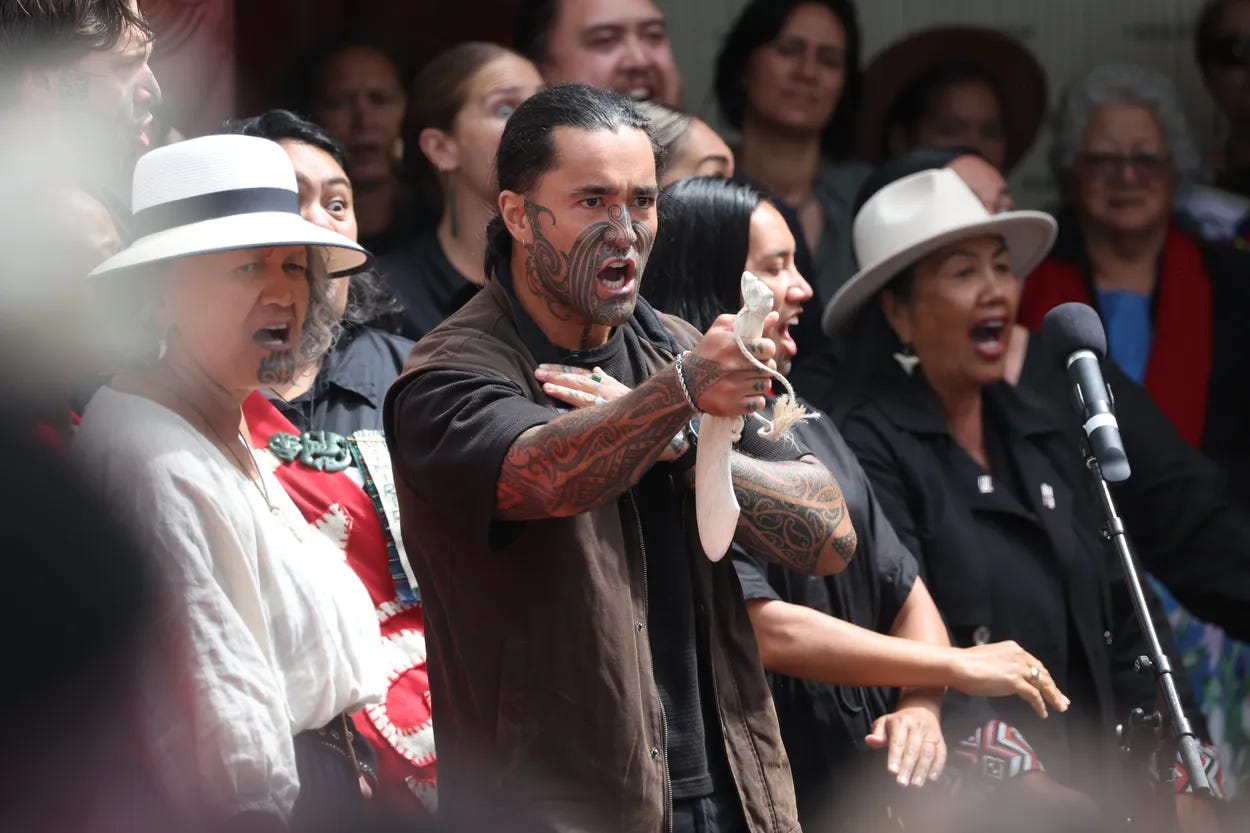
Photo: Ricky Wilson/Stuff
Te Pāti Māori co-leader Rawiri Waititi thanked Kapa Kingi for using the correct forum to air his grievances but reminded him that the real enemy was not within. Even so Waititi’s whānau performed a haka that crossed the marae space to confront Kapa Kingi which resulted in Mariameno Kapa Kingi shouting “hoki atu” (go back).
In some uncharacteristic moments of humble humility, Rawiri Waititi acknowledged the pain caused by his party’s refusal to meet Ngāpuhi late last year and publicly apologised for declining the invitation, calling for a new meeting. For a man known for fiery rhetoric, this was a significant concession and arguably the most conciliatory moment of the day. But, this magnanimous dignity did not extend to the government towards which he directed defiant language, accusing the coalition of “nibbling like a sandfly” at the Treaty. He pledged that Te Pāti Māori would continue to fight for tino rangatiratanga (self determination, autonomy) and suggested that the only enemy before them is the state, not their own people.
Waititi’s apologies weren’t received all that warmly, however. His claim that the party declined the original hui on advice from Te Tai Tokerau leaders was challenged by local elders. Mane Tahere described the explanation as inconsistent and argued that showing up to a hui is a basic sign of respect. Moana Tuwhare said Te Pāti Māori’s refusal signalled that “whakapapa Māori was worthless” if party processes overrode iwi consultation. Waititi’s apology may be an olive branch, but the deeper question is whether the party will submit to an external process or continue to insist on resolving issues internally.
As usual, Waitangi prompted a deluge of opinion pieces and hot takes from politicians, journalists, and anyone with a keyboard.
For some commentators the events have become emblematic of a politics that feels frozen in grievance and ritualised confrontation. Others framed the same scenes as evidence that Waitangi remains one of the few places where unresolved constitutional tensions are still aired honestly, rather than managed behind closed doors.
On talkback, Mike Hosking argued that the repeated heckling of prime ministers risks turning Waitangi into a stage-managed hostility exercise that alienates the wider public. This line of commentary resonated strongly with his listeners who see Waitangi Day less as a constitutional forum and more as a national holiday that should, at minimum, not feel as permanently adversarial as it does.
Commentators such as Audrey Young and Vernon Small focused less on the noise and more on the underlying recalibration taking place. Instead of headline constitutional battles, they pointed to the Government advancing narrower administrative and funding decisions that cumulatively reshape how the Treaty is recognised in practice.
NZ Herald Now’s Ryan Bridge wrote that protest “lances society’s boils and keeps powerful people in check,” but warned that the moment fists or shoving replace kōrero, “you lose the room”. Bridge argued that most New Zealanders, regardless of colour or ancestry, are hardworking people who look after each other, and that this unity is worth celebrating on Waitangi Day.
The Spinoff and Newsroom, commentary leaned heavily into the idea of political dissonance. Writers argued that the Government’s language of unity sits uneasily alongside policy retrenchment, especially in health, co-governance, and Māori institutional autonomy. The recurring phrase was not “division” but “disconnect”.
As The Spinoff’s Liam Rātana noted, every year politicians descend on Waitangi seeking to be perceived as principled or misunderstood. It is all a carefully and anxiously choreographed dance of narratives from all involved. Parties were successful in their narrative control to various degrees. The government parties for the most part succeeded in presenting themselves in accordance with their brands and approach to the election year.
National spent a lot of time positioning itself to the centre by ruling out and tutting at its coalition partners’ policy proposals. ACT sought to lay the groundwork for a kind of Treaty Principles 2.0 and NZ First blasted everyone with their characteristic defiance and fearlessness. Meanwhile, Labour and Te Pāti Māori competed over who could have the most internal drama. Labour lost control of its narrative altogether with a handful of disastrous media stand ups that saw Chris Hipkins stutter and stumble while Peeni Henare gave him a metaphoric middle finger. And the Greens struggled for relevancy failing to get traction for their Treaty messages nor critical minerals mining talking points.
Interestingly, there was little patience across the spectrum for Labour’s positioning. Several columnists noted that Chris Hipkins’ reception at Waitangi was warmer than that afforded to government ministers, but warned that Labour’s strength at Waitangi remains tonal rather than substantive. Careful language, but uncertainty about what the party would actually do if returned to power. As one commentator put it, Labour is currently benefiting from being the least threatening option in the room, not the most compelling. A more polite version of Eru Kapa Kingi’s accusation of stabbing in the back.
Prime Minister Christopher Luxon delivered a somewhat familiar speech, but to be fair there is only so many ways you can argue for self-evident and popular concepts of unity knowing you’ll get beat up in the media regardless. Luxon’s framing was sound and classic National. It anchored the Treaty in devolution rather than co‑governance, acknowledging iwi authority while maintaining national sovereignty.
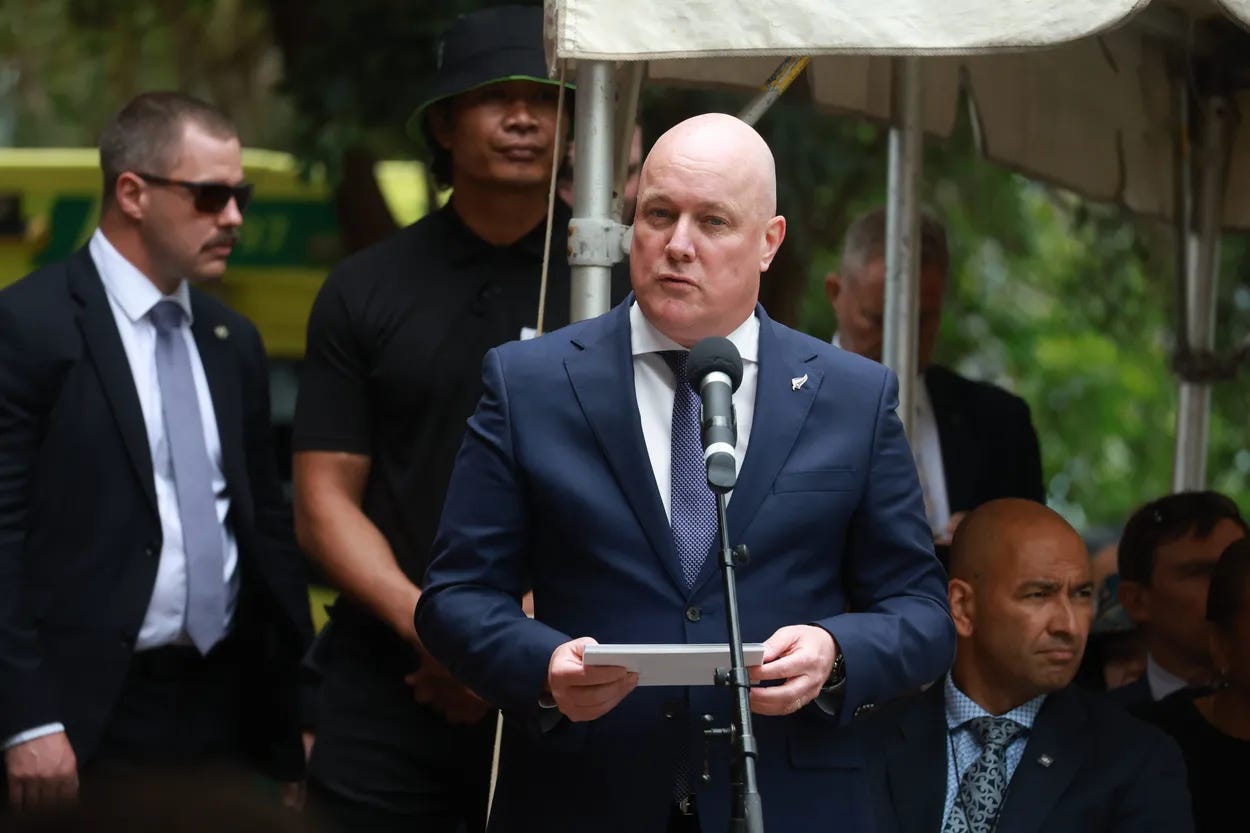
Photo: Ricky Wilson/Stuff
He framed the three articles of the Treaty as principles that empower iwi and guarantee equal citizenship. He interpreted Article One as the Crown’s right to govern for all, Article Two as affirming iwi and hapū authority over their resources, and Article Three as bestowing equal rights and responsibilities on all New Zealanders. Crucially, he argued that Article Two requires devolution and property rights, not separate systems:
“Honouring Article Two does not mean creating separate, disconnected systems for Māori and other New Zealanders.”
He extolled Whānau Ora and charter schools as examples of targeted programmes that devolve decision making while still delivering within a single system. This all sounded ironically very consistent with David Seymour’s Treaty Principles Bill. The one he refused to support.
Luxon emphasised that Article Three’s promise of equal citizenship implies equality of opportunity, not equality of outcome. He vowed to “lift outcomes” in health, education and safety by focusing on early intervention and measurement. He rejected calls for separate governance structures, saying the law must treat everyone the same regardless of whakapapa or background. He also asserted that debate and disagreement are part of democracy and should take place on marae and in Parliament, but not through violence. Luxon’s speech was interrupted by some heckling and cries of “treason,” particularly when he mentioned Education Minister Erica Stanford and structured literacy initiatives. This is sad given her success in achieving some extraordinary improvements in Māori education outcomes.
ACT leader David Seymour has built a brand around challenging orthodoxy around the Treaty and, at Waitangi this year, he doubled down. During his speech he contended that colonisation has been a comparative net benefit for Māori and Pākehā alike, asserting that “even the poorest people in New Zealand today live like kings and queens”. When questioned about this later, Labour leader Chris Hipkins responded with disgust, sneering at what is truly an inconvenient, but fair reflection.
Seymour argued that disparities in health, education and income are the result of system failure in the present, not colonisation’s legacy, and that liberal democratic principles require uniform rules for everyone. In response to protesters he said the defeat of his Treaty Principles Bill was merely a “pyrrhic victory”. He declared it a battle lost but not the war.
New Zealand First leader Winston Peters delivered another searing rebuke of his opponents. When hecklers interrupted his speech, he retorted that he did not come to be insulted and admonished younger protesters for not understanding protocol. He declared that New Zealand is “one people, one nation”. Peters also fired back at Eru Kapa Kingi’s accusations, telling reporters that his government was not anti‑Māori and calling for dignity in the debate. He couldn’t help but smile through the heckling, demonstrating the thick skin and love of a scrap that has defined his career.
Peters’ perspectives should be paid close attention to. New Zealand First holds the balance of power in the coalition and his party is influential among northern iwi. The Greens and Te Pāti Māori can disrespect him all they like with ageist comments and misrepresentation of his legacy, but he will inevitably get the last laugh.
Green Party co‑leader Marama Davidson took to the ātea (place for debate on marae) to emphasise that the Treaty must be honoured by returning land and addressing social and climate injustice. The Greens are leaning hard into critical race theory and globalist movements like “Land Back”. She accused the government of trampling “te ao Māori,” and argued that the Treaty is inseparable from action on housing, kai, and the climate. Green MP Teanau Tuiono used the occasion to announce the party’s candidates for Māori seats and proposed legislation to recognise whales as legal persons. Yeap.
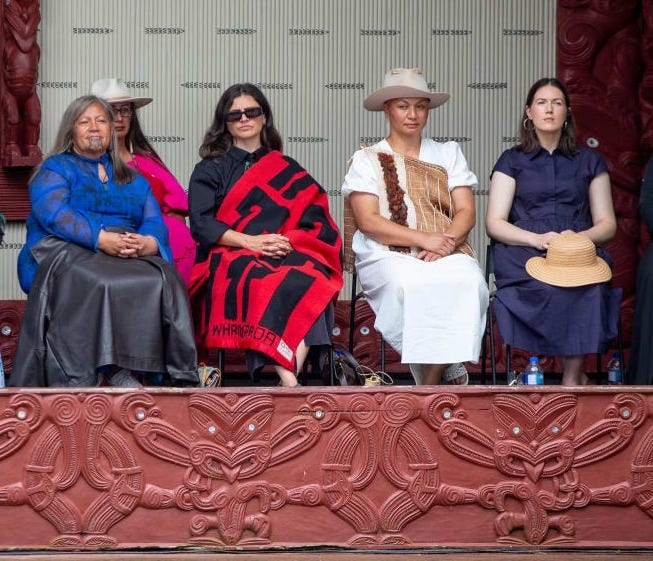
Photo: MARK PAPALII / RNZ
While Davidson’s message resonates with many activists, it will sit uncomfortably with the wider population’s understanding of the Treaty. The call to “give land back” may appeal to those who see the Treaty as a vehicle for grievance and compensation, but it lacks nuance about the complex history of land transactions and the need to respect current property rights.
Davidson and Tuiono were very on brand with their hyperbole and separatism, but things could have been much worse. Chloe Swarbrick and her escalating rhetorical aggression could have delivered the speech.
Opposition leader Chris Hipkins claimed to approach Waitangi as a listener rather than a provocateur. Butter wouldn’t melt. He acknowledged the Treaty as a living promise and bizarrely launched into explaining Māori concepts of kotahitanga (unity), manaakitanga (hospitality), and kaitiakitanga (guardianship) to a largely Māori audience. His strongest moment in a stammering and underwhelming speech was when he recounted a whakataukī (proverb) from an unnamed native American tribe about two wolves representing good and evil. He told the crowd that the wolf that prevails is the one you feed. This was a strong message and very in line with the theme of coming together.
Labour’s approach has been to reject what they characterise as radical constitutional changes while supporting some forms of devolution. His speech threaded the line between acknowledging Māori frustrations while attempting to avoid anything that could be seen as separatism and would scare middle New Zealand.
His rhetoric of unity and self-portrayal of himself as “Mr Nice Guy” was hampered considerably by his party’s treatment of Peeni Henare, the rumours surrounding it, and even the loss of former Speaker of the House Adrian Rurawhe a couple of weeks earlier. Many would think he would relish another stint in the Speaker’s chair so his departure isn’t exactly a vote of confidence in Labour’s election chances.
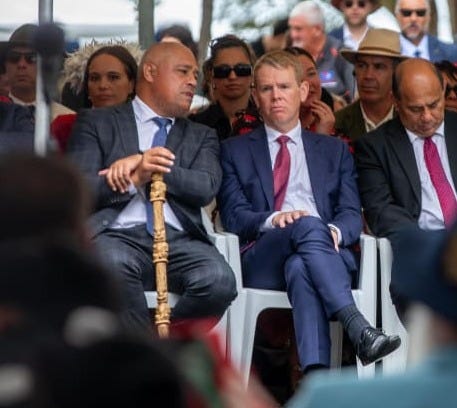
Photo: MARK PAPALII / RNZ
The sudden resignation of senior Labour MP and former minister Peeni Henare stole the show. Despite being set to lead Labour at Waitangi this week, Henare instead announced that he would not contest Tāmaki Makaurau in 2026 and would step away from Parliament. This seemingly spontaneous decision is undoubtedly linked to his swift departure from Parliament after just one day last week. Some say he left after falling out with Willie Jackson over the party’s relationship with Te Pāti Māori while others say Labour leadership sent him home.
Henare has insisted he will continue to contribute to politics outside Parliament, particularly through work in Te Tai Tokerau and Ngāpuhi. But the rumour mill has been going in overdrive aided by cheeky comments from other MPs. New Zealand First deputy leader Shane Jones, a relative of Henare’s, told RNZ that there may be more to the story, hinting that the “kumara vine” would reveal all.
“Peeni, you’re not the first Māori from Tai Tokerau to leave the Labour Party, bro. I’ll just leave that right there,” Shane Jones said in his speech.
Jones mused that Henare’s lineage gave him options and suggested he might be courted by other parties. This supports the most popular rumour that Peeni Henare might pop up at New Zealand First as a candidate. This would be a significant hit to those who persistently call the party and the coalition “anti-Māori”. Henare’s whakapapa and his own record could never be called “anti-Māori” so his endorsement of New Zealand First would hold weight. He also would not be such an awkward fit as some might assume. He would need to pare back the separatist ideas, but his wider politics are more centrist than many in Labour.
Henare’s whakapapa (Ngāti Hine and Ngāpūhi) additionally means he could be a handy influence on the stalled Ngāpuhi settlement as an adviser or negotiator if he were to join the coalition via New Zealand First.
Chris Hipkins has dismissed Jones’ insinuations as “mischief‑making,” emphasising that Henare’s decision came from exhaustion and a desire for renewal. He also stressed that the early release of the news, that landed in the middle of his press conference, was due to an unrelated leak, not a plot to push Henare out nor sabotage from Henare. And I’ve got a bridge to sell you.
The underlying theme of Waitangi 2026 is that the country remains at a crossroads. National killed the Treaty Principles Bill, but the coalition continues to pursue policies that reflect its core premise. National, ACT, and New Zeland First all emphasise equal citizenship, some devolution, liberal democracy, and one law. On the other side, Te Pāti Māori demands structural change, a separate parliament, and abolishment of prisons, while the Greens tie Treaty justice to Land Back and climate. Labour is trying to have a bob each way.
Waitangi Day 2026 was, as ever, a demonstration of New Zealand’s complex political terrain. Underneath all of the theatrics, however, are genuine questions about what New Zealand’s future looks like and what the Treaty means for us in the twenty‑first century.
The formal events continue on Waitangi Day itself. Let’s see if the Left can train their rhetorical guns on the Government rather than each other today.
Ani O'Brien comes from a digital marketing background, she has been heavily involved in women's rights advocacy and is a founding council member of the Free Speech Union. This article was originally published on Ani's Substack Site and is published here with kind permission.
4 comments:
Hi Ani. Really enjoy your clear and informative articles. Keep them coming, please.
Ani, Thank you for this clear account of events at Waitangi. Notably little news of the day on TV or online, penetrated my total boredom with the whole issue. My thought, that maybe most NZers are BORED by the Maori pantomime, and just take the day off....
A house divided cannot stand and will not flourish....a lesson for NZ whose division may now be irreversible.
Still cannot figure out why Luxon so publically rejected Acts Treaty Principles Bill, when at Waitangi he practically endorsed it! Too timid to go so strong on the issue? Wanted to be "Mr Nice Guy" and appease the Maori radicals? Only he knows, but David Seymour is not going to let the issue go, so Mr Luxon is going to be forced to make his mind up, whether he's ready or not
Post a Comment
Thank you for joining the discussion. Breaking Views welcomes respectful contributions that enrich the debate. Please ensure your comments are not defamatory, derogatory or disruptive. We appreciate your cooperation.