

Today must end it. After a weeks and months of constant cycles of breathless speculation, anonymous briefings, and increasingly hysterical headlines, Christopher Luxon walked into caucus, forced the issue, and called a vote of confidence on his own leadership. It passed.
That has to be it. Line drawn in the sand.
That has to be it. Line drawn in the sand.
What happens next inside the National caucus will determine whether they crash and burn before the election. The vote has been held and the question of confidence in Luxon’s leadership has been tested and answered. From this point forward, the only thing that will register with voters is whether the party behaves like a government or continues to look like a collection of individuals pursuing their own agendas. Stability is a prerequisite for credibility. If National cannot project it now, after drawing a line through a formal confidence vote, then it will quickly find that the polls can in fact get worse.
It does not matter whether every MP is personally enthusiastic about Christopher Luxon. I am not particularly. Although popularity certainly plays a part, caucus is not a personality contest. Far more important than whether a leader is liked, is the common interests they hold with their MPs. Caucus is a collective exercise in discipline because they all want to get voted back in to achieve a broadly similar set of objectives under broadly aligned principles.
Voters do not expect unanimous adoration of a leader, but they do expect a minimum standard of cohesion from a governing party. When that breaks down and the public sees leaks, briefings, and constant background noise, it erodes confidence not just in the leader, but in the party and government as a whole.
Further cycles of drama will translate directly into declining public trust. Every anonymous complaint that makes its way into a headline reinforces the impression of a government distracted from its job. Every fresh round of speculation invites voters to ask whether the people in charge are capable of focusing on anything beyond their own internal dramas.
It does not matter whether every MP is personally enthusiastic about Christopher Luxon. I am not particularly. Although popularity certainly plays a part, caucus is not a personality contest. Far more important than whether a leader is liked, is the common interests they hold with their MPs. Caucus is a collective exercise in discipline because they all want to get voted back in to achieve a broadly similar set of objectives under broadly aligned principles.
Voters do not expect unanimous adoration of a leader, but they do expect a minimum standard of cohesion from a governing party. When that breaks down and the public sees leaks, briefings, and constant background noise, it erodes confidence not just in the leader, but in the party and government as a whole.
Further cycles of drama will translate directly into declining public trust. Every anonymous complaint that makes its way into a headline reinforces the impression of a government distracted from its job. Every fresh round of speculation invites voters to ask whether the people in charge are capable of focusing on anything beyond their own internal dramas.
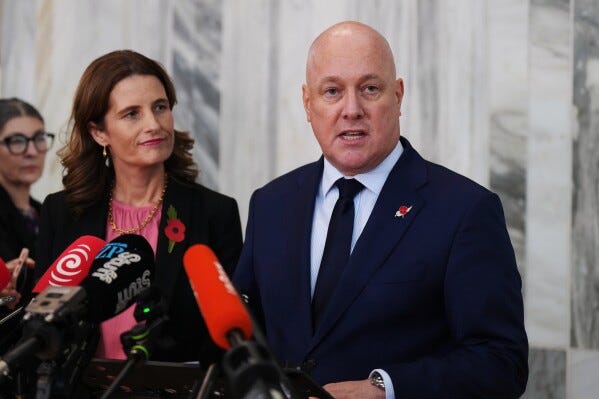
Credit: Charlotte Graham-McLay.
National now has a choice about the kind of campaign it wants to run into the election. It can present as a disciplined, unified team focused on governing in difficult circumstances, or it can continue to indulge a culture of internal agitation that signals weakness. One of those paths gives voters a reason to stick with them. The other hands their opponents an easy, ongoing attack line that requires no effort to sustain. Up until now Labour and Chris Hipkins have been dining out on it.
However, unfortunately, for National they cannot control the media and its relentless collective mission to discredit itself with transparent bias and agenda-driven reporting. This is where I differ from my friend Liam Hehir, I do think there is a difference in how they report on Labour/Greens/Te Pāti Māori internal woes. This has been true for some time and that is why Luxon’s handling of the post-caucus press conference was almost spot on. I say “almost” because I am eternally hopeful that he will get just a bit more mongrel in him, but in his style it was spot on.
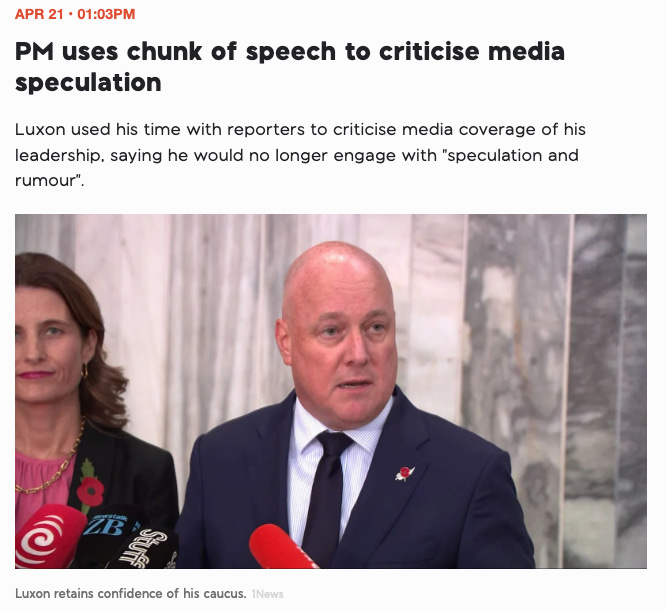
He delivered a short message in which he expressed his frustration with the cycles of feverish speculation about his leadership, drawing a deliberate line between what he cast as media-fuelled gossip and the “real” concerns of ordinary New Zealanders. The tone was controlled but unmistakably irritated. And best of all, he walked off immediately afterwards without answering any questions, reminding the media that he is in charge and they are not running the show.
Predictably, Chris Hipkins was appalled by this snubbing of the media never mind that prime ministers like Helen Clark have made similar moves in the past. The media have been allowed countless chances to interrogate Luxon aggressively, and at times pretty disrespectfully, about rumours and speculation regarding his leadership. They have not be deprived of opportunities to further their narratives at all. In fact, they have run at least five rounds of “Luxon is going to be rolled” so far and given he has not been rolled, they have a one hundred percent fail rate. As Hehir says:
“When the press gallery declares a crisis every three months and nothing happens, it should be more embarrassing to the journalists involved than it is…
…That never ending sense of drama has resulted in journalists becoming participants in the story who shape what happens instead of disinterested chroniclers of what happens in Wellington. The media has been pushing and pushing for this leadership challenge and that push has in no small part precipitated it.”
The Prime Minister now knows he can be defiant to the media pack and he needs to take that confidence forward. Of course, he should answer all questions about the government and a reasonable few about party matters, but when journalists start screeching at him with the same banal speculation over and over again, he should shut press conferences down.
As constitutional lawyer Graeme Edgeler posted to X:
I would kind of admire it if the Prime Minister ended any *Government* press conference (like say post-Cab) as soon as any question was asked about party matters: 'oh, no more questions about matters of government? thanks everyone, see you next week.'
New Zealanders admire strength and have a strong sense of what is fair. They will respect firm handling of the media that has zero tolerance for nonsense. This idea that he should be permissive and a doormat for the media because then they’ll be nice to him or at least not be as mean as they could is utter rubbish. They declared war on him from day one. They tried to make his entire personal and political being about abortion and then when that failed they have been derisive and treated him with none of the benefit of the doubt that Hipkins and Ardern receive.
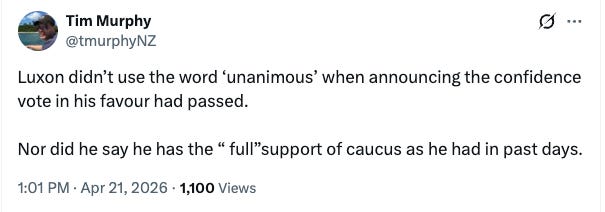
In any case, Luxon will have to be strong because it is clear that the media will not let this go. They immediately honed in on him not explicitly saying the confidence vote was “unanimous” and mainstream media commentators have been essentially saying “this ain’t over” for the rest of the day. MPs emerged from caucus and, one after another, confirmed their support for the Prime Minister. Rather than accepting the outcome, the press gallery immediately set about trying to unpick it. Was it unanimous? Did you personally vote for him? What does “support” really mean? The objective was not to clarify, but to create ambiguity where none exists. Do not mistake this for scrutiny or some kind of accountability, it is narrative maintenance through and through.
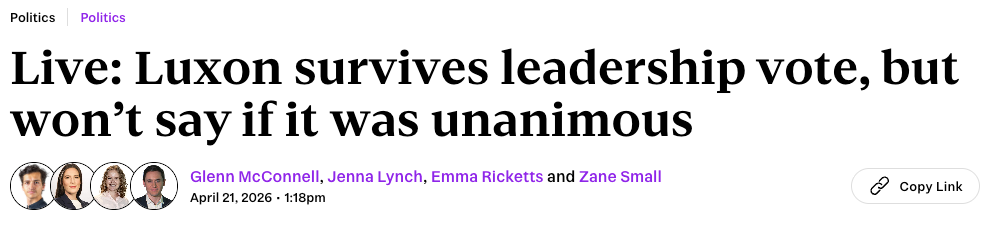
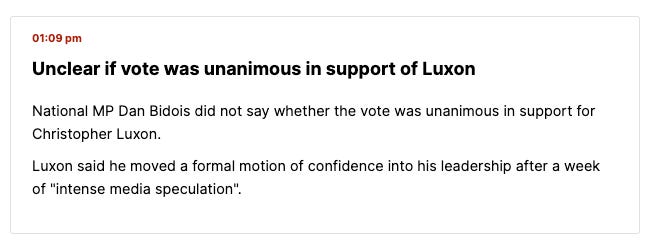
Click images to view
If he does not maintain control at every stand up and press conference they will run away with the narrative again. They will bully him and he will not look like the nice guy, he will look weak.
Nope. From now on, Luxon should be professional toward the press gallery, but he should be picturing giving them the middle finger the whole time. He needs to be Pierre Poilievre eating an apple. Unflappable.
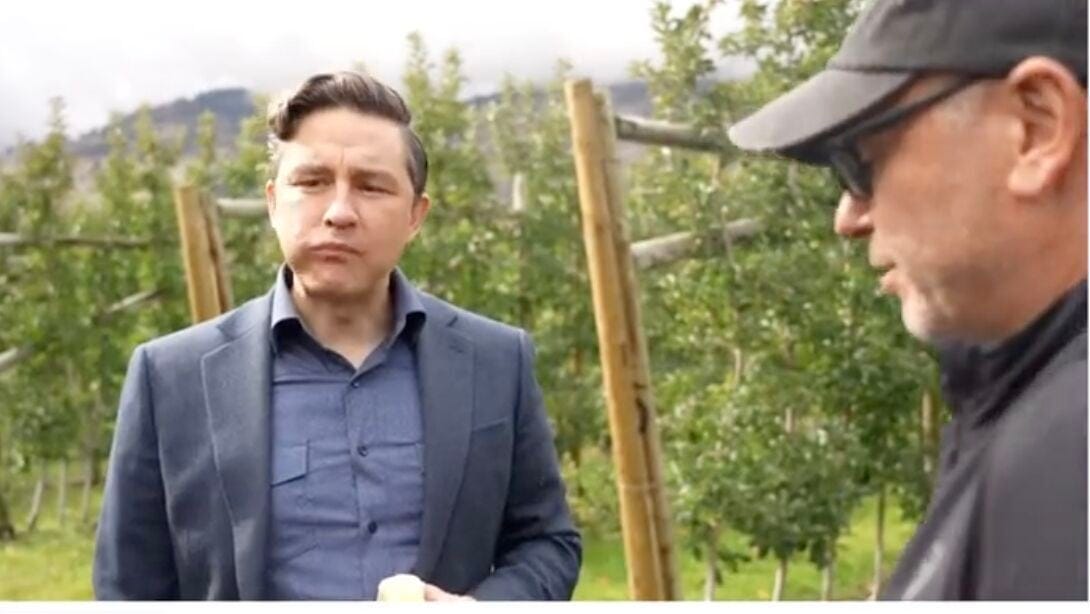
Pierre Poilievre, Leader of the Opposition of Canada.
At face value, the apple moment was trivial, but politically, it was a disruption power dynamics and tone-resetting. Journalists typically control the rhythm and framing of interviews. By eating an apple slowly and deliberately Poilievre signalled that he wasn’t going to play by those rules. He set the pace, interrupted the expected seriousness, and subtly undermined the authority of the interviewer without ever raising his voice.
He also projected confidence bordering on disdain. The message was “I’m so unbothered by your line of questioning that I can literally eat through it.” That is why it landed so well with voters who already distrust media institutions. It was a form of controlled confrontation. It showed he doesn’t avoid hostile media; he engages, but on terms that make the media look flustered or silly.
As I say, the media will not be deterred from their mission to claim Luxon’s scalp. What should be a reset following a leader who has tested his support and secured it, is instead to them a minor setback. They will reappear in a month or so with another set of “unsubstantiated” rumours. They will make a leadership challenge where there is not one. The media has spent the better part of eighteen months predicting Christopher Luxon’s imminent downfall. They have been wrong consistently, repeatedly, and without consequence. Each failed prediction is quietly discarded and replaced with a new one, built on the same formula.
Yes the media has been fed gossip and intel by some MPs, but internal frustration is hardly unusual in any governing party and has been inflated into a full-blown leadership crisis. And the story is too useful not to continue. It serves journalists chasing a narrative, opposition politicians happy to see the government distracted, and, most destructively, a small number of National MPs who have discovered they can destabilise their own leader without ever having to take responsibility for it.
Every caucus has malcontents. Politics is full of ambitious individuals who believe they should be promoted faster, listened to more, or placed in more influential roles. But that frustration has been allowed to spill into the public domain, laundered through “sources,” and fed into a media ecosystem that amplifies it far beyond its actual significance. Because leaks do not simply reveal instability, they create it.
This is how you end up with a Prime Minister having to call a confidence vote in himself without there even being a credible challenger with the numbers to act. This dynamic rewards cowardice. Those who are unwilling to front up internally can instead brief externally, shaping the narrative without ever having to test their claims in the only place that matters: the caucus room.
If today’s vote means anything, and it must, then it requires a change in behaviour. There can be no more anonymous briefings, no more background agitation, no more attempts to have it both ways by undermining the leader in private while professing loyalty in public. Either the caucus accepts the outcome of today’s vote and behaves accordingly, or it continues down the current path of death by a thousand leaks, a permanent haze of instability, and an election campaign fought under a cloud of its own making.
Voters may not follow every detail of internal party dynamics, but they understand chaos when they see it. They understand a government that looks distracted and divided.
Christopher Luxon also has a role to play in this. Calling the vote was necessary, but it is not sufficient. Discipline must be enforced. If there are MPs who have been actively undermining the leadership, there must be consequences. Without consequences, the message is that the behaviour is tolerated. Ultimately, however, this is not just about Luxon. It is about the culture of the caucus and the incentives that have been allowed to take hold. At present, those incentives are badly misaligned. Now the line must be drawn. Either stand behind the leader, or step aside. There is no longer any space for constant, low-grade sabotage.
Full statement from Luxon:
Kiwis elected me to deal with the cost of living, to get our economy back creating jobs and lifting incomes, and improving the education of our kids.
That is what I came to Parliament to do. And that is what I will keep doing.
For the last week, there has been intense media speculation about my leadership – about who said what to whom.
Today our Caucus had a good, honest discussion. Our team is more determined than ever to serve Kiwis and to win the election.
To put that media speculation to rest, I moved a formal motion of confidence in my leadership.
That motion was passed, confirming what I have been saying – I have the support of my caucus as their leader.
Caucus has answered clearly and decisively. It has backed my leadership.
That matter is now closed and I won’t be commenting further on it.
Looking out at the world today – it is clear we are living in uncertain and volatile times, and that underscores the importance of strong economic management to steer New Zealanders through this time and provide the security they deserve.
A free press is important in a democracy. You give citizens the chance to know the truth about their countries and their governments. And hold leaders like me accountable. I welcome that.
But if the media want to keep focusing on speculation and rumour, I am not going to engage.
Kiwis expect the media to ask us the tough questions about our policies, to hold us to account for our pledges to New Zealanders, and to interrogate us about the things that matter to them. They are not interested in this media soap opera.
Everyday Kiwis will not be losing sleep over political sideshows in Wellington – they’ll be thinking about their mortgage, their kids’ education and the safety and security of their community.
My message to New Zealanders today – as it is every day – is that I’m exclusively focused on fixing this economy and building a better New Zealand for our children and grandchildren.
The future of our country and the pressures Kiwis face in response to global uncertainty is just way too important.
I am genuinely optimistic about New Zealand. Because this country has the talent, the institutions, the natural endowments, and the people to come through this and build something remarkable.
We’ve done it before. And we will do it again.
Recommend reading:

Click to view
Ani O'Brien comes from a digital marketing background, she has been heavily involved in women's rights advocacy and is a founding council member of the Free Speech Union. This article was originally published on Ani's Substack Site and is published here with kind permission.
3 comments:
A likely sign on every modern journalist's wall -
"Don't let the truth get in the way of a good story."
They want National out, so who cares if the un-named source is the person sitting next to them in the office.
Now what means nothing has been fixed or changed. Now what to National means attacking their coalition partner where their vote is going, 5 months out from an election, imitating a hard core group of kamikaze enthusiasts.
Luxons total unsuitability as a politician let alone PM is the h of elephants in the room that won't be going anywhere.
Expect National to continue to haemorrhage votes until election day. Especially as the economy worsens.
They made their bed a long time ago, now National are strapped down into it,
Please reread the first paragraph of Luxon's speech after the confidence vote inter alia;
"Kiwis elected me to deal with the cost of living , to get our economy back creating jobs and lifting incomes , and improving the education of our kids"
We all voted for much more for NZ future where we expected Maori culture , Net Zero , Paris Accord , Co governance, Maori electorates et al to be addressed not kicked down the road.
Post a Comment
Thank you for joining the discussion. Breaking Views welcomes respectful contributions that enrich the debate. Please ensure your comments are not defamatory, derogatory or disruptive. We appreciate your cooperation.