

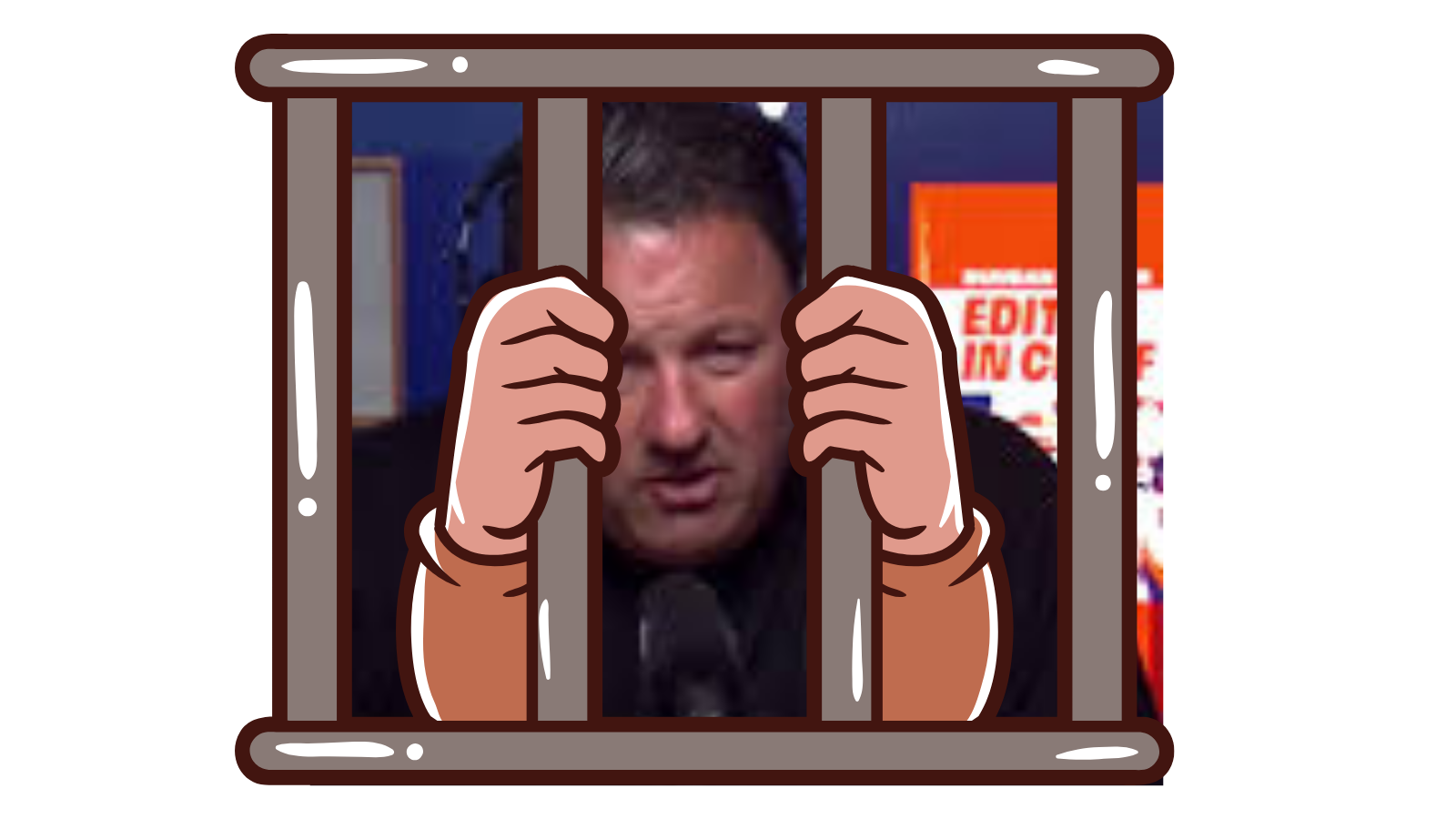
Duncan Garner drove on a suspended license. Our media were on top of the story from the moment news broke. Push alerts. Banners. So serious was the reporting that Garner’s dear mum got into a state because she thought he had been hauled off to prison. But these journalists missed the real scoop. No, I’m not talking about the Leader of the Opposition being caught in another lie (although that happened). You heard it here first on Thought Crimes… back in the day Duncan Garner was banned from the annual media golf tournament aged just 22. How has he got away with it for so long? Why is he able to roam the streets freely without at least an ankle bracelet? He must be cancelled immediately! Tear up his goddamn passport!!
Chris x2 survive + a reshuffle
At the start of the week, it looked like we might be heading for a double political execution. Both Chrises, Hipkins and Luxon, were under real pressure, for very different reasons but both facing the question as to whether they are politically viable leaders in an election year. Here we are on Saturday and both are still standing. Luxon survived by “hustling” as he likes to say. Hipkins, on the other hand, survived for the much simpler reason that the media has absolutely no appetite to finish him off.
What we got instead of a leadership spill was a Cabinet reshuffle. After a week of rumours about Sunday night meetings, polling panic, and jittery MPs insisting everything was “normal,” Luxon emerged to rearrange the furniture. The upcoming departures of Judith Collins and Shane Reti necessitated the re-jig, but it also allowed for some political moves.
Simeon Brown picks up Energy taking the important portfolio off more junior minister Simon Watts. Chris Penk finally makes the jump into Cabinet becoming Minister of Defence and getting the intelligence portfolios, and Penny Simmonds is returned to Cabinet despite being biffed earlier this term. Chris Bishop becomes Attorney General which is a crucial role and you would think it would put to bed rumours of him being punished for allegedly doing the numbers on Luxon. However, he also loses the (election) Campaign Chair and Leader of the House roles.“Lightening the load,” we’re told, but it certainly does strip Bishop of positions of internal influence. Louise Upston takes over as Leader of the House and Simeon Brown picks up Campaign Chair.
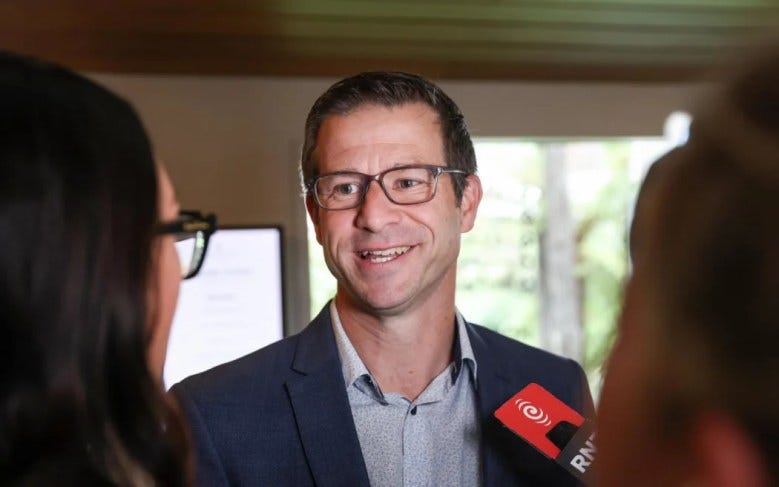
New Minister of Defence Chris Penk. Photo: RNZ/Nathan McKinnon
Clever moves on the whole, but the fact that Luxon continues to keep a lame duck in Cabinet (Matt Doocey) when he has just a single portfolio (Mental Health) in which he appears to do not much at all is just wild. It is plain as day that Doocey is a Luxon loyalist and this is what is ensuring his survival. James Meager would have been a decent South Island substitute for Doocey… but perhaps he has too much potential.
Candidate season arrives and it’s already messy
If you wanted a neat, orderly pre-election runway, we clearly aren’t going to get one. Which is great because this is more entertaining.
Within the space of a few days, the Green Party has managed to land itself on both sides of the “culture wars”. On one hand, it proudly rolled out pro-puberty blocker trans activist Lauren Craig as a new list candidate. On the other, it found itself accused of being “anti-sex work” after it did not select a candidate who “had a background in sex work” and who has claimed the process for selection included intrusive questioning, reputational risk anxiety, and gatekeeping. That is kinda how selection works. Good to see the Greens have learnt their lessons.
National’s Papakura selection should have been a routine handover in a safe seat. Instead, there appears to be some factional drama. Emma Chatterton’s win has triggered internal resentment about process, influence, and whether her boss Erica Stanford leant her weight on the scales. Chatterton is an excellent candidate on paper, a very polished choice, but as Erica Stanford’s ministerial staffer there have been raised eyebrows about special treatment. Seems to be a storm in a teacup to be honest.
Meanwhile, Brooke van Velden’s decision to step aside has made safe Tāmaki a genuine contest, with National’s Mahesh Muralidhar, Labour’s Comrade Max Harris, and a yet-to-be-confirmed ACT candidate.
Labour’s selection of former MP Naisi Chen in Auckland Central over Auckland Councillor Pippa Coom is interesting as they both have political experience. But there have been grumblings about selection coming down to a matter of the disproportionate number of Asian New Zealanders in the electorate who might be more likely to vote for Chen.
In a blast from the past, the Alliance Party is back and running a slate of Christchurch-focused candidates heavy on “real world” backgrounds and cost-of-living rhetoric. Whether that translates into votes is another question.
Fuel Crisis update
The fuel situation continues to be the big black cloud hanging over everything. New Zealand is in “phase one” of our fuel response plan, with officials pointing to roughly 50–60 days of supply across petrol, diesel and jet fuel. But those numbers include fuel that is not physically in the country, fuel that is weeks away, and in some cases fuel that is not immediately usable. At the same time, diesel prices have surged past petrol, and Treasury is now warning inflation will go “much higher” as the effects ripple through the economy.
Ministers are exploring swapping New Zealand’s “fuel tickets” under the International Energy Agency system for usable fuel, while also looking to expand storage capacity at Marsden Point. Shane Jones says additional storage will be ready by late May, but the company that owns the tanks has said conversion will take “several months”. In other words, even if the fuel can be secured, there is no guarantee we can store it when it arrives.
Public transport usage is rising in major centres as households respond to price shocks, and ministers are working through how the system might cope if that trend accelerates. But the problem is buses themselves run largely on diesel (with some electric ones in the mix), meaning this system too is exposed to the same underlying constraint.
The Government has responded to the mounting pressure on New Zealanders’ wallets with some more targeted interventions. This week Health Minister Simeon Brown announced a 30% increase in mileage rates for home and community support workers, lifting reimbursement from 63.5 cents to 82.5 cents per kilometre. That delivers roughly an extra $19 per 100 kilometres travelled against fuel cost increases of around $8.56 for petrol and $11.83 for diesel.
The Government’s handling of the crisis continues to be one that projects calm, control, and is learning the lessons of the COVID-19 response. Nicola Willis continues to front for the Government on the issue and her communication skills and ability to connect are providing a sharp contrast to her boss.
Winston Peters strikes deal with Cook Islands
Winston Peters has, again, proven why he is unparalleled as Foreign Minister. He has turned a messy diplomatic spat into something that looks suspiciously like under control. After more than a year of increasingly public tension with the Cook Islands triggered by its government signing opaque agreements with China and failing to brief Wellington, Peters has reasserted New Zealand’s position with a new Defence and Security Declaration that is far more explicit about who needs to be told what, and when. The agreement effectively forces “timely and transparent” consultation on any matters touching defence or security, and in practice gives New Zealand a de facto veto over arrangements that could threaten the realm.
The earlier Cook Islands–China agreements, particularly around maritime infrastructure, triggered alarm bells because they tested the limits of the free association relationship. This new declaration doesn’t unwind those deals outright, but it places “massive limitations” on them and, more importantly, ensures there won’t be a repeat performance. And, of course, the chequebook follows diplomacy. With the ink barely dry, New Zealand’s roughly $30 million in annual funding, which was suspended during the standoff, is back on the table.
Raise a glass to Kieran McAnulty this Easter
Parliament managed to deliver a small, practical reform this week that most people will appreciate if they head out for a drink this weekend. Although Christian groups have naturally opposed it.
Labour MP Kieran McAnulty’s members’ bill to loosen Easter and public holiday alcohol restrictions has passed just in time for the Easter weekend, scrapping the old requirement that you must purchase a “substantial meal” in order to have a drink.
McAnulty’s argument was that if venues are already open, and staff are already working, they should be able to operate under normal conditions. The legislation has a narrow scope and is not a sweeping liberalisation of alcohol laws, nor the end of Easter itself.
Defining reality (apparently controversial)
No doubt certain corners of the internet are in hysterics after New Zealand First MP Jenny Marcroft’s members’ Bill to define “man” and “woman” in law has been pulled from the biscuit tin. The Opportunity Party certainly is.
They have decided to weigh in with a snarky, dismissive post, reducing the issue to a glib throwaway about how New Zealand First is focused on “what’s in people’s pants” while they are a serious party focused on serious things. It’s a pity they haven’t figured out how to actually get elected yet.
For years now, New Zealand has been stuck in a messy legal and institutional web where the most basic category underpinning women’s rights (sex) has been treated as optional, subjective, or simply too awkward or “bigoted” to define. But if the law cannot clearly say what a woman is, then it becomes increasingly difficult to justify why women-only spaces, protections, or opportunities should exist at all. Women’s rights exist for a reason and they are grounded in sex-based differences in physical vulnerability, in reproductive biology, and in the long and very real history of discrimination on that basis.
New Zealand First’s Bill doesn’t “remove rights” from trans people or from anyone. It simply restores clarity and certainty and reinforces the foundation upon which all of our sex-based rights sit.

Click to view
Mamdani meets Electoral Commission Orange
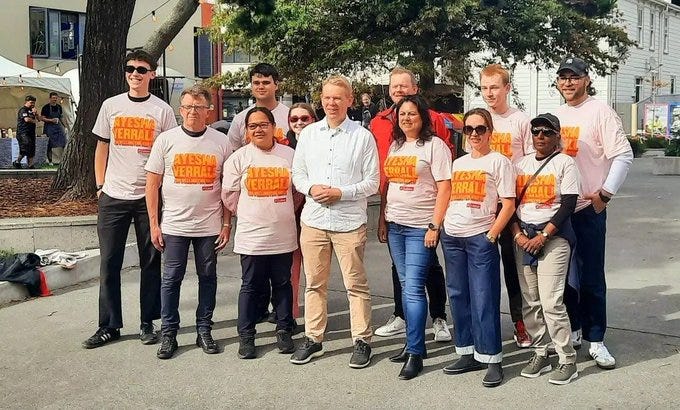
Labour gave us an early glimpse of its election campaign and it came with a noticeable aesthetic shift. Out went the familiar, unmistakable Labour red. In comes orange. And while political rebrands are hardly unusual, this one raised eyebrows because orange is also the core branding colour of the Electoral Commission.
The Electoral Commission’s brand is intended to signal neutrality, authority, and process. It is meant to be instantly recognisable as official. A political party becoming confused with the Electoral Commission must be avoided at all costs. Whether intentional or not, it creates a situation where campaign messaging could borrow the credibility cues of public institutions.
Then there is also an international stylistic comparison. Beyond the colour choice, the overall look and feel of the campaign has a distinctly imported quality. The flat graphics, the typography, the social-first layout feels reminiscent of the recent campaign conducted by now-New York Mayor Zohran Mamdani. It has the digital campaign aesthetic of bold colour blocking, youth-oriented design language, and an attempt to signal energy and outsider momentum.
That in itself is not a problem. Political parties borrow from each other constantly. But it remains to be seen if the visual to nod to Mamdani is surface deep or if it is a signifier for policy similarity too. Mamdani’s campaign was explicitly ideological, built around socialist ideals, identity politics, and a fairly relaxed relationship with economic constraint.
Auckland Housing flip flops
Housing policy in Auckland has flipped again. The Government has revised down its housing capacity target again, cutting the minimum number of homes enabled under Plan Change 120 from an initial 2 million, then 1.6 million, and now to 1.4 million .
The politics around the Plan Change has been dynamic and robust disagreements have resulted between the Prime Minister, ministers, officials, experts, and the Mayor of Auckland. Concerns about over-intensification, infrastructure strain, and voter backlash, particularly in suburban Auckland, have collided with the equally real problem that without significant new supply, housing will remain fundamentally unaffordable.
The risk is that this is policymaking by negotiation rather than design and that can have dire consequences. Housing reform is stuck in a balancing act between coalition partners, local resistance, and national expectations.
Wellington Council office dramas
I honestly didn’t think there would be an episode two to the Wellington City Council drama over who gets the best office. But here we are. The tiff about the new council headquarters has now tipped into full-blown dysfunction. The councillors effectively boycotted the blessing of their own building this week. Out of 16 elected members, only five bothered to show up. The rest stayed away in what was, by any reasonable reading, a coordinated snub.
Council executives have secured the top floors of the new waterfront building with harbour views, prime positioning, the works, while elected representatives, including the mayor, have been relegated to lower levels. Andrew Little’s office reportedly looks out over a carpark.
At the same time this office saga is playing out, the highly productive and functional council is staring down a potential legal fight over its cleaning contracts. Councillors unanimously signalled they wanted to explore bringing services back in-house. Officials, meanwhile, have pressed ahead with outsourcing anyway, arguing it’s an “operational” matter under the chief executive’s authority. Unions are threatening judicial review, councillors are accusing staff of ignoring democratic direction, and the widening rift between governance and management has become a chasm.
Elected members feel sidelined in the place they should be in charge. And this might all sound trivial, but politically it cuts to a deeper issue of who actually runs Wellington. Who has the power? The people voters elect, or the bureaucratic machine behind them?
A case study in how to torch your own credibility: FENZ
On one side, you have frontline firefighters escalating strike action, walking off the job for an hour twice a week after months of stalled negotiations and an Employment Relations Authority finding that FENZ failed to properly consult on sweeping cuts affecting hundreds of roles.
On the other side, at the very moment tensions reach peak hostility, the board signs off on pay rises of up to 79%… FOR THEMSELVES. Seventy-nine percent. The chair jumps more than 40%. This was waved through on the basis that it’s needed to “attract talent” which is a claim that might carry more weight if the organisation wasn’t, by almost every account, struggling to function properly.
“Tone deaf” does not even begin to describe it. How did they think this was going to play out? Look at the contrast between executives cashing in and firefighters sitting just above minimum wage while risking their lives.
The union response has been quite rightly volcanic, describing the move as a slap in the face. You cannot, on the one hand, plead fiscal restraint when negotiating with frontline staff, and on the other, quietly approve near-doubling of board fees.
A slap on the wrist and a sanitised crime
The sentencing of former NZME One-Roof CEO Greg Hornblow resulted in a punishment the equivlent of a slap on the wrist with a wet bus ticket. How his offending was framed both in media and the justice system was just as appalling.
Hornblow admitted paying a 14 year old girl for sex after initiating contact, exchanging money and goods for explicit material, and arranging a sexual encounter. The court was explicit that he knew she was underage, that his conduct involved effectively enticing a child into prostitution, and that this was not a fleeting lapse in judgement but a sustained course of conduct. Yet the charge, and much of the reporting, has consistently been described using the language of “receiving commercial sexual services.”
That phrasing may be technically correct under the Prostitution Reform Act framework, but she was 14 year old. It was the sexual exploitation of a child. When terminology obscures reality, it risks also obscuring the power imbalance and the nature of the harm. Compounding that is the repeated use of the term “sugar daddy” in reporting. This was not a transactional relationship between consenting adults and using such language reframes what was, in reality, an adult man targeting, coercing, and exploiting a child for sex.
The sentence Hornblow received was pitiful. Ten months’ home detention and a fine. It can be explained within our woeful existing sentencing frameworks, with discounts for guilty pleas, “previous good character”, and assessments around risk. But many New Zealanders will see this outcome as out of step with the seriousness of the offending.
Minister of Defence hopefully not on the ropes in first week on the job
And finally because not everything in politics needs to be miserable spare a thought (and ideally a few dollars) for our new Defence Minister Chris Penk, who this weekend will be swapping Cabinet papers for boxing gloves. Penk is stepping into the ring as “The Penk Panther” in a charity bout at the Kaipara Tavern, having engaged in what he has described as a “sporadic” attempt at training.
The event is raising money for Tony Cooper who is a community legend in Helensville. A volunteer firefighter of 35 years, coach, and mentor, Tony is battling bowel cancer and challenging treatment costs.
Frankly, if Chris Penk is willing to take a few punches to the face to help out, the least the rest of us can do is chip in. So consider this gentle encouragement… if you can afford to please support Tony’s fight.
Chart of the week

Click chart to view
“The developmental lifespan has been stretched out. In the past people left school at age 15 & had been working for 15 years by the age of 30.Now we're still kids at age 30.Presents a real problem when many women enter perimenopause between 35-40!”
In short - other stuff that happened
- After falling 55 metres down a remote West Coast waterfall, a border collie named Molly was found alive a week later following a volunteer-led search using thermal imaging, funded by a surge of public donations. The dog was located in rugged terrain where she had remained for seven days before being winched to safety and reunited with her owner.
- NASA’s Artemis II mission has left Earth orbit for the Moon, the first crewed lunar trajectory since 1972, with a four-person crew set to fly nearly 400,000km before returning.
- The Supreme Court has quashed David Tamihere’s 1990 murder convictions, finding his trial was fundamentally unfair and relied in part on perjured evidence, and has ordered a retrial while leaving the decision to proceed to prosecutors.
- Australian fugitive Dezi Freeman, wanted over the fatal shooting of two police officers, was shot dead by police after a multi-hour standoff at a rural property following a 216 day manhunt involving hundreds of officers and a $1m reward.
- Police documents released under the OIA show a Netflix documentary crew was given privileged access to the Tom Phillips investigation, including being alerted to his shooting before family and other media, prompting the Police Commissioner to admit protocols were not followed and should not have allowed access.
- Wellington-based car-share company Mevo has entered administration after running out of funds, despite raising $3.28m in new capital and expecting a further $1.7m investment, following losses of nearly $2m in both 2024 and 2025.
- Green MP Tamatha Paul provided a letter of support for prolific graffiti offender Karl Truell, responsible for widespread “Pork” tagging across multiple cities, during his sentencing for intentional property damage. This continues a pattern of Green MPs backing defendants in criminal cases, though the judge ultimately disregarded her submission.
- Allbirds has agreed to sell its intellectual property and key assets for US$39m ($68m) and wind down the company, marking a collapse from its US$4.1b ($7b) IPO valuation in 2021 after years of losses, declining sales, and failed product expansions.
- One person was hospitalised in moderate condition after being bitten by a sea lion at Brighton Beach near Dunedin, with emergency services responding to the incident on Friday afternoon.
- Whakatāne District Council is consulting on changes to its alcohol control bylaw, including a proposed shift to a nightly 9pm–7am ban and the option of a 24/7 alcohol ban in the CBD, alongside expanded enforcement powers and new alcohol-free zones.
- The All Whites suffered a loss to Finland before bouncing back with a win against Chile, splitting their latest international fixtures as preparations continue ahead of upcoming competitions.
- A major police investigation revealed that senior gang figures were allegedly orchestrating large-scale methamphetamine imports from inside prison using smuggled cellphones, coordinating with corrupt baggage handlers at Auckland Airport to bypass border controls. The operation led to the arrest of 20 airport workers.
- Wellington institution Havana Bar, a Cuba Street staple for more than two decades, has been put on the market as a going concern, with the sale including both the business and the historic cottages it operates from. The award-winning venue has been linked to everything from Welly Hospo accolades to the Tory Whanau controversy.
- A UK court has ruled it is impossible to determine the father of a child conceived after a woman had sex with identical twin brothers within days of each other, as standard DNA testing cannot distinguish between them. The case, now before the Court of Appeal.
- A senior Victoria Police officer has been charged with two counts of sexual assault involving a 16–17-year-old under his supervision. The 52 year old, who was off duty at the time, has been summonsed to appear in court at a later date and was not arrested or required to apply for bail.
- Failed Wellington mayoral candidate Graham Bloxham has been issued a trespass notice by Upper Hutt City Council, following a series of controversies including protest-related arrests and disputes with local officials during the recent mayoral race.
- Golfer Tiger Woods has pleaded not guilty to driving under the influence after a crash in Florida, with police alleging he had hydrocodone pills in his pocket and showed signs of impairment despite passing a breath test.
- More than 25 sanctioned Russian “shadow fleet” oil tankers have continued to pass through UK waters despite Prime Minister Keir Starmer’s pledge to crack down and authorise potential seizures.
- Auckland businessman Baltej Singh has been identified as the figure behind a major drug importation scheme involving methamphetamine concealed in “honey bear” beer bottles.
- Fleetwood Mac guitarist Lindsey Buckingham was attacked in Los Angeles when a woman threw an unknown substance at him. Police are treating the suspect as a known stalker.
- A 23-year-old transgender Scottish independence campaigner has pleaded guilty to creating AI-generated indecent images of children.
- Ngāti Whakaue has unveiled plans for a 38-home housing development in Ngongotahā, Rotorua, aimed at easing housing shortages through a mix of rental homes prioritised for those in need, including iwi members, with rents capped at 25% of income. The project, backed by a partnership with the Ministry of Housing and Urban Development.
- Now former-Energy Minister Simon Watts has reaffirmed the Government’s commitment to progressing an LNG import terminal, despite political pressure and changing global conditions, saying Cabinet has already made a “definitive decision” to proceed.
- A NZ Herald review of the Teachers’ Disciplinary Tribunal decisions found at least 125 New Zealand teachers have been disciplined over the past 20 years for inappropriate relationships with students, ranging from grooming and sexual relationships to pregnancies and long-term abuse of trust.
This Lloyd Burr Stuff piece lays out a sobering set of Treasury modelling scenarios showing what happens if New Zealand does nothing about its ageing population and rising healthcare and superannuation costs. By 2065, pensions and health spending balloon, the number of workers per retiree shrinks dramatically, and the tax system would have to stretch to absurd levels… like GST at 51% or top income tax rates north of 80%. If, like me, this is your pet anxiety-inducing topic, this article is basically a flashing red siren.
This Nature feature takes a careful, data-heavy look at the increasingly popular claim that “boys are in crisis”and refuses to give you an easy, partisan answer. It lays out real concerns like how boys are falling behind in education, have higher rates of injury and suicide, weaker social connections, and experience confusion about masculinity in a rapidly changing world. But it also shows that girls still face significant disadvantages globally, and argues that framing boys as uniquely oppressed risks fuelling resentment and backlash rather than solving anything. I agreed with some of it, not all. But it is an analysis that shows how messy this issue is.
Ani O'Brien comes from a digital marketing background, she has been heavily involved in women's rights advocacy and is a founding council member of the Free Speech Union. This article was originally published on Ani's Substack Site and is published here with kind permission.
4 comments:
I would describe Luxons cabinet changes as just that, changes. Not clever, just performative.
What he doesn't want to admit is National imitating Labour is killing his party. We voted for change, not Labour in blue lipstick. Co-governance, as started by Key, has trundled on under Luxon, and would have been cooking off nicely were it not for his coalition partners.
The other deeper problem is because they carried on being Labour, minus the in your face idiots, the economy has continued its steady decline. It seems like years of recession followed by a barely perceptible pulse of growth suggesting the corpse may still be alive. Just. Personally, I've never rated National and creativity when it comes to economics, they've generally been steady as you go. Trouble is, that was not the answer this time.
Malaise is what National are going into this election on, that being almost guaranteed recessions, and we are bound to go there yet again owing to the Iran war, and woke leftist dogma we thought we'd rid ourselves of.
No wonder their polling is in recession. It's what National is good at!
Another garbage Nature article. Boys are in troub...TO HELL WITH THEM THINK OF THE GIRLS!!!!!!!
Anon 716 sounds like a true liberated femocrat.
I agree, Barend
Post a Comment
Thank you for joining the discussion. Breaking Views welcomes respectful contributions that enrich the debate. Please ensure your comments are not defamatory, derogatory or disruptive. We appreciate your cooperation.