

Note: it is my editorial policy to use pronouns that relate to the biological sex of the person.
I am fuming. It is 2026 and the rest of the world is unwinding the destructive and nonsensical policies of the trans madness era, and here in New Zealand they are continuing to be embedded.
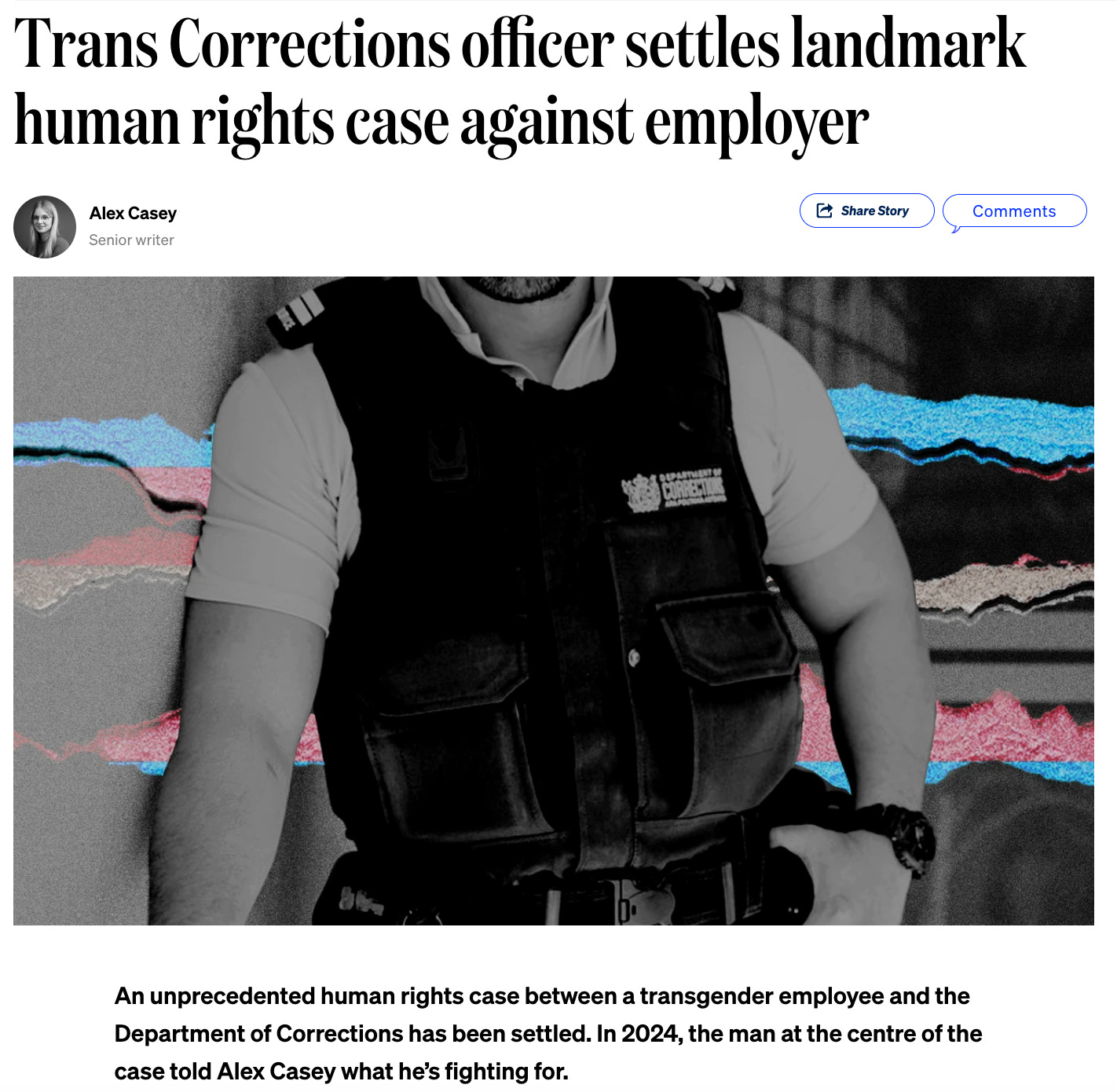
Today, news broke that a female prison officer who now “identifies as a man” has managed not only to extract an apology and a confidential compensation payment from the Department of Corrections, but also get them to agree to change their policy on intimate searches to reflect her demands. The New Zealand Herald called her “Adam” so I will too. This came from a complaint Adam made to the Human Rights Commission about Corrections which was before the Human Rights Review Tribunal prior to the settlement being reached.
Adam had worked for Corrections for about five years before she started “identifying as a man”. When this happened Corrections made it clear she was not to do rub-down searches on male prisoners. But in late 2022, during a routine safety search when some metal detectors weren’t working, Adam asked prisoners if they were okay with her doing rub-downs as she was the only “male” staff member present. They consented (not sure what would have happened if they said “no”) and she began the process until a senior female officer immediately yelled at her to stop. Prisoners also later complained about a female staff member searching them. At this point, Corrections did the absolute right thing and issued a Letter of Expectations calling her actions “unlawful” and warning of disciplinary action.
Adam took a complaint to the Human Rights Commission.
Corrections has been operating under a mixed policy approach which I do not entirely agree with. Transgender prisoners could choose whether they were searched according to their birth sex or their gender identity, with that preference recorded for future and, if no choice was made, gender identity generally used as the default. It is my firm view that biological sex should be the basis on which all of these policies are enacted, but in any case there was no expectation that prisoners should be subjected to searches according to the identities of their guards.
In prison we necessarily strip people of many rights. They lose liberty, privacy, and control over their communications and possessions. They also lose the autonomy over much of their daily decision making. Intimate and rub down searches are authorised and necessary because prisons are high risk environments and it is a important that weapons, drugs, and contraband are prevented from being smuggled in. These searches are incredibly intrusive and that is why the rules must be crystal clear about who performs them, what prisoners can refuse, and what they cannot. Prisoners do not get to consent their way out of necessary security, but they absolutely should not be forced into intimate contact with officers of the opposite biological sex, no matter how that officer identifies.
Male prisoners should have the same rights in this regard as female prisoners. I have spent more than a decade arguing for the rights of women in spaces like prisons, but men too are entitled to the rights that trans activists so eagerly want to take away. Many prisoners, male and female, are victims of sexual abuse and other trauma, and while that does not mean they can be exempt from intimate searches, it is unnecessarily cruel to subject them to the unwanted contacted by a member of the opposite sex simply because a prison guard demands to have their identity “validated”.
It is important to note that in this situation the guard can walk away. She can find employment that does not have such important differentiation between the sexes and where her biological sex isn’t such a big deal. The prisoners cannot. They are stuck there. They have little autonomy and the few rights they are still entitled to should be protected. Prisoner rights and bodily privacy must come before any staff member’s feelings about their innate identity.
Additionally, a female prison guard may identify as a male, but generally she will be observably trans, especially if prisoners have witnessed the transition and know that she is female. This puts her at risk because the male prisoners will know they are likely able to overpower her and these are on the whole incredibly dangerous men. It is best for everyone that biological sex, not gender identity, is what these policies are based on.
But this settlement has blown that all apart. Corrections has rolled over to the activists who are embedded in the public service, issued a grovelling statement, promised training (indoctrination), and changed policy so staff can perform the “full range of duties that align with their gender.” Not only will male prisoners have their rights compromised, but it follows that now female prisoners, who are much more vulnerable, will face the very real prospect of intimate searches by male officers who declare they are women. This is perverse, dangerous, and a betrayal of basic safeguarding.
This case proves why New Zealand First’s Legislation (Definitions of Woman and Man) Amendment Bill is essential. New Zealand law is vague on “man,” “woman,” “male” and “female”, and trans activists have used this fact to their advantage. Without clear biological definitions applying across legislation, Corrections, Crown Law, and the Human Rights Commission have been able to twist themselves into ideological knots. Clear statutory language based on biological sex would provide certainty and protect prisoners, staff, and the public.
While we indulge this madness, overseas jurisdictions are unwinding the gender identity experiments. In April 2025, the UK Supreme Court unanimously held that, for the purposes of the Equality Act 2010, the terms “man”, “woman” and “sex” refer to biological sex. The Court was careful to emphasise that transgender people remain protected from discrimination under the separate protected characteristic of gender reassignment (the ones who have gone through actual reassignment, that is), but it rejected the idea that “sex” in the legislation should be interpreted to mean gender identity.
That decision has led to public bodies across the United Kingdom scrambling to review and rewrite policies for single-sex services, including prisons, healthcare and sport, to ensure they comply with the Court’s interpretation. In Scotland, the Government accepted another court ruling that its prison policy was unlawful, meaning prisoners will now be allocated according to biological sex rather than gender identity. This has meant that male prisoners already being housed in women’s prisons due to their stated gender identity were moved back to the men’s prisons. England and Wales had already tightened their approach, with policies introduced in 2023 providing that trans-identifying males who retain male genitalia will not ordinarily be housed in the mainstream women’s prison estate. While trans-identifying prisoners continue to receive legal protections and individual risk assessments, overall the UK has been towards placing greater weight on biological sex in sex-segregated settings rather than expanding policies based solely on gender identity.
Meanwhile New Zealand hurtles deeper into the abyss.
In this case, the Human Rights Commission and Office of Human Rights Proceedings have shown again how hopelessly corrupted they are by ideology. They prioritise trans demands over women’s rights and prisoner protections. It is a fact that gender identity is not listed in the Human Rights Act 1993, but sex is. The Commission and Crown Law are continuing to misrepresent the law by treating these as interchangeable based on an untested 17 year old legal opinion that suggested that they might be related concepts. They are not enforcing the law as written. Instead they are pretending it means what they want it to mean. It is an outrageous display of politicisation and activism.
It is therefore very unsurprising that the Commission and Crown Law might have been eager to settle this case rather than see it through to a ruling. The settlement conveniently avoids testing that opinion in open tribunal and risking a precedent they don’t like being established. It stinks of avoidance. No tribunal judgment means no reasoned weighing of prisoner privacy against staff gender identity, no precedent on whether the old policy was lawful, and no public explanation of the legal analysis.
It is my opinion that Crown Law and the Human Rights apparatus preferred this quiet “win-win” scenario through which they could force through a drastic policy change. Settlements happen for many reasons, including cost, risk, uncertainty, but the timing and outcome here are too convenient for my liking.
Someone with resources should take a strong case against the Human Rights Commission. Then we should campaign hard to abolish it. Public money should not fund activism that misrepresents the law and steamrolls the rights of others in order to preference the demands of a sacred caste. Our judiciary, including Crown Law, is hopelessly captured too, but sorting that out is a lot more complicated.
I have reached out to the Minister’s office about this case and lodged Official Information Act requests with Corrections, Crown Law, the Human Rights Commission (including the Office of Human Rights Proceedings), and the Tribunal. We need the legal advice, policy papers, briefings and correspondence, and unfortunately that means waiting the statutory twenty working days for them to inevitability say it is going to take even longer. In the meantime please reach out if you have any suggestions for how we can ensure this policy change is reversed and how we can take action against these captured government agencies.
This is not just about one entitled officer. It is about whether prisoners are entitled to the remaining basic rights we haven’t taken away as part of punishment or security measures, or whether ideology now overrides safety, dignity, and biological reality. Corrections’ new position is a disgrace as is the way they have handled this situation. Parliament must act with clear law, beginning with passing the Definitions Bill. The rights of women, and men, must not become collateral damage for someone else’s validation. For goodness sake.
Ani O'Brien comes from a digital marketing background, she has been heavily involved in women's rights advocacy and is a founding council member of the Free Speech Union. This article was originally published on Ani's Substack Site and is published here with kind permission.
9 comments:
Couldn't agree more Ani, a perverse decision by the human rights commission. These troons are in need of therapy. Andrew
Few want to say, in the insanity and full on mental health diagnosis of the times that is the trans rights movement, that this emperor has NO clothes. They/them is finely dressed in the best quality silks and textiles of the day, don't you know. Not butt naked.
If Susan wants to be known as Adam, fine by me. I truly do not care. But rules around gender for prisoner searches are not nice to have options. If a male prisoner is accused of indecency against Adam or vice versa, odds are Adam would morph back into Susan in a heart beat. Similarly, if Adam searches a female prisoner because Adam is really Susan, and the prisoner complained, quite rightly, a bloke had touched her intimate regions, then what? Corrections, who struggle to attract and retain staff, would be liable.
The wokes obsession with this absurd subject has no logical outcomes, only multiples of the original insanity that its based on. And at that point, there can be no point to rules or laws they insist on because you cannot make laws for insane processes.
So why do we sane people keep entertaining this crazy shit and when will sanity prevail? Is the trans rights gig as important as angry climate gods, hatred of white people, cycle lanes and meaningless equity to woke voters or is it not so important?
According to the polls, a hard core of voters in the Greens think it is. But how many others?
The hard-core Green voters are themselves insane, so who cares?
I’m trans panicking even more than I was gay panicking in the 80s.
Am I "allowed" to make a very controversial statement?
Sine the Gay Community was allowed to rejoin Society we have seen over the past years just how 'progressive' many have become.
In the case of Transgender issues we have 'seen' males 'move to be females' and have "proudly' broadcast their new ideology ( I use that term against biology, as it is a more an ideological approach & demand) - to the point of demanding "access" to female spaces and when "true" females rise & complain, they "are shouted down" by the collective Gay Community and if the case ends in Court, the Bench side with the Gay Community, to a point that "the normal, biological females "retreat" as they afraid of the consequences of speaking out.
Note it is not uncommon for other parts of society to 'remain silent", least their opinions also get them "cancelled".
When those "normal, biological females " do rise and confront ( as seen in America ) - this young lady (Riley Gaines, swimmer)) had her sports career 'destroyed' more so by the Gay Community and with support of others via social media.
But she learned from her beliefs and has not backed down.
So what is related within this article is not new, and will continue to be an "item" within employed across NZ, as more DEI culture is adopted with Employment Criteria.
On a slightly different tack.
I don't know where the need comes from to "celebrate" the "alphabet community" at all?
Every time any awareness campaign (propaganda) kicks off the advertising bombards the general public with "celebratory" slogans.
People are free to make their own choices in lifestyle.
But why do I need to celebrate the choices of other people?
What possible vicarious pleasure is there in doing that?
The alphabet mob can have their parade and their month-long party but don't expect those who really don't care...to "celebrate".
Especially since it is now causing division and biological females are now becoming marginalized and bullied in domains that were once their own
Anon 325 it is because of “othering”. People who take jibes and accuse a whole category of people of being criminals or potential criminals. To let them know that they are accepted, loved, and part of us.
On another track: trans people don’t seem to be committing sex crimes at anything like the rate of people in positions of power. There has been one particular example of this in the news this week that doesn’t seem to be getting anything air in right wing circles, but it fits a concerning pattern. As an advocate, Ani must be outraged. Can we get some comment from her on this?
We can’t trust politicians.
Doctors: There's a medication that reduces anxiety, depression, and suicidality for a select group of people. We've been using these medications for other people for decades and they're safe and reversible.
Politicians: That particular group of people offend me. Disallow.
Honestly, I don't think that politics has any place in medicine. Be it puberty blockers or women's health.
Post a Comment
Thank you for joining the discussion. Breaking Views welcomes respectful contributions that enrich the debate. Please ensure your comments are not defamatory, derogatory or disruptive. We appreciate your cooperation.