

You can read my first dive into the Official Information Act requests here.
In this article, I focus on the tension between what evolving evidence and medical experts were advising about the spacing between first and second doses of the vaccine and the decisions regarding spacing made by the New Zealand Government, plus the way promotion of the vaccine may have breached law.1
The interval between first and second doses of the Pfizer vaccine in New Zealand was not treated as a purely clinical question. It became a policy lever that determined how quickly “fully vaccinated” numbers could rise, how soon mandates could take effect and be lifted, and what level of risk younger populations were exposed to in the process.2
Medsafe’s Comirnaty (mRNA vaccine developed by Pfizer/BioNTech) data sheet states that for those aged 12 and over, the approved primary course is two doses at least 21 days apart.3 This is the clinical baseline. However, as time wore on and the world acquired more data on side effects of the vaccine, expert advice shifted to recommend longer intervals between doses and other countries moved to implement this. So did New Zealand, for a time, but then strangely reverted back.
Medsafe’s safety communications published on their website on 9 June 2021 were explicit about the shifting understanding of the risk of myocarditis/pericarditis and how to mitigate against it. Medsafe moved myocarditis from a monitoring communication to a formal alert (July 2021) concluding it was a rare side effect and noting it was seen “often in younger men” and “shortly after the second dose.”4 Nonetheless, this did not appear to be reflected in public messaging from the Government at the time.
As I say, at first, it appeared New Zealand was making adjustments to the length of interval between doses in line with much of the rest of the world. On 12 August 2021, the Ministry of Health publicly announced that the standard time between Pfizer doses was being increased:
The rationale presented was primarily operational in that a longer gap “allows us to give a first dose to a larger number of people faster,” with “early findings” suggesting an extended interval produced “at least an equally robust immune response, with no additional safety concerns.” There was no mention of the fact that around the world governments were lengthening the interval based on advice that it lowered the risk of myocarditis.
In Canada, the Council of Chief Medical Officers of Health (CCMOH) recommended, in late 2021, extending the interval between Pfizer doses to around eight weeks:
In January 2021, the Government in the United Kingdom initially stated the “second [Pfizer] vaccine dose can be offered between 3 to 12 weeks after the first dose.”7 But by August 2021 they said:
By November 2021, the UK was offering a second Pfizer dose for 16 and 17 year olds but instructing that it should only be given “12 weeks or more following the first vaccine dose”.9 The advice went on to state:
What followed suggests that mitigating this specific risk was not the dominant priority in New Zealand’s rollout. The policy direction, particularly around interval timing, increasingly aligned with accelerating full vaccination coverage rather than adopting the more cautious spacing emerging internationally.
No doubt the original intentions were noble, but it seems to have became a race, a game, to some, at least. Vaccine targets dominated the discourse and were communicated at each daily press conference.
The media got right behind this with the New Zealand Herald, for example, running an entire campaign tracking our progress to the percentage goal of 90% vaccinated.10 They ran a sustained series of daily vaccination trackers, live dashboards, editorial pushes, and region-by-region breakdowns, turning vaccination into a visible, competitive metric. Headlines regularly emphasised which areas were “falling behind” and which were “leading the charge,” creating a sense of urgency and social pressure around uptake.
The tone of much of this coverage went beyond neutral reporting. Editorials and opinion pieces reinforced the idea that high vaccination rates were the pathway out of lockdowns and restrictions, aligning closely with the Government’s messaging.
What emerged was effectively a media-supported mobilisation effort, where vaccination rates became not just a public health statistic but a daily national scorecard. The Government also deployed numerous public campaigns to incentivise and coerce taking the vaccine and even organised a “Vaxathon” called “Super Saturday.”
Super Saturday was held on 16 October 2021 and was the Government’s flagship mass-vaccination push. It was a one-day, nationwide campaign designed to rapidly lift first dose uptake and close the gap to the 90% targets underpinning the so-called “roadmap out of lockdowns”.11 Spearheaded by Chris Hipkins and the wider COVID-19 response team, the goal was explicitly to drive a surge in vaccinations, particularly in under-vaccinated communities.
The event was heavily choreographed, with extended clinic hours, walk-in access, community pop-ups, and a saturation media campaign. Major broadcasters including TVNZ and MediaWorks partnered with the Government to promote the day, culminating in a live “Vaxathon” broadcast featuring celebrities, politicians, and public health messaging. It was a fullscale mobilisation blending policy, communications, and media spectacle, aimed squarely at accelerating vaccination rates as quickly as possible.
It is in this context that just ten days before the event, on 6 October 2021, the Government line on the interval between doses pivoted. At a press conference, Chris Hipkins said that health advice now said for the public to “consider a shorter gap” than six weeks “in light of the increased risk from the current Delta outbreak,” and he even explicitly said the quiet part aloud: “we also need all those people to be fully vaccinated with two doses as soon as possible.”12
When challenged that the Ministry had been saying “optimal [interval] time is still six weeks” only days earlier, then-Director of Public Health at the Ministry of Health Dr Caroline McElnay responded that the technical advisory group advised “there never was any safety concerns” with vaccinating at the three week timeframe, and framed the shift as “pragmatic” to get people fully vaccinated in the moment. However, Dr McElnay appeared to get herself a bit tied in knots as she described the “optimal schedule” as “a six to eight-week gap was the recommendation,” while also insisting that what was “fixed” was the “three-week gap between the two doses.”
From a timeline perspective, we now have three conflicting positions sitting side by side in official messaging. The Ministry of Health determined “standard”13 spacing was six weeks in August, then in early October it said “optimal”14 spacing was six to eight weeks, but then on 6 October operational urgency was used to justify returning to a three week minimum so that people could be “fully vaccinated sooner.”
The timing of this sudden halving of the recommended interval between doses appeared to come out of nowhere and is puzzling considering elsewhere in the world the trend was that intervals were being elongated. New Zealand was back to three weeks between doses when the UK was waiting four times as long.
It is difficult not to somewhat cynically note that the Health Ministry later described Super Saturday as the culmination of a “10-day campaign launched by Minister Hipkins at the 1pm stand-up on Wednesday 6 October,” aimed at increasing uptake.15 The same day the Ministry of Health says the Super Saturday campaign launched, the Government pressed the public to ignore previous medical advice and reduce the interval between first and second dose by half to speed up “fully vaccinated” numbers.
Proactively released documents from the Ministry of Health say:
This timeline appears to establish that the shift to a faster second dose pathway was operationally aligned with a major, politically branded mobilisation event whose success would be measured in doses delivered and second doses completed. Ultimately, more than 130,000 doses were administered on the day including nearly 91,000 second doses.
The retraction to a three week interval between first and second doses was never reversed. This is difficult to understand given the amount of information and discourse about longer intervals mitigating against the risk of myocarditis and pericarditis in relation to young people. In the March 2022 Cabinet Paper in Chris Hipkins’ name, he refers to the CV TAG advice from December 2021 that maintains he still did not see. That advice said:
One would assume that even without having seen that specific advice, nor observing the youth vaccine protocols of Canada, UK, Israel, and the US, the New Zealand Government was aware of what the World Health Organisation (WHO) was saying. In July 2021, WHO published updated guidance from the COVID-19 subcommittee of the WHO Global Advisory Committee on Vaccine Safety (GACVS) which explained that:
While not quite as a long as the UK’s intervals, the WHO too had officially lengthened their recommended intervals for young people by January 2022:
Additionally, the WHO urged countries to communicate clearly the risks and signs of myocarditis and pericarditis:
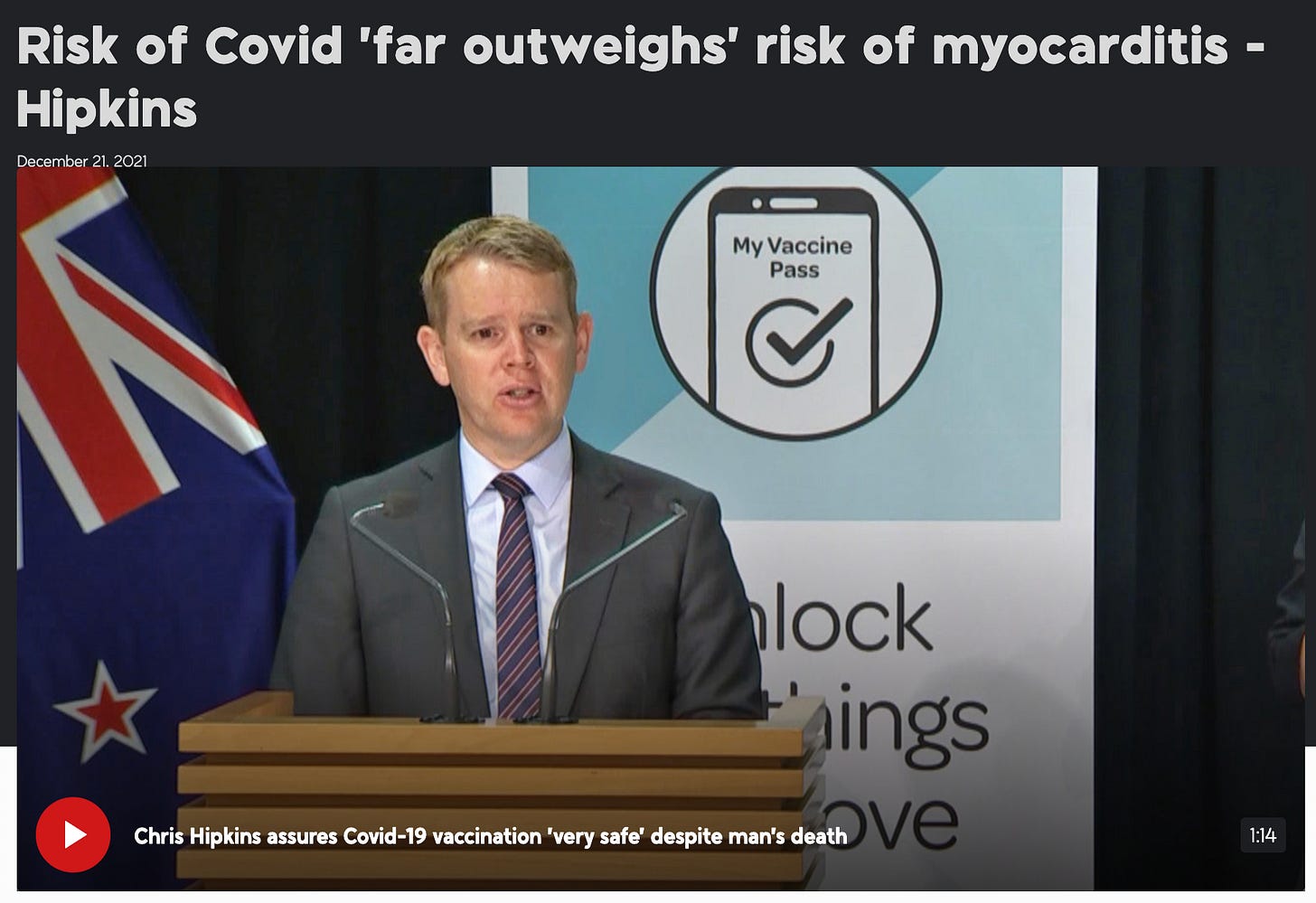
It is hard to see how the New Zealand Government can claim to have done so given the way discussion about adverse effects was treated. In fact, on 21 December 2021, Chris Hipkins declared that COVID-19 “far outweighs” risk of myocarditis in response to questions about 26 year old Dunedin plumber Rory Nairn who died from myocarditis caused by the Pfizer Covid-19 vaccine.21
This is significant also because just this week Chris Hipkins claimed to have never given the public medical advice. In General Debate this week, David Seymour quoted Hipkins as saying:
In reality, Chris Hipkins frequently gave medical advice and asserted to the public that the Pfizer vaccine was “very safe,” arguing that “any small risk associated with the vaccine is by far outweighed by the risk of getting Covid-19” and that taking the vaccination was “absolutely the best course of action.”23 This reflects the orthodox public health position at the time, but contradicts the regulatory expectations of New Zealand’s medicines law.
Under the Medicines Act 1981, communications that promote the use of a medicine must not be misleading or unbalanced, and must reflect the known risk profile of the product. Section 57 says:
No pharmaceutical company could dream to get away with anything like the sweeping and emphatic claims about the efficacy and safety of the vaccine. Especially since, by mid 2021, both domestic and international authorities had identified a specific, non-trivial pattern of risk of myocarditis.
The issue, then, is whether repeatedly describing the vaccine as “very safe,” while collapsing the risk discussion into a generalised comparison with COVID-19, met the standard of balanced communication required under the Act. The obligation is to communicate risk with sufficient specificity that individuals, especially those in higher-risk groups, can make an informed decision. Instead, the Minister for the COVID-19 Response mandated that a double dose of the vaccine was required in order to partake in public life.
What this paper trail shows is a sequence of decisions made in full view of evolving evidence, where the known trade-offs were increasingly clear, and the policy response consistently favoured speed, targets, and compliance over caution. Ministers did not need perfect certainty to act differently because they had enough information to recognise that interval spacing mattered, that younger populations carried a different risk profile, and that compressing the dosing schedule carried consequences. The issue is no longer whether they knew everything. It is whether, given what they did know, they chose to act in a way that minimised risk or simply in a way that maximised vaccination numbers.
1 https://www.beehive.govt.nz/sites/default/files/2021-10/Hipkins%2C%20Dr%20McElnay%20Press%20Conference%206%20October.pdf
2 https://medsafe.govt.nz/safety/Alerts/comirnaty-myocarditis-alert.htm
3 https://www.medsafe.govt.nz/profs/Datasheet/c/Comirnaty0.2mlOrangeCapinj.pdf
4 https://www.medsafe.govt.nz/safety/Alerts/comirnaty-myocarditis.asp?
5 https://m.scoop.co.nz/stories/GE2108/S00063/time-between-doses-of-covid-19-vaccine-extended.htm
6 https://www.canada.ca/en/public-health/news/2021/12/statement-from-the-council-of-chief-medical-officers-of-health-ccmoh-update-on-the-use-of-covid-19-vaccine-boosters-and-on-covid-19-vaccines-and-th.html
7 https://www.gov.uk/government/publications/vaccine-update-issue-316-january-2021-covid-19-special-edition/vaccine-update-issue-316-january-2021-covid-19-special-edition
8 https://www.gov.uk/government/publications/jcvi-statement-august-2021-covid-19-vaccination-of-children-and-young-people-aged-12-to-17-years/jcvi-statement-on-covid-19-vaccination-of-children-and-young-people-aged-12-to-17-years-4-august-2021
9 https://www.gov.uk/government/publications/covid-19-vaccination-in-children-and-young-people-aged-16-to-17-years-jcvi-statement-november-2021/joint-committee-on-vaccination-and-immunisation-jcvi-advice-on-covid-19-vaccination-in-people-aged-16-to-17-years-15-november-2021
10 https://www.nzherald.co.nz/nz/vaccine-tracker-how-many-kiwis-have-been-vaccinated/ENMCOHM5QW6W3UN6MRMCOQKO2U/?
11 https://www.rnz.co.nz/national/programmes/ninetonoon/audio/2018814921/a-roadmap-out-of-lockdown
12 https://www.beehive.govt.nz/sites/default/files/2021-10/Hipkins%2C%20Dr%20McElnay%20Press%20Conference%206%20October.pdf
13 https://m.scoop.co.nz/stories/GE2108/S00063/time-between-doses-of-covid-19-vaccine-extended.htm
14 https://www.beehive.govt.nz/sites/default/files/2021-10/Hipkins%2C%20Dr%20McElnay%20Press%20Conference%206%20October.pdf
15 https://www.health.govt.nz/information-releases/super-saturday-and-vaxathon-information
16 https://www.health.govt.nz/system/files/2022-05/super-saturday-proactive-release-information-5mar22.pdf
17 https://www.health.govt.nz/system/files/2022-05/implementation_of_covid-19_pfizer_paediatric_vaccine_for_children_aged_5_to_11_years_report_back.pdf
18 https://www.who.int/news/item/09-07-2021-gacvs-guidance-myocarditis-pericarditis-covid-19-mrna-vaccines
19 https://cdn.who.int/media/docs/default-source/immunization/sage/2022/january/who-2019-ncov-vaccines-sage-recommendation-bnt162b2-2022.1-eng.pdf?sfvrsn=f41d7e47_5&
20 https://cdn.who.int/media/docs/default-source/immunization/sage/2022/january/who-2019-ncov-vaccines-sage-recommendation-bnt162b2-2022.1-eng.pdf?sfvrsn=f41d7e47_5&
21 https://www.1news.co.nz/2021/12/21/risk-of-covid-far-outweighs-risk-of-myocarditis-hipkins/
22 https://hansard.parliament.nz/hansard-transcript/2026-04-01/debates-general-debate?sId=414ba236b9564e2dac525c22a80224f9
23 https://www.1news.co.nz/2021/12/21/risk-of-covid-far-outweighs-risk-of-myocarditis-hipkins/
Ani O'Brien comes from a digital marketing background, she has been heavily involved in women's rights advocacy and is a founding council member of the Free Speech Union. This article was originally published on Ani's Substack Site and is published here with kind permission.
Medsafe’s Comirnaty (mRNA vaccine developed by Pfizer/BioNTech) data sheet states that for those aged 12 and over, the approved primary course is two doses at least 21 days apart.3 This is the clinical baseline. However, as time wore on and the world acquired more data on side effects of the vaccine, expert advice shifted to recommend longer intervals between doses and other countries moved to implement this. So did New Zealand, for a time, but then strangely reverted back.
Medsafe’s safety communications published on their website on 9 June 2021 were explicit about the shifting understanding of the risk of myocarditis/pericarditis and how to mitigate against it. Medsafe moved myocarditis from a monitoring communication to a formal alert (July 2021) concluding it was a rare side effect and noting it was seen “often in younger men” and “shortly after the second dose.”4 Nonetheless, this did not appear to be reflected in public messaging from the Government at the time.
As I say, at first, it appeared New Zealand was making adjustments to the length of interval between doses in line with much of the rest of the world. On 12 August 2021, the Ministry of Health publicly announced that the standard time between Pfizer doses was being increased:
“From today, the standard time will become six weeks.” 5
The rationale presented was primarily operational in that a longer gap “allows us to give a first dose to a larger number of people faster,” with “early findings” suggesting an extended interval produced “at least an equally robust immune response, with no additional safety concerns.” There was no mention of the fact that around the world governments were lengthening the interval based on advice that it lowered the risk of myocarditis.
In Canada, the Council of Chief Medical Officers of Health (CCMOH) recommended, in late 2021, extending the interval between Pfizer doses to around eight weeks:
“An 8-week interval between the first and second dose is recommended, as longer intervals such as this are likely to have less risk of myocarditis than shorter intervals and likely to result in improved protection.”6
In January 2021, the Government in the United Kingdom initially stated the “second [Pfizer] vaccine dose can be offered between 3 to 12 weeks after the first dose.”7 But by August 2021 they said:
For persons aged <18 years old who do not have underlying health conditions that put them at higher risk of severe COVID-19, there is more uncertainty in the precision of the harm-benefit balance…
Further data and the potential availability of alternative vaccine options will inform exact details which will be provided in a subsequent update of this advice before second doses are due at approximately 12 weeks after the first dose.8
By November 2021, the UK was offering a second Pfizer dose for 16 and 17 year olds but instructing that it should only be given “12 weeks or more following the first vaccine dose”.9 The advice went on to state:
Reports from the USA and Israel indicate a higher reporting rate with the second vaccine dose compared to the first vaccine dose; in these countries the second vaccine dose is typically given 3 to 4 weeks following the first dose (Table 2). There is some data to suggest that a longer interval (more than 8 weeks) between first and second doses, as used in the UK, is associated with a lower myocarditis reporting rate following the second vaccine dose.
What followed suggests that mitigating this specific risk was not the dominant priority in New Zealand’s rollout. The policy direction, particularly around interval timing, increasingly aligned with accelerating full vaccination coverage rather than adopting the more cautious spacing emerging internationally.
No doubt the original intentions were noble, but it seems to have became a race, a game, to some, at least. Vaccine targets dominated the discourse and were communicated at each daily press conference.
The media got right behind this with the New Zealand Herald, for example, running an entire campaign tracking our progress to the percentage goal of 90% vaccinated.10 They ran a sustained series of daily vaccination trackers, live dashboards, editorial pushes, and region-by-region breakdowns, turning vaccination into a visible, competitive metric. Headlines regularly emphasised which areas were “falling behind” and which were “leading the charge,” creating a sense of urgency and social pressure around uptake.
The tone of much of this coverage went beyond neutral reporting. Editorials and opinion pieces reinforced the idea that high vaccination rates were the pathway out of lockdowns and restrictions, aligning closely with the Government’s messaging.
What emerged was effectively a media-supported mobilisation effort, where vaccination rates became not just a public health statistic but a daily national scorecard. The Government also deployed numerous public campaigns to incentivise and coerce taking the vaccine and even organised a “Vaxathon” called “Super Saturday.”
Super Saturday was held on 16 October 2021 and was the Government’s flagship mass-vaccination push. It was a one-day, nationwide campaign designed to rapidly lift first dose uptake and close the gap to the 90% targets underpinning the so-called “roadmap out of lockdowns”.11 Spearheaded by Chris Hipkins and the wider COVID-19 response team, the goal was explicitly to drive a surge in vaccinations, particularly in under-vaccinated communities.
The event was heavily choreographed, with extended clinic hours, walk-in access, community pop-ups, and a saturation media campaign. Major broadcasters including TVNZ and MediaWorks partnered with the Government to promote the day, culminating in a live “Vaxathon” broadcast featuring celebrities, politicians, and public health messaging. It was a fullscale mobilisation blending policy, communications, and media spectacle, aimed squarely at accelerating vaccination rates as quickly as possible.
It is in this context that just ten days before the event, on 6 October 2021, the Government line on the interval between doses pivoted. At a press conference, Chris Hipkins said that health advice now said for the public to “consider a shorter gap” than six weeks “in light of the increased risk from the current Delta outbreak,” and he even explicitly said the quiet part aloud: “we also need all those people to be fully vaccinated with two doses as soon as possible.”12
When challenged that the Ministry had been saying “optimal [interval] time is still six weeks” only days earlier, then-Director of Public Health at the Ministry of Health Dr Caroline McElnay responded that the technical advisory group advised “there never was any safety concerns” with vaccinating at the three week timeframe, and framed the shift as “pragmatic” to get people fully vaccinated in the moment. However, Dr McElnay appeared to get herself a bit tied in knots as she described the “optimal schedule” as “a six to eight-week gap was the recommendation,” while also insisting that what was “fixed” was the “three-week gap between the two doses.”
From a timeline perspective, we now have three conflicting positions sitting side by side in official messaging. The Ministry of Health determined “standard”13 spacing was six weeks in August, then in early October it said “optimal”14 spacing was six to eight weeks, but then on 6 October operational urgency was used to justify returning to a three week minimum so that people could be “fully vaccinated sooner.”
The timing of this sudden halving of the recommended interval between doses appeared to come out of nowhere and is puzzling considering elsewhere in the world the trend was that intervals were being elongated. New Zealand was back to three weeks between doses when the UK was waiting four times as long.
It is difficult not to somewhat cynically note that the Health Ministry later described Super Saturday as the culmination of a “10-day campaign launched by Minister Hipkins at the 1pm stand-up on Wednesday 6 October,” aimed at increasing uptake.15 The same day the Ministry of Health says the Super Saturday campaign launched, the Government pressed the public to ignore previous medical advice and reduce the interval between first and second dose by half to speed up “fully vaccinated” numbers.
Proactively released documents from the Ministry of Health say:
“The ultimate decision to schedule Super Saturday in mid-October 2021 was based upon a number of factors, with one major consideration being the objective to drive first dose uptake while there was still time for people to receive their second dose and be ‘fully vaccinated’ before the summer holidays.”16
This timeline appears to establish that the shift to a faster second dose pathway was operationally aligned with a major, politically branded mobilisation event whose success would be measured in doses delivered and second doses completed. Ultimately, more than 130,000 doses were administered on the day including nearly 91,000 second doses.
The retraction to a three week interval between first and second doses was never reversed. This is difficult to understand given the amount of information and discourse about longer intervals mitigating against the risk of myocarditis and pericarditis in relation to young people. In the March 2022 Cabinet Paper in Chris Hipkins’ name, he refers to the CV TAG advice from December 2021 that maintains he still did not see. That advice said:
“12.1 the individual health risk of COVID-19 to under 18 year olds was low
12.2 the risk of transmission among under 18 year olds were insufficient to justify mandating a two dose schedule in order to work in any environment
12.3 a two dose schedule, particularly administered in the shortest possible clinical timeframe, may add an unnecessary risk of myocarditis in this population
12.4 requiring vaccination certificates for children could unintentionally exclude them from educational activities
12.5 there should not be pressure on young people to receive both primary course doses of vaccine in the shortest possible interval
12.6 informal exclusions are facilitated by issuing vaccination certificates for those aged under 18 years.”17
One would assume that even without having seen that specific advice, nor observing the youth vaccine protocols of Canada, UK, Israel, and the US, the New Zealand Government was aware of what the World Health Organisation (WHO) was saying. In July 2021, WHO published updated guidance from the COVID-19 subcommittee of the WHO Global Advisory Committee on Vaccine Safety (GACVS) which explained that:
Cases of myocarditis and pericarditis have been observed following vaccination with the mRNA COVID-19 vaccines. These cases occurred more often in younger men and after the second dose of the vaccine, typically within few days after vaccination.18
While not quite as a long as the UK’s intervals, the WHO too had officially lengthened their recommended intervals for young people by January 2022:
WHO recommends that the second dose should be provided 4-8 weeks after the first dose, preferentially 8 weeks as a longer interval between doses is associated with higher vaccine effectiveness and potentially lower risk of myocarditis/pericarditis.19
Additionally, the WHO urged countries to communicate clearly the risks and signs of myocarditis and pericarditis:
Vaccinated individuals should be instructed to seek immediate medical attention if they develop symptoms indicative of myocarditis or pericarditis such as new onset and persisting chest pain, shortness of breath, or palpitations following vaccination.20
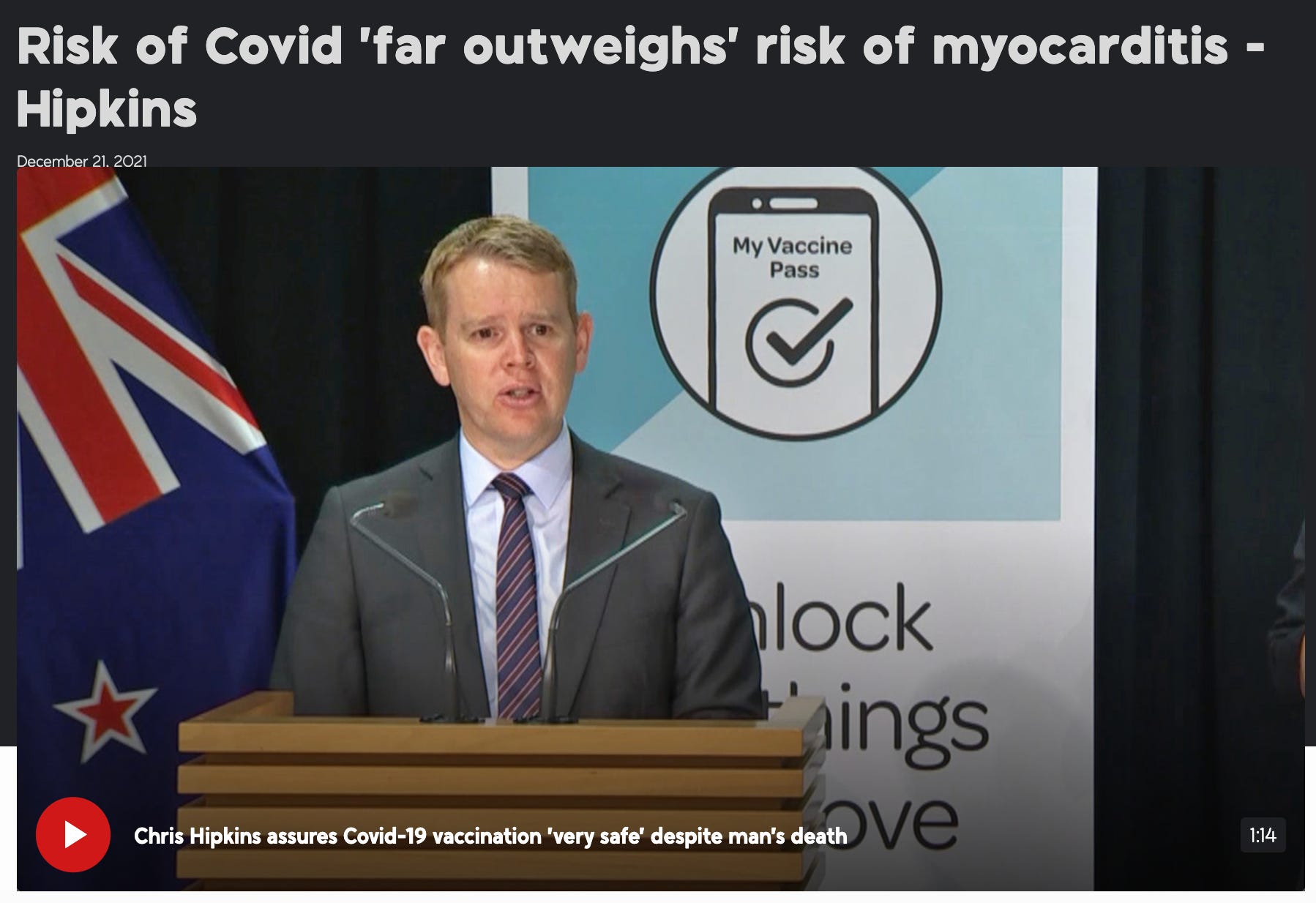
It is hard to see how the New Zealand Government can claim to have done so given the way discussion about adverse effects was treated. In fact, on 21 December 2021, Chris Hipkins declared that COVID-19 “far outweighs” risk of myocarditis in response to questions about 26 year old Dunedin plumber Rory Nairn who died from myocarditis caused by the Pfizer Covid-19 vaccine.21
This is significant also because just this week Chris Hipkins claimed to have never given the public medical advice. In General Debate this week, David Seymour quoted Hipkins as saying:
“All of those 1 p.m. press conferences were fronted by a Minister and a public health official, and I, certainly for the ones that I was fronting, always left the advice on vaccine safety, health advice—I always left that to the relevant health officials at those meetings and I think that was appropriate. I’m not a health practitioner. I think it was appropriate that we left that to the relevant health officials.”22
In reality, Chris Hipkins frequently gave medical advice and asserted to the public that the Pfizer vaccine was “very safe,” arguing that “any small risk associated with the vaccine is by far outweighed by the risk of getting Covid-19” and that taking the vaccination was “absolutely the best course of action.”23 This reflects the orthodox public health position at the time, but contradicts the regulatory expectations of New Zealand’s medicines law.
Under the Medicines Act 1981, communications that promote the use of a medicine must not be misleading or unbalanced, and must reflect the known risk profile of the product. Section 57 says:
(1) No person shall publish or cause to be published, either on that person’s own account or as the agent or employee of the person seeking to promote the sale, any medical advertisement that—
(f) is false, or is likely to mislead any other person, with regard to the nature, quality, strength, purity, composition, origin, age, uses, or effects of medicines or medical devices of that description, kind, or class or of any ingredient or component thereof; or
(g) directly or by implication states or suggests that medicines or medical devices of that description, kind, or class, cannot harm any person, or any person belonging to a particular class of persons, or is not habit-forming.
No pharmaceutical company could dream to get away with anything like the sweeping and emphatic claims about the efficacy and safety of the vaccine. Especially since, by mid 2021, both domestic and international authorities had identified a specific, non-trivial pattern of risk of myocarditis.
The issue, then, is whether repeatedly describing the vaccine as “very safe,” while collapsing the risk discussion into a generalised comparison with COVID-19, met the standard of balanced communication required under the Act. The obligation is to communicate risk with sufficient specificity that individuals, especially those in higher-risk groups, can make an informed decision. Instead, the Minister for the COVID-19 Response mandated that a double dose of the vaccine was required in order to partake in public life.
What this paper trail shows is a sequence of decisions made in full view of evolving evidence, where the known trade-offs were increasingly clear, and the policy response consistently favoured speed, targets, and compliance over caution. Ministers did not need perfect certainty to act differently because they had enough information to recognise that interval spacing mattered, that younger populations carried a different risk profile, and that compressing the dosing schedule carried consequences. The issue is no longer whether they knew everything. It is whether, given what they did know, they chose to act in a way that minimised risk or simply in a way that maximised vaccination numbers.
1 https://www.beehive.govt.nz/sites/default/files/2021-10/Hipkins%2C%20Dr%20McElnay%20Press%20Conference%206%20October.pdf
2 https://medsafe.govt.nz/safety/Alerts/comirnaty-myocarditis-alert.htm
3 https://www.medsafe.govt.nz/profs/Datasheet/c/Comirnaty0.2mlOrangeCapinj.pdf
4 https://www.medsafe.govt.nz/safety/Alerts/comirnaty-myocarditis.asp?
5 https://m.scoop.co.nz/stories/GE2108/S00063/time-between-doses-of-covid-19-vaccine-extended.htm
6 https://www.canada.ca/en/public-health/news/2021/12/statement-from-the-council-of-chief-medical-officers-of-health-ccmoh-update-on-the-use-of-covid-19-vaccine-boosters-and-on-covid-19-vaccines-and-th.html
7 https://www.gov.uk/government/publications/vaccine-update-issue-316-january-2021-covid-19-special-edition/vaccine-update-issue-316-january-2021-covid-19-special-edition
8 https://www.gov.uk/government/publications/jcvi-statement-august-2021-covid-19-vaccination-of-children-and-young-people-aged-12-to-17-years/jcvi-statement-on-covid-19-vaccination-of-children-and-young-people-aged-12-to-17-years-4-august-2021
9 https://www.gov.uk/government/publications/covid-19-vaccination-in-children-and-young-people-aged-16-to-17-years-jcvi-statement-november-2021/joint-committee-on-vaccination-and-immunisation-jcvi-advice-on-covid-19-vaccination-in-people-aged-16-to-17-years-15-november-2021
10 https://www.nzherald.co.nz/nz/vaccine-tracker-how-many-kiwis-have-been-vaccinated/ENMCOHM5QW6W3UN6MRMCOQKO2U/?
11 https://www.rnz.co.nz/national/programmes/ninetonoon/audio/2018814921/a-roadmap-out-of-lockdown
12 https://www.beehive.govt.nz/sites/default/files/2021-10/Hipkins%2C%20Dr%20McElnay%20Press%20Conference%206%20October.pdf
13 https://m.scoop.co.nz/stories/GE2108/S00063/time-between-doses-of-covid-19-vaccine-extended.htm
14 https://www.beehive.govt.nz/sites/default/files/2021-10/Hipkins%2C%20Dr%20McElnay%20Press%20Conference%206%20October.pdf
15 https://www.health.govt.nz/information-releases/super-saturday-and-vaxathon-information
16 https://www.health.govt.nz/system/files/2022-05/super-saturday-proactive-release-information-5mar22.pdf
17 https://www.health.govt.nz/system/files/2022-05/implementation_of_covid-19_pfizer_paediatric_vaccine_for_children_aged_5_to_11_years_report_back.pdf
18 https://www.who.int/news/item/09-07-2021-gacvs-guidance-myocarditis-pericarditis-covid-19-mrna-vaccines
19 https://cdn.who.int/media/docs/default-source/immunization/sage/2022/january/who-2019-ncov-vaccines-sage-recommendation-bnt162b2-2022.1-eng.pdf?sfvrsn=f41d7e47_5&
20 https://cdn.who.int/media/docs/default-source/immunization/sage/2022/january/who-2019-ncov-vaccines-sage-recommendation-bnt162b2-2022.1-eng.pdf?sfvrsn=f41d7e47_5&
21 https://www.1news.co.nz/2021/12/21/risk-of-covid-far-outweighs-risk-of-myocarditis-hipkins/
22 https://hansard.parliament.nz/hansard-transcript/2026-04-01/debates-general-debate?sId=414ba236b9564e2dac525c22a80224f9
23 https://www.1news.co.nz/2021/12/21/risk-of-covid-far-outweighs-risk-of-myocarditis-hipkins/
Ani O'Brien comes from a digital marketing background, she has been heavily involved in women's rights advocacy and is a founding council member of the Free Speech Union. This article was originally published on Ani's Substack Site and is published here with kind permission.


5 comments:
Okay, the government should have been quicker to follow evolving guidelines (which were of course more speculative than conclusive) and, say, followed the advice of WHO (which during COVID was criticized repeatedly). Then some demographic groups may have had their boosters spaced out by a few more weeks, perhaps lowering the risk for some (perhaps with underlying health issues) of being in the .006% risk group that developed myocarditis or other chest issues. Those who get myocaditis die at a rate of 13-20 per 100000.
Thank you for the excellent research. One can forgive Ardern & Hipkins for prioritising the Covid jabs for the greater good but for Hipkins now to deny, lie and deflect from what actually happened under their watch shows that he is a pathological liar - of that there can be little doubt now from the revelations in recent weeks.
Rowan Dean on Sky suggests that "Perhaps it's time we introduced the concept of political negligence.” He argues the concept of “political negligence” should apply to Australian politicians, saying there are rarely any “severe punishments” when they do the wrong thing. “Is there any form of accountability for bad politicians?” Mr Dean said. “If I do a job, ignore the precautions and warnings I am given, and damage is done, I am guilty of professional negligence. “But if you're a politician, there's rarely any punishment for anything you do other than, perhaps, a few bad headlines, or you lose the next election." Methinks I agree, we have a few candidates lining up here in New Zealand.
I contrast with the manufacture of the Covid virus in the Chinese laboratory which has killed an estimated 20 million people since 2019. Criticism of China was shut down and even saying the virus came out of a Chinese lab in the early 20s could have led to the sack at work for many.
Ani, please make sure you keep many copies of your perceptive analysis. NZ historians down the track 50 years from now (if there are any) will simply not believe their own research on the Covid era of 20-2024. The behaviour of (particularly) the top Labour politicians of that time can only be described as diabolical. But they were so supremely successful in their efforts that we still have people believing their abominable lies. And we might even put the very worst of them back into power before the year’s end. God help us all.
Post a Comment
Thank you for joining the discussion. Breaking Views welcomes respectful contributions that enrich the debate. Please ensure your comments are not defamatory, derogatory or disruptive. We appreciate your cooperation.