

After eight elections, 12 years in Government, 12 years in Opposition, and countless examples of embodying political resilience, Judith Collins announced she will leave politics later this year to take up a role as president of the Law Commission. Christopher Luxon and Justice Minister Paul Goldsmith both empasised that she is perfectly suited to the Commission’s work and that her considerable experience would strengthen the legal system.
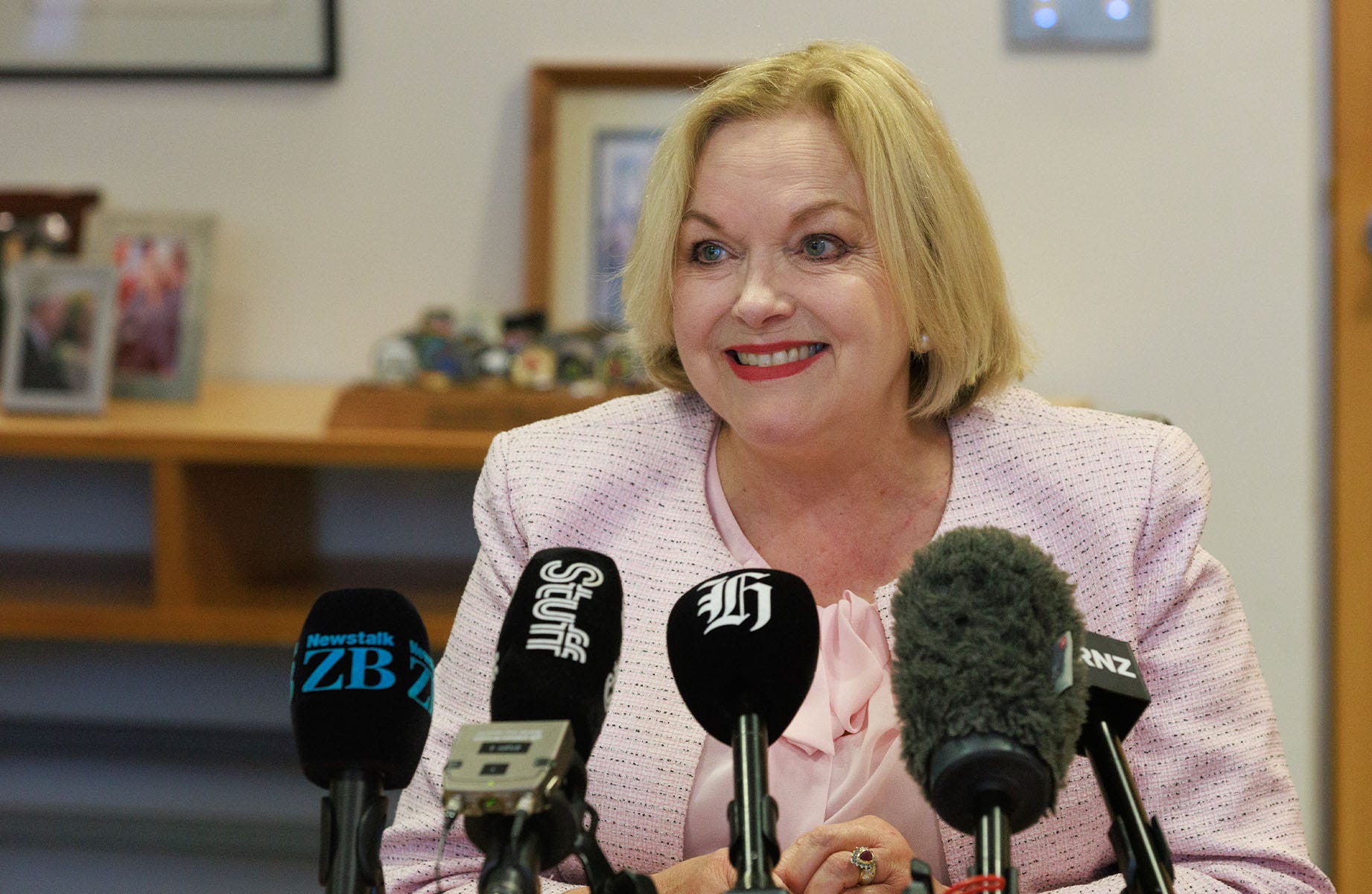
Judith Collins holds press conference to announce
retirement from politics.
Collins’ departure leaves National without one of its toughest scrappers, wisest heads, and most supportive caucus members. Her decision also signals a generational change in the National caucus and choosing her replacement in Papakura will be a critical one.
Having endured at times brutal treatment by the media is great to see genuine respect and fondness for Judith from across Parliament this week. Chris Hipkins called her “a worthy adversary” while his Finance spokesperson Barbara Edmonds reminisced fondly of her time working as an advisor in Judith’s office when she was the Minister of Revenue. Judith has a genuine friendship with Prime Minister Christopher Luxon and has been one of his highest performing ministers. Nicola Willis, Marama Davidson, and Chloe Swarbrick all referenced her fierce advocacy for women in Parliament with Swarbrick commenting “one thing that I can definitely say is that she always on a personal level was looking out for the women of every party here".
Collins’ departure leaves National without one of its toughest scrappers, wisest heads, and most supportive caucus members. Her decision also signals a generational change in the National caucus and choosing her replacement in Papakura will be a critical one.
Having endured at times brutal treatment by the media is great to see genuine respect and fondness for Judith from across Parliament this week. Chris Hipkins called her “a worthy adversary” while his Finance spokesperson Barbara Edmonds reminisced fondly of her time working as an advisor in Judith’s office when she was the Minister of Revenue. Judith has a genuine friendship with Prime Minister Christopher Luxon and has been one of his highest performing ministers. Nicola Willis, Marama Davidson, and Chloe Swarbrick all referenced her fierce advocacy for women in Parliament with Swarbrick commenting “one thing that I can definitely say is that she always on a personal level was looking out for the women of every party here".
Disclaimer: I worked in Judith Collins office when she was leader of the opposition.
National and Labour team up on the Modern Slavery Bill
National’s Greg Fleming and Labour’s Camilla Belich used Standing Order 288 to cosponsor the Modern Slavery Bill. The Bill requires companies with revenue over $100 million to report on risks of modern slavery in their supply chains, enables fines of up to $200,000, and civil penalties up to $600,000 for non‑compliance. It also envisages an anti‑slavery commissioner in the future.
ACT refused support, denouncing the bill as virtue signalling. Deputy leader Brooke van Velden argued that modern slavery isn’t a priority given other economic challenges and David Seymour said the bill imposes costs while failing to capture small companies. Their opposition is principled in that they hate red tape, but it gives the impression of being tone‑deaf. New Zealand’s $100 million threshold is high compared to Australian and UK laws, and the reporting requirements are hardly onerous.
For National, the cross‑party approach is smart. It inoculates the government from claims of being soft on human rights, shows Luxon can work constructively with the opposition and fosters goodwill ahead of an election. Labour, meanwhile, gets to claim a moral victory without being in power. Next up: will Labour back the India Fair Trade Agreement?
The Fair Trade Agreement
Winston Peters and NZ First are opposing the India free‑trade agreement, warning that its visa provisions amount to a “free migration deal.” Peters argued that by creating a specific employment visa stream for Indian citizens the agreement could see “tens of thousands” of Indian workers arriving in New Zealand, competing for jobs and driving down wages.
This criticism prompted an unusually blunt rebuttal from his coalition partners. Prime Minister Christopher Luxon said Peters was “wrong” about the agreement’s immigration impact and noted that he had also previously opposed the China FTA. Trade Minister Todd McClay stressed that the FTA authorises only 1,670 skilled worker visas and does not give any right for Indians to settle permanently. McClay said there is nothing in the FTA that gives “tens of thousands” of people a right to come to New Zealand.
Without NZ First’s support, it will come down to whether Labour will back the deal.
Holocaust Remembrance Day
Last Saturday was International Holocaust Remembrance Day, an event marked worldwide but, with a distinctly different vibe this year after the Bondi massacre not long ago and years of increased hostility toward Jews. Incredibly, the BBC’s flagship breakfast show did an entire segment on the day without mentioning Jews, you know, the six million people slaughtered. After an outcry, the BBC apologised, calling the omission “hurtful, disrespectful and wrong”.
New Zealand’s response was miles better. National minister Chris Bishop hosted an event at Parliament where he spoke emphatically against the contemporary antisemitism proliferating. He warned against those who add a “but” after condemning terrorism. He also had a message that likely was directed to members of the Green Party saying:
"Please, let’s drop the “From the River to the Sea” chants. The Jewish community has made it very clear what they think this chant means. Political leaders in New Zealand involving themselves with this should know better. Can we make the “lived experience” of Jews matter too please?
Likewise, “long live the Intifada” and “globalise the Intifada” are not just simple protest slogans. They mean violence and plenty of it.”
Across the Tasman, former Australian prime minister Scott Morrison gave a great speech at the Second International Conference on Anti‑Semitism. He recounted the Bondi Beach terror attack and quoted the late Rabbi Jonathan Sacks, who warned that antisemitism is a sign of civilisational crisis. Morrison criticised grievance politics on both the far left and far right, arguing that antisemitism finds new forms in radical ideologies.
Election-year guidance for the public service
The Public Service Commission released its General Election 2026 guidance for public servants and agencies this week. The foreword by Commissioner Sir Brian Roche emphasises that political neutrality is essential to maintaining public trust and that public servants must uphold the integrity of the civil service before, during and after the election. The guidance recognises that public servants have the same rights to freedom of speech and political activity as other New Zealanders, but stresses they must keep their personal views separate from their professional roles. It reminds agencies not to use public funds for political purposes, to treat MPs’ information requests like any other, and to avoid advertising that could be construed as partisan.
The guidance may seem dry, but it matters. Last election saw accusations of politicised agencies, from health boards pushing campaigns to departments retweeting ministers’ speeches. The Commission’s advice is clear and accessible; agencies and staff would be wise to read it and follow it.
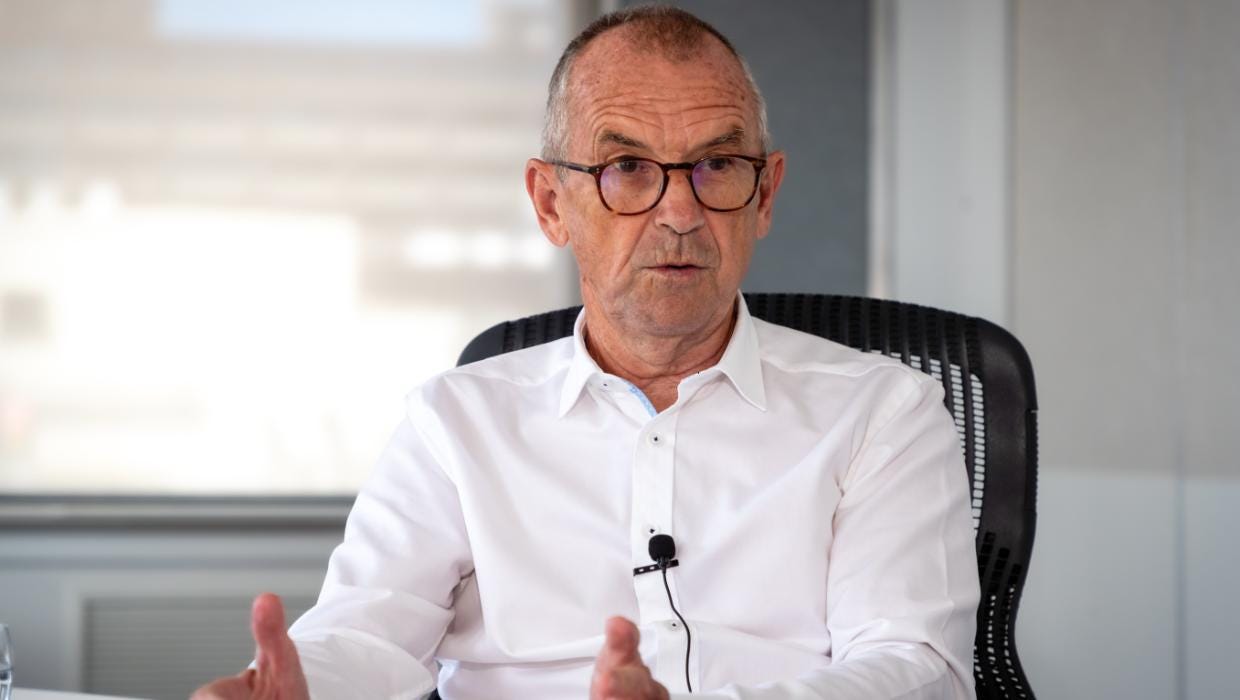
Public Service Commissioner Sir Brian Roche.
BRUCE MACKAY / The Post
Police, NZTA, Brian Tamaki, and the very fragile Harbour Bridge
Brian Tamaki’s Freedom and Rights Coalition planned another protest march across the Auckland Harbour Bridge this weekend, but police refused permission, citing safety concerns; specifically that the bridge is not designed for pedestrians and the clip‑on structure has long been fragile. Superintendent Naila Hassan said police would have a significant presence and block any attempt to access the bridge. The NZ Transport Agency declined the coalition’s application too and noted that not even the All Blacks victory parade is allowed to cross the bridge.
This all treats New Zealanders as idiots as we all have seen several protests cross the bridge in recent years including pro-Palestine activists and Toitū te Tiriti. There is also the small matter of the Auckland Marathon charging across each year.
Tamaki has quite fairly cried “selective policing” and insists he’s a peaceful protester. You don’t have to support Tamaki and his cause to expect consistency from our Police and NZTA.
Diocesan’s new principal smeared on front page but all isn’t as it seems
Yesterday the New Zealand Herald ran a large front page story on new Diocesan principal Dr Sandra Hastie alleging she left Brisbane’s Somerville House under a scandal. She did in a way, but all is not as it seems.
Late last year a file written by teachers and containing comments about students including personal content about their appearances, family situations, and medical diagnoses was uncovered. It was uploaded to an unsecured Microsoft Teams server and accessible publicly.
What our media did not mention is that file was written in 2021 and Dr Hastie did not take up the role of Principal until 2024. Yes, she had to manage a scandal, but it was one emerged five years after it happened.
The reporting suggests that Diocesan’s board may not have done due diligence before appointing Hastie, but it all reeks of a beat up on a wealthy private school.
A storm in a tea cup or a principled stand? Councillor refuses to attend marae planning day
Newly elected, and top-polling, Hastings District councillor Steve Gibson skipped a strategic planning session because it was held at Waiohiki Marae. Gibson said the late notice was a factor, but also that the agenda made him uncomfortable. He said did not appreciate extended addresses delivered in te reo without translation and felt the spiritual aspects of marae proceedings were inappropriate given they should be secular in local government. On a personal level it caused him discomfort because he has different religious beliefs. He argued that council business should occur on neutral ground and not in venues associated with specific cultural or religious practices.
Mayor Wendy Schollum responded that sessions are often held in community venues, including marae, halls and function centres, to “connect with diverse communities” and encourage open discussion. Takitimu Māori ward councillor Heather Te Au‑Skipworth said councillors were welcomed with aroha and that the venue choice allowed effective engagement. Ngāti Kahungunu Iwi Incorporated chair, and former Hastings District councillor, Bayden Barber called the action “distasteful” and “disappointing”.
Another despicable sentence for a violent criminal
David Farrar’s Kiwiblog highlighted a disturbing sentencing in Rotorua this week. Francee Edwin Reweti Page (51) assaulted a father at a playground after accusing the man’s six year old daughter of taking his grandchild’s shoes. According to the police summary, Page punched the victim three times, knocked him to the ground and continued assaulting him. The victim suffered a broken jaw, concussion and swelling while his daughter was deeply traumatised.
Page pleaded guilty to injuring with intent to injure, a charge carrying a maximum sentence of five years’ jail. However, Judge Andree Wiltens sentenced him to just 150 hours of community work and two years of intensive supervision; not even home detention. The victim described the sentence as a “pitiful” slap on the wrist.
Luxon says “no” to Trump’s Board of Peace
The Government has declined Donald Trump’s invitation to join his “Board of Peace”. The board is to oversee Gaza’s ceasefire but has begun morphing into a wider body for global conflict mediation. The Prime Minister has said New Zealand will not join the board “in its current form”. Foreign Minister Winston Peters added that regional states had stepped up and New Zealand “would not add significant further value”. Peters stressed that the board’s work must be complementary to and consistent with the UN Charter and that clarity is needed on its scope. He also praised the United States’ leadership on the issue.
The decision makes sense given our relative insignificance and the fact that membership requires a US$1 billion contribution. New Zealand has not got the spare cash to justify such an expense.
The parole hearing of psychopathic killer Clayton Weatherston
Clayton Weatherston, the man who stabbed his ex‑girlfriend Sophie Elliott 216 times and mutilated her body in 2008, is now eligible for parole after serving his 18 year non‑parole period. At his first parole hearing, he told the board his attack was “just an F‑U to everything about her”. He said he felt ashamed and remorseful and claimed his offending was about alleviating his frustration, projecting his anger onto Elliott. His lawyer acknowledged he was not actually seeking parole this time and understood more time would pass before release.
The Parole Board declined parole in any case and he will remain in prison until at least November 2027. Weatherston’s brutal crime shocked the nation and led to the abolition of the provocation defence. Given his history of minimising his offending and the board’s assessment that he remains high risk, any suggestion of his release is reckless and moronic.
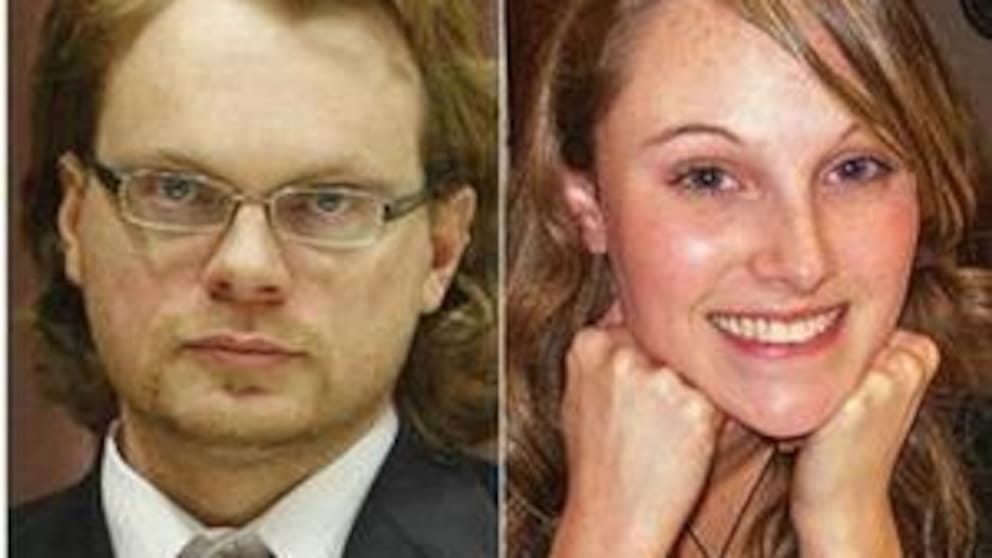
Clayton Weatherston and Sophie Elliott.
Mt Maunganui landslide support and accountability
Prime Minister Christopher Luxon told media there is a “strong case” for an independent government inquiry into the deadly landslide at Mount Maunganui. He has asked Associate Emergency Management Minister Chris Penk to provide advice on the inquiry’s scope. Luxon acknowledged that Tauranga City Council has ordered its own review but said six grieving families deserve answers and any conflict of interest must be avoided.
The Government also announced an initial $1.2 million in immediate mayoral relief funds and another $1 million to reimburse marae providing welfare support.
Chris Hipkins waited a week before turning up to Mt Maunganui and claimed his flight schedule meant he wasn’t able to attend any of the vigils. Combined with early politicisation of the tragedy and having lots to say about how the Government should handle an inquiry, this is not a particularly good look.
Do New Zealanders trust the police?
An RNZ–Reid Research poll asked New Zealanders how much trust they have in the police and about 20.7% said they had a lot of trust, while 50.5% had a fair amount. Just over 20% had “not much” trust and 5.7% had no trust at all. Trust was lowest among supporters of Te Pāti Māori (48.2% had little or no trust) and the Greens (44.1%), while only 12.4% of National voters, 18% of ACT voters reported little or no trust, and 36% of New Zealand First supporters expressed low trust.
Interestingly, the poll was conducted after former Deputy Police Commissioner Jevon McSkimming admitted possessing child‑sex and bestiality videos and was sentenced to home detention. Yet more than half of respondents said the scandal had not knocked their trust in police.
On balance, 70% of New Zealanders still have at least a fair amount of trust in police and Police Commissioner Richard Chambers has set a goal of 80% saying audits are underway to identify behaviour that falls short.
Rawiri Waititi’s hero in Burkina Faso dissolves all political parties
The military rulers of Burkina Faso, who seized power in September 2022, took another authoritarian step this week by dissolving all political parties. A decree approved by the council of ministers scrapped the legal framework governing parties and transferred their assets to the state. Interior Minister Emile Zerbo said the decision was part of a broader effort to “rebuild the state” and argued that the proliferation of parties had fuelled divisions and weakened social cohesion.
Rawiri Waititi’s public praise for Burkina Faso’s military coup leader Ibrahim Traoré is concerning and quite bizarre. Whatever anti-colonial rhetoric he is basing his admiration on, this is still a regime that came to power through extreme violence, suspended democratic processes, and governs by force rather than consent. For an elected New Zealand MP to romanticise a militant coup leader is an endorsement of authoritarianism and violence. If you claim to stand for self-determination and human rights, cheering on military strongmen who seize power at gunpoint is incoherent.
Critical mineral deal being discussed with US
Newsroom revealed that New Zealand is in closed door discussions with the United States about a “non‑binding critical minerals framework”. The admission came after a memo to the Waitangi Tribunal highlighted a “secret” deal between Australia and the US and warned that a similarly private arrangement would breach Te Tiriti o Waitangi. The Ministry of Foreign Affairs and Trade confirmed discussions with the US.
Critical and rare‑earth minerals like nickel, antimony, cobalt and vanadium (including deposits off the Taranaki coast) are essential for electronics and defence. China currently dominates processing and Donald Trump has threatened retaliatory tariffs on countries that don’t sign supply deals. New Zealand joined the Minerals Security Partnership last year and released a strategy aiming to double mineral exports to $3 billion by 2035. Resources Minister Shane Jones sees an opportunity to attract foreign investment, but the Greens are saying that the government is bending to Trump’s demands and ignoring Treaty obligations.
Chart of the Week:
Two charts from Charted Daily this week. First @Charteddaily says “crime data out today shows victimisations fell for the second consecutive year in 2025 - down 5.6% from 2024. The only larger annual decline recently was in 2020 (due to the strict Covid lockdowns).”
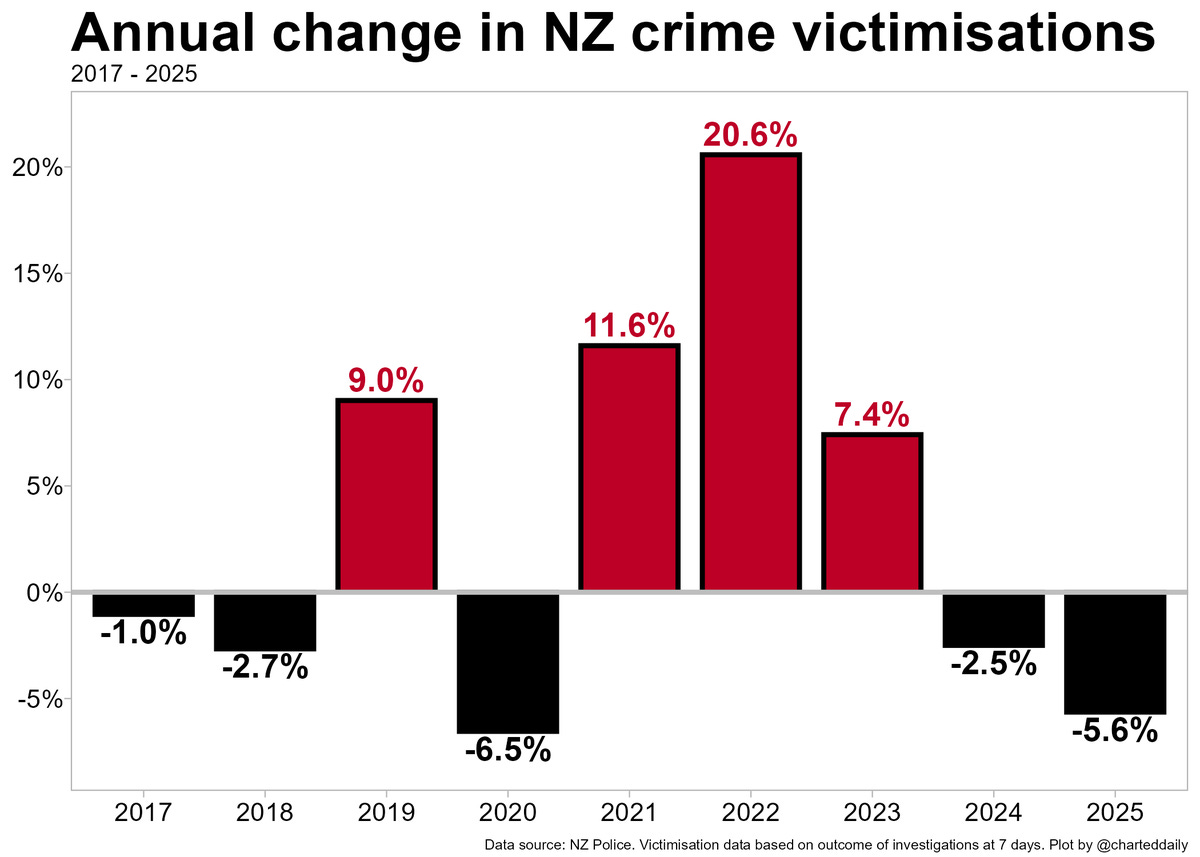
Click to view
And second, I couldn’t resist the chance to mention the ageing population and demographic crisis! [LINK]
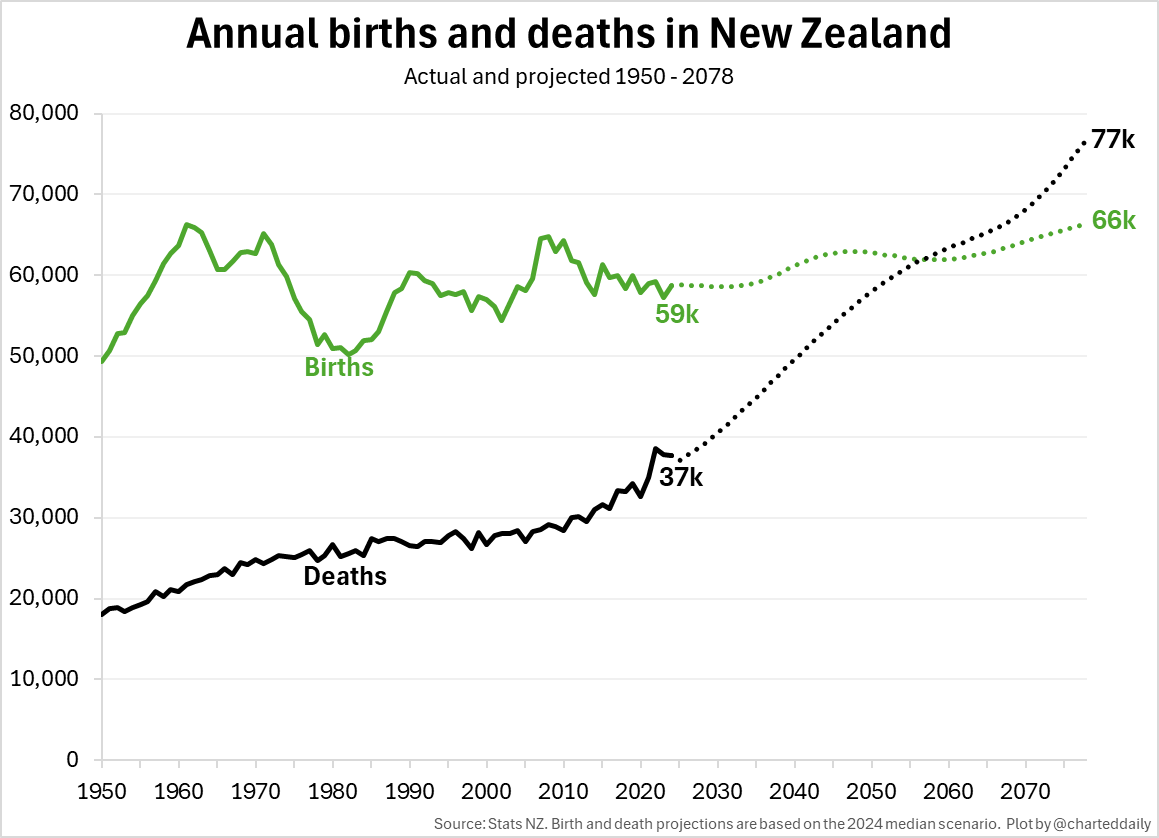
Click to view
In short - other stuff that happened:
- A media application related to Tom Phillips has been placed under suppression and referred back to the Family Court, limiting what can be reported while the court considers the matter.
- The latest RNZ–Reid Research poll found that 38% of respondents believe the Treaty of Waitangi has too much influence on government decisions, 34% think the influence is about right and 17% say it is too little.
- Rewi Gregory (74) has declared his Ngaruawāhia home an “embassy” and hasn’t paid rates in 18 years. He insists the land is Māori customary and therefore exempt, but the High Court disagreed, noting there was no evidence the property was Māori land and ordering him to pay more than $165,000 in outstanding rates.
- The House Oversight Committee voted on a bipartisan basis to hold Bill and Hillary Clinton in contempt for defying subpoenas in the Jeffrey Epstein inquiry. A handful of Democrats joined Republicans to send the resolution to the full House.
- Convicted terrorist Shahid Butt is standing for Birmingham City Council. Butt was jailed for plotting attacks on the British consulate, an Anglican church, and a hotel in Yemen but now could represent the heavily Pakistani Sparkhill ward.
- The man accused of murdering bus passenger Sefo Leger and wounding another has interim name suppression. This is despite his name being all over media when there was a manhunt for him. His trial has been scheduled for 2027.
- Green MP and former Wellington mayor Celia Wade‑Brown announced she won’t stand for Parliament again in 2026.
- Northland and Auckland hospitals endured a 12 hour IT outage this week.
- Hawke’s Bay Mongrel Mob member Lou Daniel Harmer has been jailed for 12 years and six months after being convicted on 14 charges relating to sexual offending against multiple young girls.
- Wellington’s ‘Cake Tin’ stadium will soon have a new name. Formerly known as Sky/Westpac Stadium becomes Hnry Stadium after the sole‑trader accountancy service bought naming rights in a five year deal.
- Four men, aged 26, 39, 42 and 46, have been arrested in Sydney after officers seized thousands of videos depicting ritualistic child sex abuse and “Satanic” symbols. They are being held without bail as investigators work to identify victims.
- In an attempt to spring alleged killer Luigi Mangione from jail, a Minnesota man Mark Anderson posed as an FBI agent and demanded that Brooklyn jailers release him. He produced a driver’s licence as “ID”, tossed documents at staff and claimed to have weapons.
- A $162 million, 60 bed mental health unit has opened at Auckland’s Mason Clinic. The three storey E Tū Wairua Hinengaro replaces leaky, ageing buildings and is designed for patients with serious mental health issues who have committed or are charged with serious crimes.
- Perth police responded to a harrowing scene in Mosman Park where a man, woman, their teenage sons and three pets were found dead in a suspected murder‑suicide.
- Australian activewear brand AROHA has been accused of cultural appropriation after non‑Māori owner Katie Bourke admitted she picked the Māori word for “love” simply to be “a little bit different”.
- New warnings about the Nipah virus have been issued to New Zealanders travelling to India and elsewhere in Asia. MFAT advises avoiding bats, sick pigs…
Thomas B. Edsall’s New York Times column ‘I wouldn’t say the Democrats are in good shape’ is a corrective to lazy assumptions that Democrats are on the brink of renewal. Drawing on a stack of recent polling, focus groups, and critiques from across the centre-left, Edsall argues that while MAGA may be wobbling, Democrats remain deeply mistrusted, widely seen as weak, and still captured by illiberal instincts that alienate working and middle-class voters. It’s a clear-eyed, often uncomfortable read that forces liberals to confront the gap between elite narratives and voter reality and why “Trump fatigue” is not the same thing as genuine confidence in the Democratic Party. Highly recommended if you want analysis rather than “hopium”, and a serious look at why the Democrats’ problems are structural, not just situational. READ HERE.
The Post Millennial posted ‘Leftist writer never reported her Las Vegas gang rape because she believes ‘in the abolition of police and prisons’’, a devastating case study in what happens when ideology overrides basic self-preservation and moral clarity. It recounts a left-wing writer who says she never reported a brutal gang rape because her commitment to abolishing police and prisons mattered more to her than justice, accountability, or even her own safety and the safety of other potential victims. This is what can only be described as suicidal empathy. Whether you read it with anger, sadness, or disbelief, it’s an essential example of how radical anti-institutional politics can collapse into something profoundly cruel and deranged. READ HERE.
Thanks to Bob McCroskie for bringing this paper called ‘Sexual orientation, crime victimization, and relationship to the offender: Insights from New Zealand police records, 2014–2024’ from Auckland University of Technology to my attention. It is framed in the language of care, compassion, and social justice, but it is ideologically corrupted to the point of not being useful at all for informing public policy. Bob accuses the authors of starting with a preferred narrative and then shaping the presentation to fit it and I tend to agree. READ HERE.
Off the record: Gossip, rumours, and speculation
- Lots of names have been floated as potential replacements for National in Judith Collins’ Papakura seat, but James Christmas’ name seems to be the one being repeated. He is a barrister and former senior ministerial advisor to Christopher Finlayson.
- A senior Labour MP stormed out of Parliament and Wellington, flying home after just a day back in Parliament. I am told there are ongoing relationship issues between him and another senior Labour MP which came to a head. Watch this space.


3 comments:
Ms Collins: a distinguished record. However, as National leader, she quickly towed the party line to shut down the 2021 "Demand the Debate" campaign to counter the He Puapua document.
Serious opposition at that point would have had real impact. Too late now.
Thanks Ani. Great read.
Yes Anon 4:11am - You are absolutely right. The National Party shut down Judith’s “Demand the Debate” quick smart. They gave us labour-lite Luxon and his left of centre kitchen cabinet instead. It’s not immigration or the economy that’s critical for NZ in this year’s election, it’s equal citizenship and democracy. National won’t say so, but they’re happy to erode both. NZ First says one thing while doing the opposite. Only Act has been prepared to stand and open the debate, but too many NZers aren’t yet listening, or are still only consuming msm propaganda.
Post a Comment
Thank you for joining the discussion. Breaking Views welcomes respectful contributions that enrich the debate. Please ensure your comments are not defamatory, derogatory or disruptive. We appreciate your cooperation.