

The fuel shock triggered by the Iran conflict is already biting in New Zealand, and the Government is openly preparing for a worst-case scenario. Ministers have warned that “things could get worse before they get better,” with contingency planning underway. While officials insist there is no immediate supply crisis, it is important for Kiwis to understand the impact will be far more broad than just the prices at the pump.
We rely on diesel trucks to get food around the country and plastics made using petrol products wrap that food. This is a huge vulnerability and supermarkets are warning of further food price hikes. Manufacturers too are flagging both cost pressures and supply risks.
The modelling shows that in a scenario where the Strait of Hormuz remains disrupted for several months, oil prices could surge to around US$185 a barrel, pushing petrol prices toward $4 per litre and driving inflation back up into the 5–6% range. That is an economic shock we could do without to say the least. It comes with real risks to production, transport, farming, and the ability to move goods around the country.
The modelling shows that in a scenario where the Strait of Hormuz remains disrupted for several months, oil prices could surge to around US$185 a barrel, pushing petrol prices toward $4 per litre and driving inflation back up into the 5–6% range. That is an economic shock we could do without to say the least. It comes with real risks to production, transport, farming, and the ability to move goods around the country.
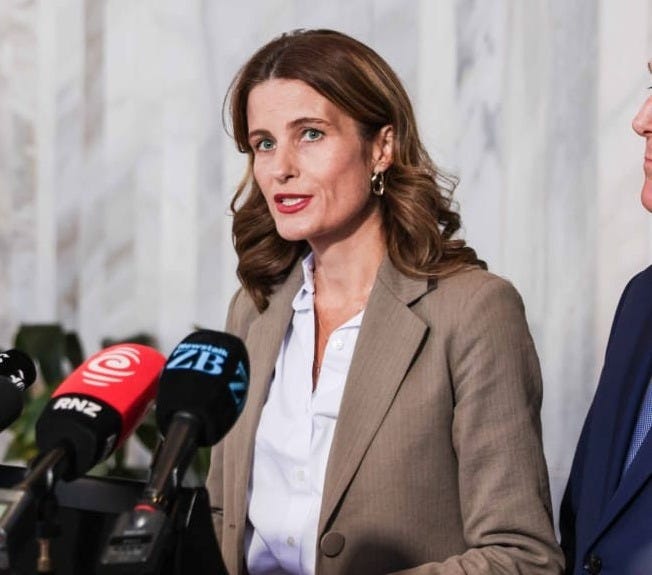
Nicola Willis has been the steadying force for the Govt.
Photo: RNZ / Samuel Rillstone
Chris Hipkins, the media, and a lot of benefit-of-the-doubt
I refer you to the article I published yesterday (below).

The sudden discovery of restraint and empathy in journalism
Ani O’Brien 20 Mar
Read full story
New Zealand prioritises sovereignty and Helen Clark has kittens
New Zealand has formally rejected the World Health Organisation’s amendments to the International Health Regulations which were adopted in 2024. There was a time limit to either accept or reject the amendments after they were adopted. Winston Peters confirmed the decision was made to preserve sovereign decision-making. The Foreign Minister posted to X:
“New Zealand First has always said that any decisions about the health of kiwis should be made from Wellington, not Geneva.”
The changes were pitched as improved coordination and preparedness after Covid, but the Government has taken the view that signing up to new global frameworks deserves more scrutiny than automatic acceptance. New Zealand remains part of the existing rules, so this is hardly a retreat from the world.
New Zealand’s ex who pops up everywhere, Helen Clark, declared the move “reputation-wrecking” and warned the country was veering into fringe territory. It is far less dramatic than that. It is a government choosing sovereignty over blindly falling in line. Hardly the end of civilisation despite the Chicken Little routine from those who seem to believe international cooperation only counts if you never say “no”.
The United States, Italy, Israel and Argentina also rejected them outright. Among the countries who partially or temporarily rejected the amendments were Canada, the Netherlands, Germany, Switzerland, and Austria. Whatever your view of the pandemic response, the WHO did not emerge from COVID with an unblemished record. I have been working on a Substack about this and the outrageous behaviour of China which I hope to publish soon.
Rape trial collapses after jury goes full victim-blaming
A rape trial in Nelson was abandoned after jurors submitted a series of questions enquiring about the complainant’s underwear, sexual history, and personal life. The law is very clear that things like clothing, past sexual history, or intoxication are not proxies for consent or credibility. Judge Bill Hastings had little choice but to discharge the jury, ruling that the reasoning underpinning those questions was so deeply entrenched that no judicial direction could undo the risk of a miscarriage of justice. In his words, “a mishap has happened” which feels like an understatement for a system grinding to a halt mid-trial because the jury were a bunch of victim blamers.
The case was about a 17 year old girl who was raped after a night out drinking with colleagues. She had been “getting to know” one man who was present, but it was another man who assaulted her when she was passed out. A new trial has since been held and her rapist was found guilty on March 13.
🇦🇺 Defence Strategy: stay close to our bigger cousins
New Zealand and Australia have signalled a move toward a far more integrated military partnership. Defence Minister Judith Collins, alongside her Australian counterpart Richard Marles, outlined a vision for an “increasingly integrated, combat capable Anzac force by 2035”. This would be essentially two militaries that can operate seamlessly together across training, equipment, and operations. In practical terms, that means deeper coordination in the Pacific, shared capability (including buying the same equipment, like the proposed Seahawk helicopters), and forces that can plug into each other’s structures when needed. It reflects the obvious reality that Australia has scale, New Zealand has niche capability, and in a more unstable world neither country can afford to operate in isolation. Though I daresay, we need Australia more than they need us.
In her remarks, Collins’ nonetheless insisted on sovereignty. She was clear that New Zealand retains full control over its personnel and decisions and that if Australia acts in a way we’re not comfortable with, we simply don’t participate.
Our economic recovery meets the Strait of Hormuz
The economic picture this week is one of cautious improvement colliding with fresh global risk. We were seeing the beginnings of a fragile recovery with things on paper moving in the right direction. We have recorded three quarters of GDP growth, but we cannot get carried away because that growth has been small. The economy is growing, but it’s not yet translating into people actually feeling better off.
Unfortunately, the interest rate story is starting to turn again and not in a way that commentators were predicting late last year. BNZ and Westpac have both lifted their mortgage rates and the expectation now is that rates could rise again or at least stay higher for longer, especially if inflation is reignited by global energy shocks.
And those energy shocks are the cat among the pigeons for our economic recovery. The Iran conflict is already driving up global oil prices, with petrol prices here $3.16 (at my local yesterday) and likely to push toward $3.50 a litre soon with the possibility of going significantly higher if the situation worsens. In 2022, the conflict in Ukraine saw us hit similar prices to where we are now, but that was the peak.
Evil chatbots go wild in Emergency Departments
Health New Zealand’s much-extolled AI rollout has hit a snag, with researchers demonstrating that the Heidi chatbot used in emergency departments can be jailbroken in just a handful of prompts. Once pushed outside its guardrails, it was able to generate guidance on things like identity theft, drug manufacture, and even produce clinical-style outputs despite being approved and deployed on the basis that it is merely an administrative note-taking tool. Officials have emphasised that no patient data was exposed and the specific exploit has now been patched.
The real concern is that a system rolled out nationwide into frontline healthcare appears to have passed through months of review without anyone identifying one of the most well-known and easily tested vulnerabilities in AI systems. If an external firm could bypass safeguards with minimal effort, it raises questions about what the approval process actually involved and whether it included any meaningful attempt to break the system before deploying it at scale. Read more here.
Faster deportations, fewer excuses
Immigration Minister Erica Stanford has signalled a clear tightening of New Zealand’s approach to non-citizens who commit serious crimes, particularly within the asylum system. The Government is advancing the Immigration (Enhanced Risk Management) Amendment Bill, which is designed to strengthen the ability to identify, manage, and ultimately remove people who pose a risk to public safety. That includes expanding deportation settings, lowering some of the thresholds that have historically made removals slow or difficult, and giving officials greater scope to act earlier when there are clear indicators of risk rather than waiting until harm has already occurred.
A key focus is ensuring that individuals who commit violent or serious offences while in New Zealand do not remain here indefinitely while cases drag through legal processes. The proposed changes are about reinforcing the principle that the right to stay in New Zealand is conditional on abiding by its laws. There is also an emphasis on improving information-sharing and risk assessment at the border.
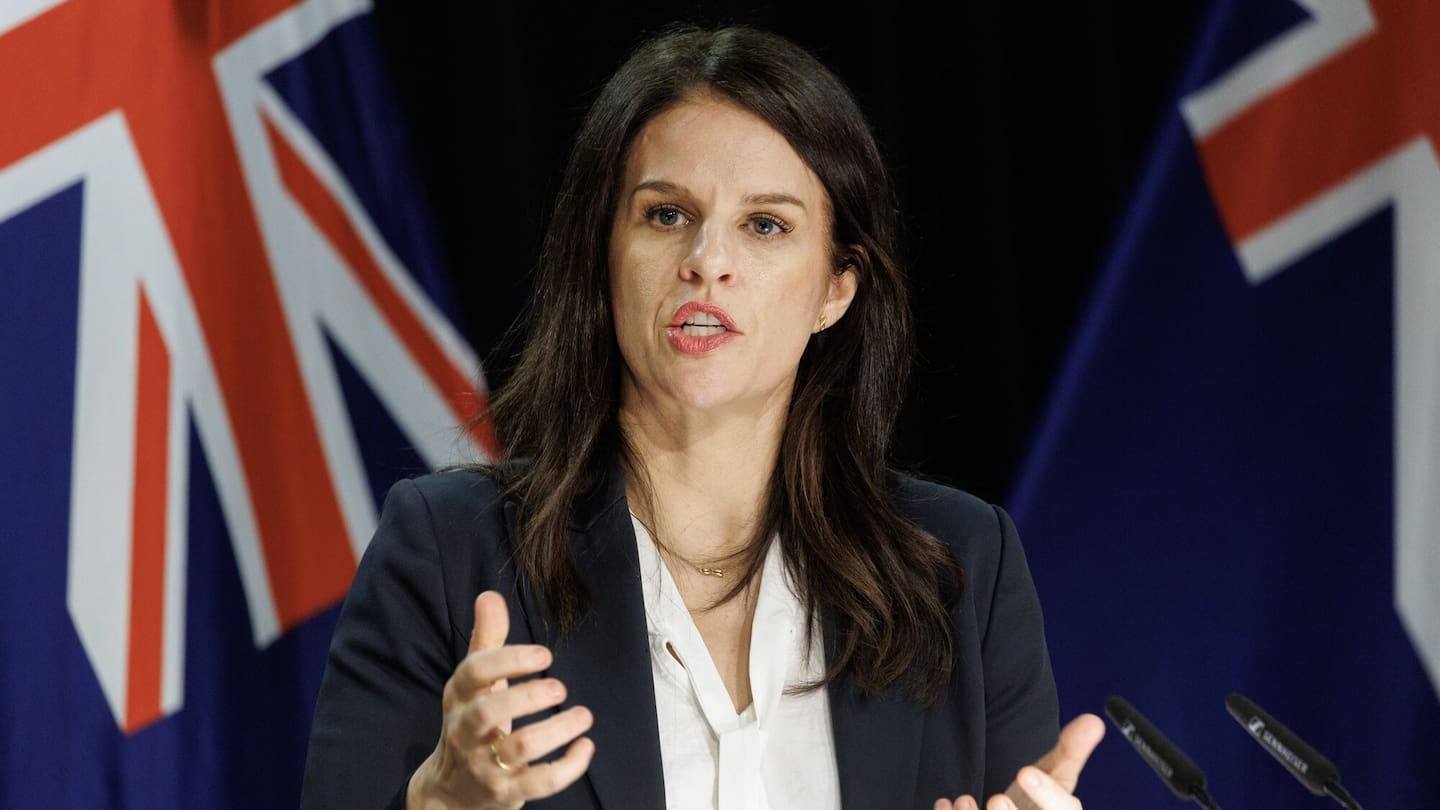
Immigration Minister Erica Stanford. Photo / Mark Mitchell
🇨🇰 A cool reception for Cook Islands Prime Minister
Foreign affairs took on a slightly awkward tone this week with the visit of Cook Islands Prime Minister Mark Brown. A visit that underscored the lingering strain in the relationship. Brown did not meet with Prime Minister Christopher Luxon, instead having an informal meeting with Foreign Minister Winston Peters in Auckland. This is hardly the full diplomatic reset you might expect between two countries with such close constitutional and historical ties. It could be read as calibrated coolness and New Zealand wanting to register its displeasure.
The backdrop here is the unresolved fallout from the Cook Islands’ push to deepen its relationship with China, including agreements that caught Wellington off guard and raised concerns about transparency and alignment. New Zealand, which maintains constitutional links with the Cook Islands and provides significant financial and defence support, has made it clear it expects to be consulted on matters with strategic implications. The Cook Islands has been asserting a more independent foreign policy while expecting no change to financial support. What this week showed is that while both sides are keeping lines of communication open, the relationship is not yet back on stable footing.
🇵🇰 🇦🇫 Pakistan bombs Afghani hospital and kills four hundred
A mass casualty event this week barely registered on global media’s radar. Unlike when anything happens in Gaza, when Iran-ally Pakistan deployed a strike on a hospital in Afghanistan which has resulted in the deaths of an estimated 400 civilians, there was little acknowledgment.
It’s difficult not to notice the disparity. We are told, repeatedly, that civilian harm in conflict is the ultimate moral line, and rightly so. But that principle appears to be applied selectively. Some conflicts are scrutinised in forensic detail, with every development amplified, analysed, and moralised. Others pass almost without comment, despite casualties on a comparable or even greater scale.
🇺🇸 Quit “lion” about the lyrics
In news that feels like it was generated by AI trained exclusively on 2026 headlines, the man, Grammy-winning composer Lebo M, behind that Lion King opening chant is suing comedian Learnmore Jonasi for translating it wrong.
The iconic “Nants’ingonyama bagithi Baba”… The spine-tingling, childhood-defining, circle-of-life moment has now entered its litigation era thanks to a comedian who (deliberately?) incorrectly translated it as “look, there’s a lion, oh my god.” It really means something like “all hail the king.” For this grave cultural offence, the comedian is being hit with a US$27 million lawsuit. Somewhere, in a very expensive legal office, someone is being paid by the hour to argue that “oh my god, a lion” constitutes trade libel.
The legal filing insists this was not a joke, but a “fabricated, trivialising distortion” that has apparently undone 30 years of artistic legacy. Which is impressive, frankly, given even a bad Disney live-action cash grab failed to achieve that.

Picture Credit: The Lion King & Instagram/Lebo M
Little office dramas in the capital
No week in Wellington is complete without something faintly ridiculous, so I bring you a full-blown political drama over…office views.
While the city grapples with pipes exploding, rates skyrocketing, and general managed decline, the real crisis at Wellington City Council appears to be that the bureaucrats have bagged the penthouse harbour views, while elected officials, including the Mayor, have been relegated to what has been described as a “lovely outlook over a carpark wall.” Andrew Little is reportedly “fuming”. You don’t claw your way to the top job in the capital city to end up hosting dignitaries next to the carpark.
The new $207 million waterfront HQ, leased over 25 years, has the people voters actually chose on the first floor in a shared workspace, while the unelected executive layer is upstairs, gazing out over the harbour like royalty. Though it is reflective of a system that enables its bureaucrats to censure elected representatives via code of conduct complaints.
This is hardly the most pressing issue facing Wellington, but it is absolutely positively Wellington. A city where the infrastructure doesn’t work, the finances are cooked, and yet somehow they still find themselves locked in a passive-aggressive turf war over office feng shui. Apparently despite the mayor’s displeasure, it’s “too late to change,” so no one is responsible, and everyone is annoyed. Which might just be the most accurate summary of Wellington governance ever.
A big week for Big Fishing
The fishing industry had a big week, and it was almost entirely about Shane Jones’ Fisheries Amendment Bill. A sweeping reform package that will reshape how commercial fishing is regulated. The bill includes multi-year catch decisions, more flexibility around unused catch entitlement, new rules for returning some quota species to the sea when monitored, and a full carve-out putting onboard camera footage beyond the reach of the Official Information Act. It also creates new disclosure offences, with penalties of up to $50,000 for unlawful release of camera recordings.
Fisheries are a major export earner and employer, with the seafood industry contributing about $2 billion in export earnings and supporting roughly 16,500 jobs. This is the basis for Jones’ case for reform. He descries a productive, strategic industry that is being constrained by outdated rules. But there is some backlash from opponents who see it as a shift in power toward quota owners and away from public oversight, recreational interests, and long-term abundance.
Jones conceded on one aspect of his proposed action this week. A proposal to let commercial fishers retain and sell certain reef fish species caught as bycatch in the upper North Island will not go ahead, after more than 22,000 submissions and strong public opposition. The existing ban remains in place.
🇦🇺 🇬🇧 This week in Islam and the West
Australian Prime Minister Anthony Albanese had a very public reminder yesterday that global conflicts don’t stay neatly overseas. During a visit to Lakemba Mosque in Sydney for Eid prayers, he and Home Affairs Minister Tony Burke were heckled, booed, and accused of being “genocide supporters” by a group of protesters angry at the government’s position on the Israel–Gaza conflict.
"You called him honourable, he's responsible for the deaths of 1 billion people, 1 billion of our brothers and sisters," one attendee shouted at a speaker calling for calm. International media have reported on some of the heckling New Zealand media chose to leave out. The Telegraph says he was also called “putrid dog” and ““Alba-tizi”, a derogatory Arabic play on his surname referencing the buttocks.”

Reuters.
In London, in Trafalgar Square, a large Islamist prayer gathering drew crowds, chants, and imagery that would have been unthinkable in that setting not long ago. What stood out wasn’t just the size of the crowd, but the tone; explicitly political, overtly religious, and in parts openly hostile to Western institutions and values. This wasn’t a quiet cultural or religious event; it was a demonstration of confident dominance staged in the symbolic heart of Britain. Oh, and the Mayor of London attended.
A former British ambassador has also warned that “Islamist entryism” is influencing parts of the UK Civil Service, contributing to what he describes as a growing bias in how Middle East issues are interpreted. He argues that this has led to a moral inversion where allies like Israel are subjected to intense scrutiny while adversaries such as Iran are increasingly contextualised or excused.
Chart of the week
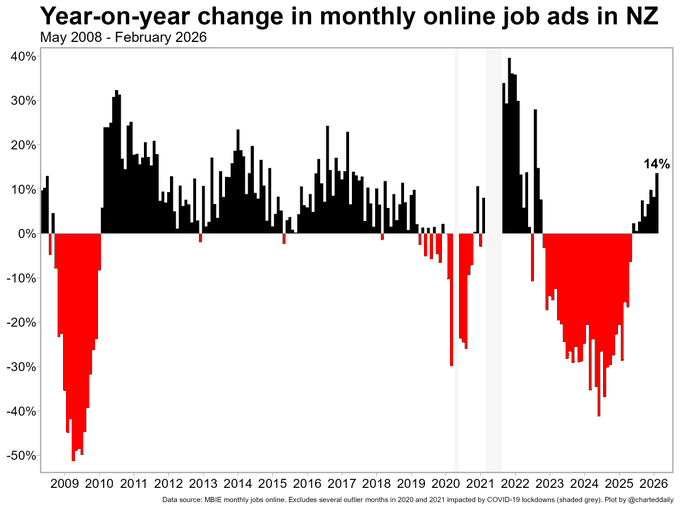
@Charteddaily: New Zealand online job ads were up 14% year-on-year in February.
Growth was strongest in the South Island and in construction, healthcare and manufacturing.
Click to view
In short - other stuff that happened
- The Government is rolling out a new digital wallet in its Govt.nz app that will allow people to store and eventually use digital IDs, including driver licences and proof of age, instead of physical cards. Legislative changes are required before they can be widely used.
- Te Pāti Māori MP Mariameno Kapa-Kingi says she has had no meaningful contact with party leadership since being reinstated by the High Court, describing the lack of communication or apology as “deafening”.
- Former Wellington Mayor Dame Kerry Prendergast has admitted she has lost her licence for 3 months after repeated speeding offences. She says it’s “very easy” to speed in a Tesla.
- Convicted child sex offender James Skelton has returned to the Coromandel town where his offending occurred just days after his sentence and restrictions ended. Despite the severity of his crimes, there are no legal barriers preventing him from living near his victim.
- 🇦🇺 Queensland’s 2026 Young Australian of the Year, Jarib Branfield-Bradshaw, has been charged with eight counts of possessing child exploitation material. The case is now before the courts.
- 🇬🇧 A charity linked to King Charles has cancelled a boxing course for disadvantaged girls after concerns were raised about biological males participating. Instead of just separating boxing competitions by sex they cancelled the girls’ comp.
- The Chatham Islands Council is in a dire financial position following a major spending blowout by CEO Paul Eagle, with the Auditor-General raising serious concerns about potential misconduct now being considered by the Serious Fraud Office. The council is seeking a bailout from the Government.
- 🏴 Police Scotland is moving to record biological sex rather than self-identified gender across its systems, following legal clarification that “women” in the Equality Act refers to biological women. The change unwinds earlier policies introduced under Nicola Sturgeon.
- Tracey, a 15 year old girl, was last seen in Conifer Grove on February 27 and reported missing on March 4. She is described as around 150cm tall with brown eyes and black hair, and was last seen wearing a purple T-shirt and black Nike pants; anyone with information is urged to call 111. Click for photo.
- Harness racing driver Jordan Crawford was sentenced to 10 months’ home detention after repeatedly assaulting his partner, with a judge condemning his actions as “cowardly” and “gratuitous violence” and warning he was lucky to avoid prison.
- 🇺🇸 In an awkward moment during President Trump’s meeting with Japan’s Prime Minister he was asked why allies weren’t warned about strikes on Iran. He retorted “Who knows better about surprise than Japan?” before adding, “Why didn’t you tell me about Pearl Harbour?” The Japanese Prime Minister visibly reacted but said nothing, leaving the remark hanging in an uncomfortable silence.
- A 68 year old man has been found guilty of sexually assaulting a teenager at his Canterbury bach more than three decades ago. He has been remanded in custody ahead of sentencing in May, with his name suppression to be reconsidered.
If you’re looking for a break from the endless bad news, outrage, and general chaos, the Department of Conversation kākāpō livestream is a surprisingly mediative experience. It’s just one bird quietly going about her life in a nest on a remote island, raising her chick, completely untouched by the noise of the modern world.
There are only 236 kākāpō left on Earth, and most people will never see one in real life so watching her feels kinda special and oddly grounding. Honestly, I needed an escape from the bullsh*t this week and I found this.
Ani O'Brien comes from a digital marketing background, she has been heavily involved in women's rights advocacy and is a founding council member of the Free Speech Union. This article was originally published on Ani's Substack Site and is published here with kind permission.


1 comment:
On this oil crisis I do worry how we will go. Obviously now it's too late to ensure our reserves are stored in NZ, where they're it's capacity of the government had sorted out Marsden Point rather than fluff about and do nothing. And obviously this situation is entirely on the doing of the US and Israel, but...
Nicola Willis has proven at best inept, at worse clueless as a Minister of finance and just her and Nationals management could well exacerbate the problems. Two and a half years have been wasted by their fiscal management and we are NOT in a good position to handle this. The proof is so far is their inaction. They are raking in the GST and...crickets. it's not her usual fiddling while Rome burns, it's doing a Luxon and hiding.
I cannot help but conclude whatever it will be will be poorly thought out.
Post a Comment
Thank you for joining the discussion. Breaking Views welcomes respectful contributions that enrich the debate. Please ensure your comments are not defamatory, derogatory or disruptive. We appreciate your cooperation.