

During a recent visit by the US President to Beijing, President Xi of China made it clear that Taiwan must become part of China. Xi has frequently talked of Taiwan as part of China, and that it will eventually be reunited including by military force if necessary.
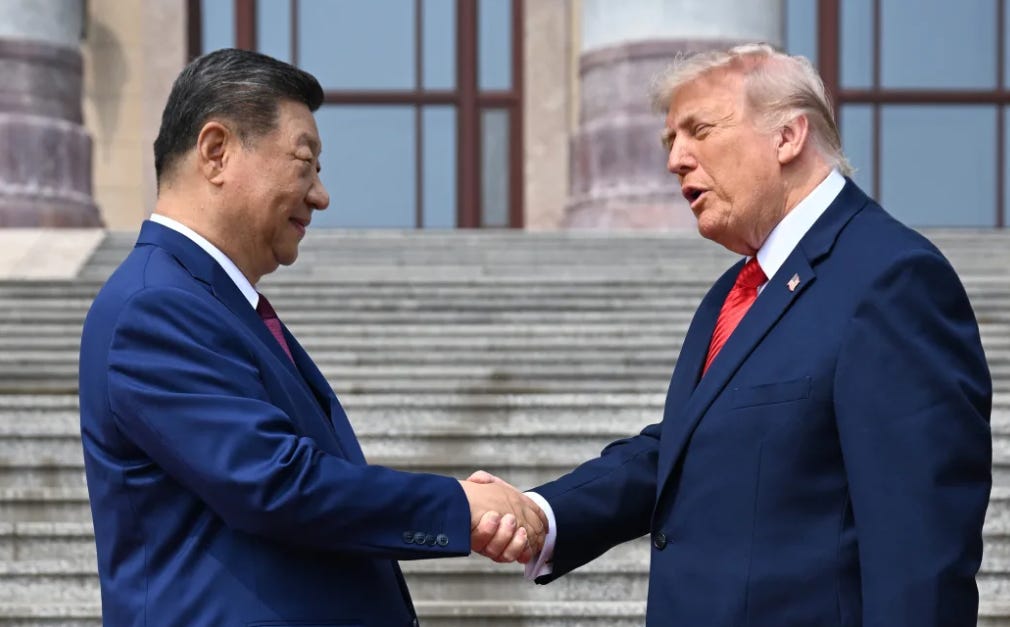
China’s President Xi, and the America’s President Trump
at their recent meeting in Beijing. Photo credit: AFP.
This is not a new position by the leader of the Chinese Communist Party (CCP) and as such, people often just accept the position without much question.
We should however, step back from the familiarity and see this position for what it is – a well-armed, militaristic autocracy wanting to take over a vibrant functioning democracy.
Our reaction should not be indifference, but outrage.
As I have frequently said, if we believe in democracy, then we should believe in it’s value and importance everywhere. Taiwan was once a dictatorship, but now free of those shackles. I had the good fortune to visit a few years ago, including meeting President Tsai, and the country is amazing. The idea that a totalitarian communist regime could control the country should concern everyone. Not just that there is no equivalence between communist regimes and democracies, but also from an economic and military perspective. For China to control Taiwan would instantly change the geo-political and strategic balance in the Pacific. This cannot be overstated.
This is not a new position by the leader of the Chinese Communist Party (CCP) and as such, people often just accept the position without much question.
We should however, step back from the familiarity and see this position for what it is – a well-armed, militaristic autocracy wanting to take over a vibrant functioning democracy.
Our reaction should not be indifference, but outrage.
As I have frequently said, if we believe in democracy, then we should believe in it’s value and importance everywhere. Taiwan was once a dictatorship, but now free of those shackles. I had the good fortune to visit a few years ago, including meeting President Tsai, and the country is amazing. The idea that a totalitarian communist regime could control the country should concern everyone. Not just that there is no equivalence between communist regimes and democracies, but also from an economic and military perspective. For China to control Taiwan would instantly change the geo-political and strategic balance in the Pacific. This cannot be overstated.
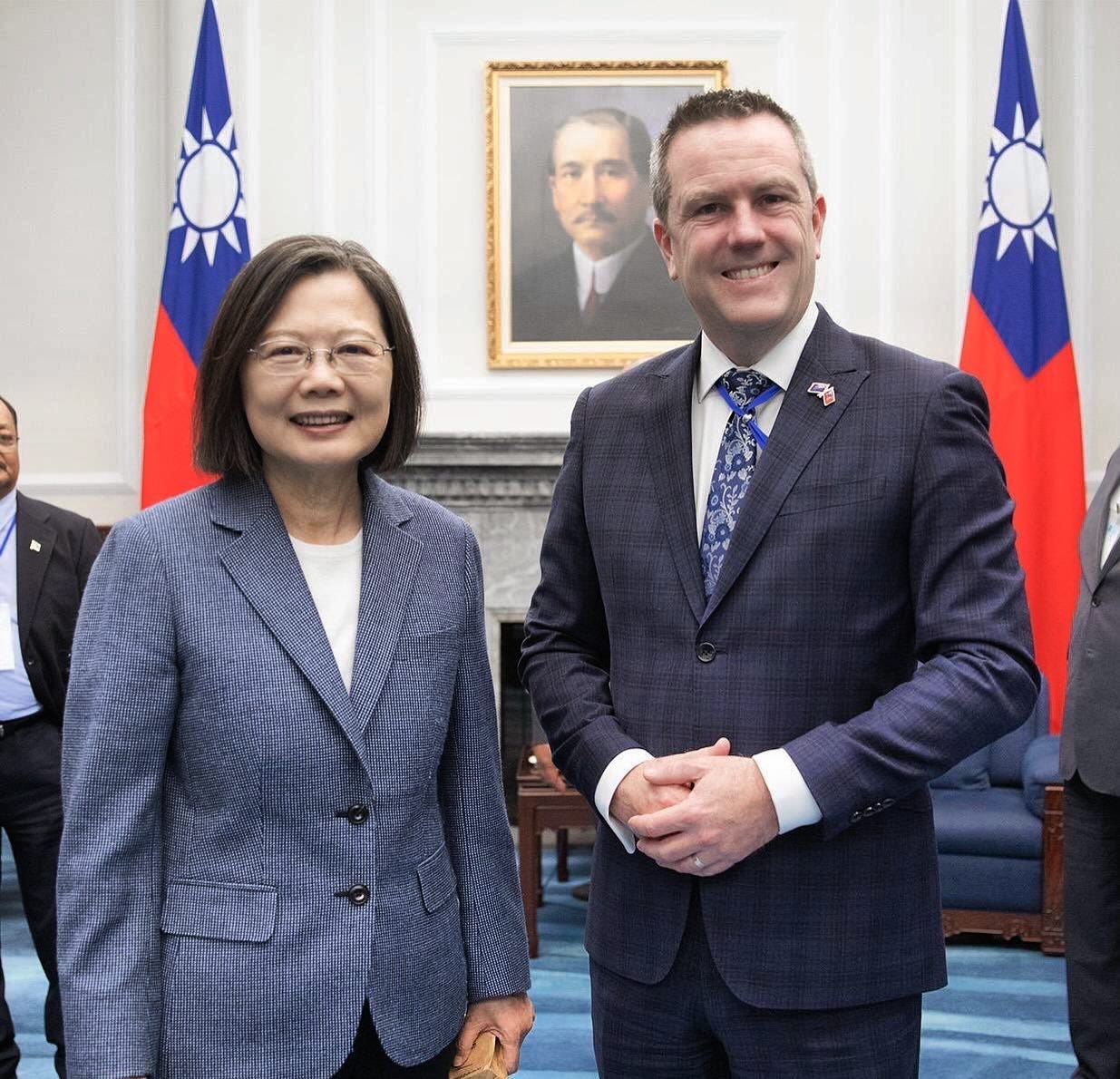
Meeting Taiwan’s President, President, Tsai Ing-wen, in 2023.
But the key objection remains a moral one – if we value our democracy in New Zealand, we should value democracies around the world. As I keep stressing, not all political systems – or cultures, religions, philosophies for that matter – are made equal.
You would think New Zealand the rest of the Western world would have learned from the tragedy of Hong Kong. Like Taiwan is today, Hong Kong was once vibrant and democratic, with a free press and the other freedoms we perhaps take for granted here at home. However, from 2019 onwards, this democracy has been crushed. There is no free press, no free elections, and state control is everywhere.
While I am very familiar that China is New Zealand’s largest trading partner, this should not blind or silence us around these matters. Furthermore, when dictators like Xi talk about these things, we should believe them.
The New Zealand government and corporate boards should be preparing now in anticipation of Chinese aggression across the Taiwan Strait. We should rightly be calling for restraint and an end to the threats, but preparing contingencies is also prudent.
If China’s People’s Liberation Army (PLA) attacks Taiwan, the consequences will be massive. I would posit that it will make the economic fallout of Covid and current fuel issues look minor in comparison. We should be considering alternative trade routes, variations of supply, and what we currently rely on from overseas that we could better develop here at home. We need strategic resilience and this begins with planning early. It also means real investment into local industry and also into our military. I am aware of the various speeches and intentions, including the Prime Minister’s recent speech about New Zealand’s place in a more volatile world. It was an excellent speech, but more than words are needed. To date, the coalition government’s words and claims have not always reflected the reality of the situation (granted, that’s true of any government!). There will need to be a prioritising of spending into strategic infrastructure as well as defence. This will not be easy of course, for there is no shortage of demands for funding and certainly not enough money to cover every need.
I would maintain that New Zealand should have been better prepared for the consequences of the current conflict in the Middle East. What is happening there was well-signalled and should not have surprised anyone. While credit can be given to how both government and corporate entities have reacted, the lesson should be to have being already prepared – not simply reacting after the fact. For example, we should have already been building onshore capacity to increase fuel stocks.
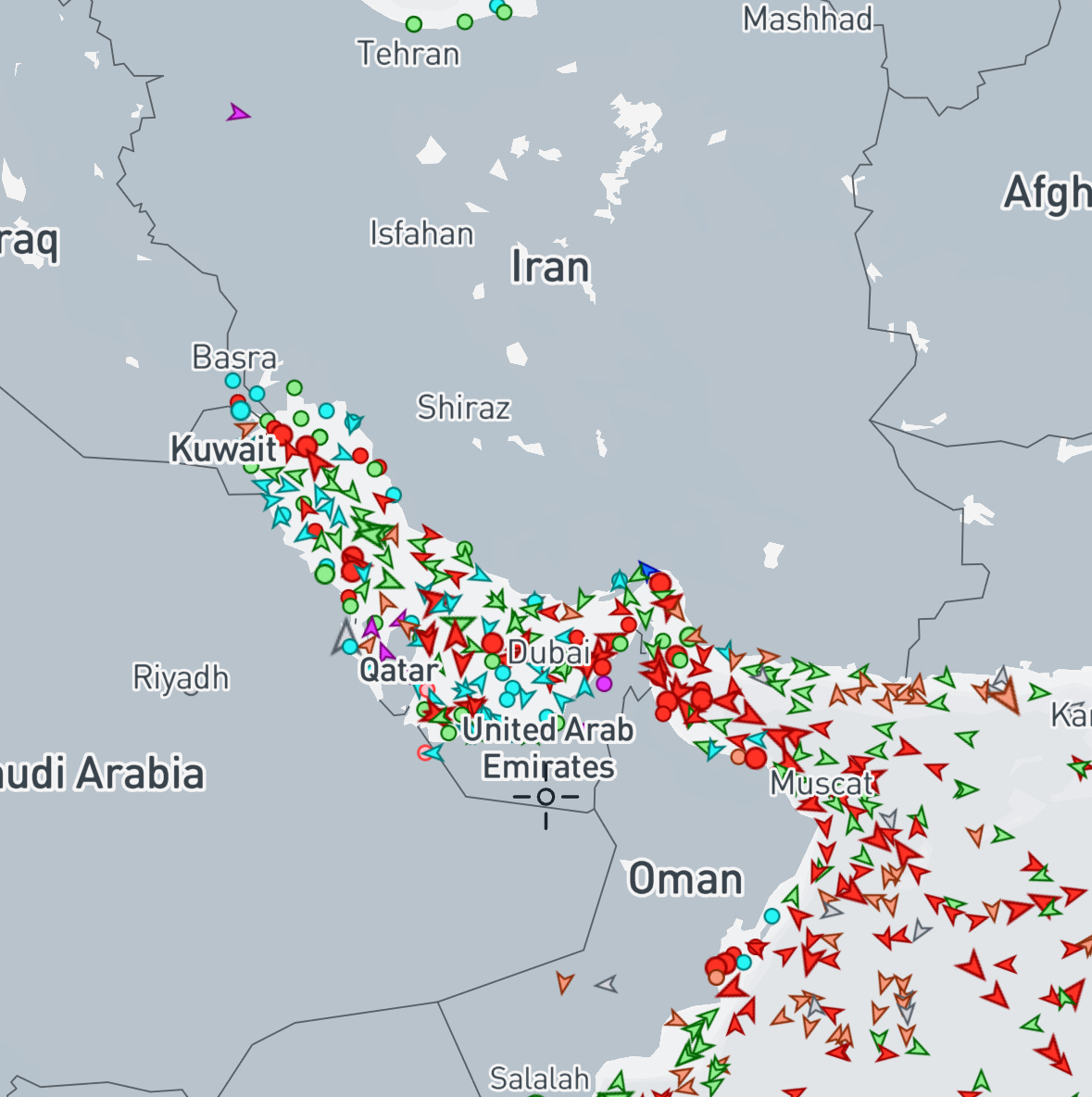
Just some of the current marine traffic in the blocked up Strait of Hormuz
We live in a more unstable world with the rules-based order – to which we have become comfortable with - fraying notably. These changes are happening before our eyes and from friend and foe, and alongside the threats by the likes of the CCP, we should be ready. There is no excuse to be unprepared.
Simon O'Connor a former National MP graduated from the University of Auckland with a Bachelor of Arts in Geography and Political Studies . Simon blogs at On Point - where this article was sourced.


6 comments:
Are there any Jews involved? If not don't expect any outrage from us.
In 1949, the communist insurgents defeated the Kuomintang government forces and the legitimate, internationally recognised government of China was exiled to Taiwan.
The UK was the first country to recognise the communist govt in Beijing in 1950. Other European nations rapidly followed suit, although it was not until the 1970s that full diplomatic relations were in place. The One China Principle (or Policy, as usually stated by Western govts) was just about universally accepted by the end of the 1970s.
We see here a process of betrayal by the West that began the year after the communist take-over - betrayal of the West's own professed governmental values that supposedly sanctify democracy and liberty.
I realise I am in a minority, but I personally regard Taipei as the capital of China with a legitimate claim to rule the whole country. Not all of us abandon our bottom-line principles so easily.
O'Connor is quite correct that there is no excuse to be unprepared for the coming Taiwan War. Xi's intentions are quite explicit.
In that respect, our dangerous trade imbalance with China carries massive strategic risk.
The cost to New Zealand from the closure of Hormuz will be chickenfeed compared with the potential losses from the closure of the South China Sea trade routes when the war starts.
And that's always assuming we have any trade with China by then, given their ability to choke off the New Zealand economy by refusing to buy our stuff.
Never forget they tried to cut off Australia at the knees by banning Australian ore imports over a minor diplomatic slight. Our siding with Taiwan will not be seen as minor.
Fortunately for Australia they rapidly found new buyers. And that's why our new trade agreement with India is so important for us because diversification is precisely how we prepare ourselves for that eventuality.
Peters doesn't deserve his job as Foreign Minister if he opposes ratification of that deal for petty political reasons. New Zealand First he says. Yeah right. He and his party are a danger to the country. We need more deals like the Indian one, and fast. Time is running out.
Today, most new Zealander's will not recall the "final days of Hong Kong, as the 99 year lease started to come to an end.
The People of Hong Kong, did not look forward to the prospect of being 'taken over', by the neighbor to the north, one that they had watched since late 1949 and what that "neighbor" had done to both the people and the Country (China) and continued to watch across the years the changes that occurred, not always to the betterment of the People.
From 1997 onward we saw the progressive movement of Hong Kong Citizens toward NZ and the number who started buying houses, in Auckland, for the ultimate move to NZ..
Those that "spoke" clearly stated (with caution, as any family reaming in Hong Kong or even in China, could be at risk of Police brutality, for 'mis-spoken' words - many spoke under anonymity) - what was likely to happen from 1999 onward and their words "came true" in a sense with riots in Hong Kong and the brutal retaliation by the Police, who were then controlled by the CCP.
Over the years the "placement" of CCP members in various Cities across the world, not all in Diplomatic Service (but no doubt travelled with a Diplomatic Passport) and created "Offices" that were and still are, as "an outpost" for entrenchment into Chinese Communities, in those Countries and to establish control over those people, more by 'blackmail'.
I am sure Taiwan has "watched" the same process and knows what is likely to happen to both Citizens & Country "if" China "steps a shore".
When that happens, me thinks the US will just have to 'sit and watch', knowing that any intervention is going to be the "wrong thing".
Oh and once Taiwan is "taken", then Korea and then Japan.
Then the move South toward the Philippines, Malaya, Indonesia.
They are already "locating" potential harbours for the placement of Naval vessels and support people.
While I agree that China can destroy us economically, and probably would, I disagree with their probable takeover of Taiwan.
Both Venezuelan and Iran relied on Chinese supplied anti-aircraft technology that failed spectacularly.
Taiwan knows China better than we do and isn’t sitting idly by resigned to an inevitable takeover.
Then there is the American president to consider, nothing will happen while Trump’s president or if Vance or Rubio take over in ‘29.
Some good points here Simon, especially about the need for national resilience, and some seriousness about Defence. However, it would have been quite difficult to tell the difference between a communist dictatorship and the ‘democracy’ in NZ over the period 2020-2023. And if democracy actually means meeting the wishes of the mass of the population, it might still be a little problematic.
Post a Comment
Thank you for joining the discussion. Breaking Views welcomes respectful contributions that enrich the debate. Please ensure your comments are not defamatory, derogatory or disruptive. We appreciate your cooperation.