

Labour has had a busy time announcing policies (finally). Last week was the public transport fare cap of $20 a week in Auckland, Wellington and Christchurch, and $10 elsewhere. Labour costed it at $65 million a year, but the numbers immediately began to wobble. Economists Sam Warburton and Brad Olsen put the more realistic figure somewhere between $91-112 million.
Then came “free” maternity scans. Obviously, no one wants pregnant women paying unnecessary costs to check their babies are healthy. But the policy is less revolutionary than advertised. Pregnancy scans are already publicly funded when clinically indicated so what many women are paying is a co-payment charged by some community providers. Some regions don’t have a co-payment at all, and generally it will be waived in situations of hardship.
Then came “free” prescriptions. Labour wants to scrap the $5 prescription charge, at a claimed cost of $74.5 million a year. The pitch is that people could save “up to” $100 a year, which sounds much better than “most people will save considerably less, and some already get prescriptions free because they are 65+, have Community Services Cards, or go to pharmacies that absorb the charge themselves.” The policy is to be paid for by the capital gains tax that is apparently also paying for everything else.
And then Labour’s education spokesperson Ginny Andersen confirmed that Labour would scrap the Government’s new primary school testing tool. The Smart Tool is meant to provide twice-yearly checks in reading, writing and maths for students in years 3 to 10.
The party is trying to buy its way back into contention with small, but tangible cost-of-living offers: cheaper buses, “free” prescriptions, “free” GP visits, “free” scans. But the same capital gains tax (that is meant to be narrowly applied) is being asked to fund an expanding list of promises and the costings are already being challenged.
Then came “free” prescriptions. Labour wants to scrap the $5 prescription charge, at a claimed cost of $74.5 million a year. The pitch is that people could save “up to” $100 a year, which sounds much better than “most people will save considerably less, and some already get prescriptions free because they are 65+, have Community Services Cards, or go to pharmacies that absorb the charge themselves.” The policy is to be paid for by the capital gains tax that is apparently also paying for everything else.
And then Labour’s education spokesperson Ginny Andersen confirmed that Labour would scrap the Government’s new primary school testing tool. The Smart Tool is meant to provide twice-yearly checks in reading, writing and maths for students in years 3 to 10.
The party is trying to buy its way back into contention with small, but tangible cost-of-living offers: cheaper buses, “free” prescriptions, “free” GP visits, “free” scans. But the same capital gains tax (that is meant to be narrowly applied) is being asked to fund an expanding list of promises and the costings are already being challenged.
Simeon Brown commits the unforgivable sin of making ministerial appointments
Health Minister Simeon Brown has caused outrage this week by exercising his ministerial appointment powers. The controversy began after Brown declined to reappoint Medical Council chair Dr Rachelle Love and deputy chair Simon Watt. His reason was that the council had become distracted from its core job of regulating doctors and protecting patients, and was instead drifting into ideological territory through its work on culture, privilege, dominant culture, appropriation, and “dismantling systems”.
Naturally, the people who have spent the past several years embedding their own ideology into our medical institutions are now shrieking “ideology!” This is the great trick of institutional capture. Takeover the body, rewrite the standards, call your politics “evidence-based practice”, then accuse anyone who objects to it of politicising what you politicised first.
The same panic has now spread to the Nursing Council, where Brown has replaced several members. The New Zealand Nurses Organisation says this shows a lack of focus on patient safety. Others have called it political interference, overreach, even a “whitewash”. I think that is a racial comment. We are apparently meant to believe that patients are now in danger because fewer regulatory appointees share the precise ideological priorities of the outgoing regime.
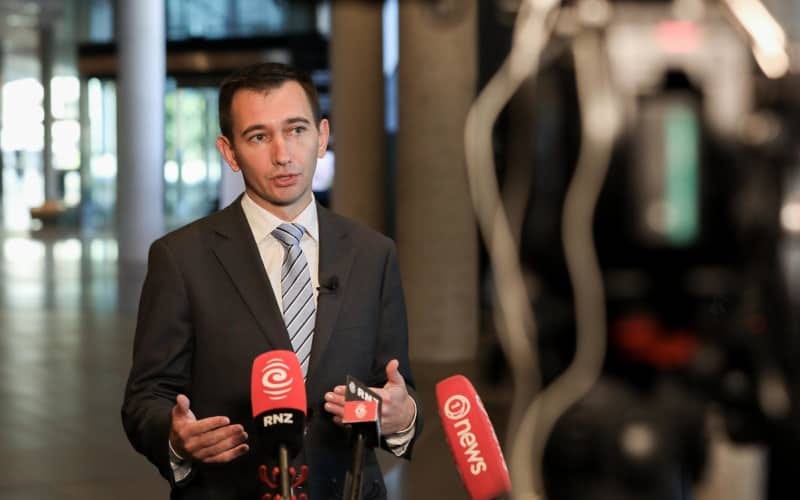
Health Minister Simeon Brown. Photo credit:Nathan Mckinnon / RNZ
Patient safety does not depend on whether doctors have been instructed to examine their privilege or whether nurses are governed by a board that has pronouns in their email footer. Patient safety depends on competence, standards, timely access to care, workforce capacity, clinical judgement, and accountability. Brown’s argument is not that culture never matters in medicine. It is that professional regulators should not be distracted from their statutory purpose by political projects.
In any case, ministerial appointments exist so elected governments can ensure public bodies remain aligned with the priorities they were elected to pursue. That does not mean ministers should micromanage clinical decisions, but it does mean they are entitled to appoint people who will focus on what they need them to focus on.
The outrage is not really that Brown has politicised these institutions. It is that, the establishment does not like his Government. For years, regulators, councils, universities, and public bodies have steadily absorbed the language of equity ideology, Treaty obligation, cultural safety, systemic bias, and decolonisation. This has been presented as neutral, professional, and beyond debate. But the moment a minister says, “Actually, please get back to your core job,” we are told democracy itself is under threat and patients may suffer.
Immigration NZ: Seven years, $30 million, zero results
Immigration New Zealand spent more than $30 million over seven years on a biometric technology project that delivered absolutely nothing. Not “less than expected” or “behind schedule”. An independent review concluded that it delivered no measurable benefits whatsoever. Nothing.
Worse still, the review found repeated governance failures, misleading reporting, escalating costs, and allegations that officials engaged in what staff themselves reportedly described as “creative accounting” to avoid Cabinet scrutiny. According to Immigration Minister Erica Stanford, officials repeatedly assured both her and previous Labour ministers that the project remained viable despite mounting evidence that it was not. Officials even restructured and split the project so that increased funding would stay under the threshold requiring Cabinet approval.
The review paints a remarkable picture of red flags accumulated over years, repeated delivery dates missed, costs increased, and external reviews questioning whether the project could succeed at all. Staff who raised concerns reportedly found themselves sidelined or removed from the project.
Former Labour Immigration Minister Andrew Little has indicated the revelations are consistent with his own experience dealing with officials. This appears to be a system that has become increasingly detached from the people who were supposed to be overseeing it.
A Public Service Commission investigation is now underway. Potential employment consequences are already being discussed, but the risk will be that a handful of individuals will be identified, punished, and then everyone will move on. Winston Peters is furious and determined not to let that happen. He called it a “conspiracy against the people”, and said officials who misled ministers and hid a failing project from Cabinet scrutiny should not only lose their jobs but be put in prison. Stanford said she would not go that far.
Winston vs the Mouth-Breathers
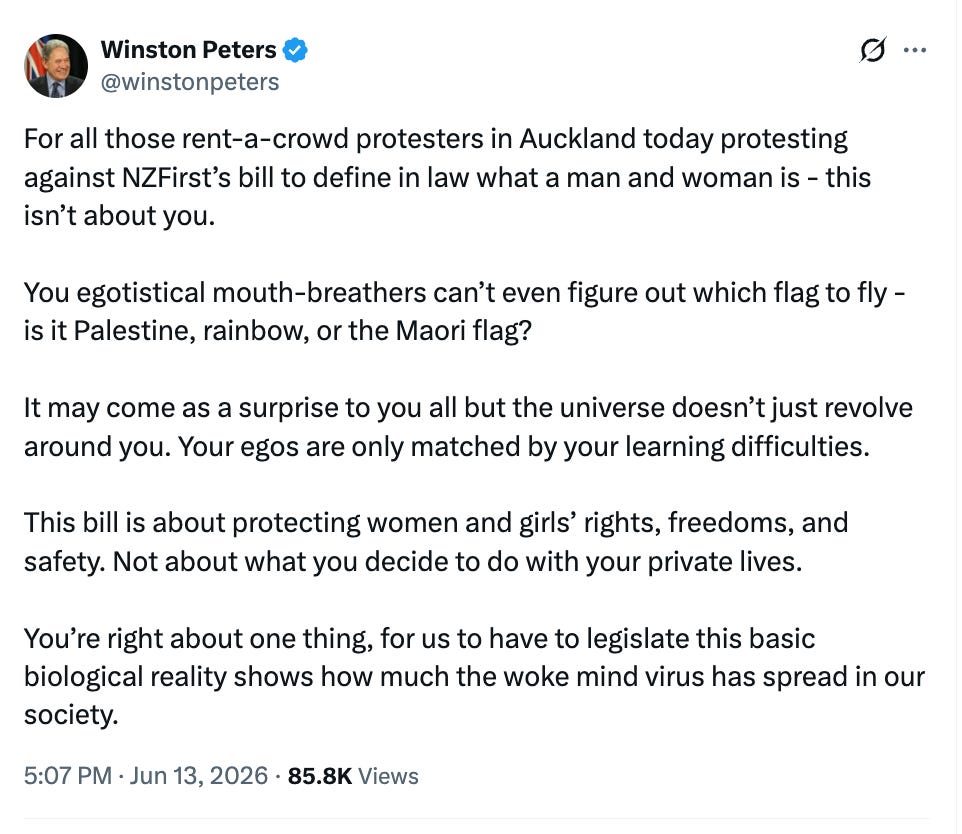
After trans activists staged a protest over New Zealand First’s Definitions of Woman and Man Bill, Winston Peters took to social media to post a few lines of absolute poetry describing them as “rent-a-crowd protesters” and “egotistical mouth-breathers”. Peters’ argued that the bill is about women’s rights, safety, sport, bathrooms and single-sex spaces.
Rainbow Action Tāmaki then sent him a legal letter alleging defamation, demanding he delete the post, publish an apology, and donate to RainbowYOUTH. Unsurprisingly, he responded by refusing to delete the post, noting it had reached 1.7 million views on Facebook, refusing to donate, and offering this apology: “I am sorry. I am sorry that you have proven us right.”
Don’t forget to submit on the bill before 2nd July. You see my submission here.
Click to view
Shane Jones and the $63,000 mining conference
For weeks now, politicians have been under intense scrutiny over spending and expenses, with every line item looking extravagant during a cost-of-living crisis. Against that backdrop, Shane Jones found himself in the headlines after it emerged a 2025 trip to Canada cost taxpayers $63,000, when the budget approved by Cabinet was $33,000.
The biggest reasons for the blowout were business class flights, accommodation, and a private limousine service that remained on standby for a total of 24 hours across three days. For long-haul travel, it is common for ministers to travel business class, but the idling limo is a little harder to explain.
Finance Minister Nicola Willis described the situation as reflecting “significant errors” by Jones and his office. Prime Minister Christopher Luxon characterised it as an administrative mistake that should not happen again. Jones, however, argued travel arrangements were handled by officials and warned critics to “provoke the matua at your peril”.
Labour was quick to seize on the story, with Chris Hipkins accusing the Government of telling New Zealanders to tighten their belts while senior ministers “live it up large” and Willie Jackson joking that Willis had thrown Jones “under the limousine”.
A catastrophic case of mistaken identity
An 11 year old autistic girl who is largely non-verbal wandered away from home in March 2025. Some time later a member of the public reported seeing her climbing on the railings on Fairfield Bridge. Police responded and took her to Waikato Hospital for assessment.
There was a bunch of confusion about her identity with police officers weighing up if she was a 20 year old woman known to mental health services. The responding officers compared images and concluded she probably wasn’t the same person. However, after contacting a supported accommodation provider connected to the missing 20 year old woman, police passed on a “potential identification” to hospital staff. Hospital staff then began treating the girl as if she were the missing adult woman, who had a history of psychosis and was under a compulsory treatment order.
Clinicians consequently assessed the child through the lens of the adult woman’s psychiatric history and behaviours associated with an autistic little girl were interpreted as potentially psychosis. She was admitted to the adult mental health unit under the adult woman’s name. She was not violent, was not presenting an immediate risk to others, and did not display behaviour that staff described as unmanageable. Nevertheless, staff restrained her and injected her with antipsychotic medication. Later that evening, after she again refused oral medication, she was restrained and injected a second time.
The mistake was only discovered that night when the same police officer who had dealt with her saw a missing-person notification and recognised her. Hospital staff were contacted, the error was confirmed, and the child was reunited with her mother.
This week an inquiry found that the central failure was the complete breakdown of identity verification. No one independently confirmed who she was. The report concluded that the two forced injections were administered without lawful authority and would have been unlawful even if she had actually been the adult woman she was mistaken for. Health New Zealand has officially apologised.
Auckland Pride's Pyrrhic Victory
Ro Edge and Save Women’s Sport Australasia have been arguing that women and girls deserve fair, safe and meaningful sporting opportunities for years. Recently they sought to intervene in Auckland Pride’s judicial review against the Minister for Sport and Recreation challenging the Minister’s directive to withdraw Sport New Zealand’s Guiding Principles for the Inclusion of Transgender People in Community Sport. The High Court declined the intervention application and Auckland Pride has now succeeded in obtaining a costs award against Edge.
However, the Court recognised that there was a genuine public interest dimension to the issues Edge was attempting to raise and following the hearing, appointed Nicolette Levy KC as counsel assisting the Court on key questions surrounding the meaning of “sex” in the Human Rights Act. Very good news indeed.
Auckland Pride’s conduct in going after costs has been called malicious given they were represented by DLA Piper, one of the largest international law firms in the world, acting on a pro bono basis. Meanwhile, Save Women’s Sport is a grassroots advocacy group. Nevertheless, Auckland Pride was awarded more than $6,800 against Edge. Thankfully we did a bit of a whip around on X and the costs have been covered by ordinary Kiwis who want their daughters to play sport safely and fairly.
FENZ isn’t spending its cash
Internal Affairs Minister Brooke van Velden has put Fire and Emergency NZ on notice over what looks like a persistent pattern of under-delivery, weak governance, and financial mismanagement. It turns out the organisation warning about ageing trucks, equipment failures, stretched crews, and looming funding gaps, is also sitting on substantial cash reserves and failing to deliver its own capital programme!
Van Velden pointed to a projected $24 million underspend this financial year with delays in property and fleet procurement driving the gap. FENZ is also expected to finish the year with around $152 million in cash. In other words, the issue is not that the money does not exist. It is that the organisation does not appear capable of reliably turning money into trucks, stations, systems, and frontline capability.
The New Zealand Professional Firefighters Union is beyond furious and has claimed FENZ wasted more than $60 million on an abandoned payroll system and is now spending on another replacement system. The same week, the Union said an Auckland City crew missed callouts to a building fire, vegetation fire, and medical incident because their truck broke down.
Federated Farmers has piled in too expressing concern that rural communities are paying more through rising levies while seeing declining service, rundown trucks, weakening rural expertise, and an urban-focused model. FENZ is funded overwhelmingly through levies on insurance policies, but its work now extends beyond fighting fires. Minister van Velden is asking questions of the funding model.
FENZ is clearly not a frontline failure story. The firefighters, volunteers, and crews turning up to emergencies are being let down. The problem is the management layer above them as well as the systems, procurement, governance, monitoring, and accountability structures that are meant to ensure frontline staff have working trucks, reliable equipment, functioning payroll, and clear operational support.
Social media ban incoming but is the govt protecting children or building infrastructure?
The Government is signalling with all the subtly of a gun that some form of social media ban is coming. The final Cabinet paper is expected within weeks and Budget 2026 set aside more than $30 million over four years to develop and implement online safety measures.
Education Minister Erica Stanford has made it clear she views the issue as urgent and has said that every month of delay leaves more young people exposed to harmful content. Labour appears willing to support some version of the proposal so it could pass even if coalition partners refuse.
Stanford describes a “tsunami” of countries moving against Big Tech. Yet the international experience should be making policymakers more cautious, not more confident. Australia’s ban has already demonstrated that teenagers are extremely good at getting around them.
The argument is often framed as a choice between protecting children and doing nothing. But the real question is what infrastructure must be built in order to make a ban possible. As retired District Court Judge David Harvey has argued, a workable age-verification regime effectively requires every New Zealander to prove who they are before accessing major online services. In New Zealand’s case, that verification system would sit alongside a digital identity framework.
Meanwhile, in Britain, what began as age restrictions is now expanding into discussions about curfews, platform controls, algorithm regulation and restrictions on how young people interact online.
Election 2026: Polls, campaign launches, and a professional wrestler
New Zealand First is holding what it describes as a “major” candidate announcement event in South Auckland this weekend. The party has also launched a policy to abolish Auckland Council’s Independent Māori Statutory Board, arguing that unelected bodies should not exercise influence over public decision making. Auckland Mayor Wayne Brown has responded by dismissing the proposal as “dumb, racist stuff”, but the context here is that he has relied on the IMSB for significant votes in council.
ACT is to hold its own major election rally in Auckland next weekend under the banner “Unlock New Zealand’s Potential”. David Seymour has promised a significant policy announcement, the unveiling of ACT’s new deputy leader, and a campaign launch setting out the party’s direction.
Meanwhile, National says Labour has an $18.2 billion hole in its spending plans, while Labour insists its full fiscal package will be released closer to the election. And the NZ Herald profiled Green candidate Michel Mulipola, a professional wrestler who performs under the name “Liger”.
The out-sized media attention being paid to The Opportunity Party is paying off with a handful of polls placing it closer to the crucial 5% mark. The latest NZ Herald-Motu Poll of Polls gives TOP roughly a 15% chance of crossing the threshold.
Police call on Rowena Walker’s partner to do the right thing
The disappearance of Christchurch woman Rowena Walker took a grim turn this week, with police confirming they now believe the 39 year old mother was the victim of foul play and is no longer alive. Walker was last seen in August 2025 and would have celebrated her 40th birthday this week. Detective Senior Sergeant Jo Carolan has revealed that Walker's partner at the time is the last known person to have seen her alive and has so far declined to speak with investigators. Police stress that he is entitled to remain silent, but have publicly urged him to "do the right thing" and assist the investigation.
🇪🇺 EU begins the arduous task of turning the mass migration behemoth around
The European Parliament has approved what is being described as their toughest migration law in decades, backing new rules to speed up the removal of migrants who have no legal right to remain in the EU. The legislation passed 418 votes to 218 and will allow member states to set up “return hubs” outside the EU where people subject to deportation orders could be sent. Unsurprisingly, the vote produced parliamentary theatre. Right-wing MEPs chanted “send them back”, while left-wing MEPs replied with “shame on you”.
The substance of the law is that it will allow longer detention periods for people awaiting removal, tougher entry bans, wider powers to search residences and seize belongings, and an end to the automatic suspension of deportation while appeals are underway. Unaccompanied minors would be exempt from transfer to return hubs, but families with children may not be. Of course, human rights groups have condemned the proposal, warning that offshore centres could become legal black holes where migrants are effectively stranded.
Whether the policy works is another question. Britain’s Rwanda scheme collapsed and Italy’s Albania model has faced legal trouble. Finding third countries willing to host Europe’s deportation infrastructure will not be easy, and the courts will almost certainly get involved. But as a political signal, this vote says the era of pretending irregular migration can be managed with slogans and moral lectures is coming under pressure.
In short - other stuff that happened
- 🇬🇧 A three year old boy was critically injured after being thrown into a crocodile enclosure at a zoo. Police arrested a 30 year old man on suspicion of attempted murder and say the man was not known to the child.
- The Public Service Association is furious about a proposal to scrap the Diversity, Equity and Inclusion team at the Public Service Commission. Of course they are.
- Parents on paid parental leave will get an increase from 1 July, with the maximum weekly payment rising to $811.05. The increase is automatic and tied to wage growth. Every extra dollar helps when you’re staring down nappies, sleep deprivation, and the financial black hole that is a newborn.
- Wellington City Councillor Karl Tiefenbacher was barred from voting on the future of the Golden Mile project after the Auditor-General ruled his ownership of Courtenay Place hospitality businesses created a conflict of interest. Opposing the Golden Mile was one of the main reasons voters elected him in the first place, so he was prohibited from voting on the issue he campaigned on.
- New Zealand’s economy grew 0.8% in the March quarter, comfortably outperforming both Australia and the United States and coming in well ahead of Treasury’s forecasts. Long may it continue.
- 🇬🇧 Blackpool teacher Jamie Varley (37) was given a whole life prison order for sexually abusing and murdering Preston Davey (1), the baby he and his partner John McGowan-Fazakerley adopted. Preston died in July 2023 after four months of physical, sexual, and emotional abuse. McGowan-Fazakerley was sentenced to 25 years for sexual assault, child cruelty, and allowing the death.
- GP funding is getting an extra $120.6 million a year, but the bigger change may be how that money is allocated. For the first time in more than 20 years, the formula will move beyond age and sex to include factors such as chronic illness, deprivation, and rurality when determining how much individual clinics receive.
- 🇦🇺 Israel Folau says a proposed return to the NRL with the Wests Tigers collapsed after opposition within the game’s leadership, despite assurances that the deal had been cleared. Folau and his wife Maria claim concerns about his past comments and public controversy ultimately outweighed the club’s interest in signing him for the remainder of the season.
- Shane Jones has shelved his controversial Fisheries Amendment Bill after opposition from environmental groups, recreational fishers, Māori aquaculture interests, coalition partners and MPs across Parliament. The bill will be sent back for further consultation with Jones conceding there was too much “disharmony” for it to proceed in its current form.
- Police are investigating a report of alleged inappropriate behaviour by Horowhenua College teacher Asaria Saili, after the Teaching Council was notified of what it described as "serious concerns" involving a student. Saili is not currently teaching as his authority to teach expired in March.
- The Government has committed another $14.5 million to homelessness services, expanding rough-sleeper outreach programmes into Tauranga, Whakatāne, New Plymouth, Napier, Whanganui and Waimakariri. Ministers say 674 households who had been sleeping rough have been moved into stable housing since September.
- English teacher David Charles Howell (34), who arrived in New Zealand in January 2024 on a working visa and taught maths in Auckland high schools, has been sentenced to 20 months in prison and will be deported back to England. He admitted grooming an undercover officer posing as a 14 year old girl with explicit sexual messages and a masturbation video, plus indecently exposing himself to three women and a 13 year old girl, and attempting to film a woman in the shower.
- Model Elijah Timmins-Scanlon accused Huffer of using his likeness to create an AI-generated model and he has now received a legal letter from the fashion brand after he spoke out. Huffer denies the image resembles Timmins-Scanlon and has refused to clarify whether the model pictured was a real person.
- A $79 million funding increase has been approved for aged residential care providers next year, including a 4% uplift and new expectations that rest homes accept clinically appropriate admissions over weekends. Ministers say the move is aimed at reducing unnecessary hospital stays.
- Parents at Far North's Taipa Area School are demanding answers after two separate allegations involving the same staff member. One family says CCTV footage shows the employee grabbing and pushing their 8 year old son to the ground, while another claims the staffer later threw keys at her 13 year old son's head and shoved him. The Ministry of Education has begun following up on the more recent allegations.
- 🇬🇧 A British couple sailing to France found themselves at the centre of an international incident after a Russian warship fired warning shots while passing in the English Channel. The couple insist they were following maritime rules but Russia claims the yacht was on a dangerous course and had to be warned off to avoid a collision.
- There’s been a $26.6 million funding increase for community pharmacies, including more money for dispensing medicines, vaccinations, and expanded clinical services.
- The Government is planning a legislative spring clean, with Attorney-General Chris Bishop identifying 152 Acts for repeal, including a century-old milk licensing rule and law empowering Dunedin City Council to buy and sell sheep. Most of the targeted legislation dates back to the 19th and early 20th centuries and remains on the books despite serving no practical purpose today.
- After nearly five years of name suppression, former Lotto presenter and entertainer Russell Harrison has pleaded guilty to money laundering after helping move drug money linked to the Comancheros motorcycle gang. Harrison maintains he acted out of naivety rather than criminal intent, but now faces a potential prison term of up to seven years.
🇬🇧 This week the Rape Gang Inquiry Report commissioned by UK MP Rupert Lowe was released and it was horrific. Read my article about it below, but please be aware it is hard to read the details.
White, working class girls sacrificed
Ani O’Brien 19 Jun Read full story
----------------------------------
Before I go, I have some news. I am going on the road with the Free Speech Union on a tour of New Zealand. We have called it the Good Faith Yarns Tour and I will be talking with incredible Kiwis about challenging topics. We will do a decent Q+A session at each event too.
Queenstown — 21 July, 6:30pm with Mayor John Glover and Mike Casey from Rewiring Aotearoa
Christchurch — 22 July, 6:30pm with Professor Te Maire Tau (Ngāi Tahu)
Dunedin — 23 July, 6:30pm with Sir Ian Taylor
Whangārei — 27 July, 6:30pm with Far North Councillor Davina Smolders
Hamilton — 28 July (details to come)
Auckland — 29 July, 6:30pm with AUT Chancellor Rob Campbell CNZM
Tauranga — 30 July, 6:30pm with Dr Alistair Reese and Professor Paul Moon
Palmerston North — 4 August (details to come)
Wellington — 5 August, 6:30pm with Act MP Todd Stephenson and former National MP Simon O’Connor
Nelson — 6 August (details to come)
I’d love to see you there. Tickets are available now, but there are potentially more locations to come. I will let you know when additional locations are added.
Ani O'Brien comes from a digital marketing background, she has been heavily involved in women's rights advocacy and is a founding council member of the Free Speech Union. This article was originally published on Ani's Substack Site and is published here with kind permission.


18 comments:
God bless Labour. They actually made me think about public transport and how at 85% subsidised it fails to attract more than 7% of the population. Even where it is most saturated in Auckland and Wellington, it still fails.
Even half price fares under Labour 2022, failed to lift patronage by less than 10%.
But why?
Is it the inbuilt inconvenience?
Is it because it is so slow?
Is it because it is used by antisocial criminals who don't pay and this appears encouraged by the elites councillors who think PT should be free anyway?
And related, is it because it is increasingly unsafe, and the reported violence is the tip of the iceberg?
Is it as simple as the woke elite don't like cars?
I've used it, I've worked in it (and the wasted money was horrific) and for sure, there is a need of sorts but largely it's an expensive flop that pouring more money into is pointless and insane, in a country that increasingly cannot pay its way.
The failed Wellington Golden Mile project that cost $26 million that purchased virtually nothing, states, "An early LGWM report said "future improvements [are!] considered essential" describing the area as heavily congested, unpleasant and noisy". The accompanying artists impression show zero cars, a cyclist, an invalid in a wheel chair on a wide footpath and a tram. Nirvana. The point is this vision that spent $26 mill for nothing, was based on a subjective - probably academic - definitely woke opinion that became the basis for this simply criminal waste of public money. Yet that opinion of woke decision makers interpreting an alive city centre with motor vehicles as gauche, unsophisticated and to be cancelled, failed to see how Auckland Council had similar visions of granduer and killed off the Auckland CBD in the process.
I look at PT as equally futile. And I thank Labour for bringing it to our attention. No more money. And no more good intentions to buy votes with that make us all poorer.
That Simeon Brown as Health Minister is taking such baby steps is rather late but good on him.
I cannot help but conclude for politicians of his flavour, or other more common sense colleagues such as Sam Uffindell, is they are labouring under their leaders visceral fear of anything remotely controversial or confrontational and hence the near 3 years of inaction and malaise. Which leads me to also conclude, Luxon is one giant sea anchor on the National Party.
As a long time user of Trains and buses, I find the service excellent. Thanks to all of those who provide it.
Agree with Anon. Mass transit in Auckland is well on the way to becoming world class
Why does Ani hate trans people so much? As a minority herself, the logic makes no sense that she is intent on punching down on a marginalised group that are causing zero harm to society. Perhaps it is ignorance of history?
I disagree with Ani’s submission. Trans people have a right to exist in society without having to hide. The definition bill is the opposite of something that benefits society unless you want Big. brother redefining words for the people. I remember when ACT was supportive of small government, and when the free speech advocates supported free speech. The whole world has gone topsy-turvy.
The trains run about 10 months a year, if that, missing in action on random weekends, yeah, going well at great expense. And being a certified MMA fighter is handy on buses too!
I’ve never had an issue on a bus and I’m supportive of the fantastic catchup track work that AT and kiwi rail have done after the infrastructure debt that successive has finally started to be paid back. Wonderful that the CRL is about to go online. Keep it going , Auckland and show how it can be done e to the rest of NZ.
Anon 5:54
The bill to define the meaning of the words Man and Women does NOT take away trans people's "right to exist". All it does is say that whatever subjective sexual "identity" a person has, they cannot legally require the rest of society to recognize that identity. Trans people can do whatever they want to do as long as they do not insist that I recognize their self identity by for example using pronouns that don't fit the reality of what I see, for example, a man wearing women's clothes. Also, person with a penis, that's what I call a man, should not be allowed in women's only spaces, women's only sports or prisons. This is NOT taking away a trans persons "right to exist".
BTW, Ani is a self professed lesbian. She doesn't identify with the "rainbow" crowd, and she has made that very clear. She supports biological women and she makes it clear that doesn't include biological men who "identify" as women.
The bill says nothing about people in others people spaces. This is a copy paste of the 70s/80s gay panic. We’ve seen it all before, this scaremongering. All to divide and distract while the rich rob us blind.
Re: Anon 1100
>"The bill says nothing about people in others people spaces."
Yes it does, albeit indirectly. The Explanatory Note to the Bill includes the following: "The purpose of this amendment is to uphold legal certainty, protect the integrity of sex-based rights, and ensure that language in law reflects biological reality." "Sex-based rights" includes single-sex spaces.
>"This is a copy paste of the 70s/80s gay panic."
The Homosexual Law Reform Bill of 1986 was objected to by some people, some of whom hold archaic views about homosexuality. This does not constitute 'gay panic' which insinuates widespread attitudinal malaise. In a democracy, conservative minorities too have a right to voice their opinion.
>"We’ve seen it all before, this scaremongering."
People being concerned about their wives, sisters and daughters being subjected to naked males in female changing rooms and the like is not 'scaremongering'. It's expressing a legitimate concern about something that is already happening and that many women and girls object to.
>"All to divide and distract while the rich rob us blind."
Oh dear, we have no relevant critiques of the Bill to present (the preceding being sheer bottom-of-the-barrel junk) so let's fall back on a tried and tested (and invariably found wanting) ploy: direct attention towards affluent people, regardless of how they accumulated their wealth. Not that that has anything at all to do with the topic of discussion here, but what the heck, some of the rank and file of fellow travellers will snap it up.......
The line in the 80s was that we don’t want grown men gays in changing rooms with our kids. This is a direct copy+paste of that.
Folks, the Māoris and the immigrants and the trans aren’t doing anything to make your life worse. It’s the rich and powerful and it always has been.
>"The line in the 80s was that we don’t want grown men gays in changing rooms with our kids. This is a direct copy+paste of that."
No it's not. In the 80s people some people were worried about homosexual men in changing sheds with BOYS. Now the concern is for having grown men in those spaces with GIRLS, a section of the population Anon936 (formerly Anon 1100) appears to be oblivious to the existence of.
>"the Māoris and the immigrants and the trans aren’t doing anything to make your life worse. It’s the rich and powerful and it always has been."
Same tactic as before - draw attention away from the issue towards something fashionable with the crowd one is appealing to but totally irrelevant to the topic under discussion. Poor old thing, it just ain't gonna work on this website at least. Go and do your puerile thing on the Greens' website, babe.
“Same tactic as before - draw attention away from the issue”
Looks like all the comments agree then! Some people don’t know what the real issue is though. They think it’s a culture war but it has always been a class war. The word sheeple is overused on this site but you can see how it fits certain commenters. I wish I had a bridge to sell to Barend while we were at it.
Good debate though, chap. Always enjoy engaging with you on the substance.
So Anon 552 denies the existence of the 'culture wars' because the 'real issue' is class war. The use of this classical Marxist moniker may indicate that Anon 552 is a dyed-in-the-wool classical Marxist, although that would assume that s/he knows what the term 'class war' means in all its glory and there does appear to be a question mark hovering over that assumption.
We are in the market for a new bridge here in Ashburton so by all means make us a good offer and we'll see where we go from there.
I dunno what a Marxist is but I do know the oligarchs don’t have the public good at the forefront of their thinking. I can tell that only because of their words and actions, mind you. Why would they want to distract us with trans hatred? Why doesn’t Elon’s daughter want anything to do with him?
The rich have all the money needed to fix significant issues in society, health, homelessness, hunger, division…but for some reason they choose not to. Why would that be? I’m baffled. Someone out there knows, we need to get them in here.
>"I dunno what a Marxist is"
Truthful words at last, especially the first two. Better stop using Marxist epithets then.
>"Why would they want to distract us with trans hatred? Why doesn’t Elon’s daughter want anything to do with him?"
It's news to me that 'they' (referring to an undefined bunch of 'oligarchs') "distract us with trans hatred". There is a small minority of folks who are so disparaging of transsexuals that the term 'hatred' could be applied to them, but I'd be interested to know how many of those were 'oligarchs'. The relationship between Elon Musk and his daughter really has nothing to do with this. Elon doesn't like his daughter being 'queer' but he certainly isn't the only parent to feel that way and that hardly amounts to 'hate'.
>"The rich have all the money needed to fix significant issues in society, health, homelessness, hunger, division…but for some reason they choose not to."
This reminds me of the fallacy that if all the cattle in India were slaughtered for meat, it would solve the country's nutritional problems. It wouldn't. It would give many Indians an unaccustomed square and (for them) far too rich meal that would result in a bad case of the runs. After that, it would be back to normal.
Social problems are not fixed by simply throwing money at them. Many are caused, or at least contributed to, by the very people identified as 'victims'. Attitudinal change is what is needed most. Give an alcoholic tramp who sleeps on a park bench a fistful of cash and he'll only spend it on more and better booze and still sleep on a park bench.
>"I’m baffled."
Yes, you are. Wake up. Grow up.
Anon 9-36/1100. you forgot to mention "all the rich landlords who are being given $million in tax breaks". I am disappointed in you! (not)
Post a Comment
Thank you for joining the discussion. Breaking Views welcomes respectful contributions that enrich the debate. Please ensure your comments are not defamatory, derogatory or disruptive. We appreciate your cooperation.