

The Law Commission Hara ngākau kino | Review of hate crime law has surprised me. In an area crowded with panic, symbolism, and bad drafting, it has refused to solve the wrong problem. In Hara ngākau kino, it concluded that New Zealand should keep the current sentencing model, under which hostile motivation aggravates an existing offence, rather than create standalone hate-crime offences. It recommended practical reforms instead, including a hate-crime flag at charging stage, formal recording in court records, express judicial statements when hostility is proved, broader coverage for associated victims and bystanders, the addition of sex to the statutory list, better guidance and training, and annual publication of police and court data.
Just as important, the Commission did not pretend that hate crime and hate speech are the same thing. Hate speech was explicitly outside the scope of the review, even though submitters repeatedly raised it. The report distinguishes between punishing violent or intimidating conduct and criminalising expression about ideas, beliefs, and doctrines. New Zealand should preserve that distinction like its constitutional life depends on it. Because it does.
The political pressure to bring in hate speech laws has not gone away. In fact, it has begun to show a more honest shape, one that is driven largely by demands from Islamic lobbyists for blasphemy laws. The Federation of Islamic Associations of New Zealand’s (FIANZ) own proposed definitions extend well beyond direct incitement of violence to speech that “denigrates”, “demeans”, “vilifies” or promotes hostility towards religious beliefs and practices. Its suggested warning signs include calling members of a group liars, cheats or criminals, alleging conspiracies, or associating the group with child abuse. Note that FIANZ want the belief and practices protected, not just the adherents of the beliefs.
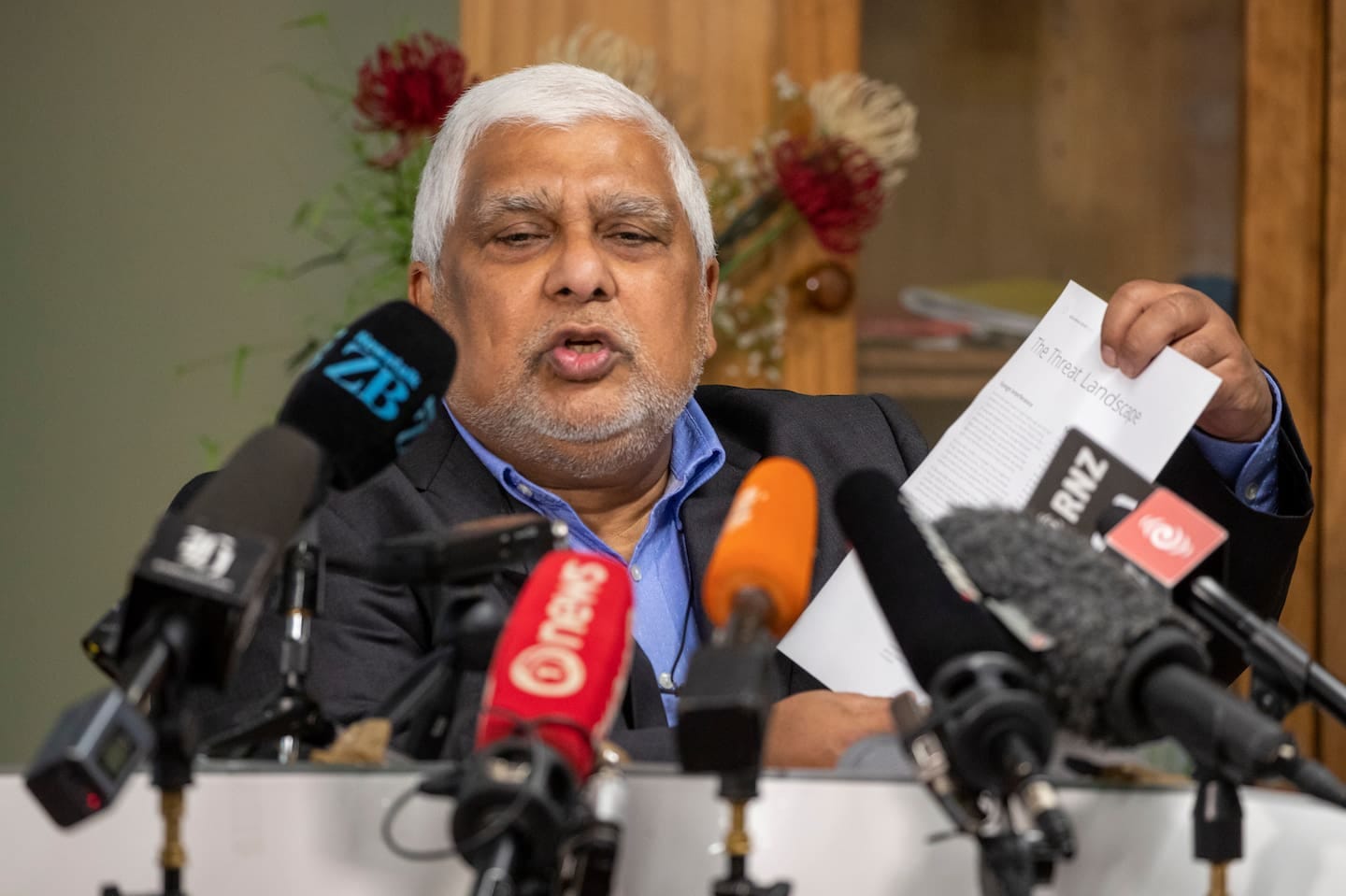
FIANZ spokesperson Abdur Razzaq. Photo / Mark Mitchell
No organisation has pursued the expansion of New Zealand’s hate speech laws with greater persistence than FIANZ. At this point, it is becoming difficult to identify a political controversy involving religion, extremism, or social cohesion that FIANZ does not use as another opportunity to demand restrictions on speech. It has become something approaching organisational singularity.
FIANZ was advocating for expanded hate speech and hate crime laws immediately after the Christchurch mosque attacks in 2019. In 2022, when the Labour Government proposed adding religious belief to the protected categories in the Human Rights Act, FIANZ did not celebrate the change as sufficient progress. It criticised the Government for failing to go further, complained that the proposal did not cover electronic communications adequately, and argued that the relevant provision should instead be placed in the Crimes Act.
In 2023, it demanded a firm timetable, dedicated funding, and additional resources to complete the legislation. FIANZ representatives argued that social cohesion initiatives would not work unless backed by law, dismissed objections as coming from only a small number of people, and suggested that the Ministry of Justice should simply get on with producing the legislation.
When the National-led Government halted the hate speech review in 2024, FIANZ returned to the media to demand an explanation. Its representative insisted that hate speech and hate crime were inseparable and that “you can’t have one without the other.”
In 2025, after Brian Tamaki’s supporters tore and burned religious and political flags at a protest, FIANZ again called for a legislative framework protecting faith communities. The display was ugly, provocative, and deliberately offensive. The correct response in a free country is condemnation, ridicule, counter-protest and, where genuine threats or disorder occur, enforcement of existing law. FIANZ’s instinct was once again to reach for new speech restrictions.
Then, in May 2026, FIANZ warned that New Zealand was experiencing its worst anti-Muslim environment in two decades and renewed calls for “legislative safeguards”. Its chairman described a “hate soup boiling over” and argued that inflammatory rhetoric was creating the conditions for violence. Violence enacted by who?
Yet the minister responsible for the intelligence agencies said the national threat level remained steady, the NZSIS had not identified one ideology as presenting a greater current threat than others, and the Prime Minister said he had seen no intelligence indicating an increased threat specifically to Muslim communities.
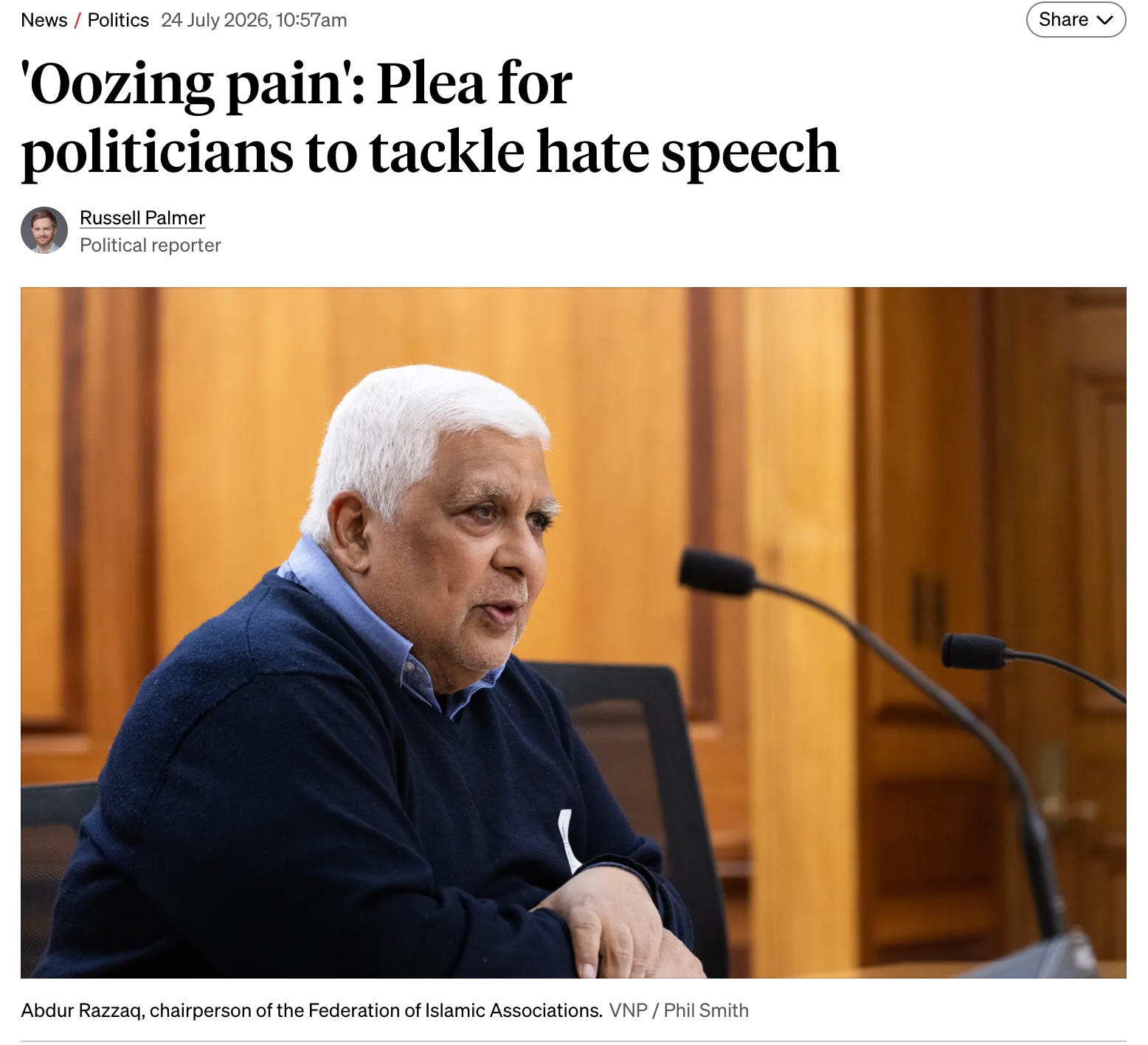
And now, following the Law Commission’s 2026 report, FIANZ is back again. Its response was not simply to disagree with the report’s conclusions. It is complaining that hate speech was excluded from the terms of reference and urging political parties to return to the Royal Commission’s proposals. Its spokesperson, Abdur Razzaq, dismissed thousands of free speech submissions as potentially little more than one person repeatedly clicking a button, while presenting FIANZ’s own preferred interpretation of public opinion as authoritative.
To FIANZ, every offensive protest is evidence that speech laws are inadequate, every delay is a betrayal, every review that does not deliver the desired result is too narrow, and every government that hesitates is accused of abandoning vulnerable communities. Most manipulatively, every objection is reframed as indifference to the victims of Christchurch.
The murder of 51 Muslims in Christchurch was an atrocity, and Muslim New Zealanders are entitled to the full protection of the criminal law. But that does not mean FIANZ is entitled to dictate the boundaries of lawful public discussion. Victimhood does not come with a veto over civil liberties, and the horror of one terrorist attack cannot become a permanent blank cheque for censorship.
We must all see FIANZ for what it is; a political organisation that lobbies for greater power for itself. This can be seen in the distinction FIANZ continually blurs between protecting Muslims and protecting Islam. Muslims are people and they possess rights. Islam is a religion and it must remain open to scrutiny, mockery, rejection, and fierce criticism, just as Christianity, Judaism, Hinduism, atheism, and every political ideology must be.
FIANZ participates vigorously in contested cultural debates. In 2023, it issued an “urgent advisory” encouraging Muslim parents to object to Pride Week activities in schools. It provided template letters and urged parents to make their opposition known to principals, boards, and teachers. That was entirely within its democratic rights. Religious communities are free to object to state-funded messages about sexuality and gender. But the principle must work both ways. FIANZ cannot demand the freedom to tell schools that Islamic parents reject aspects of Pride while also seeking laws broad enough to punish criticism that comes the other way.
FIANZ’s persistence is politically understandable. Advocacy groups exist to advocate, and an organisation representing Muslim associations will naturally focus on the fears and interests of Muslim communities. Its original calls for improved recording of hate-motivated crimes were also reasonable. In 2019, it joined calls for police to collect better information and for the law to distinguish hate-motivated offending from ordinary crime. But their campaign has moved far beyond better data and stronger protection from violence. It has become a sustained effort to obtain legal protection from certain forms of expression. And because the definition of “hate” remains elastic, the power being requested would ultimately be exercised not only against violent extremists, but against ordinary citizens.
FIANZ can keep demanding. The rest of us have every right, and every reason, to keep saying “no”.
I repeat: People have rights, religions do not. We understood that when we repealed the offence of blasphemous libel in 2019, with the Government stating that the provision was obsolete and inconsistent with modern protections for freedom of expression. That was the correct decision then, and it remains the correct principle now. The state may protect citizens from threats, discrimination, and violence, but it has no business shielding “sacred” claims from challenge, mockery, insult, or criticism.
International human rights law supports this although it is under similar pressure to capitulate to the Islamic lobby. The UN Human Rights Committee’s General Comment 34 states that prohibitions on displays of lack of respect for a religion, including blasphemy laws, are incompatible with the ICCPR except in narrow circumstances, and it specifically says such laws cannot be used to prevent criticism of religious leaders or commentary on doctrine and tenets of faith. The Rabat Plan of Action went further and called national blasphemy laws counter-productive because they stifle the healthy debate and criticism that free societies need.
New Zealand’s own public authorities already recognise the difference. Police explain that some hateful expression may be “awful but lawful” and that speech alone is not a basis for arrest unless it crosses a criminal threshold. A liberal democracy does not merely protect the devout. It protects the sceptic, the apostate, the dissenter, the atheist, the reformer, and the person who has left the faith community of their birth. The moment the law starts treating criticism of religion as legally suspect, those people are the first to lose.
New Zealand keeps batting back attempts at speech suppression. Aside from the almost-introduction of hate speech laws under Labour a few years ago, there was also the fortunately terminated Human Rights (Incitement on Ground of Religious Belief) Amendment Bill which would have extended sections 61 and 131 of the Human Rights Act to religious belief, using language about words that are “threatening, abusive, or insulting” and likely to excite hostility or bring groups into contempt or ridicule. Elastic definitions of “hostility” would have been used not to protect Muslims as citizens but to slide into protecting Islam as an ideology.
Blasphemy-style laws repeat old hierarchies and function as power grabs. They protect the beliefs of some people from criticism, make it easier for them to punish ex-believers, and tell women inside conservative faith communities that they may not complain of mistreatment because it denigrates the theology underwriting it. It is a process of enforced submission.
If you think this is all theoretical, you should look overseas. Pakistan’s blasphemy regime has roots in British colonial law, but its modern Islamic expansions have created some of the harshest religious-offence provisions in the world. Academic Junaid Hafeez was arrested after students accused him of anti-Islam blasphemy on social media, held in solitary confinement after attacks by other prisoners, and sentenced to death in 2019. His lawyer, Rashid Rehman, was murdered.
Indonesia offers the same lesson in another form. Human Rights Watch reported that restrictions on the Ahmadiyah community, sold by officials as necessary to reduce violence, in fact fuelled hatred and failed to stop attacks. Reuters has also reported that Indonesian courts jailed comedian Aulia Rakhman for joking about the name Muhammad.
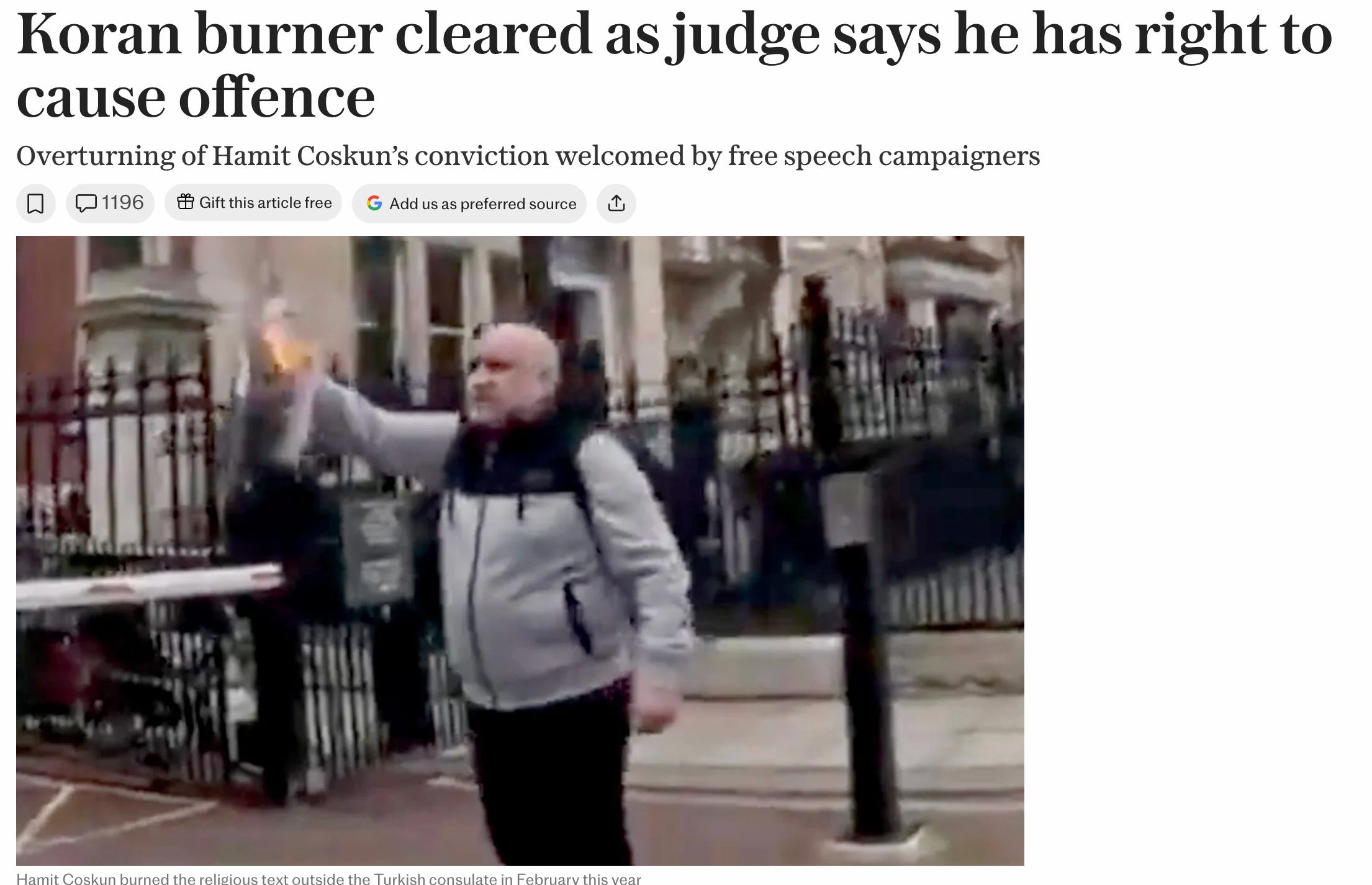
Even Britain, which abolished blasphemy laws, shows how quickly the same instinct returns by another route. Section 29J of the Public Order Act expressly protects discussion, criticism, ridicule, insult and abuse of religions and their beliefs or practices. That safeguard exists because Parliament understood that protecting believers from hatred must not become a ban on criticising belief. Yet Hamit Coskun was still prosecuted and convicted in 2025 after burning a Qur’an outside the Turkish consulate, before his conviction was overturned on appeal. The original conviction, and the CPS’s earlier use of wording directed at the “religious institution of Islam”, showed how easily ordinary public-order tools can be steered towards de facto blasphemy when officials forget the difference between hostility to people and attack on ideas. If that can happen in a jurisdiction with an explicit free-expression clause, New Zealand should not flatter itself that vague “anti-hostility” definitions would stay narrow here.
Click to view
The current terrorism landscape does not justify insulating ideology from criticism. The terrible Christchurch Terror Attack in 2019 is often used as a justification as to why free speech should be disregarded in favour of blasphemy laws. It is incredibly hard to argue against invocations of the massacre as we are somewhat collectively traumatised by the horrors of that day.
Nonetheless, if we are actually honest about the true nature of terrorism in the 21st century it must be acknowledged that there is something profoundly absurd about creating new protections around Islam. Across the Western world, security agencies are dealing with a continuous stream of Islamist plots, radicalisation cases, terrorist propaganda, attempted attacks, and completed atrocities. The threat is very real, immediate, organised, and ideological. It consumes enormous police and intelligence resources every day. Why should the ideology that is behind the overwhelming majority of terroristic violent attacks globaly be the one our governments protect?
The Global Terrorism Index 2026 reports that terrorism deaths in the West surged by 280%. The same body reports that youth radicalisation is rising and that lone-wolf attacks accounted for 93% of fatal attacks in the West over recent years. That is the profile of a threat that is decentralised, memetic, online, emotionally charged, and often wrapped in political or religious grievance. You do not defeat that threat by teaching the public that the ideology behind it may not be named, analysed or condemned without legal risk. You meet it by exposing ideas to light before they harden into permission for violence.
Caveat time. Of course that does not mean ordinary Muslims are terrorists, although moderates do not tend to speak out or condemn the extremists much. It does mean that Islamist terrorism is real, persistent, and disproportionately significant within the contemporary scope of terrorist threats.
There is also a moral obscenity in responding to Islamist violence by curtailing the freedoms of its intended victims. Jihadists have repeatedly murdered people for drawing cartoons, writing books, teaching history, leaving Islam, criticising clerics or simply refusing to obey religious taboos. To answer that violence by making the taboo more enforceable is to reward the threat. This is a thugs’ veto. It tells the fanatic that intimidation works.
Instead of confronting this reality, we are constantly told that the urgent problem is actually excessive scrutiny of Islam. Apparently, while police officers investigate bomb-making, knife plots, recruitment networks, and teenagers consuming jihadist propaganda, the rest of us must become more circumspect about discussing the belief system invoked by the perpetrators.
A religion that is overtly political and that makes claims about law, sex, family, dress, apostasy, blasphemy, warfare, and the organisation of the state is theocratic. And we must ensure it cannot enter the public square carrying a rulebook for everyone else and then demand immunity from reply.
Islam is not a race nor an immutable characteristic. It is a collection of theological claims, moral rules, historical traditions, legal doctrines, and political interpretations. And there is a legitimate and necessary right to criticise Islam for doctrines and practices that are fundamentally at odds with liberal democracy. That statement should not be controversial. Religions are systems of ideas and those ideas affect real people, especially when religious institutions seek political influence or when believers attempt to turn doctrine into law.
Islamic societies and institutions vary, but there are plainly significant numbers of Muslims whose interpretations of Islam subordinate women. These can include male guardianship of adult women, unequal inheritance, unequal evidential status, restrictions on dress and movement, tolerance of polygamy for men, pressure into arranged or forced marriages, acceptance of male violence, and systems in which divorce is substantially easier for husbands than wives. In some jurisdictions, women are punished for sexual conduct, pregnancy outside marriage, or alleged breaches of modesty while male violence against them is excused, minimised or concealed. Underage marriage for girls is also widely accepted by the faith.
It is not anti-Muslim to say that these practices are wrong. It would, in fact, be a betrayal of Muslim women not to say it.
Western feminists would never accept the argument that Christianity must be protected from criticism because some Christians might feel targeted. They readily criticise Catholic teachings on abortion, evangelical views on sexuality, and conservative Christian attitudes toward women. Yet that strident advocacy for women’s rights collapses when Islam is involved. Fear of appearing prejudiced overrides the basic feminist obligation to tell the truth on behalf of women.
The same double standard appears in relation to homosexuality. In Muslim-majority countries, homosexuality remains criminalised, and penalties can include imprisonment, corporal punishment, or death. Even where such laws are not enforced to their maximum extent, gay people face family rejection, forced marriage, intimidation, blackmail, and violence. A gay person has every right to criticise a religion whose authoritative texts, clerics or institutions describe his or her relationships as immoral, corrupting or worthy of punishment. It is frankly insane that when Islam advocates for our murder we are condemned for calling it out.
Tolerance cannot mean that liberal people must tolerate doctrines that deny their equality while being forbidden to describe those doctrines honestly. This is where Karl Popper’s tolerance fallacy is evident. A society committed to tolerance cannot survive if tolerance is interpreted as an obligation to submit indefinitely to movements that reject reciprocity, suppress dissent, and seek to deprive others of the very freedoms they themselves enjoy.
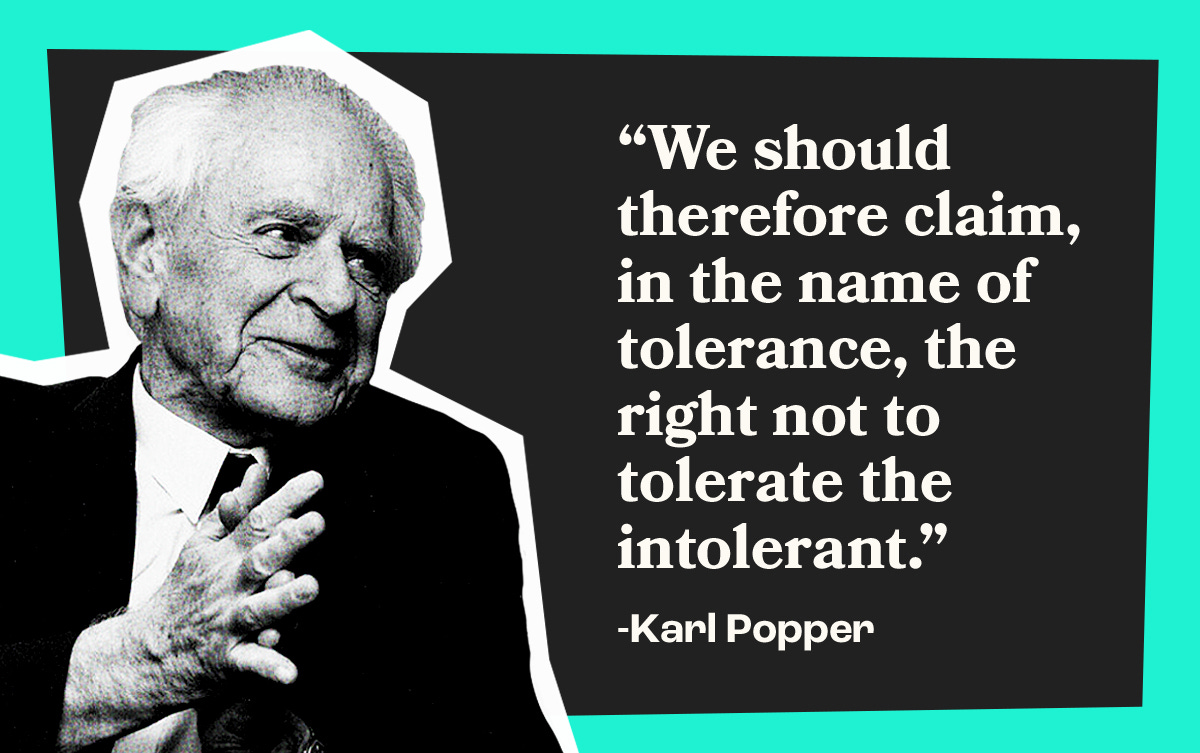
Popper’s argument was that danger arises when tolerance ceases to be a liberal virtue and becomes a tool by which illiberalism advances.
Liberal societies rightly allow Muslims to practise their religion. But liberalism cannot require women, gay people, apostates or secular critics to remain politely silent about doctrines that subordinate them. It cannot offer religious conservatives the freedom to condemn homosexuality while denying homosexuals the freedom to condemn religious homophobia. It cannot protect the right to teach that women must obey men while treating feminist criticism of that teaching as hatred. The bargain is not that one group may make sweeping moral claims about everybody else while its own beliefs are placed off limits.
The paradox of tolerance is not an excuse for suppressing Islam, nor for restricting the civil liberties of Muslims. It is a warning against allowing tolerance to be manipulated into surrender. Liberalism must be confident enough to defend freedom of religion without abandoning freedom from religion, and to protect minority communities without granting minority doctrines authority over what the rest of us may say.
When extremist violence is committed in the religion’s name, it is preceded by ideas including a theory of divine authority, a division between believer and infidel, a grievance rendered sacred, a justification for violence, and a promise of spiritual reward. Police may disrupt the final stages, but a free society also has to challenge the preceding arguments. That requires people to be free to discuss doctrine, expose preachers, compare interpretations, investigate institutions, satirise and critique, and say plainly when an idea is dangerous.
You cannot counter extremist ideology while forbidding accurate descriptions of it.
Censorship hands extremists a monopoly. Special definitions of “Islamophobia” or “anti-Muslim hostility” begin with conduct everyone agrees is wrong, such as threatening Muslims or denying them equal treatment, then expand until criticism of Islamic beliefs, political movements, or historical practices is treated as an attack on Muslim people. The protected category shifts from the believer to the belief.
That is how a blasphemy law is built in a secular country. Nobody announces that God must be protected from insult. They say a community must be protected from harm and redefine theological criticism as group hostility. The enforcement mechanism may be a criminal prosecution, an employment investigation, a regulatory complaint, or a professional sanction, but the message is the same: you cannot criticise Islam.
Christianity is criticised relentlessly in New Zealand, and that is fair game in a free society. Its scriptures are mocked and its teachings on sexuality, marriage, abortion, and sex/gender are challenged in the media, universities, and politics. Christians may object, protest, boycott, or attempt to persuade others that the criticism is unfair. What they cannot do is demand that the state silence their critics. That is how a liberal democracy should function. No religion has a right to legal protection from criticism simply because its adherents find it offensive.
The same principle must apply equally to every religion. Muslims are entitled to the full protection of the law against threats, discrimination, and violence, just as Jewish New Zealanders are entitled to protection from the disturbing rise in antisemitism seen since the Hamas attacks of 7 October 2023. But protecting people does not require protecting ideas. Islam may be criticised for its doctrines, history, institutions, or treatment of women, homosexuals, apostates, blasphemy, or political authority, just as Christianity and Judaism may be criticised for theirs. Religious ideas belong in the marketplace of ideas alongside every other worldview. They should succeed or fail through persuasion, not legal privilege.
So the choice in front of New Zealand is not between caring about vulnerable communities and defending free speech. That is a false framing, and it has done enough damage already. The real choice is between a legal order that protects citizens as equal rights-bearers, and a legal order that starts smuggling sacred immunity and blasphemy laws back into public life under therapeutic language. The Law Commission has shown the better path with stronger consequences for hate-motivated violent offending, clearer denunciation, better data, better enforcement, no new offence architecture built on a nebulous concept of hate, and no confusion between violence and disagreement.
New Zealand repealed blasphemous libel because it recognised that modern democracy cannot treat irreverence as a crime. It should not now recreate the same logic in updated vocabulary. We do not need anti-blasphemy law with a diversity label. We do not need a doctrine of “religious harm” so malleable that it chills journalists, apostates, ex-Muslims, feminists, satirists, scholars, and ordinary citizens who want to speak plainly about what religions teach and demand. We need a state confident enough to say that no mosque, church, temple, synagogue, prophet, scripture, imam, pastor or ideology is above criticism. Not one.
Ani O'Brien comes from a digital marketing background, she has been heavily involved in women's rights advocacy and is a founding council member of the Free Speech Union. This article was originally published on Ani's Substack Site and is published here with kind permission.


1 comment:
When you are unable to critique an idea or a thought then you are truly conquered.
Post a Comment
Thank you for joining the discussion. Breaking Views welcomes respectful contributions that enrich the debate. Please ensure your comments are not defamatory, derogatory or disruptive. We appreciate your cooperation.