

The inconsistencies of Wayne Brown
Wayne Brown says he is looking into getting better security following an incident at an event hosted by real estate businessman Graham Wall on the 23rd June 2026. He says that at this event an “angry little man…took a swing at him” and he blames this on lobby groups who have been heavily criticising him following the Auckland rates rise.
The problem is that the event was a small private event that Brown attended with his wife and no one who attended is backing up his account of what happened. What use, beyond flipping the narrative to make himself the victim, would this increased security have been in a gathering of about 30 mostly very wealthy people, likely mostly known to him? What did this have to do with “lobby groups” except that he is especially excised lately that they (or anyone) dares to criticise him?
Brown’s account of the evening is not consistent with any of the people who attended the event that I, nor the media, have spoken to. The version of events I heard from attendees sounds a lot like the version Newstalk ZB’s Barry Soper was told by the man who had the confrontation with Wayne (let’s call him Mr A). That is that Graham Wall invited a bunch of people around to informally meet Candace Kinser. It wasn’t a National Party event, but National’s Auckland Central candidate was invited to speak at it.
Wayne Brown says he is looking into getting better security following an incident at an event hosted by real estate businessman Graham Wall on the 23rd June 2026. He says that at this event an “angry little man…took a swing at him” and he blames this on lobby groups who have been heavily criticising him following the Auckland rates rise.
The problem is that the event was a small private event that Brown attended with his wife and no one who attended is backing up his account of what happened. What use, beyond flipping the narrative to make himself the victim, would this increased security have been in a gathering of about 30 mostly very wealthy people, likely mostly known to him? What did this have to do with “lobby groups” except that he is especially excised lately that they (or anyone) dares to criticise him?
Brown’s account of the evening is not consistent with any of the people who attended the event that I, nor the media, have spoken to. The version of events I heard from attendees sounds a lot like the version Newstalk ZB’s Barry Soper was told by the man who had the confrontation with Wayne (let’s call him Mr A). That is that Graham Wall invited a bunch of people around to informally meet Candace Kinser. It wasn’t a National Party event, but National’s Auckland Central candidate was invited to speak at it.
As Candace spoke, the Mayor repeatedly interjected and this made other attendees uncomfortable. Having sat on the table next to his at a Labour Party event earlier this year, this does not surprise me in the slightest. This was a large official event and he still called out repeatedly. At the end of the speech, Mr A made complimentary remarks about Kinser and referenced her being a talented or great “young lady”. Contrary to the claim Brown made to The Post, that he spoke up to object to the other man making a sexist remark, witnesses say it was Brown who made a quip along the lines of “I don’t know about ‘young’”.
The gathering continued and later, Brown, Mr A, Kinser’s campaign manager John Hanna, another guest, and a campaign volunteer or staff member were in the kitchen. People outside the kitchen heard glass breaking and shouting, but those inside the kitchen are reluctant to talk.
This is understandable as Brown is not somebody who is shy about wielding his power. If one were, for example, involved in business deals or property development in Auckland they might reasonably conclude that speaking out about the incident would not be worth the risk.
What we do know is that Hanna has publicly said he did not see Mr A take a swing as Brown alleges. Mr A told Barry Soper that Brown’s version of events is totally wrong and he had considered whether he should go to police at the time. That suggests that it was a bit more than a shouting match. Indeed, Soper has surmised that it was Brown who broke the glass in the confrontation between the two men.
Brown and his wife left the event abruptly and without saying goodbyes.
Some kind of altercation occurred in that kitchen. Perhaps more evidence will emerge or Mr A will speak publicly. But based on what witnesses have actually confirmed, it is safe to say the Mayor’s behaviour was very poor. He has made it worse by running a narrative that other attendees say is nonsense and by suggesting he was some kind of hero defending Kinser from sexism when a room of people saw him make the comment.
🇬🇧 The Murder of Ann Widdecombe
When it was announced last week that Reform spokeswoman and former Conservative MP Ann Widdecombe had died, no details of the cause of her death were included and it seems everyone just assumed that at 78 she had succumbed to old age. It was with horror that we learned not long after that she had been murdered.
Immediately we were told by police a white man was responsible and there was no political motivation. Suspicions were roused by this straight away and inconsistencies in how police and media handled the identity of the suspect were noted.
Counter terrorism officers have now taken over the investigation after evidence emerged indicating that it was afterall a politically motivated “targeted attack”. British press are reporting that the suspect was motivated by Widdecombe’s conservative politics, with speculation focusing on her outspoken views on immigration, Brexit, and transgender issues.
Widdecombe is the third political figure to be murdered in Britain in the past decade. Labour MP Jo Cox was murdered in 2016 and Conservative MP Sir David Amess in 2021. And yet, despite Nigel Farage and Reform expressing very similar grief and concern that Labour and Conservatives did, they have been accused of “politicising” Widdecombe’s death by raising concerns about political violence directed at its members. In 2016 and 2021, entirely appropriate discussion about the threats facing public figures and the health of British democracy was sparked much like it has been in this case.
The reaction online to Widdecombe’s assassination has been disturbing. Across social media, particularly on Bluesky, there have been countless users openly celebrating Widdecombe’s death, joking about it, or insisting she somehow deserved her fate because of her political beliefs.
One particularly grotesque example came from a University of Aberdeen employee and transgender activist Heather Herbert in Scotland, who celebrated Widdecombe’s death online posting that Widdecombe's death was "good news". He said he hoped it was an "extremely painful death" and that “she was handcuffed to the bed as she screamed in agony." Police Scotland has now arrested and charged him. Free speech advocates have spoken up saying that although the comments were vile, callous, and morally repellent, they were not illegal and he should not have been arrested.
The exact political motivation has not been named but police have said that it is left wing in nature. For years, governments, police and media organisations have focused overwhelmingly on the threat posed by the far right which certainly exists and should be taken seriously. But there has been far less willingness to acknowledge that in 2026 political extremism and violence in large part left wing.
Election 2026: new candidates
National has selected Rangitīkei Māori ward councillor Coral Raukawa to contest the Māori electorate of Te Tai Hauāuru. But in her first major media interview Raukawa publicly questioned the Government’s decision to require referenda on Māori wards and declined to explicitly endorse several Government policies affecting Māori, saying instead that “our people have spoken up, and I guess they’ll speak at the polls too”.
Meanwhile, the Green Party has proposed making union membership the default for new employees. Under the policy, workers covered by a collective agreement would automatically be enrolled in the relevant union unless they actively opted out.
ACT caused a stir when they announced that former broadcaster Paul Henry is standing for them. Henry has given a series of interviews that reveal both his appeal and his potential headaches. On one hand, he’s an experienced communicator who can dominate a news cycle almost at will. On the other, he has already demonstrated a willingness to diverge from ACT orthodoxy on firearms, for example.
A manufactured scandal
The New Zealand Herald‘s ran a front page story about Nicole McKee recusing herself from reappointing members to her Ministerial Arms Advisory Group because of a potential conflict of interest. I kept waiting for the actual scandal to emerge. It never really did.
Three existing members of the advisory group had reached the end of their terms and wished to continue. McKee initially began the reappointment process, then decided there was a potential perception of a conflict given her previous work in the firearms sector. In accordance with policy, she handed the decision to Justice Minister Paul Goldsmith, who independently approved the reappointments before Cabinet signed them off.
These weren’t controversial new appointments. They were reappointments of people already serving on the advisory group. The criticism also creates an impossible standard. Ministers are expected to appoint people with relevant expertise and unsurprisingly, experts in a sector tend to know other experts in that sector and a minister with experience in the sector will too. Safeguards exist to manage potential conflicts and I fail to see how acting within those safeguards is news.
It is likely this is more about firearms politics as McKee has long been demonised for her past involvement with COLFO (Council of Licensed Firearms Owners).
When disagreement becomes “silencing”
There was another media beat up this week that left me wondering whether we’ve forgotten how representative democracy is supposed to work.
Stuff ran a lengthy piece suggesting Health Minister Simeon Brown was “silencing scientists” after four prominent public health physicians accused him of political interference for declining to reappoint the chair and deputy chair of the Medical Council. The article frames a perfectly ordinary ministerial decision as an attack on science itself.
Nobody has been censored, prevented from publishing their views, nor disciplined for speaking out. In fact, the very article alleging they are being “silenced” revolves around a lengthy editorial they wrote in the New Zealand Medical Journal, widely reported by the media. Is that what being silenced looks like?
The real disagreement is about priorities. Brown has been explicit that he believes health regulators have become too focused on issues such as cultural safety and race-based policy, and not focused enough on their core functions of professional standards, competence, and patient outcomes. It is unsurprising that thee authors of the editorial disagree profoundly with that assessment since they are all prominent Māori public health academics or physicians who supported the vision of the former chair and deputy.
Ministers are meant to advance the policies of their government in their portfolios. They should all have a vision for what they want to achieve and how to go about it. The blow back on the Health minister doing exactly that has been a demonstration of the arrogance of politicised public servants who have refused to accept the directions set by the government.
Kupe and Cook
Winston Peters has announced that the two new Cook Strait ferries will be named Kupe and Cook. Excellent names. They are simple, historic and unmistakably New Zealand. They recognise the two great seafaring traditions that shaped this country; Polynesian navigation and European exploration. Kupe and Cook both crossed enormous distances, charted unfamiliar waters and became central figures in the story of these islands.
Naturally, that is not how everyone has chosen to receive them.
Peters predicted that the “snivelling wokesters” would work themselves into a lather over the name Cook, and almost immediately sections of the media and activist class set about proving his point. Rather than seeing Kupe and Cook together as a balanced recognition of the two traditions from which modern New Zealand emerged, critics treated the inclusion of Cook as inherently offensive.
That tells us something depressing about the limits of our supposed commitment to “biculturalism”. Māori arrival is treated as exploration, courage, and settlement. European arrival must be framed primarily through violence, colonisation, and guilt.
History should not be sanitised. But nor should Cook be reduced to a cartoon villain whose name cannot appear on a ferry without being treated as an endorsement of every injustice that followed European contact.
A genuinely mature bicultural country should be capable of holding more than one thought at once. It should be able to honour Kupe without pretending Māori history began in perfection, and honour Cook without pretending European history was free from wrongdoing.
Instead, we increasingly seem to have arrived at a version of biculturalism in which one culture is celebrated and the other is tolerated only when it is confessing its sins.
Kupe and Cook are good names precisely because they place both traditions side by side. They do not erase one another. They reflect the country as it actually exists: shaped by Māori and European settlement, conflict and cooperation, continuity and change.
The activists complaining about Cook’s name are making it harder to sustain. A shared national story cannot survive if half of it must always be spoken of in shame.
Two stories that made me question whether we’ve learnt anything
Two stories this week perfectly illustrate why I remain deeply sceptical that New Zealand’s institutions are emerging from the peak years of gender ideology.
The first was the judicial review initiated by the misleadingly named Professional Association for Transgender Health Aotearoa (PATHA) over the Government’s ban on new puberty blocker prescriptions.
PATHA’s central legal argument wasn’t about the scientific evidence and harm to young people. It was about identity. Counsel explicitly told the High Court that the case was “not about medication” but about “whether society will accept and affirm” transgender young people. An extraordinary concession.
Medical treatments should rise or fall on evidence of safety, efficacy and clinical judgment, not on whether declining to prescribe them is interpreted as denying someone’s identity.
The irony is that the Government’s position is actually a remarkably cautious one. Unlike in other parts of the world that have outright banned the drugs for treating gender dysphoria, existing patients can continue treatment. The restriction applies only to new prescriptions.
Despite the weakness of PATHA’s argument, judicial fondness for identity politics in New Zealand means the outcome is far from certain.
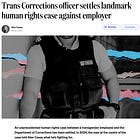
Then there was an employment settlement between Corrections and a female prison office who “identifies as a man”. She complained after being prevented from conducting intimate searches of male prisoners and rather than defending what is a reasonable safeguarding policy, Corrections apologised, paid confidential compensation, and changed its policy so staff can now carry out duties according to their gender identity rather than their biological sex.
Prisoners lose many rights when they are sentenced to prison. They lose their liberty, privacy, and an enormous amounts of personal autonomy. But they do not lose every right. One remaining safeguard has always been that they are entitled to have intimate and rub-down searches conducted by officers of the same biological sex.
Many prisoners have histories of sexual abuse and trauma and these searches are intrusive and thorough. But the rights of prisoners have been subordinated to the emotional validation of a staff member.
The settlement avoids the matter going to tribunal or court and confronting a long contested legal question of whether “sex” in the Human Rights Act should be interpreted to include gender identity. This has rested largely on an old Crown Law opinion rather than binding judicial authority. By settling before a tribunal ruling, everyone avoids having that question properly tested. Convenient.
The rest of the democratic world is increasingly stepping back from this ideology. New Zealand, meanwhile, still seems determined to double down.
Click to view
Was this Corrections case settled to avoid a precedent Crown Law & Human Rights Commission did not want?
Ani O’Brien 14 Jul Read full story
🇬🇧 Amnesty International’s spectacular own goal
Own goal of the week goes to Amnesty International UK. The organisation that once built its reputation defending prisoners of conscience and victims of authoritarian regimes published a report on the supposed “anti-rights movement” in Britain. Among the organisations it chose to blacklist were feminist groups, gay and lesbian organisations, For Women Scotland, and, most astonishingly of all, Beira’s Place, the women-only sexual violence support centre founded by JK Rowling.
You could not invent a more perfect example of institutional capture if you tried.
Beira’s Place exists because female survivors of sexual violence are entitled to access trauma support from women in a women-only environment. Apparently, in the fevered ideological imagination of Amnesty UK, that basic safeguarding principle now amounts to hostility towards human rights.
The report also attacked For Women Scotland, the group that successfully went to the UK Supreme Court to clarify that “woman” and “sex” in the Equality Act refer to biological sex. Instead of pausing to consider whether the country’s highest court had identified an important legal distinction, Amnesty responded by placing the women who vindicated that distinction on a list of ideological enemies.
The backlash was immediate and entirely predictable. Amnesty UK pulled the report, claiming it had been uploaded without going through the proper internal checks, and expressing regret over its language.
Even Amnesty International’s global secretariat has now begun edging away from its UK branch. The international body stressed that it had not been involved in preparing the report and supported its withdrawal.
Unfortunately for Amnesty UK, the consequences may not end with just a humiliating climbdown. Lawyers for Beira’s Place have accused the charity of defamation and demanded that the report be withdrawn permanently, that Amnesty publish a prominent apology ,and that an external investigation be commissioned into how such “egregious falsehoods” were published. JK Rowling has also offered financial support to other women’s and gay men’s organisations considering legal action.
The Charity Commission is now assessing the matter after Amnesty UK filed a serious incident report about itself. There are also calls for its chief executive to consider her position.
Ban the hardware, not the software
If you’d told me a fortnight ago that an idea I wrote about on Substack would end up in a David Seymour speech, be reported by every major political outlet in the country, and spark a national conversation about whether teenagers should have smartphones, I probably wouldn’t have believed you.
The idea itself was simple. Rather than trying to regulate every social media platform on earth (requiring age verification, threatening adults’ online privacy, and forever chasing whatever Silicon Valley invents next) why not focus on the piece of hardware that gives children constant access to all of it?
Ban the hardware, not the software.
RNZ, Stuff, The Post, the Herald, Newstalk ZB and countless commentators all weighed in. Kerre Woodham endorsed it and Jenna Lynch had fun pointing out the irony of ACT suddenly flirting with banning something. Suddenly a conversation that had previously been about impossible-to-enforce social media bans became a much broader discussion about what smartphones have done to childhood.
Winston Peters was not a fan of the idea. He was denounced it as “totalitarian”, insisting the Government shouldn’t be telling parents what phones their children can have. For the record, I don’t think Winston is entirely wrong either. The tension between protecting children and preserving parental responsibility is exactly the sort of trade-off worth arguing about. Public policy gets better when people are willing to test ideas in public rather than treating every suggestion as a blood oath.
Hear me out: Ban the hardware not the software
Ani O’Brien 12 Jul

Across the developed world, governments have concluded they can no longer ignore the mounting evidence that social media is harming children. Australia has legislated an under 16 social media ban that is proving to be pretty flawed to say the least. Britain has announced one and is now floating the idea of a VPN ban. The European Union is actively consi…
Read full story
How did LynnMall happen?
The coronial inquest into the 2021 LynnMall terrorist attack has moved into the next phase: how New Zealand ended up with a known violent extremist under police surveillance who was nevertheless able to stab six people.
Ahamed Samsudeen had been on the authorities’ radar for years. He had been identified as a terrorist threat, arrested at Auckland Airport amid suspicions he intended to travel to Syria to join Islamic State, imprisoned for possessing extremist material, and closely monitored after his release. Police believed he had previously been mobilising towards an attack. Yet seven weeks after leaving prison, he walked into the LynnMall supermarket, took a knife from the shelves and began stabbing strangers.
The inquest is now examining whether there were opportunities to prevent that outcome, and the emerging evidence is uncomfortable.
There is no evidence Samsudeen was radicalised before arriving in New Zealand in 2011. By March 2016, however, his commitment to violent extremism was apparent. The coroner is considering whether his four years on remand, including 17 months in segregation, the quality of his mental health care and the religious and cultural support he received contributed to his radicalisation.
That does not mean prison created a terrorist. Samsudeen was not a passive victim of circumstance. Witnesses have described a deeply difficult, manipulative, and hostile man. He distrusted authority, abused prison officers, threw urine and faeces at staff, attempted to bargain his cooperation for electronic devices, and then withdrew consent once he got what he wanted. His probation officer told the inquest he had never managed an offender requiring such extraordinary oversight.
There was also a disturbing pattern in his treatment of women. Samsudeen became fixated on his lawyer, repeatedly contacting her after being asked to stop, attempting to arrange meetings alone and eventually engaged in conduct experts described as stalking and harassment. A forensic psychiatrist told the inquest that the stalking could not be separated from the attack and suggested that a non-association order made the day before the stabbing may have intensified his rage. Other expert evidence identified misogyny as part of his worldview and concluded that he presented a broader risk to women.
Violent extremism is rarely only about abstract ideology. It often combines political or religious grievance with personal resentment, isolation, humiliation, fixation and hatred. In Samsudeen’s case, his belief that Muslims were being persecuted sat alongside contempt for authority, obsessive conduct towards women and an apparently growing desire to act.
The State’s difficulty was that officials could see the danger but had limited powers to address it. Samsudeen refused psychological intervention. He could not lawfully be detained indefinitely. His refugee status had been cancelled, but he remained a protected person under immigration law and could not be deported. Police therefore followed him covertly through the community, knowing he might attack with little warning but unable to arrest him for a crime he had not yet committed.
The inquest has not yet concluded that any single agency failure caused the attack, but it is clear New Zealand had a man whom police believed was committed to violent extremism, Corrections found almost impossible to manage, rejected efforts to help him, showed escalating hostility and fixation, and who nevertheless could not legally be kept away from the public.
NZ Muscle and the Wayne Brown Paybook
Social activist Dave Letele and NZ Muscle appear to have borrowed the same public-relations playbook Wayne Brown used this week: when scrutiny becomes uncomfortable, flip the story so that you become the victim.
To be absolutely clear, death threats and publishing someone’s home address are unacceptable. But that does not mean the threats should be allowed to swallow the original story.
NZ Muscle is facing serious questions about the labelling, packaging, and safety of products consumed by thousands of people. Regulators are investigating and customers are entitled to be angry and to demand answers.
Instead, the media narrative has rapidly shifted from what NZ Muscle did to how awful people have been to NZ Muscle and Dave Letele.
Letele has arrived as the respected public face of a company whose reputation is collapsing. He says he is there to fix it, save jobs, and restore trust. But he has also inherited the obligation to answer for what went wrong.
The existence of extremists making threats is being used to blur the distinction between harassment and accountability. But a person asking whether NZ Muscle knowingly cut corners is not responsible for a death threat sent by somebody else. A customer demanding proof that the product they consumed was safe is not harassing Dave Letele’s family.
A competent crisis response would keep those matters separate. It would report threats to the police, protect staff and families, and then return immediately to addressing failings and winning back the trust of customers.
In short - other stuff that happened
- Former ACT Party president Tim Jago has pleaded guilty to another historical charge of sexual violation by unlawful sexual connection and is due to be sentenced in Auckland District Court. He is already serving a 2.5 year prison sentence after being convicted in 2024 of indecently assaulting two teenage boys he mentored in the 1990s.
- 🇬🇧 England were eliminated from the 2026 FIFA World Cup in a 2–1 semifinal loss to Argentina. After the match, Argentine players displayed a banner reading "Las Malvinas Son Argentinas" ("The Falklands are Argentine"), prompting questions about whether it breached FIFA's rules on political messaging.
- Michael David McLeod (42) a Dunedin musician, was jailed for two years and three months in the Dunedin District Court on July 15, 2026. He pleaded guilty to a representative charge of contracting a 15 year old girl for sex services and drug-related charges.
- 🇬🇧 Former New Zealand Labour campaign manager Hayden Munro has been appointed political director to incoming UK Prime Minister Andy Burnham after helping run Burnham's successful leadership campaign. Munro previously managed Labour's 2020 and 2023 election campaigns in New Zealand before moving to the UK to work in politics and lobbying.
- A Porirua early childhood teacher has had her teaching registration cancelled after the Teachers' Disciplinary Tribunal found she attended work impaired by alcohol. The tribunal found her guilty of serious misconduct, citing evidence she regularly drank up to two bottles of wine at night, and ordered her to pay more than $25,000 in costs.
- New Zealand has confirmed its first case of the H5N1 strain of bird flu after a brown skua found on Petone Beach tested positive, prompting increased surveillance and monitoring of wild birds. Authorities say the immediate risk is to native wildlife and poultry rather than humans, and are urging the public not to handle sick or dead birds and to report them to MPI’s biosecurity hotline.
- And now a second bird flu case has been identified. A kāhu (swamp harrier hawk) found in Wairarapa.......The full article is published HERE
Ani O'Brien comes from a digital marketing background, she has been heavily involved in women's rights advocacy and is a founding council member of the Free Speech Union. This article was originally published on Ani's Substack Site and is published here with kind permission.


7 comments:
I voted Wayne Brown in 2022, not because I thought he was the best candidate, far from it, but out of the original pool of non woke candidates, he was the last man standing. Never again.
Over the next 3 years it became clear he was anti car, anti commerce in his support for the sale of the Downtown car park, seemingly supporting anything that drove away people from the CBD who didn't use buses or bicycles and has an insatiable appetite for taxing the city to death. Anyone who stood up against his stupid decision making is squashed. Ask Viv Beck for speaking the truth to the dire unsafe state of the CBD.
He drew support from the Heralds woke journo Simon Wilson, and ministerial super failure Phil Twyford, so you know where Wayne is coming from. Then his unqualified picks to head major committees like the uber woke social worker Richard Hills and bicycle activist Julie Fairey, sealed it.
His council sounds increasingly dysfunctional, with it becoming clearer that its councillors of the left persuasions - you are with us or you are against us - ugliness, leading the charge.
Brown has become a plague on Auckland. Those who thought an end to big spending on social leftist causes would end under him are sadly disappointed. His incredibly unjustified ego adding fuel to the fire. Someone, anyone to boot this foul mouthed big tax lefty out is required.
And btw Wayne. You don't own Auckland and you answer to central government like the rest!
More good stuff, thank you Ani.
"Kupe and Cook" odds on the name Cook will be changed if Labour get into power.
It's supposedly bad luck to rename a vessel. Not sure if that relates only to ships in the water or includes one being built.
Come to think of it, I seem to recall the current ships were renamed on arrival here.
Might be something in it, given their performance of late.
Ani distracts with talk of left wing extremists while right wing extremists are actually getting arrested for actual crimes in USA. The Tate bros are what is really happening they represent right wing reality.
Maybe we shouldn’t quibble about the even-handed approach to the ferries naming. A Maori language name plus an English language name. Is Winston making a point here that the English navigation of 1769 and later was thoroughly documented, versus a totally mythical Maori character who in all probability arrived accidentally. I would prefer that Cook was remembered by his full name and have the ferry launched as the James Cook.
I agree Eamon, The 'James Cook' is more befitting, in recognition of one of the world's great navigators and cartographers and whose existence is beyond doubt in his significance to the recorded history of this country. Anything less is quite inappropriate and, in my view, actually insulting.
Even 'Captain Cook' would be better than plain "Cook'
Following up on my earlier comment. There is a precedent for naming a vessel for the honouree’s full name. Our navy named a vessel as the Charles Upham back in the1990’s. Charles Upham was awarded a double VC back in World War 2. Unfortunately the vessel turned out to be totally unfit for purpose and was sold back to Europe.
Post a Comment
Thank you for joining the discussion. Breaking Views welcomes respectful contributions that enrich the debate. Please ensure your comments are not defamatory, derogatory or disruptive. We appreciate your cooperation.