

The King’s Birthday Honours list was released this week, recognising 178 New Zealanders. Among them were former Chief Ombudsman Sir Peter Boshier, literacy expert Sir James Chapman, journalist Barry Soper, New Zealand Initiative education researcher Michael Johnston, former Rangitoto College principal Patrick Gale, and a host of community leaders, educators, sportspeople, and volunteers.
But one recipient stood out to me in particular. Professor Elizabeth Rata has been made a Dame Companion of the New Zealand Order of Merit for services to education.
Rata is one of New Zealand’s most important educational thinkers. Over several decades she has challenged some of the dominant assumptions that have shaped education policy, arguing that schools should focus on transmitting knowledge and providing all children access to the same intellectual inheritance, regardless of their background.

Dame Elizabeth Rata.
In recent years she has become one of the most prominent critics of the growing tendency to treat knowledge as political, cultural, or identity-based. She has challenged ethnic essentialism, questioned the politicisation of curriculum, and consistently defended the idea that education should unite students rather than divide them into competing identity groups. That has often put her at odds with prevailing academic opinion.
Agree with her or not, Rata has shown a level of intellectual courage that has become rare in public life.
Election 2026: Five months out and Labour has no plan
With just over five months until election day, campaigns are beginning to take shape and it has not been a good fortnight for Labour. The most significant development was the latest Roy Morgan poll, which showed support for the National-ACT-NZ First coalition up to 51.5%, while the combined Labour-Greens-Te Pāti Māori bloc fell to 41.5%. National jumped 5 points to 30.5%, Labour collapsed a massive 7.5 points to 26.5%, and the Opportunities Party comes from nowhere to sit at 6%. If those numbers were replicated on election day, the Government would retain power comfortably.
Not a peep from media though. Usually they froth over a poll, but they ignored this one completely. When National was polling in the mid-to-high twenties, the media treated it as a crisis. Journalists chased Christopher Luxon through airports asking whether he would survive as leader. Every poll triggered breathless speculation about coups, leadership challenges, and instability. Yet Labour has now fallen to exactly the same territory at 26.5 % in this poll and the reaction has been silence. There are no daily questions about whether Chris Hipkins should be rolled and no journalists pursuing Labour MPs asking whether they still back their leader.
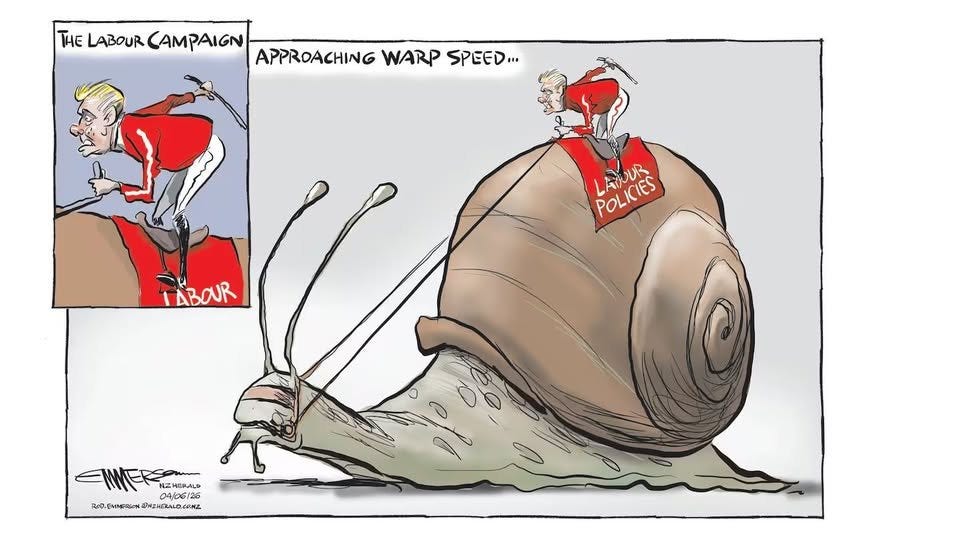
Following Budget 2026, Labour’s lack of policy has begun to be criticised more aggressively too. Hipkins admitted this week that Labour is still working through the Budget and has yet to decide what parts it would keep or scrap if elected. While he promises a wave of policy announcements in coming weeks, it is remarkable that less than six months out from an election the party is still struggling to articulate a coherent alternative vision for government.
Meanwhile, ACT has unveiled 37 electorate candidates. The list reflects the party’s continuing evolution from a one-man band into a serious political movement, featuring educators, engineers, lawyers, health professionals, military veterans and business leaders.
New Zealand First has also continued to expand its ranks. Former Labour Cabinet Minister Stuart Nash has formally joined the party and will contest Napier, while Hobson’s Pledge spokesman Elliot Ikilei has also been announced as a candidate. Nash brings ministerial experience, while Ikilei further strengthens New Zealand First’s credentials on issues such as equal citizenship, democratic accountability and opposition to race-based political arrangements.
🇬🇧 The murder that shook Britain
Henry Nowak was an 18 year old university student. In December 2025, he was fatally stabbed by Vickrum Digwa who then falsely claimed Nowak of racially abusing and attacking him. Police bodycam footage showed Nowak handcuffed while dying, repeatedly telling officers he had been stabbed to which an officer replied “I don’t think you have, mate”. He pleaded with them, saying he could not breathe, before he died at the scene.
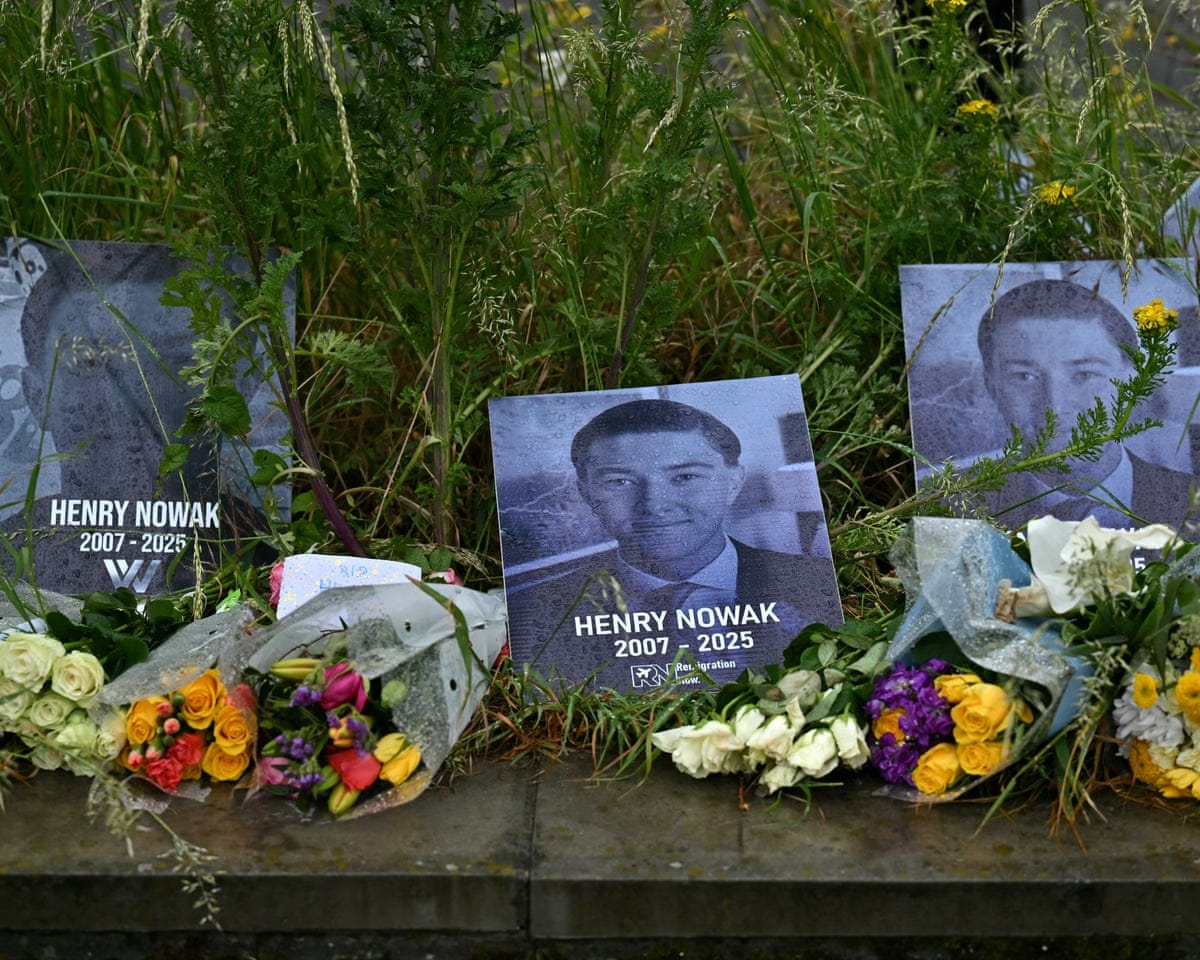
That is the part of the story that has enraged people. Not just that a young man was murdered. But that, in his final moments, he was treated as a suspect while the killer’s false allegation of racism was uncritically believed.
Digwa has been convicted of murder and sentenced to life imprisonment. His mother was also convicted over hiding the murder weapon, and his brother and father face weapons-related charges.
Many argue the case exposes “two-tier policing” and a system so terrified of racial allegations that it failed a dying white victim. Others have accused figures such as Nigel Farage and Elon Musk of exploiting the tragedy and inflaming racial tensions. These same people “took the knee” for George Floyd.
I wrote about this in depth this week. Read here.
The end of unelected voting in Local Government
Local Government Minister Simon Watts’ decision to restrict voting rights on council committees to elected representatives was a pleasant surprise for those who have been raising the alarm about the powerful role unelected people have been playing at a council level.
Act MP Cameron Luxton had a member’s bill in the tin aiming to address the matter and NZ First too were making the right noises about this. That Watts has acted is a sign that National have woken up to the number of votes they are bleeding to their coalition partners.
Opponents immediately framed the change as an attack on Māori. Te Pāti Māori claimed the Government was removing iwi voices from local government and ensuring Māori have “absolutely zero say” in decisions affecting their whenua.
But, the legislation applies equally to everyone. Watts referenced iwi representatives, youth representatives under 18, and other ‘appointed’ members. This is not about race. The only thing changing is that voting rights will be reserved for people voters can hire and fire at the ballot box.
If you haven’t won your place in an election, you shouldn’t have a vote on how ratepayers’ money is spent. Unelected members can still participate, advise, and offer expertise, but they won’t be able to cast votes.
The never-ending war on taxpayers and ratepayers
The Taxpayers’ Union has continued to do the hard work of digging through Official Information Act responses and council documents to expose waste that would otherwise go unnoticed. This week, they revealed that Tiāki Wai (the new organisation that will deliver water services across the Wellington region) is spending $420,000 on an advertising campaign to tell Wellingtonians that Tiāki Wai exists. Apparently there is always money for branding, communications and marketing, but never enough money to fix the actual problems.
Meanwhile, Wellington City Council is facing questions after it emerged a dedicated website for the new central library cost nearly $600,000 to design and build. Critics have pointed out that users cannot even join the library through the website and are instead redirected to the existing library site.
In Christchurch, ratepayers discovered their council had out done Wellington, spending an eye-watering $7.7 million on what many councillors believed was an app, but which turned out to be a website.
And it isn’t just local government. The Taxpayers’ Union also revealed that Corrections has spent more than $32 million pursuing carbon-neutral government targets since 2021. That includes hundreds of electric vehicles, charging infrastructure, emissions reporting, and, of course, consultants.
Paul Joseph Dally: Some offenders should never be released
Paul Joseph Dally is serving a life sentence for the 1989 rape, torture and murder of 13 year old Karla Cardno. He abducted her while she was biking home from the shops, held her for 22 hours, raped and tortured her, then buried her alive in a shallow grave. It is one of the most depraved crimes in New Zealand history.
Now, after more than 35 years in prison, the Parole Board is preparing for the possibility of his release. Worse, it has ruled that current photos of Dally cannot be published if he is released, along with information that could identify where he is living. This is apparently because his notoriety may make accommodation difficult to secure and could put his safety at risk. What about the safety of the public?
Parole Board perspectives on the prospect of releasing him has evolved significantly. In 2009, a review found he scored highly on the psychopathy checklist and had a likelihood of serious violent and sexual reoffending. In 2013, the Parole Board said release was “out of the question” and described him as a high-risk offender with a “potentially sinister combination of psychopathy and possible sadistic sexual practices”. In 2014, he reportedly acknowledged enjoying the control he exercised over Karla during his offending.
Since then, the language around Dally has softened. We are now told he has moved from an extremely high risk of reoffending to a low risk of violent offending and an average risk of sexual offending. I don’t know about you, but “average risk of sexual offending” is not particularly reassuring to me.
The Sensible Sentencing Trust says only a small number of criminals are so dangerous, so sadistic, and so morally deformed that they should never again be released into the community and Paul Joseph Dally is one of those few.
Political violence gets a shrug
A 24 year old man has been charged with arson after a fire at Christopher Luxon’s Botany electorate office this week. Emergency services were called after reports of a fire at the rear of the building, locals reported hearing a loud bang, and police treated the blaze as suspicious. Fortunately, staff were safe and nobody was harmed.
Still, someone tried to set fire to the Prime Minister’s electorate office. It could well have ended in tragedy with Luxon’s staffers as collateral damage.
I’m sick of griping about the media, but the coverage has been oddly flat. It has been treated largely as a minor crime story rather than an attack on the PM’s office. Had this been the office of a Labour Prime Minister it is hard to imagine the same blasé treatment. We would already be having national conversations about extremism, hatred, online radicalisation, violent rhetoric, and threats to democracy.
But the target was Christopher Luxon, so it has been filed under “small fire on a deck”.
This is not about overstating what we know which is not a lot. There appear to be suppression orders around his identity. The courts will deal with the facts, but we do not need to know every detail before recognising that setting fire to an elected representative’s office is serious.
The Mooney Bill myth
Fonterra and Z Energy provided a briefing note to a then-senior staffer in the Prime Minister’s office in mid-2024 about the Smith v Fonterra litigation and the possibility of legislative change. That document was not properly captured in the official record and was therefore not released under the OIA when it should have been. It has since emerged that the document was also sent to the staffer’s private email account. That is not acceptable. It undermines transparency and the Prime Minister’s office is right to say so. The Ombudsman and DIA are now looking into it.
But the leap from poor process to grand conspiracy is ridiculous. The media narrative suggests that the Government only acted because large companies lobbied it to do so. The inconvenient fact is that the legislative proposal existed independently of that lobbying. National MP Joseph Mooney lodged his Climate Change (Restriction on Civil Proceedings) Bill as a member’s bill in March 2025, and RNZ itself reported that Mooney said he had no interaction with Fonterra or Z Energy about the bill before submitting it.
One of the sillier parts of this whole saga is the suggestion that ministers somehow aren't allowed to disagree with officials. But officials advise; ministers decide. Officials are entitled to recommend the status quo, warn about risks, and set out alternatives. Ministers are entitled to disagree. If senior officials want to make final political decisions, they are welcome to resign, join a party, and put their names on a ballot paper.
The record-keeping failure deserves scrutiny, lobbying should be transparent, and private email should not be used for official business. But disagreement between officials and ministers is not corruption and companies expressing a view to government is not inherently sinister.
The Press Gallery vs Gerry Brownlee
A stoush has broken out between Speaker Gerry Brownlee and the Press Gallery after Stuff published a photograph of Minister Louise Upston walking through a parliamentary corridor that has restrictions for filming. Brownlee says the image breached the spirit of Parliament’s filming rules, while Stuff and other senior political journalists argue the photo was taken from an area where filming and photography are permitted.
There are two things to note here. The first is that the media should be able to scrutinise MPs. The second is that Parliament has rules for a reason. The Press Gallery enjoys extraordinary access to elected representatives, ministers, staff, and the parliamentary precinct. That access comes with obligations. Journalists do not get to decide for themselves which rules matter and which ones are merely inconvenient. If they breach the rules, they should cop the consequences.
That said, proportionality matters. A reminder, warning, clarification of the rules, or formal censure may be justified if Brownlee concludes Stuff went too far. But suspending an entire press gallery team over a photograph taken from an area journalists believed they were allowed to work in feels heavy-handed.
I support Brownlee getting stricter about standards in Parliament. Both MPs and the Press Gallery should sharpen up their standards. But if the rules are unclear, they should be clarified before the nuclear option is used.
🇨🇳 China tests New Zealand's backbone
China has had quite a week in relation to New Zealand, and none of it is especially good. Four New Zealand MPs (National’s Maureen Pugh, Labour’s Duncan Webb, ACT’s Laura McClure and NZ First’s David Wilson) have been banned from entering China, Hong Kong and Macau for a year after visiting Taiwan as part of a cross-party parliamentary delegation. China’s embassy expressed anger, warning that MPs are “not ordinary citizens” and that anyone who crosses Beijing’s “red line” on Taiwan will “face the consequences.”
New Zealand’s One China policy has not changed. However, MPs have visited Taiwan for decades and they were not travelling as ministers or representatives of the Government. They were elected MPs participating in parliamentary engagement, which is entirely normal in a free democracy.
The SIS and New Zealand’s Five Eyes partners have also warned that China’s military intelligence services are using job sites and professional networking platforms to target people with access to sensitive government and defence information. The method is grubby but simple; they use fake consultancy or analyst roles and then escalate requests for privileged information. The Chinese Embassy has denied the claims and accused New Zealand and its partners of smearing China.
🇬🇧 Trans violence and missing context
Lost under all of the Henry Nowak reporting this week was another story the establishment tried to obscure. Darren Rigby (21) was jailed for 28 months after sending death threats to three girls-only schools in Merseyside. He threatened to “shoot and stab” girls, kill women staff members, and attack pupils with weapons. The schools went into lockdown and young girls were terrified.
But the most important context was largely missing from mainstream coverage. Rigby’s threats actually referred to the “oppression” of “trans women”, accused the girls of being “TERFs”, and framed the threatened violence as retaliation for alleged mocking, deadnaming, and misgendering.
Yet major outlets reported the case as though it were merely a generic hoax threat story. The BBC reported that a man had sent threatening emails to schools and caused lockdowns, but did not explain why girls’ schools were targeted or what ideological language appeared in the threats. Merseyside Police also framed the matter this way.
Obscuring motive changes the story. A man threatening to massacre girls and women in the name of “trans women” is not simply a disturbed individual sending random hoax emails. It is an example of extreme misogyny dressed up in the language of progressive grievance. The public is entitled to the full facts, even when those facts are politically inconvenient. Thanks to Reduxx for getting the real story out there.
Apocalypse Now… according to Iwi leaders
The Waitangi Tribunal’s held an urgent inquiry into the government’s plan to amend Treaty clauses across 19 pieces of legislation. Iwi leaders arrived armed with the most catastrophic rhetoric ready to go. Waikato-Tainui leader Tuku Morgan described the coalition as “the most racist, anti-Māori government ever to come to power” and accused ministers of conducting an “unrelenting assault” on Māori rights. He must have forgotten the earlier governments who committed the acts the Waitangi Tribunal was set up to facilitate settlements for.
Justice Minister Paul Goldsmith argues that decades of legislation have produced a patchwork of obligations ranging from “honour” and “give effect to” through to “have regard to” and “take into account”, creating uncertainty in the law. The proposed changes would repeal some Treaty clauses, amend others, and generally lower the required standard to “take into account” across a number of Acts.
Critics, however, see it as a deliberate rollback of Treaty obligations. Witness after witness warned the Tribunal that the reforms would weaken Māori influence in areas ranging from health and education to environmental management. Constitutional lawyer Dr Carwyn Jones described the package as “the most wide-ranging legislative breach of Te Tiriti in modern history.”
Iwi rhetoric has become increasingly apocalyptic. A hui at Parliament following the Budget saw iwi representatives accuse the government of creating “economic apartheid” and “turning its back on Māori”. They clearly do not understand apartheid if they think the Government is enacting it by removing separatist policies.
Winston Peters summed up that mood with characteristic flare when he responded to Morgn’s accusations by declaring that the real assault was on “Māori elitist troughers and bureaucratic separatists stuck to the teat of the taxpayer in make-work schemes like the Waitangi Tribunal.”
The other story that attracted attention was DOC’s investigation into its relationship with Ngāti Kuri. The department has launched an external review after concerns were raised about contracting, procurement and debt management processes in Northland. Documents released under the Official Information Act show DOC estimates it is owed around $1.8 million in campground revenue retained by the iwi trust board, while Ngāti Kuri disputes that any debt is owed.
The Kiwi Meta wants to silence
New Zealander Sarah Wynn-Williams has become a rather uncomfortable problem for Meta. Her book, Careless People, lifts the lid on her years working inside Facebook, including allegations about the company’s internal culture, its political influence, its dealings with China, and the behaviour of senior executives. Meta disputes her claims, has described the book as false and defamatory, and has pursued legal action that prevents Wynn-Williams from promoting it or speaking freely about it.
This week, Wynn-Williams appeared at the Hay Festival in Wales but sat in silence for the entire panel discussion about her own book. She was unable to speak, nod, or even shake her head. Carole Cadwalladr introduced her as “an author in a hostage situation”.
Thought Crimes Book Club read Careless People earlier this year, and I have made my review publicly available.
Chart of the week
Swapping Chart of the Week for Cartoon of the Week. The usually Labour-friendly Rod Emmerson is clearly fed up with Hipkins’ lack of substance.
Click to view
In short - other stuff that happened
- Oranga Tamariki's new chief executive has inherited an agency under obvious strain. With 180 vacancies and urgent child harm concerns being responded to on time only 80% of the time, taxpayers will be hoping the extra $261 million allocated in Budget 2026 delivers more than another round of reports and restructures.
- The Far North lost one of its most respected educators this week. Tārati "Nanny Dot" Buckley spent decades promoting te reo Māori and kaupapa Māori education. She was murdered over King’s Birthday Weekend and Police have charged a 26 year old man with murder, arson, burglary, vehicle theft and other offences.
- Academics are celebrating the death of one of the country's favourite bureaucratic exercises. The Government will scrap the Performance-Based Research Fund's cumbersome assessment process and replace it with a system that focuses more heavily on actual research outputs.
- Researchers from the University of Otago are calling for greater Māori involvement in eating disorder treatment and recommended expanding kaupapa Māori services, culturally specific assessment tools, peer support programmes and whānau-centred treatment approaches.
- Paula Bennett's 63% pay rise as Pharmac chairwoman generated predictable outrage this week. It takes her annual fee from $66,000 to $104,360, but Kiwis need to ask themselves if they want major Crown entities run by experienced governors or bargain-bin appointees.
- George Murphy Starling, who drugged and raped two women at a 2011 party, was released on parole this week after serving less than 2 years of his 6 year sentence. The judge originally started at 10 years but reduced it substantially for factors including youth, previous good character, a head injury and time already served on another matter.
- Gurshabad Singh (8), who was non-verbal and autistic, drowned in a private swimming pool in Te Atatū South after escaping from a specialised school transport van during drop-off. The homeowner discovered him submerged in the pool and called 111, while a neighbour and the homeowner’s grandson pulled him from the water and attempted CPR, but he could not be revived.
- A man gained unauthorised access to The Press newsroom in Christchurch on 13 May while delivering a letter to the editor, prompting security measures after one staff member reported hearing a reference to the 2015 Charlie Hebdo terrorist attack which was disputed by others. Police were not notified until five days later, but subsequently identified and spoke to the man, assessed him as low risk, and provided advice about his behaviour.
- Government agencies spent almost $184 million responding to Official Information Act requests last year, with costs projected to nearly double over the next 5 years. Officials are now exploring reforms including greater proactive disclosure and the use of AI tools to handle routine requests.
- Wellington's infrastructure disgraced itself again this week. Heavy rain left faecal matter, toilet waste and sanitary products strewn across roads, footpaths and cycleways in Island Bay after a wastewater overflow.
- A casual comment from Defence Minister Chris Penk reignited New Zealand's long-dormant nuclear debate this week. While supporters argue small modular reactors could eventually provide reliable low-emissions electricity, critics point out the technology remains expensive, unproven at scale and politically radioactive.
- The Free Speech Union is accusing the Government of putting the cart before the horse after they allocated $30.7 million to develop online safety systems before Parliament has even debated the legislation those systems would enforce.
- A 38 year old man has been charged with unlawfully being in an enclosed yard, theft, injuring a police dog, and resisting police after allegedly entering a Point Chevalier property naked and later assaulting and attempting to drown a police dog during an arrest in a nearby swamp. You can’t make this stuff up.
- Nelson City Council is still trying to untangle questions around councillor Lisa Austin's eligibility to hold office after concerns were raised about indirect financial interests linked to council contractors. The matter now appears headed for further legal scrutiny.
- The government has announced a $30 million programme to install solar panels on 500 schools by 2028, with the first 80–100 schools expected to receive systems next year and a standard installation estimated to save up to $8,000 annually in electricity costs. The scheme is funded by $20 million from EECA and $10 million from the Ministry of Education.
- Dunedin councillor Benedict Ong says someone deliberately pulled down his home security cameras this week, adding another chapter to what has become one of local government's strangest political careers. The incident has been reported to police and follows a separate alleged road-rage incident in which Ong says another person brake-checked his vehicle and brandished a baton.
- Housing Minister Chris Bishop has welcomed seven new social homes designed specifically for autistic adults which have opened in Tauranga. The project combines self-contained housing with ongoing pastoral support.
- One of the week's positive stories was the opening of Whangārei's new $60.9 million radiation oncology service. The facility will allow many Northland cancer patients to receive treatment closer to home rather than making regular trips to Auckland.
This week I have been morbidly fascinated by Graham Platner, the Maine Democrat trying to unseat Republican Senator Susan Collins. He’s a Marine veteran, oyster farmer, economic populist, anti-establishment, supposedly authentic, and wrapped in a working-class aesthetic. But, his campaign has become a rolling dumpster fire of scandals. He has had old Reddit posts using slurs and making ugly comments about rape, race, police and political violence, a tattoo of the Nazi Totenkopf symbol which he claims he did not understand but an ex-girlfriend says he was proud of, sexting with a dozen women outside his marriage; and now claims from former girlfriends describing volatile, toxic, and physically threatening behaviour.

Bernie Sanders and Graham Platner 24 May 2026.
Photo: Joe Raedle/Getty Images
What is more extraordinary is the response from Democrats who usually moralise ad nauseum about “believe women”, “character matters”, condemning “grab them by the pussy”, and the existential danger of anything even adjacent to Nazi symbolism. Bernie Sanders, Elizabeth Warren, Chuck Schumer and the usual progressive choir seem perfectly willing to look the other way because they think he can beat Susan Collins.
The Obama-bro Pod Save America crowd have also been busy laundering this as a touching story of growth and redemption, as if “dark period” is a magic phrase that turns a Nazi tattoo, misogyny, and an apparent fixation on rape, into a minor youthful indiscretion. He was 35 when he did the Reddit posts by the way. Leftist Podcaster Kyle Kulinski’s says Platner could have sexted his mother and he would still vote for him. These are the same people who have spent years sermonising at everyone else about misogyny, consent, accountability and decency. Apparently all of that only applies when the other team is doing it.
By contrast, John Fetterman has been one of the few Democrats willing to say plainly that the man is revolting. He has called Platner out over the tattoo, the online comments, the Kik account, and the wider pattern of behaviour, while others mumble about grocery prices and pretend the issue is a private matter between him and his wife. Fetterman is often treated as a problem by his own side because he refuses to chant from the approved progressive hymn sheet. But he frequently looks like one of the only adults in the room. Certainly the one with the most principles.
Ani O'Brien comes from a digital marketing background, she has been heavily involved in women's rights advocacy and is a founding council member of the Free Speech Union. This article was originally published on Ani's Substack Site and is published here with kind permission.
What is more extraordinary is the response from Democrats who usually moralise ad nauseum about “believe women”, “character matters”, condemning “grab them by the pussy”, and the existential danger of anything even adjacent to Nazi symbolism. Bernie Sanders, Elizabeth Warren, Chuck Schumer and the usual progressive choir seem perfectly willing to look the other way because they think he can beat Susan Collins.
The Obama-bro Pod Save America crowd have also been busy laundering this as a touching story of growth and redemption, as if “dark period” is a magic phrase that turns a Nazi tattoo, misogyny, and an apparent fixation on rape, into a minor youthful indiscretion. He was 35 when he did the Reddit posts by the way. Leftist Podcaster Kyle Kulinski’s says Platner could have sexted his mother and he would still vote for him. These are the same people who have spent years sermonising at everyone else about misogyny, consent, accountability and decency. Apparently all of that only applies when the other team is doing it.
By contrast, John Fetterman has been one of the few Democrats willing to say plainly that the man is revolting. He has called Platner out over the tattoo, the online comments, the Kik account, and the wider pattern of behaviour, while others mumble about grocery prices and pretend the issue is a private matter between him and his wife. Fetterman is often treated as a problem by his own side because he refuses to chant from the approved progressive hymn sheet. But he frequently looks like one of the only adults in the room. Certainly the one with the most principles.
Ani O'Brien comes from a digital marketing background, she has been heavily involved in women's rights advocacy and is a founding council member of the Free Speech Union. This article was originally published on Ani's Substack Site and is published here with kind permission.


19 comments:
RE Hipins/Labour's "unannounced policies": no surprise. The Party hopes for an unexpected win (or to be in a Coalition and then announce them as bargaining chips). Either way, they will knock your socks off: e.g. draconian wealth tax and/or fast rack to He Puapua. e.g. a written Te Tiriti-based constitution. Hipkins is totally unscrupulous - but he will tap into the politics of envy which riddle NZ.
Why does Pharmac even exist?
There is a fight going on to block Elizabeth Rata's award. Will the Government back down from leftist pressure?
Answer to Ken above. Pharmac is the drug buying agency for the New Zealand Health system. All of our drugs are produced overseas by multinational companies. Pharmac negotiates with the companies to get the best price for New Zealand.
Their track record, going back 30 years or so, is very good at getting affordable pharmaceuticals.
Once again, Ani - Thank You for your excellent article.
Truly you are the best journalist!
NZ has 2 tier policing as well as Britain.
Are any of the financial crimes by Maori ever investigated - the millions ripped off with the police and authorities turning a blind eye.
Just a small example mentioned above with the DOC fees being stolen up north.
The Maori waka that went out to an authorized landing on the Kermadecs, after getting away with the blessing of a similar landing at the Poor Knights.
Etc, etc
I promise you Labour has policy. It's basic. Give the entire house, lock stock and barrel to Maori. End of conversation. And if 2020-23 is anything to go by, Labour, which is owned by Willie Jackson et al, will be very very driven. They will be backed by the Greens whose number one cause is the same, with a Cuban/pre Soviet collapse Albanian flavour to add to the non democratic tribal rule.
Whatever else they dream up will be substantless bumper sticker fluff to pretend the rest of us matter.
The tactics are now clear. Labour TPM and the Greens are peas in a pod but unelectable and they know it. Hence Labour 2.0, TOP. The urban chic party at home in Tesla's, law firms and wokery but with a glimmer they may be harmless to vote for. With that insurance policy, managed by Ian Lees Galloway, Labour can bring in it's identical siblings and bring in their only policy that matters.
Never ever underestimate the weapons grade manipulation the left are capable of.
I think the face of guy standing behind Platner in the photo sums up everything about the progressive left.
It’s a bit rich for the lefties to criticise Paula Bennett’s 63% pay rise after the pretend man, that largely destroyed NZ’s economy, Grant Robertson, scored a $640,000 job plus a free house courtesy of Otago University.
Winston does indeed have flare, especially when speaking in Parliament.
Flair too.
I printed out Elizabeth Rata's article . It was so well written and backed up with accurate historical references that I plan to give a copy to any who question it, but can never remember to open this blog.
She was my best pick for an Honour.
Elizabeth Rata deserves the highest accolades, if only for the presentation of the true meaning of the word "indigenous" through Breaking Views , is not about people, but original plants in a country. There are few more worthy recipients.
Those who challenge Elizabeth's honours need to consider carefully those in education who should now be defrocked or whatever the term is for the evil they did. Prime candidate for defrocking is Dame Marie Clay who somehow deceived the whole of the English speaking world for 50 + years, that guessing words from context and pictures was reading. Also, she insisted on a now thoroughly disproved theory that reading was as natural as learning to speak. Being a constructivist Clay certainly did not believe children should be taught knowledge
Well folks, honouring Clay for decades has meant we now have the longest tail of underachievement in the developed world and the worst reading scores in the English speaking world.
To attack this great mountain of educational garbage, which created this failure is revolutionary and extremely brave . The opposition is formidable. They seethe with fury. I have seen it on the AEC site, specifically set up to knock out all of Erica's changes. Gaynor
Thanks Doug for your remarks re Pharmac. In my early morning brain fog I was confusing Pharmac with Medsafe which, I believe, exists only to rubber-stamp the rubber-stampers.
Humble apologies for my stupidity,
AEC... a collective of retarded, angry, failures in edjicashun.... spawn of the last 30-40 years in skool....
To Anon 9.08: you mean bowing to pressure led by " the renowned" Mrs Hipkins ( mother of CH)? Prof Rata is " slightly" more renowned than this person.
Anonymous 6:07PM . AEC are a very angry and bitter group but some contributors are professors of Education etc , who have gained many accolades and high salaries in elitist academia teaching our youth their destructive ideologies.
Marie Clay opined on moi.... "a bit slow she said" after talking to moi - a troubled adolescent with HUGE family issues yet to emerge. But "slow" has BA and BMus[Hons 1st class] - twit of a woman.... out of her depth even then...
In other news jobs for the boys is also jobs for the girls! 60% pay rise for nepo DEI hire Paula Bennett from her old mate across the aisle in the ACT party. Corporate socialism and the class war continues unreported while less-informed individuals keep on blaming the Māoris for their troubles.
Post a Comment
Thank you for joining the discussion. Breaking Views welcomes respectful contributions that enrich the debate. Please ensure your comments are not defamatory, derogatory or disruptive. We appreciate your cooperation.