

Today I found myself somewhere I have not been for sometime… A Labour Party event. I used to be a Labour Party member and in fact they still send me auto-emails asking me to renew. Before that even, I was a Greens member, but we were all naive and high once. In 2020, for the first time I cast my vote for the centre-right after being effectively excommunicated from polite progressive society over my insistence that humans cannot change sex and gender ideology activism was becoming a problem.
That political journey left me politically homeless for a while until I learned that politics is about tradeoffs. I needed to pick a side to work with and the centre-right was willing to at least talk about women’s rights, the left were not.
The experience taught me some valuable lessons about the pitfalls of tribalism and the importance of letting your own values and principles guide you to make the necessary tradeoffs to get what you care about done.
My vote will never be guaranteed to any party. I swore to myself I would not approach an election simply backing “my team”. Instead I repeatedly weigh up what matters to me and who serves those interests best. Sounds pretty self-evident, but it isn’t as common as you think. A great deal of people see politics as a matter of picking a team and, come hell or high water, hating the other team.
So when libertarian anarchist and fellow professional irritant Damien Grant invited me to Labour’s State of the Nation, hosted by the Auckland Business Chamber, I said yes.
My vote will never be guaranteed to any party. I swore to myself I would not approach an election simply backing “my team”. Instead I repeatedly weigh up what matters to me and who serves those interests best. Sounds pretty self-evident, but it isn’t as common as you think. A great deal of people see politics as a matter of picking a team and, come hell or high water, hating the other team.
So when libertarian anarchist and fellow professional irritant Damien Grant invited me to Labour’s State of the Nation, hosted by the Auckland Business Chamber, I said yes.
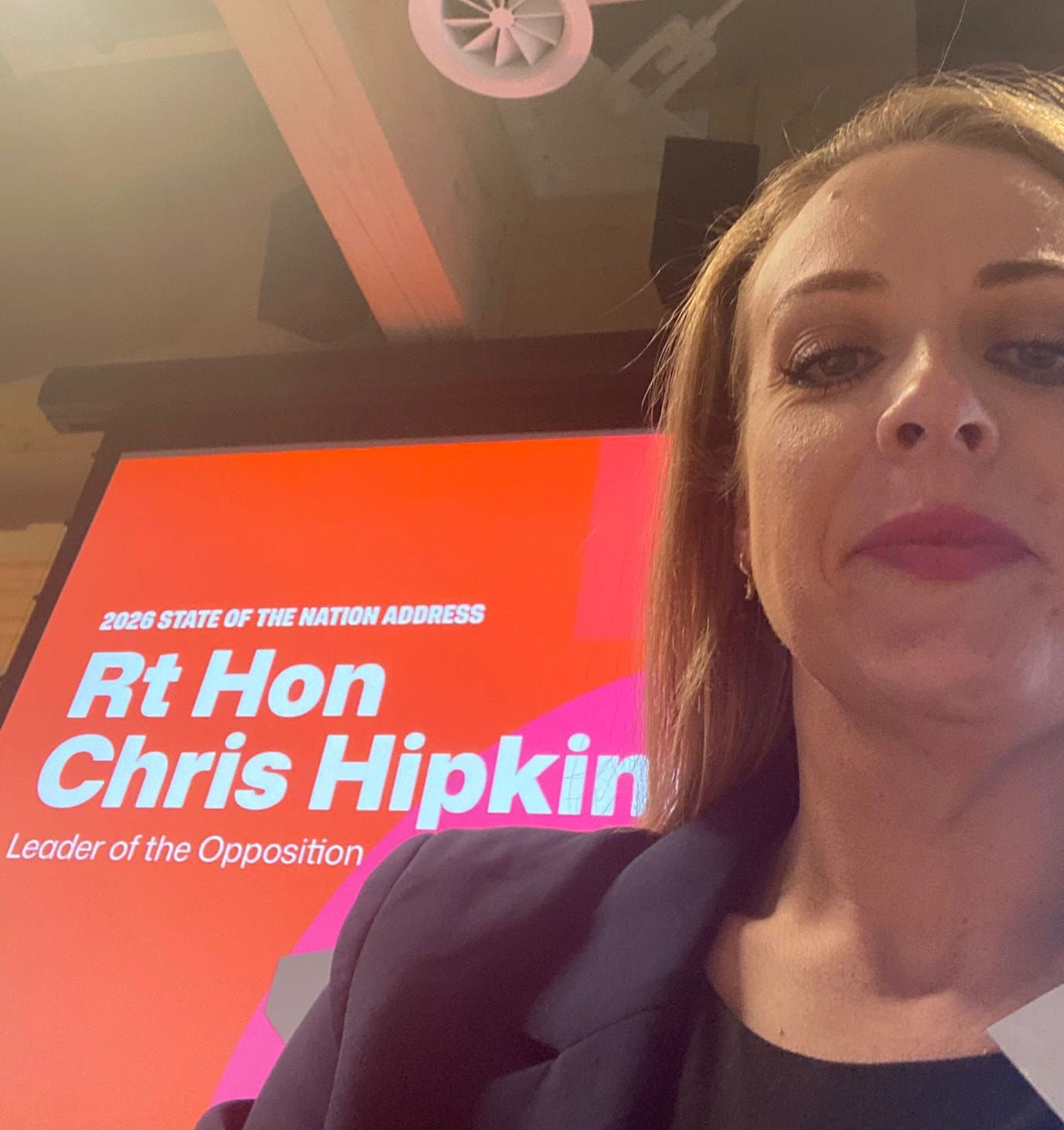
If democracy is struggling all over the world, as Leader of the Opposition Chris Hipkins himself later suggested, the least we can do is still show up in rooms with people we disagree with. It is after all an election year.
Former National Minister Maurice Williamson was at my table, attending as an Auckland Councillor. While on the next table over was Auckland Mayor Wayne Brown. Maurice did not mince words about what he perceived as a distinct lack of substance in Hipkins’ speech, and on the other hand the Mayor made no secret of his apparent preference for a Labour Government. He threw in a few quips and even a “hear hear!” when Hipkins referred to the need for central government to get out of the way and devolve to Auckland Council. I honestly think the Mayor might have been the most enthusiastic attendee.
It was a speech I had heard Chris Hipkins give before. The lines have been well-repeated, there were no new policy announcements, and I felt I learned more about Hipkins’ approach to the election and potentially governing again in the Q&A with Simon Bridges after. However, to be fair to the Labour leader, this is likely strategic. Most New Zealanders do not take the interest in politics that I do and will not hear him speak repeatedly. Message discipline is sometimes just repeating the same stuff for a slightly different audience to ensure that as many Kiwis as possible hear it at least once.
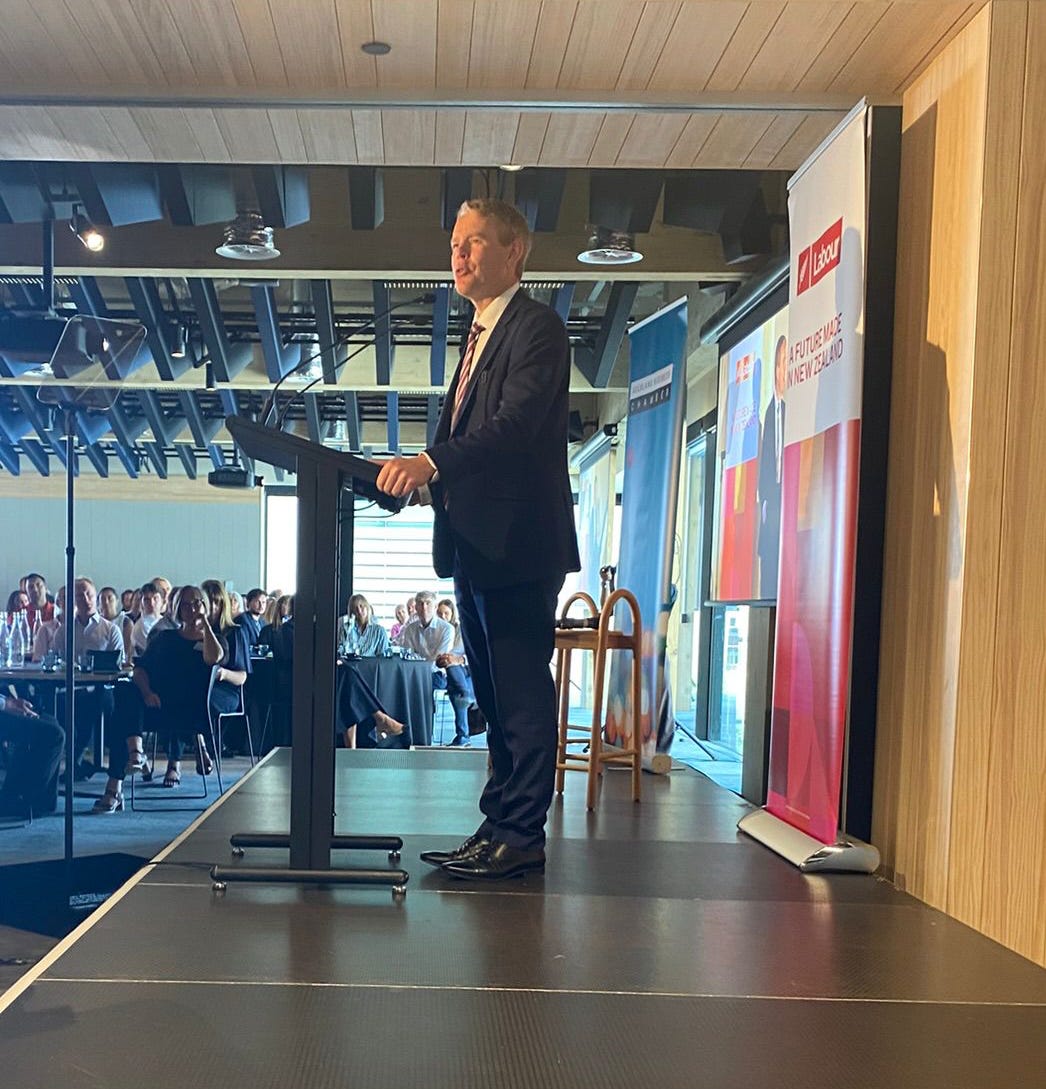
“Jobs. Health. Homes.” was a slogan they introduced last year and it was core to his speech today. While I remember being unimpressed with it when they first trotted it out, its simplicity serves them well now. The problem will come when they need to speak on issues outside of those core facets because, crime, for example, is difficult to ram to any of the categories.
Incidentally, I don’t recall him mentioning any law and order issues or policies at all. Whether that is because it simply isn’t a priority or that the current Government did such a great job in that area that Labour don’t want to draw attention to it, I am not sure. It is extraordinary to observe, however, that when safety, ram raids, and justice were such key issues of the last election, they were not mentioned today.
The speech was diagnostic rather than prescriptive. As I say, we got a run down of the wrongs of this government, but beyond three “free” doctor visits (taxpayer funded) and the mysterious Future Fund, we were left without much of an idea of how Labour will do things differently. There were references to resources, talent, innovation, exports, industry, the right words. “Productivity” came up a lot along with the admission that has been declining in our lands under successive governments. It has “stagnated,” he said.
It did not even feel that the messages being communicated were particularly tailored to the very specific Auckland business community to whom Hipkins’ spoke. He mentioned the desire to win over Auckland, acknowledging that 2023 was particularly brutal for his party in our big city, but the most tantalising tidbit we Aucklanders got was a rule out of any tolling of the Auckland Harbour Bridge. He did say they support the idea of a second crossing, but given they had a crack at getting that going when they were last in government, that isn’t surprising.
To be honest, the most audience-customised aspect of Hipkins’ remarks was the fact that when he accused the Coalition Government of tax cuts for tobacco lobbyists and “tech bros,” he conspicuously left out his usual “tax cuts for landlords”. It is fair to assume, perhaps, that there might have been a few landlords in the room.
He briefly made the case for his Capital Gains Tax (CGT) with the caveats that it is simple and narrow. He reminded his audience that Australia has had a CGT for some forty years too. If National and Labour could both just admit that our existing Brightline Test is in effect a CGT-lite, that would save us all a lot of grief. But it suits them both to play pretend on that one.
Infrastructure got a good chunk of attention with the Labour leader criticising the amount of chopping and changing from government to government and how that hampers long term delivery. A good message, but one he cancelled out by categorically declaring that the LNG Import Terminal will not go ahead on his watch.
He argued that Labour’s oil and gas ban has been misrepresented and is not responsible for increased energy prices; lucky Shane Jones was not in the room to heckle him. Hipkins did say that gas remains part of the energy mix, but nonetheless rejected the terminal as adding cost through imported energy. It is very clear they intend to prosecute this issue and pin the prospect of future increases in power bills on National.
Paying the requisite amount of lip service to climate change, he warned fossil fuels are only going to get more expensive. But again, aside from not doing the LNG terminal there was nothing to tell us what Labour intend to do balance their competing priorities of saving the planet and lowering energy costs. The Greens increasingly don’t try to pretend this can be balanced preferring to just to envisage unrealistic car-less, mining-free utopias in which they fly to Japan on holidays and still have an iPhone, but Labour need to find answers or they will fall off the tightrope. “Affordable,” another of the day’s key words, is not one that is frequently associated with climate policies.
Kudos to Hipkins for calling out big business to their face, commenting on how difficult it is for Kiwis to stomach high energy prices when the energy companies are making record profits. He also called out some other sectors represented in the room he reckoned should do better by New Zealanders including the grocery sector. Not sure it was the right group of people for the message, but it landed well with me.
Much of the speech felt like it was circling the perimeter rather than cutting to the bone. He kept returning to key themes including a message National used at the last election that hard work should pay off in New Zealand, but it doesn’t. He framed the economy as rewarding the wrong things, particularly housing speculation, and returned to how this is impacting the number of Kiwis moving overseas over and over again.
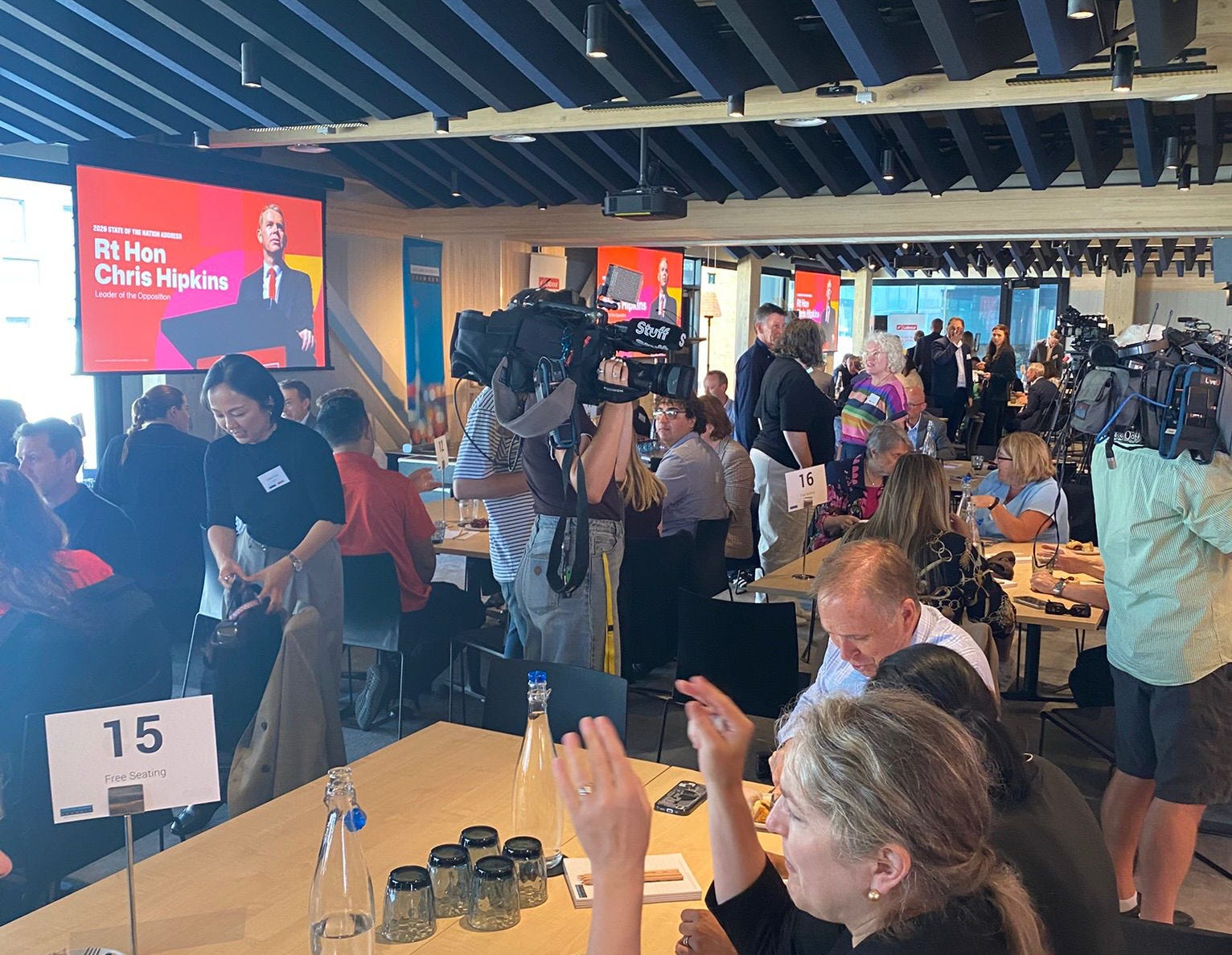
Hipkins claimed that the equivalent of the combined populations of Napier, New Plymouth, and Rotorua, have left New Zealand in the past two years. I checked Stats NZ and my numbers did not add up. The two year net loss of New Zealand citizens was 83,700 in 2024-2025 and the populations of Napier + New Plymouth + Rotorua = 234,500. There are often may ways to do these kinds of comparisons though so I will seek clarity on the numbers they are using. It is a clever way to demonstrate the point and, pending accuracy, I expect we will see it used frequently.
Flying dangerously close to inadvertently slagging off New Zealand as Luxon did last election with “wet and whiney”, Hipkins said that “we” haven’t made New Zealand good enough for our children. Clearly Labour want to terrify all parents and grandparents that all of their kids are going to move overseas if they vote this government back in, but it is a framing of which they will need to be cautious.
One of his stronger narratives is the one constructed around change. He said New Zealanders did not vote for the government they got. He conceded the country voted for change, but argued that the coalition has not delivered on its promises to “fix the economy”. This is a fair point. I have written several times about the problem National has simply due to Christopher Luxon overpromising early on that they could turn things around quickly. This is one of the biggest challenges they have to overcome this year. As Hipkins quipped “change only matters if it delivers”.
His best line of the day was when he returned to “Jobs. Health. Homes” and followed it up with “that is not a slogan, it is a to do list.” Slick. Hat tip to the speechwriters. Use that one again, folks.
While Hipkins did acknowledge that “we didn’t get everything right last time in Government,” I would really like some specifics. I think most Kiwis, especially those crucial swing voters would be keen to learn if it was, for example, economic policy, co-governance, or restructuring the health system in the middle of a pandemic, that he regrets. It is difficult to make a judgment on whether to believe his party is capable of change, if you don’t know what bits they think need changing and what bits they would do again.
It was actually in the Q&A section with Bridges, that Hipkins provided the most satisfactory insights into his mindset, in my view. In the course of discussion he expressed that were he to get the opportunity to lead New Zealand again, he would “not try to do as much”. He wants to focus on fewer things and do them well.
He was candid that he was “worried about promising too much” pointing to the National Party tax cut promise that ended being rammed through in what he says was the wrong time and to poor affect. This might have been the only time he got agreement from Maurice Williamson.
He also softened on the idea that the government have been a total failure, saying multiple times words to the effect of “if it is sensible” we will keep it. He singled out some of the deregulation of the construction industry by this government as “sensible” changes he will keep.
However, he would not be pushed into giving a definitive answer on whether his party will join National and Act in voting for the India Free Trade Agreement to pass. He gave it the ol’ “gotta do due diligence”. He signalled strongly that Labour’s concern centres on the enormous investment clause in the FTA, comparing it to the smaller one we agreed to with China. He called out the Government’s “shifting narratives” on student visas, but does not appear to share the concerns of New Zealand First.
Bridges also had a crack at getting him to comment on his relationship with Winston Peters, but apart from saying he had not ruled out working with anyone, he didn’t really say much.
An interesting, and somewhat surprising answer came when Bridges asked him how PM Hipkins 2.0 would be different and he said he is a “softer politician”. He went right back to the beginning of his Parliamentary career saying that having worked for Trevor Mallard prior, he tried to emulate him at first and as he has got older that has softened. Thank goodness he never copied his mentor in having a scrap outside Parliament! The “reality of governing,” especially during the pandemic, knocked the edges off him, he says.
I wanted to claw my own face off when he added that he is a “kinder person now.” Auckland in particular, he should remember, had the experience of “kindness” being rammed down their throats while they were locked in their homes for far longer than they should have been (as Hipkins has previously admitted) leading to a plethora of financial, social, familial, and mental problems for a lot of people. The word “kindness” probably hits the mark with his base still, but for a chunk of those he needs to convince to switch allegiances, it is triggering.
So what were my takeaways? Well, it is clear that Chris Hipkins wants to be seen as a chastened leader who has learned from 2023. A man who has learned the cost of overreach, under-delivery, and some other unspoken stuff that we might eventually hear about, hopefully. He explicitly does not want to repeat what he characterises as a cycle of broken promises and this is all very pragmatic. Wise even. But it is also small.
It was not a speech that will electrify a base. It was restrained and decidedly anti-transformative. It was pitched to be reassuring, sensible, not scary. And you know what, that may appeal to voters fatigued by turbulence. Maybe Labour is betting that voters want less drama in a world that feels increasingly in unprecedented space..
A softer leader with smaller ambitions who will make your kids want to stay here. Somehow.
We will all have to wait and see if Chris Hipkins comes through on the promise that policy announcements will come later and they will give us the solutions to the problems he is getting very good at describing, but not offering an alternative plan for.
I certainly saw nothing today that would convince me to once again vote Labour. I would like to see the coalition see through some more of their plans and be given enough time to actually see results. Three years is not long as Hipkins himself conceded today when he described that what he has planned for New Zealand is longterm and will require time.
I am very glad I attended the event though. It has really invigorated me to think about the kind of writing I want to do this year. I am not trying to be the mainstream media. I have neither the time nor the resources to be reporting on everything, but I enjoy sharing my thoughts with my readership on things I think are interesting. I have my biases and I think honesty is the best policy on that front so excuse me if I let it all hang out.
I will do my best to attend as many events as I am invited to this election year by any of the parties (or third party supporters). I suspect there will be some who will have no interest in my presence, that’s okay. But if we’re all serious about the long term health of our democracy, we need to engage outside of our bubbles and I’d like to be able to offer my readers much more than just one perspective.
Ani O'Brien comes from a digital marketing background, she has been heavily involved in women's rights advocacy and is a founding council member of the Free Speech Union. This article was originally published on Ani's Substack Site and is published here with kind permission.


17 comments:
It would be helpful if Hipkins told us what he thinks the Labour government got right so we can all have a good laugh.
What will they do differently? Just look at what they did before - He Puapua, Maori and Pacifica preferential access to health, housing and government support, more holidays, more cycle ways but with the downside of more pollution, close coal mines and import coal instead, increase benefits, employ an army of PR people in government, sack the doctors & blame National, pay money to gangs and reduce the number of criminals in prison.
Yes, take heart Annie, even the great Thomas Sowell was taken in by Marxist doctrine before seeing the light. It is just unfortunate that too many amongst us are too indoctrinated or ignorant to see the truth.
As for Chipkins, 'not trying to do as much' - well, before he was PM, he was a Minister with just a few portfolios to manage. Even then he was next to useless - whether it be
increasing crime and truancy rates, or falling educational standards, and that's before mentioning his Covid management incompetence.
No, it will be the death knell for NZ, if he ever holds the levers of power again, for it won't only be his wayward management, but that also of the inevitable 'baggage' that'll accompany him.
Anon at 7.28 is correct; Labour comes with a lot of difficult baggage. One matter of real concern is the willingness of Hipkins & co to trade democracy for an ethnostate by covering up the He Puapua plan. If elected, Hipkins would be the puppet of the Maori members of caucus.
To Anon at 8.20am: You hit the nail on the head. A Labour govt would unleash Act 2 of the Ardern/Mahuta nightmare towards tribal rule. And just wait to see the exodus if that happens !
Anon 7:28 and 8:20 - you are absolutely right !!
A Labour government would recall He PuaPua and destroy our once proud and free nation.
I genuinely fear for the future our grandchildren are going to face here in apartheid New Zimbabwe !
Excellent review.
When one thinks of Hipkins, what you get is an aging student activist from a very political upbringing, who went into politics without living and working in the real world. A guy whose lived off the generous guaranteed income paid for by the taxpayer employing the mystical fantasising cruelty of the Progressive movement. A guy whose risked nothing and built and created nothing, except a hell of a mess by 2023. And in this he reflects to the last syllable, the caucus he leads.
But overall, his party policies are not worth a can of beans, because their obsession with co-governance is what demarcates Labour from sanity. Hipkins et al think you can somehow divide NZ (sorry, Aotearoa) up into two governments based on race, Maori and everyone else, end one person one vote and the country will somehow surge forward happily ever after in sheer absurdity. It's here, more than any other of the plethora of Labours failures or combinations thereof, that the writing is on the wall for this country should you give your vote to the Hipkins nightmare.
I was a lifetime Labour voter until 2023. Never again.
Can I "place before" all New Zealander's.
Australia - Scott Morrison led a Govt into/ and onto the Treasury benches, with all the panoply of 'what we are going to do'.
And failed.
Come election time, the People "swung" left and voted for a Labour Party to become the Govt.
Now.
Just look at where Australia is 'today' and what a Labour Govt "promised" on the campaign trail, that HAS NOT been delivered.
And the PM, what does he do, "spits verbal brickbats" at the opposition parties for their collective failures (in many case of their own doing) but when asked a question - re anything that Labour has done, should be doing, the response - "crickets".
Ani's article is one that should be read, then re-read. If you miss the salient points -
re Labour's policies going forward, there is nowhere in the article (as Ani points out) is their "substance".
Looking at the line up of current MP's and possible 'add on's', look forward to the "rinse, repeat, recycle" of Hipkins words, but from other mouths.
Oh, and Ani, you forgot to mention how many Auckland based Staff from the various
Unions were present, these are 'the cash cows"' for campaign funds, money out, promises made, promises kept.
Also nice to 'note' that Auckland has its own version of Gavin Newsom, former Mayor of San Francisco, now Governor State of California (nephew of Nancy Pelosi) a man credited with -
- destroying a City
- now destroying a State.
Oh wonder "who that person is"?
A well written article. Thank you for sharing your thoughts Ani.
Absolutely no surprise Wayne Brown is left of left. His picks for prime decision making councillor roles are uber wokesters like Richard Hills and Julie Fairey. He hates cars and parasitically sees motorists as a cash cows. He wants road tolling and paid street parking everywhere and may well have got it thanks to the leftist National Party.
Zohran Mamdani is outraging New Yorkers proposing a 9% property tax increase, Wayne does that as a casual side gig, annually. Mine were up slightly under 20% last year.
I didn't vote for him as it was easy to see through the bullshit facade that this guy was a socialist lamb in foul mouth wolf's clothing.
Of course we want good government. People are sick of the current right- wing nut jobs rolling through legislation with no basis in reality. Totally agree Ani.
Message to Ani, and to anyone else listening. Show us some respect and stop referring to us as Kiwis, please. Kiwi is the name of an avian species - full stop. We are New Zealanders, always have been and always will be. I wrote this question on another blog site: Would we ever refer to Australians as Kangaroos or Emus? Is the Australian dollar ever referred to as the Kangaroo?
Ani, you have made four references to Kiwis. However I will give you points for three references to New Zealanders. Next time around use Find and Replace to replace Kiwis with New Zealanders.
Otherwise I am in agreement with your sentiments.
I am not an Aucklander but I follow the Auckland political goings on. Am I correct in suggesting that Mayor Brown is seeking to form his own form of separatist Auckland Government? And it might not be Co-Governance. What is coming next? A push to extract an Auckland share of GST? In the same manner as Australian states actually receive a negotiated share of GST.
Eamon, the moniker 'Kiwi' has been applied to NZers (specifically NZ soldiers in WW1) since 1917, and the Oxford of 1918 lists it as a label for NZers. So you're a wee bit late in making a fuss about it. There is nothing derogatory about it the way it is used worldwide - if anything, it is a term of endearment.
Exactly, Barend.
New Zealanders vs Kiwis
I could carry on with this thread on a number of fronts if I had the time. I have seen numerous write-ups and opinion pieces where references alternate between New Zealanders and Kiwis, as Ani has here. This would be confusing and misleading for a first time reader. My point is that the term is basically a slang term that ought not to be used in any formal sense or where doubt could arise over the writers intentions.
Prime Minister Luxon offended in his State of the Nation speech, switching between both terms.
See here for further ideas:
https://eamonsloan.blogspot.com/
Click on Read More.
For Barend. At the risk of provoking a dictionary war. Oxford Concise (14th) notes Kiwi as an informal description of New Zealander, i.e. a slang term.
A little item of humour now. My very battered Oxford Concise (4th, 1950) lists Kiwi as “non-flying member of the Air Force”. Single definition exact wording, and noted as slang (sl) – also tags the scientific name “Apteryx”. Would we really like to be known as Aotearoan Apteryxes?
Until the later years of the 19thC, 'New Zealanders' was used for Maori.
As I noted earlier, 'Kiwis' for New Zealanders in general has been around for over 100 years. It is universally recognised by people who speak English (even if not so well) and the risk of confusion is very slight indeed.
'Informal' is not quite the same as 'slang'. Slang tends to occur in the spoken language rather than the written, and tends to be used by the more unrefined classes. Informal language use usually involves words and constructions that are fine in colloquial discourse but not in formal (especially written) discourse. For instance, "for a country like NZ" (informal) cf. "for a country such as NZ" (formal). Where informal terms are used in formal writing, these may be in inverted commas.
I am no fan of Luxon but there was absolutely nothing 'offensive' about his word use.
Hipkins revealed his thought processes are still in the class of " A dog has 4 legs. That animal has 4 legs therefore it is a dog " when he stated the to be Anti-Treaty is to be Anti-Maori.
'Nuff said.
Post a Comment
Thank you for joining the discussion. Breaking Views welcomes respectful contributions that enrich the debate. Please ensure your comments are not defamatory, derogatory or disruptive. We appreciate your cooperation.