

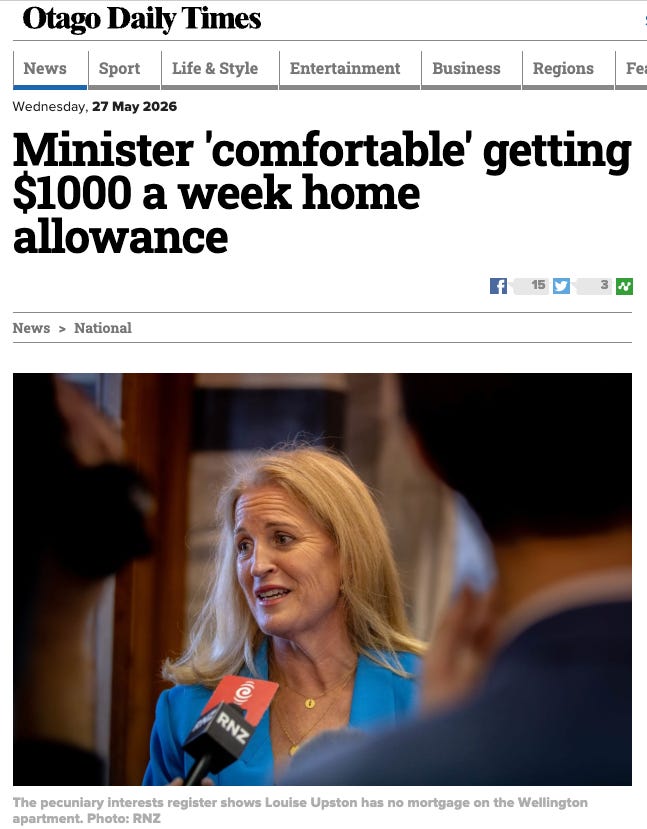
The media have created a controversy over Louise Upston’s accommodation allowance. Naturally the story has triggered public anger because it appears, at first glance, to confirm every suspicion people already hold about politicians. A minister receives around $1,000 a week in taxpayer-funded accommodation support while also owning an apartment in Wellington. Politically, it ain’t a great look. A minister tightening accommodation support for ordinary people while receiving accommodation support herself was always vulnerable to being seized upon by opposition including media.
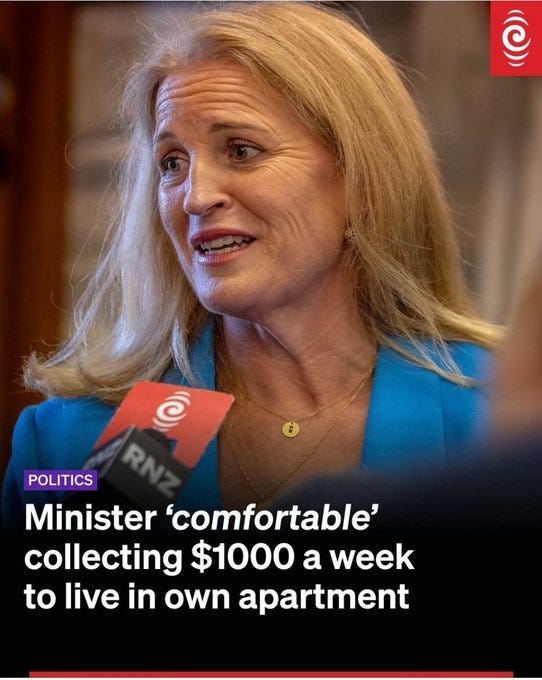
But the problem with the reporting is not that it raises the issue which is a legitimate thing for New Zealanders to be aware of and discuss. It is that it has framed the situation in a way that encourages outrage about one particular minister. We are being pushed toward the conclusion that this is a uniquely outrageous perk enjoyed by a single minister exploiting a loophole, when the actual picture is of a system in which a large number of MPs do the same or similar. If they are pointing the finger at her, they should be also be pointing it at many others.
The parliamentary accommodation system exists because New Zealand runs a centralised Parliament in Wellington while electing MPs from all over the country. Unless Parliament intends to become an institution reserved only for Wellingtonians, Aucklanders wealthy enough to maintain a second residence, or independently wealthy retirees, some mechanism has to exist to support MPs who are required to live and work in two places simultaneously.
The public often imagines MPs as people who “move to Wellington” once elected. In reality, many are expected to maintain homes in their electorates while also needing somewhere to stay in Wellington for extended periods throughout the parliamentary year attending Parliament, select committees, caucus meetings, ministerial briefings, votes, media appearances, and late-night legislative debates in Wellington. So the nature of the job itself creates duplicate housing costs.
That doesn’t mean every claim is reasonable, and personally I think the system probably could be tightened up. But the idea that MPs are somehow morally corrupt for using an entitlement that Parliament itself created is a different argument entirely.
One detail largely missing from the coverage is that ministerial accommodation is disclosed differently from ordinary MPs’ expenses which makes selective outrage easy by being selective in the data used. Parliamentary Service disclosures cover MPs’ accommodation entitlements. Ministers, however, receive support through Ministerial Services administered separately through the Department of Internal Affairs.
I took a look at the full 2025 expense disclosures across MPs and ministers. I then checked the pecuniary interest registers for what property they own (including those held in trusts).
Dozens of MPs received accommodation support during 2025. National MPs. Labour MPs. Green MPs. ACT MPs. NZ First MPs. Te Pāti Māori MPs. The system is widely used for MPs based outside Wellington who spend significant time in the capital. The amounts vary, but the underlying principle is the same throughout Parliament.
Some MPs receiving Wellington accommodation support also own Wellington property. Others own family homes elsewhere while renting in Wellington. Some hold property through family trusts. A proper look at the disclosures reveals examples across every political party.
Want to look for yourself?
Members of Parliament Barbara Kuriger, Todd Stephenson, Celia Wade-Brown, Arena Williams, Duncan Webb, Jan Tinetti, Jenny Salesa, Kieran McAnulty, Willie Jackson, Jamie Arbuckle, Carl Bates, Carlos Cheung, Catherine Wedd, David MacLeod, Ryan Hamilton, Stuart Smith, Tim Costley, Vanessa Weenink, Paulo Garcia, Melissa Lee, Andrew Bayly, Hamish Campbell, Andy Foster, and Deborah Russell all receive accomodation allowances while owning property in some form in Wellington.
Ministers Mark Patterson, Louise Upston, Paul Goldsmith, Todd McClay, Simon Court, Andrew Bayly, Judith Collins, and Melissa Lee received some form of accomodation allowance while own property in some form in Wellington. The Speaker Gerry Brownlee receives an allowance while owning property in Wellington, but his entitlements are different again.
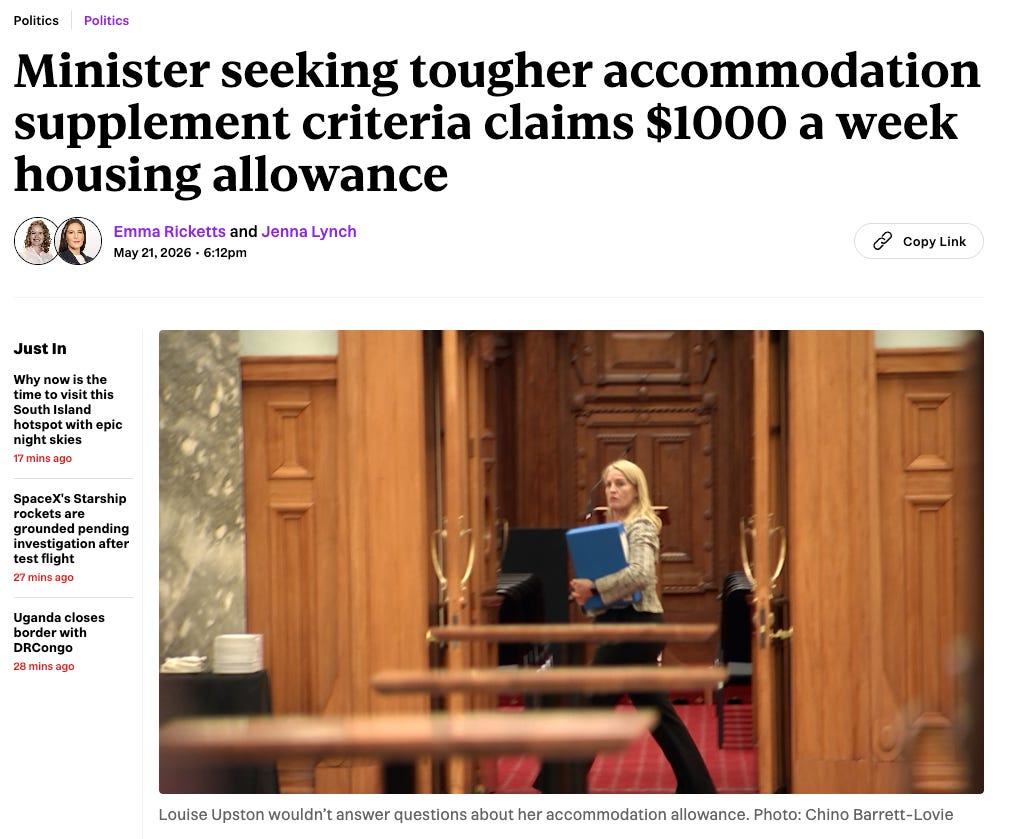
Members of Parliament who don’t own property in Wellington and received the accomodation allowance in 2025 to cover renting and other arrangements are: Benjamin Doyle, Rawiri Waititi, Rima Nakhle, Tracey McLellan, Laura McClure, Mark Cameron, Francisco Hernandez, Lawrence Xu-Nan, Ricardo Menéndez March, Scott Willis, Steve Abel, Teanau Tuiono, Adrian Rurawhe, Cushla Tangaere-Manuel, Damien O’Connor, Glen Bennett, Helen White, Ingrid Leary, Jo Luxton, Megan Woods, Peeni Henare, Phil Twyford, Rachel Boyack, Reuben Davidson, Tangi Utikere, Willow-Jean Prime, Dan Bidois, Dana Kirkpatrick, Maureen Pugh, Mike Butterick (now a minister), Miles Anderson, Sam Uffindell, Tim van de Molen, Tom Rutherford, Debbie Ngarewa-Packer, Hana-Rawhiti Maipi-Clarke, Mariameno Kapa-Kingi, Kahurangi Carter, Cameron Luxton, Lemauga Lydia Sosene, Chlöe Swarbrick, Marama Davidson, Carmel Sepuloni, Cameron Brewer (now a minister), Suze Redmayne, Priyanca Radhakrishnan, Camilla Belich (owns property in Waikanae Beach - 58km from Wellington), Joseph Mooney, Grant McCallum, Hūhana Lyndon, Greg Fleming, Vanushi Walters, Takutai Kemp, Rachel Brooking, Shanan Halbert, Nancy Lu, David Parker, Tanya Unkovich, David Wilson, Katie Nimon, Parmjeet Parmar, Tākuta Ferris (owns two properties in Ōtaki Beach - 78km from Wellington), Mike Davidson, James Meager, and Oriini Kaipara. Note that the amount they received varies.
Ministers who don’t own property in Wellington and received the accomodation allowance in 2025 to cover renting and other arrangements are: Brooke van Velden, David Seymour, Karen Chhour, Casey Costello, Shane Jones, Chris Penk, Dr Shane Reti, Erica Stanford, Mark Mitchell, Matt Doocey, Simeon Brown, Tama Potaka, James Meager, Simon Watts, Jenny Marcroft, Penny Simmonds, Scott Simpson, Andrew Hoggard, and Nicola Grigg.
Ministers who don’t own property in Wellington and received the accomodation allowance in 2025 to cover renting and other arrangements are: Brooke van Velden, David Seymour, Karen Chhour, Casey Costello, Shane Jones, Chris Penk, Dr Shane Reti, Erica Stanford, Mark Mitchell, Matt Doocey, Simeon Brown, Tama Potaka, James Meager, Simon Watts, Jenny Marcroft, Penny Simmonds, Scott Simpson, Andrew Hoggard, and Nicola Grigg.
Members of Parliament and ministers also can receive allowances for out of Wellington accomodation where appropriate, but for simplicity I will leave that out for now.
In other words, owning property both inside and outside Wellington is not remotely unusual within Parliament. It is a recurring feature of how MPs organise their lives around a job that effectively requires them to operate in two places at once.
I repeat, that does not necessarily mean the optics of it are great nor make accepting the accomodation allowance politically wise. But it also does not follow that we can’t scrutinise whether someone is receiving an allowance in a way that is in keeping with the spirit of which it is intended. But it does make the current reporting incomplete to the point of deliberate distortion.
Where, for example, are the articles generating outrage about Labour MPs Arena Williams and Duncan Webb who are two clear examples that undermine the idea that this is some uniquely National Party phenomenon?
Arena Williams declared both a family home in Manurewa, Auckland and a family home in Te Aro, Wellington. Duncan Webb declared a Christchurch family home as well as a share in a Wellington family home held through a trust. Both also received accommodation support during 2025. In 2025, Arena Williams received $37,800 for Wellington accomodation that she owns as well as $5,039.34 for non-Wellington accomodation. Duncan Webb also received $37,800 for Wellington accomodation and $3,150.62 for non-Wellington.
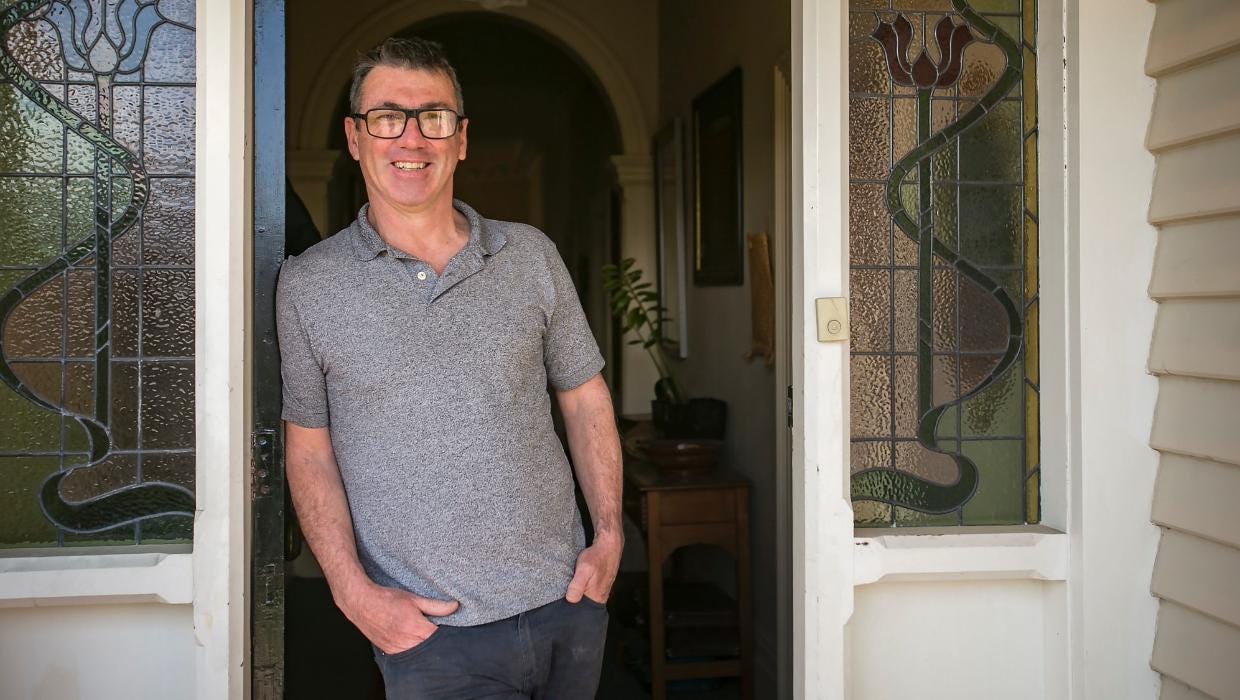
Labour MP Duncan Webb Photo: DAVID WALKER / STUFF
When we examine these costs, we have to grapple with an uncomfortable tension that many commentators seem unwilling to acknowledge honestly. That is that New Zealanders simultaneously demand that MPs be “ordinary people” while also recoiling whenever the realities of maintaining an ordinary life while serving in Parliament become visible. We need people to be willing to put their hands up to represent us and if it is going to mean taking a massive hit financially much fewer people will do so.
If an MP from Invercargill, Northland, Nelson, or Hawke’s Bay, for example, is expected to maintain ties to their electorate while working weeks at a time in Wellington, there are only a handful of possible outcomes. Either they receive accommodation support, they personally absorb enormous financial costs, they become dependent on private wealth, or politics increasingly becomes the domain of those already rich enough not to care.
As I say, I do think there is a case for tightening some of the rules. Plenty of voters will reasonably ask why owning a mortgage-free Wellington property should not affect eligibility and there is certainly an argument for stricter means-testing.
But the current outrage cycle skips past serious analysis and discussion in favour of personalised scandal politics. The reporting encourages readers to believe that the media have caught Louise Upston red-handed secretly running a rort while everyone else nobly suffers. In reality, the system is longstanding, bipartisan, publicly disclosed, and deeply embedded in how Parliament operates.
Even the pecuniary interest angle has often been reported in a selectively suggestive way. The emphasis on the absence of a Wellington mortgage is designed to imply Upston has no housing costs associated with the apartment. But pecuniary interest registers are not full forensic balance sheets. They disclose specified interests and debts according to parliamentary reporting requirements. They do not necessarily reveal every financial arrangement, ownership structure, maintenance cost, family arrangement, or legal interest associated with a property.
A healthy media should help citizens understand systems, not merely inflame resentment toward the politicians they chose to target. It should provide context proportionate to the outrage it generates and distinguish between “this looks politically bad”, “this is ethically questionable”, “this may warrant reform”, and “this is corruption”. They are not interchangeable categories. At the moment, much of the reporting deliberately blurs them together.
Outrage is easy journalism. It encourages readers to draw the most cynical possible conclusion. The harder form is explaining systems honestly enough that people can critique them in informed ways rather than knee-jerk reactions.
This should not be a constructed “scandal” about Louise Upston. She has not done anything wrong or manipulated any systems.
New Zealand has to fund parliamentary representation in a geographically dispersed country and there is tension between transparency and populist outrage. But the current media cycle is an example of how easy it is to turn an issue of policy or process into a personalised attack on the decency of one person. And it is a reminder of how New Zealand’s political reporting is driven a lot by personal and organisational bias and emotional baiting.
Ani O'Brien comes from a digital marketing background, she has been heavily involved in women's rights advocacy and is a founding council member of the Free Speech Union. This article was originally published on Ani's Substack Site and is published here with kind permission.


11 comments:
Ani mate you’re usually terfic but you’re so obviously in the wrong here. More wise commentators would be aware of Marie Antoinette and “let them eat cake”. Upston is a hypocritical monster.
Your “go after the media” approach is telling. Right-wing fascists have always gone after the media when news comes out that they don’t like. Who funds Ani?
Since when did factual reporting become emotional bias? Facts don’t care about your feelings, Ani.
I’ve noticed more and more leftie comments like the two above creeping in to breaking views responses of late. Surely this has to stop.
When a 'leftie' makes a comment that deserves a firm rebuttal, I let it through in the expectation that one of our more articulate readers will do just that. To delete it would be to run away from a challenge which is surely not how a 'rightie' should respond.
Mentally-deficient lefty comments aside, the extremely one-sided telling of this story by the media is indeed worth highlighting, and thank you Ani for doing so. BTW to hold a 'freehold' apartment in Wellington could easily run to $30k per annum in corporate body fees, rates, power and internet connection costs. At the same time such apartment would have dropped substantially in capital value over the past couple of years, at least. Media fuss about this is much ado about nothing. As always, lefties should be careful what they wish for.
I see nothing left wing about anon 721. Since when did facts become left wing territory?
I think Anon 854 might be a leftist plant trying to make fun of us.
No comment on the morals of what Upston is doing.
She’s an abhorrent hypocrite and it is our kiwi duty to call her out on it. Anything less is weakness.
Seems to me that O'Brien has quite capably presented the evidence to support her conclusion that this should not be a constructed “scandal” about Louise Upston, because she has "done nothing wrong or manipulated any systems". O'Brien warns us about knee-jerk reactions based on incomplete reporting and, right on cue, Anon 7.10 illustrates her point. He/she does nothing to rebut O'Brien's core assertion that all MPs play these games because the law entitles it. So, if Anon 7.10 doesn't like the law, let him or her make a case for reform. Not attack Upston for daring to apply the law to herself. Publish Anon 7.10's opinion by all means if only because it allows all other readers to see the hollowness of their opinion.
Anon@7:21, since when picking some facts and leaving others behind became “factual reporting”?
Anon 320 since Newstalk ZB got bought out by oligarchs, mate!
Payment for Members of Parliament was an important step forward in the extension of democracy. The first real working-class movement in England, the Chartists, had it as one of their central demands as early as 1838. At that time MPs weren't paid, ensuring that only wealthy individuals could enter parliament. In fact the demand wasn't won in England until 1911! (In NZ MPs were paid an "honorarium" from 1854.)
It's important too that payments of salaries and reasonable expenses to MPs remain universal, i.e., not subject to means testing, which only opens the door to all sorts of demagogy. Of course, the level of salaries and the "reasonableness" of expenses and perks is a somewhat different matter, to say nothing of the possibility of any individual rorting the system.
Another of the Chartists demands was for annual parliaments. Now, there's an idea. Another was for universal male suffrage at 21, which shows that even the most progressive political movement at the time hadn't quite embraced the principle of women's equality.
Post a Comment
Thank you for joining the discussion. Breaking Views welcomes respectful contributions that enrich the debate. Please ensure your comments are not defamatory, derogatory or disruptive. We appreciate your cooperation.