

The sudden enthusiasm for a “Grand Coalition” between the New Zealand Labour Party and New Zealand National Party is being presented by proponents as a sober, pragmatic response to the complexities of modern governance. Its advocates speak the language of stability, maturity, and responsibility. They gesture toward international examples, invoke economic necessity, and lament the supposed distortions of coalition politics under MMP. But under the paternalistic managerial tone and the carefully chosen euphemisms, is an admission of political failure and more troublingly, a repudiation of the democratic choices voters have been making and the subtle-as-a-gun signals they have been sending to the political class.
Central to the grand coalition argument is that New Zealand’s political system has become dysfunctional because smaller parties wield too much influence. This is often framed in the metaphor of the “tail wagging the dog,” a phrase that has acquired the status of conventional wisdom in establishment commentary. It was invoked this week by Auckland Mayor Wayne Brown who is among the most vocal political voices calling for a grand coalition. But this framing is problematic. It treats minor parties as aberrations and negative outcomes of the MMP system. It actually is MMP functioning just as it was intended. The main parties are simply failing to appeal to the public as they once did and a substantial and growing portion of the electorate have turned to alternative options. That is democracy. The will of the people in action.
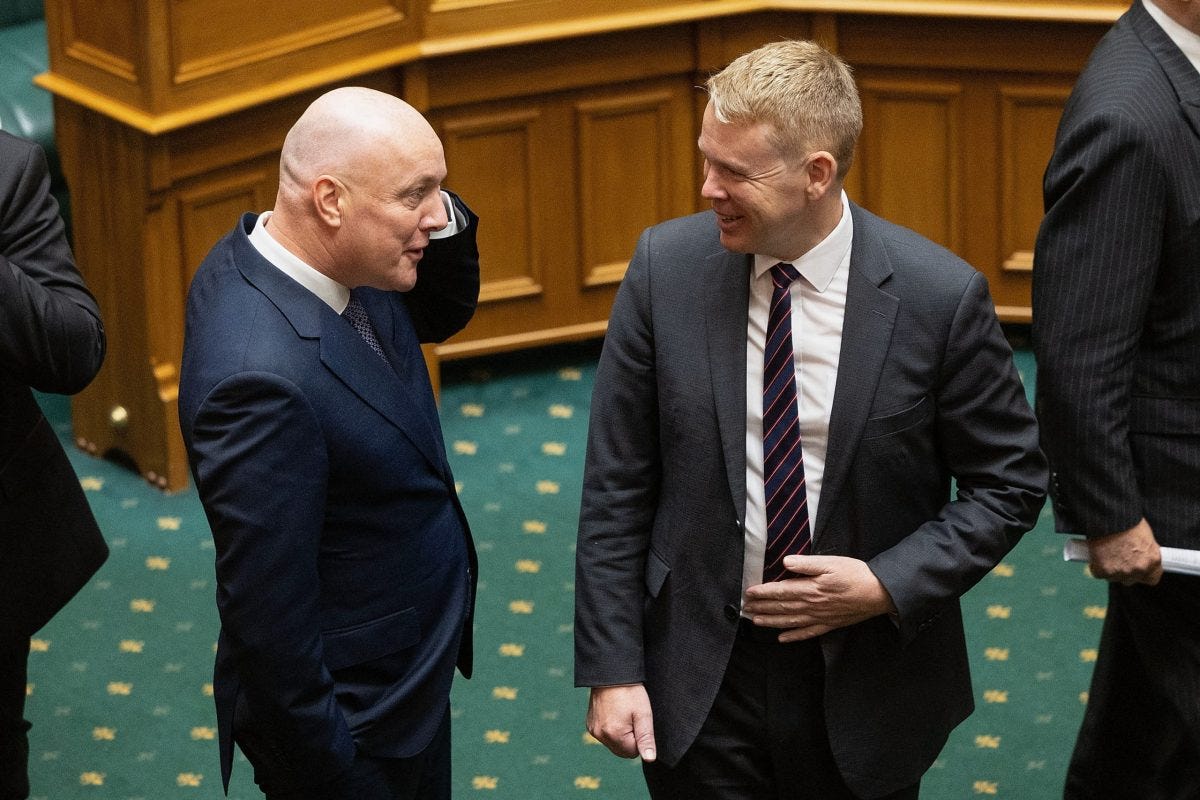
Christopher Luxon andChris Hipkins. File photo: Getty Images
When commentators complain about the influence of these smaller (for now) parties, they are not identifying some kind of structural flaw in MMP. They are expressing their discomfort with voters who have deliberately chosen alternatives to the two establishment parties. They are alarmed by the prospect that the will of the people could bring about substantial structural change and a reordering of power dynamics.
Under proportional representation, voters are able to express more nuanced political preferences, and increasingly they are doing so. It is also worth remembering what MMP has actually achieved because of this. It has delivered a Parliament that more closely resembles the country it governs, particularly in demographic terms. The number of Māori MPs has increased significantly and rapidly under proportional representation, no longer confined to a handful of designated seats but present across multiple parties and portfolios in a way that reflects both population share and political diversity. That is a direct consequence of a system that allows voters to express identity, values, and priorities beyond the blunt instrument of two-party competition.
At the same time, however, representation has become more homogenised in other respects. Parliament is now overwhelmingly drawn from a narrow professional class that is highly educated, urban, and managerial in background with far fewer MPs from working class or trade-based pathways than in earlier decades. So where MMP has widened representation along ethnic and sex lines, it has also narrowed it along lines of class and lived experience.
The fact that a significant share of the electorate now supports parties outside the traditional duopoly is not evidence of confusion or instability. It is evidence of dissatisfaction that has been building over years of perceived policy convergence, broken promises, and an absence of meaningful choice between the major parties.
Audrey Young wrote eagerly about the prospect of a grand coalition for the New Zealand Herald this week and her piece reads like a kind of Beehive fantasy football. She has spent some time shuffling around her deck of player cards to form an imaginary Cabinet. She errs right from the beginning though as she casually assumes Christopher Luxon would remain Prime Minister, with Chris Hipkins as his deputy. If Labour continues polling higher, there is no chance they would sit back and allow National to retain the top spot.
From there, the article descends into an intricate Cabinet-building exercise of portfolio splits, associate ministers, carefully balanced pairings. It is detailed, but entirely detached from political reality. The central question of whether voters actually want this arrangement is never seriously engaged with. Instead, politics is reduced to technocratic optimisation and getting the “right” people in the right roles and the system will function more smoothly. “Right” according to who exactly?
For example, under a grand coalition, the direction of cogovernance would not be contested so much as efficiently consolidated. Without smaller parties forcing sharper scrutiny or drawing clear lines (in both directions), Labour and National would default to the path of least resistance; the one largely set by the public service and its prevailing orthodoxy. In practice, that means incremental entrenchment of bureaucratic bulldust (to borrow a word from Winston Peters). More advisory bodies, more shared decision making structures, and more policy frameworks built on assumptions that are rarely put to democratic test. Working groups. So many working groups. Neither party, operating in tandem, would have strong incentives to disrupt that trajectory. The result would not be a dramatic shift announced to voters, but a steady embedding of initiatives that reshape governance by small degrees, largely insulated from pushback.
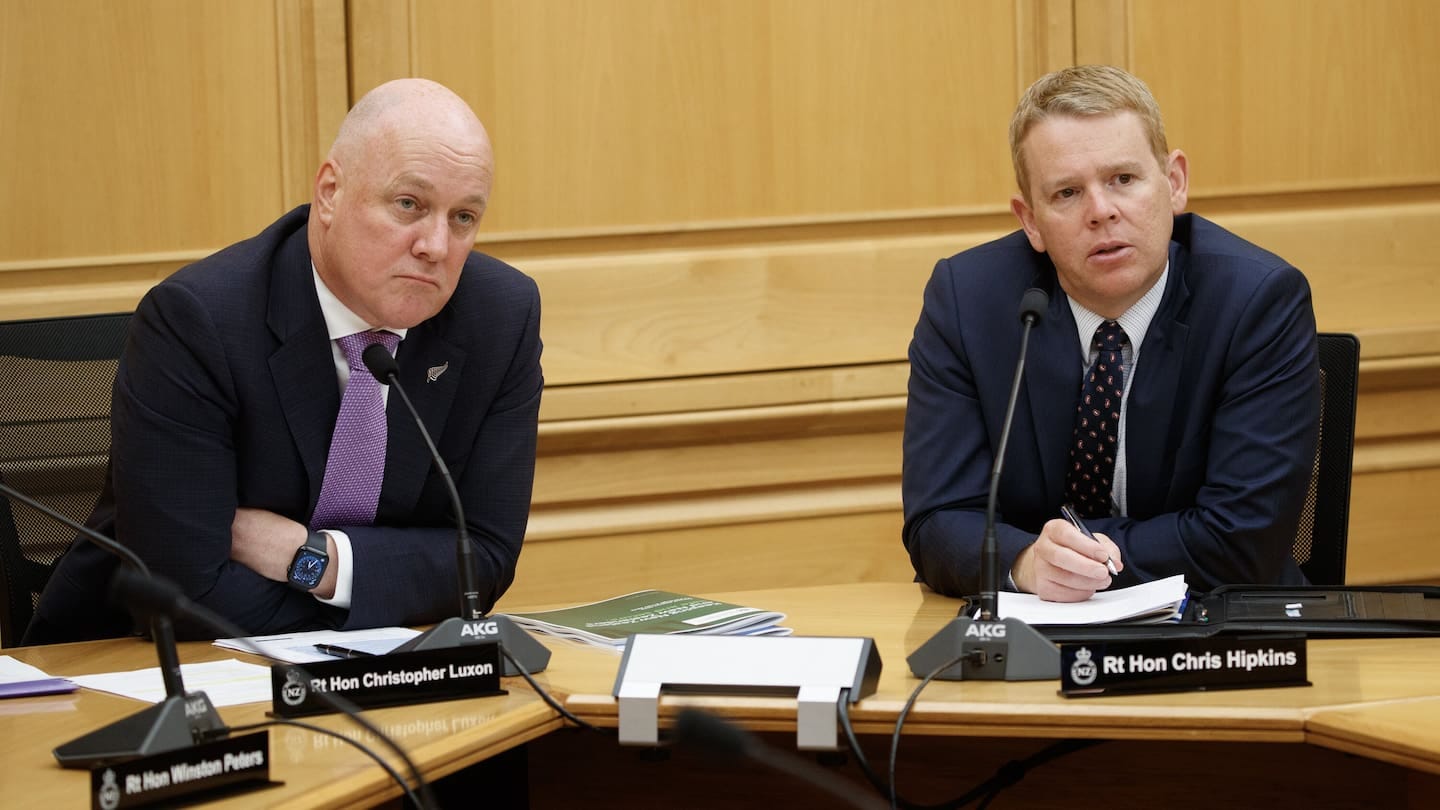
Chritopher Luxon and Chris Hipkins. Photo / Mark Mitchell.
Rather than confronting the dissatisfaction of the voting public, Audrey’s grand coalition proposal seeks to neutralise it. To take away the possibility that the people might exercise their democratic power in a way that the professional managerial class disapprove of. This class decides that if voters are unwilling to return to Labour and National, then Labour and National will simply govern together, rendering those voter preferences politically irrelevant. This is not presented as a subversion of democracy, of course. It is framed as a necessary corrective, a way to restore stability, ensure the continuation of technocratic policy, and prevent the excesses of ideological fringe actors. They are totally transparent in their agenda and react to naughty voters insisting on making the “wrong” choices, by adjusting the system so that those choices no longer matter.
Derision for the masses is not unique to New Zealand. It reflects a broader pattern that has emerged across Western democracies over the past decade or so. When voters in the United Kingdom supported Brexit, they were widely dismissed as misinformed or manipulated. Or malicious. When Americans elected Donald Trump, Hillary Clinton infamously characterised many of his supporters as a “basket of deplorables.” In each case, the response from political and media elites followed the same script where rather than engaging with the reasons behind voter discontent, they sought to delegitimise the voters themselves. The grand coalition proposal in New Zealand is a more institutional expression of that same thing. It does not insult voters directly, but it does sideline them and suggest that what they want is irrelevant if it does not fit the status quo power structure.
The economic argument for a grand coalition follows a similar pattern of wonky assumptions. We are told that New Zealand faces serious structural challenges like declining productivity, infrastructure deficits, demographic pressures and that these problems are widely understood by both major parties. Correct, these are significant problems that we are facing, but the implication is that solutions already exist, that Labour and National broadly agree on them, and that the only obstacle to implementation is the friction introduced by coalition politics. They seem to have the fantastical belief that if only the two parties could govern together, free from the constraints of smaller partners, these long-standing issues could finally be addressed.
But the challenges being described are not, in fact, new. They have persisted across many many electoral cycles and under governments led by both Labour and National. If the solutions are indeed so well understood, and broadly agreed upon, it is difficult to explain why they have not already been implemented with bipartisan support. The more plausible explanation is that the supposed consensus between the two parties is itself part of the problem that the shared assumptions and policy frameworks of the political centre have failed to deliver the outcomes they promised.
Voters are not turning to smaller parties because they are confused about the nature of New Zealand’s challenges. They are doing so because they no longer trust the major parties to address them effectively. So to respond by further consolidating power within those same parties is essentially class warfare. It is a tale as old as time. The elite class, the decision makers, the capital, the public servants…they talk a lot about what the poor and vulnerable need, but the minute that group exhibits some political autonomy they move quickly to shut it down.
Politics is not simply a technical exercise in implementing pre-agreed solutions. It is meant to be a contest of ideas. That is why we have an adversarial system with an Opposition whose job it is to interrogate every action the government takes. It requires the presence of meaningful alternatives (ahem, Labour, now would be a good time to offer some policy), the ability of voters to choose between competing visions, and the existence of an Opposition capable of holding the government to account. A grand coalition would erode all three of these. It would concentrate power within a single governing bloc, reduce the opposition to a fragmented collection of smaller parties, and blur the distinctions that allow voters to make informed choices at election time. It can produce policy compromise rather than policy innovation, settling for positions that are acceptable to the risk appetites of both major parties rather than effective in addressing complex problems. And it can foster a sense of alienation among voters who feel that the political system no longer offers them a genuine voice.
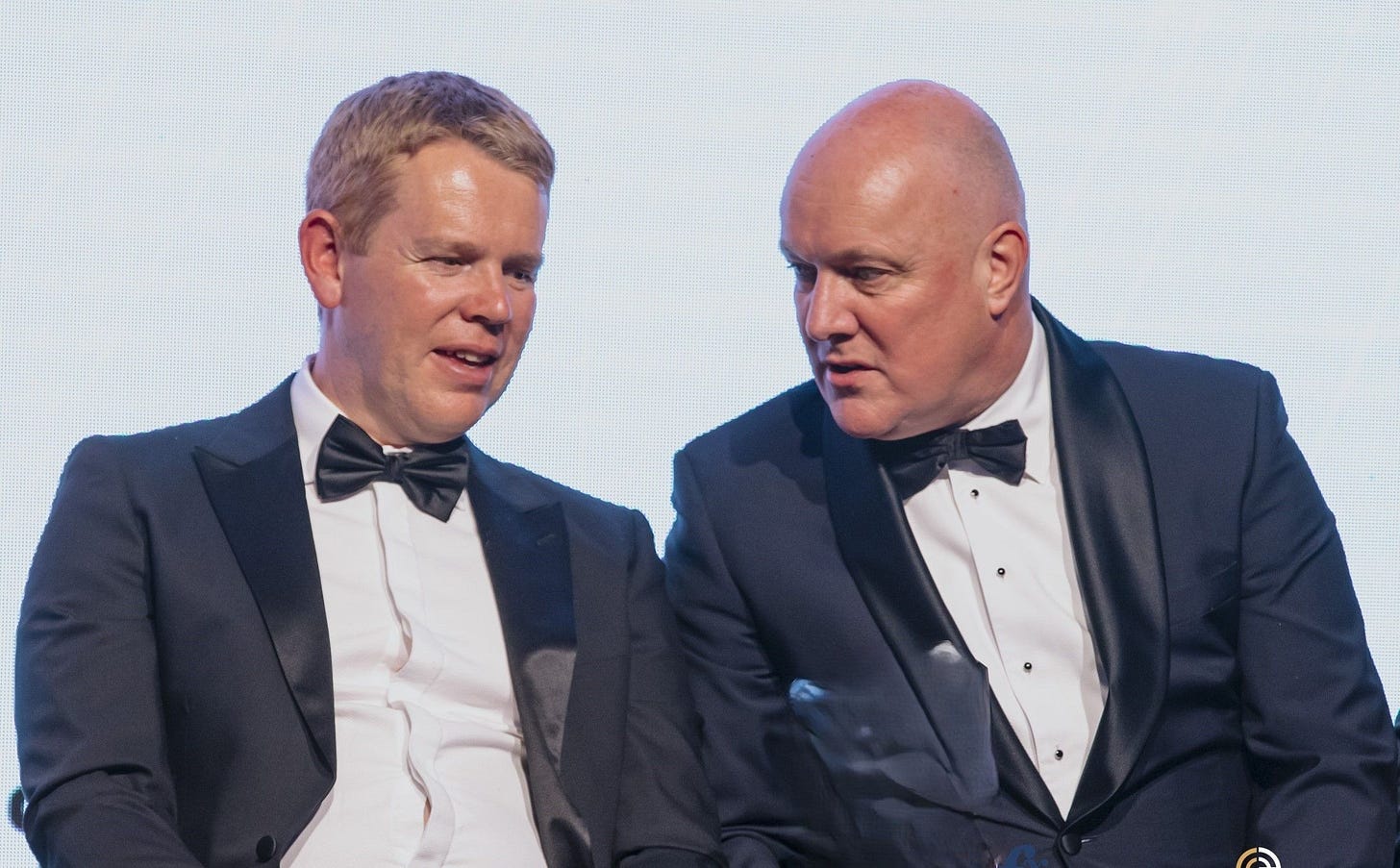
Indian NewsLink photo of the two leaders at INBA Awards 2024
Proponents of a grand coalition have pointed to overseas examples where it “works”, but the international experience reinforces the concerns I outlined above. In Germany, where grand coalitions have been relatively common, the long-term effect has not been to stabilise the political system but to further erode the support base of the major parties and create space for insurgent movements. When the political centre becomes a unified governing entity, it loses its capacity to represent distinct constituencies. And voters who feel unrepresented do not simply disappear; they seek alternatives, often at the margins of the political spectrum.
So in actual fact, by seeking to contain political fragmentation, they actually risk intensifying it. By removing meaningful competition at the centre, they make the system more brittle, not more resilient. The appearance of stability is achieved at the cost of legitimacy.
Ultimately, the appeal of a grand coalition tells us less about the state of New Zealand politics than it does about the mindset of those promoting it. It reflects a class of commentators and political figures who are increasingly uneasy with the direction of voter behaviour and are searching for ways to restore a sense of control. Faced with an electorate that is dispersing its support across a wider range of parties, they have concluded that the problem lies not with the political offerings available but with the structure of choice itself.
This is all elitism. It is a loud whinge from the lanyard wearers who want to be able to embed cogovernance, spend recklessly, and wield moral authority over the population without pesky smaller parties objecting. The diversification of political support should not be treated as a crisis to be managed; it is a signal to be understood. A grand coalition would be a retreat from democratic principles rather than something like a renewal. New Zealand’s political system is experiencing strain, but the answer is not to narrow the range of voices within it. It is to broaden it further and to embrace the pluralism that MMP was designed to facilitate. We must recognise that disagreement, far from being a defect, is the essential mechanism through which democratic societies adapt and evolve.
Ani O'Brien comes from a digital marketing background, she has been heavily involved in women's rights advocacy and is a founding council member of the Free Speech Union. This article was originally published on Ani's Substack Site and is published here with kind permission.
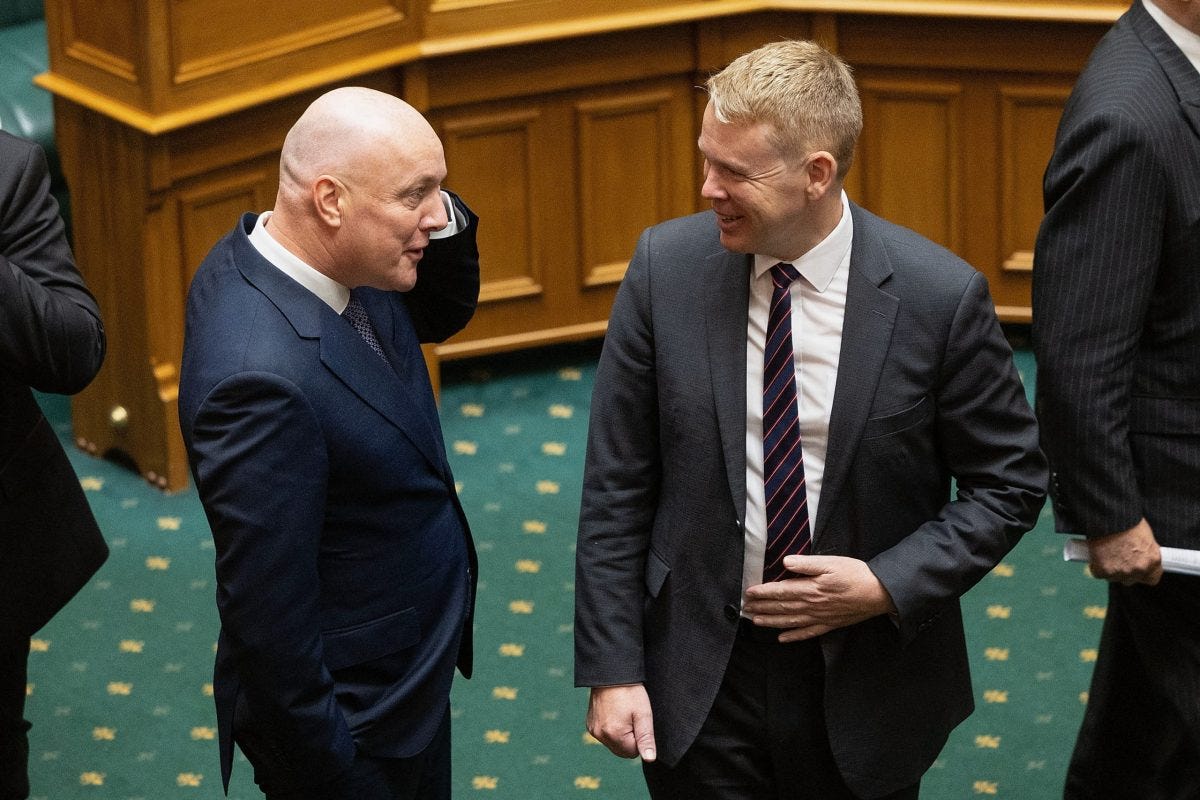
Christopher Luxon andChris Hipkins. File photo: Getty Images
When commentators complain about the influence of these smaller (for now) parties, they are not identifying some kind of structural flaw in MMP. They are expressing their discomfort with voters who have deliberately chosen alternatives to the two establishment parties. They are alarmed by the prospect that the will of the people could bring about substantial structural change and a reordering of power dynamics.
Under proportional representation, voters are able to express more nuanced political preferences, and increasingly they are doing so. It is also worth remembering what MMP has actually achieved because of this. It has delivered a Parliament that more closely resembles the country it governs, particularly in demographic terms. The number of Māori MPs has increased significantly and rapidly under proportional representation, no longer confined to a handful of designated seats but present across multiple parties and portfolios in a way that reflects both population share and political diversity. That is a direct consequence of a system that allows voters to express identity, values, and priorities beyond the blunt instrument of two-party competition.
At the same time, however, representation has become more homogenised in other respects. Parliament is now overwhelmingly drawn from a narrow professional class that is highly educated, urban, and managerial in background with far fewer MPs from working class or trade-based pathways than in earlier decades. So where MMP has widened representation along ethnic and sex lines, it has also narrowed it along lines of class and lived experience.
The fact that a significant share of the electorate now supports parties outside the traditional duopoly is not evidence of confusion or instability. It is evidence of dissatisfaction that has been building over years of perceived policy convergence, broken promises, and an absence of meaningful choice between the major parties.
Audrey Young wrote eagerly about the prospect of a grand coalition for the New Zealand Herald this week and her piece reads like a kind of Beehive fantasy football. She has spent some time shuffling around her deck of player cards to form an imaginary Cabinet. She errs right from the beginning though as she casually assumes Christopher Luxon would remain Prime Minister, with Chris Hipkins as his deputy. If Labour continues polling higher, there is no chance they would sit back and allow National to retain the top spot.
From there, the article descends into an intricate Cabinet-building exercise of portfolio splits, associate ministers, carefully balanced pairings. It is detailed, but entirely detached from political reality. The central question of whether voters actually want this arrangement is never seriously engaged with. Instead, politics is reduced to technocratic optimisation and getting the “right” people in the right roles and the system will function more smoothly. “Right” according to who exactly?
For example, under a grand coalition, the direction of cogovernance would not be contested so much as efficiently consolidated. Without smaller parties forcing sharper scrutiny or drawing clear lines (in both directions), Labour and National would default to the path of least resistance; the one largely set by the public service and its prevailing orthodoxy. In practice, that means incremental entrenchment of bureaucratic bulldust (to borrow a word from Winston Peters). More advisory bodies, more shared decision making structures, and more policy frameworks built on assumptions that are rarely put to democratic test. Working groups. So many working groups. Neither party, operating in tandem, would have strong incentives to disrupt that trajectory. The result would not be a dramatic shift announced to voters, but a steady embedding of initiatives that reshape governance by small degrees, largely insulated from pushback.
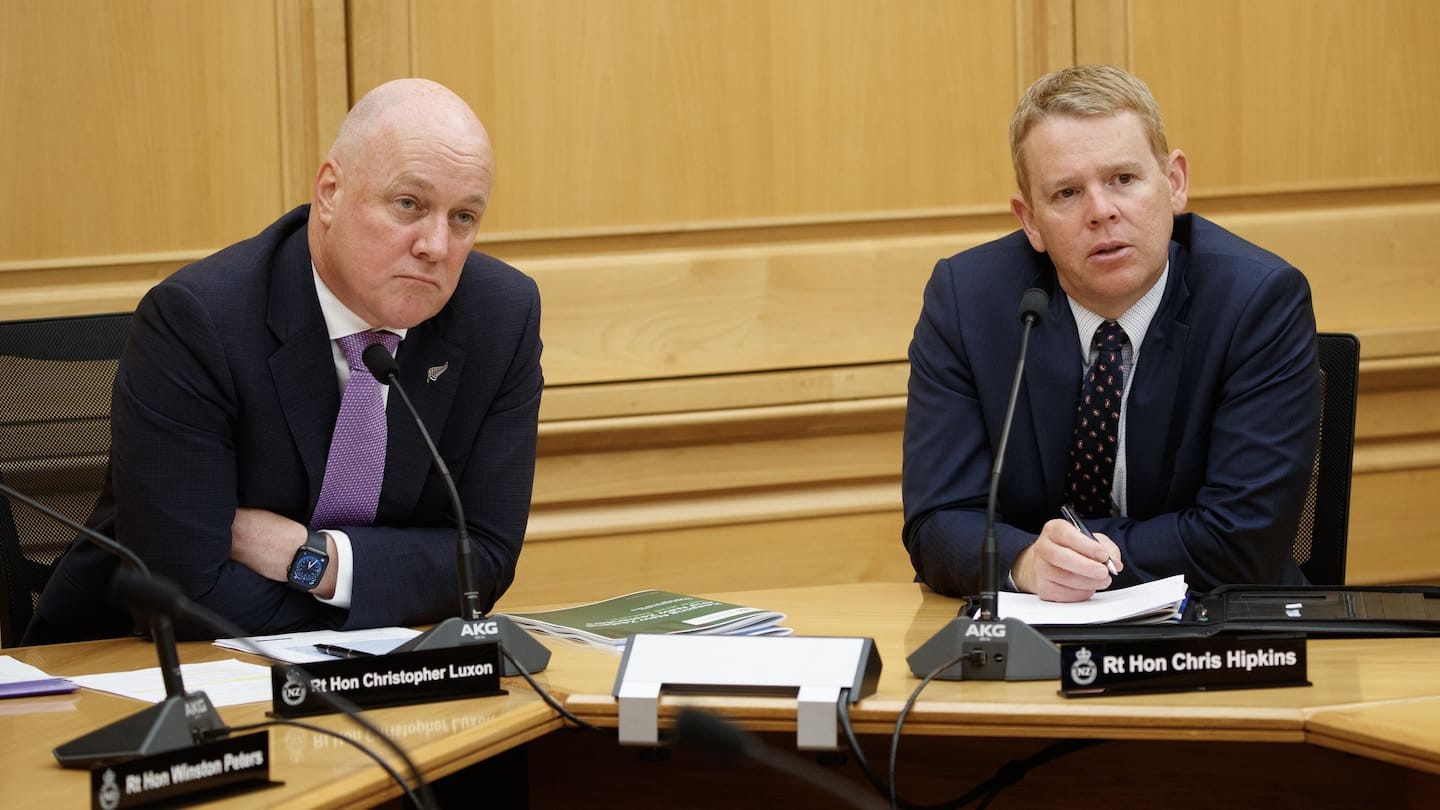
Chritopher Luxon and Chris Hipkins. Photo / Mark Mitchell.
Rather than confronting the dissatisfaction of the voting public, Audrey’s grand coalition proposal seeks to neutralise it. To take away the possibility that the people might exercise their democratic power in a way that the professional managerial class disapprove of. This class decides that if voters are unwilling to return to Labour and National, then Labour and National will simply govern together, rendering those voter preferences politically irrelevant. This is not presented as a subversion of democracy, of course. It is framed as a necessary corrective, a way to restore stability, ensure the continuation of technocratic policy, and prevent the excesses of ideological fringe actors. They are totally transparent in their agenda and react to naughty voters insisting on making the “wrong” choices, by adjusting the system so that those choices no longer matter.
Derision for the masses is not unique to New Zealand. It reflects a broader pattern that has emerged across Western democracies over the past decade or so. When voters in the United Kingdom supported Brexit, they were widely dismissed as misinformed or manipulated. Or malicious. When Americans elected Donald Trump, Hillary Clinton infamously characterised many of his supporters as a “basket of deplorables.” In each case, the response from political and media elites followed the same script where rather than engaging with the reasons behind voter discontent, they sought to delegitimise the voters themselves. The grand coalition proposal in New Zealand is a more institutional expression of that same thing. It does not insult voters directly, but it does sideline them and suggest that what they want is irrelevant if it does not fit the status quo power structure.
The economic argument for a grand coalition follows a similar pattern of wonky assumptions. We are told that New Zealand faces serious structural challenges like declining productivity, infrastructure deficits, demographic pressures and that these problems are widely understood by both major parties. Correct, these are significant problems that we are facing, but the implication is that solutions already exist, that Labour and National broadly agree on them, and that the only obstacle to implementation is the friction introduced by coalition politics. They seem to have the fantastical belief that if only the two parties could govern together, free from the constraints of smaller partners, these long-standing issues could finally be addressed.
But the challenges being described are not, in fact, new. They have persisted across many many electoral cycles and under governments led by both Labour and National. If the solutions are indeed so well understood, and broadly agreed upon, it is difficult to explain why they have not already been implemented with bipartisan support. The more plausible explanation is that the supposed consensus between the two parties is itself part of the problem that the shared assumptions and policy frameworks of the political centre have failed to deliver the outcomes they promised.
Voters are not turning to smaller parties because they are confused about the nature of New Zealand’s challenges. They are doing so because they no longer trust the major parties to address them effectively. So to respond by further consolidating power within those same parties is essentially class warfare. It is a tale as old as time. The elite class, the decision makers, the capital, the public servants…they talk a lot about what the poor and vulnerable need, but the minute that group exhibits some political autonomy they move quickly to shut it down.
Politics is not simply a technical exercise in implementing pre-agreed solutions. It is meant to be a contest of ideas. That is why we have an adversarial system with an Opposition whose job it is to interrogate every action the government takes. It requires the presence of meaningful alternatives (ahem, Labour, now would be a good time to offer some policy), the ability of voters to choose between competing visions, and the existence of an Opposition capable of holding the government to account. A grand coalition would erode all three of these. It would concentrate power within a single governing bloc, reduce the opposition to a fragmented collection of smaller parties, and blur the distinctions that allow voters to make informed choices at election time. It can produce policy compromise rather than policy innovation, settling for positions that are acceptable to the risk appetites of both major parties rather than effective in addressing complex problems. And it can foster a sense of alienation among voters who feel that the political system no longer offers them a genuine voice.
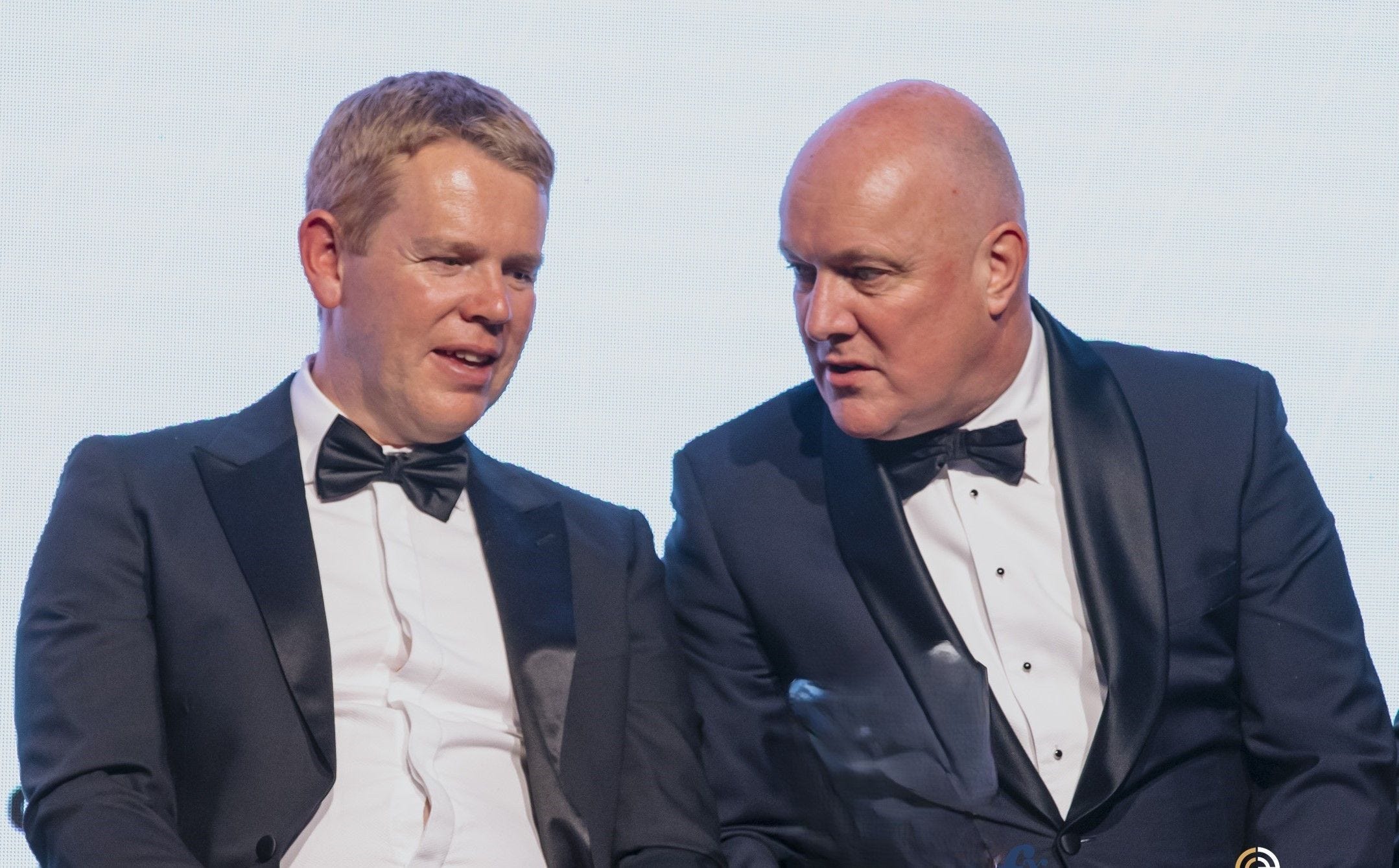
Indian NewsLink photo of the two leaders at INBA Awards 2024
Proponents of a grand coalition have pointed to overseas examples where it “works”, but the international experience reinforces the concerns I outlined above. In Germany, where grand coalitions have been relatively common, the long-term effect has not been to stabilise the political system but to further erode the support base of the major parties and create space for insurgent movements. When the political centre becomes a unified governing entity, it loses its capacity to represent distinct constituencies. And voters who feel unrepresented do not simply disappear; they seek alternatives, often at the margins of the political spectrum.
So in actual fact, by seeking to contain political fragmentation, they actually risk intensifying it. By removing meaningful competition at the centre, they make the system more brittle, not more resilient. The appearance of stability is achieved at the cost of legitimacy.
Ultimately, the appeal of a grand coalition tells us less about the state of New Zealand politics than it does about the mindset of those promoting it. It reflects a class of commentators and political figures who are increasingly uneasy with the direction of voter behaviour and are searching for ways to restore a sense of control. Faced with an electorate that is dispersing its support across a wider range of parties, they have concluded that the problem lies not with the political offerings available but with the structure of choice itself.
This is all elitism. It is a loud whinge from the lanyard wearers who want to be able to embed cogovernance, spend recklessly, and wield moral authority over the population without pesky smaller parties objecting. The diversification of political support should not be treated as a crisis to be managed; it is a signal to be understood. A grand coalition would be a retreat from democratic principles rather than something like a renewal. New Zealand’s political system is experiencing strain, but the answer is not to narrow the range of voices within it. It is to broaden it further and to embrace the pluralism that MMP was designed to facilitate. We must recognise that disagreement, far from being a defect, is the essential mechanism through which democratic societies adapt and evolve.
Ani O'Brien comes from a digital marketing background, she has been heavily involved in women's rights advocacy and is a founding council member of the Free Speech Union. This article was originally published on Ani's Substack Site and is published here with kind permission.


12 comments:
Blue Chris and Red Chris look like partners in crime. Their common goal: "Hang on to power at all costs. " The UK local govt results should terrify them.
Without political consensus we are doomed in the big ticket items. Labour is one of the few parties who is mature enough to set aside politics and reach out across the aisle when it matters. You’ll never see such maturity from the lunatic fringe of ACT and NZF. National is turning more and more towards dirty politics, so opportunities form sustainable solutions are only getting more and more limited. People celebrating political divides are distracting you from the real issues, people.
Modern Labour are seriously toxic, as in a debilitating damaging way, National under Luxon et al are Milquetoast submissive Labour. Both are loathsome for different reasons, National especially for pretending it's something its not. Labour for its sheer stupidity and arrogance.
The pair are on many fronts indistinguishable. Believers in the angry climate gods schtick, National because it thinks it a fashionable vote winner, Labour because it can bring about embedded socialist political change. Neither because they actually think anything we do will make any difference. Its a game.
Both seek co-governance albeit National doesn't quite seem to realise what's its signing up to, Labour thinks it does but both are hopelessly duped. Labour knows it will end democracy, but hasn't thought about the sad destructive fate that awaits this nation because of it. National thinks it can carry on, as always, with bronze age tribal rule being a manageable side show. Both are equally delusional.
They are both lovers of big government, weak law enforcement, (despite the clever illusions National project), and both think they know how to spend our money better than us centrally planned, of course.
Both a believers in a magnanimous unquestioning welfare state where rotting on welfare payments in public funded housing is an unimpeachable entitlement and lifestyle choice. So much so, the universal old age pension is in both party's sights to be slayed.
Let's be honest, both are already in an informal but well established grand coalition. Its not the insane Greens or the hateful ethno nationalist TPM who are of concern, those two are simply branches of the Labour Party movement. The problem for the GC proponents is ACT and NZF. This is what they are trying to expunge from politics because it's they who are the threat.
Bronze Age tribal rule, Pete? The Maoris didn't make it to the Bronze Age. Make that 'Stone Age'.
You summed it up right here, Ani :-
"Voters are not turning to smaller parties because they are confused about the nature of New Zealand’s challenges. They are doing so because they no longer trust the major parties to address them effectively."
Luxon did the dirty on us after the last election.
Trust him not to do that again ?
Flotillas of refugee boats heading for Australia, the Cooks, Fiji - anywhere other than NZ (or the USA).........
You are right over the target here Ani. Our political system in its entirety is a balsa wood structure, now rotting in plain sight. No ‘coalition’ of the treasonous or incompetent can save what’s coming. One suggestion that might start things towards a potential recovery: stop paying MPs. We might then see those stepping up for election as the ‘fit for purpose’ types that Parliament now lacks. And of course, hopefully, the collapse of political parties as a result.
Ani, I really want to thank you for the great work you do. Keep it up.
"Labour is one of the few parties who is mature enough to set aside politics and reach out across the aisle when it matters" - what unadulterated piffle. And, as for "the lunatic fringe", that surely can only be Labour's partners in crime, the Greens and TPM, for there's nothing like identity politics to foster lunacy.
It never ceases to amaze how warped some views can be, but then just look at the following still garnered by those that have done greatest harm in burdening our future generations.
What did Lloyd say to Maiki?? Can’t believe she reacted like that but what we would give to know the provocation
Quite right Ani. But there's another reason why a grand coalition would be doomed to failure. Despite the similarities in their (timid) centrist approaches, they are from completely different ideological tribes. National want to (at least notionally) generate wealth whereas Labour want to redistribute it. National are predominantly made up of successful entrepreneurs or managers whereas Labour are comprised of union officials, academics and career politicians. Most Labour politicians have never run a successful business so they are uniquely unsuited to running a country. The chances of them finding some common ground are negligible. It would be chaos.
The voice of sanity Ani - very well-informed. Intelligent comment juxtaposed with the inspirational (?) photograph of the two Chrisses (Oh Lord !)
Post a Comment
Thank you for joining the discussion. Breaking Views welcomes respectful contributions that enrich the debate. Please ensure your comments are not defamatory, derogatory or disruptive. We appreciate your cooperation.