

Click to view
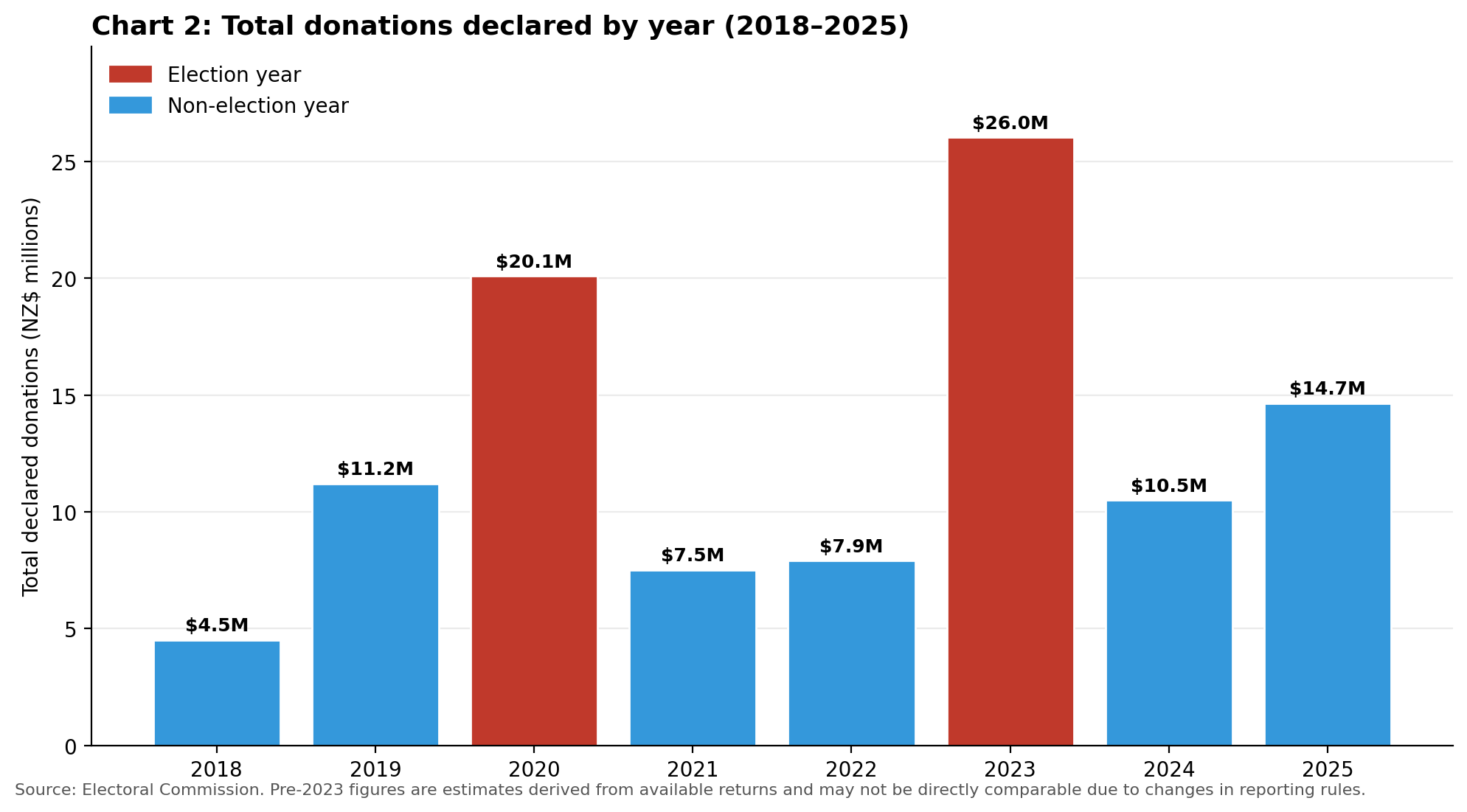
That last line matters. We are not yet in election year. We are in the warm-up.
Last year I produced an audit report for the Democracy Project, “Following the Money in 2025”, which examined the patterns of giving across the 2024 returns. The conclusion then was that wealthy vested interests were buying access and influence in ways the existing rules barely contained. If anything, the new numbers sharpen that picture.
Over the coming week I’ll work through the new returns and publish some further columns on what they reveal. This is the first — an overview, a pointer to the bigger questions to come.
Click to view
The headlines
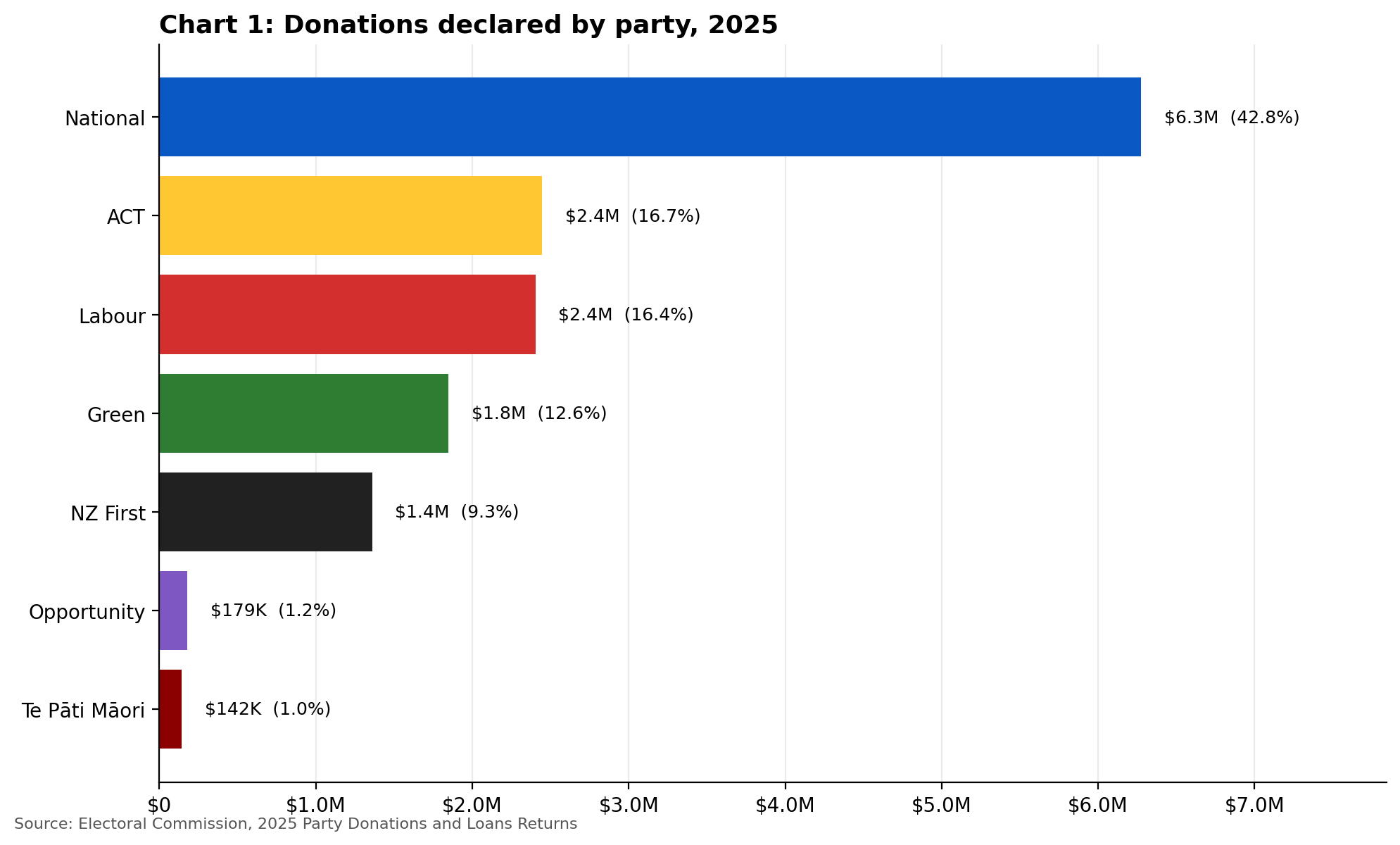
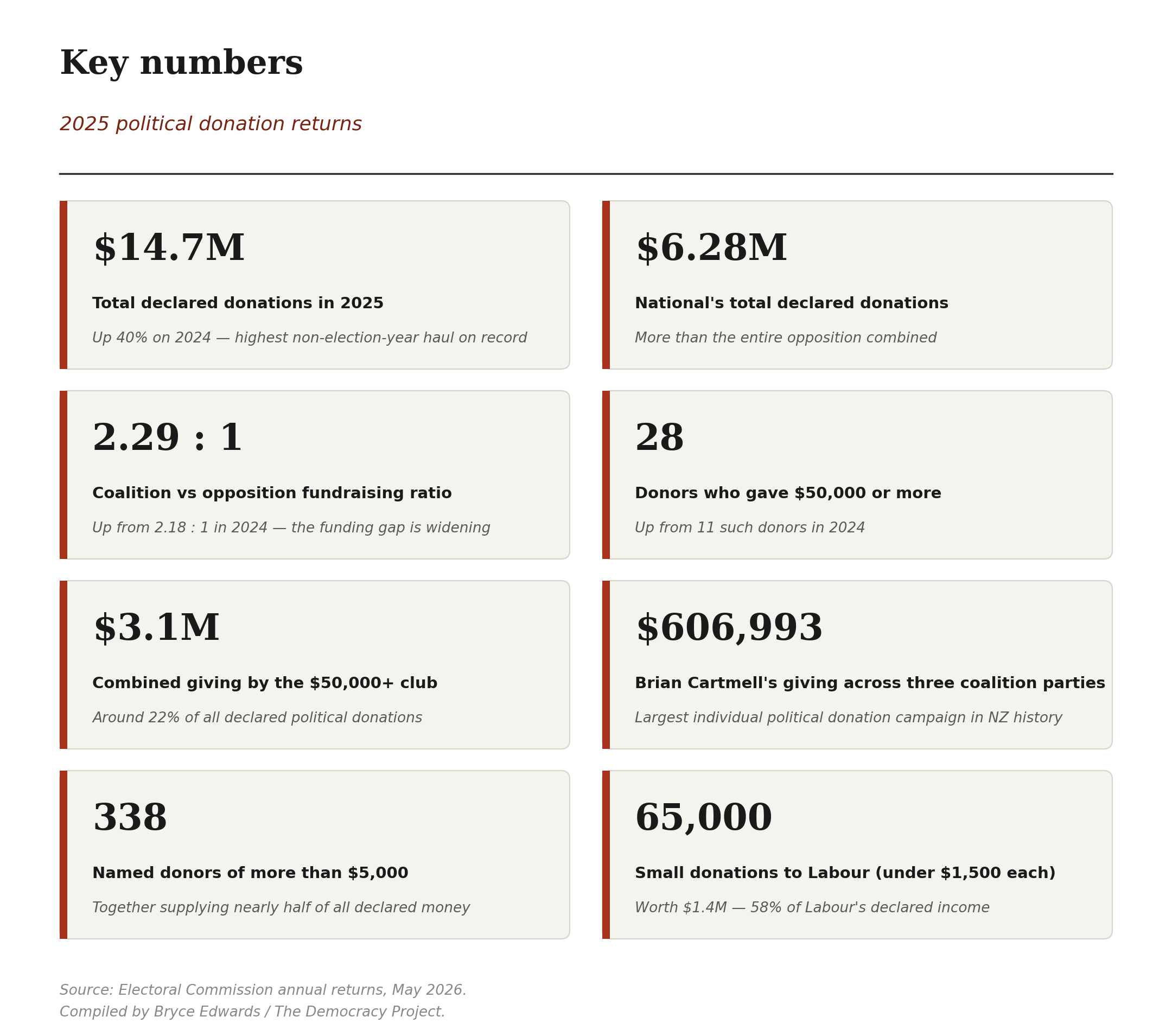
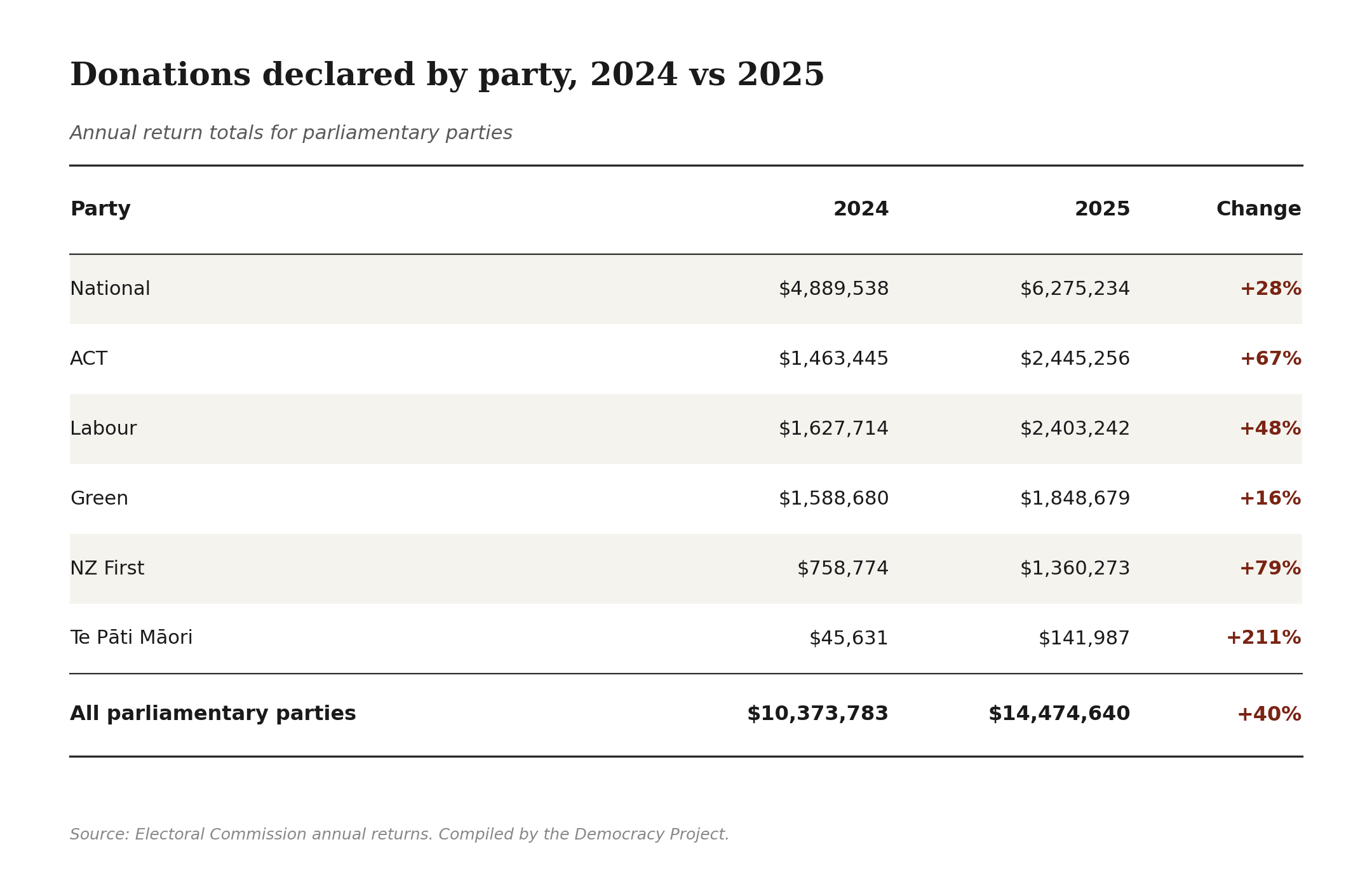
National declared $6.28 million in donations — more than the entire opposition combined. Act raised $2.45 million, narrowly overtaking Labour. NZ First nearly doubled its take. The three coalition parties between them pulled in just over $10 million; Labour, the Greens and Te Pāti Māori trailed on $4.4 million between them.
Click to view
That works out to a government-to-opposition ratio of 2.29 to one in 2025, up from 2.18 to one in 2024. The funding gap between the two halves of New Zealand parliamentary politics widened by roughly $1.85 million in a single non-election year.
National’s dominance is no surprise. Governing parties always attract donor attention, and National has been the bigger fundraiser for years. What the 2025 numbers show is that the gap between the centre-right ecosystem and everyone else is now structural, not just a quirk of incumbency.
Julia Gabel put the gap simply in her Herald lead: National received “almost $4 million more than the Labour Party”.
Click to view
Act slips past Labour
The most striking single shift in the 2025 numbers is the Act Party overtaking Labour as the country’s second-best-funded political party. The gap is small in dollar terms — barely $42,000 — but the symbolism is significant.
Act raised less than a third of National’s haul as recently as 2024. In 2025 it pulled in 67% more money than the year before. Once again, Act has become a serious fundraising operation.
Act’s donor list is dominated by ultra-wealthy individuals and corporate vehicles — average named donations of around $39,000 each, more than three times Labour’s average of $13,500. Forty per cent of Act’s named-donor money came from just its top ten donors: the most concentrated donor base of any major party. The party most aggressively committed to deregulation is also the party most reliant on concentrated wealth. The alignment is not accidental.
The $50,000 club
In last year’s audit I identified eleven donors who had given $50,000 or more in 2024, contributing about $1.18 million between them — around 11% of all declared money for that year.
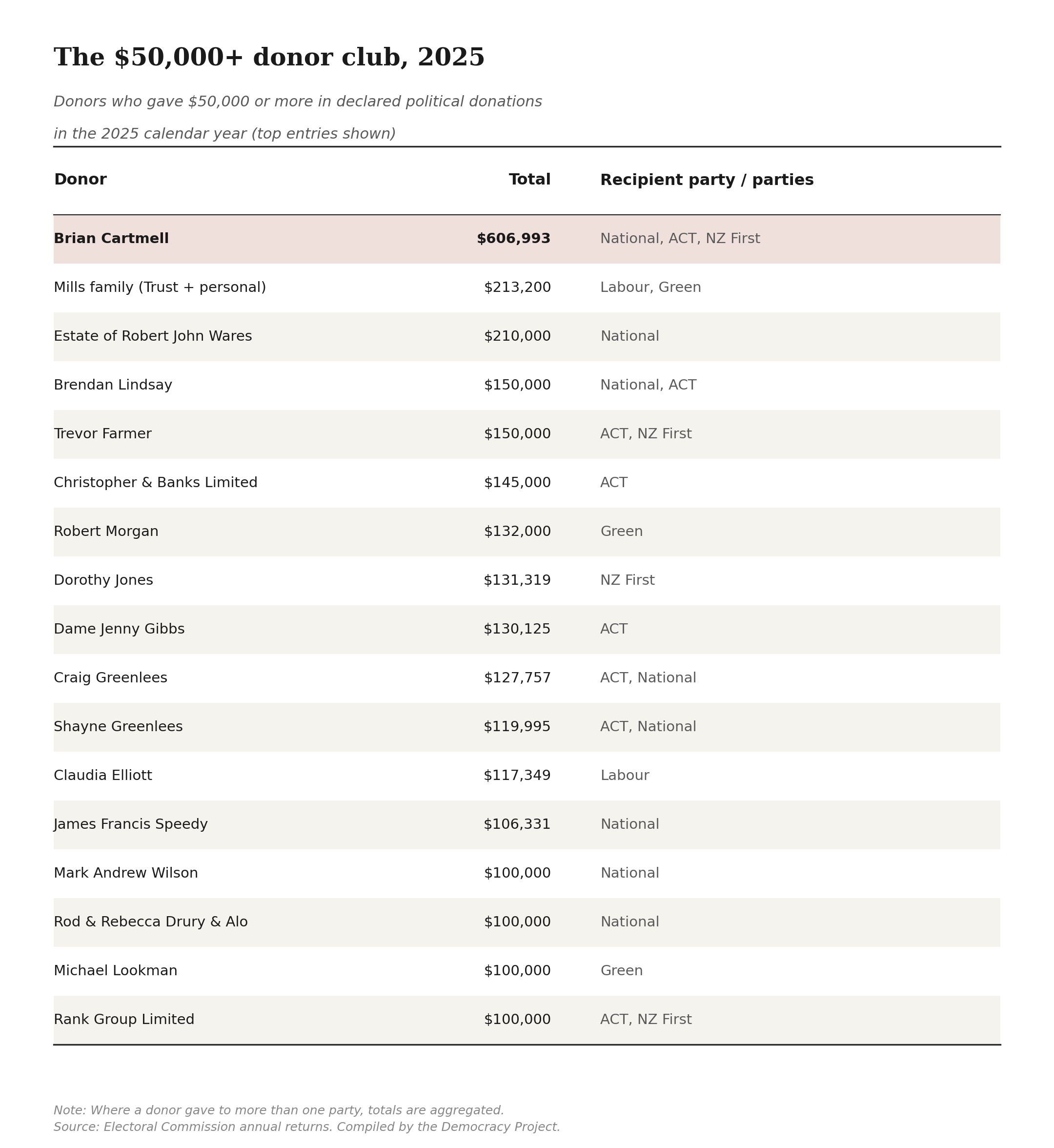
The 2025 club has more than doubled. In the latest figures, 28 donors gave $50,000 or more, contributing roughly $3.1 million between them — over 20% of all declared political donations for the year.
Click to view
These are big numbers. The very top of the table is dominated by individuals giving simultaneously to multiple coalition parties. It is worth pausing on what those names tell you about who has the money in New Zealand politics now: tech investors, property developers, manufacturers, agribusiness magnates, finance bosses, with a handful of estates and one party president scattered among them. The $50,000+ club is now where the action is.
Not every large donor is a villain, of course. Some are ideological. Plenty are loyal. Quite a few probably just think politics matters enough to pay for it. The question for democratic equality isn’t really their motive — it’s their weight. And the weight of a $200,000 donor is not in the same universe as the rest of us.
Dr Bryce Edwards is a politics lecturer at Victoria University and director of Critical Politics, a project focused on researching New Zealand politics and society. This article was first published HERE


3 comments:
Looks like we are getting the best democracy that money can buy!
Can anyone tell me if the Maori Party has supplied it's election expenses and donations for the last couple of elections ?
Successful/rich people have money. Successful/rich people vote right of center. Ergo, successful people donate to National (and ACT). Unsuccessful/poor people vote left but have no money so Labour and the Greens get less. Why should that be a newsworthy surprise? Alternatively, if we think successful people giving more to National and ACT is unfair, perhaps we should use taxpayer money to make up the difference and give the unsuccessful people a shot at running the country instead.
Post a Comment
Thank you for joining the discussion. Breaking Views welcomes respectful contributions that enrich the debate. Please ensure your comments are not defamatory, derogatory or disruptive. We appreciate your cooperation.