

That is not noise. It is a flashing red light.
But for all the data he marshals, Edwards stops short of asking the most obvious question: what exactly has failed?
Instead, he gestures toward “market liberalism” — a vague, decades-old economic shift — while leaving untouched the system that is explicitly political: the one New Zealand chose in the 1990s.
That omission matters.
New Zealand did not just change its economy in the 1980s. It fundamentally changed its political architecture in the 1990s with the adoption of Mixed-Member Proportional representation.
MMP was sold as a corrective. It would make Parliament more representative, give voice to minority and previously excluded groups, reduce disconnection, and restore trust in democratic institutions.
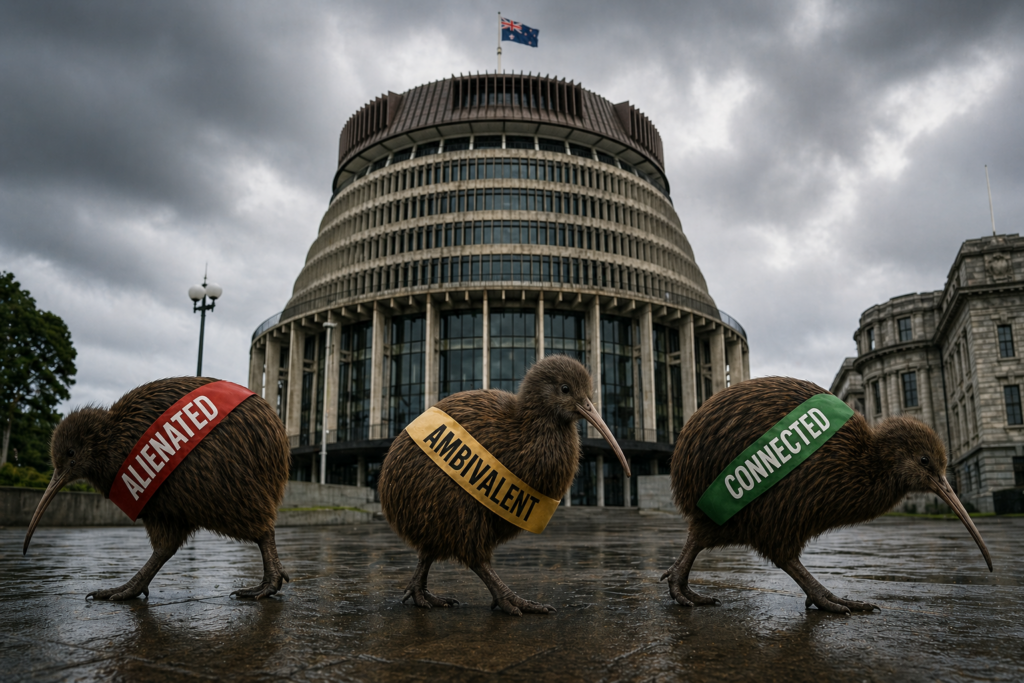
In narrow terms, it succeeded. Parliament is more diverse. Smaller parties have influence. Groups Edwards identifies as “alienated” now have direct political representation through parties such as Te Pāti Māori, the Greens, and New Zealand First.
Which raises an uncomfortable question.
If representation was the problem, and MMP solved representation, why has alienation increased?
Edwards’ own evidence makes the contradiction hard to ignore.
He highlights deep divides in trust, legitimacy, and belief in fairness, particularly along economic lines. But these are not the symptoms of a system that simply lacks representation. They are the symptoms of a system that people increasingly believe does not deliver outcomes, regardless of who is represented within it.
New Zealand may have improved voice while weakening effectiveness.
Under MMP, governments are typically coalitions stitched together through negotiation and compromise. That can be a strength. It can also produce diffused accountability, policy incoherence, and a sense that voters are choosing parties but not governments. When outcomes fall short, responsibility is shared, blurred, or avoided.
For voters under financial pressure, the very group Edwards focuses on, this is not an abstract concern. It looks like a system that listens but does not act.
Edwards argues that alienation is driven primarily by financial stress. That is plausible and supported by the report.
But it is not a complete explanation.
Financial stress exists in many countries. What differs is how political systems respond to it, and whether people believe those systems are capable of responding at all.
If nearly half the country now believes the political system needs major change or replacement, then the burden of proof shifts. It is no longer enough to say people are struggling. We have to ask why so many think the system itself cannot fix it.
That is a question about institutions, not just economics.
Yet Edwards largely avoids it.
For decades, MMP has been treated as settled. Criticism exists, but it tends to be technical and narrow. The larger question has been left alone.
Is this system delivering better governance? Has it strengthened or weakened democratic legitimacy? Has it improved the country’s ability to make hard, necessary decisions?
Those questions are no longer theoretical.
They are being asked, implicitly, by the 44 percent of New Zealanders who say the system needs major change or replacement.
None of this is an argument for a simple return to First Past the Post. That system had its own distortions, and it was rejected for reasons that should not be forgotten.
But it is an argument for something that should be uncontroversial in a healthy democracy.
New Zealand should be willing to revisit the choice.
MMP was introduced to fix a problem. If that problem persists, or has worsened, then the system must be open to scrutiny on its core promise.
Edwards is right that New Zealand has an alienation problem. But diagnosing it as a lingering effect of economic reforms from forty years ago, while ignoring the political system put in place thirty years ago, is an evasion.
If the country is serious about restoring trust, legitimacy, and cohesion, it needs to ask harder questions.
Not just about how the economy works, but about how the country is governed, and whether the system it chose is still the right one.
Nicholas Kerr, who grew up in New Zealand, is a marketing consultant in Texas, where he lives with his wife and two small children. This article was sourced HERE
Instead, he gestures toward “market liberalism” — a vague, decades-old economic shift — while leaving untouched the system that is explicitly political: the one New Zealand chose in the 1990s.
That omission matters.
New Zealand did not just change its economy in the 1980s. It fundamentally changed its political architecture in the 1990s with the adoption of Mixed-Member Proportional representation.
MMP was sold as a corrective. It would make Parliament more representative, give voice to minority and previously excluded groups, reduce disconnection, and restore trust in democratic institutions.
In narrow terms, it succeeded. Parliament is more diverse. Smaller parties have influence. Groups Edwards identifies as “alienated” now have direct political representation through parties such as Te Pāti Māori, the Greens, and New Zealand First.
Which raises an uncomfortable question.
If representation was the problem, and MMP solved representation, why has alienation increased?
Edwards’ own evidence makes the contradiction hard to ignore.
He highlights deep divides in trust, legitimacy, and belief in fairness, particularly along economic lines. But these are not the symptoms of a system that simply lacks representation. They are the symptoms of a system that people increasingly believe does not deliver outcomes, regardless of who is represented within it.
New Zealand may have improved voice while weakening effectiveness.
Under MMP, governments are typically coalitions stitched together through negotiation and compromise. That can be a strength. It can also produce diffused accountability, policy incoherence, and a sense that voters are choosing parties but not governments. When outcomes fall short, responsibility is shared, blurred, or avoided.
For voters under financial pressure, the very group Edwards focuses on, this is not an abstract concern. It looks like a system that listens but does not act.
Edwards argues that alienation is driven primarily by financial stress. That is plausible and supported by the report.
But it is not a complete explanation.
Financial stress exists in many countries. What differs is how political systems respond to it, and whether people believe those systems are capable of responding at all.
If nearly half the country now believes the political system needs major change or replacement, then the burden of proof shifts. It is no longer enough to say people are struggling. We have to ask why so many think the system itself cannot fix it.
That is a question about institutions, not just economics.
Yet Edwards largely avoids it.
For decades, MMP has been treated as settled. Criticism exists, but it tends to be technical and narrow. The larger question has been left alone.
Is this system delivering better governance? Has it strengthened or weakened democratic legitimacy? Has it improved the country’s ability to make hard, necessary decisions?
Those questions are no longer theoretical.
They are being asked, implicitly, by the 44 percent of New Zealanders who say the system needs major change or replacement.
None of this is an argument for a simple return to First Past the Post. That system had its own distortions, and it was rejected for reasons that should not be forgotten.
But it is an argument for something that should be uncontroversial in a healthy democracy.
New Zealand should be willing to revisit the choice.
MMP was introduced to fix a problem. If that problem persists, or has worsened, then the system must be open to scrutiny on its core promise.
Edwards is right that New Zealand has an alienation problem. But diagnosing it as a lingering effect of economic reforms from forty years ago, while ignoring the political system put in place thirty years ago, is an evasion.
If the country is serious about restoring trust, legitimacy, and cohesion, it needs to ask harder questions.
Not just about how the economy works, but about how the country is governed, and whether the system it chose is still the right one.
Nicholas Kerr, who grew up in New Zealand, is a marketing consultant in Texas, where he lives with his wife and two small children. This article was sourced HERE


6 comments:
For me the problem with MMP is not the system but rather the practicioners within it. We have reached the stage where MPs like Bishop, Brown and Stanford are stand-outs just for doing their jobs. The rest, on both sides of the House just display varying levels of incompetence.
The one change needed for MMP is to adopt the German rule whereby any party wishing to form a Government must negotiate in good faith with the party with the majority of the votes. Such a rule would, I believe, avoid the farce that 2017 produced.
Its quite clear to me that the growth of the power of the Wellington bureaucracy and the capture of the media by the left are the cause of the alienation.
32% trust MSM, we are forced to gather our understanding of the world from the scrapes that spill of the arrogant subsidized unholy coalition of media and govt fools who grow by the day.
Luxon still thinks these groups are able to be talked to, they see him as filth and ready for slaughter, that he may be naive is obvious but the people, don't like the self appointed fools stealing from them.
The only hope is for the coalition to feed their releases through new channels such that the power is restored to a balanced new and historic media.
The squabble with the faggot slur shows this they should be suspended until it can be shown that that was not said. as simple as that.
Drinking in parliament with the enemy, and they are , is folly.
In the 17 NZ elections prior to MMP in 1996, an average of 54% of the votes went to parties who didn’t end in government. In the elections since MMP an average of 52% of the votes went to parties who didn’t make it into government.
Plus ça change, plus c'est la même chose. MMP makes almost no difference other than to allow for more small parties to run around making lots of noise but achieving nothing (Apart from Winston’s Gold Card of course)
Good points Nicholas. Could I summarise by noting that you seem to want our best people to be our legislators? Well, you will never get that by relying on political parties to make the choice. In fact, such parties will never seek the qualities you would want. As we can so plainly see, from the record of the last 40 years, at least. Perhaps we would benefit from some sort of ballotted conscription, where we impartially select our very best, mature citizens for a strictly limited term? We can of course guarantee that the existing bunch would never approve of anything like that. Turkeys never vote for an early Christmas.
MMP cannot be fixed. It has never worked. A return to First Past the Post would not make it over the line politically. What we should consider is Supplementary Member. Under this system the Party gets its electoral seats plus its vote percentage of list seats. Let's say the New Zealand Party gets 20 electorate seats and 20% of the party vote. It would get 20 seats plus 20% of the last seats, not 20% of the overall seats. I suggest we have 80 electorate seats and 40 list seats. So the New Zealand Party would get 8 list seats and 20 electorate seats - 28 in all. Under MMP they get 20% of 120, or 24. Doesn't sound very different? Well it is when the numbers are larger. In 2017 National got 44% of the vote so would have had its electorate seats plus 20 odd list seats. The important thing about SM is it allows smaller party representation but greatly limits their ability to manipulate larger parties in post election wrangling. It also greatly strengthens the importance of local electorate MPs, something sadly missing with MMP which has seen us suffer the biggest collection of ratbags and no hopers over in the House.
Get rid of the two vote system that people like TPM are trying to get their voters to manipulate. You get one electorate vote which also counts towards a list seat for the same party. (Not sure whether that is the same as Supplementary Member system as mentioned previously)
The other thing the incoming Govt should be allowed to do is appoint their choice of Public Service Commissioner with a mandate to replace Department heads who do not follow Ministers directives and push their own agenda. This would stop the Welligton public service bureacracy from undermining Govt policies
Post a Comment
Thank you for joining the discussion. Breaking Views welcomes respectful contributions that enrich the debate. Please ensure your comments are not defamatory, derogatory or disruptive. We appreciate your cooperation.