

Forget “a week’s a long time”. A day is an eternity in politics. And yet consequences can arrive with brutal speed.
This morning Chris Penk was a Cabinet minister, ranked 14th on National’s newly released party list, with responsibility for Defence, Building and Construction, Veterans, Space, the GCSB and NZSIS, as well as an associate Emergency Management portfolio. Tonight he has announced that he will not contest November’s election.
In between, Christopher Luxon survived a confidence vote and then stripped Penk of every ministerial portfolio, declaring that he had “launched a leadership challenge” and that his continued presence in Cabinet was therefore “untenable”. This was the right thing for the Prime Minister to do. He had to send a message that the cycle of attempted coups must end and he had to make an example out of someone. It is a tragedy, in my view, that it was Chris Penk who took the fall.
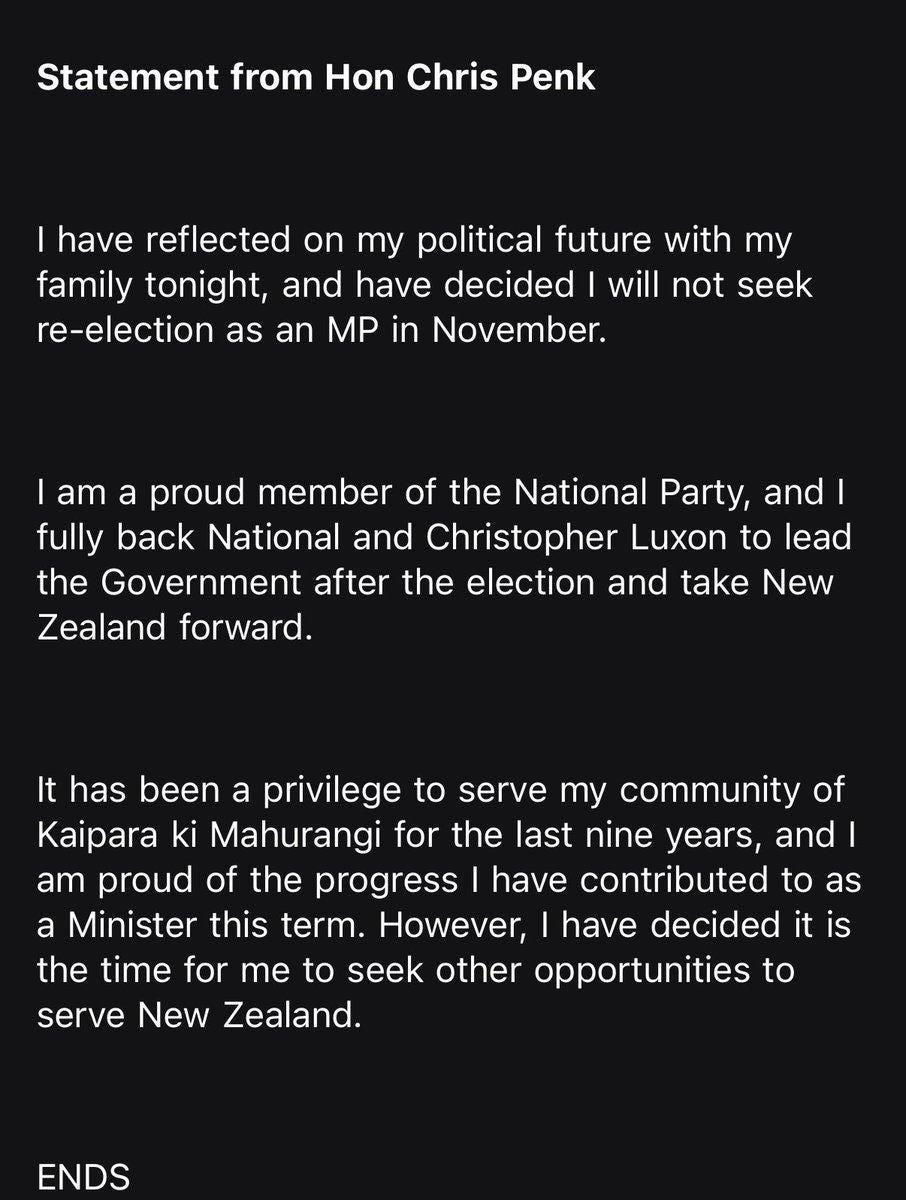
Penk released a short statement saying that, after reflecting on his political future with his family, nine years in Parliament would be enough.
Earlier today there were reports that Penk had been doing the numbers for his own leadership bid. Frankly I thought this sounded ludicrous and posted on X that anyone saying so must be “cuckoo”. It has been my assumption all day that he must have been doing the numbers for someone else. However, this evening when the media tracked down Chris Bishop he was adamant that Penk had not been doing the numbers for him and that he had been doing them for himself. He said that people do not launch leadership challenges on somebody else’s behalf and distanced himself and Stanford from Penk.
Bishop was high on the suspect list of instigators simply by virtue of being in one of the more precarious situations of any senior National MP. He is likely to lose Hutt South and despite being second in line for a list seat (assuming Luxon gets Botany) National may not get enough for him to make it over the line. The logic of incentives and motivations indicated that Bishop was involved. But that is not the case. At least not directly.
The version of events being shopped around this evening is that Penk challenged Luxon, Penk lost, Penk was sacked from Cabinet, so Penk quit. But that version just does not make sense to those of us who know Chris Penk.
Like I say, when the first reports emerged that Penk had been ringing around National MPs and “doing the numbers”, I was confused. Not because I thought it inconceivable that there was serious dissatisfaction with Luxon. You would need to have spent the past few months living under a particularly large rock to think that. Nor because I thought Penk was incapable or unqualified of being a leader one day. But because he is in one of the safest seats in the country and does not have the same pressure on him as others. He is also politically astute and not naive about the realities of caucus politics.
Most of all, it did not make sense that Chris Penk was doing the numbers for Chris Penk. His name has not been in the mix for Prime Minister except amongst his fan boys on X and it was strange to think he would back himself for a run out of no where.
I know now that I was right. And I was wrong.
This evening I have learnt that what Chris Penk was actually canvassing was support for an Erica Stanford–Chris Penk leadership ticket. To be clear that is: Stanford for leader and Penk as her deputy. And to be equally as clear: I have not been able to determine the level of involvement of Erica Stanford in the discussions.
Anyway, Penk was sounding out colleagues about whether there might be sufficient support within caucus. Things had not progressed much beyond initial discussions.
Then somebody talked.
Another MP leaked what was happening to the media before the possible leadership ticket had been sufficiently supported. Suddenly what was supposed to be an exercise in determining whether an alternative leadership team was viable became an immediate public leadership crisis.
The story was out, journalists were ringing MPs, MPs were being asked to declare allegiances, and Luxon had every incentive to force the issue immediately rather than allow his opponents time to organise properly.
The coup, if you want to call it that, had been triggered far too early.
When National MPs assembled in Wellington today, they never got to the question of whether Stanford and Penk had support. The first hurdle was simply whether Christopher Luxon retained the confidence of his caucus. And he did.
Once Luxon won that confidence vote, the process stopped. There was no vacancy and therefore no contest between alternative candidates.
The public explanation being offered tonight is that Penk himself mounted a challenge for the leadership. The Prime Minister’s Office has explicitly maintained that Penk was challenging for himself rather than acting on behalf of somebody else. 1News reports that the Prime Minister’s Office says neither Stanford nor Bishop officially challenged and that Penk was the person who did so at caucus. Curiously, for a meeting whose proceedings are supposedly confidential, the Prime Minister’s Office has been remarkably willing to tell journalists who did and did not challenge.
The precise details of what happened inside National’s caucus room will remain a mystery. People have strong incentives to minimise their involvement after an unsuccessful challenge, and that is what we are seeing right now. The schemers have all fled the scene.
My sources tell me that while Penk was the “stalking horse”, he did not make a leadership challenge in caucus. But someone else did. I am working to corroborate who that was.
The idea that Chris Penk suddenly, out of no where, decided, three months before an election, that he should become Prime Minister is seriously implausible. Him being part of a ticket as a deputy makes much more sense. And whatever one thinks of the wisdom of attempting to change leader this close to an election, the collateral damage is that Parliament is losing one of its genuinely good MPs.

Source: Facebook
Chris Penk has never quite fitted the mould of the modern professional politician, which is part of what made him such a good one.
Before Parliament he got a BA and law degree from Auckland, served in the Royal New Zealand Navy aboard Te Kaha and with the Royal Australian Navy’s submarine squadron, then a had legal career and his own law firm. He arrived in Parliament in 2017 as John Key’s successor in Helensville and comfortably won the seat. Boundary changes turned it into Kaipara ki Mahurangi, which he held through National’s 2020 wipeout and again in 2023.
He spent his first six years largely in opposition, doing the unglamorous apprenticeship of select committees, portfolios, late night speeches in the House, and constituency work. When National finally returned to government, he was given Building and Construction, Veterans, and associate responsibilities in Defence.
Building and Construction is hardly a portfolio designed to make you famous, but Chris was good at it. He got stuck into the maddening accumulation of rules, delays, and bureaucracy that makes building anything in New Zealand so impossible. Self-certification for trusted professionals, faster inspections, granny-flat exemptions, less red tape for sheds and garages, and wider reform of the building system followed.
That performance earned him promotion to Cabinet in April after Judith Collins retired. His previous naval service also made Defence a natural fit.
While his time in the job was brief, it included work on replacing the Navy’s ageing frigates, rebuilding Defence infrastructure, and expanding support for veterans. In July he announced another 1,300 veterans would become eligible for health, rehabilitation and financial support for deployment-related conditions. In May he opened new homes for Defence families at Linton, Ohakea, and Burnham, delivered ahead of schedule and under budget.
Now, four months after entering Cabinet, he is leaving politics altogether. That is, in my view, an enormous waste of talent and experience. But my sadness about Chris leaving is not about a list of ministerial achievements.
Those who have met him know that he is clever, extremely funny, nerdy and, most importantly, a fundamentally good person. He has strong political views but has never needed to regard everyone who disagrees with him as stupid or evil. He is quick-witted without being cruel, can laugh at himself, and is genuinely interested in ideas.
I understand why Luxon sacked him. You cannot participate in an attempt to remove the Prime Minister, lose, and reasonably expect to wander back into Cabinet on Monday morning as though nothing happened. Politics is not kindergarten and there are no participation certificates for unsuccessful coups.
But understanding the consequence does not make it easier to stomach. And it is especially frustrating given how it appears to have unravelled. A leadership move that was still at the stage of testing numbers was leaked before those numbers were secured.
His statement tonight was characteristically gracious. No attack on Luxon, no airing of caucus laundry, no attempt to burn down the house on his way out. He reaffirmed his support for National and for Luxon to lead the Government after the election.
Political careers end all the time, and often deservedly so. But Chris Penk still had an enormous amount to offer.
He made a gamble and it failed. That is politics.
But his nine years of public service deserve to be remembered as considerably more than one chaotic Wednesday in August.

Source: Facebook
Ani O'Brien comes from a digital marketing background, she has been heavily involved in women's rights advocacy and is a founding council member of the Free Speech Union. This article was originally published on Ani's Substack Site and is published here with kind permission.
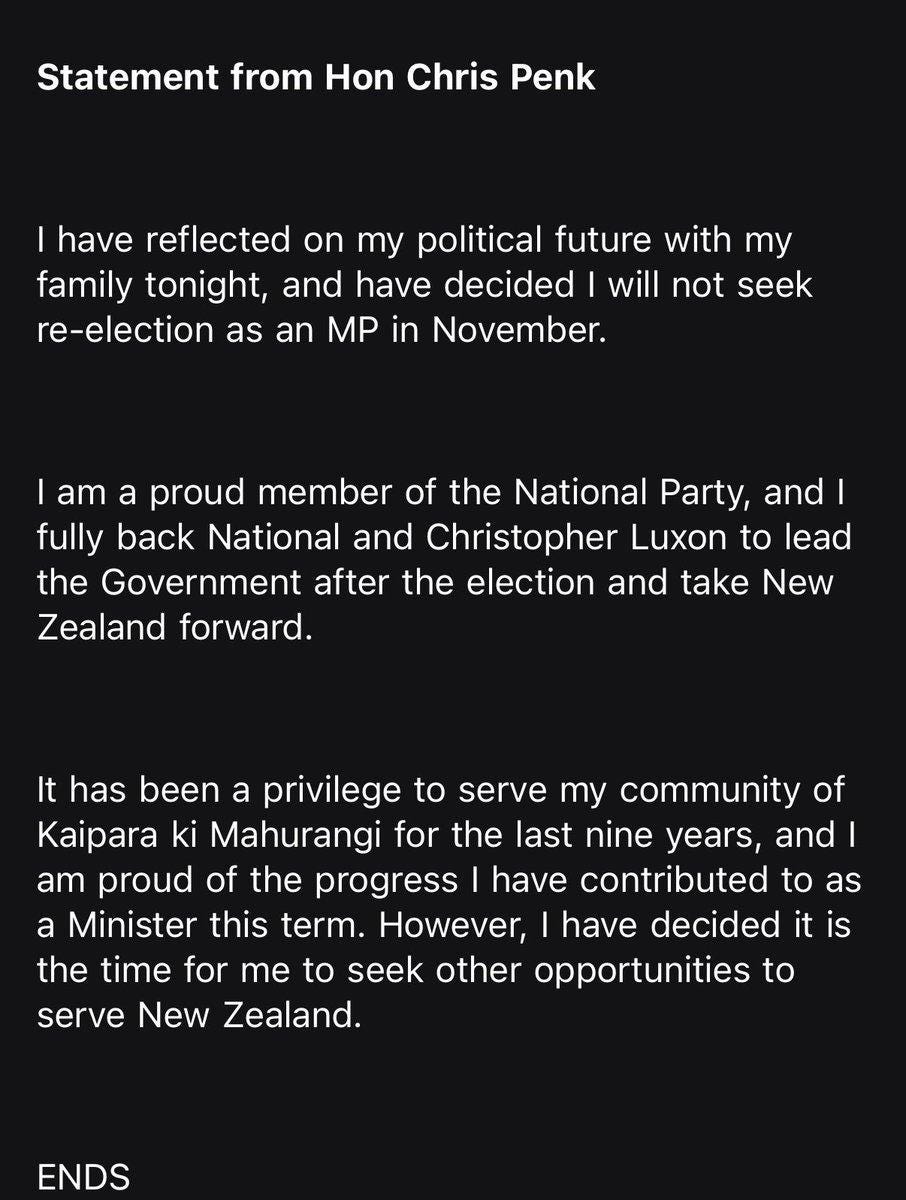
Penk released a short statement saying that, after reflecting on his political future with his family, nine years in Parliament would be enough.
Earlier today there were reports that Penk had been doing the numbers for his own leadership bid. Frankly I thought this sounded ludicrous and posted on X that anyone saying so must be “cuckoo”. It has been my assumption all day that he must have been doing the numbers for someone else. However, this evening when the media tracked down Chris Bishop he was adamant that Penk had not been doing the numbers for him and that he had been doing them for himself. He said that people do not launch leadership challenges on somebody else’s behalf and distanced himself and Stanford from Penk.
Bishop was high on the suspect list of instigators simply by virtue of being in one of the more precarious situations of any senior National MP. He is likely to lose Hutt South and despite being second in line for a list seat (assuming Luxon gets Botany) National may not get enough for him to make it over the line. The logic of incentives and motivations indicated that Bishop was involved. But that is not the case. At least not directly.
The version of events being shopped around this evening is that Penk challenged Luxon, Penk lost, Penk was sacked from Cabinet, so Penk quit. But that version just does not make sense to those of us who know Chris Penk.
Like I say, when the first reports emerged that Penk had been ringing around National MPs and “doing the numbers”, I was confused. Not because I thought it inconceivable that there was serious dissatisfaction with Luxon. You would need to have spent the past few months living under a particularly large rock to think that. Nor because I thought Penk was incapable or unqualified of being a leader one day. But because he is in one of the safest seats in the country and does not have the same pressure on him as others. He is also politically astute and not naive about the realities of caucus politics.
Most of all, it did not make sense that Chris Penk was doing the numbers for Chris Penk. His name has not been in the mix for Prime Minister except amongst his fan boys on X and it was strange to think he would back himself for a run out of no where.
I know now that I was right. And I was wrong.
This evening I have learnt that what Chris Penk was actually canvassing was support for an Erica Stanford–Chris Penk leadership ticket. To be clear that is: Stanford for leader and Penk as her deputy. And to be equally as clear: I have not been able to determine the level of involvement of Erica Stanford in the discussions.
Anyway, Penk was sounding out colleagues about whether there might be sufficient support within caucus. Things had not progressed much beyond initial discussions.
Then somebody talked.
Another MP leaked what was happening to the media before the possible leadership ticket had been sufficiently supported. Suddenly what was supposed to be an exercise in determining whether an alternative leadership team was viable became an immediate public leadership crisis.
The story was out, journalists were ringing MPs, MPs were being asked to declare allegiances, and Luxon had every incentive to force the issue immediately rather than allow his opponents time to organise properly.
The coup, if you want to call it that, had been triggered far too early.
When National MPs assembled in Wellington today, they never got to the question of whether Stanford and Penk had support. The first hurdle was simply whether Christopher Luxon retained the confidence of his caucus. And he did.
Once Luxon won that confidence vote, the process stopped. There was no vacancy and therefore no contest between alternative candidates.
The public explanation being offered tonight is that Penk himself mounted a challenge for the leadership. The Prime Minister’s Office has explicitly maintained that Penk was challenging for himself rather than acting on behalf of somebody else. 1News reports that the Prime Minister’s Office says neither Stanford nor Bishop officially challenged and that Penk was the person who did so at caucus. Curiously, for a meeting whose proceedings are supposedly confidential, the Prime Minister’s Office has been remarkably willing to tell journalists who did and did not challenge.
The precise details of what happened inside National’s caucus room will remain a mystery. People have strong incentives to minimise their involvement after an unsuccessful challenge, and that is what we are seeing right now. The schemers have all fled the scene.
My sources tell me that while Penk was the “stalking horse”, he did not make a leadership challenge in caucus. But someone else did. I am working to corroborate who that was.
The idea that Chris Penk suddenly, out of no where, decided, three months before an election, that he should become Prime Minister is seriously implausible. Him being part of a ticket as a deputy makes much more sense. And whatever one thinks of the wisdom of attempting to change leader this close to an election, the collateral damage is that Parliament is losing one of its genuinely good MPs.

Source: Facebook
Chris Penk has never quite fitted the mould of the modern professional politician, which is part of what made him such a good one.
Before Parliament he got a BA and law degree from Auckland, served in the Royal New Zealand Navy aboard Te Kaha and with the Royal Australian Navy’s submarine squadron, then a had legal career and his own law firm. He arrived in Parliament in 2017 as John Key’s successor in Helensville and comfortably won the seat. Boundary changes turned it into Kaipara ki Mahurangi, which he held through National’s 2020 wipeout and again in 2023.
He spent his first six years largely in opposition, doing the unglamorous apprenticeship of select committees, portfolios, late night speeches in the House, and constituency work. When National finally returned to government, he was given Building and Construction, Veterans, and associate responsibilities in Defence.
Building and Construction is hardly a portfolio designed to make you famous, but Chris was good at it. He got stuck into the maddening accumulation of rules, delays, and bureaucracy that makes building anything in New Zealand so impossible. Self-certification for trusted professionals, faster inspections, granny-flat exemptions, less red tape for sheds and garages, and wider reform of the building system followed.
That performance earned him promotion to Cabinet in April after Judith Collins retired. His previous naval service also made Defence a natural fit.
While his time in the job was brief, it included work on replacing the Navy’s ageing frigates, rebuilding Defence infrastructure, and expanding support for veterans. In July he announced another 1,300 veterans would become eligible for health, rehabilitation and financial support for deployment-related conditions. In May he opened new homes for Defence families at Linton, Ohakea, and Burnham, delivered ahead of schedule and under budget.
Now, four months after entering Cabinet, he is leaving politics altogether. That is, in my view, an enormous waste of talent and experience. But my sadness about Chris leaving is not about a list of ministerial achievements.
Those who have met him know that he is clever, extremely funny, nerdy and, most importantly, a fundamentally good person. He has strong political views but has never needed to regard everyone who disagrees with him as stupid or evil. He is quick-witted without being cruel, can laugh at himself, and is genuinely interested in ideas.
I understand why Luxon sacked him. You cannot participate in an attempt to remove the Prime Minister, lose, and reasonably expect to wander back into Cabinet on Monday morning as though nothing happened. Politics is not kindergarten and there are no participation certificates for unsuccessful coups.
But understanding the consequence does not make it easier to stomach. And it is especially frustrating given how it appears to have unravelled. A leadership move that was still at the stage of testing numbers was leaked before those numbers were secured.
His statement tonight was characteristically gracious. No attack on Luxon, no airing of caucus laundry, no attempt to burn down the house on his way out. He reaffirmed his support for National and for Luxon to lead the Government after the election.
Political careers end all the time, and often deservedly so. But Chris Penk still had an enormous amount to offer.
He made a gamble and it failed. That is politics.
But his nine years of public service deserve to be remembered as considerably more than one chaotic Wednesday in August.

Source: Facebook
Ani O'Brien comes from a digital marketing background, she has been heavily involved in women's rights advocacy and is a founding council member of the Free Speech Union. This article was originally published on Ani's Substack Site and is published here with kind permission.


10 comments:
"Politics is not kindergarten". I get quite the opposite impression from their behaviour.
Major loss for National - and NZ.
And therein lies the huge difference between National and Labour/Greens - Penk has a life and a career outside of politics to go to due to his background whileas the career politicians in Labour/Greens have never done anything outside of sucking on taxpayers’ tits.
Good luck to Penk although I must state that he should have known better.
Luxon has a track record of getting rid of the best and brightest. Dumb and dumber becomes the National party.
To anon @8.10. Spot on mate. In fact that's pretty much the difference between the left and the center. Full stop. The left are parasitic down and out radical losers and the center are the ones supporting them. It's an odd relationship. But I will tell you this, the left need me far more than I need them. That has become blatantly obvious since the ardern era.
No doubt in my mind Stanford knew and supported what Penk was doing and threw him under the bus.
Penk probably reached his limit and eventually got in over his head.
His progression from being a naval officer to spy master chief spook (portfolios in GCSB and NZSIS) is in itself interesting.
But he got sloppy because "somebody talked".
Probably never had enough time in his career to refine his ability to spot a "mole".
If the previous coup attempt was a vote of 27 to 22 this one needed only three to switch to reverse it 25 to 24. Is that why Luxon suddenly realised the voting could well have swung against him. National is now probably down to its bedrock support. Will therefore just get back in with NZ First and ACT who can then exact a very heavy price for their support.
Chris Penk may be a very nice guy but what he instigated was pretty dumb - from a political perspective.
I hope you are right Eamon, the alternative doesn't bear thinking about. Still, grab your tickets out folks, prepare for worst-case scenario, the good people will leave and leave the left parasites to do the only thing they are actually good at, bludge off one another.
Post a Comment
Thank you for joining the discussion. Breaking Views welcomes respectful contributions that enrich the debate. Please ensure your comments are not defamatory, derogatory or disruptive. We appreciate your cooperation.