

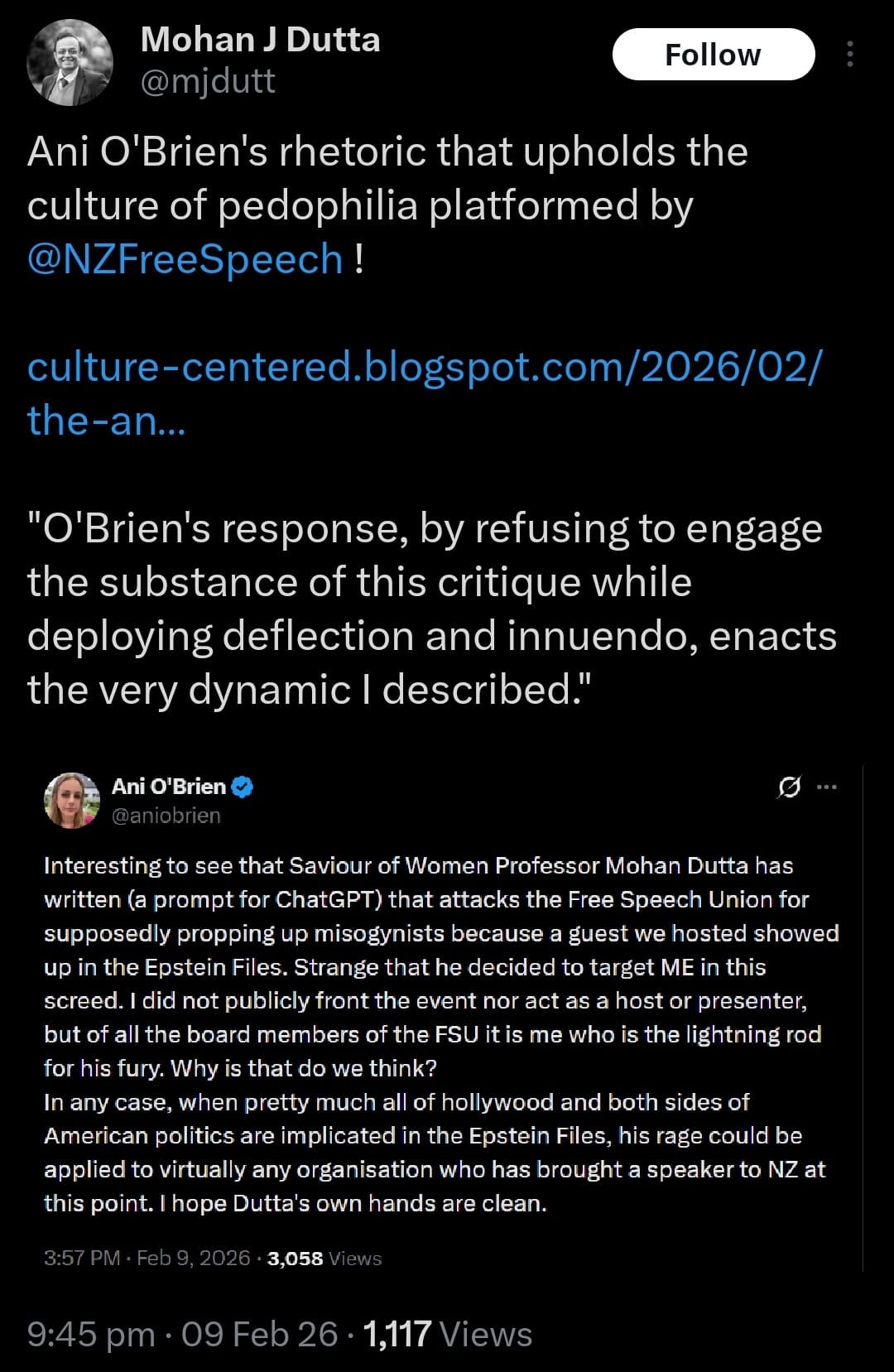
In early February 2026 the Free Speech Union (FSU) invited renowned Harvard psychologist Steven Pinker to speak in Auckland about his latest book. Contrary to what Massey University’s Professor Mohan Dutta alleges, I had no role in organising the event, although I did attend it. I am one of eleven volunteer council members, three women and eight men, and my involvement with the FSU is no different from the other ten. I also appear on the podcast, write occasional newsletters, and attend events meeting with supporters. Yet in a blog post titled “The Free Speech Facade: Inviting Steven Pinker and the Hypocritical War on ‘Woke’ as Strategy for Protecting Powerful White Men,” Dutta focused obsessively on me. He described me as emblematic of a “war on woke,” suggested that my presence “mobilises harm,” and insinuated that I have helped shield “white supremacist, racist, and pedophile‑adjacent men”. Given his much-professed advocacy for marginalised communities, his fixation on the only lesbian woman on the council is interesting, and, I think, just one example of a great deal of hypocrisy.
My aim here is to correct the record, expose just a few of the inconsistencies in Professor Dutta’s arguments, and remind him that while free speech is a pillar of democracy, and one I defend, there are legal and ethical limits of academic rhetoric. I support his right to express his opinions, but I also have a right to defend my reputation with facts.
Click to view
Dutta’s article, and subsequent comments, makes damaging claims about my character and motives. Some of those claims stray firmly into defamation while others display a troubling disregard for evidence. Contrary to common misunderstanding, defamation law isn’t anti-free speech, rather it’s the guardrail that stops “free expression” turning into consequence-free lying. You’re free to criticise, argue, offend, satirise, and even be wrong, but you’re not free to make false statements of fact that seriously harm someone’s reputation. When Professor Dutta asserts that I mobilise harm or that I “uphold pedophilia”, without evidence, he makes statements of fact, not mere opinion. It is also deeply, deeply upsetting which I suspect is his exactly his intention.
I am too broke to consider defamation action and Mohan Dutta wouldn’t be my first stop if I could afford it. However, he and Massey University should be aware of the liabilities they could be facing if he continues with his kind of sustained, reckless, defamatory behaviour towards others who might be more inclined to take legal action. The law recognises a defence of “honest opinion”, but only if the opinion is based on true facts and clearly identified as opinion.
Public debate is healthier when disputes are resolved through dialogue rather than courtrooms. In writing this response to Professor Dutta’s piece, I hope to encourage him to adhere to the truth. He is entitled to his opinions about Steven Pinker, the Free Speech Union, and me. If he disagrees with my advocacy, he is free to critique my arguments. But he should refrain from attributing crimes or depraved motives to me that he cannot prove.
As I say, my aim is not to “cancel” Professor Dutta. On the contrary, I have defended his right to speak even when I profoundly disagree with him. I ask only that he extend the same courtesy to those who he disagrees with. Let’s have a robust conversation about free speech, academic freedom and whatever else without resorting to smears and assigning collective guilt. Accusing someone of pedophilia or enabling it is a truly revolting thing to do and not the act of someone who can credibly then make claims about the harms others do online.

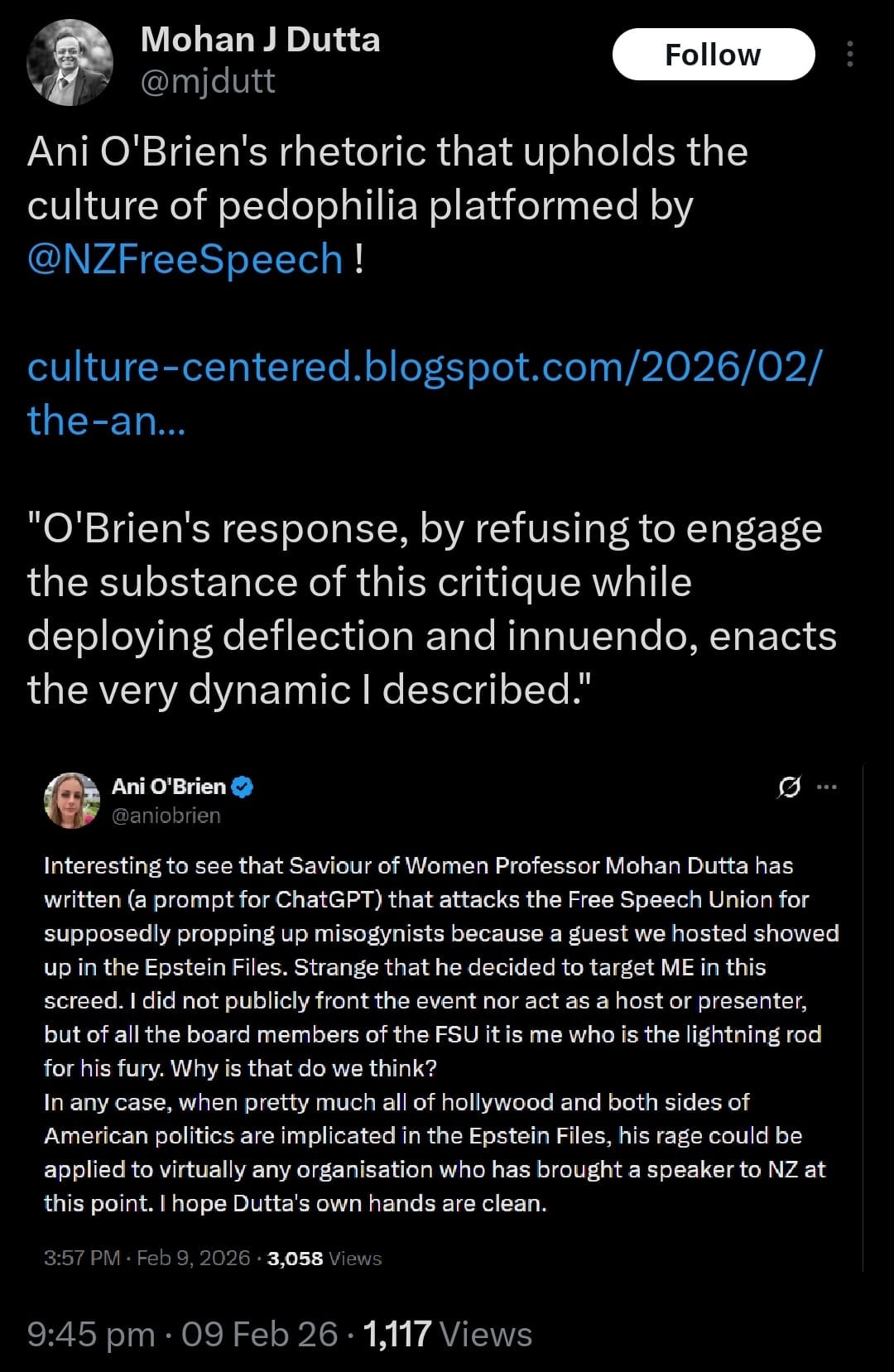
Professor Mohan Dutta, Massey University
Setting the record straight
Professor Dutta’s blog post makes several assertions about me and about the Free Speech Union that are either demonstrably false or deeply misleading.
1. Allegation: I mobilise harm and cause violence
Dutta devotes a section of his post to explicitly connecting me to violence. He claims that my attendance at women’s rights rallies and my advocacy for sex‑based rights “mobilises harm” and implies that a 42% increase in reported hate crimes against transgender people was caused by events I attended. This is both baseless and irresponsible. The RNZ article he cites reports that the spike in reports around British activist Posie Parker’s tour coincided with heightened media attention and may reflect increased reporting rather than more incidents. Nowhere does the article claim that I incited violence nor even that Posie Parker’s critics were physically harmed by her supporters. We know the opposite to be true.
I am a political commentator and a protest attendee. I have never organised violence, and throughout my advocacy for women’s rights I have never so much as strayed into violent rhetoric. Yes, I have called men “men” and I do not play pronoun games. If this is the “violence” Dutta refers to he needs to get a grip. As a lesbian woman who is outspoken about the existence of biological sex and the fact that we cannot change it, I have received regular threats (of actual violence, rape, and death) for the past decade or more. I have been stalked, bullied, and harassed by the very people Dutta calls the “most vulnerable”.
In addition, Dutta ignores the fact that I have advocated for the safety of all participants at public events. When Posie Parker spoke in Auckland in 2023, I called for peace and lawful behaviour from all. My advocacy for women’s rights and safeguarding policies has always been rooted in concern for fairness and evidence, not hatred. To equate criticisms of self‑identification laws with incitement to violence is to shut down debate by labelling dissenters as dangerous.
2. Allegation: I portray transgender people as predators and celebrate violence
Dutta asserts that I have portrayed transgender people as “predators” and celebrated the harming of minorities. He offers no quotes or sources for this because none exist. My written submissions to Parliament and my columns have focused on the effects of puberty blockers on children, the fairness of women’s sports, and the need for public consultation on gender self‑identification. These are legitimate policy questions raised by a broad spectrum of clinicians, parents, and feminists. When I argue that biological males should not compete in women’s sport, I do so out of respect for the integrity of female competition, not out of malice toward men who wish to be seen as women. When I question the long‑term effects of puberty blockers, I rely on a growing body of international research and the experiences of detransitioners. I have repeatedly called out individual men who “identify as women” and who are predators, but I have never suggested every single trans-identifying male is a predator. There are simply a lot of cases where predators have found the lack of safeguards around gender identity as a useful vehicle to behave like predators. I have also discussed how men have used institutions like the church, sporting organisations, and positions of power to facilitate offending against women and children. When you remove scrutiny or place a group above it, it is inevitable that the worst among us will seek to exploit it.
I have described trans-identifying people as “mentally unwell,” as Dutta suggests. That should be highly uncontroversial seeing as one of the favourite past times of trans activists is to list their diagnoses and compete for who has the most victimhood points. They actively identify with mental illness and so I fail to see how I should not agree with them. Additionally, no matter how much compassion you may have for a person, if they think they are “born in the wrong body” they are not well. We are our bodies, we cannot be born into the wrong one. Embodying and performing the stereotypes of the opposite sex is not evidence of mental illness, but thinking you can change sex is.
3. Allegation: The Free Speech Union shields pedophiles and racists
Dutta writes that the FSU “sustains a culture where white supremacist, racist, and pedophile‑adjacent men are shielded under the banner of discourse”. This claim is not only offensive, it is entirely unfounded. The FSU is a cross‑partisan organisation that defends free speech regardless of ideology or subject matter. We have supported drag performers, nurses and teachers targeted by employers, Chinese-New Zealand journalists under attack from CCP proxies, and right‑wing commentators being cancelled. When Dutta himself faced online harassment, the FSU issued statements defending his right to speak. Alleging that we harbour pedophiles or racists, without a single evidenced example, is reckless. In fact, the only evidence Dutta offers is that Steven Pinker (along with almost every prominent American it seems) has appeared in the latest iteration of the Epstein Files which dropped less than a day before his talk in Auckland. That is a far cry from “protecting pedophiles.” If Dutta believes that one indirect association renders the FSU immoral, he should apply the same logic to his own academic heroes.
4. Allegation: I am the driving force behind the FSU’s “war on woke”
Throughout his post Dutta inflates my role within the FSU. Although it is flattering that he thinks I am some kind of influential force in the organisation, he is selling my colleagues short as I am surrounded by some seriously impressive people. Lawyers, academics, a Democratic Party organiser, a producer/screenwriter, a medical doctor (but he is also a lawyer so I am doubling up), a former member of Parliament, and business owners. I actually often get imposter syndrome hanging out with that lot.
Dutta also describes me as leading a “war on woke” and controlling the FSU’s agenda. This is laughable, but not as funny as the time another New Zealand activist with Ani Derangement Syndrome called me New Zealand’s “High Priestess of Hate”. As I have said, the FSU is governed by a multi‑member council that votes on policy positions and governs much like any other board... though perhaps with more open sharing of opinions. I do not unilaterally choose our international guests, in fact other than expressing enthusiasm for various guests over the years I would not say I had actively played a role in selecting them. Dutta’s belief that I orchestrated the event is a convenient fiction and, if we apply his grievance politics framework, it simply allows him to attack a woman while mostly ignoring a council of accomplished men.
Hypocrisy and intellectual inconsistencies
Dutta’s claims about me lack evidence and quite obviously depart from academic scrutiny into plain bullying, but they also reveal deep inconsistencies in his own moral reasoning. As the saying goes, Professor, “glasshouses”.
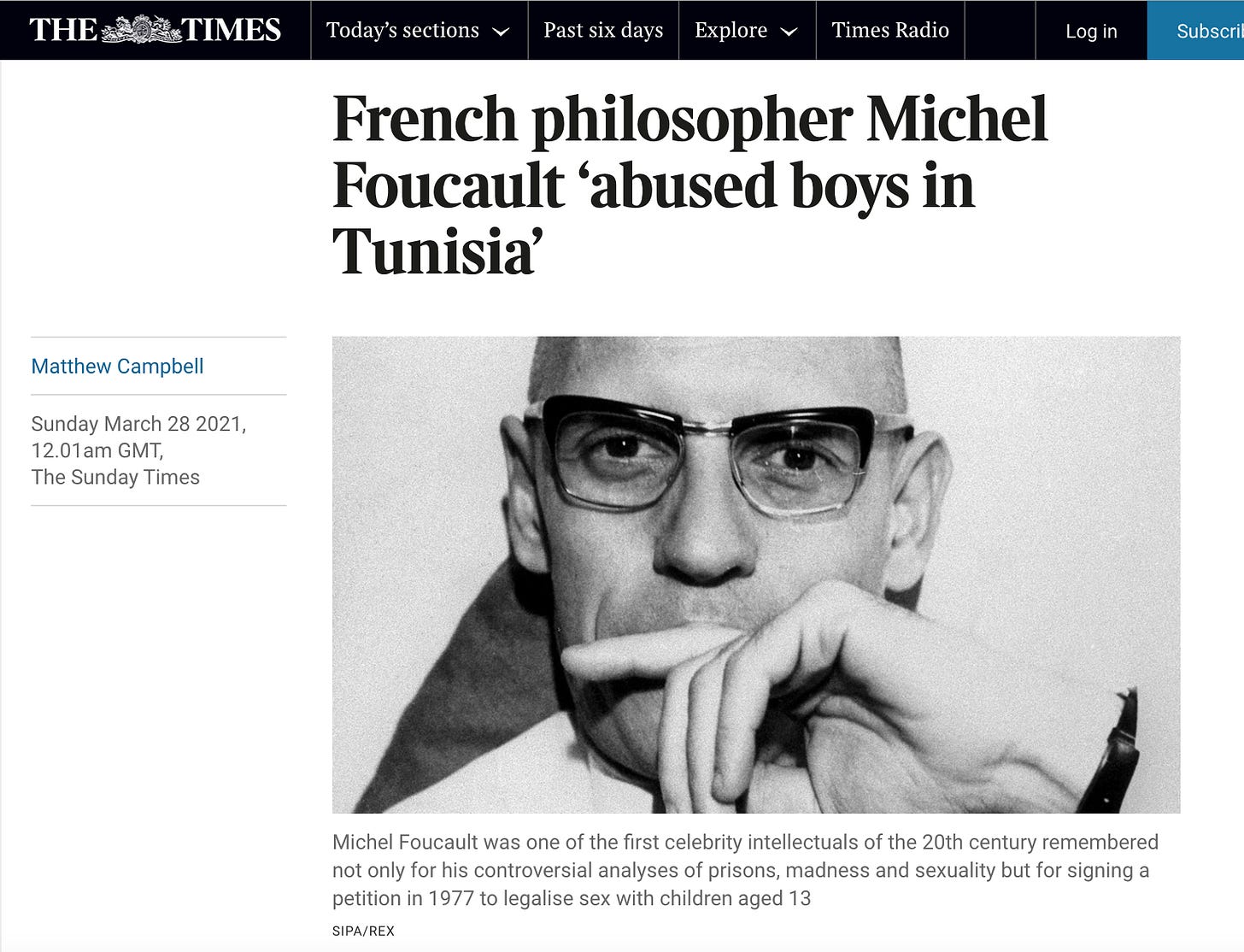
One of Dutta’s central arguments is that Steven Pinker should be shunned because he had a connection to Jeffrey Epstein. Dutta presents this as proof that FSU is “rehabilitating” pedophiles. Yet Dutta’s own scholarship frequently draws on the French philosopher Michel Foucault. In one of his peer‑reviewed articles he cites Foucault’s concept of “disciplined and resistant bodies” to argue that marginalised communities resist domination through bodily practices. Foucault signed a notorious 1977 petition urging that France should allow children and adolescents to consent to sexual relations with adults. In a 1978 interview he argued that it was “intolerable” to assume a child cannot consent to sex. These facts are well documented in mainstream publications. There are also much more terrible widely known allegations about Foucault’s predatory behaviour that I will leave unspoken.
Click to view
However, I do not believe that repeatedly citing Foucault makes Dutta a supporter of child sexual abuse. Scholars often engage critically with problematic thinkers. As the Epstein Files show, our world is unfortunately filled with creeps and predators, especially among men with power and wealth.
Noam Chomsky, for example, is a hard leftist academic who has substantially featured in the Epstein Files and I have one of his books sitting on my shelf just across the room right now. Actually, I can see Hillary Clinton’s book too. Does the presence of their books in my home render me further complicit in the enabling of pedos and whatever else Dutta has invented? If either of them came to New Zealand I would probably attend their event because I find them interesting and they have greatly influenced the world. It doesn’t mean I like them as people or support the fact that they are in the Epstein Files.
Regardless, Dutta’s attempt to cancel Pinker for a connection to Epstein, while he continues to draw on Foucault’s work, is a glaring double standard. If guilt by association is the standard, he fails his own test.
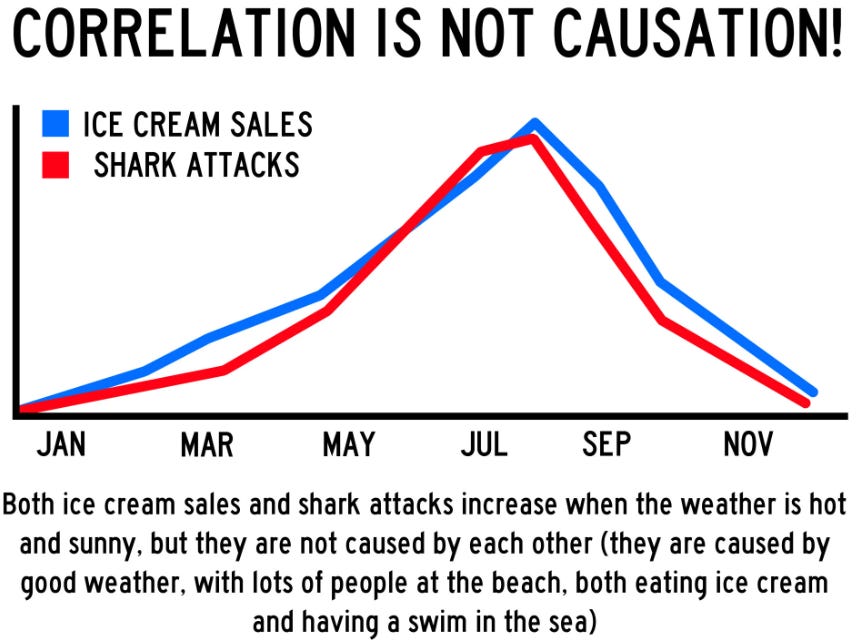
Another inconsistency lies in Dutta’s use of statistics. He cites police data showing a 42% increase in reported hate crimes against transgender people and leaps to the conclusion that my “activism” causes violence. Yet, as mentioned earlier, the report he references explicitly cautions that the rise in reporting may simply reflect increased awareness. Social scientists call this the difference between correlation and causation. Dutta is an academic who teaches critical thinking, he surely knows that temporal proximity is not evidence of causal linkage. By conflating the two when it suits his narrative and ignoring it elsewhere, he undermines his own credibility.
That same kind of faulty reasoning could be turned against Dutta as well. One might, for example, note that hate speech complaints to Massey University increased during the period when he published a series of articles accusing white men of mediocrity, and infer that his writing incites racism. But, that could be unfair as there are many factors influencing complaint numbers and that is precisely why responsible scholars avoid making causal claims without clear evidence.
Additionally, Dutta portrays himself as a champion of academic freedom and free expression. He mocks who he considers conspiracy theorists and liberally applies hyperbolic labels to people and organisations he disagrees with. In a 2023 Massey University op‑ed he began with:
He then goes on to attach people and organisations to the hate he describes with zero evidence offered as to why they should be lumped in. He names Family First who are a pretty run of the mill Christian organisation in New Zealand who promote family values and oppose abortions and same-sex marriage. Some might disagree with what they promote and believe, but they are certainly no worse than any Muslim organisation in New Zealand, for example, that advocates for those things and more. He also touches on one of the funniest New Zealand-grown conspiracy theories I have come across: the Atlas Network. The scaremongering around Atlas is wild especially since globally a lot of their work is involved with alleviating poverty and the most recent winner of the Nobel Peace Prize was an Atlas member.
In this same university-published op-ed, Dutta takes particular aim at journalist Karl Du Fresne accusing him of being a “far right propagandist”. Paragraph after paragraph of ad hominem follows and one does have to wonder if anyone at the university paused to think: are we publishing academic work here or a personal tirade against a journalist Mohan doesn’t like?
In a December 2023 blog post, Dutta accused the FSU of being “invested in producing and circulating disinformation” and alleged that one of our co‑founders “actively targets the freedom of academics” who criticise Israel. His anger in this blog post cannot be divorced from his outspoken disgust at Israel and what I consider pretty overt antisemitism. He calls FSU council members “Zionists” in the way many antisemites now do to try an inoculate themselves from accusations of Jew-hatred. He also discredits himself by perpetuating a conspiracy of a “FSU-Zionist ecosystem” that simply doesn’t exist.
The post is frankly a bizarre rambling that comes across as a conspiracist’s rant rather than serious academic writing. He bounces from one conspiracy to the next invoking all the big names and theories.
His handwringing about cancellation is also pretty unbelievable given the fervour with which he has demanded the cancellation of events and speakers he deems “far right.” That seems to be everyone to the right of Karl Marx. This pattern reveals a consistent inconsistent approach where Dutta defends his own right to speak, but smears others as “racists” or “pedophile‑adjacent” to discourage them from exercising theirs.
I repeat, I do not want cancel Professor Dutta because he has bad opinions and behaves in cruel, unprofessional, and hypocritical ways online. I am not about to engage in that kind of shenanigans despite the vile and false things he has said about me, friends of mine, and people I admire. However, just reading some of his work that Massey University has posted on their website as I write this piece, I am struck by the abysmal standards on display. What happened to academic rigour and providing evidence and sources? I also thought universities discouraged ad hominem attacks? I would not question them deciding to publish a strongly argued and evidenced piece on the far-right or white supremacy or the “dangers” of free speech, but to publish multiple clearly personal attacks without much to back them up at all is actually woeful. Is this the standard Massey usually works to?
Identity games
As I mentioned earlier, we could play the identitarian games that Professor Dutta bases so many of his arguments on. We could interrogate the gendered nature of Dutta’s latest attack and how his blog post reserves its most vitriolic rhetoric for me, a lesbian woman who has expressed feminist views that he finds objectionable. He is certainly not the first man to object to women talking about women’s rights. He refers to me as a “grifter” and as linked me to the upholding and enabling of pedophilia multiple times. He is vicious in going after me and this targeting reveals an interesting pattern. In my assessment of things, he sees women as props to use or destory. We are either useful to him as victims which he can make a show of defending and use to justify his attacks on groups he doesn’t like eg white men. Or, we are inconvenient to his narrative and must be discredited and ridiculed. Dutta loves to evoke the spectre of misogyny when he can accuse other men of it, or bad women of internalising it.
This gendered/sexed pattern dovetails with his broader habit of essentialising groups. Yeap, I can whip out the academic terms too. In a March 2025 blog post, Dutta wrote that “whiteness has been built on mediocrity” and that “mediocre practices of colonial and imperial violence” are characteristic of white people. He went on to argue that “white men reward each other, recognise each other and perpetuate racist structures” and that these men are often “incompetent, inefficient and ineffective”. In another blog piece he suggested that the “ideology of Whiteness … protects mediocrity under the guise of standards”. And, he has claimed that “white men’s sexual impunity was the daily performance of supremacy”. These sweeping generalisations reduce individuals to their race and sex and mirror the prejudiced rhetoric he claims to oppose.
They also place his attack on me in the context that Dutta is comfortable making disparaging statements about entire categories of people, especially “white men,” and he extends that animus to women who are associated with them. This is bigotry. It is divisive, racist, and it shouldn’t get a pass, but it does. It is difficult to avoid the conclusion that Professor Mohan Dutta simply loathes white people and gives select exemptions to some white women depending on their politics.
While Dutta accuses me of endangering minorities, his own writing evidently regularly traffics in collective blame. He engages in essentialising entire demographic groups and vilifying them. What he fails to understand is that when such rhetoric is aimed at one group, it creates permission structures for similar rhetoric to be deployed against other groups. Society cannot benefit when academics normalise collective contempt and blame.
I reject the idea that any group should be judged by the worst actions of its members. I also reject the claim that it is acceptable to generalise about white men but not about others. Equitable discourse requires consistent principles. If Dutta wishes to condemn harmful behaviours associated with colonisation or patriarchy, he should do so without reducing individuals, born nearly two centuries later, to their birth characteristics. Otherwise he risks reproducing the very injustices he decries.
My context and why men like Dutta hate me
I joined the FSU because I believe free and open debate is essential to a healthy democracy and my experience speaking out about women’s rights had given me a short sharp lesson in how fragile our rights are. I was first “cancelled” more than a decade ago after I commented in passing, on Twitter, in opposition to a male murderer and rapist (in America) being moved to a women’s prison because he “identified as a woman”. I was hounded, bullied, ostracised, and put through repeated “struggle sessions”. When I refused to back down the threats started and even incitements to suicide. The mob was made up mostly of the leftist political class that used to dominate Twitter and now tries to shut it down. Some of the ringleaders now lead organisations like PATHA and worked for the Disinformation Project.

Luis Morales aka Synthia Chyna Blast raped and
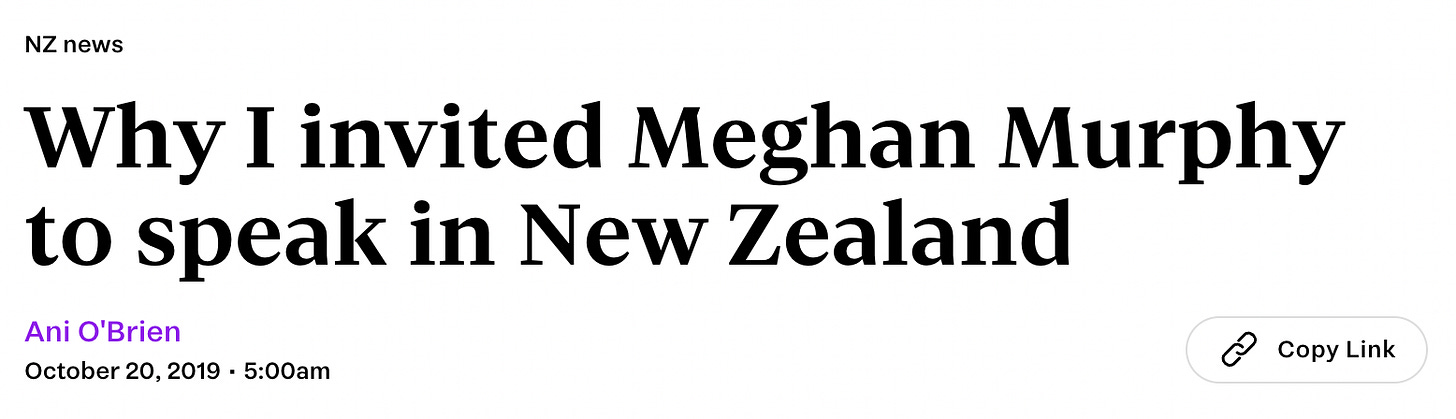
A Stuff article I wrote at the time
In this context, free speech has become a cause very dear to my heart. I have been repeatedly silenced and had my character smeared by people like Professor Dutta. In fact, Massey University banned Speak Up For Women from holding our event on their Wellington campus. They would not allow me, Meghan Murphy, Dr Holly Lawford-Smith, and now-Race Relations Commissioner Dr Melissa Derby, to speak. Our event was a discussion of the implications of the Births, Deaths, Marriages, Relationships, Registration Bill that was before Parliament at the time. Thankfully, David Seymour stepped in and hosted us at Parliament instead.
We also had several events cancelled by local councils and so the Free Speech Union supported us in taking Palmerston North City Council and Auckland Council to court in separate cases. Wellington Council came up to Auckland to observe as we also indicated that we would take action against them. Ultimately, Auckland caved part way through the case and we were able to book a venue and Wellington backed down allowing us to hold our event at the Michael Fowler Centre. Although the council used ratepayer funds to light the thing up in the trans flag colours on the night of our talk.
We won our case against Palmerston North Council with the High Court finding that the cancellation decision was not a rational and reasonable limitation on rights and ordered that the event proceed. I cried reading the judgment because in it Justice Nation ruled that Speak Up For Women could not rationally be described as a "hate group". After years of being called every name under the sun and being accused of the most vile things, it was a moment of such relief to have a ruling that said we were not what they called us.
Although Speak Up For Women received help from the Free Speech Union, the FSU’s mission is to defend free speech across the political spectrum and not tied to certain issues. We have defended the rights of drag queens to perform in council buildings even if I had to hold my nose while we did it given my own views that drag queens are adult entertainers and shouldn’t be performing for children.
When Professor Dutta complained that he was doxxed and harassed by Hindutva trolls, FSU members publicly defended his right to academic freedom. We did so because we believe that even our harshest critics deserve the protection of free speech principles.
Our decision to host Steven Pinker arises from the same principle. Pinker is a world‑renowned cognitive scientist whose work on linguistics, rationality and the decline of violence has influenced scholars across disciplines. We invited him to speak about his latest book because we think New Zealand audiences benefit from engaging with diverse thinkers. That does not mean we endorse everything he has ever done or said. Likewise, FSU does not endorse all of my views or those of any council member. Our organisation is intentionally pluralistic.
Free speech thrives when participants act in good faith. I will continue to speak up for women’s rights, for the principles of liberal democracy, and for free speech. I will continue to challenge ideas that I believe are bad and harmful, including the notion that entire groups of people are inherently violent or mediocre.
In the spirit of free speech and good faith engagement, I want to extend an invitation to Professor Dutta to a discussion with me or any of the other members of the Free Speech Union council. This is despite the hurt he causing me with his unfounded and gross accusations of pedophilia enabling.
We can do a podcast chat or organise an event. I am happy to organise something, but if Mohan would prefer, he can set something up at Massey. This will require them to lift their ban on me speaking at their campuses however.
We can talk about free speech, academic freedom, or any of my views that he has taken issue with. Heck, he can introduce a whole new topic if he wishes. I simply want us to engage as humans in good faith. It is an opportunity for us to model how to disagree in principled ways without descending into personal attacks. I am not the person that Professor Dutta describes in his op-ed and I am confident enough in myself and my opinions that I am willing to open myself up to questioning by him.
So, what do you say, Professor? Shall we set something up?
Ani O'Brien comes from a digital marketing background, she has been heavily involved in women's rights advocacy and is a founding council member of the Free Speech Union. This article was originally published on Ani's Substack Site and is published here with kind permission.
Click to view
Dutta’s article, and subsequent comments, makes damaging claims about my character and motives. Some of those claims stray firmly into defamation while others display a troubling disregard for evidence. Contrary to common misunderstanding, defamation law isn’t anti-free speech, rather it’s the guardrail that stops “free expression” turning into consequence-free lying. You’re free to criticise, argue, offend, satirise, and even be wrong, but you’re not free to make false statements of fact that seriously harm someone’s reputation. When Professor Dutta asserts that I mobilise harm or that I “uphold pedophilia”, without evidence, he makes statements of fact, not mere opinion. It is also deeply, deeply upsetting which I suspect is his exactly his intention.
I am too broke to consider defamation action and Mohan Dutta wouldn’t be my first stop if I could afford it. However, he and Massey University should be aware of the liabilities they could be facing if he continues with his kind of sustained, reckless, defamatory behaviour towards others who might be more inclined to take legal action. The law recognises a defence of “honest opinion”, but only if the opinion is based on true facts and clearly identified as opinion.
Public debate is healthier when disputes are resolved through dialogue rather than courtrooms. In writing this response to Professor Dutta’s piece, I hope to encourage him to adhere to the truth. He is entitled to his opinions about Steven Pinker, the Free Speech Union, and me. If he disagrees with my advocacy, he is free to critique my arguments. But he should refrain from attributing crimes or depraved motives to me that he cannot prove.
As I say, my aim is not to “cancel” Professor Dutta. On the contrary, I have defended his right to speak even when I profoundly disagree with him. I ask only that he extend the same courtesy to those who he disagrees with. Let’s have a robust conversation about free speech, academic freedom and whatever else without resorting to smears and assigning collective guilt. Accusing someone of pedophilia or enabling it is a truly revolting thing to do and not the act of someone who can credibly then make claims about the harms others do online.

Professor Mohan Dutta, Massey University
Setting the record straight
Professor Dutta’s blog post makes several assertions about me and about the Free Speech Union that are either demonstrably false or deeply misleading.
1. Allegation: I mobilise harm and cause violence
Dutta devotes a section of his post to explicitly connecting me to violence. He claims that my attendance at women’s rights rallies and my advocacy for sex‑based rights “mobilises harm” and implies that a 42% increase in reported hate crimes against transgender people was caused by events I attended. This is both baseless and irresponsible. The RNZ article he cites reports that the spike in reports around British activist Posie Parker’s tour coincided with heightened media attention and may reflect increased reporting rather than more incidents. Nowhere does the article claim that I incited violence nor even that Posie Parker’s critics were physically harmed by her supporters. We know the opposite to be true.
I am a political commentator and a protest attendee. I have never organised violence, and throughout my advocacy for women’s rights I have never so much as strayed into violent rhetoric. Yes, I have called men “men” and I do not play pronoun games. If this is the “violence” Dutta refers to he needs to get a grip. As a lesbian woman who is outspoken about the existence of biological sex and the fact that we cannot change it, I have received regular threats (of actual violence, rape, and death) for the past decade or more. I have been stalked, bullied, and harassed by the very people Dutta calls the “most vulnerable”.
In addition, Dutta ignores the fact that I have advocated for the safety of all participants at public events. When Posie Parker spoke in Auckland in 2023, I called for peace and lawful behaviour from all. My advocacy for women’s rights and safeguarding policies has always been rooted in concern for fairness and evidence, not hatred. To equate criticisms of self‑identification laws with incitement to violence is to shut down debate by labelling dissenters as dangerous.
2. Allegation: I portray transgender people as predators and celebrate violence
Dutta asserts that I have portrayed transgender people as “predators” and celebrated the harming of minorities. He offers no quotes or sources for this because none exist. My written submissions to Parliament and my columns have focused on the effects of puberty blockers on children, the fairness of women’s sports, and the need for public consultation on gender self‑identification. These are legitimate policy questions raised by a broad spectrum of clinicians, parents, and feminists. When I argue that biological males should not compete in women’s sport, I do so out of respect for the integrity of female competition, not out of malice toward men who wish to be seen as women. When I question the long‑term effects of puberty blockers, I rely on a growing body of international research and the experiences of detransitioners. I have repeatedly called out individual men who “identify as women” and who are predators, but I have never suggested every single trans-identifying male is a predator. There are simply a lot of cases where predators have found the lack of safeguards around gender identity as a useful vehicle to behave like predators. I have also discussed how men have used institutions like the church, sporting organisations, and positions of power to facilitate offending against women and children. When you remove scrutiny or place a group above it, it is inevitable that the worst among us will seek to exploit it.
I have described trans-identifying people as “mentally unwell,” as Dutta suggests. That should be highly uncontroversial seeing as one of the favourite past times of trans activists is to list their diagnoses and compete for who has the most victimhood points. They actively identify with mental illness and so I fail to see how I should not agree with them. Additionally, no matter how much compassion you may have for a person, if they think they are “born in the wrong body” they are not well. We are our bodies, we cannot be born into the wrong one. Embodying and performing the stereotypes of the opposite sex is not evidence of mental illness, but thinking you can change sex is.
3. Allegation: The Free Speech Union shields pedophiles and racists
Dutta writes that the FSU “sustains a culture where white supremacist, racist, and pedophile‑adjacent men are shielded under the banner of discourse”. This claim is not only offensive, it is entirely unfounded. The FSU is a cross‑partisan organisation that defends free speech regardless of ideology or subject matter. We have supported drag performers, nurses and teachers targeted by employers, Chinese-New Zealand journalists under attack from CCP proxies, and right‑wing commentators being cancelled. When Dutta himself faced online harassment, the FSU issued statements defending his right to speak. Alleging that we harbour pedophiles or racists, without a single evidenced example, is reckless. In fact, the only evidence Dutta offers is that Steven Pinker (along with almost every prominent American it seems) has appeared in the latest iteration of the Epstein Files which dropped less than a day before his talk in Auckland. That is a far cry from “protecting pedophiles.” If Dutta believes that one indirect association renders the FSU immoral, he should apply the same logic to his own academic heroes.
4. Allegation: I am the driving force behind the FSU’s “war on woke”
Throughout his post Dutta inflates my role within the FSU. Although it is flattering that he thinks I am some kind of influential force in the organisation, he is selling my colleagues short as I am surrounded by some seriously impressive people. Lawyers, academics, a Democratic Party organiser, a producer/screenwriter, a medical doctor (but he is also a lawyer so I am doubling up), a former member of Parliament, and business owners. I actually often get imposter syndrome hanging out with that lot.
Dutta also describes me as leading a “war on woke” and controlling the FSU’s agenda. This is laughable, but not as funny as the time another New Zealand activist with Ani Derangement Syndrome called me New Zealand’s “High Priestess of Hate”. As I have said, the FSU is governed by a multi‑member council that votes on policy positions and governs much like any other board... though perhaps with more open sharing of opinions. I do not unilaterally choose our international guests, in fact other than expressing enthusiasm for various guests over the years I would not say I had actively played a role in selecting them. Dutta’s belief that I orchestrated the event is a convenient fiction and, if we apply his grievance politics framework, it simply allows him to attack a woman while mostly ignoring a council of accomplished men.
Hypocrisy and intellectual inconsistencies
Dutta’s claims about me lack evidence and quite obviously depart from academic scrutiny into plain bullying, but they also reveal deep inconsistencies in his own moral reasoning. As the saying goes, Professor, “glasshouses”.
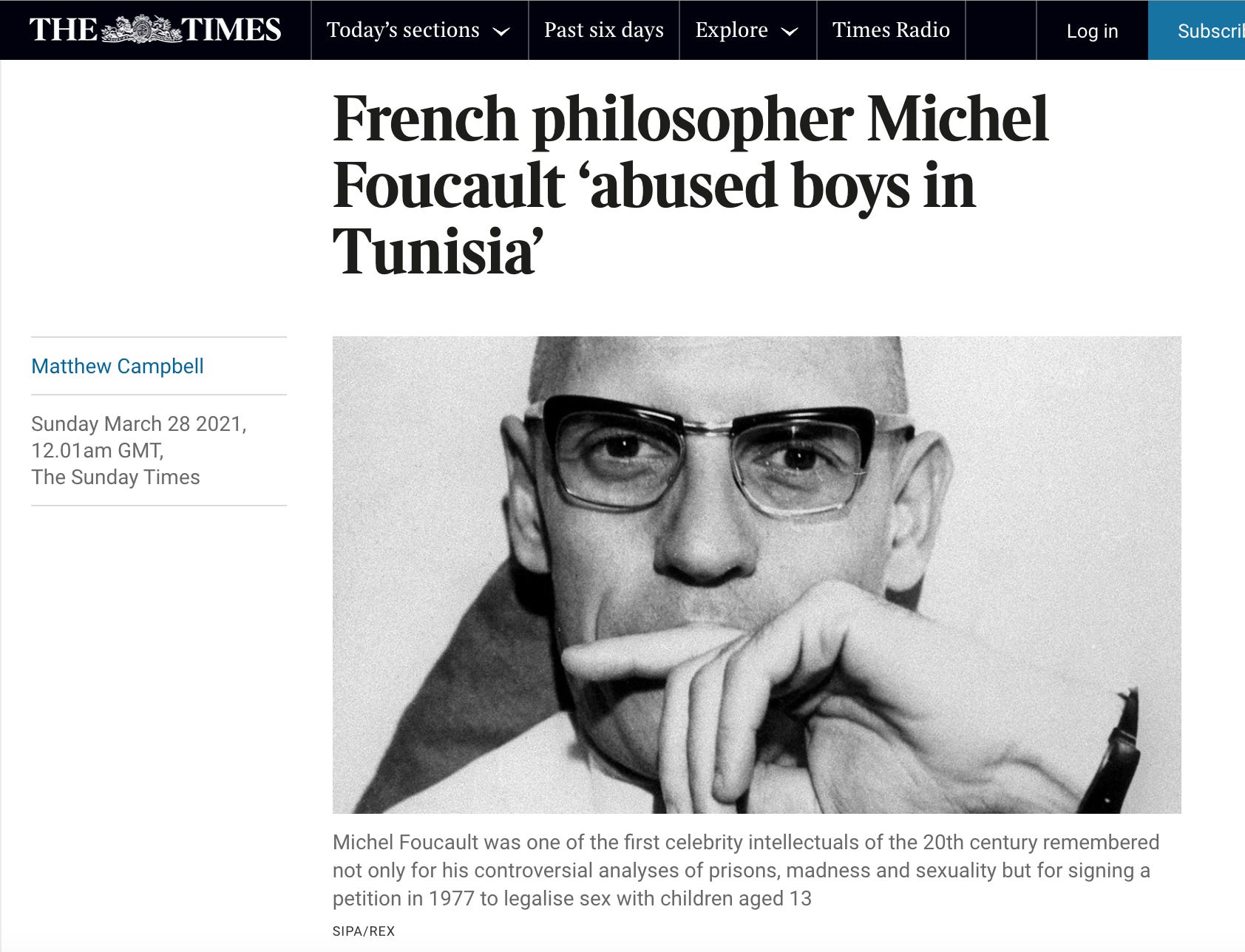
One of Dutta’s central arguments is that Steven Pinker should be shunned because he had a connection to Jeffrey Epstein. Dutta presents this as proof that FSU is “rehabilitating” pedophiles. Yet Dutta’s own scholarship frequently draws on the French philosopher Michel Foucault. In one of his peer‑reviewed articles he cites Foucault’s concept of “disciplined and resistant bodies” to argue that marginalised communities resist domination through bodily practices. Foucault signed a notorious 1977 petition urging that France should allow children and adolescents to consent to sexual relations with adults. In a 1978 interview he argued that it was “intolerable” to assume a child cannot consent to sex. These facts are well documented in mainstream publications. There are also much more terrible widely known allegations about Foucault’s predatory behaviour that I will leave unspoken.
Click to view
However, I do not believe that repeatedly citing Foucault makes Dutta a supporter of child sexual abuse. Scholars often engage critically with problematic thinkers. As the Epstein Files show, our world is unfortunately filled with creeps and predators, especially among men with power and wealth.
Noam Chomsky, for example, is a hard leftist academic who has substantially featured in the Epstein Files and I have one of his books sitting on my shelf just across the room right now. Actually, I can see Hillary Clinton’s book too. Does the presence of their books in my home render me further complicit in the enabling of pedos and whatever else Dutta has invented? If either of them came to New Zealand I would probably attend their event because I find them interesting and they have greatly influenced the world. It doesn’t mean I like them as people or support the fact that they are in the Epstein Files.
Regardless, Dutta’s attempt to cancel Pinker for a connection to Epstein, while he continues to draw on Foucault’s work, is a glaring double standard. If guilt by association is the standard, he fails his own test.
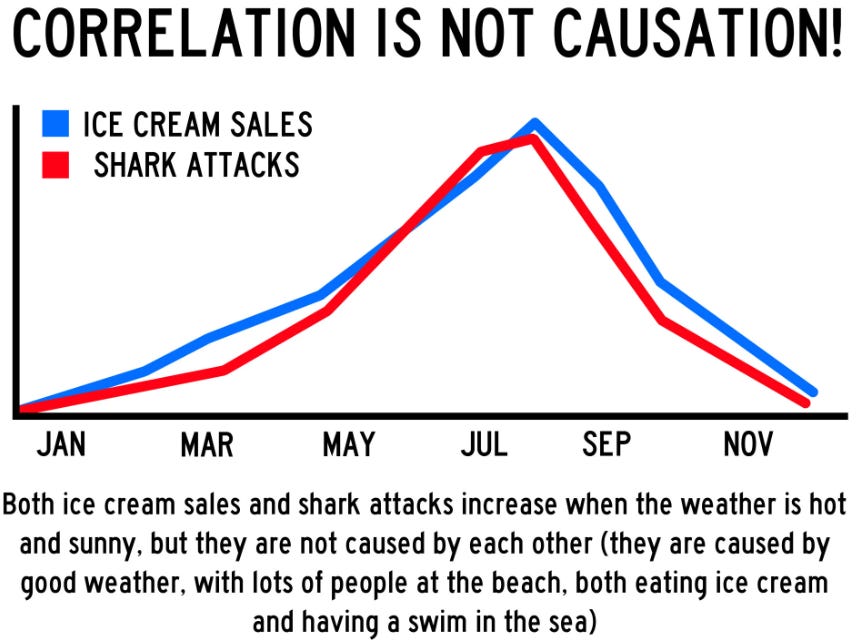
Another inconsistency lies in Dutta’s use of statistics. He cites police data showing a 42% increase in reported hate crimes against transgender people and leaps to the conclusion that my “activism” causes violence. Yet, as mentioned earlier, the report he references explicitly cautions that the rise in reporting may simply reflect increased awareness. Social scientists call this the difference between correlation and causation. Dutta is an academic who teaches critical thinking, he surely knows that temporal proximity is not evidence of causal linkage. By conflating the two when it suits his narrative and ignoring it elsewhere, he undermines his own credibility.
That same kind of faulty reasoning could be turned against Dutta as well. One might, for example, note that hate speech complaints to Massey University increased during the period when he published a series of articles accusing white men of mediocrity, and infer that his writing incites racism. But, that could be unfair as there are many factors influencing complaint numbers and that is precisely why responsible scholars avoid making causal claims without clear evidence.
Additionally, Dutta portrays himself as a champion of academic freedom and free expression. He mocks who he considers conspiracy theorists and liberally applies hyperbolic labels to people and organisations he disagrees with. In a 2023 Massey University op‑ed he began with:
The far-right thrives on hate.
Hate is both a political and an economic tool. It drives profits, both for the producers of hate and the platforms carrying the hate.
He then goes on to attach people and organisations to the hate he describes with zero evidence offered as to why they should be lumped in. He names Family First who are a pretty run of the mill Christian organisation in New Zealand who promote family values and oppose abortions and same-sex marriage. Some might disagree with what they promote and believe, but they are certainly no worse than any Muslim organisation in New Zealand, for example, that advocates for those things and more. He also touches on one of the funniest New Zealand-grown conspiracy theories I have come across: the Atlas Network. The scaremongering around Atlas is wild especially since globally a lot of their work is involved with alleviating poverty and the most recent winner of the Nobel Peace Prize was an Atlas member.
In this same university-published op-ed, Dutta takes particular aim at journalist Karl Du Fresne accusing him of being a “far right propagandist”. Paragraph after paragraph of ad hominem follows and one does have to wonder if anyone at the university paused to think: are we publishing academic work here or a personal tirade against a journalist Mohan doesn’t like?
In a December 2023 blog post, Dutta accused the FSU of being “invested in producing and circulating disinformation” and alleged that one of our co‑founders “actively targets the freedom of academics” who criticise Israel. His anger in this blog post cannot be divorced from his outspoken disgust at Israel and what I consider pretty overt antisemitism. He calls FSU council members “Zionists” in the way many antisemites now do to try an inoculate themselves from accusations of Jew-hatred. He also discredits himself by perpetuating a conspiracy of a “FSU-Zionist ecosystem” that simply doesn’t exist.
The post is frankly a bizarre rambling that comes across as a conspiracist’s rant rather than serious academic writing. He bounces from one conspiracy to the next invoking all the big names and theories.
His handwringing about cancellation is also pretty unbelievable given the fervour with which he has demanded the cancellation of events and speakers he deems “far right.” That seems to be everyone to the right of Karl Marx. This pattern reveals a consistent inconsistent approach where Dutta defends his own right to speak, but smears others as “racists” or “pedophile‑adjacent” to discourage them from exercising theirs.
I repeat, I do not want cancel Professor Dutta because he has bad opinions and behaves in cruel, unprofessional, and hypocritical ways online. I am not about to engage in that kind of shenanigans despite the vile and false things he has said about me, friends of mine, and people I admire. However, just reading some of his work that Massey University has posted on their website as I write this piece, I am struck by the abysmal standards on display. What happened to academic rigour and providing evidence and sources? I also thought universities discouraged ad hominem attacks? I would not question them deciding to publish a strongly argued and evidenced piece on the far-right or white supremacy or the “dangers” of free speech, but to publish multiple clearly personal attacks without much to back them up at all is actually woeful. Is this the standard Massey usually works to?
Identity games
As I mentioned earlier, we could play the identitarian games that Professor Dutta bases so many of his arguments on. We could interrogate the gendered nature of Dutta’s latest attack and how his blog post reserves its most vitriolic rhetoric for me, a lesbian woman who has expressed feminist views that he finds objectionable. He is certainly not the first man to object to women talking about women’s rights. He refers to me as a “grifter” and as linked me to the upholding and enabling of pedophilia multiple times. He is vicious in going after me and this targeting reveals an interesting pattern. In my assessment of things, he sees women as props to use or destory. We are either useful to him as victims which he can make a show of defending and use to justify his attacks on groups he doesn’t like eg white men. Or, we are inconvenient to his narrative and must be discredited and ridiculed. Dutta loves to evoke the spectre of misogyny when he can accuse other men of it, or bad women of internalising it.
This gendered/sexed pattern dovetails with his broader habit of essentialising groups. Yeap, I can whip out the academic terms too. In a March 2025 blog post, Dutta wrote that “whiteness has been built on mediocrity” and that “mediocre practices of colonial and imperial violence” are characteristic of white people. He went on to argue that “white men reward each other, recognise each other and perpetuate racist structures” and that these men are often “incompetent, inefficient and ineffective”. In another blog piece he suggested that the “ideology of Whiteness … protects mediocrity under the guise of standards”. And, he has claimed that “white men’s sexual impunity was the daily performance of supremacy”. These sweeping generalisations reduce individuals to their race and sex and mirror the prejudiced rhetoric he claims to oppose.
They also place his attack on me in the context that Dutta is comfortable making disparaging statements about entire categories of people, especially “white men,” and he extends that animus to women who are associated with them. This is bigotry. It is divisive, racist, and it shouldn’t get a pass, but it does. It is difficult to avoid the conclusion that Professor Mohan Dutta simply loathes white people and gives select exemptions to some white women depending on their politics.
While Dutta accuses me of endangering minorities, his own writing evidently regularly traffics in collective blame. He engages in essentialising entire demographic groups and vilifying them. What he fails to understand is that when such rhetoric is aimed at one group, it creates permission structures for similar rhetoric to be deployed against other groups. Society cannot benefit when academics normalise collective contempt and blame.
I reject the idea that any group should be judged by the worst actions of its members. I also reject the claim that it is acceptable to generalise about white men but not about others. Equitable discourse requires consistent principles. If Dutta wishes to condemn harmful behaviours associated with colonisation or patriarchy, he should do so without reducing individuals, born nearly two centuries later, to their birth characteristics. Otherwise he risks reproducing the very injustices he decries.
My context and why men like Dutta hate me
I joined the FSU because I believe free and open debate is essential to a healthy democracy and my experience speaking out about women’s rights had given me a short sharp lesson in how fragile our rights are. I was first “cancelled” more than a decade ago after I commented in passing, on Twitter, in opposition to a male murderer and rapist (in America) being moved to a women’s prison because he “identified as a woman”. I was hounded, bullied, ostracised, and put through repeated “struggle sessions”. When I refused to back down the threats started and even incitements to suicide. The mob was made up mostly of the leftist political class that used to dominate Twitter and now tries to shut it down. Some of the ringleaders now lead organisations like PATHA and worked for the Disinformation Project.

Luis Morales aka Synthia Chyna Blast raped and
murdered a 12 year old girl
The horrible treatment I received only served to urge me to look into things further and made me more certain that there was a women’s rights disaster unfurling before our eyes. I became a full-blown “TERF”, as they call us, a Trans-Exclusionary Radical Feminist. Though I have always maintained that there is nothing radical about knowing that there are two sexes and we differentiate between them based on the potential for producing large or small gametes. But in any case, it was simply this that created the derangement that can be found to this day about me online. This is my original sin.
I gained further attention, when having found other despicable terfs, I became the spokeswoman for Speak Up for Women, a grassroots campaign to preserve sex‑based protections in New Zealand law. Many of us involved back then, and the women who run it now, are lesbians, mothers, feminists who felt that mainstream political parties were ignoring our concerns about the impact of self‑identification policies on women’s spaces, sports, and rights. We were smeared as “anti‑trans” even though we made concerted efforts to consistently affirm the rights of transgender adults to live free from discrimination so long as they were not impinging on the rights of others.
This cemented me as a persona non grata. A witch. Someone not to be seen with. And I have spent the past decade being amused and frustrated as people have discovered upon meeting me that I am not in fact the devil incarnate they expected.
The horrible treatment I received only served to urge me to look into things further and made me more certain that there was a women’s rights disaster unfurling before our eyes. I became a full-blown “TERF”, as they call us, a Trans-Exclusionary Radical Feminist. Though I have always maintained that there is nothing radical about knowing that there are two sexes and we differentiate between them based on the potential for producing large or small gametes. But in any case, it was simply this that created the derangement that can be found to this day about me online. This is my original sin.
I gained further attention, when having found other despicable terfs, I became the spokeswoman for Speak Up for Women, a grassroots campaign to preserve sex‑based protections in New Zealand law. Many of us involved back then, and the women who run it now, are lesbians, mothers, feminists who felt that mainstream political parties were ignoring our concerns about the impact of self‑identification policies on women’s spaces, sports, and rights. We were smeared as “anti‑trans” even though we made concerted efforts to consistently affirm the rights of transgender adults to live free from discrimination so long as they were not impinging on the rights of others.
This cemented me as a persona non grata. A witch. Someone not to be seen with. And I have spent the past decade being amused and frustrated as people have discovered upon meeting me that I am not in fact the devil incarnate they expected.
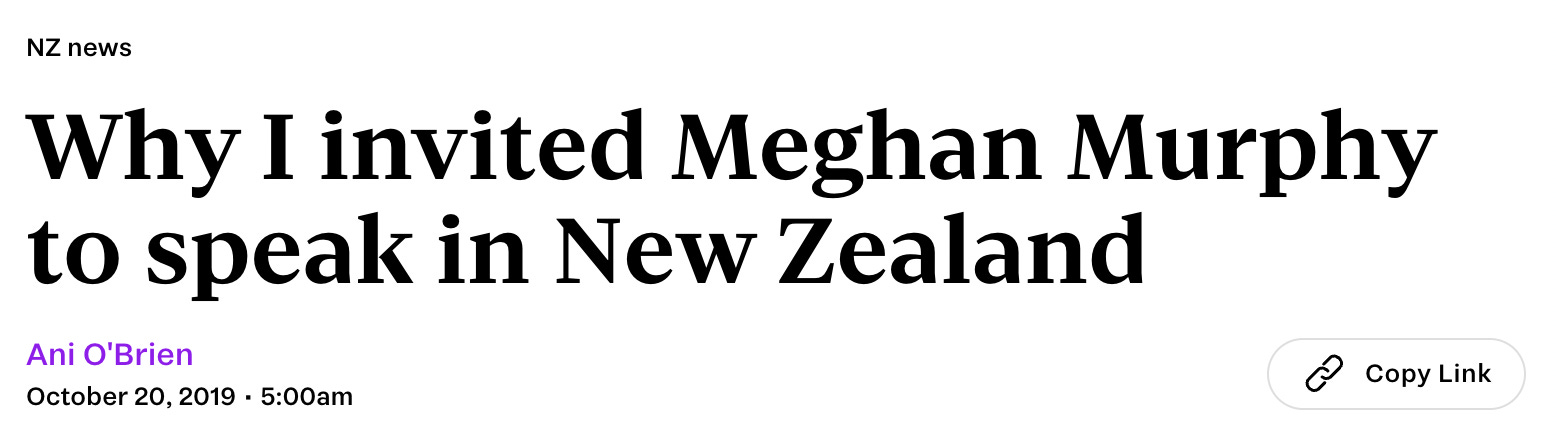
A Stuff article I wrote at the time
In this context, free speech has become a cause very dear to my heart. I have been repeatedly silenced and had my character smeared by people like Professor Dutta. In fact, Massey University banned Speak Up For Women from holding our event on their Wellington campus. They would not allow me, Meghan Murphy, Dr Holly Lawford-Smith, and now-Race Relations Commissioner Dr Melissa Derby, to speak. Our event was a discussion of the implications of the Births, Deaths, Marriages, Relationships, Registration Bill that was before Parliament at the time. Thankfully, David Seymour stepped in and hosted us at Parliament instead.
We also had several events cancelled by local councils and so the Free Speech Union supported us in taking Palmerston North City Council and Auckland Council to court in separate cases. Wellington Council came up to Auckland to observe as we also indicated that we would take action against them. Ultimately, Auckland caved part way through the case and we were able to book a venue and Wellington backed down allowing us to hold our event at the Michael Fowler Centre. Although the council used ratepayer funds to light the thing up in the trans flag colours on the night of our talk.
We won our case against Palmerston North Council with the High Court finding that the cancellation decision was not a rational and reasonable limitation on rights and ordered that the event proceed. I cried reading the judgment because in it Justice Nation ruled that Speak Up For Women could not rationally be described as a "hate group". After years of being called every name under the sun and being accused of the most vile things, it was a moment of such relief to have a ruling that said we were not what they called us.
Although Speak Up For Women received help from the Free Speech Union, the FSU’s mission is to defend free speech across the political spectrum and not tied to certain issues. We have defended the rights of drag queens to perform in council buildings even if I had to hold my nose while we did it given my own views that drag queens are adult entertainers and shouldn’t be performing for children.
When Professor Dutta complained that he was doxxed and harassed by Hindutva trolls, FSU members publicly defended his right to academic freedom. We did so because we believe that even our harshest critics deserve the protection of free speech principles.
Our decision to host Steven Pinker arises from the same principle. Pinker is a world‑renowned cognitive scientist whose work on linguistics, rationality and the decline of violence has influenced scholars across disciplines. We invited him to speak about his latest book because we think New Zealand audiences benefit from engaging with diverse thinkers. That does not mean we endorse everything he has ever done or said. Likewise, FSU does not endorse all of my views or those of any council member. Our organisation is intentionally pluralistic.
Free speech thrives when participants act in good faith. I will continue to speak up for women’s rights, for the principles of liberal democracy, and for free speech. I will continue to challenge ideas that I believe are bad and harmful, including the notion that entire groups of people are inherently violent or mediocre.
In the spirit of free speech and good faith engagement, I want to extend an invitation to Professor Dutta to a discussion with me or any of the other members of the Free Speech Union council. This is despite the hurt he causing me with his unfounded and gross accusations of pedophilia enabling.
We can do a podcast chat or organise an event. I am happy to organise something, but if Mohan would prefer, he can set something up at Massey. This will require them to lift their ban on me speaking at their campuses however.
We can talk about free speech, academic freedom, or any of my views that he has taken issue with. Heck, he can introduce a whole new topic if he wishes. I simply want us to engage as humans in good faith. It is an opportunity for us to model how to disagree in principled ways without descending into personal attacks. I am not the person that Professor Dutta describes in his op-ed and I am confident enough in myself and my opinions that I am willing to open myself up to questioning by him.
So, what do you say, Professor? Shall we set something up?
Note: Someone will need to send him a link to this as I have just discovered he has blocked me on X.
Ani O'Brien comes from a digital marketing background, she has been heavily involved in women's rights advocacy and is a founding council member of the Free Speech Union. This article was originally published on Ani's Substack Site and is published here with kind permission.


17 comments:
Am always mystified why anybody credits Dutta and the Duttas in the academic world (and there are many). They are in the weakest academic disciplines like Communications, never ever have anything original to say, bang on about the madeup Global South, their so called research, qualitative of course, simply recycles similar terrible research. They are heavy on theory--always a sign of unoriginality. Yet they are rarely called out for their unoriginal uncreative tedious wordplay scholarship--which tells you about the mediocrity of academics, Deans, Provosts....
I dont know anything about either yourself or Dutta. However I think everyone knows that Massey is an outfit full of the weird and the insane. I would have thought that the old saying that explaining is loosing applies.
Let Dutta open his mouth to prove he is rather strange...
Can well understand your dismay and disgust Ani, but Dutta simply isn't worth spending a moment's time on. He's an irrelevancy, and challenging him just gives him more promotion and oxygen that he most certainly doesn't deserve.
He does himself, least of all Massey, no credit, and given enough rope he'll eventually hang himself, if he hasn't already? Most of us have well woken up to him and ignore his utterances - one can only assume the dunderheads that employ him will eventually do likewise. But then they are 'academics'?
Dutta is behaving like the superstitious people hunting witches in Salem and across the Christian world. Such witch-hunting (and thereby cancelling) is typical of the left and especially so regarding paedophilia and sexual offending generally.
There seems to be an expectation that everyone who visited Epstein's Island to party in luxury and to mix with the rich and famous should be prosecuted, regardless of the lack of any evidence that they knew anything inappropriate was going on or indeed participated in that. Prosecuted for going somewhere.
The 'paedophile' term for those attending Epstein's parties ignores the arbitrary legal age of consent that varies across a five-or-more year range for different countries. It portrays 17-year-old young women as children with no agency or responsibility for their star-struck or financial decisions. It denies the likelihood that some of the allegations of sexual coercion will be motivated by potential hush money or legal reparation from some of the wealthiest people in the world.
If there is good evidence that someone attending the Epstein island committed crimes, then it's appropriate each such person be prosecuted with the right to due process. 'Me-too' has no more ethical role in this than does 'You-too' when applied to any and all guests of Epstein.
Take him to court for defamation - well worth the investment.
For a supposed academic, Dutta seems unarmed to be able to debate.
Dutta has quickly posted a lengthy, word-salad riposte on his blog. And no, he made no mention of Ani’s invitation to cross swords in public.
This mirrors his 2023 exchange with Karl du Fresne, where Karl publicly offered a debate on language and journalism and Dutta simply let the offer pass without response. On past form, it seems unlikely he’ll descend from his version of Saruman’s tower anytime soon.
—PB
Anon 842 raises a legitimate point in drawing attention to the differing ages of consent in various jurisdictions.
It is rather reminiscent of Silvio Berlusconi's 'sex parties' a decade back. Accusations of paedophilia were flying despite the girl at the centre of the furore being past the age of consent in Italy. However, she was below the age at which a young woman in Italy can go into prostitution.
The meaning of words no longer matters to many people. Paedophilia is attraction to pre-pubescent children (up to 10yo). Attraction to kids undergoing puberty (11-14) is called hebephilia. In most countries the age of consent to sexual relations is 14-16.
Have you heard the song “Speak up for Women” by the punk band D*ck Move? It covers the situation nicely.
This snippet form the article really drives it home
“He engages in essentialising entire demographic groups and vilifying them. What he fails to understand is that when such rhetoric is aimed at one group, it creates permission structures for similar rhetoric to be deployed against other groups.”
I know we’re in a post-truth future, I didn’t know we were in a post-irony one.
Let me express my solidarity with Ani O'Brien in the face of this attack from Professor Dutta. Particularly outrageous are the professor's double guilt-by-association claims that inviting Steven Pinker to speak or going to hear him somehow makes the FSU or Ani pedophile protectors. And I say this as someone who does not share Pinker's political views. (Pinker's extremely one-sided view of world history since the Enlightenment makes him an apologist for capitalism, but that's another discussion...)
Why is it that the most egregious examples of wokism seem to be concentrated among bourgeois academics? You never, or very rarely, find this nonsense in the working class. Perhaps one day a sociologist will write a thesis on this.
Lack of accountability- the curse of our time! Lies and malicious misuse of facts are not free speech. If it is unaffordable to challenge those in a court of law then the free speech will continue to lose value.
Ani, I will help you fund a case against this toxic far left disgrace. Im sure many will help. Let's make it happen. I will endeavor to reach out to you.
Dutta - protected amd supported by a university and woke academia.
All meaningless weasel words.
Couldn't survive in the real world of earning a living by doing something useful.
Anon 938 you’re off-base fella. The band that sings that song is called Unsanitary Napkin. Still a banger of a tune though and it covers off Ani’s points in a minute and a half.
Seriously, has Dutta been on the right side of any argument during his entire sad and pathetic life?
Anon 938 I grabbed the lyrics to that song, it is a fairly short song, typical for a punk band (even a feminist one). Adding here for convenience of people in this thread:
SPEAK UP FOR WOMEN?
YOU DON'T SPEAK FOR ME
WITH DAVID SEYMOUR AT YOUR SIDE
YOU'VE DEBASED YOURSELVES COMPLETELY
YOU'RE VITRIOLIC TRAITORS
WANNABE GERMAINE GREERS
CREATING TOXIC CULTURE
WITH TRANSPHOBIC, BASELESS FEARS
EMPOWERMENT FOR ALL WOMEN!
TRANS WOMEN ARE WOMEN!
Post a Comment
Thank you for joining the discussion. Breaking Views welcomes respectful contributions that enrich the debate. Please ensure your comments are not defamatory, derogatory or disruptive. We appreciate your cooperation.