

Note: my analysis is political and so relies much more on perception, sentiment, and what things appear to be. I include economic and fiscal commentary from those more qualified than myself, but if you are after the true nuts, bolts, forecasts, OBEGALs, and OBEGALxs you won’t find it here.
Nicola Willis spent months lowering expectations for Budget 2026. She made it abundantly clear that there would be no “lolly scramble” or “sugar hits”. She set the expectation that the usual election year ‘bribes’ would not be on the agenda. My personal favourite line of hers was from yesterday when she said:
“There are no rabbits to pull out of the hat. The last Government killed them all, so I don't have that luxury.”
By the time she finally stood up in Parliament this afternoon, New Zealanders had been well prepared for a pretty depressing budget.
And, as intended, it wasn’t quite that bad. Bleak, but not dire. Yet. The narrative is about survival, though some dispute the accuracy of that yarn. However, it is fair to say that it is a Budget that would have been handy to have two budgets ago. A more sober budget despite the Government’s insistence that the economy is improving, growth is forecasted, surplus is projected, and debt is expected to peak earlier.
Subscribe
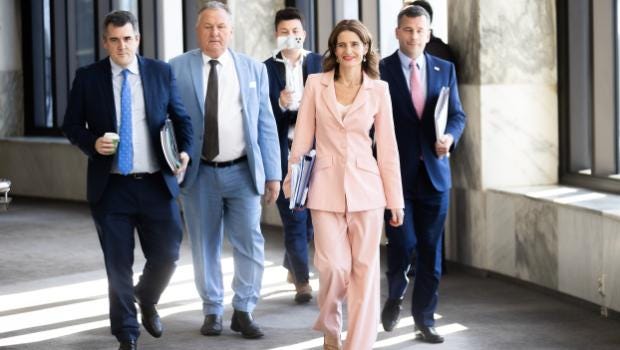
Photo: David Unwin/The Post
Today there are no dramatic tax cuts à la this Government’s first budget nor sweeping welfare expansion like from the 2020-2023 Labour era. There is no transformational flagship policy designed to dominate headlines. This is meant to be a managerial, responsibility budget, not one designed to transform or light the world on fire.
The Taxpayers’ Union have greeted it with cautious restraint. Executive Director Jordan Williams described it as “Spend today, save tomorrow”, warning that the path back to surplus still relies on optimistic assumptions about growth and global stability. Head of Communications Tory Relf was even less enthused accusing National of breaking its “no new taxes” promise with the introduction of a new prudential levy on banks and deposit takers.
The gap between my focus on perceptions and their hard facts was evident in the fact that I had only just typed “not an Election Budget” when the Taxpayers’ Union newsletter landed in my inbox telling me:
“This is an election year Budget. In the short term, it’s actually Nicola Willis’ most profligate in terms of the immediate ‘sugar hit’. It has a wide range of spending initiatives (see below) across transport, health, education, law & order, defence, and energy.
The vast majority of the “savings” come later – in 2027/28, and it is assumed the international situation gets back to normal in the short term.”
Maybe TU is right and it is just not meant to look like an election year budget?
From the other side of politics The Kākā by Bernard Hickey expressed similar sentiments saying that the Governments “tough love, sensible, and grown up pre-election Budget” is “failing the economy” and relies on “much-more-indebted households borrowing to fill resulting GDP gap”.
Labour leader Chris Hipkins said "Nicola Willis has given New Zealanders nothing to ease the pressure they are under. Instead of helping struggling New Zealanders, Christopher Luxon and Nicola Willis chose to make lives harder." While his self-appointed future Finance Minister Chloe Swarbrick said "Everyday, New Zealanders feel the reality that Luxon's government has no hope, no plan, no ambition and no vision for our country. Today's Budget is yet more proof."
In my view, Budget 2026 marks the end of the post-Covid political era in New Zealand. The age of endless performative cushioning, emergency spending, creeping state expansion and politics-by-subsidy is over. In its place is something more austere-esque, pragmatic, and revealing about how this Government sees the world. This is not meant to be a Budget that fills you with optimism. It is a resilience Budget. But it also is padded out so the bad bits don’t feel quite so bad.
The underlying message running through almost every Government Budget PR is that New Zealand has become too fragile, dependent, exposed, bureaucratically clogged, financially stretched, and complacent about the basics required to keep a modern country functioning. And so, the logic goes, the actions they are taking are meant to strengthen, develop autonomy, increase productivity, and just be all around more sensible.
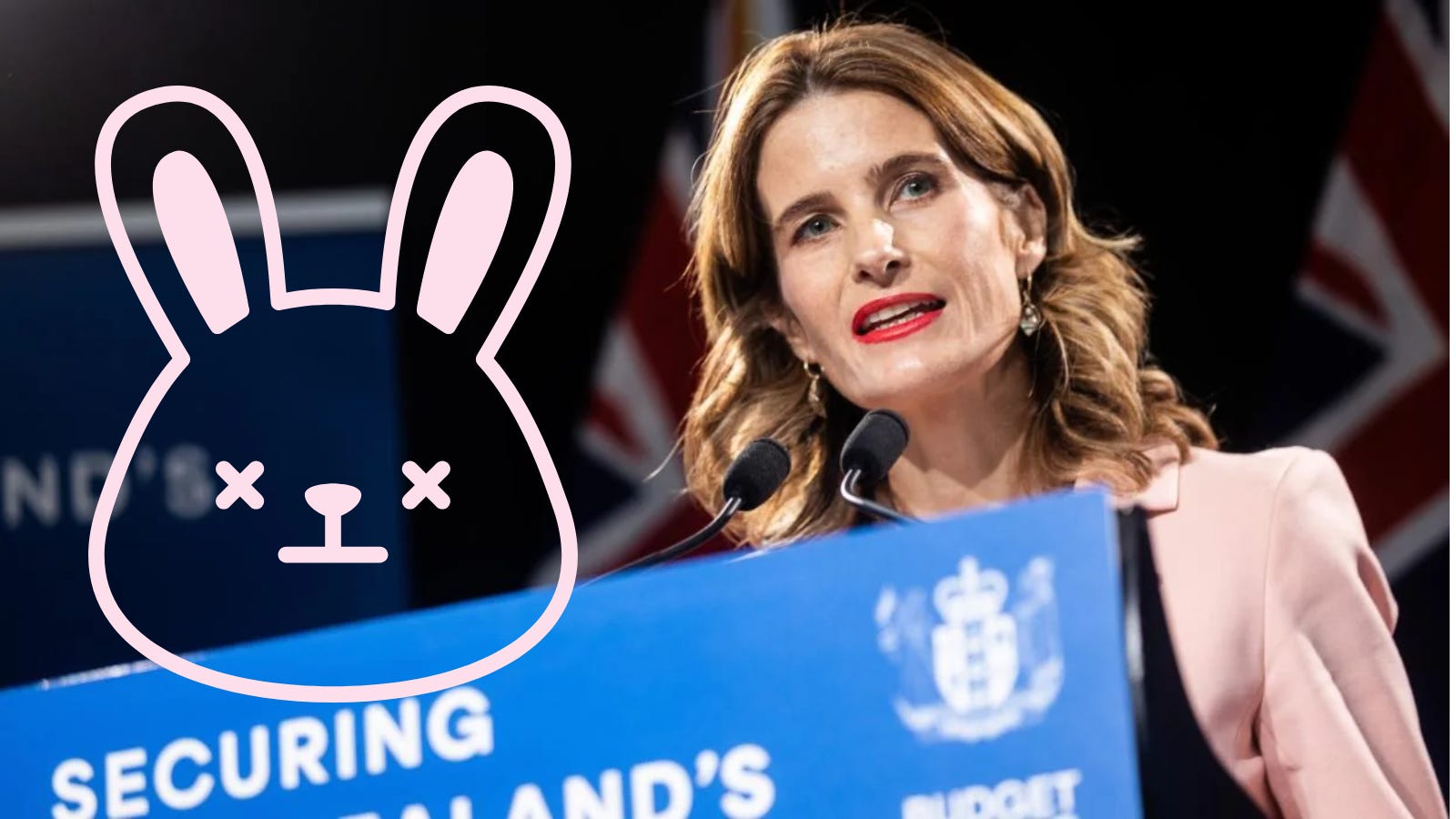
Photo:” David Unwin/The Post
So where is the money going? The Government is pouring money into hospitals, cyber security, rail, roads, flood resilience, emergency management systems, policing, corrections, fuel contingencies, and strategic infrastructure because, it says, New Zealand is entering a harsher and more unstable era. The world ministers describe throughout the Budget documents is not one of abundance and optimism. It is a world of geopolitical instability, supply shocks, energy insecurity, cyber threats, ageing infrastructure (and people), and fiscal limits.
Winston Peters’ language is perhaps the clearest example of this. In announcing additional foreign affairs and aid funding, Peters described New Zealand as facing “the most adverse and contested geostrategic environment of the past 80 years.” That is the language of a politician conscious that all the assumptions we have relied upon in the post-Cold War world are collapsing.
More than $1 billion has been committed to KiwiRail’s network investment programme. The Government has created a $450 million fuel crisis contingency fund. There is $400 million for state highway resilience projects and major investment in emergency management systems, hazard mapping, and cyber security for the health system.
In the media space, the Government has injected $48 million into Māori broadcasting over the next four years in pursuit of "long-term sustainability". On the other hand, Radio New Zealand has received another cut with its baseline funding reduced by a further $1.4 million on top of last year’s $4.6 million annual reduction. RNZ chair Jim Mather warned the organisation would need to make “further changes” to remain financially sustainable. NZ On Air also took a hit.
Winston Peters’ again showed off his uncanny ability to get funding for his portfolios with this Budget, but if we are to pick a winner, Health Minister Simeon Brown is it. He has managed to secure an increase in his portfolio of about 10% on last year which is pretty extraordinary in the circumstances. There will be some pretty happy hospital administrators looking at the spending coming their way. It leans heavily into hospital infrastructure, with $680 million in capital spending earmarked for redevelopments at Palmerston North, Tauranga and Hawke’s Bay hospitals, alongside a new 158 bed tower block at Whangārei Hospital and land acquisition for a future South Auckland hospital in Drury. Additionally, another $930 million will go toward new clinical equipment, technology upgrades and hospital facilities.
Many commentators have similarly interpreted the Budget’s “restraint.” Audrey Young described it as a Budget where Willis had successfully “lowered expectations”. Jenna Lynch argued that Willis had resisted the temptation to produce an election-year “bribe-less Budget”, constrained both by fiscal pressures and coalition partners. RNZ characterised it as a “back-to-basics” Budget focused on prudence and discipline rather than headline-grabbing giveaways.
One of the more interesting dynamics of this Budget is how absent Christopher Luxon feels from it all. This is ostensibly his Government’s final Budget before an election, yet politically and visually it belongs almost entirely to Nicola Willis. Even the imagery around Budget Day reinforced that impression. Willis was front and centre flanked by Shane Jones, David Seymour and Chris Bishop like a strange coalition backing band. Luxon himself felt peripheral to the entire production. That may actually be deliberate and actually rather wise. Luxon has never looked comfortable trying to embody economic pain, restraint, or managerial austerity. Willis, by contrast, increasingly looks like the Government’s true leader; calm under pressure, fluent in the fiscal detail, and capable of selling discipline without appearing panicked. In many ways Budget 2026 felt less like a Prime Ministerial moment and more like the emergence of Nicola Willis as the coalition’s central governing figure.
Despite the pressures and challenges they face, this Budget actually allows the coalition’s governing philosophy to come into focus. National, ACT and NZ First are often portrayed as an awkward marriage of convenience. Yet Budget 2026 demonstrates a coherent worldview solidifying between them. Sure, they have different emphases, priorities, and political styles. But never have their assumptions about the state of the country been so aligned.
The coalition believes New Zealand’s core problem is not insufficient redistribution, but declining capability. All three of them reject the idea that the problems we have are based in the pie being cut up unevenly. Instead they view the situation as being one where the pie is not big enough. The pie must grow. The recipe must be adjusted.
Politics of capability, rather than redistribution, has very different priorities. This is evident in a budget focused on infrastructure, productivity, resilience, security, and institutional functionality. The central (impossible) promise that government will protect everyone from all hardship became embedded under Ardern’s Governments and this Budget instead pivots the promise to one where the government will ensure the country can better withstand hardship in the first place.
This is in a way the anti-Ardern Budget. There is very little utopianism and moral theatre. And the language is far less about transformation, wellbeing, systems change, or national reimagining. Ministers instead repeatedly talk about roads remaining open, cyber systems remaining functional, hospitals coping with demand, rail operating reliably, councils consenting housing faster, and police having updated systems.
Managerial politics. Fixing the essentials. Making sure the stuff we have works and building the stuff we need. And, you know what, after years of visible institutional dysfunction, managerial politics may prove more electorally appealing than many commentators realise.
Buried beneath the larger headlines was the new Incentives for Growth Fund for councils. The policy reflects the Government’s desire to remove barriers to housing development. Councils currently experience growth as a financial punishment because more housing means more infrastructure costs, pipes, roads, pressure on local services, and more angry ratepayers. As a result, at least subconsciously, councils obstruct development.
The Government’s response here is just classic incentive-based economics. Instead of more handwringing about housing supply, it is attempting to alter the financial incentives driving council behaviour. Councils that consent more housing will receive funding to support the infrastructure required for growth.
Not everyone is happy about this though. The Taxpayers’ Union is furious with the initiative with Relf saying “handing councils $400 million in additional revenue without bringing forward a rates cap means councils are under even less pressure to rein in their costs.”
Her assessment that councils have a spending problem is entirely fair as is her complaint that they should be forced to exhibit discipline before receiving more dosh. The TU’s Senior Local Government Policy Analyst Josh van Veen told me bluntly “it won’t work”. However, I am inclined to agree with Simon Watts deciding to err on the side of carrot rather than stick in this instance. I would rather him get the stick out to sort their outrageous wading into constitutional matters, but that is for another Substack (currently half written in my drafts!)
The education announcements provide further evidence of functional, practical spending. The Government is redirecting priorities toward vocationalism, trades, workforce alignment, and labour market productivity. Fees Free is being wound back because it did absolutely nothing to help deprived young people into tertiary education, while Trades Academy places are nearly doubled to 20,000 by 2030. The vibe appears to be that New Zealand has become too credential-focused and not enough capability-focused and here is the adjustment.
Similarly, welfare policy is now being openly reframed around workforce participation rather than permanent support that functions practically like a Universal Basic Income. The state’s role, in this framework, is not to indefinitely cushion people from market realities, and hardship, but to restore workforce participation and economic independence wherever possible. This positioning is a return to an older conception of the welfare state where assistance is transitional rather than permanent.
Now, it is important to note that none of this means the Government is shrinking the state in any meaningful sense. In fact, many parts of the state are expanding. As I said, Health received another enormous funding uplift, taking annual health spending to $34.2 billion. Law and order agencies receive $1.3 billion in additional funding too. And Defence spending continues rising sharply.
This is still not a small-state Budget. That is why the fiscal conservatives and libertarians are grumbling. Much of the commentary surrounding National governments still assumes the old neoliberal framework of the 1990s with its deregulation, privatisation, globalisation, and market primacy. But Budget 2026 does not fit that mold.
It reflects a much newer political reality emerging across much of the Western world where Governments of various stripes move to actively build national resilience in response to geopolitical instability, energy insecurity, ageing infrastructure, migration pressures, cyber threats, and slowing productivity growth. In that sense, this Budget feels like a post-Covid, post-Ukraine, post-Gaza, post-globalisation Budget rather than a conventional centre-right Budget.
Even the much-discussed bank levy reflects this shift. The Taxpayers’ Union argues that the costs will inevitably flow through to savers and mortgage holders. But Willis framed the levy as a principled move reflecting that financial institutions should contribute toward the cost of their own regulation rather than leaving taxpayers to carry the burden. The levy itself is relatively modest and expected to recover about $209 million over four years and amounting to less than 1% of the major banks’ profits.
Politically it is an interesting signifier because it again reveals the limits of old ideological labels. The coalition is not libertarian as much as David Seymour might wish it was. It is quite comfortable using the state strategically where it believes national resilience or institutional legitimacy requires it. The public sector cuts are hardly Argentinian in scale and there is no danger of anything remotely like a shrinking state.
Throughout the Budget the Coalition has continued its pattern of airing its dirty laundry. They are all seeming to be quite comfortable now with standing strong on what unifies the three parties while shrugging off the swipes at each other. The accusations of disharmony just aren’t landing the way they used to because the Government is comfortable in their own skin as a solid family that has squabbles from time to time.
Nicola Willis’ direct attack on New Zealand First over superannuation was one such moment. She openly warned that refusing to reform superannuation settings amounted to “robbing” younger generations. Shane Jones, sitting beside her, visibly declined to engage, deferring instead to Winston Peters as his “rangatira”. None of this is unexpected. They all know where they stand and New Zealand does too.
That exchange does expose a central contradiction sitting underneath all of New Zealand politics though. The demographic and fiscal pressures building around superannuation are ticking time bomb and we should be talking about it. The political system will need to find the courage to confront it directly but it is tough because pensioners remain one of the most politically powerful voting blocs in the country.
The entire mood of Budget 2026 had a sense of gentle(?)/lite(?) foreboding to it. The easy years are over and the fiscal room for manoeuvre is shrinking. The geopolitical environment is about as stable as a three-wheeled shopping trolley. New Zealand’s infrastructure deficits are impossible to ignore and the ageing population is going to place enormous pressure on the public finances. The state has become bloated in some areas while dangerously weak in others.
And perhaps the biggest obstacle to getting anything sorted is the question of whether the public fully understands all of this. New Zealanders need to confront the ugly truth. We need to realise that our options are either to raise taxes and have less money to pay our own bills or for the government to cut its spending. We have to choose a path. Indulging a fantasy where we can pay less and get more is irresponsible and immoral. Certain parts of the opposition need to understand this too.
Ani O'Brien comes from a digital marketing background, she has been heavily involved in women's rights advocacy and is a founding council member of the Free Speech Union. This article was originally published on Ani's Substack Site and is published here with kind permission.


4 comments:
“So where is the money going?”
We already know: Landlords, billion dollar holiday highways that not even Northland wants, ferry contract cancellations, tobacco companies, accommodation supplements for MPs to live in their own houses, interest on record borrowing. The usual right-wing special interest groups and grifts.
At least it’s not going to the usual left wing special interests groups and grift. Chalk one up for the good guys.
Agree with Anon 838. Landlords and tobacco companies have been doing it though for too long.
Summary of NZ? A country that is incrementally getting poorer, but retaining luxury beliefs and an entitlement that goes with developed first world countries with a high academic population.
We need to realise, like real, that we are in hot competition with Australia for our most innovative taxpayers. When petrol prices at an average BP are $1.79 per litre for 91, diesel at 2.25 in Australia and in NZ we are a full 75% dearer, we are instantly out of the race. Yes, Nicola is so proud of our tax purity but it's so much harder to make a living and money here and getting worse by the day. What do we have this attract talent here?
Auckland has been in recession for neigh on 30 months. We have an out of control mayor and council. Where's the solutions?
We need a major step change, where tens of millions of dollars are not going to pointless causes despite all of our fiscal issues. We need to reign in the iwi grift industry and saying, a near half million Kiwi's on the dole is even microscopically acceptable. At a time when foreign labour flies in this do what beneficiaries are too broken to do. How is that even remotely acceptable?
Where the dreamy unreality of things magically improving by Nicola carefully managing the household budget is confined to the dust bin and a new raw, can do attitude both towards business, education and law and order takes over.
What Willis set out was the same old same old, the failure of the past repackaged. It wasn't stupid but it certainly wasn't hopeful either. We are like a firm still trying to live to a budget of its glory days, whilst simultaneously going broke.
When you give away $48 million for Maori broadcasting in this year's budget, you are not serious about money, especially when there are multi billion dollar tribal corporations who could, if they were equally fiscally illiterate, fund this so called importance themselves. But in doing so, you, as in National, have demonstrated you are wedded to the past and truly have no idea what you're doing or plan beyond illusion or is it delusion.
Post a Comment
Thank you for joining the discussion. Breaking Views welcomes respectful contributions that enrich the debate. Please ensure your comments are not defamatory, derogatory or disruptive. We appreciate your cooperation.