

Te Pāti Māori’s internal warring has kicked into a new phase with Mariameno Kapa-Kingi formally quitting the party (after previously taking them to court for booting her out) and announcing she is launching her own party, the “Te Tai Tokerau Party”. The new electorate-specific party name may actually be an issue, however, as concerns have already been raised about whether the Electoral Commission will allow a party named after an electorate as it may present confusion or advantage.
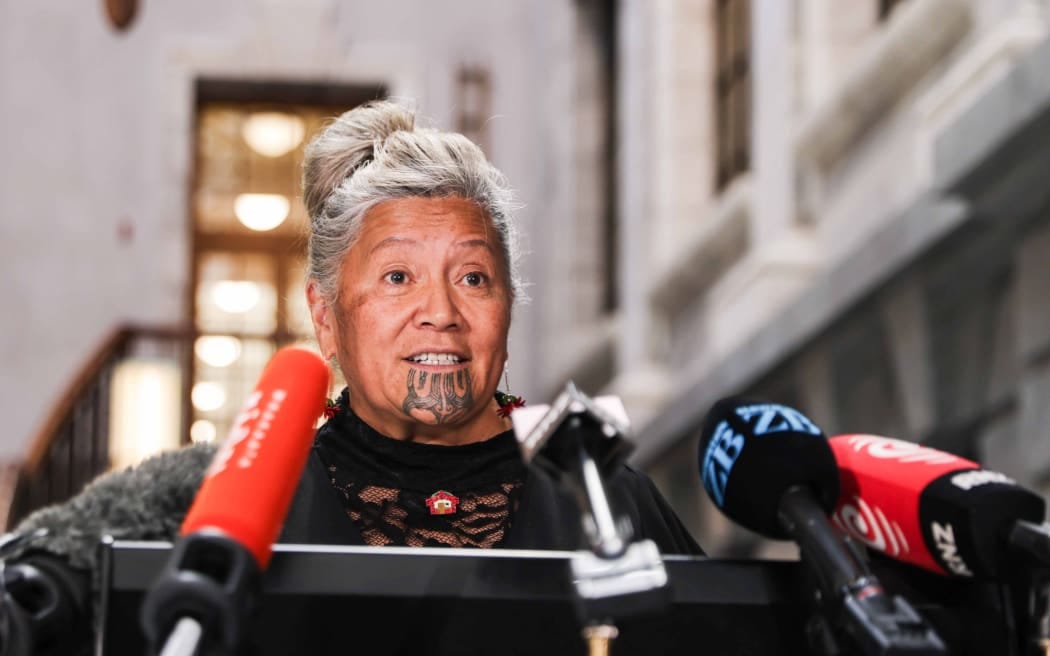
Mariameno Kapa-Kingi. Photo: RNZ / Samuel Rillstone
Kapa-Kingi is the sitting MP for the Te Tai Tokerau electorate, with enough local support and name recognition to have a good shot at winning back the seat. In a twist for the ages, there is growing speculation that former MP Hone Harawira may step in to run against Kapa-Kingi as Te Pāti Māori’s candidate. Harawira split from the Māori Party (as Te Pāti Māori was called then) back in 2011. It would be quite ironic for him to come full circle.
Meanwhile, no one is more confused than MP Oriini Kaipara. In the space of 24 hours, she issued statements suggesting she was considering leaving Te Pāti Māori and insisting she remained fully committed to it. The party have blamed communications staff and for now it appears she has not jumped ship.
Then Tākuta Ferris, who remains stranded in political limbo after his own expulsion. He might run independently, join Kapa-Kingi’s party (tricky given it is aligned to the Northern electorate specifically ), or somehow reconcile with Te Pāti Māori.
The biggest winner from all of this is Labour Party. A fragmented Māori political movement dramatically improves Labour’s chances of reclaiming seats it lost in 2023.
Election 2026: campaigning update
Labour has announced their Tukituki candidate will be meteorologist Dan Scott (22). He introduced himself in a social post first and foremost as a “climate justice activist” and union delegate. Although he attended school in Napier, he now lives in Wellington.
National’s already-announced candidate for Whangārei, former Bayleys Auckland CEO Lloyd Budd, received some heavy weight support with former Prime Minister John Key and former Deputy Prime Minister Paula Bennett publicly backing him.
Chris Hipkins is continuing to not announce any policy nor provide an alternative vision while criticising everything the government is doing. This week he also insisted Aucklanders have “moved on” from the Covid lockdown years. That may prove optimistic. Labour clearly wants the election conversation focused on cost of living, wages and healthcare rather than the legacy issues that continue to dog Hipkins personally. But every time Labour talks about trust, competence or “putting people first”, voters are inevitably reminded of the period where Auckland spent months under some of the harshest restrictions in the world.
Immigration and glasshouses
Immigration is rapidly emerging as one of the defining political fault lines of the 2026 election. For most of this term, unlike New Zealand First, National and ACT appeared somewhat reluctant to engage directly with mounting public concern around migration levels, infrastructure strain, housing pressure and social cohesion. They both have been firm on the benefit of skilled migration to business and the economy.
This week the Prime Minister made one of the most politically significant comments on immigration we have heard from him, explicitly stating that, having learnt from the migration crisis in Europe, when faced with a choice between economic interests and social stability, he would choose social stability. That is a substantial shift from “migration is purely an economic necessity”.
Likewise, Immigration Minister Erica Stanford delivered a notably firmer tone during Question Time, pointing to changes already made around visa settings, English language requirements, enforcement, and penalties.
Politicians are openly acknowledging the previous taboo that poorly managed mass immigration can place pressure on social cohesion and political stability. The Prime Minister referenced the fracturing seen across parts of Europe and North America and suggested New Zealand is not immune from those same pressures; an extraordinarily politically risky statement only a few years ago.
Labour’s reaction to this all genuinely bordered on self-parody. I just about spat my coffee across my desk when they chose Phil Twyford to attack the Government over its supposedly anti-immigration rhetoric. Yes, Mr “Chinese-sounding names” himself. Watching Labour deploy the architect of one of the most infamous immigration controversies as the moral authority on race and migration was spectacular.
The Government moves on Treaty Clauses
The coalition Government announced that Treaty references are being removed entirely from several Acts, including the Education and Training Act, Smokefree Environments and Regulated Products Act, and Crown Pastoral Land Act. In other laws, including the Climate Change Response Act and Taumata Arowai legislation, stronger Treaty obligations are being amended so agencies need only “take into account” Treaty principles.
The coalition’s argument is that vague Treaty clauses have gradually enabled activist interpretation, bureaucratic expansion and co-governance arrangements without explicit democratic consent. Over time, “Treaty principles” have become increasingly elastic concepts shaped through courts, tribunals and public service culture rather than clearly defined legislation.
The Government is now attempting to reassert parliamentary control over that process. ACT argues that in a democratic society, constitutional principles should be clearly defined by elected lawmakers, not endlessly expanded through interpretation.
Budget 2026: The era of restraint
Attention is now turning toward Budget 2026, and the Government is laying the groundwork to prepare the public for a budget defined by restraint, uncertainty and global instability.
Christopher Luxon delivered what was effectively the Government’s pre-Budget framing speech to BusinessNZ in which he said the world is becoming more volatile, New Zealand is exposed, and the era of easy money and endless borrowing is over. The speech was heavy on economic resilience, fiscal discipline, energy security and social stability rather than traditional political optimism.
The Government has confirmed it still intends to return the books to surplus by 2028/29 and reduce debt toward 40% of GDP, despite worsening global conditions. Luxon also confirmed the operating allowance for new spending has been cut from the previously indicated $2.4 billion down to $2.1 billion.
Business and special interest groups are now openly warning against any return to big-spending politics. BusinessNZ, Federated Farmers and retail sector leaders have all publicly emphasised certainty, stability and inflation control over flashy spending announcements. And the Government appears to finally be listening as they increasingly argue that fiscal discipline is a form of national security.
Naturally, the Government is carefully trying to balance austerity messaging with promises of targeted investment. Defence spending, infrastructure, schools, hospitals and energy security are all being positioned as priorities. They have also signalled long-term structural reform, particularly on superannuation and private savings. Although there is notable disagreement between the coalition parties around things like the super age.
Budget 2026 is shaping up less like a traditional election-year lolly scramble and more like a stress test for how honest New Zealand politics is prepared to be about the country’s fiscal reality.
Budget 2026 kills off Fees Free
The Government will be scrapping the remaining university Fees Free scheme as part of Budget 2026. When Chris Hipkins and Labour introduced Fees Free in 2018, the promise was that removing first year tertiary fees would dramatically increase participation, particularly among poorer and disadvantaged students who supposedly saw university costs as the primary barrier to study.
Despite taxpayers spending close to $2 billion on the scheme, evidence shows it failed to meaningfully lift tertiary participation or substantially change enrolment patterns among disadvantaged groups. Instead, much of the benefit flowed to students who were already intending to attend university anyway effectively turning what was sold as a social mobility programme into a taxpayer subsidy for middle-class students.
However, despite Fees Free once being central to Labour’s identity, the party has not committed to restoring or preserving it if it wins the election.
Government hits pause on the Social Media Ban
The Government has put the brakes on its proposed social media ban for under 16s. The bill, championed by Catherine Wedd, would have imposed Australian-style age restrictions on social media platforms. It was politically attractive on the surface with parents anxious about what social media is doing to children. But once officials and ministers got deeper into the practical realities and the measures in Australia proved to be pretty useless, the problems quickly became obvious.
There was also a philosophical tension within the coalition as ACT New Zealand has built much of its identity around individual liberty, scepticism of state overreach and opposition to heavy-handed regulation. And so it looked like Labour was going to join forces with National again to pass the bill had it not been paused. This would not have appealed to National who are already dealing with suggestions of a “grand coalition”, the idea of which is likely to send supporters sprinting to ACT and New Zealand First.
Government moves against climate litigation
The Government has adopted Joseph Mooney’s member’s bill to block the use of tort law as a vehicle for climate change activism. The legislation is a direct response to the Smith v Fonterra case, where activist Mike Smith sought to use the courts to pursue companies for alleged contributions to climate change. The case targeted some of the country’s largest businesses including Fonterra, Genesis, NZ Steel and Z Energy through legal arguments that attempted to create a new form of climate liability through the courts rather than through Parliament.
The case represented a potentially enormous expansion of judicial power into economic and regulatory policymaking. In legislating to halt this, the Government is arguing that climate policy should be made democratically through legislation and national regulation, not piecemeal through activist litigation and judicial experimentation. Justice Minister Paul Goldsmith explicitly said the Government was acting to stop the emergence of “a new regime” that contradicted the framework Parliament had already established through the Climate Change Response Act and the Emissions Trading Scheme.
🇮🇱 The October 7 denialism problem
Silenced No More, a report detailing the systematic sexual violence and brutality carried out by Hamas during the October 7 massacre and against hostages held in Gaza, was released this week.
The report draws on survivor testimony, witness accounts, forensic evidence and visual documentation and its findings are sickening. Women and girls were subjected to rape, torture, mutilation and sexual humiliation during the attacks. The report concludes these acts were not random or incidental, but part of a broader pattern of deliberate terror and dehumanisation.
It has been disturbing these past few years to see the reaction to the atrocities in parts of the Western world. Activists, commentators and political movements immediately moved into denial, minimisation or moral equivocation. Some openly cast doubt on reports of sexual violence before investigations had even been completed and others simply looked away.
October 7 was not an act of “resistance”. It was a massacre. Terrorism. And the release of this report is a grim reminder of just how degraded parts of our political and cultural discourse have become.
Parliament says goodbye to Judith Collins
Judith Collins delivered her valedictory speech after nearly two and a half decades in Parliament. She leaves as one of the most formidable and consequential politicians of her generation. She occupied a unique space in New Zealand politics in that she was simultaneously feared, mocked, underestimated, and respected. Few politicians survived as many scandals, leadership battles, media pile-ons and political obituaries only to repeatedly claw their way back. In the dictionary next to the word “resilience” is a photograph of Judith Collins.
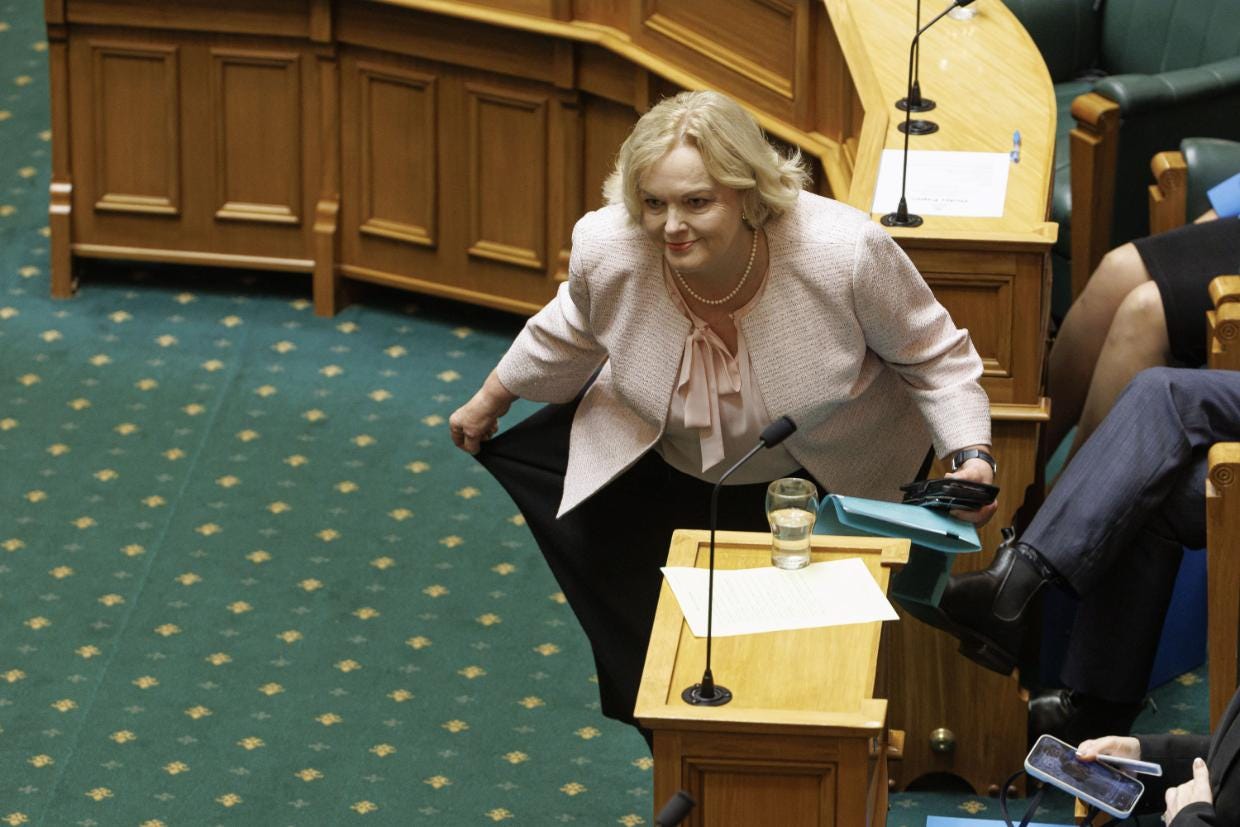
Judith Collins. ROBERT KITCHIN / THE POST
Her political style was always deeply unfashionable within Wellington’s increasingly managerial political culture. She was combative, sharp-edged, tribal, and utterly uninterested in the performative softness modern politics increasingly rewards. At times that made her politically damaging to herself, but no one could accuse her of inauthenticity.
A trailblazer, Collins was one of the first genuinely powerful women in modern National Party politics who did not feel the need to sand down her edges to survive. She was not trying to be universally liked. The “Crusher Collins” persona became both a weapon against her and part of her endurance.
Her valedictory speech reflected that mix of toughness and sentimentality that made her politically distinctive. She came from an era of politics where MPs were expected to absorb punishment, not curate emotional “authenticity” online.
I had a front row seat to much of her stint as National leader. It was brutal and her task arguably impossible. She inherited a fractured caucus, collapsing morale and a political environment dominated almost entirely by pandemic management. By the end, much of the media commentary treated her leadership as little more than a holding pattern before replacement.
Yet Collins endured longer than many who once dismissed her. And despite the circumstances she was amazing to work for. She is funny, caring, protective of her team, and very very clever. I will never forget 2021 and the wild ride I had in her office.
🇦🇺 Australia’s absurd “Giggle v Tickle”ruling
Australia’s Federal Court has delivered one of the most appallingly stupid legal decisions, dismissing the appeal in the “Giggle v Tickle” case and effectively reaffirming that women can be punished under discrimination law for excluding biological males from female-only spaces.
The case centred around entrepreneur and women’s rights advocate the wonderful Sall Grover, who created a female-only app. She removed a user calling himself “Roxanne Tickle” because he is male, and was subsequently sued by him. The court has now upheld the finding against Grover and gone even further, ruling that Tickle was directly discriminated against.
I am furious on behalf of Sall Grover and Australian women generally. Because this ruling means that women in Australia are still not legally entitled to define what a woman is, who belongs in female spaces, or where our own boundaries begin and end. Courts and bureaucrats now expect women to subordinate biological reality to ideological doctrine, and if we refuse, we risk legal punishment.
Grover has indicated that she will be heading to the High Court to continue appealing. I will share details for how we can all support her when the time comes.
This case demonstrates why New Zealand First’s Bill to define “woman” and “man” is so important. It is not frivolous. Women should not have to put up with this kind of absurdity. I will endeavour to find out if National and ACT will support this Bill.
“Do you recognise this toaster?”
Stuff’s Jenna Lynch created a new meme this week when she asked Chris Hipkins “do you recognise this toaster?” and revealed that a former Labour Party staffer was behind a social media troll account dedicated almost entirely to attacking Christopher Luxon including posts depicting the Prime Minister having sex with a pig and content laced with homophobic jokes.
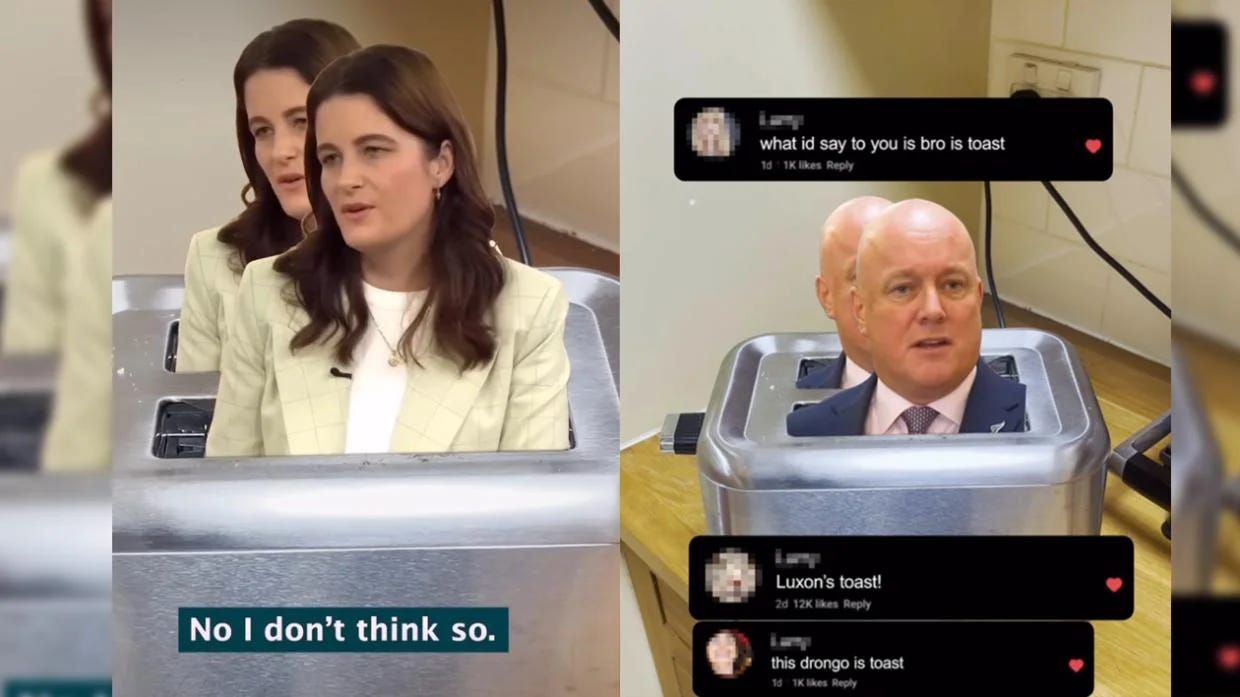
The account, “luxury_marmite_sandwich_”, produces terminally online political sludge that is occasionally funny. Lynch was able to ascertain its links to Labour because a toaster appearing in a video is in fact located in one of the kitchenettes in Labour’s area of Parliament.
Interestingly, the individual involved is unnamed and is insulated from the kind of public moral condemnation that usually arrives at warp speed whenever the ideological direction runs the other way. There have been no pearls clutched or accusations of dirty politics. No op-eds about political toxicity nor calls for apologies from Labour.
The same people who spent days hyperventilating about a factual, newsworthy story suddenly become extraordinarily relaxed when the behaviour involves one of their own circulating homophobic jokes and bizarre pornographic imagery about the Prime Minister. Homophobia is unacceptable and online abuse creates dangerous environments. Unless, it seems, the person involved has the correct politics. It is genuinely difficult to keep up with the rules anymore.
🇺🇸 The crisis inside UK Labour
UK Labour’s local election results were nothing short of catastrophic last week with support for Reform UK continuing to rise sharply. No longer simply damaging the Conservatives, Farage’s party is eating up Labour’s traditional working-class support base. Labour is losing support from multiple directions simultaneously. Progressive voters are frustrated by what they see as managerial caution and lack of transformative policy, while many working-class and socially conservative voters feel Labour has failed to seriously address immigration, crime, cost of living pressures and broader concerns about national identity and social cohesion.
At this stage, despite everyone seeming to agree Starmer must go, there is no formal leadership challenge underway. Frankly, who would want to take on the leadership of a party that has tumbled so far from grace?
Several names have cropped up including Starmer’s original deputy, Angela Rayner, up-until-very-recently Health Secretary Wes Streeting, Secretary for State Yvette Cooper, Deputy David Lammy, and Home Secretary Shabana Mahmood.
And then there is Andy Burnham who is not currently in Parliament. He is the Mayor of Greater Manchester and they call him the “King in the North”. Speculation around has path to the premiership has now begun to take shape. Burnham cannot challenge Keir Starmer unless he is back in Parliament so another Labour MP Josh Simons has announced he will resign his safe Labour seat in Makerfield specifically to allow Burnham to contest the by-election and return to Parliament.
Labour has held the Makerfield seat for decades, but Reform UK came second there in 2024 with nearly 32% of the vote. If Nigel Farage’s movement performs strongly, or wins, Labour will be out of the frying pan and into the fire.
🇦🇺 Keli Holiday and Abbie Chatfield FAFO
We may have witnessed the FAFO moment of 2026 this week when Keli Holiday (real name Adam Hyde) from the Australian band Peking Duk was denied entry to the United States.
Holiday had been touring the US before briefly travelling to Toronto, only to discover on attempting to get back into America that US officials had denied him re-entry. He was detained at the border, booted back to Australia, and had to cancel shows.

This prompted his insufferable wokescold reality star girlfriend Abbie Chatfield to suddenly upload a long apology video frantically trying to explain away an anti-Trump video from 2025 in which she urges "someone” to kill him after online speculation grew that it may have contributed to Holiday’s situation. Of course, now Chatfield is desperately trying to clarify she was absolutely not advocating violence against the President.
For years the activist-influencer ecosystem Chatfield and Holiday have enthusiastically championed has promoted the idea that speech has consequences, online rhetoric is dangerous, and political extremism must be monitored…Except when it comes to them calling for the death of people they disagree with.
And now, suddenly, everybody is meant to gasp in horror that US immigration officials may have looked at publicly available online political content and decided that perhaps the mad musician and his equally mad girlfriend who have been advocating for the assassination of POTUS aren’t worth the risk of letting in?
The panicked tone of the apology was pure FAFO territory. Chatfield insists the video was “misinterpreted”. Apparently Keli had never even seen the video. Apparently she is not the same person she was…less than a year ago. She has done a huge amount of “growing,” you know. I wonder if the world will show her more grace than she has ever shown anyone else.
Chart of the week
I’m sure many of you will have seen this before. Colin Wright created this highly relatable graphic years ago and has updated it a few times. It depicts my political experience pretty accurately.
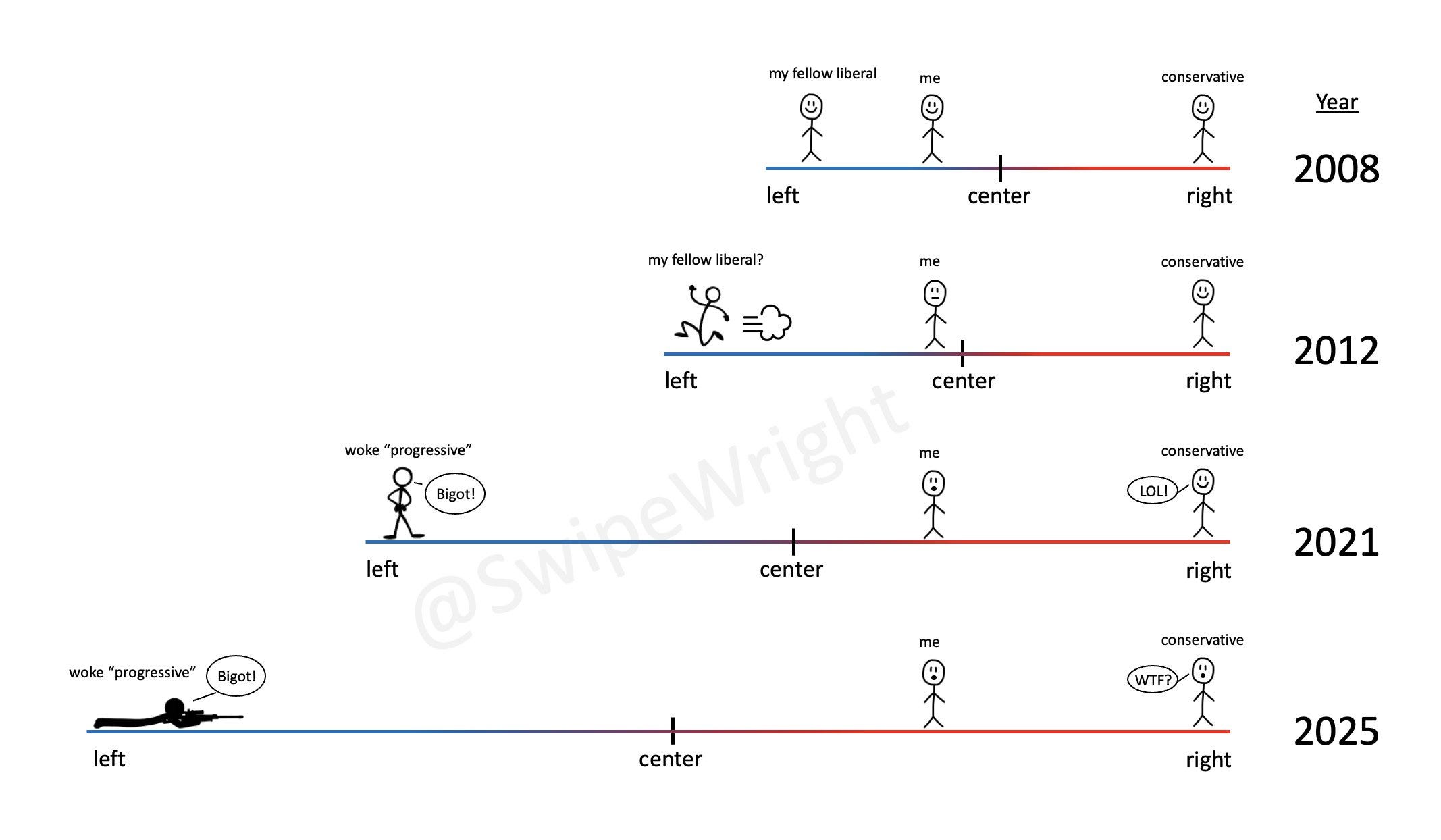
Click to view
In short - other stuff that happened
- Budget 2026 will invest $15.5 million over four years to establish a specialist paediatric palliative care service with dedicated North and South Island teams to support children with life-threatening illnesses. The rollout is expected to begin from mid-2027.
- Te Arikinui Kuini Nga wai hono i te po met King Charles III at Buckingham Palace during a visit to London marking the 50th anniversary of The King's Trust. Earlier in the week, the Māori Queen also met Prince William at Windsor Castle.
- A new community-based cancer infusion centre is opening in Henderson allowing patients to receive treatment closer to home. The Health New Zealand-run service will support around 45-50 patients weekly as part of a wider Government plan to deliver 14 new infusion centres and expand 14 more nationwide backed by a $210 million Budget 2024 investment.
- Three long-running Hauraki Treaty settlements passed this week, with the Crown formally settling historical claims with Ngāti Rāhiri Tumutumu, Ngāti Tara Tokanui and Ngāti Hei after negotiations that began in 2011. The settlements include Crown apologies, acknowledgements of Treaty breaches, financial and commercial redress totalling $5.5 million for Ngāti Rāhiri Tumutumu, $6 million for Ngāti Tara Tokanui and $8.5 million for Ngāti Hei.
- New Zealand Nurses Organisation members employed by Health New Zealand have voted to accept a new 20 month collective agreement covering around 35,000 staff, including pay rises of 2.5% in the first year and 2% in the second year, lump-sum payments of up to $2000, and an increase in the nurse practitioner professional development allowance from $5000 to $6000 annually.
- Pharmac has proposed widening access to three type 2 diabetes medicines, empagliflozin, liraglutide and dulaglutide, from 1 August 2026 by removing ethnicity-based eligibility criteria and lowering the cardiovascular risk threshold used for access. The changes would expand access to an estimated 10,000 additional patients in the first year and 23,000 within five years.
- The Environment Select Committee has recommended proceeding with the Government’s bill to fold the Ministry for the Environment into a new “Cities, Environment, Regions and Transport”. The bill passed committee by majority support from coalition MPs, while Labour and Green members strongly opposed it.
- The Conservation Amendment Bill is aimed at speeding up concession approvals, reducing regulatory requirements, and increasing economic activity on conservation land. The reforms include a new National Conservation Policy Statement and new international visitor access charges at selected high-use sites projected to raise around $60 million annually for reinvestment into biodiversity protection, tracks, huts and visitor infrastructure.
- The Government has warned councils to pursue voluntary amalgamations and structural reform or risk forced intervention, with ministers telling local authorities to “lead your own reform, or we will do it for you”.
- The Ngā Hapū o Te Iwi o Whanganui Claims Settlement Bill passed its first reading in Parliament this week after nine years of negotiations, with the settlement including a Crown apology, acknowledgements of Treaty breaches, and $30 million in financial and commercial redress.
- Waipareira Trust is facing intense scrutiny after newly released documents from a five year Charities Services investigation alleged the trust used charitable resources to support the political campaigns of its chief executive and Te Pāti Māori president John Tamihere. Investigators recommended possible deregistration of the trust.
- A new endoscopy suite will be built at Wairarapa Hospital as part of a $34.2 million diagnostic services investment aimed at increasing local capacity for bowel screening, surveillance, and planned care procedures. The new facility will be housed alongside a $3.7 million MRI scanner and is designed to reduce wait times and patient travel by replacing the hospital’s current theatre-based endoscopy setup, which does not meet national standards and cannot keep pace with growing demand.
- The Government has delayed the rollout of four parts of the new school curriculum with new Years 0–8 Health and Physical Education now pushed to 2029 and Arts, Technology and Languages delayed until 2028, while Science and Social Science will still begin from 2027.
- Former Wellington mayor Tory Whanau testified before the Waitangi Tribunal this week that sustained racist, misogynistic and sexualised abuse during her time as mayor ultimately drove her out of politics and out of New Zealand. Tamatha Paul also testified.
- Billy Macfarlane, founder of the Pūwhakamua prisoner rehabilitation service and general manager of the Tikanga Aroro Charitable Trust, has been charged with assault on a person in a family relationship. The Department of Corrections terminated its contract with the trust but has paid approximately $3.9 million in funding to the service since 2022.
- Three men (19/20), who have interim name suppression, were sentenced in the High Court at Auckland after being convicted of raping a 19 year old German backpacker in an industrial carpark in 2025. They received sentences of 10 years and five months for two of them and eight years and 10 months for the other. The offenders had not been in New Zealand long.
- Kuljinder Singh (39) was sentenced to just 10 months’ home detention in Hamilton District Court for sexual connection with a 13 year old girl he met through Snapchat. The judge opted not to put him on the sex offender register.
- Mukesh Prashad is on trial in the High Court at Auckland accused of murdering his 5 year old daughter, Tulsi Amola, by smothering her with a pillow after allegedly becoming convinced he had infected her with herpes, despite medical examinations later confirming she did not have the virus.
- 🇺🇸 Harvey Marcelin, an 87 year old transgender-identifying serial killer previously convicted of murdering two women, was convicted in New York this week for the 2022 murder and dismemberment of Susan Leyden (68) after her headless torso, leg and head were found scattered across Brooklyn. The jury convicting him after roughly one hour of deliberation.
- Negotiations are underway for the University of Auckland to sell its vacant 15 hectare Epsom campus, with the site estimated to be worth around $250 million and iwi potentially first in line to purchase it under Treaty settlement right-of-first-refusal provisions. David Seymour said he wants part of the land secured for neighbouring schools amid wider debate over the future use of the site.
- A Cape Verde international football player remains eligible for World Cup selection despite being under New Zealand police investigation over an alleged sexual assault at the team hotel in Auckland during the FIFA Series tournament in March.
- 🇺🇸 Brandon Clarke (29), Memphis Grizzlies basketballer, has died. Authorities are reportedly investigating Clarke’s death as a possible drug overdose.
- Danny and Roberto Jaz, the brothers at the centre of Christchurch’s Mama Hooch drink-spiking and sexual assault case, have launched a further appeal to the Court of Appeal. The pair were convicted in 2023 on 69 charges including rape, sexual violation, stupefying women, making intimate recordings without consent and supplying illicit drugs, with Danny Jaz sentenced to 16and a half years’ imprisonment and Roberto Jaz sentenced to 17 years.
- 🇺🇸 Alex Murdaugh’s murder convictions and life sentence for the 2021 killings of his wife Maggie and son Paul were overturned by the South Carolina Supreme Court after judges found the trial court clerk improperly suggested to jurors that Murdaugh was guilty. Prosecutors have confirmed they intend to retry Murdaugh who remains in prison serving separate 40 year federal and 27 year state sentences for stealing around US$12 million from clients.
This article reports on a series of alleged vigilante-style assaults in Southland where groups used dating apps to lure people to meetings before allegedly attacking them, filming the incidents and sharing the footage online. Police say the offending appears linked to overseas online trends involving “predator hunting” content, and have warned the public not to share or encourage the videos.
I feel like there are some critical facts missing from this reporting, particularly around who exactly was being targeted, whether police believe the victims were actually attempting to meet minors, whether any arrests have been made, and the broader context behind why these groups believed they were carrying out the assaults.
Ani O'Brien comes from a digital marketing background, she has been heavily involved in women's rights advocacy and is a founding council member of the Free Speech Union. This article was originally published on Ani's Substack Site and is published here with kind permission.


7 comments:
Your column here is one of the best reads of any given week. Appreciate it!
Thank you for the update Ani.
I was particularly interested to read about Silenced No More, the report detailing the systematic sexual violence and brutality carried out by Hamas during the October 7 massacre and against hostages held in Gaza.
Something similar has been going on in England for decades.
Here: https://breakingviewsnz.blogspot.com/2024/04/barrie-davis-there-will-always-be.html
More recently here: https://www.youtube.com/watch?v=PTD8utWMY8o
Note the similarity with New Zealand.
I am looking forward to catching up on Tommy Robinson’s rally in London yesterday.
On Judith Collins. A classic lawyer in a sea of lawyers looking for a reason to justify becoming one, so she chose to became a politician and one deserving of an Oscar award for best actor, playing the uncompromising conservative. But in stereotypical liberal lawyer way, she never was conservative.
Her gig as Justice Minister in Keys government saw some of the most substantial changes to criminal law in decades and not for the betterment of society. The watering down of the Crimes Act time unlimited charges, the replacement and watering down of the Summary Proceedings Act to the Criminal Procedure Act, all of which translated to putting a firm miserly dollar figure on Justice, be it for defendants or prosecution in terms of public funding. It was the end of the era where justice was the only focus to government book balancing. Combined with Anne Tolleys governance in Youth Justice, Blue National were really Green Red liberal, with the resulting predictable crime spree in the following decade.
But it's these last 2.5 years that nailed her true beliefs. In a very liberal woke left Luxon era, she oversaw the disastrous Manawanui sinking that exposed how bad the Navy was by the time she took over, how DEI played its role in a Commander who literally had no idea how her ship worked, much less understood the extreme risk of sailing less than a mile off a reef, warranting her direct oversight on the bridge instead of wherever she was. And her command will be forever remembered in Navy folklore for reminding her crew to "go to the loo" before abandoning the stricken vessel. (I'm sure the Captain of the Bismark did likewise!) So what if anything did Collins do? Answer, she quickly hosed down criticism and reality with the lefts ultra favourite overused cancellation phrase "Misogyny". Our media, card carrying members of woke ideology, remaimed silent. No promise or even suggestion that our Defence Minister would be changing anything or taking this clusterfuck seriously. To this day, to me, our Navy is more a threat to shipping and the environment through sheer incompetence in part, thanks to its current Minister and her sheer indifference.
The same indifference and claimed unawareness was exhibited with the Army's adoption of pseudo Maori religion as its pre-eminent basis and purpose of its top brass and everyone beneath them. With huge implications, whilst the very nature of war unfolds at lightening speed in Ukraine that has torn up the manual on every aspect on the way militaries fight, NZ has missed that entirely and instead gone down a very Wellington style ideological rabbit hole of race based insanity. It's as if the whole silly Ukraine thing never happened. Where was Judith? God only knows, but I suspect in warm agreement down that rabbit hole.
She is another lifer in politics that did not leave us better off, or even, no worse off, but a person who fronted a powerful unjustified ego, who got paid well and played her small part in ensuring we are just a little more shit than ever. But bravo, cue rapturous applause, the award is well deserved
Thanks Ani - your words become an indelible record of history in NZ as it happens.
Watch future generations of Maori twist them around to mean something else.
"The October 7 denialism problem"
https://electronicintifada.net/content/israels-7-october-rape-hoax-gets-300-page-reboot/51405
This article shows numerous examples of why there is a dispute and is not denialism, but rather Israeli propaganda of the worst sort.
Instead of snorting, and believing gross falsehoods, it would be proper to read the above
Peter Stevens may be swayed by a site called "electronicintafada" but it will take a bit more than that to convince most of us that the accounts constitute a 'hoax'.
For the UN report see
https://www.un.org/unispal/document/conflict-related-sexual-violence-report-of-the-secretary-general-s-2025-389/
More 'hoax', Peter?
Ani keeps ignoring the basic facts. This government is not about restraint as evidence by them electing to borrow even more than Labour did in their term, while magically making cuts to beneficial programmes, and slowing the economy and raising unemployment. Truly, a skilled collection of economic geniuses and Ani is more than happy to talk about other things, like year old spats that have been settled. You’re worth your salt Ani!
Post a Comment
Thank you for joining the discussion. Breaking Views welcomes respectful contributions that enrich the debate. Please ensure your comments are not defamatory, derogatory or disruptive. We appreciate your cooperation.