

If you were shocked by what happened at Bondi last night you have ignored every warning sign.
You might be horrified. In fact, if you are, you are human. But if you are surprised you have not been paying even minimal attention to what has been happening across Western cities for the past two years. The last twenty plus years really. This was the inevitable direction of travel.
Since October 7th 2023 all over the West, the Anglosphere, our streets have become the stage for theatrical activism that overflowed with hatred for the Jewish people. What happened at Bondi was not an aberration. It was an execution of an idea that has been loudly, aggressively, and repeatedly promoted.
The Islamist terror attack at Bondi Beach was not random. It was not disconnected from the people who on October 9th 2023 chanted “gas the Jews” on the steps of the Sydney Opera House. It was not some isolated outburst of individual pathology, just like the antisemitism expressed by Bankstown-Lidcombe nurses Sarah Abu Lebdeh and Ahmad Rashad Nadir on a livestream while on shift was not an isolated individually spontaneous case. It was an act of ideological violence, aimed squarely at Jews, carried out in the name of a worldview that has never found a problem to which the solution isn’t death. A worldview that has been able to flourish in the very places that should have been most hostile to its intolerance, violence, and hatred. It has been able to not only survive, but thrive because of the luxurious space, oxygen, and endless hospitality afforded to it by Western weakness, moral confusion, and political cowardice.
The Islamist terror attack at Bondi Beach was not random. It was not disconnected from the people who on October 9th 2023 chanted “gas the Jews” on the steps of the Sydney Opera House. It was not some isolated outburst of individual pathology, just like the antisemitism expressed by Bankstown-Lidcombe nurses Sarah Abu Lebdeh and Ahmad Rashad Nadir on a livestream while on shift was not an isolated individually spontaneous case. It was an act of ideological violence, aimed squarely at Jews, carried out in the name of a worldview that has never found a problem to which the solution isn’t death. A worldview that has been able to flourish in the very places that should have been most hostile to its intolerance, violence, and hatred. It has been able to not only survive, but thrive because of the luxurious space, oxygen, and endless hospitality afforded to it by Western weakness, moral confusion, and political cowardice.
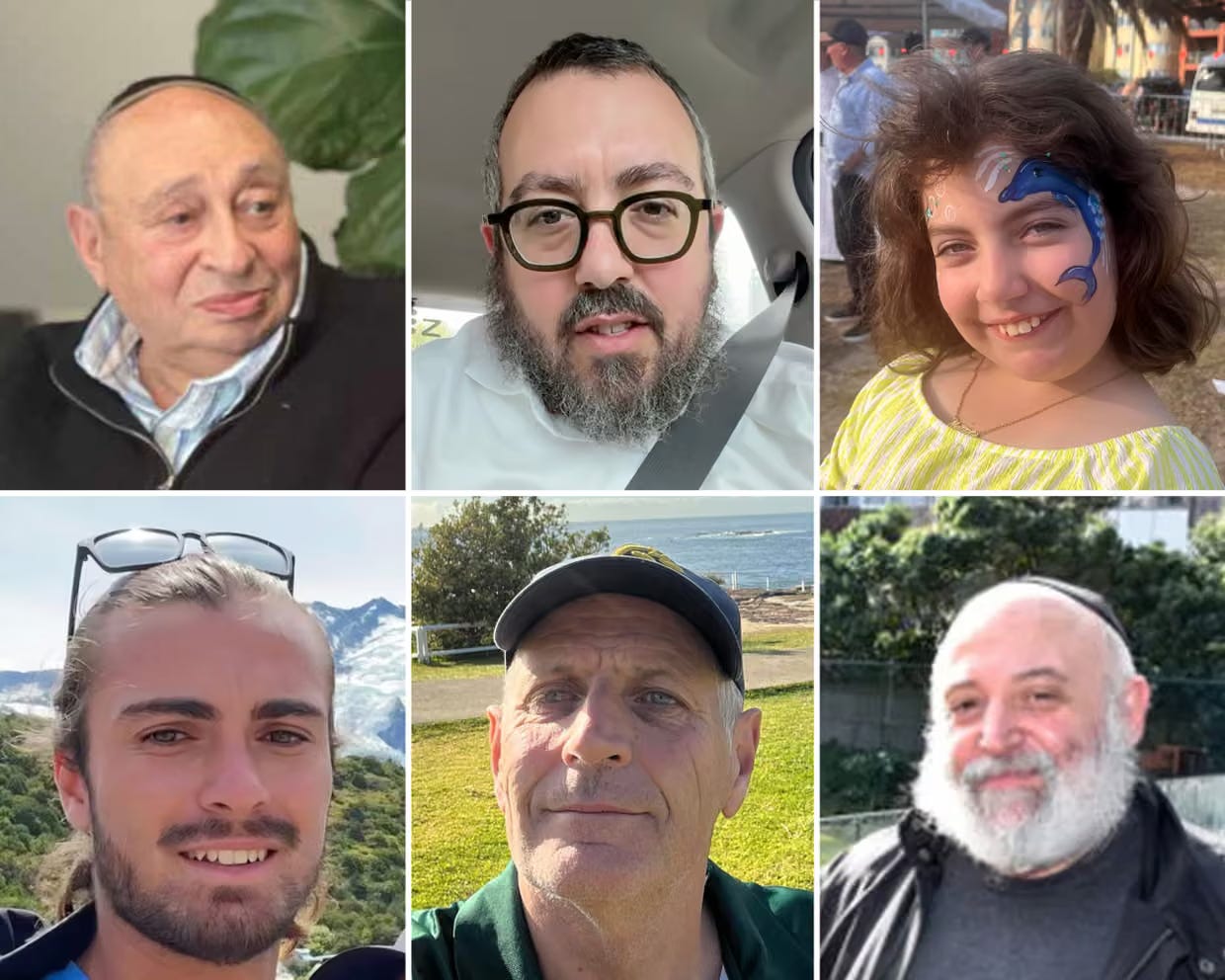
Bondi shooting victims. Top row: Alexander Kleytman,
Rabbi Eli Schlanger and Matilda. Bottom row: Dan Elkayam,
Peter Meagher and Reuven Morrison. Source: Guardian.
One of the West’s greatest blind spots when confronting Islamism is our complete failure to understand how differently it operates. Islamists conceive of the world in entirely different ways than we do. Even how they think about time and life and death is fundamentally different. Liberal democracies are built around individual lifetimes. We plan in electoral cycles and measure success in years, not centuries. Death is an ending. Violence is a catastrophe to be avoided. Progress is incremental, fragile, and oriented toward making this life safer, freer, longer, and more comfortable.
Islamism does not operate on that timeline at all.
For the Islamist, the individual life is not the unit of meaning. The cause is. Nor is death a conclusion; it is a transition. Martyrdom is not failure; it is a victory to be celebrated by one’s family and which results in divine reward. If one man dies, another picks up the mantle. If one attack fails, there will be another. The jihad is not judged by short-term outcomes or immediate political wins, but by persistence across generations. It is a relay race, not a sprint, and the baton is passed without the sentimentality we imbue everything with in the West.
This is why (my airforce veteran Godfather tells me) Islam will likely ultimately win. Islamist movements can absorb losses that would break Western political will. Prison, deportation, death… none of these end the struggle. They are incorporated into the narrative that sustains the forward momentum toward religious supremacy and ideological dominance. A dead jihadist is not a warning of the perils of violence, no, he becomes propaganda, a symbol of strength and honour. A failed attack will not deter them because it will serve to inform the next. Time itself is an ally and they are willing to wait. The goal is not victory within one lifetime, but continuity across many.
The West makes the mistake of assuming that we can exhaust our adversaries into accepting our resolutions. That if enough time passes, their zeal will cool and violence will burn itself out. And, our conceptions of death and the meaning we attribute to it have falsely informed us that grief eventually produces moderation. This is all projection. It is us mistaking our psychology for a universal one. Islamist ideology has proven it does not decay through attrition in the way Western movements do, because it is simply not anchored to the same assumptions about life, death, or moral finality.
This is also why slogans like “globalise the intifada” are so completely misinterpreted by Westerners or dismissed as theatrical excess. “Globalise the intifada” is not a demand for immediate global chaos because that would be unrealistic. It is a declaration of intent across time. It is a cry for incremental action, one drop of blood at a time. They believe that the intifada will not stop. Someone else will always be ready to step forward. The struggle is permanent, and individual lives are expendable.
Until the West grasps the fundamental asymmetry of our short-term thinking versus their long-term patience, we will keep misreading the threat. And we will keep treating each attack as an isolated rupture rather than as part of a continuous project.
One of the West’s greatest blind spots when confronting Islamism is our complete failure to understand how differently it operates. Islamists conceive of the world in entirely different ways than we do. Even how they think about time and life and death is fundamentally different. Liberal democracies are built around individual lifetimes. We plan in electoral cycles and measure success in years, not centuries. Death is an ending. Violence is a catastrophe to be avoided. Progress is incremental, fragile, and oriented toward making this life safer, freer, longer, and more comfortable.
Islamism does not operate on that timeline at all.
For the Islamist, the individual life is not the unit of meaning. The cause is. Nor is death a conclusion; it is a transition. Martyrdom is not failure; it is a victory to be celebrated by one’s family and which results in divine reward. If one man dies, another picks up the mantle. If one attack fails, there will be another. The jihad is not judged by short-term outcomes or immediate political wins, but by persistence across generations. It is a relay race, not a sprint, and the baton is passed without the sentimentality we imbue everything with in the West.
This is why (my airforce veteran Godfather tells me) Islam will likely ultimately win. Islamist movements can absorb losses that would break Western political will. Prison, deportation, death… none of these end the struggle. They are incorporated into the narrative that sustains the forward momentum toward religious supremacy and ideological dominance. A dead jihadist is not a warning of the perils of violence, no, he becomes propaganda, a symbol of strength and honour. A failed attack will not deter them because it will serve to inform the next. Time itself is an ally and they are willing to wait. The goal is not victory within one lifetime, but continuity across many.
The West makes the mistake of assuming that we can exhaust our adversaries into accepting our resolutions. That if enough time passes, their zeal will cool and violence will burn itself out. And, our conceptions of death and the meaning we attribute to it have falsely informed us that grief eventually produces moderation. This is all projection. It is us mistaking our psychology for a universal one. Islamist ideology has proven it does not decay through attrition in the way Western movements do, because it is simply not anchored to the same assumptions about life, death, or moral finality.
This is also why slogans like “globalise the intifada” are so completely misinterpreted by Westerners or dismissed as theatrical excess. “Globalise the intifada” is not a demand for immediate global chaos because that would be unrealistic. It is a declaration of intent across time. It is a cry for incremental action, one drop of blood at a time. They believe that the intifada will not stop. Someone else will always be ready to step forward. The struggle is permanent, and individual lives are expendable.
Until the West grasps the fundamental asymmetry of our short-term thinking versus their long-term patience, we will keep misreading the threat. And we will keep treating each attack as an isolated rupture rather than as part of a continuous project.
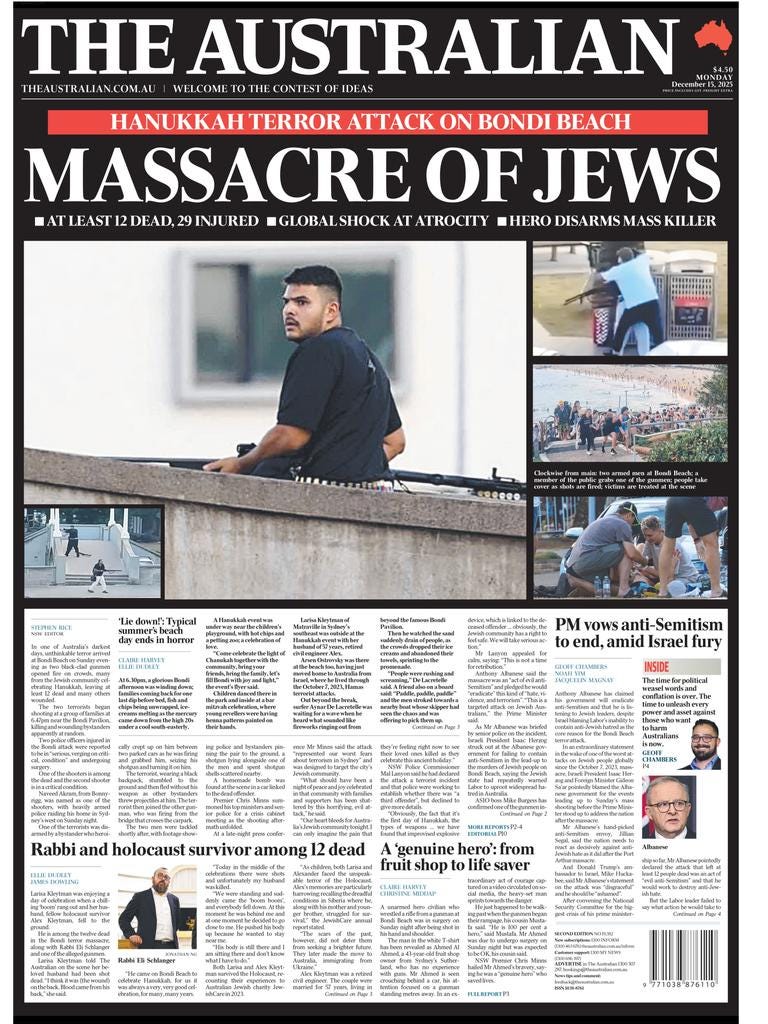
Naveed and Sajid Akram, the father and son duo who slaughtered 15 people and injured many more, chose that day and that place specifically. They knew there was to be a Chanukah by the Sea event and that many Jewish Australians would gather to celebrate. They wanted to kill Jews and terrify Jewish communities everywhere. All other infidels are secondary to Jews, but our terror satisfies the jihadis too.
Jewish people were targeted by these terrorists because antisemitism is the connective tissue of Islamist extremism. It is not a controversial view held by some, a kind of fringe or extreme element. It is not even a “dog whistle” in Islamist teaching. It is a foghorn. Antisemitism is a core organising principle in Islamist movements which deliberately root their worldview in early Islamic conflicts with Jewish tribes, particularly Muhammad’s break with the Jewish communities of Medina, which ended, ultimately, in execution. Islamism constructs Jews as an eternal enemy, beyond simple political opponents, and more like adversaries on a metaphysical level. Modern Islamist antisemitism is therefore not accidental nor misunderstood; it is part of a radicalised ideology that fuses selective theology, grievance, and conspiracy into a permanent justification for violence.
This context is so little understood, and the irrationality of the hatred against the Jewish people is often overlooked, because Westerners assume there must be a good reason for it. Collectively, our woeful historical knowledge and the erosion of intergenerational narratives have served us very poorly.
For a few decades after World War II, the Western world understood with rare moral clarity that antisemitism was not just another prejudice; it was uniquely lethal. It had ended in industrialised murder, mass graves, and a civilisational stain so deep that “never again” was embedded in collective conscience. For a time, that warning was taken seriously. But, of course, antisemitism did not disappear. It was, however, pushed to the margins and recognised as a moral failure, a social toxin, and a red line that respectable politics would not cross.
Our vigilance against antisemitism was not perfect, and it was not universal. It persisted in pockets, in private, and very openly in parts of the Muslim world. But in the post-war West, there was at least a shared understanding that Jews were not to be treated as a collective enemy, that conspiracy theories about Jewish people were not harmless, and that dehumanisation led somewhere very specific and very dark.
“Never again” functioned as a kind of moral infrastructure. It shaped laws, norms, media standards, and political instincts. It taught successive generations that antisemitism was not just wrong, but dangerous, and that it corroded societies from the inside and ultimately consumed everyone, not just its initial targets. The memory of where that road led acted as a brake on grievance politics and ideological excess.
What has been most shocking since October 7, 2023, is how quickly that infrastructure collapsed. Within days of the worst mass murder of Jews since the Holocaust, the old reflexes gave way. The dead were contextualised and attackers explained. Antisemitic tropes that had been radioactive for decades resurfaced almost overnight, repackaged as “anti-Zionism,” “resistance,” or “decolonial critique.” The taboo didn’t erode slowly; it evaporated.
What we are witnessing now is not the emergence of a new hatred, but the unmasking of old hatred that was kept in check by memory and shame. As the Holocaust recedes from living memory, so too does the instinctive revulsion that once met antisemitism in public life. October 7 did not create this collapse, but it did reveal it.
In two years that have followed, in New Zealand, as throughout the wider West, certain politicians have actively lent legitimacy to extremist Islamist rhetoric. They have stood on stages and chanted slogans into microphones enjoying the fanatical validation that it earned from the keffiyeh-wearing crowds. Crucially, they have framed antisemitic agitation not as hatred, but as righteous resistance. In doing so, they have taken ideas that should have remained on the fringe and ushered them into the mainstream under the legitimacy of political and parliamentary respectability.
None have done this to the same degree as co-leader of the Green Party, Chlöe Swarbrick. She has taken on the role of fanatic with fervour, delivering rousing speeches with wild-eyed passion and folding explicitly antisemitic activists into her political sphere. Despite many people trying to explain the meaning to her, she has continued to chant slogans with very specific, very bloody meanings; slogans rooted in campaigns of violence against Jewish civilians. The Jewish community in her electorate has met with her to express the impact of her behaviour and she has remained unmoved.
Swarbrick has done this not as a private activist blowing off steam, but as a Member of Parliament, cloaked in institutional authority and insulated by a media class that treats her extremism as youthful passion rather than moral recklessness.
She is entitled to speak freely as we all should be, but, as they say, with great power comes great responsibility and so our political leaders must necessarily understand the impact of their words. When MPs normalise jihadist slogans, they create moral cover for those who take them literally. When political leaders flirt with extremist rhetoric, they drag the Overton window toward violence, whether they intend to or not. They turn ideas that once carried social consequence into ideas that feel licensed, validated, and protected.
A full 24 hours after our closest ally, Australia, experienced its most lethal mass shooting in 30 years, neither of the New Zealand Green Party’s co-leaders, nor the party itself, have made any statement. This is a conscious display of disregard for the suffering of those nearest to us by people who have spent a great deal of time screaming in our faces every day about highly-contested reports of what has been happening in Gaza.
A few days ago, despite the many challenges facing the New Zealanders who voted for them, the Greens posted this video. They are fanatics. Worse, they are the fanatics’ useful idiots. They are the leftists who aided the PLO in Lebanon and the leftists who supported overthrowing the Shah in Iran. Guess what happened to the leftists in both of those cases?
Western countries have made a catastrophic mistake by allowing political activists full of civilisationally suicidal ideas to guide our response to Islamist terror attacks. Our leaders have been responding weakly, and often apologetically, to Islamist extremism for decades. On our behalf, they have bent over backwards to avoid offence and buried us in euphemisms. They have pretended that the problem is always “complex,” always “contextual,” always anything other than ideological. If possible it is blamed on our own society, contemporary or historical. Each attack is followed by the same ritual speeches about unity and “diversity is our strength”, flowers, candles, platitudes, and a refusal to name what is happening in plain language.
In doing so, they, and we, have confused tolerance with submission. And the price of that confusion is paid over and over again in blood.
Some argue that the West has already given up and that the point of surrender came years ago. One could certainly argue that we waved the white flag when after an Islamist suicide bomber murdered children at an Ariana Grande concert in Manchester, our cultural and political elites responded not with fury or resolve. They organised a concert and sang Don’t Look Back in Anger.
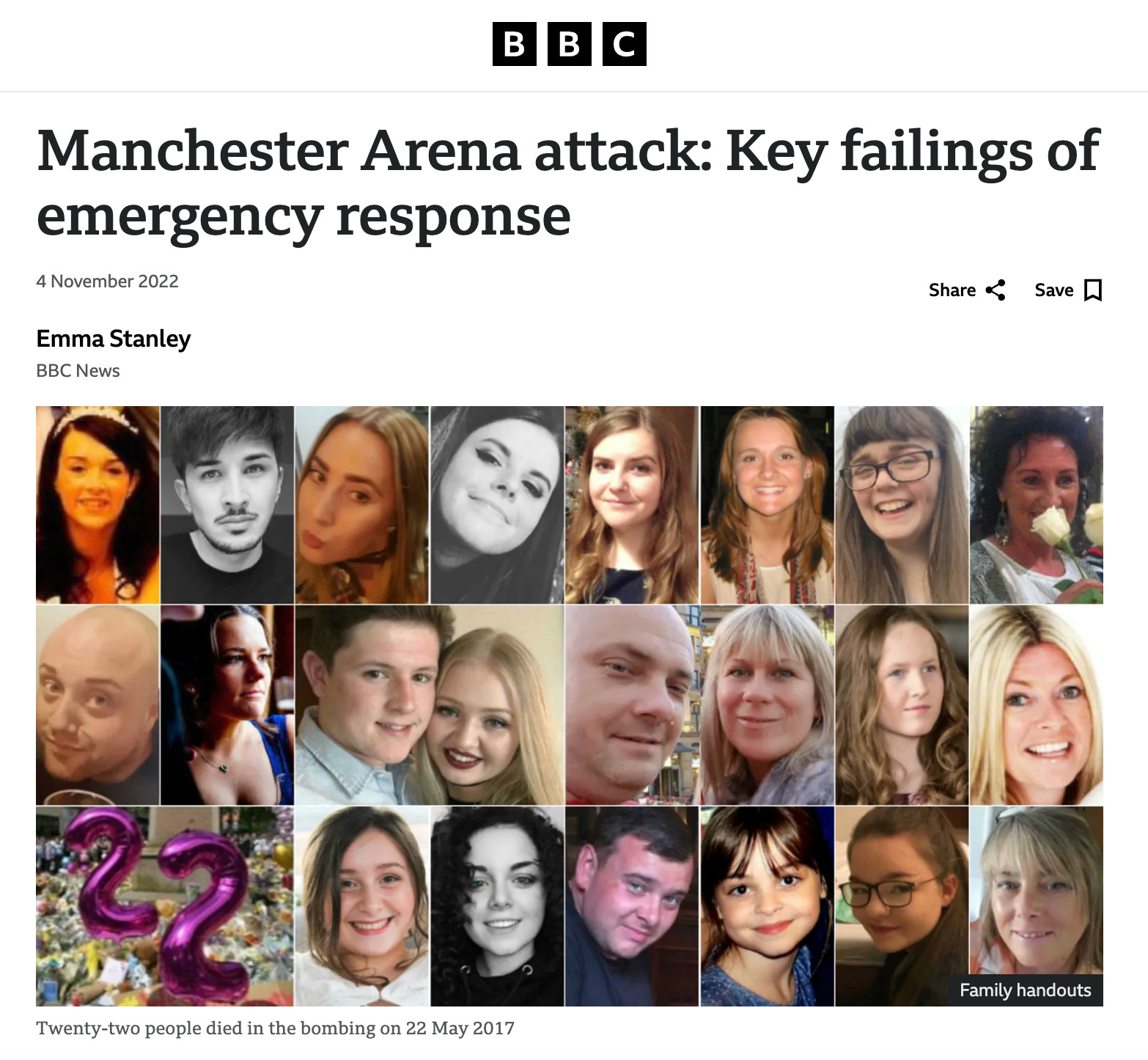
If we will not express anger at the slaughter of our children at a pop concert, when will we?
The contrived unity and forgiveness of the response to the Manchester Arena bombing did not heal us nor bring peace. It was simply an abdication of leadership. It was evidence that Western leadership had long ago lost its moral nerve. If even the mass murder of British young people would be met not with righteous anger or decisive action, but with soothing symbolism and an almost pathological refusal to confront the ideology that produced the violence, this was no longer the country of Winston Churchill.
I am not suggesting that war should have been declared and violence enacted in response. But anger, properly directed, is not simply thoughtless expressions of violence. It can be a moral signal. It is the recognition that something intolerable has occurred and that it cannot be allowed to continue. “Don’t look back in anger” may be a nice lyric, but it is a disastrous governing philosophy.
The time has come, long past, in fact, to look back in anger, to reckon honestly with failure, and to act accordingly.
High-trust societies do not survive by being permissive toward those who reject the foundations on which that trust is built. Liberal democracies do not endure by accommodating movements that openly despise liberalism. Multicultural societies do not function when the loudest and most aggressive voices are allowed to incite violence with impunity and then retreat behind claims of victimhood and marginalisation.
Doing nothing is not “being the bigger person” nor is it neutral. It is a choice that rewards the most ruthless actors while punishing the peaceful majority, including Muslims who want nothing to do with Islamist extremism.
This is not about demonising immigrants. It is not about collective guilt. It is not about race. It is about whether Western countries are willing to defend the values that make pluralism possible at all or whether we are content to outsource our moral authority to extremists while singing ourselves lullabies about how lovely we are.
Values only matter if they are protected and promoted. Principles only survive if they are defended. And societies that refuse to act in their own defence eventually discover that someone else is more than willing to act in their place.
New Zealand is a multicultural country as are most of our western allies. The overwhelming majority of people, of every background, live peacefully, raise families, work hard, and contribute positively to their communities. That is the norm, not the exception. But, and this is very important, social cohesion is not a miracle. It is the product of millions of ordinary people choosing to live within a shared civic framework.
The relative peace we live in exists because of shared values that were hard-won and are easily lost. These values that act as the invisible infrastructure of a functioning society are rarely noticed when they are intact, but their absence immediately felt when things begin to fracture.
Western societies are built on a small number of non-negotiable principles including equality before the law, rejection of political violence, freedom of speech and belief, protection of minorities, the rule of law over rule by force, secular governance, and individual rights over collective coercion. They are our operating system.
These values are not “Western” in the sense of being racially owned or biologically inherited. They are Western because Western civilisation fought for them, argued over them, legislated for them, and bled to establish them. They emerged through centuries of conflict, reform, and failure, and they are so so so incredibly precious.
The open, high-trust, free societies these values have created are the reason people from all over the world want to live in the West in the first place. And one of the most corrosive lies in modern Western politics is the claim that insisting on shared values is somehow intolerant.
Multiculturalism only works when there is a dominant civic culture that sets clear boundaries. Without those boundaries, you do not get harmony. Instead you get fragmentation, grievance politics, and eventually violence. You get parallel moral systems competing for dominance inside the same society, each claiming exemption from common rules.
Radical Islam is not compatible with Western liberal values, not because individual Muslims are inherently incompatible (many integrate successfully and live peacefully), but because radical Islam rejects equality before the law, elevates religious authority over democratic governance, sanctions violence against civilians, and treats Jews as eternal enemies rather than equal citizens. This is reality and ignoring this reality is resulting in a terrible steady flow of lethal Islamist terrorist attacks across the West.
Philosopher Karl Popper warned about exactly this problem of tolerating the intolerable. A tolerant society, he argued, cannot survive if it extends unlimited tolerance to those who are themselves intolerant. If a society allows movements that reject equality, reject reason, and reject peaceful coexistence to operate without constraint, it does not become more open, it commits suicide. Tolerance, Popper understood, is not a suicide pact. It depends on a shared commitment to the rules of the game.
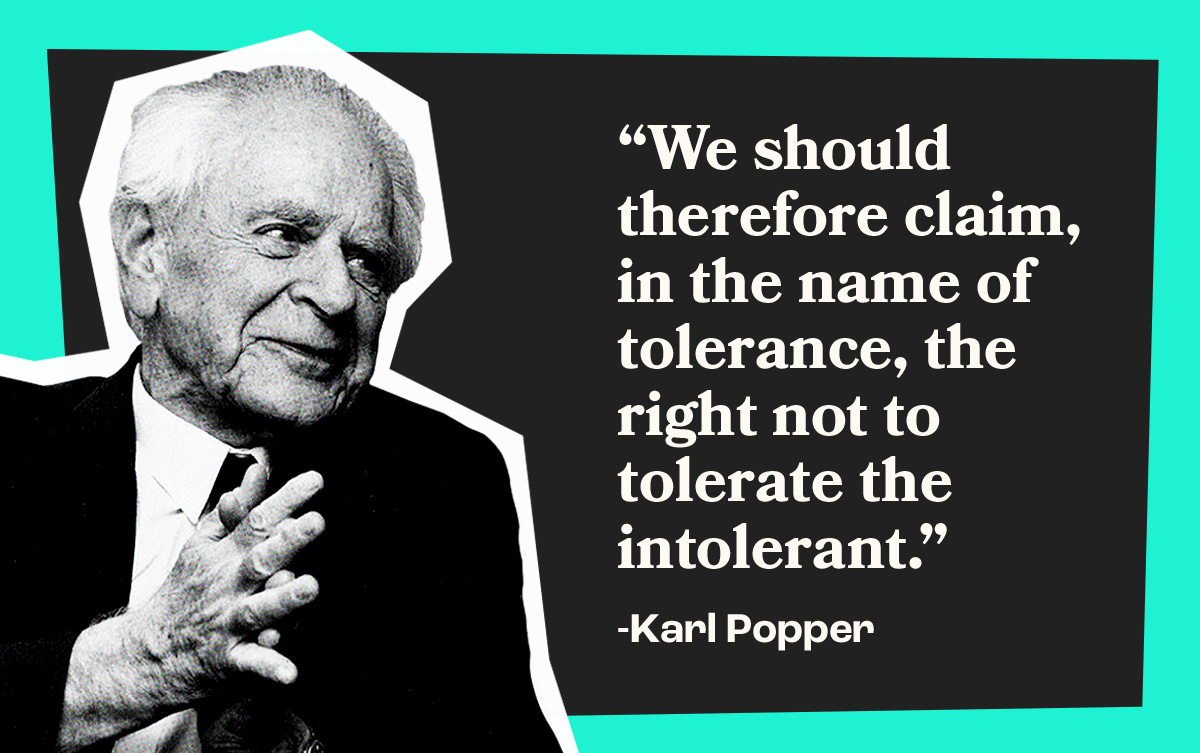
This is where Western countries have gone badly wrong. In the name of tolerance, we have tolerated ideologies that explicitly deny tolerance to others. We have allowed calls for violence to masquerade as cultural expression and defended the indefensible because challenging it felt uncomfortable.
It is astounding how thoroughly Popper’s paradox is managed into existence by weak politicians. Not through grand ideological commitment, but through cowardice. Every refusal to name threats clearly does it. As does the belief that stability can be preserved by soothing language rather than by drawing lines.
Instead of confronting antisemitism, politicians speak of “heightened tensions.” Instead of naming jihadist ideology, they gesture vaguely and speak in circles. Instead of condemning calls for violence, they retreat into the language of “context” and “understanding.” This choice consistently favours the intolerant by shielding them from moral scrutiny while demanding endless restraint from everyone else.
The moral failure of euphemism is the mechanism by which Popper’s warning is violated. Every time a politician chooses comfort over clarity and a journalist downplays jihadist violence they are laundering ideology.
This is how a society talks itself into paralysis. By refusing to describe reality honestly, leaders convince themselves they are being responsible when in fact they are surrendering the moral high ground. Euphemism becomes a substitute for courage and extremists learn very quickly that if they wrap their hatred in the right language, no one in power will stop them.
We cannot keep doing this and expect different outcomes. A society that refuses to enforce the boundaries of tolerance will find those boundaries erased by people who have no intention of reciprocating.
Bondi should end the pretending, but sadly it won’t. After all, if the Manchester Arena bombing didn’t, what will?
Ani O'Brien comes from a digital marketing background, she has been heavily involved in women's rights advocacy and is a founding council member of the Free Speech Union. This article was originally published on Ani's Substack Site and is published here with kind permission.


11 comments:
Keep an eye on the USA, we have people apologising for Elon throwing Nazi salutes, open unchecked nazi propaganda on twitter, the executive branch deciding that the swastika is no longer a hate symbol. The ISIS recruitment division can’t believe their luck with the current lot in charge over there! Oh and the US president and vice president wear makeup. This is not masculine leadership.
Good on the Victoria government for clamping down at every opportunity. Strong, masculine action they have shown is just the ticket. Something other states can look to for sure.
Well said.
Indeed the ideology has a much longer term goal than we can imagine.
This is why Islam has never had a re-invention since its golden age where once done the ideology reverted back to its fundamentalism and has stayed stuck in the 14th century in many countries since.
The majority of Muslims are not extremists but the extremists are never held to account by the moderates and that is because they are always 'brothers in arms' regardless of who carries the armoury......
This is getting expensive for chloe, one day your buying (or thieving if your golrum) a hijab(or was that the commie?), then a keffiya, and now expected to cut a bra in half for a skull cap thingy.......ohh, the greens haven't seemingly yet uttered some hollow words?
Would a hallmark card do?
Am I alone in being intolerant of tolerance? I find myself thinking of that statement "Rule one, there are no rules" as that seems to cover the long term ethos of Islamic extremism.
Well written Ani, but it seems to me that most of your commentary is a perfect fit for NZ as it is now and will increasingly become.
A very good and thought provoking piece, especially for us here in NZ where our awareness of antisemitism is far from our only 'challenge' to societal norms. Where there is a similar coterie of politicians, bureaucrats, academics, and msm personnel, all actively seeking to undermine our accepted Westminster conventions of purported equality - all with violence a potential conclusion.
To 7.20 am. Please go an watch the full video of Elon Musk's speech from the time he walked on stage and you will see that it clearly wasn't a Nazi salute.
We can consistently acknowledge the tragedy here while also acknowledging the causal relationship between Israel's actions in the Middle East against Muslims and Muslims shooting Jews. Moreover, the tiny minority of Jews in the West have always led the push for multiculturalism regardless of how it negatively affects gentiles, but then we are supposed to feel unique sympathy when Jews are finally negatively affected?
Muslims were shooting Jews long before Gaza became an issue. Yet IC Clairly persists in portraying Israel's legitimate acts of self-defence against the Muslims in Gaza as aggression. The hypocrisy of "acknowledging" the Bondi tragedy is staggering given his/her support for HAMAS. That support makes him/her just as culpable for Bondi as everyone else in the "river-to-the-sea" mob. And that support is where the real "causal relationship" may be found.
Annie, your comments re the NZ Green Party and their "specific" utterances, postures, are nothing new for The Green Party.
You only have to look at how & when the Green Party was created back in the 1950's
- by the KGB in East Germany
- which had as it core membership hardened young people, initially in East Germany, then later West Germany- many University students
- had as it 'side arm' Academics in both halves of the divided Country
- citizens who engaged with the rhetoric and also the cash
- the protests against the West German Govt.
Interestingly, they still exist, are elected MP's to the Bundestag, do not create laws or direction to better Germany, still protest at Govt systems/direction and are known to still have connections to Russian ideology.
A 'grouping' of like minded people that spread across the Globe, and if you look at Australia they have the same "pedigree' of people that can be found in NZ.
One of their 'elected persons' who has a track record of Anti Semitism (pro Gaza), turned up at Bondi Beach, "claiming she was there to show solidarity". Yup you heard that right.
Thankyou Ani for a very thought provoking article. You are correct when you say our views on life, death and martyrdom are so different. Muhammad was a warlord which explains some of his writings in the Koran
Post a Comment
Thank you for joining the discussion. Breaking Views welcomes respectful contributions that enrich the debate. Please ensure your comments are not defamatory, derogatory or disruptive. We appreciate your cooperation.