

If you’ve ever tried to build a deck, subdivide a section, or watched a major infrastructure project slowly suffocate in a decade of “consenting hell,” you already know the RMA is New Zealand’s great productivity killer. For over 30 years, it has been the bedrock of New Zealand’s environmental and planning law. It is also, by almost universal agreement, broken.
Now the Government has wheeled out its replacement, calling it “the single largest economic reform in a generation.” Normally when politicians start thumping their chests like that, my instinct is to roll my eyes. But for once, the hype might actually be justified. The RMA is dead. In its place, we are getting two new laws: the Planning Bill and the Natural Environment Bill.
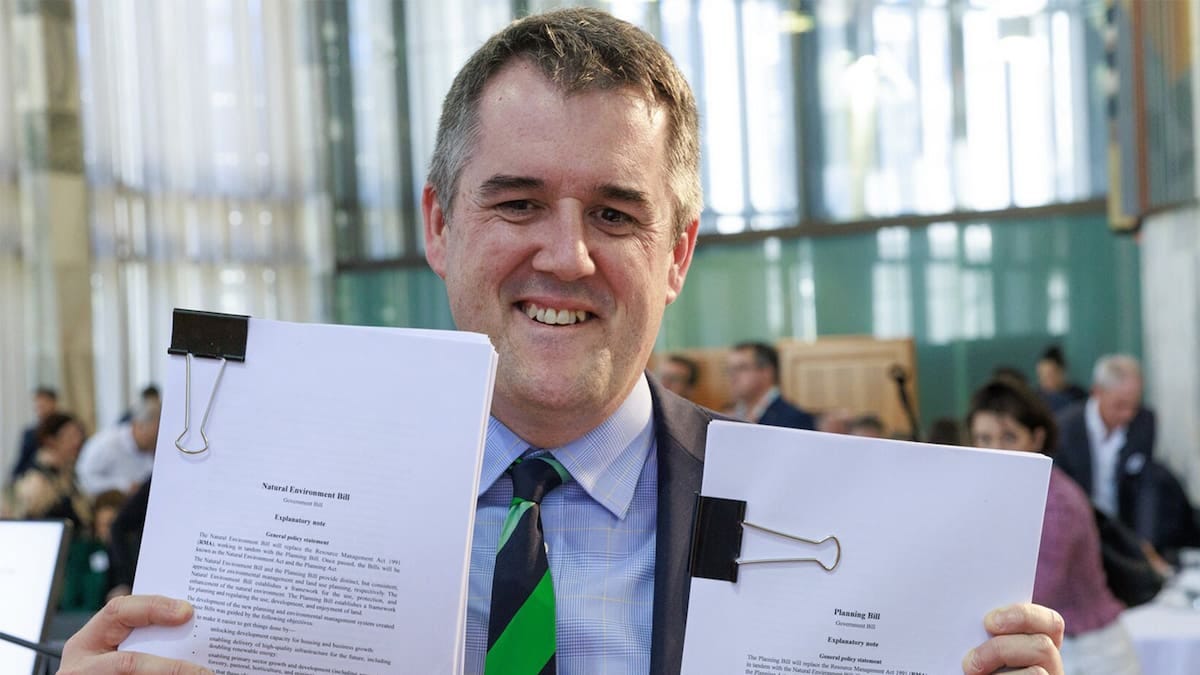
The main architect of the reforms, Minister Chris Bishop.
The Coalition Government is promising a “culture of yes” that slashes red tape, unlocks billions in economic growth, and finally makes housing affordable. And the reaction has been predictably political. Developers are popping champagne, environmental scientists are sounding alarms about a “death by a thousand cuts,” and iwi are heading to the High Court.
This isn’t just a tweak to the rules, it is a fundamental shift in the philosophy of who gets to do what with land in this country.
To understand why the government is taking a sledgehammer to the RMA, you have to look at the mess we are currently in. The story of the RMA is basically the story of New Zealand tying a two-tonne anchor to its ankle and asking why we are slow.
Right now, New Zealand has 78 different local authorities, each writing their own rulebooks. Across the country, there are over 100 different policy statements and plans, creating a fragmented regulatory nightmare. Perhaps the most damning statistic provided by the Government is that across our small nation, there are currently 1,175 distinct land-use zones.
One thousand, one hundred and seventy-five zones in a country you can drive the length of in a day. That’s how you get a system where a builder in Hamilton practically needs a translator to work in Tauranga.
The Government’s solution is to centralise and simplify. The 100-plus distinct plans will be collapsed into just 17 Regional Combined Plans. Instead of every council reinventing the wheel, we will have nationally standardised zones. If you are in a “Residential Zone” in Christchurch, it will mean roughly the same thing as a “Residential Zone” in Auckland.
The new Planning Bill will handle development and land use, essentially, the “building stuff” law. The Natural Environment Bill will handle environmental protection.
The Government projects this new system will result in 15,000 to 22,000 fewer resource consents annually. That is a reduction of up to 46%. If they pull it off, that is massive. Independent economic modelling suggests this could boost GDP by 0.56% by 2050 and deliver around $13.3 billion in benefits over the next 30 years.
“Regulatory Takings”
The aspect of the new regime that has perhaps attracted the most positive and negative attraction is a mechanism that will radically shifted the power dynamic: compensation for “regulatory takings.”
Under the current RMA, a council can restrict what you do on your land, like forbidding you from cutting down a tree that is in the way of you building a granny flat, without paying you a cent. It’s viewed as regulation for the public good. If the council says it is a special tree, you have to suck it up.
The new Planning Bill changes that. It proposes that if a council places a restriction on private property for a public benefit (like protecting a view shaft or a significant ecological area) that devalues the land, the landowner might be entitled to compensation.
This is why environmentalists are in meltdown. It forces councils to put an actual price tag on their moralising. Suddenly “protecting nature” requires budget approval not just stroppy activists.
If a council wants to save some trees on private land, they effectively have to ask: “Can we afford to buy that protection?” This shifts things heavily in favour of private property rights. Some see this as restoring fairness. Others see it as a capitalist apocalypse. The truth is somewhere messier.
The Winners and the worried
When you propose a shake-up this big, you are going to make enemies. It’s already clear who’s thrilled and who’s ready to riot and, predictably, everyone has something to say. Let’s start with the loudest voices:
Developers and business community are happy
After 30 years of waiting for councils to stop acting like medieval guilds, developers are ecstatic. For the business community, this reform is the end of a very long headache. They view the current RMA as a “consent lottery” where outcomes are unpredictable, expensive, and painfully slow.
Infrastructure New Zealand and major energy players are firmly in the “cheering” camp. Their logic is simple: New Zealand needs to double its renewable energy generation to meet climate goals. Under the current system, getting a wind farm consented can take longer than building it. By streamlining the process and reducing the number of consents required for infrastructure, the new bills promise to unlock the renewable projects we desperately need.
Business NZ views the reforms as a long-overdue solution to significant economic barriers. Their position is one of relief and cautious optimism, centred on the promise of efficiency and certainty. They strongly welcome the collapse of 1,175 zones into 17 regional plans with nationally standardised rules. Ultimately, they see the reform as a necessary return to common sense, providing the long-term certainty needed for capital investment and growth.
Property Council New Zealand’s Chief Executive Leonie Freeman says the introduction of the two new bills represents a once-in-a-generation opportunity to simplify the planning system and support New Zealand’s growth.
The NZ Property Investors Federation (NZPIF) welcomed the Government’s proposed changes:
“All around the country we have members who tried to replace tired old houses, only to be stymied by planning laws and their application. At best they’ve faced delays and added costs, at worst projects have had to be abandoned. Homes that Kiwis could have lived in were never built, creating a housing crisis that should never have happened.”
The Taxpayers’ Union applauds cutting the ‘Regulatory Tax’
The Taxpayers’ Union has enthusiastically backed the reforms, framing the overhaul as a necessary act of tax relief and pro-growth policy. They view the RMA’s costs, delays, and complexity as a massive “regulatory tax” on businesses and households, arguing that the compliance burden has been the single worst handbrake on the nation’s productivity. They celebrate the projected cut of up to 46% in annual consents as a victory over “clipboard-wielding busybodies” and a restoration of common sense. Crucially, the Union supports the new compensation mechanism, viewing it as essential “regulatory relief” that returns the right to use land to the people who want to build and grow, rather than leaving control in the hands of council officials and NIMBY objectors.
Environmentalists say it’s a death by a thousand cuts
If business is relieved, the environmental sector is the opposite. Their primary concern is that by splitting development (Planning Bill) from protection (Natural Environment Bill), the holistic oversight of the RMA is lost.
Dr. Jo Monks, President of Te Aka Toro New Zealand Ecological Society warns:
“We appear to be entering an era where public authorities must pay to prevent the loss of habitats and biodiversity, an approach that is both economically untenable and a profound reversal of long-standing policy.”
Her concern is that the new system prioritises speed and individual property rights over the cumulative impact of development. One subdivision might not do much damage, but fifty of them will. The RMA, for all its flaws, she says, forced decision-makers to look at that big picture. The fear is that the new streamlined process will treat the environment as a checklist of nice-to-haves rather than a hard limit.

Dr Jo Monks. Source: DOC
Dr. Joanne Clapcott President of the New Zealand Freshwater Sciences Society echoes this, worrying that the fast-track mentality will bypass essential scientific scrutiny. She says:
If “regulatory relief” means the public compensates private landholders for protecting biodiversity, we risk inverting the polluter-pays principle at precisely the moment freshwater needs it most.
There is skepticism about the “regulatory takings” clause in these communities. Critics argue it effectively monetises nature. If a council has to pay to protect a wetland, and they don’t have the budget, the wetland gets paved. It turns environmental protection into a luxury item for wealthy councils, rather than a national baseline.
Greens call it a “Smash and Grab”
For the Green Party, the Government’s rhetoric about “protecting the environment” rings hollow. They see the entire reform package as a legislative attack on nature, designed solely to facilitate profit and fast-track destructive industries.
Green Party co-leader Marama Davidson said:
“This government has shown time and time again that they will pass laws that further erode our environment... The Greens would love to see the Government cut through the political posturing and actually create a system that protects the environment and prioritises the public good ahead of the private gain they are constantly pandering to.”
Their primary concern is that by limiting the scope of regulated effects (e.g., ignoring visual amenity, views from private property, or “less than minor” adverse effects), the Bills create deliberate loopholes. This, combined with the new compensation clause for environmental restrictions, fundamentally changes the dynamic. Where the RMA made environmental protection mandatory, the Greens say the new bills make it optional, or prohibitively expensive, for cash-strapped councils. They view the new laws as a “latest smash and grab against the environment.”
Renewable Energy Sector say it removes the handbrake
Interestingly, some environmentalists, the ones who actually work in energy rather than lecture halls, love the reforms. They’re sick of wind farms dying in courtrooms and want a system that treats renewable energy as a national priority, not a neighbourhood annoyance.
This community views the old RMA as a massive impediment to New Zealand’s decarbonisation and climate goals. Major players and industry groups like Electricity Retailers’ and Generators’ Association of New Zealand (ERGANZ), have strongly backed the changes, citing the decade-long delays and cost increases that stalled crucial wind, solar, and geothermal projects under the old system. They welcome the new bills for providing essential strategic national direction, arguing that the RMA failed to recognise the national importance of renewable energy. The promised acceleration of project timelines, reduction in red tape, and increased certainty through 30-year regional plans are seen as critical policy tools needed to unlock billions in investment, meet New Zealand’s energy security needs, and successfully transition to a low-carbon economy.
Local Government is caught in the middle
Councils are in a bind. On one hand, many local government leaders welcome the simplification. Dealing with fewer, standardised plans could eventually lower their administrative burden.
On the other hand, the compensation clause is keeping mayors awake at night. The Queenstown Lakes District Council has been particularly vocal. Their district is full of “Outstanding Natural Landscapes”. That is areas heavily restricted to protect the pristine views that drive their tourism economy. If they suddenly have to compensate every landowner who is told they can’t build a McMansion on a ridgeline, the council could face financial ruin.
This, say some in local government, creates a perverse incentive: to avoid the risk of paying compensation, councils might simply stop designating areas as protected.
Iwi and Māori say this is a constitutional fight
For iwi, this isn’t just about planning; it’s about the Treaty. The RMA contained specific clauses recognizing the relationship of Māori with their ancestral lands and water. Iwi leaders fear the new bills dilute these protections and undermine the principle of kaitiakitanga (guardianship).
The tension has already moved from the marae to the courtroom. The National Iwi Chairs Forum has filed proceedings in the High Court, challenging the Government’s engagement process. They argue that rewriting the laws governing land and water without substantive Māori partnership is a breach of the Treaty of Waitangi.

Tukoroirangi Morgan at the Iwi Chairs Forum at Waitangi.
Photo: RNZ / Ella Stewart
This legal challenge is a significant hurdle. If the courts find the government hasn’t met its obligations, it could stall the entire reform process, dragging “the culture of yes” into a long, litigious “culture of maybe.”
This legal challenge is a significant hurdle. If the courts find the government hasn’t met its obligations, it could stall the entire reform process, dragging “the culture of yes” into a long, litigious “culture of maybe.”
Te Pāti Māori say it is a dilution of Treaty obligations
The concerns raised by Te Pāti Māori are existential, running parallel to the court proceedings filed by the National Iwi Chairs Forum.
They argue that the previous Labour Government’s attempts at reform, while flawed, included co-governance mechanisms and made Te Oranga o te Taiao (the health of the environment) a supreme priority. The Coalition has stripped this out.
Under the new bills, they say, the Māori role is significantly reduced to consultation and “having regard to” high-level goals. The legislation merely “recognises the Crown’s responsibilities” in relation to the Treaty, a legal formulation that some Treaty experts argue is significantly weaker than the RMA’s existing Treaty clause.
There is no guaranteed decision-making role for iwi in the new regional planning bodies, no co-governance, and no obligation for councils to adopt Māori views or cultural assessments. This is viewed by Te Pāti Māori as a betrayal of kaitiakitanga (guardianship) and a marginalisation of mana whenua’s role in decision-making over land and water. The party asserts that by weakening the Treaty clause and limiting notification on consent applications, the bills remove Māori autonomy and participation in decisions affecting their ancestral lands and resources
Labour say the Coalition are “Copycats”
Politically, Labour’s reaction has been one of bemused frustration. Their line is essentially: you’re just copying our homework.
And if you squint, they have a point. The previous Labour Government spent years on the Natural and Built Environment Act, which this Government repealed before the ink was dry. The skeletons of the two regimes look identical; both split the RMA in two, both collapse 100+ district plans into roughly 15-17 regional plans, and both rely on a “National Planning Framework” to dictate terms from Wellington.
But while the Coalition might have stolen Labour’s ring-binder, they painted it blue and threw out the essay inside. To say this is a simple “copy-paste” job ignores the fatal flaw that sank Labour’s attempt… the ideological wiring.

Labour leader Chris Hipkins. Photo: RNZ / Mark Papalii
Labour’s reforms were built on a complex, contentious co-governance model. Their proposed Regional Planning Committees were to be split 50/50 between council representatives and mana whenua. On paper, it was a partnership; in practice, it looked to many like a dismantling of democracy. It would have handed massive decision-making power over zoning, infrastructure, and land use to bodies where half the members were completely unaccountable to the ballot box.
Ratepayers would have been footing the bill for plans written by people they couldn’t vote out. That wasn’t just a “process” issue; it was a constitutional rewire that alienated huge swathes of the electorate and made the legislation toxic.
Add to that Labour’s introduction of legally fuzzy concepts like Te Oranga o te Taiao (the health of the environment) as a supreme bottom line, and you had a recipe for endless litigation. Instead of clarity, developers saw a new, more expensive maze of metaphysical hurdles.
So, yes, the Coalition has kept the efficiency mechanism, the regional plans, but they have ruthlessly stripped out the social engineering. They’ve evicted the co-governance committees, returning power to local mayors, and swapped Labour’s nebulous environmental spiritualism for hard-nosed property rights. Labour might feel robbed, but the Coalition would argue they just saved the good bits from a wreck of Labour’s own making.
The Trade-Offs
There are no easy answers in politics, only trade-offs.
Speed versus Democracy: We all want houses built faster and infrastructure delivered on time. But “streamlining” is often requires limits on how the public can exercise its right to have a say. The new system reduces the opportunities for you to object to your neighbour’s development. That is great when you are the one building and it is less great when a three-storey townhouse goes up next to your fence. We are trading local participation for national efficiency.
And efficiency, in this context, is vital. Delays in resource consent processes have been directly linked to New Zealand’s housing crisis, driving up construction costs and keeping house prices perpetually out of reach. Furthermore, Infrastructure New Zealand estimates that the country has forgone billions in economic benefits because critical projects, from wind farms to major roads, have been held up for a decade or more in the RMA’s adversarial process. When the Government cuts the number of required consents by almost half, they aren’t just saving paperwork, they are trying to inject desperately needed momentum into the economy and the housing market.
Property Rights versus ‘Public Good’: This is the philosophical heart of the entire reform, and it’s one of the oldest political arguments in liberal democracies.
The RMA, in effect, leaned heavily towards the idea that land use is a community concern. Its principle is that your right to develop your land is secondary to the need to manage environmental impacts for the public good, without compensation. This perspective, common in modern planning, treats development as a privilege granted by the community, not an inherent right.
The new Planning Bill swings the pendulum sharply back toward the individual. It asserts that what you do on your land is fundamentally your business, and that any significant restriction imposed for the public’s benefit (the “regulatory taking”) must be compensated.
This is a massive victory for property rights advocates, who trace their lineage back to Enlightenment thinkers like John Locke, who viewed property ownership as a core aspect of liberty and a check on arbitrary state power. Historically, a robust protection of private property, often enshrined in constitutions, has been seen as essential to prevent the government from impoverishing citizens on a whim.
By introducing the compensation clause, the Government is deliberately elevating the sanctity of private property rights above uncompensated regulatory control. It forces the state to internalise the cost of its environmental or planning aspirations. If a council wants to protect a view, it must be willing to pay the landowner for the lost value.
The risk, of course, is that it could, in effect, privatise the benefits of intense development while socialising the environmental and infrastructural costs. But proponents of this view would counter that the old system socialised the cost of conservation by placing the burden of uncompensated regulation solely on the landowner; a burden they argue the whole community should share. This clause is a constitutional moment that redefines the boundary between individual liberty and collective control over land.
National Consistency versus Local Character: Standardising 1,175 zones down to a manageable, nationally consistent handful makes absolute, undeniable economic sense. A developer in Dunedin should not have to pay five different sets of consultants to decipher five radically different sets of rules across the South Island. For the sake of efficiency, predictability, and ultimately, affordability, this consistency is vital.
The current system, by allowing 78 different local authorities to endlessly craft their own unique rulebooks, effectively turned the RMA into a tool for regulatory paralysis. New Zealand is geographically complex, yes, but the argument that every tiny district needs a bespoke land-use regime is preserving local interests at the expense of national needs.
The cost of this “local character” is staggering. It means every small council must maintain an army of planning staff, and every major business must hire expensive legal teams to navigate a chaotic patchwork of contradictory rules. This overhead is ultimately passed on to consumers and ratepayers, making every new house and every new wind farm unnecessarily expensive.
The new system acknowledges that the national interest in building houses and infrastructure, and in providing a consistent investment environment, is paramount. By enforcing national standards, the government is not killing local character; it is killing the costly, time-consuming tendency of local authorities to indulge in regulatory vanity projects and, crucially, allowing NIMBYism to indefinitely stall nationally beneficial development.
The RMA gave immense power to localised objectors. A single homeowner could weaponise the planning process, often citing minor infringements on “amenity values” to delay or derail projects for years. This reform is designed to dramatically reduce the power of these objectors. This move sacrifices micro-level nuance and the ability of a few loud voices to block progress, for macro-level efficiency and affordability, and that is a necessary trade-off for a country struggling with a housing and infrastructure deficit.
What happens next?
The bills will head to the Select Committee, which is the public’s chance to submit on the legislation, and you can expect a flood of submissions from every lobby group in the country.
The Government aims to pass the legislation by mid-2026. In the meantime, to the relief of farmers, existing resource consents will be rolled over until at least 2031 to provide stability during the transition.
We are about to embark on a messy, complicated, and expensive transition period. But the reality is, the status quo was not an option. The RMA was a handbrake on a country that needs to move.
We are swapping a system that made it too hard to say “yes” for one that makes it harder to say “no.” Whether that is a price worth paying depends entirely on your politics.
Ani O'Brien comes from a digital marketing background, she has been heavily involved in women's rights advocacy and is a founding council member of the Free Speech Union. This article was originally published on Ani's Substack Site and is published here with kind permission.


7 comments:
Be nice if we ended up with less visually crappy wind farms and more reliable out of way power generation like mini nuclear or anthracite coal power or even concentrated solar power…..instead we get asbestos loaded wind turbines and giant solar farms
The RMA had it's faults .Politicians have tinkered with it and made it worse.
This change is likely to see the environment suffer and NZ changed into something like a sprawling city looking for a reason to be.
Bishop and Watts and Luxon never understood the RMA and most politicians don't understand Local Government.
Practical people are never consulted when they are needed.
Great summary, thankyou.
Anon 7:56 . Practical people are having a big say and we must thank ACT List MP Simon Court for his experience and expertise as a Civil Engineer who has worked professionally for and against the RMA for various clients. His input has been valuable because it is experienced, pragmatic and with vital understanding of the RMA
Basil Walker
If anyone claims that this dilutes treaty obligations or goes against the principles of the treaty, I hope the govt. demands that the claimant proves what the principles or obligations are.
Alas, Anon@6.53, it'll likely be the Court's that get to decide the issue, and it's not hard to predict which way they'll be leaning given their more recent pronouncements. Whether the Govt will have the fortitude to rein then in will remain to be seen.
Wow! A very good summary of a very complex subject. It is hard to be optimistic, as the author notes, the usual suspects have already decided the draft is evil/good depending on their situation.
In essence, the two main protagonists have dug in their positions; the socialists on one hand who have always held that no one should "own" land, let alone have rights over it. The only split in that group is those who want to take land ownership by revolution versus those who want the same thing but by gradualism and perhaps a degree of democracy. Our own Labout Party once had a scheme of "usehold" as opposed to the current "freehold", and only ditched the concept when they realised it was a big vote loser....pragmatism over principle.
And as the author concludes the capitalists, especially the rich variety that have made a career out of land development & sale, greet any easing of land ownership responsibilities as a good thing.
Good luck with any compromise between these factions.
The author also identifies those, particularly scientists who see no shades of grey, only black & white extremes, probably without even reading the proposed legislation....I would rather doubt any new legislation will support ownership rights with no mention of responsibilities.
What the author failed to stress was the sheer incompetence of the current 1991 RMA which in my opinion was a disastrous attack on the Rule of Law which many would rank as the hǰmain foundation of our western system of democracy.
It was drafted unconventionally and in haste by a private law firm: died a justifiable death when the then Labour Government was kicked out of office, only to be naively resurrected by the new National government. It was full of flowery sentiment quite undefined thus leading to need for interpretation by Courts. It lacked coherent detail but just authorized civil servants to invent substantial law, varying from local authority to local authority.
The Rule of Law holds that "the law" should be widely known, stable, and created by our elected representatives, not unelected technocrats.
The changeable shambles that is the RMA has arguably cost billions in unnecessary bureaucracy, many expensive law suits, even between adjacent local authorities, and amended plans by armies of local bureaucrats.
And,...for what? Can anyone claim that NZ's land management is the more effective because of the RMA?
Of course the greenies will never admit that mere landowners have themselves got better at managing land issues over time. The days when riverside shops and factories,...and local governments, simply tipped their rubbish into the nearest stream have long gone (except the cowboys, both private & public)
I might even acknowledge that a conservation minded political party might be a useful thing, pricking our consciousness from time to time and helping the conversation to a better tomorrow. Pity the Greens flagged that role in favour of hating the rich.
Post a Comment
Thank you for joining the discussion. Breaking Views welcomes respectful contributions that enrich the debate. Please ensure your comments are not defamatory, derogatory or disruptive. We appreciate your cooperation.