

The current Government has proposed legislation designed to reform New Zealand’s resource management laws. National Party Government Minister Christopher Bishop is leading the reforms.

The proposal is to replace the current Resource Management Act with two new Acts of Parliament; a Planning Act to govern land use and development (including housing, infrastructure, and zoning), and a Natural Environment Act, to regulate natural resource use and protection (including of land, air, freshwater, coastlines and life forms).
Under the proposal, the existing 100+ local authority plans will be consolidated into 17 regional plans, zoning will become nationally standardized and consent categories will shrink to four. Resource management will focus more on material externalities – significant effects on others or the environment. Minor or internal effects will not be regulated.
The proposal includes compensation (“regulatory relief”) for people whose rights are adversely impacted by regulatory approvals. Councils will have to compensate land owners for consents that adversely affect privately owned land to a significant extent. Compensation may take the form of cash payments, rates rebates, extra development rights, no-fee consents, land swaps, or free expert advice.
Woke victimization projection
Traditionally, before Woke came along, debate about the merits of proposed law reforms focused on whether or not the reforms would benefit the New Zealand collective i.e. would the reforms make New Zealanders better or worse off, overall.
Under the proposal, the existing 100+ local authority plans will be consolidated into 17 regional plans, zoning will become nationally standardized and consent categories will shrink to four. Resource management will focus more on material externalities – significant effects on others or the environment. Minor or internal effects will not be regulated.
The proposal includes compensation (“regulatory relief”) for people whose rights are adversely impacted by regulatory approvals. Councils will have to compensate land owners for consents that adversely affect privately owned land to a significant extent. Compensation may take the form of cash payments, rates rebates, extra development rights, no-fee consents, land swaps, or free expert advice.
Woke victimization projection
Traditionally, before Woke came along, debate about the merits of proposed law reforms focused on whether or not the reforms would benefit the New Zealand collective i.e. would the reforms make New Zealanders better or worse off, overall.

Under Woke’s status and virtue signalling economy, power elites and aspirants project competing claims of virtue and victimhood, particularly around contrived “issues” of identity, oppression, and social justice. Competing claims of compounding marginalization (race + gender + sexuality + class) create a hierarchy of victimhood. This is what Critical Social Justice is all about.
So, how is the Woketimhood competition playing out with the resource management reforms?
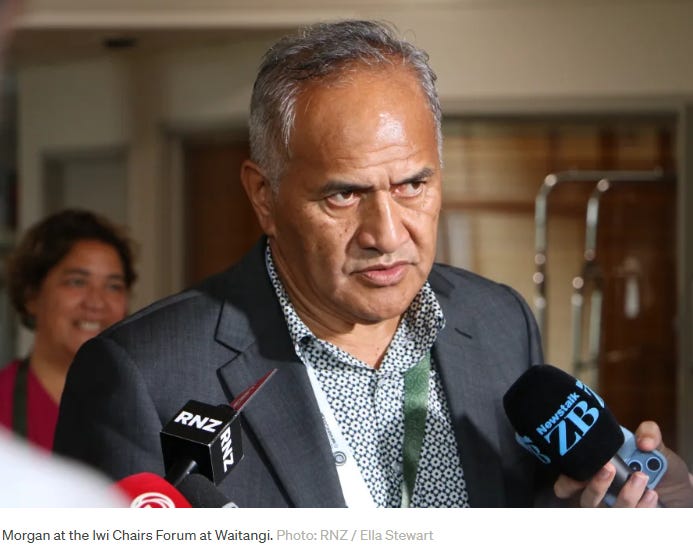
The National Iwi Chairs Forum is playing the race victimhood card (in the colonisers’ Court system), filing proceedings claiming that the reforms would breach Treaty of Waitangi settlements.
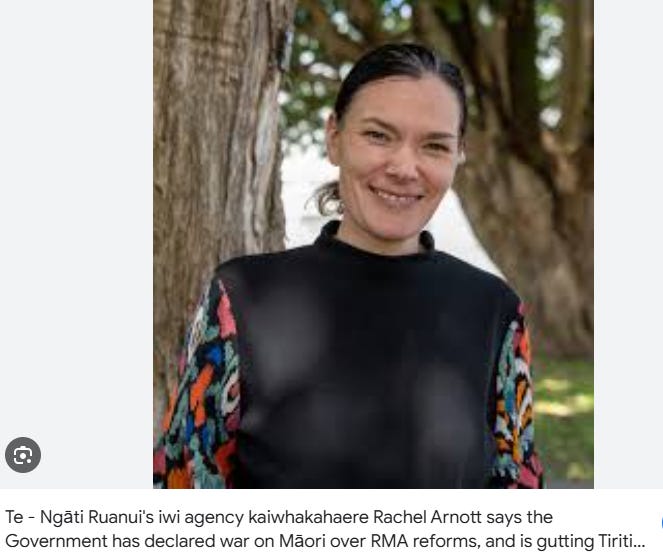
Rachel Arnott, who doesn’t look much Māori (who cares) but affiliates with a South Taranaki iwi, is vying for peak victimhood, claiming “this government has an ideological and political commitment to gut Tiriti-guaranteed rights of iwi, hapū and whānau”.

Graham Young, of the same iwi, has doubled down, playing two victimisation cards. In addition to alleging that the reforms threaten the racial “partnership of sovereignty” (whatever that means), Young claims his iwi is also being class-victimised in the old fashion Marxist sense, oppressed by capitalist “big business”.
Of course, none of this race-based pseudo-hysteria has much to do with principled objections to the resource management reforms. It has everything to do with dreaded dilution of the lucrative veto powers currently vested in privileged Māori groups in relation to resource consenting.

The Environmental Defence Society, intersectionally wedded to the natural environment, is most concerned – according to its Reform Director, Dr Greg Severinsen - with “the concept of regulatory relief, which is a significant threat to environmental wellbeing”. This is an anti-property, Marxist objection.
Desperate not to be outdone on the environmental victimisation front, Forest & Bird has chirped up, with F&B head lawyer Erika Toleman claiming, without evidential foundation, that, “Nearly 4,000 of our native species are already on the brink. We simply cannot reduce environmental protections and expect anything other than more extinctions.”
Bill McKay, of Auckland University’s School of Architecture, has been vocal in his opposition to the reforms, throwing the whole Identitarian shooting box at the proposed changes with the following anti-business, pro-Māori, anti-Government, climate catastrophizing attempt to define the oppressors and the oppressed:
“Who are the winners? Infrastructure developers, business, farmers. The losers? Māori, local consultation, environment, climate change action, and councils as there will be more central government/ministerial direction and decision making.”
But Bill, being a Pakeha dude (and heterosexual, as far as I can tell), was always going to struggle projecting his virtue to anywhere near the summit of Mt Victimhood.

In my view, no-one has played the race victimisation card more loudly and proudly than Linda Te Aro, Associate Professor of Law at Waikato University, who has produced the following profuse pearlers of professed powerlessness:
“The Coalition government continues to “flood the zone” with a relentless onslaught of legislative reform and policy announcements that have stripped references to the Treaty of Waitangi from legislation and confiscated Māori voices from key decision-making processes affecting matters that go the heart of our culture – our language, education, health and the environment.”
“…the colonial project in New Zealand has led to widespread loss and alienation of Māori land and assaulted the social and cultural fabric of Māori communities.”
“The cumulative effects of legislative reform are deeply disturbing. Kaitiakitanga is under siege. Changes to Fast Track processes, Regulatory Standards, provisions that affect conservation, the ability for Māori to successfully claim customary marine title and have a stronger voice in decisions that affect the takutai moana...”
Brooding Mare Linda Te Aro is therefore my favourite in the Resource Management Reforms Oppressed Victims Stakes.
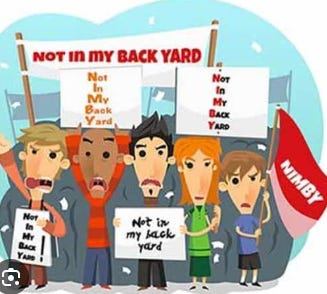
The NIMBY (Not In My Back Yard) brigade have so far been silent on the reforms, perhaps because it’s tricky to project oppressed virtue when you’re mainly rich, with white skin. (Arise Chris Findlayson, Oppressing Gay NIMBY!?) NIMBYs tend to work behind the scenes to preserve their fortunate status quo statuses.
But there’s one thing that unites opponents to the resource management reforms. The opponents’ intersectionality is that they’re all – one way or another – members of New Zealand’s colossal “cottage” resource management industry. It’s the cottage industry that makes it needlessly difficult to build cottages, or do much else that’s materially useful, in New Zealand’s current Aotearoan incarnation.
From the loads of loafers in local government, to the ranks of race-hustlers, to the coteries of consultants, resource management paralysis provides nice (non-little) earners for innumerable New Zealanders.
My vignette of “lived experience”
I’m no fan of the Woke notion that “lived experience” defines reality. But “lived experience” has certainly defined the visceral attitudes of multitudes of New Zealanders’ attitudes towards the current resource management regime. And I use “regime” advisedly. The current resource management system is a true regime, in the most authoritarian, dystopian sense.
Personal anecdotes are not typically much use in judging law reform proposals. But, in my resistance, I can’t resist…
The low-water mark of my resource management misery came with my involvement in the renewal of a consent to extract a moderate amount of H2O from a stream running through a parcel of private land in the Wellington region. The extracted water is used for moderate, seasonal irrigation. The origin of the stream is a spring just outside the property. Further springs along the course of the stream, as it passes through the property, mean that the volume of water that leaves the property is larger than the volume that enters. And because the stream is spring fed, it never gets remotely close to running drying. The only significant fluctuations in the level of the stream are when it rises as a result of heavy rain.
The resource consent restricts the amount of water that can be extracted, and water extraction makes no appreciable difference to the stream’s flow. Anyone with a half a brain would therefore reasonably expect the renewal of the consent to have been a formality. But not so. Wellington Regional Council staffers fought the renewal, tooth and nail, every step of the way, supported in its opposition by a mercenary army of ratepayer funded external consultants.
The protracted renewal process degenerated into frustrating farce. Under the Resource Management Act, a “river” (expressly defined to include a stream) and a “wetland” are mutually exclusive i.e., a river cannot be a wetland, and a wetland cannot be a river. Wetlands get more protected treatment under the Resource Management Act than rivers, so it should come as no surprise that the Regional Council tried to assert, contrary to all credible expert evidence and common sense, that the flowing stream is in fact a wetland.
This is just one tiny example of the wasteful, idiotic, bullying depths to which the current resource management regime has descended.

Unfortunately, little will change without radical accompanying changes to the bloated sheltered workshops that local and central government bureaucracies have become.
John McLean is a citizen typist and enthusiastic amateur who blogs at John's Substack where this article was sourced.


1 comment:
Woke people can’t battle what are you talking about, they don’t have masculinity! Hmm, masculinity.
Post a Comment
Thank you for joining the discussion. Breaking Views welcomes respectful contributions that enrich the debate. Please ensure your comments are not defamatory, derogatory or disruptive. We appreciate your cooperation.