

“In war, truth is the first casualty.”
— commonly attributed to Aeschylus
The claim that the “first casualty of war is truth” is often treated as metaphor. Currently, we are seeing it as a literal description of process. When political conflict is framed and experienced as existential, like when one side is portrayed as no longer merely wrong but morally illegitimate, truth stops functioning as a virtue and becomes an obstacle. Facts that complicate the preferred narrative are too harmful to the goal of winning the info war and so they are erased. History is repeatedly rewritten.
The current moral panic surrounding Immigration and Customs Enforcement (ICE) in the United States is a near-perfect example of this dynamic. We are told that ICE operations today represent a new and uniquely cruel phase of American governance. CNN, The Guardian, New York Times, the BBC; they all say that families are being hunted, children weaponised, communities terrorised in ways unseen in modern history. Celebrities, Democrat politicians, and countless liberal women on TikTok tell us that what is happening now is unprecedented. This claim is observably, provably false. It is deliberately dishonest, and it relies on the destruction of historical memory. It is so incredibly easy to fact check the hyperbolic claims, but unfortunately those spreading them know all too well that ordinary people have not the time nor inclination to do their own research.
Immigration enforcement in the United States did not begin with Donald Trump. It did not begin with Republicans. It did not even begin with ICE, which was formally created in 2003 by consolidating existing enforcement authorities. Deportation has been a continuous function of the American state for decades and decades, expanded and defended by presidents of both parties, quite openly.
Under Bill Clinton, immigration enforcement was not an embarrassment but a political talking point. The Illegal Immigration Reform and Immigrant Responsibility Act of 1996 dramatically widened grounds for deportation, reduced judicial discretion, and accelerated removals. Clinton justified this explicitly in economic and social terms, warning that illegal immigration suppressed wages and strained public services. In his 1995 State of the Union address, he famously stated:
Immigration enforcement in the United States did not begin with Donald Trump. It did not begin with Republicans. It did not even begin with ICE, which was formally created in 2003 by consolidating existing enforcement authorities. Deportation has been a continuous function of the American state for decades and decades, expanded and defended by presidents of both parties, quite openly.
Under Bill Clinton, immigration enforcement was not an embarrassment but a political talking point. The Illegal Immigration Reform and Immigrant Responsibility Act of 1996 dramatically widened grounds for deportation, reduced judicial discretion, and accelerated removals. Clinton justified this explicitly in economic and social terms, warning that illegal immigration suppressed wages and strained public services. In his 1995 State of the Union address, he famously stated:
“We are a nation of immigrants, but we are also a nation of laws.”
This was not controversial at the time. In fact, it was bipartisan orthodoxy and, between 1993 and 2001, removals roughly doubled. And that line of Clinton’s would be repeated ad nauseam by presidents who came after him, particularly Barack Obama.
Under George W Bush, deportations continued to rise. Bush paired enforcement rhetoric with proposals for guest worker programmes but never questioned the legitimacy of removals themselves. Guest worker programmes are government schemes that allow foreign nationals to enter a country legally for a limited period to fill specific labour shortages, usually in industries that rely on low wage, seasonal, or hard-to-staff work. Participants are typically required to leave once their visa expires.
Guest worker programmes have long been used as the rhetorical ‘escape hatch’ in immigration debates invoking proof of compassion and as a way to square economic demand for labour with political pressure for control.
By the end of George W Bush’s presidency, annual deportations exceeded 300,000, a level of enforcement that would today provoke wall-to-wall media outrage. At the time, however, these figures were not treated as evidence of cruelty or authoritarianism. They were reported largely as outputs of a functioning state carrying out routine law enforcement. There were policy disagreements, sure, but deportation itself was not framed as a moral scandal.
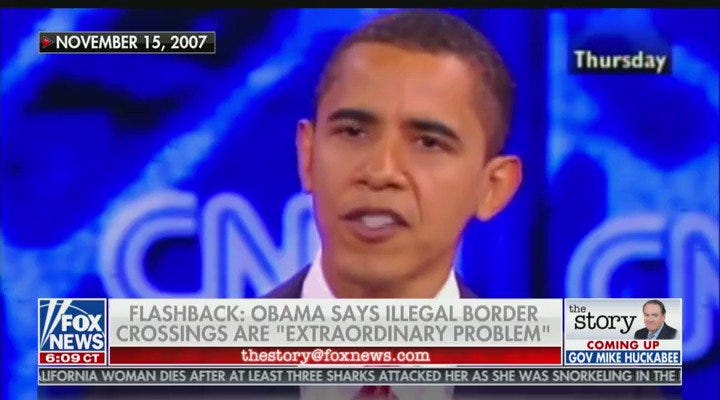
In fact, during the 2008 presidential campaign, Barack Obama explicitly criticised George W Bush for failing to enforce immigration law robustly enough, arguing that lax enforcement had fuelled illegal immigration. As Obama put it:
“We have a broken immigration system… and we haven’t done enough to secure our borders or enforce the laws on the books…”
He is on the record repeatedly and emphatically framing Bush-era enforcement not as excessive, but as insufficient.
Therefore unsurprisingly, the real transformation both in scale and in subsequent historical erasure came under Barack Obama. Between 2009 and 2016, more than three million people were deported from the United States, more than under any previous president and any president since. The Obama administration explicitly prioritised the removal of illegal immigrants with criminal convictions as Trump’s second administration is doing now.
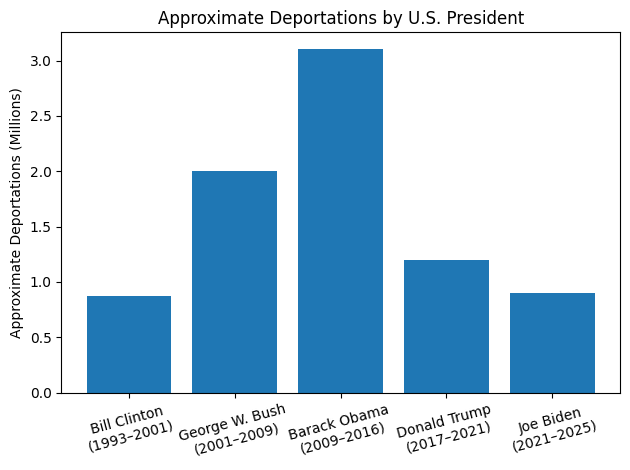
Sources: DHS Yearbooks of Immigration Statistics; Migration Policy Institute; ICE annual reports
Not only was this policy and direction not condemned, it was presented as proof of Obama’s success as President. His nickname “Deporter in Chief” was used not by Republicans but by Democrats wanting to show his strength on illegal immigration. And yet, within a few years, this entire enforcement record vanished from mainstream political memory. The policies and targets did not change, but at some point, acknowledging this history simply stopped being useful.
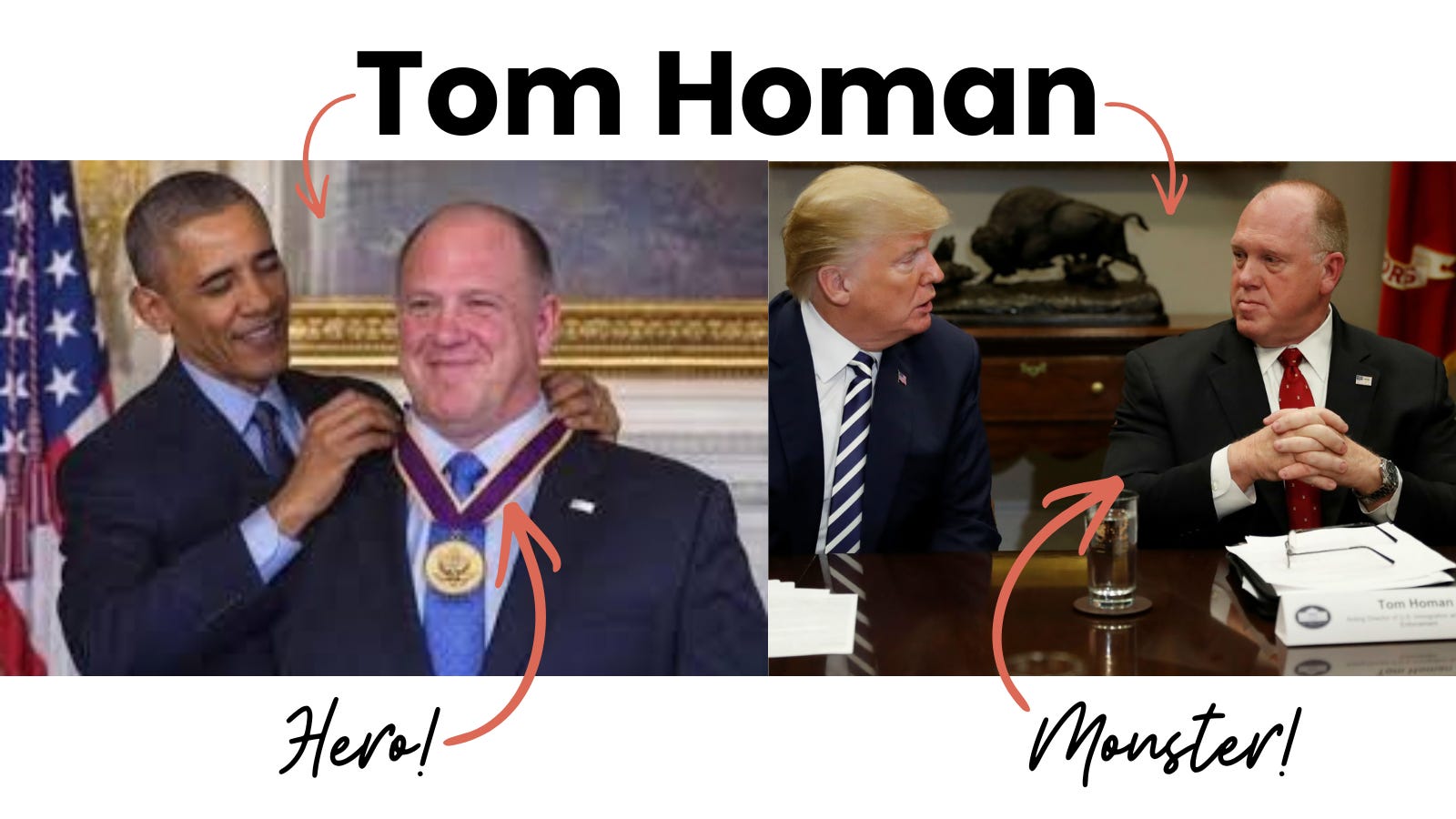
No figure illustrates this historical laundering more clearly than Tom Homan. In 2013, Obama appointed Homan as Immigration and Customs Enforcement’s Executive Associate Director of Enforcement and Removal Operations, the senior official overseeing deportations nationwide. Then in 2015, Obama awarded him a Presidential Rank Award as a Distinguished Executive, one of the highest honours available to a career civil servant. At the time, Homan was praised for leadership, professionalism, and effectiveness. Today, the same man is portrayed by Democrats and much of the media as a uniquely monstrous figure; an avatar of sadism whose very existence is treated as proof of moral collapse. The actions for which he was decorated are now cited as evidence of barbarism.
Perhaps America’s most ruthless and clinical political operative, Hillary Clinton is right in the thick of this collapse of truth. Like her husband, Clinton’s historical position on illegal immigration has not been ambiguous. As a senator, Secretary of State, and a presidential candidate, she supported deportation as a matter of law enforcement and national sovereignty. In 2008, she stated plainly:
“If you’re here illegally, you should be deported.”
In 2014, defending the Obama administration’s record, she said:
“The administration has deported more people than ever before. The message is clear: if you come here illegally, you will be sent back.”
At no point during these years did Clinton describe deportation as terror or enforcement as illegitimate. She described it as governance.
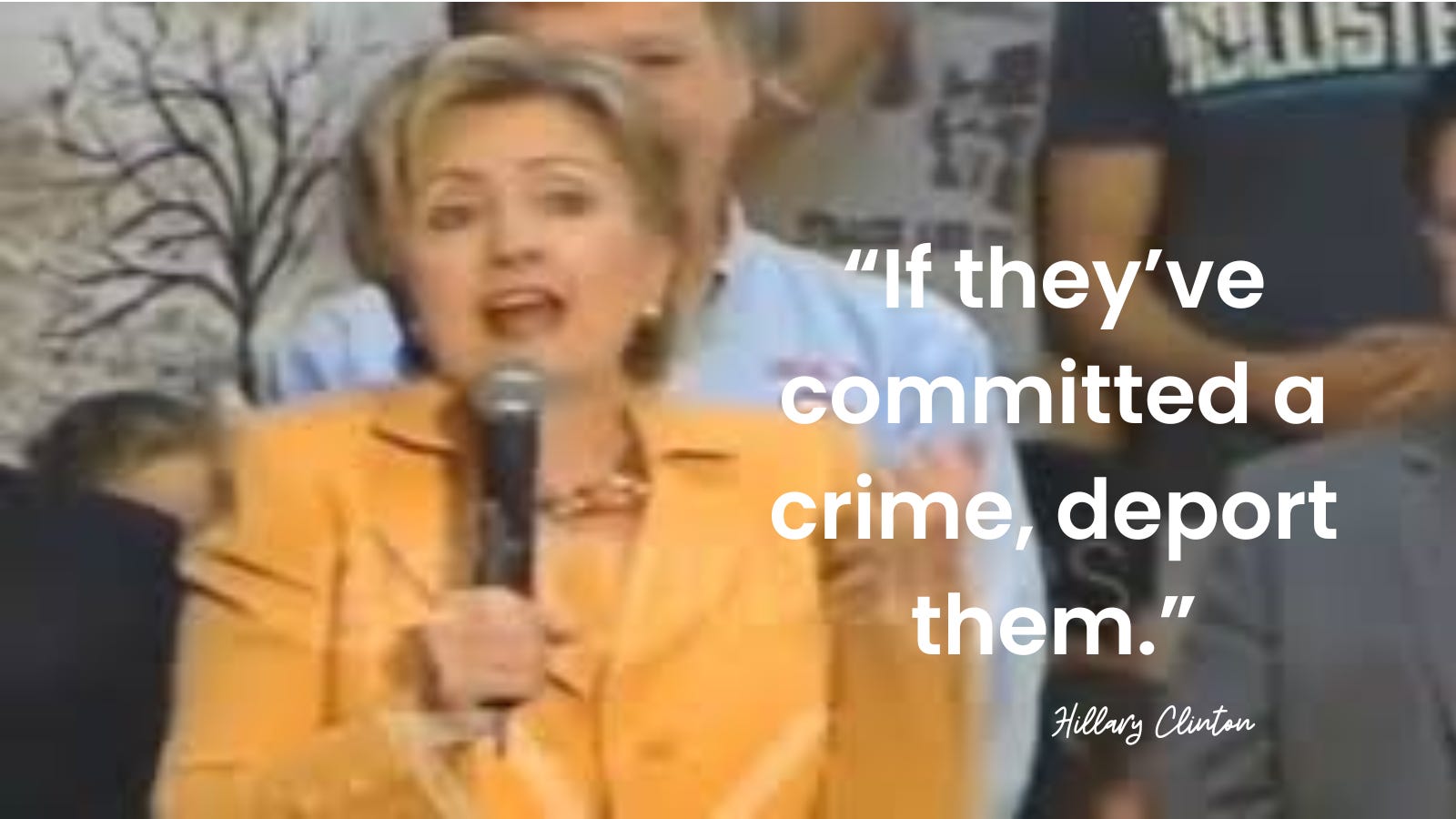
And yet, now, in January 2026, Clinton joined a coordinated campaign accusing ICE of “terrorising a population” and “using children as pawns” following an arrest in Minneapolis, despite the factual record directly contradicting that claim.
Hillary Clinton has not had a moral awakening. That is not why she holds a vastly different view on illegal immigration now. Nope. She has had a recalibration of incentives. It is now politically expedient to be anti-border enforcement because it allows one to be anti-Trump.
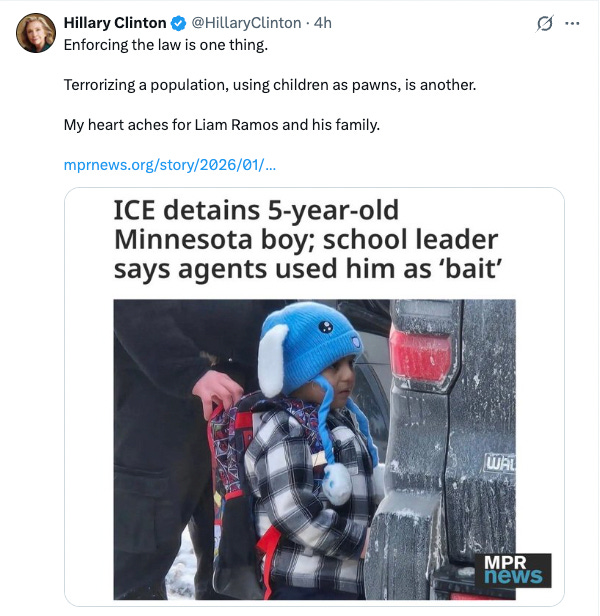
The above-mentioned Minneapolis incident deserves close examination because it is a textbook example of how truth is actively destroyed at pace.
An event occurs »> A factual sequence exists »> And yet within hours, that sequence is overwritten by a more politically useful fiction »> repeated with confidence by elected officials »> and laundered through a compliant media ecosystem.
According to repeated and consistent statements from Homeland Security and Immigration and Customs Enforcement, ICE conducted a targeted operation to arrest an illegal immigrant who had been released into the United States under the Biden administration. As agents approached, their target fled on foot, abandoning his five year old child. ICE officers did not pursue the child, but they did remain with him to ensure his safety while other officers apprehended his father. Officers then made repeated attempts to have the child’s mother take custody, explicitly assuring her that she would not be arrested, but she refused. It was at the father’s request that the child remained with him as he was detained.
This has been stated and reiterated multiple times by both DHS and ICE. There have been no shifting narratives, retractions, or deflection. Nor has there been any contradictory evidence produced. No body-cam footage has emerged showing a child being “used as bait.”
It has emerged that the mother of the child, who is pregnant, was in their home not far from the scene. She had a teenaged child with her. Agents made contact with her telling her that they wanted to hand over her child and she was not at risk of being detained. CNN has reported that it was neighbours who told her not to open the door and this mass mobilisation of busy-bodies has become a significant factor in the escalation of what should be straightforward law enforcement operations.
Homeland Security has said that once ICE agents realised the mother would not open the door, they took the little boy to a nearby McDonalds and played his favourite music in the car. The boy has now travelled with his father to an ICE facility but only because that is what his parents decided.
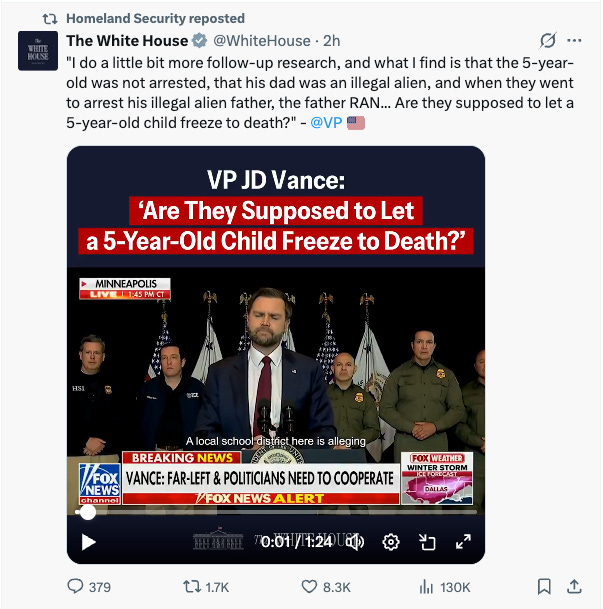
Click to view
And yet almost immediately, Democratic politicians and sympathetic media figures asserted without qualification that ICE had “arrested a child,” “used him as bait,” and “terrorised a family.” The language was confident and declarative. Democrat Representative Joaquin Castro publicly suggested the child was actually missing and announced inspections of detention facilities, amplifying the impression that ICE had effectively kidnapped a five year old.
ICE’s response was unusually blunt, but entirely understandable. The agency described the claim as “an abject lie” and stated unequivocally that the child had been abandoned by his father. Homeland Security reiterated that officers’ primary concern throughout the operation was the child’s safety not to detain him; they were looking after him. ICE went further, asking whether Hillary Clinton’s heart also ached for the thousands of families who have lost loved ones to violent criminal illegal immigrants.
That a false narrative spread is not particularly newsworthy, but the speed and ease with which it did is something to behold. As the saying goes:
“A lie gets halfway around the world before the truth has a chance to get its pants on.”
When you’re spinning a yarn there is no evidentiary threshold to clear or requirement to wait for verification. And, of course, a story that frames federal enforcement as monstrous is inherently more valuable than a boring truth involving procedure, custody refusals, and an adult fleeing responsibility. The narrative was set immediately by the Democrats and facts ceased to matter. Now as the federal government seeks to correct and clarify, their statements are the ones treated as propaganda.

The little boy at the centre of the propaganda wars.
Minneapolis is being used to frame the narrative of uniquely cruel operations and terror. However, what changed to produce the escalation in Minneapolis was not federal policy. ICE operations are occurring across the United States right now without incident. The difference is state and local obstruction. In most states, criminal illegal immigrants are transferred to ICE custody upon release from jail or prison, as has occurred under Democratic and Republican administrations alike. But, this time, Minnesota chose to deviate from these long held norms. Governor Tim Walz and Minneapolis Mayor Jacob Frey have not been shy about opposing ICE, bragging about their non-cooperation and framing routine enforcement as moral atrocity. When states refuse to hand over criminals at the point of release from prison, ICE must then conduct arrests in the community. These arrests are more visible, more confrontational, and easier to weaponise rhetorically. The responsibility for escalation should not be laid at the feet of local and federal enforcement. Rather it should be proportioned to the state elected officials who whipped their communities into a frenzy and deliberately impeded lawful operations.
This pattern of behaviour is not uniquely American, though Americans arguably practise it with a particular theatrical intensity. In New Zealand, for example, the Leader of the Opposition, Chris Hipkins, has launched election year by constructing an alternative economic reality; one in which inflation, fiscal deterioration, and cost of living pressures are treated as the sole fault of the government elected just two years ago rather than the predictable consequences of decisions taken by the government he led preceding that. His supporters will either buy this revisionism wholesale or they will be content to go along with the narrative because once the political contest is framed as a struggle between good and evil rather than competence and consequence, accuracy becomes optional.
The examples discussed here focus largely on the left attacking the right or centre-right because in both the United States and New Zealand, those factions currently hold power, and so they are the natural targets of opposition narratives. But I am not making the claim that the death of truth is a uniquely left wing responsibility. No faction is immune. All political actors lie when the incentives reward it, and all media ecosystems amplify narratives that flatter their allies and punish their enemies.
Lying is relatively low cost in modern politics. The news cycle moves too quickly for sustained accountability, corrections rarely travel as far or as quickly as falsehoods, and reputational consequences of lying are minimal. A misleading claim can dominate headlines for days while retractions and debunking, if they occur at all, are buried and quickly forgotten. Politicians understand this and so do journalists. The system rewards speed, outrage, and moral certainty, not accuracy, context, or historical memory.
The victims of this dynamic are not the politicians who deploy misinformation, nor the media organisations that profit from it. The victims are the public who are deprived of facts, manipulated by outrage, and left navigating a political landscape in which truth is not merely contested but actively undermined. This is why the metaphor of truth as a casualty is slightly misleading. Truth does not die accidentally or of natural causes. It is assassinated, early, efficiently, and without remorse.
Ani O'Brien comes from a digital marketing background, she has been heavily involved in women's rights advocacy and is a founding council member of the Free Speech Union. This article was originally published on Ani's Substack Site and is published here with kind permission.


17 comments:
Is NZ still contrbuting to the Clinton Foundation? Asking for a friend.
A brilliant assessment of the current deportation problem in the US and the history of how it was handled by former Presidents.
Let’s see how the lying MSM and Trump haters respond to this honest reporting of the facts.
They won’t because they can’t.
The Listener, the coffee table statement of the ''progressives'' is already labelling it as a moral conscience issue with a selective hand wringing narrative
How and when was ICE branded as terror? Simple: when they started terrorising people, including American citizens. Law enforcement that breaks the law just one symptom of a fascist state.
“The victims are the public who are deprived of facts, manipulated by outrage, and left navigating a political landscape in which truth is not merely contested but actively undermined”
The victims are Alex Pretti and Renee Good.
Growing up in an Irish Catholic family, politics has been part of my life since I was very small.
It took the rise of the Internet and the greater availability of dissenting views and alternative accounts of major international events, to make me realise that, over decades, we here had been propagandised at best, outright lied to at worst, by the news media which we thought we could trust. Nowadays, I don't read newspapers or listen to RNZ, and (when I watch it at all) I watch with scepticism what passes for news on TV. I take nothing reported by the msm at face value: I've made it a habit to search around the internet for countervailing stories. And they are there to be found.
To anonymous @8.26 and 8.39 (looks to be the same commenter), have you actually read the above article? I've read similar accounts online: you can also find them. Note that ICE operations of this sort are happening without incident all over the US. The trouble in Minnesota has been fomented, in part by the Democrat governor Walz.
Note, further, that large scale fraud by Somali migrants has been uncovered in that state. This is a huge scandal: the governor and officials would do well to pay attention to that and stop with the rabble-rousing.
The activities of ICE agents in the U S is obviously a matter for Americans, but most of the world is aghast at this great democracy has these groups of masked, heavily armed and armoured thugs shooting American citizens in the streets, including a mother of three being shot three times in the face while in her car, and a man causing no serious harm being beaten into the ground and shot dead in the back. Nowadays, with just about everyone carrying a cell phone able to take instant images and videos, these actions are recorded, and the situation is there for all to see. How inconvenient! Further, these act are extrajudicial and V P Vance has assured ICE agents that they will not be held legally accountable. The U S MSM is overwhelmingly condemning it.
No Mr Bibby. This is not a beat-up by the “lying MSM and Trump haters”. And yes, those that find what is happening on American streets objectionable can respond to it. Well, I have, anyway.
The facts are: ICE is a legitimate law enforcement agency. Many of these protesters are Antifa thugs inciting violence. Unfortunately, obviously they stirring up those who already suffer from TDS. The people targeted for deportation are illegal immigrants who of course could leave the country peacefully but choose not to. These are not legal immigrants. Many of them have gang affiliations. Law and order is ( undesirable as it seems for some ), necessary for a cohesive, functioning society. This is not about Trump. This is about the US citizens voting to end illegal immigration.
Informative and very valuable comment Ani. Sad about a couple of TDS commenters.
I wonder how things would turn out, if law abiding US citizens just stayed at home and stopped provoking ICE agents going about there business.
This is America after all.
Everyone's got a gun.
According to data cited by O’Brien, the Obama administration managed to deport around 3 million immigrants over a seven year period, around 430,000 a year. This is higher than any other recent administration, which O’Brien thinks is a good thing.
So where was the public outrage over Obama’s actions that Trump is now provoking for apparently doing even better? Where were the street demonstrations? Where was the media hysteria?
Seems to me the big difference between then and now is the motive of the incumbent President. Obama treated immigration compliance as a matter of law and order. He had a duty to deal with it and just got on with the job. People respected him for that.
But Trump has no concept of duty. Trump just sees immigration policy as a political cloak to cover his base motives of greed, self-aggrandisement and power seeking.
But that only works until you adopt the mantra that the ends justify the means. Perhaps shooting your citizens in the street helped drop the cloak and let the crowd see for itself that the Emperor has no clothes.
But how come he was able to promise a crack-down on immigration compliance in the first place? Easy. The Biden administration negotiated a bipartisan immigration bill that would have achieved the same end, only to have Trump order his goons in Congress to renege on their commitment at the eleventh hour and vote down the measure.
Why? Sheer self-interest, because it would deny Trump a key policy promise he needed for the upcoming election. And that, Mr Bibby, is an honestly reported fact that this particular Trump-hater is quite happy to point out when Trump falsely claims the credit for any improved deportation rates. So, remind me how much Trump’s net worth has increased during his first year back in office?
Journalist Andy Ngo did an article on this today. He managed to hack into Far Left chat rooms on Signal and saw a coordinated strategy directing agitators to get down to areas where ICE were apprehending a suspect and get in the faces of the ICE agents. The Far Left leaders want people to get themselves killed by agents so they are loving this.
The comment under "E" was mine. Ewan McGregor
I wonder which of the 10 shots fired at Mr Pretti as he lay prostrate on the ground actually killed him ?
Yes, 10 shots were fired at a human being lying on the ground.
Aides were also irked after Noem labelled Pretti a "domestic terrorist" and accused him of brandishing his legally owned firearm, a claim that wasn't backed up by video evidence.
In Chicago, Bovino was reprimanded by a federal judge who found his account of being hit in the head with a rock before deploying tear gas was not credible.
"Video evidence ultimately disproved this," said Judge Sara Ellis, who was presiding over a case concerning the tactics used by federal agents in Chicago.
"Defendant Bovino admitted that he lied," she said.
OK Jonesy and Ewan,
Given that l am instructed to be respectful when replying to your robust dismissal of my honestly held opinions about the true state of World Politics since Trump began his second term - an opinion apparently shared by most of the readers of this blog - l will attempt to satirise my final contribution to this discussion and hope you don’t find it offensive.
The late Sir Tim Shadbolt said it all really about entering into a fight unprepared for what you are about to encounter.
He of all people was quick to realise that if you want to arm wrestle with the big boys, you need to take a bit more to the table than “ bullshit and jellybeans”
Have a nice day.
Post a Comment
Thank you for joining the discussion. Breaking Views welcomes respectful contributions that enrich the debate. Please ensure your comments are not defamatory, derogatory or disruptive. We appreciate your cooperation.