

Michael Papesch does not fit the stereotype of an activist. He is methodical, careful, and appears not to be a man who enters easily into confrontation. He had a long career in the public service and has served on various boards related to renal health. His interest in organ donation is personal as he was first diagnosed with renal disease in 1996, was on dialysis in 2005-2006, and received a transplant in August 2006. Dr Paula Martin is equally more comfortable getting stuck in to policy work than tackling the world of politics. Her PhD thesis was on Increasing the rate of living donor kidney transplantation in New Zealand: developing an evidence base and it was she who donated her kidney to her husband Michael in 2006.
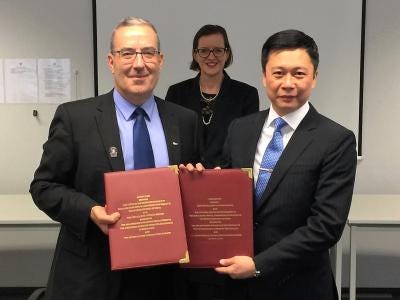
Michael Papesch (left) when working for NZ Customs.
Neither of these former public servants set out to challenge government agencies or become fixtures in parliamentary corridors. What they are, however, is persistent and unwilling to accept answers that do not withstand basic scrutiny. That is how they found themselves sitting before the Health Select Committee, asking questions that should have been easy for our health agency representatives to answer. Six years after Parliament passed legislation designed to fix New Zealand’s organ donation problem, and three years after funding was finally allocated to implement it, why are organ donation rates from deceased donors so low and still falling?
This is not a story of corruption and the couple do not allege it is. There are no Bond villains, brown envelopes, nor secret diversions of funds into private pockets. Instead, it is a story of something far more familiar and terribly common; a system that agreed change was necessary, legislated for it, funded it, and then quietly absorbed the entire reform effort into the machinery of business as usual. It is an example of public service implementation failure and the resulting obfuscation and deflection when questions are asked about what happened and why. And in the meantime, nothing changes. It is a tale as old as time of the public service beast.
As of 2024, New Zealand ranks 31st in the world for deceased organ donation, with roughly 13 donors per million population; a fraction of the rate achieved by countries like Spain and significantly below Australia, the United Kingdom, the United States, France, and most of northern Europe. This poor ranking translates directly into lives shortened or lost altogether in New Zealand. Our official kidney transplant waitlist sits at around 460 people, but that figure dramatically understates the true demand because New Zealand has very strict criteria to get onto the kidney transplant wait list. In 2021, Kidney Health NZ estimated that if everyone who is medically suitable were actually listed, the number would be closer to 900-1,000 patients.
There is a common misconception that dialysis is a sufficient solution to kidney failure, but dialysis patients live, on average, only five to six years. Kidney transplant recipients, on the other hand, live on average another fifteen to twenty. The quality of life is vastly different too. Dialysis is all consuming and incompatible with living a ‘normal’ life with a full time job, and the energy and time to enjoy social aspects of life. A kidney transplant allows for an extension of life span that is much, much closer to normalcy. Dialysis also costs the health system more than $115,000 per patient per year, while the per year cost of transplantation reduces to less than a quarter of that.
While kidney transplantation often dominates policy discussions because it can save the health system so much money, it is a mistake to treat other transplanted organs as somehow secondary or discretionary simply because they do not always deliver the same immediate fiscal savings. Heart, liver, and lung transplants are life-preserving interventions and without them, patients die. Corneal and pancreatic transplants can vastly, vastly improve quality of life, while skin, bone, and tissue donations transform the degree of recovery after trauma, burns, or cancer. These transplants may not neatly offset their costs in Treasury spreadsheets, but they deliver additional years of life that would otherwise not exist, and lives lived with dignity rather than decline.
None of this is new information. Nor is it contested. Which makes the failure of successive governments to address the failings in our systems so much more frustrating.
In 2017, after years of underperformance and mounting concern, the Government released Increasing Deceased Organ Donation and Transplantation: A National Strategy. Developed with sector experts and grounded in international best practice, it identified clear priorities of national leadership, improved hospital capability, better data systems, and stronger public and clinical engagement. In 2019, Parliament unanimously passed legislation to turn the New Zealand Blood Service into the New Zealand Blood and Organ Service, tasking the NZ Blood Service with leading implementation. MPs across parties warned at the time that without proper funding, the strategy would fail and sadly those warnings proved prophetic.
Funding to start delivering on the Strategy did not arrive until Budget 2022, when Associate Health Minister Peeni Henare had $2 million allocated, rising to $3 million per year from 2023/24 onward. This was specifically tagged for implementing the 2017 Strategy. Although questions remain whether this funding was ever going to be sufficient, it should have meant all systems a go. However, despite finally getting at least this level of initial funding, there seemed to still be road blocks at every turn and little improvement.
When Michael started asking questions a couple of years later about what had happened with this funding, a very disappointing picture emerged. The vast majority of the funding had not been used to implement new strategic initiatives at all. Instead, it had been absorbed into reinforcing existing Organ Donation New Zealand operations; staffing, rosters, administration, communications, and legal advice.
Organ Donation New Zealand is the coordination and logistics function that makes donation possible. It is their role to identify potential donors, support families at moments of unimaginable grief, liaise with intensive care units, and orchestrate the complex clinical and transport arrangements that allow organs to be retrieved and transplanted safely.
This function had been transferred in 2020 from Auckland District Health Board to the New Zealand Blood and Organ Service, consolidating key organ donation functions in one organisation. But the funding transferred alongside the staff and responsibilities was never sufficient to properly support the role. As a result, when new money was later allocated to implement the 2017 Strategy, it was quietly absorbed into propping up an underfunded core service rather than driving the system change Parliament had intended.
Organ Donation New Zealand’s work is essential. On this Michael and Paula are clear. But the Government did not approve funding to maintain the status quo and boost its baseline budget; it funded it to implement change in the system. But that is exactly what happened.
Michael and Paula have spent years trying to rectify the situation. With their personal experience and professional backgrounds in public service, policy, and health, they worked through official channels. In July 2024, Michael submitted Official Information Act requests to NZBOS. Initially he asked for Board papers regarding the implementation of the reform, but was told that there were no Board papers beyond December 2022. So he asked for papers submitted to the Senior Executive Team, and the Chief Executive, only to be told the same thing. He did manage to see the quarterly reports to the Ministry of Health on the baseline activities of ODNZ, which, it turned out, did not discuss the 2017 Strategy at all.
What he discovered was there was not a single document setting out delivery. He found no clear targets and no reporting framework tied specifically to the 2017 Strategy. In the end Michael asked NZBOS to fill in a table setting out how much money had been spent on stabilising the activities of ODNZ, and how much had been spent on the new activities required to implement the 2017 Strategy. He learned that more than $3.6million in a single year went to clinical and administrative staffing alone and only $320,000 was spent on a genuinely new initiative, a donor referral system, with no publicly reported evidence of impact.
In internal correspondence released under the OIA, NZBOS itself acknowledged that the Budget 2022 funding was “not sufficient to fund strategy implementation” and had instead been used to stabilise staffing of the existing ODNZ services. If the funding was never sufficient to implement the strategy Parliament had approved, why was that not made explicit at the time? Why was money allocated under the banner of reform effectively redirected into maintenance without Parliament being told that the reform itself would now not occur?
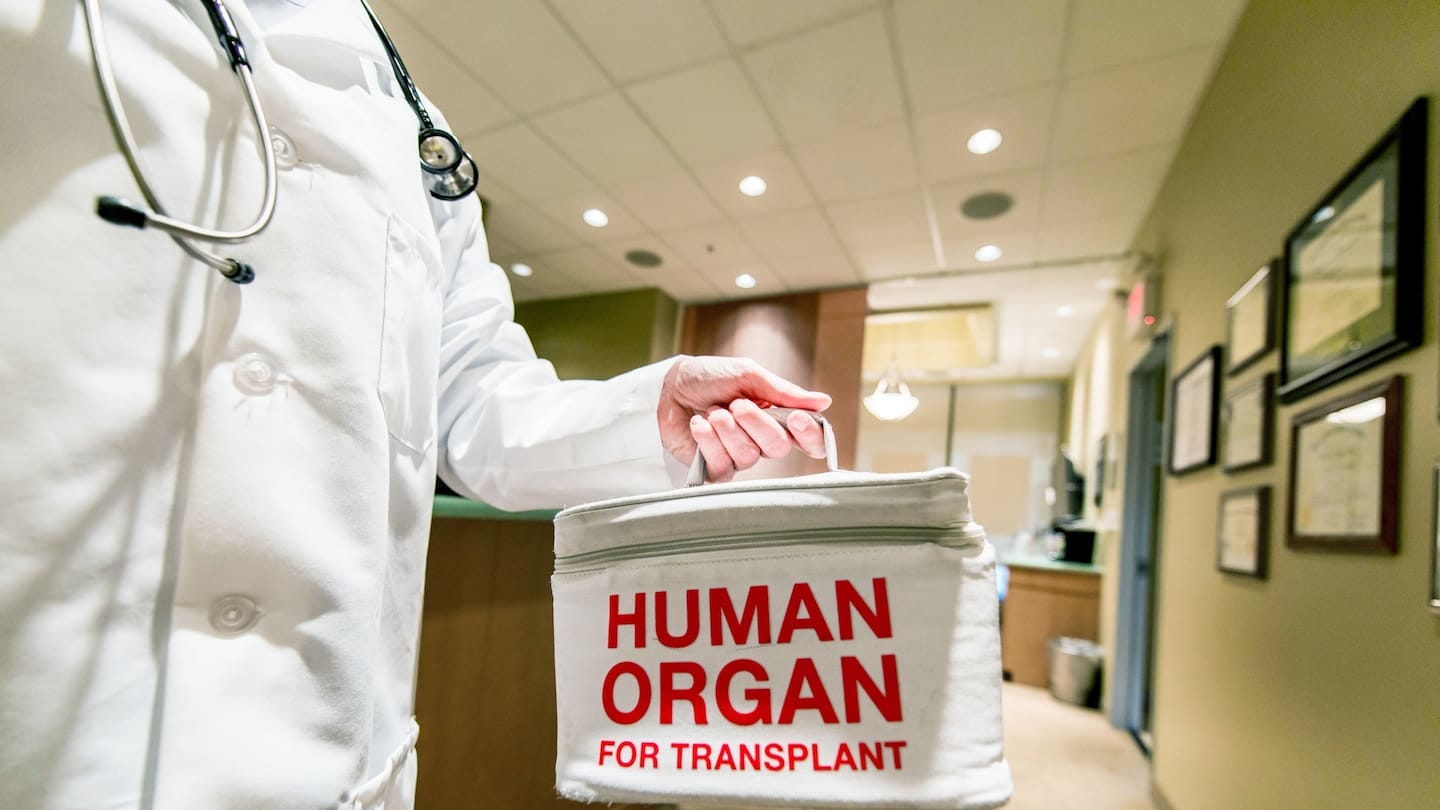
In November 2024, Michael formally wrote to Parliament’s Health Select Committee requesting a cross-party investigation into the failure to implement the strategy and the apparent repurposing of its funding. He laid out the timeline for the MPs clearly charting the strategy released in 2017, legislation passed in 2019, funding approved in 2022, and showed that nonetheless donation rates continued to decline.
By June 2025, Michael and Paula appeared before the Committee in person, telling the members of Parliament that six years after passing legislation and three years after funding, they should be analysing results, but instead Parliament must confront the fact that nothing has happened at all.
Not wanting to politicise the matter given it has crucial bipartisan support as an issue, Michael and Paula have been careful not to personalise blame and have kept their arguments structural. They have repeated the simple facts that Parliament approved reform, money was allocated for reform, but implementation has stalled and there was no meaningful monitoring of whether reform occurred.
In early December 2025, they took the same messages to Minister of Health Simeon Brown. As is the case when getting a meeting with a very busy minister the meeting was short. They spent a fair amount of their time trying to recover from the fact that while the Ministry of Health had managed to get its own briefing material to Simeon Brown, none of the material prepared in advance by Paula and Michael (nor the letters of support from the Australian and New Zealand Society of Nephrologists, and Kidney Health NZ) had been passed on to him. But despite the time constraints, both Michael and Paula came out of the meeting optimistic. They found the minister engaged and felt that he seemed to grasp the situation quickly.
A couple of weeks later, Michael and Paula were back at the Health Select Committee to watch health officials give evidence. Committee Chair National MP Sam Uffindell opened the meeting by clearly stating the problem:
“we had a strategy back in 2017. We haven’t seen it implemented. we want to make sure that the reasons it wasn’t implemented are addressed so it doesn’t happen again and then to move forward, right? Because we need to deliver better outcomes for Kiwis.”
First to speak were Alison Bennett, Ministry of Health General Manager of Health Systems Strategy, NZ Blood and Organ Service Chief Medical Officer Dr Sarah Morley, Health New Zealand Chief Medical Officer Professor Dame Helen Stokes-Lampard, and Health New Zealand Director of Strategy, Planning & Purchasing, Hospital & Specialist Services Rachel Haggerty.
Alison Bennett began by acknowledging that:
“whilst we have a strong, clear strategy, we haven’t delivered as intended and still have one of the lowest donation rates internationally.”
Dr Sarah Morley then admitted things are going backwards and that when families are approached about organ donation only about 30-40% consent which is down from 40-50% “in the relatively recent past” while in Australia and the UK it tends to be 50-60%.
She also thanked Michael for raising the issue as they agree it “is a critical one for us and I think it is becoming more critical”.

Click to view
National MP Dr Carlos Chung kicked off the questioning with a pointed query:
“Just now you mentioned the donation rates are dropped because we have a lower rate of family consent. Correct? But I look at your strategies in 2017. I think one of the things to improve how people registered and share their donation intention with families and clinicians. What approach have you actually done in the last eight years to improve the system?”
The answer he received was that some leaflets had been made, but that they would like a better registration system “but we don’t have funding at the moment to deliver that”.
Dr Chung pushed back saying that his question had not been answered and repeating “what work did you actually do? You keep saying we do a lot of work to improve that, but you can’t even mention anything…”
The response again came back to funding. The panel of public servants, likely with all the best intentions, were a demonstration of how the inertia of public service and its convoluting “collaborations” are an impediment to achieving anything.
Doggedly attempting to elicit some kind of definitive answer, Dr Chung eventually asked “So what is the timeline to implement the changes? With appropriate funding”. He was told setting up a new registry would take about a year and, again, “but as I say, we don’t have the funding”.
Chair Sam Uffiindell then stepped in saying although he did not want the meeting to turn into a “witch-hunt,” there were funds appropriated:
“So you’re saying it’s about funding, but there was funds that were put aside but it appears the funds that were appropriated for new services were not spent on new services. They were spent on existing logistics and coordination services.”
More bureaucratic excuses and frankly difficult to follow justifications were offered up, but it was abundantly clear that no one in the system would be taking responsibility for the evaporation of the funds.
Dr Ayesha Verrall also picked up on the line of questioning asking the officials to “please explain”. Bizarrely, despite the acknowledgment of the matter earlier, Labour’s health spokesperson got a refutal from the panel: “I don’t think we consider that it is true that it was used for processes that it was not appropriated for.”
But Dr Verrall was having none of it. She interjected, reading directly from their own documentation. She also pointed out that they currently have no plan to raise public awareness or understanding. The public servants answered that they had employed some communications staff. She continued to push back pointing out that:
“the committee’s support for further funding for this important initiative does depend on our ability to have confidence that it’ll be spent on the purpose for which it was intended.”
The uncomfortable grilling continued with National MP Dr Hamish Campbell asking what exactly we had spent millions of dollars on when in 2017 there were 73 deceased organ donors and last year there were 70. Interestingly, a new excuse emerges with this and one of the panel noted that:
“one of the key areas that is prominently in discussion in international evidence around organ donation for instance is the impact that first COVID and then subsequently seems to have continued around public trust in healthcare and public systems”.
Having spent so many years as public servants themselves, Paula and Michael were struck by the extent of responsibility-dodging on display from the panel of health officials. At moments, officials appeared willing to acknowledge that funding had not been used to implement the 2017 Strategy as intended, and even to concede that performance had been poor. But these acknowledgements were repeatedly followed by abrupt reversals; denials that cast doubt on the very facts Michael had placed before the Committee, supported by material released under the Official Information Act.
By the end of the meeting, the Ministry of Health was insisting that the money had been spent “appropriately” and that all but two of the Strategy’s priorities had been achieved, a claim difficult to reconcile with the documentary evidence. Faced with persistent questioning and an increasingly uncomfortable paper trail, the familiar processes of obfuscation and deflection took hold. Answers became vague, accountability blurred, and reassurance replaced explanation. It is hard to see how Select Committee members could have emerged any wiser, but officials seemed determined to leave them with a carefully managed conclusion that there was, ultimately, nothing to see here.
The committee concluded with ACT MP Cameron Luxton appearing to upset the public servants by pointing out their inconsistencies and buck passing. Michael expresses a shared frustration with this. He is determined to see the 2017 strategy implemented, but fears that any funding allocated might be quickly absorbed again. He questions “what is going to be different this time?”
The tragedy of this situation is that this failure is not down to political disagreement which is so often the case. It offends no constituency. There are no ideological landmines here, no culture war flashpoints. And yet, year after year, the system drifts.
It is also a tragedy that the 2017 strategy outlines measures that would save the Government a lot of money in the long run. It makes economic sense to facilitate more organ donations. The New Zealand Institute of Economic Research report commissioned by Kidney Health New Zealand in 2021 makes it abundantly clear that increasing kidney transplantation is one of the rare health interventions that saves lives and saves money. It estimated savings of nearly $400,000 per transplant over six years and more than $500,000 over twenty.
The report also identified the core barriers not as public reluctance or medical uncertainty, but fragmented leadership, an inability to shift funding across time, and the absence of national ownership and accountability. Observing international experiences also reinforces the necessity of addressing these problems. Countries that improved donation rates invested in leadership, hospital-based specialists, data systems, and accountability. New Zealand has acknowledged all of this repeatedly in strategies, in debates, in official advice, and then failed to act.
Michael and Paula’s recommendations are modest. They ask for explicit ministerial direction to implement the existing 2017 strategy, properly costed funding, governance oversight with delivery expertise, and transparent reporting to Parliament. None require new legislation nor a costly new strategy. All require someone in authority to decide that agreement must finally translate into action.
New Zealand’s organ donation crisis is not a mystery. Michael and Paula did not set out to expose that gap. They tried, for years, to close it quietly within the system. For them, this is not about blame. It is about responsibility. Because every year we delay, more New Zealanders die waiting, not for a miracle, but for a plan we already agreed to carry out.
Ani O'Brien comes from a digital marketing background, she has been heavily involved in women's rights advocacy and is a founding council member of the Free Speech Union. This article was originally published on Ani's Substack Site and is published here with kind permission.


4 comments:
I removed my 'donor' status from the system during the commie's term.
There is no way any of my bits are going to a
-commie labour
-green
-tea partly murri
If I was to 'look about' and 'match', I can get quite the holiday and recompense around the world.......?
Too many people in too many jobs simply do not do the work. Instead they set endless meetings, commission endless reports, go through endless consultations, etc. But they claim all these actions are productive activities! And in NZ managers making bad decisions are rarely held to account. In the real world they would be summarily fired. In NZ they often are promoted or obtain lateral positions in some other organizations....
The UK and the USA have higher organ harvesting rates because they’re opt-out systems. As in everyone’s organs are for the picking unless you explicitly opt out in writing well in advance. We shouldn’t be comparing their organ harvesting programmes to the local organ donation programme. They’re fundamentally different beasts.
I am a live kidney donor myself way back in 1994 to my brother that lasted him 15 years. My other brother donated his in 2009 and it is still going strong thankfully, as he has run out of brothers now.
Ani your article is a classic example of Government Departments not handling some things well.
Maybe it is time to bring the donor responsibility back into private enterprise and run it by the Kidney Donor Foundation and employ where possible people with actual experience. I am too old for that now but I am sure with a little effort we could achieve better results than you have outlined Ani?
Post a Comment
Thank you for joining the discussion. Breaking Views welcomes respectful contributions that enrich the debate. Please ensure your comments are not defamatory, derogatory or disruptive. We appreciate your cooperation.