

The report from the second phase of the Royal Commission into New Zealand’s COVID-19 response was released this week and much of the media treated it as little more than a historical tidy-up. The dominant narrative has been the ol’ New Zealand did well early, ministers were under pressure, mistakes were inevitable but no big deal. But the report contains findings that deserve far more scrutiny. It raises serious questions about the extended Auckland lockdown, the legality of the Christmas boundary, and the roughly $60 billion spent during the pandemic of which around $30 billion of which was not directly related to COVID response measures.
Most explosively, the report reveals that officials warned about myocarditis risks associated with the second Pfizer dose for 12–17-year-olds and advised that mandating two doses for under-18s was not justified. Winston Peters attempted to get answers via questions to now-Health Minister Simeon Brown who is in charge of the report. But the media have completely ignored the fact that Chris Hipkins has been caught out in a significant lie and not asking any questions. New Zealand First have called for a select committee inquiry into vaccine injuries.
You can read my reaction to the report here.
And my frustration with the media here.
A looming fuel problem
With the Iran war disrupting global oil markets and pressure building around supply routes, the Government has begun dusting off contingency plans for what a genuine fuel emergency would look like including purchase limits, restrictions on filling containers, altered petrol station hours, and in more serious scenarios, coupon-based rationing or fuel reserved only for critical services. Ministers insist we are not there yet, with around 50 days of fuel either onshore or on the way, and MBIE says the country is still only at Level 1 of the National Fuel Plan.
Even so, Air New Zealand has cancelled around 1100 flights affecting roughly 44,000 passengers, fuel prices are climbing, some petrol stations have run dry after heavy demand, and jerry cans are reportedly flying off the shelves. That does not mean we are about to relive Muldoon-era carless days, but it does mean New Zealand is getting a sharp reminder that when you rely almost entirely on imported refined fuel, global chaos becomes a “you” problem.
Labour’s curious reshuffle
Chris Hipkins reshuffled Labour’s caucus this week and, as always, the movements tell you something about the internal dynamics of the party.
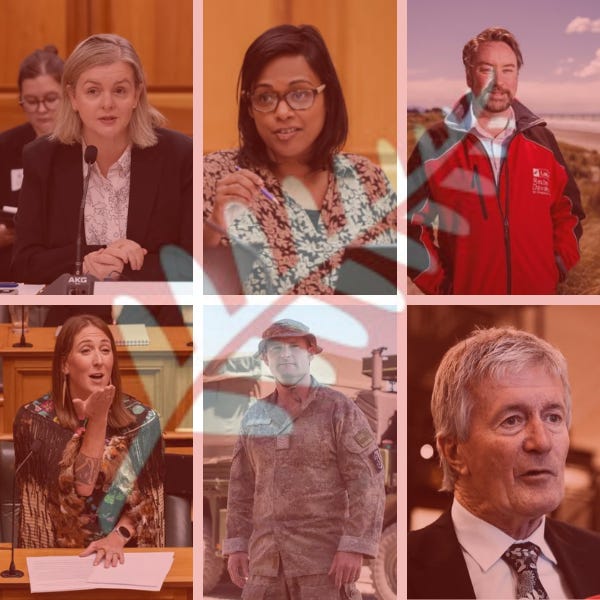
Vanushi Walters has jumped up the list and will take over Foreign Affairs, NZSIS and GCSB. Camilla Belich steps into Justice. New MPs Georgie Dansey and Dan Rosewarne have been given portfolios to match their demographics: “rainbow issues” and “rural communities” respectively.
Damien O’Connor has picked up the Defence portfolio while retaining Trade, alongside Associate Foreign Affairs. This raises eyebrows given O’Connor’s social media history of reposting commentary suggesting Palestinians had the right to do “whatever they did on October 7th,” sharing interviews with Hamas leader Yahya Sinwar, and describing the Israeli Defence Force as an “occupying force.”
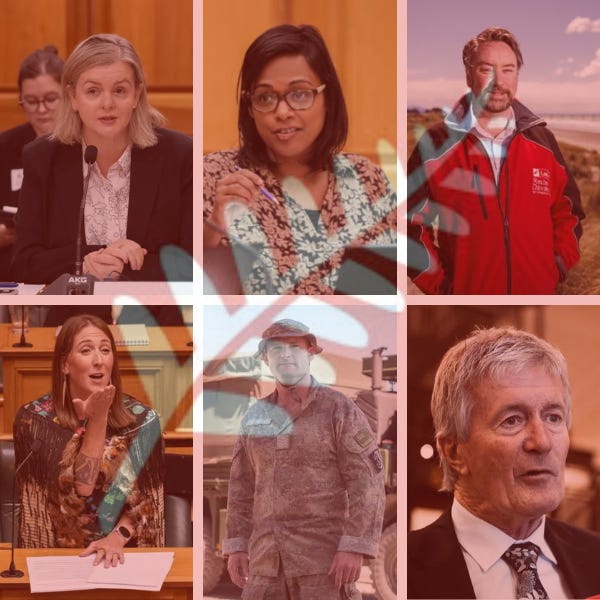
Reuben Davidson, whose pre-politics career included producing the children’s show What Now and who is the step-son of former Labour Minister Lianne Dalziel, has been handed the Economic Development portfolio. Ginny Andersen has taken over Education after Willow-Jean Prime (finally) lost the role, adding it to Police, Jobs and Income, and Treaty Negotiations.
But the most curious aspect of the reshuffle may be what didn’t happen. Deputy leader Carmel Sepuloni has a relatively narrow set of portfolios with Auckland issues, Women, and Pacific Peoples. Historically Labour deputy leaders have held heavyweight briefs like Finance (Michael Cullen, Grant Robertson) or, in Kelvin Davis’ case, Corrections and Crown–Māori Relations.
Sepuloni arguably has the most obvious background in caucus to hold Education. She has graduate and postgraduate teaching qualifications, worked as a teacher, and spent years working in the education and social sectors before entering Parliament. Instead the portfolio went to Andersen, who already carries a substantial load. Which raises obvious questions: why keep your own deputy on the sidelines when she has the experience to carry one of Labour’s most important portfolios? and Is Hipkins signalling he doesn’t see her as a policy heavyweight or keeping a potential rival from building profile?
Mariameno Kapa-Kingi is victorious in the High Court
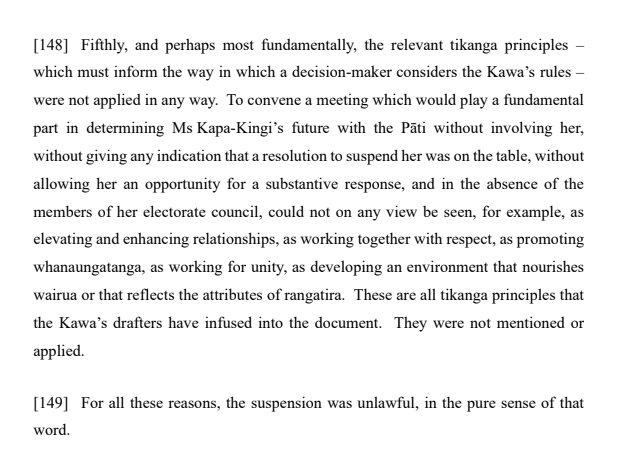
This week the High Court ruled that Mariameno Kapa-Kingi’s suspension and expulsion from Te Pāti Māori was unlawful, finding the party had breached its own constitutional processes and natural justice. The judgment means she must be reinstated as a member of the party, but the legal victory hasn’t necessarily resolved the political fallout.
Kapa-Kingi herself has made it clear she hasn’t yet decided whether she will actually rejoin the party caucus, saying the decision will depend on discussions with her Te Tai Tokerau electorate and a process of hohou te rongo (restorative dialogue) with the party leadership. She has indicated she intends to remain an MP regardless, leaving open the possibility of continuing as an independent if reconciliation fails.
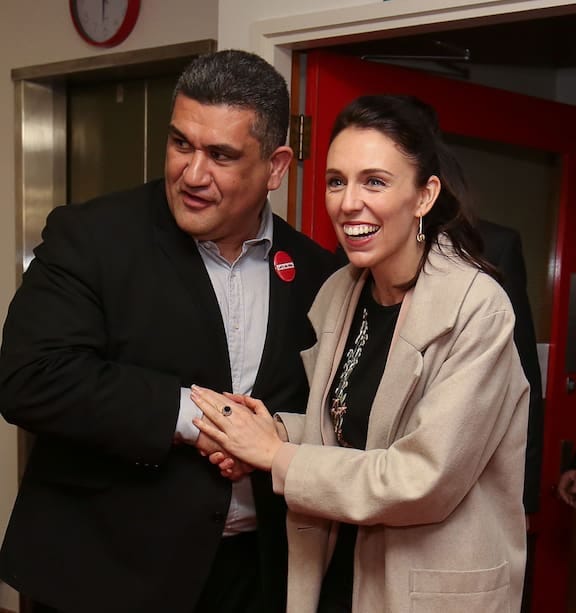
Kapa-Kingi’s son Eru has been openly critical of the party’s leadership and this week posted an Instagram story tagging former-Labour MP Peeni Henare, saying “see you soon cuz”. It’s the kind of cryptic message that inevitably sparks speculation in political circles about whether new alliances, or at least new conversations, are forming across Māori political factions. For a movement that has already endured suspensions, expulsions, and a by-election in the past year, the drama clearly isn’t finished!
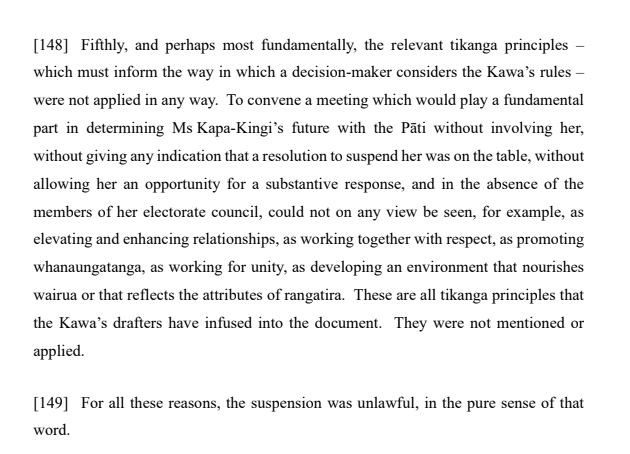
Click image to view - from the ruling.
The Eagle has laundered (hat tip: truereckons1)
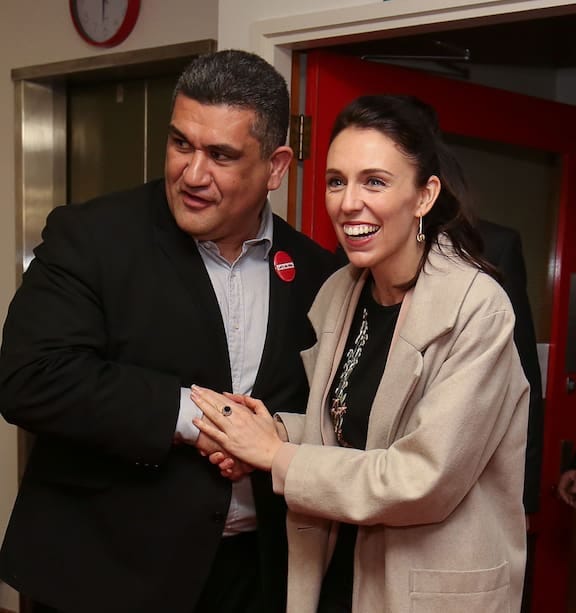
Former Labour MP Paul Eagle (though you could be forgiven for missing the Labour part, given some of the media are treating it like it was disclosed under Chatham House Rules) is now at the centre of a nasty and fast-expanding scandal. The former Rongotai MP turned Chatham Islands Council chief executive was found by the Auditor-General to have misled an official investigation into his spending by creating and altering documents, including contracts and records. Eagle has said he “panicked” and with the Serious Fraud Office now considering the findings that panic likely just got worse.
The Auditor-General described his conduct as “unacceptable” and “misleading” and the report details a $460,000 upgrade of Eagle’s council house, including high-end appliances, questionable consultancy spending, conflicts of interest involving his wife, and serious failures of transparency and oversight.
There may also be more to dig into from his final years in Parliament judging by this old Cranmer tweet. Eagle’s expense disclosures show some very noticeable spikes in travel spending, including during the period he took leave to run for Wellington mayor, and again in 2023 when he was not standing for re-election.
Ex-Cop who fell for “Gangster Dude” appears in court with new man
Former police constable Summer Smith has been sentenced to prison after leaking sensitive police intelligence to her boyfriend who just happened to be a member of the Killer Beez gang. “Boyfriend” might be a stretch though. She eventually told police (her colleagues, I guess) they were “in a sexual relationship and saw each other about once a month.”
Smith told the court she had learned her lesson after the whole unfortunate episode involving confidential databases, organised crime, and what she memorably described to the court as falling for a “gangster dude.”
Unfortunately, the rehabilitation narrative she was spinning for the judge was derailed somewhat by a slight complication… You see, former-constable Smith turned up to sentencing with a new boyfriend… who is a patched member of Black Power.
Still, credit where it’s due, she has clearly moved on. Just not, apparently, very far away from the gangs.
Defence Force’s Te Ao Māori makeover paused after Minister discovers it exists
Defence Minister Judith Collins has slammed the brakes on the New Zealand Army’s new bicultural policy after it emerged the military was in the middle of a fairly sweeping cultural makeover. The policy aimed to embed te ao Māori frameworks into Army culture, with leadership expectations (eg required to be promoted) that reportedly included learning waiata, reciting pepeha, performing karakia and incorporating tikanga into everyday military life.
This was all part of a broader vision of the Army as Ngāti Tūmatauenga the “iwi of the god of war” an idea that has floated around the Defence Force for years but which the new policy appeared to formalise in ways that caught some people by surprise. Not least the Defence Minister, who reportedly only discovered the changes after coalition partners started asking pointed questions.
At first the Army said it had only paused a “cultural skills framework.” Shortly afterwards it became clear the entire bicultural policy was on ice suggesting some crossed wires somewhere between Wellington and Waiouru.
Britain starts dismantling jury trials
Britain has taken another step towards gutting one of the oldest protections in the common law tradition, with Labour’s Courts and Tribunals Bill passing its first hurdle despite dissent from its own MPs. The woeful justification is that the courts are clogged, the backlog is intolerable, victims are waiting too long, therefore an ancient safeguard must be trimmed for efficiency. Under the plan, people accused of offences carrying likely sentences of under three years could increasingly be denied trial by jury and shuffled instead before magistrates. In other words, the state has made a mess of the justice system through chronic underfunding and mismanagement, and the proposed solution is to give the public less justice.
What has made the debate especially ugly is the way victims were wheeled out as moral cover for the policy. Labour MP Charlotte Nichols, speaking publicly for the first time about being raped, delivered a devastating rebuke to her own side, accusing ministers of using women like her as a “cudgel” and saying survivors’ experiences were being “weaponised” to sell reforms that are not actually about helping rape victims.
Then there was Conservative MP (and barrister) Sir Geoffrey Cox’s speech; an excellent defence of jury trials as one of the few institutions that stands between ordinary citizens and state power. He called it a safeguard against oppression, a point of common ground above ideology, and warned that once you start degrading these old protections for the sake of administrative convenience, you are not modernising the justice system, you are cheapening it.
Watch Sir Geoffrey Cox’s speech.
It’s a bad time to be an Ayatollah
The war between Iran, the United States, and Israel has entered a volatile holding phase after the initial wave of strikes that killed Iran’s Supreme Leader Ayatollah Ali Khamenei and triggered a broader regional escalation. US and Israeli forces have continued targeted strikes on Iranian military infrastructure, while Iran has retaliated with missile and drone attacks on Israeli targets and Gulf states hosting Western bases. Much of the global anxiety now centres on the Strait of Hormuz, the narrow shipping route through which roughly a fifth of the world’s oil normally passes. Shipping disruption and Iranian threats to keep the strait effectively closed have already pushed oil prices sharply higher.
The life expectancy of an Ayatollah has rapidly diminished in recent weeks and Khamenei’s son Mojtaba Khamenei, hastily installed as Supreme Leader after his father’s death, has reportedly already been injured and has not appeared publicly. Some reports have said he is in a coma. In practice, analysts believe the Islamic Revolutionary Guard Corps (IRGC) is now driving Iran’s military response. For now the conflict appears likely to remain a high-intensity air and missile war rather than a ground invasion, but the biggest risk is Iranian miscalculation like another large strike on Gulf infrastructure, US forces, or shipping could quickly pull more regional players into the conflict and deepen the global economic fallout.
The war time forgot: Ukraine makes new friends
Ukraine is still locked in a grinding war with Russia more than four years after the full-scale invasion, with large parts of eastern and southern Ukraine occupied. Ukraine has developed significant expertise in defending itself against the massive wave of Iranian-designed Shahed attack drones Russia has used throughout the war with more than 57,000 reportedly having been launched at Ukraine so far. That experience has unexpectedly made Ukraine a valuable partner elsewhere. Ukrainian military teams have recently been deployed to Qatar, the United Arab Emirates, Saudi Arabia and a US base in Jordan to help defend against Iranian drone attacks in the Middle East, using the techniques they developed. Kyiv is hoping to turn that expertise into leverage, asking allies in return for more air-defence systems which it urgently needs to stop Russian ballistic missile strikes.
Cuba on the Brink
Right now Cuba is in the middle of one of the worst economic and humanitarian crises it has faced since the collapse of the Soviet Union. The country is dealing with severe fuel shortages, failing infrastructure, and an ageing power grid that has left millions facing blackouts lasting 12–20 hours a day, along with shortages of food, medicine, and basic services. Protests have broken out in several cities as people bang pots in the streets demanding electricity and food, while the government has responded with arrests and tight control of information. The crisis has worsened recently because Cuba lost much of its oil supply from Venezuela and because of ongoing economic pressure and sanctions from the United States.

The US has been increasing pressure on the Cuban government. Trump has publicly said the country is “running on fumes” and hinted that the US might support major political change. This has lead to some Cuban dissidents and activists, both inside Cuba and in exile, to appeal directly to Trump to keep pressure on the government and help bring down the communist system. In the middle of worsening shortages and repression, some people on the island have gone as far as begging for US intervention, believing outside pressure might be the only way to force political change.
This week in Islamic Conquest
In Britain, Labour-run councils have been circulating school guidance warning that children’s drawings may be considered “idolatrous” or even blasphemous under some interpretations of Islam, and cautioning that music and dance classes may also conflict with religious sensitivities. The guidance is dressed up in the soft language of “cohesion” and accommodation, but British schools are clearly being coerced into bending the (knee) curriculum around religious prohibitions rooted in sharia and hadith traditions.
Meanwhile in the United States, a former National Guard member and convicted ISIS supporter, Mohamed Bailor Jalloh, carried out a terror attack at Old Dominion University in Virginia, shouting “Allahu Akbar” before opening fire in what the FBI is treating as an act of terrorism. He killed one person and injured two others before students physically subdued and “rendered him no longer alive”, almost certainly preventing a much larger massacre. The FBI said the terrorist was not shot, but his cause of death has not been publicised.
And in New York, two men, Emir Balat and Ibrahim Kayumi, were charged after throwing homemade bombs at an anti-Islam protest outside Mayor Zohran Mamdani’s residence, with police saying the attack was ISIS-inspired. To be very clear, this was not anti-Muslim protesters lobbing bombs at Zohran Mamdani’s house as media first suggested. It was two Islamist extremists throwing bombs at demonstrators who oppose Islam.
NSW Foster System leaves kids with convicted triple killer
Authorities in New South Wales have apologised after it emerged that two foster children, aged 12 and 14, were placed in a home with convicted triple killer Reginald Arthurell, who now “identifies as” Regina Arthurell, despite the Department of Communities and Justice reportedly knowing about the situation since December. Arthurell, who was convicted of murdering a partner in 1995 after previously receiving two manslaughter convictions, had been staying in the home after being invited there by an elderly woman he met in hospital, before the woman’s daughter alerted authorities over safety concerns. Police eventually raided the property and removed the children, prompting a government apology and a review into how a system designed to protect vulnerable young people allowed them to be living with someone a judge had previously warned had “unequivocally demonstrated a proclivity to violently terminate the lives of fellow human beings.”
Chart of the week
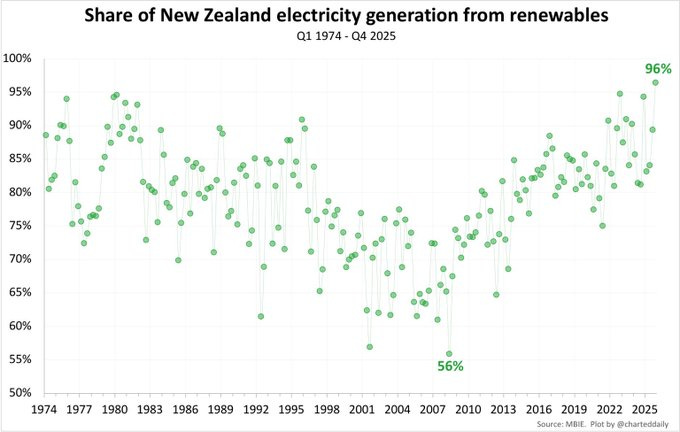
Charteddaily: “Official data out today confirms that 96.4% of New Zealand’s electricity generation in the fourth quarter came from renewables - the highest share in over 52 years.”
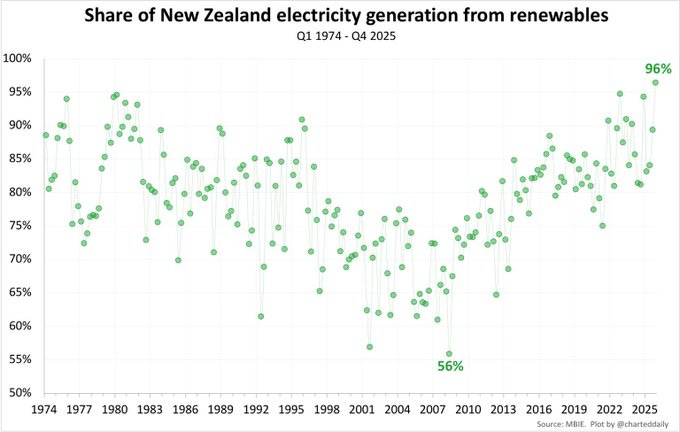
Click to view
In short - other stuff that happened
You can read my reaction to the report here.
And my frustration with the media here.
A looming fuel problem
With the Iran war disrupting global oil markets and pressure building around supply routes, the Government has begun dusting off contingency plans for what a genuine fuel emergency would look like including purchase limits, restrictions on filling containers, altered petrol station hours, and in more serious scenarios, coupon-based rationing or fuel reserved only for critical services. Ministers insist we are not there yet, with around 50 days of fuel either onshore or on the way, and MBIE says the country is still only at Level 1 of the National Fuel Plan.
Even so, Air New Zealand has cancelled around 1100 flights affecting roughly 44,000 passengers, fuel prices are climbing, some petrol stations have run dry after heavy demand, and jerry cans are reportedly flying off the shelves. That does not mean we are about to relive Muldoon-era carless days, but it does mean New Zealand is getting a sharp reminder that when you rely almost entirely on imported refined fuel, global chaos becomes a “you” problem.
Labour’s curious reshuffle
Chris Hipkins reshuffled Labour’s caucus this week and, as always, the movements tell you something about the internal dynamics of the party.
Vanushi Walters has jumped up the list and will take over Foreign Affairs, NZSIS and GCSB. Camilla Belich steps into Justice. New MPs Georgie Dansey and Dan Rosewarne have been given portfolios to match their demographics: “rainbow issues” and “rural communities” respectively.
Damien O’Connor has picked up the Defence portfolio while retaining Trade, alongside Associate Foreign Affairs. This raises eyebrows given O’Connor’s social media history of reposting commentary suggesting Palestinians had the right to do “whatever they did on October 7th,” sharing interviews with Hamas leader Yahya Sinwar, and describing the Israeli Defence Force as an “occupying force.”
Reuben Davidson, whose pre-politics career included producing the children’s show What Now and who is the step-son of former Labour Minister Lianne Dalziel, has been handed the Economic Development portfolio. Ginny Andersen has taken over Education after Willow-Jean Prime (finally) lost the role, adding it to Police, Jobs and Income, and Treaty Negotiations.
But the most curious aspect of the reshuffle may be what didn’t happen. Deputy leader Carmel Sepuloni has a relatively narrow set of portfolios with Auckland issues, Women, and Pacific Peoples. Historically Labour deputy leaders have held heavyweight briefs like Finance (Michael Cullen, Grant Robertson) or, in Kelvin Davis’ case, Corrections and Crown–Māori Relations.
Sepuloni arguably has the most obvious background in caucus to hold Education. She has graduate and postgraduate teaching qualifications, worked as a teacher, and spent years working in the education and social sectors before entering Parliament. Instead the portfolio went to Andersen, who already carries a substantial load. Which raises obvious questions: why keep your own deputy on the sidelines when she has the experience to carry one of Labour’s most important portfolios? and Is Hipkins signalling he doesn’t see her as a policy heavyweight or keeping a potential rival from building profile?
Mariameno Kapa-Kingi is victorious in the High Court
This week the High Court ruled that Mariameno Kapa-Kingi’s suspension and expulsion from Te Pāti Māori was unlawful, finding the party had breached its own constitutional processes and natural justice. The judgment means she must be reinstated as a member of the party, but the legal victory hasn’t necessarily resolved the political fallout.
Kapa-Kingi herself has made it clear she hasn’t yet decided whether she will actually rejoin the party caucus, saying the decision will depend on discussions with her Te Tai Tokerau electorate and a process of hohou te rongo (restorative dialogue) with the party leadership. She has indicated she intends to remain an MP regardless, leaving open the possibility of continuing as an independent if reconciliation fails.
Kapa-Kingi’s son Eru has been openly critical of the party’s leadership and this week posted an Instagram story tagging former-Labour MP Peeni Henare, saying “see you soon cuz”. It’s the kind of cryptic message that inevitably sparks speculation in political circles about whether new alliances, or at least new conversations, are forming across Māori political factions. For a movement that has already endured suspensions, expulsions, and a by-election in the past year, the drama clearly isn’t finished!
Click image to view - from the ruling.
The Teachers’ Union is furious… because some teachers get a pay rise
A fairly unusual standoff has emerged between the Government and the primary teachers’ union, NZEI.
Public Service Commissioner Sir Brian Roche confirmed this week that school boards can offer pay rises directly to around 10,000 non-union teachers, after negotiations with NZEI stalled and the union rejected multiple offers. The deal allows teachers on individual contracts to accept a 2.5% pay rise this year and a further 2.1% next year, roughly 4.7% within 12 months.
The union has responded by launching urgent legal action, accusing the Government of undermining collective bargaining and attempting to divide the profession. The Council of Trade Unions has gone further, describing the move as an attack on solidarity.
Roche’s response was blunt: “It may be unusual, but that doesn’t make it wrong.” His argument is if negotiations with the union are stalled, why should teachers who are not union members be prevented from accepting a pay rise? Should unions effectively control whether pay offers reach workers who aren’t even members?
A fairly unusual standoff has emerged between the Government and the primary teachers’ union, NZEI.
Public Service Commissioner Sir Brian Roche confirmed this week that school boards can offer pay rises directly to around 10,000 non-union teachers, after negotiations with NZEI stalled and the union rejected multiple offers. The deal allows teachers on individual contracts to accept a 2.5% pay rise this year and a further 2.1% next year, roughly 4.7% within 12 months.
The union has responded by launching urgent legal action, accusing the Government of undermining collective bargaining and attempting to divide the profession. The Council of Trade Unions has gone further, describing the move as an attack on solidarity.
Roche’s response was blunt: “It may be unusual, but that doesn’t make it wrong.” His argument is if negotiations with the union are stalled, why should teachers who are not union members be prevented from accepting a pay rise? Should unions effectively control whether pay offers reach workers who aren’t even members?
The Eagle has laundered (hat tip: truereckons1)
Former Labour MP Paul Eagle (though you could be forgiven for missing the Labour part, given some of the media are treating it like it was disclosed under Chatham House Rules) is now at the centre of a nasty and fast-expanding scandal. The former Rongotai MP turned Chatham Islands Council chief executive was found by the Auditor-General to have misled an official investigation into his spending by creating and altering documents, including contracts and records. Eagle has said he “panicked” and with the Serious Fraud Office now considering the findings that panic likely just got worse.
The Auditor-General described his conduct as “unacceptable” and “misleading” and the report details a $460,000 upgrade of Eagle’s council house, including high-end appliances, questionable consultancy spending, conflicts of interest involving his wife, and serious failures of transparency and oversight.
There may also be more to dig into from his final years in Parliament judging by this old Cranmer tweet. Eagle’s expense disclosures show some very noticeable spikes in travel spending, including during the period he took leave to run for Wellington mayor, and again in 2023 when he was not standing for re-election.
Ex-Cop who fell for “Gangster Dude” appears in court with new man
Former police constable Summer Smith has been sentenced to prison after leaking sensitive police intelligence to her boyfriend who just happened to be a member of the Killer Beez gang. “Boyfriend” might be a stretch though. She eventually told police (her colleagues, I guess) they were “in a sexual relationship and saw each other about once a month.”
Smith told the court she had learned her lesson after the whole unfortunate episode involving confidential databases, organised crime, and what she memorably described to the court as falling for a “gangster dude.”
Unfortunately, the rehabilitation narrative she was spinning for the judge was derailed somewhat by a slight complication… You see, former-constable Smith turned up to sentencing with a new boyfriend… who is a patched member of Black Power.
Still, credit where it’s due, she has clearly moved on. Just not, apparently, very far away from the gangs.
Defence Force’s Te Ao Māori makeover paused after Minister discovers it exists
Defence Minister Judith Collins has slammed the brakes on the New Zealand Army’s new bicultural policy after it emerged the military was in the middle of a fairly sweeping cultural makeover. The policy aimed to embed te ao Māori frameworks into Army culture, with leadership expectations (eg required to be promoted) that reportedly included learning waiata, reciting pepeha, performing karakia and incorporating tikanga into everyday military life.
This was all part of a broader vision of the Army as Ngāti Tūmatauenga the “iwi of the god of war” an idea that has floated around the Defence Force for years but which the new policy appeared to formalise in ways that caught some people by surprise. Not least the Defence Minister, who reportedly only discovered the changes after coalition partners started asking pointed questions.
At first the Army said it had only paused a “cultural skills framework.” Shortly afterwards it became clear the entire bicultural policy was on ice suggesting some crossed wires somewhere between Wellington and Waiouru.
Britain starts dismantling jury trials
Britain has taken another step towards gutting one of the oldest protections in the common law tradition, with Labour’s Courts and Tribunals Bill passing its first hurdle despite dissent from its own MPs. The woeful justification is that the courts are clogged, the backlog is intolerable, victims are waiting too long, therefore an ancient safeguard must be trimmed for efficiency. Under the plan, people accused of offences carrying likely sentences of under three years could increasingly be denied trial by jury and shuffled instead before magistrates. In other words, the state has made a mess of the justice system through chronic underfunding and mismanagement, and the proposed solution is to give the public less justice.
What has made the debate especially ugly is the way victims were wheeled out as moral cover for the policy. Labour MP Charlotte Nichols, speaking publicly for the first time about being raped, delivered a devastating rebuke to her own side, accusing ministers of using women like her as a “cudgel” and saying survivors’ experiences were being “weaponised” to sell reforms that are not actually about helping rape victims.
Then there was Conservative MP (and barrister) Sir Geoffrey Cox’s speech; an excellent defence of jury trials as one of the few institutions that stands between ordinary citizens and state power. He called it a safeguard against oppression, a point of common ground above ideology, and warned that once you start degrading these old protections for the sake of administrative convenience, you are not modernising the justice system, you are cheapening it.
Watch Sir Geoffrey Cox’s speech.
It’s a bad time to be an Ayatollah
The war between Iran, the United States, and Israel has entered a volatile holding phase after the initial wave of strikes that killed Iran’s Supreme Leader Ayatollah Ali Khamenei and triggered a broader regional escalation. US and Israeli forces have continued targeted strikes on Iranian military infrastructure, while Iran has retaliated with missile and drone attacks on Israeli targets and Gulf states hosting Western bases. Much of the global anxiety now centres on the Strait of Hormuz, the narrow shipping route through which roughly a fifth of the world’s oil normally passes. Shipping disruption and Iranian threats to keep the strait effectively closed have already pushed oil prices sharply higher.
The life expectancy of an Ayatollah has rapidly diminished in recent weeks and Khamenei’s son Mojtaba Khamenei, hastily installed as Supreme Leader after his father’s death, has reportedly already been injured and has not appeared publicly. Some reports have said he is in a coma. In practice, analysts believe the Islamic Revolutionary Guard Corps (IRGC) is now driving Iran’s military response. For now the conflict appears likely to remain a high-intensity air and missile war rather than a ground invasion, but the biggest risk is Iranian miscalculation like another large strike on Gulf infrastructure, US forces, or shipping could quickly pull more regional players into the conflict and deepen the global economic fallout.
The war time forgot: Ukraine makes new friends
Ukraine is still locked in a grinding war with Russia more than four years after the full-scale invasion, with large parts of eastern and southern Ukraine occupied. Ukraine has developed significant expertise in defending itself against the massive wave of Iranian-designed Shahed attack drones Russia has used throughout the war with more than 57,000 reportedly having been launched at Ukraine so far. That experience has unexpectedly made Ukraine a valuable partner elsewhere. Ukrainian military teams have recently been deployed to Qatar, the United Arab Emirates, Saudi Arabia and a US base in Jordan to help defend against Iranian drone attacks in the Middle East, using the techniques they developed. Kyiv is hoping to turn that expertise into leverage, asking allies in return for more air-defence systems which it urgently needs to stop Russian ballistic missile strikes.
Cuba on the Brink
Right now Cuba is in the middle of one of the worst economic and humanitarian crises it has faced since the collapse of the Soviet Union. The country is dealing with severe fuel shortages, failing infrastructure, and an ageing power grid that has left millions facing blackouts lasting 12–20 hours a day, along with shortages of food, medicine, and basic services. Protests have broken out in several cities as people bang pots in the streets demanding electricity and food, while the government has responded with arrests and tight control of information. The crisis has worsened recently because Cuba lost much of its oil supply from Venezuela and because of ongoing economic pressure and sanctions from the United States.

The US has been increasing pressure on the Cuban government. Trump has publicly said the country is “running on fumes” and hinted that the US might support major political change. This has lead to some Cuban dissidents and activists, both inside Cuba and in exile, to appeal directly to Trump to keep pressure on the government and help bring down the communist system. In the middle of worsening shortages and repression, some people on the island have gone as far as begging for US intervention, believing outside pressure might be the only way to force political change.
This week in Islamic Conquest
In Britain, Labour-run councils have been circulating school guidance warning that children’s drawings may be considered “idolatrous” or even blasphemous under some interpretations of Islam, and cautioning that music and dance classes may also conflict with religious sensitivities. The guidance is dressed up in the soft language of “cohesion” and accommodation, but British schools are clearly being coerced into bending the (knee) curriculum around religious prohibitions rooted in sharia and hadith traditions.
Meanwhile in the United States, a former National Guard member and convicted ISIS supporter, Mohamed Bailor Jalloh, carried out a terror attack at Old Dominion University in Virginia, shouting “Allahu Akbar” before opening fire in what the FBI is treating as an act of terrorism. He killed one person and injured two others before students physically subdued and “rendered him no longer alive”, almost certainly preventing a much larger massacre. The FBI said the terrorist was not shot, but his cause of death has not been publicised.
And in New York, two men, Emir Balat and Ibrahim Kayumi, were charged after throwing homemade bombs at an anti-Islam protest outside Mayor Zohran Mamdani’s residence, with police saying the attack was ISIS-inspired. To be very clear, this was not anti-Muslim protesters lobbing bombs at Zohran Mamdani’s house as media first suggested. It was two Islamist extremists throwing bombs at demonstrators who oppose Islam.
NSW Foster System leaves kids with convicted triple killer
Authorities in New South Wales have apologised after it emerged that two foster children, aged 12 and 14, were placed in a home with convicted triple killer Reginald Arthurell, who now “identifies as” Regina Arthurell, despite the Department of Communities and Justice reportedly knowing about the situation since December. Arthurell, who was convicted of murdering a partner in 1995 after previously receiving two manslaughter convictions, had been staying in the home after being invited there by an elderly woman he met in hospital, before the woman’s daughter alerted authorities over safety concerns. Police eventually raided the property and removed the children, prompting a government apology and a review into how a system designed to protect vulnerable young people allowed them to be living with someone a judge had previously warned had “unequivocally demonstrated a proclivity to violently terminate the lives of fellow human beings.”
Chart of the week
Charteddaily: “Official data out today confirms that 96.4% of New Zealand’s electricity generation in the fourth quarter came from renewables - the highest share in over 52 years.”
Click to view
In short - other stuff that happened
- Minister Mark Mitchel will marry his fiancée Sarah Mattson, next week in Kūaotunu in the Coromandel. The wedding is expected to be attended by Prime Minister Christopher Luxon and several other Cabinet colleagues.
- The Department of Corrections plans to introduce rongoā Māori healing services in 14 prisons, backed by about $9 million in funding.
- National MP Dr Shane Reti announced he will retire from politics at the election. One of the true nice guys, he earned respect from all over the House with his calm, analytical approach.
- In Auckland a protest meeting of left wing activists opposing the US and Israeli strike on Iran was met by a counter-protest of Iranians who support the strikes as a path to liberating Iran from the Islamic regime. Tensions escalated outside the venue leading to a scuffle between protesters and police intervening, with charges being considered against a man wearing a mask holding a sign saying “Israel kills children” who fought with an Iranian protestor.
- Newly released US Department of Justice files have revealed that the last prison guard to see Jeffrey Epstein alive made a series of suspicious cash deposits in the year before his death and allegedly falsified routine cell checks. The same guard also searched online for updates about Epstein minutes before he was found dead.
- Three people have been arrested following a bombing at the Dalí nightclub in Trujillo, Peru, which injured 44 people, including several teenagers.
- A new NBC News poll has found the Democratic Party has a net favourability rating of –22 among registered voters, worse than the Republican Party, President Donald Trump, and even the much-criticised ICE. The only entity viewed more negatively by respondents in the survey was Iran, at –53.
- A Marvel-licensed Deadpool t-shirt sold at Walmart Canada has been criticised after people said its facial design resembles tā moko. Stuff says using moko-style patterns on a comic character’s mask and selling it commercially is an insulting example of cultural appropriation.
- Sydney fashion designer Katie Perry has won a legal battle against pop star Katy Perry (real name Katheryn Elizabeth Hudson), with Australia’s High Court ruling the singer infringed her trademark. The court found the global star had shown a “calculated disregard” for the designer’s rights in a dispute that has stretched nearly 17 years.
- Auckland teacher Lisa Marie Edmondson has had her registration cancelled after she filmed pornographic videos in school classrooms which were later uploaded to an adult website. The ruling said she used school premises and identifiable student property to create explicit content for personal gain.
- Waikato lawyer Damian Botherway was suspended from practising after repeatedly exposing female staff to pornography on his office computer. The disciplinary tribunal described his behaviour as “egregious”.
- Plans have been announced to build the first new oil refinery in the United States in nearly 50 years, with a facility proposed for the Port of Brownsville, Texas designed to process 100% American light shale oil.
- In this LawNews opinion piece, Gary Judd KC argues that the use of karakia in court settings risks undermining judicial neutrality, which he says must be absolute under the judicial oath. While recent guidance discourages court-initiated karakia, Judd contends this does not go far enough because even voluntary participation can create institutional pressure and the appearance of partiality, particularly if lawyers feel reluctant to object.
- I never thought I’d see the day, but Verity Johnson has produced a piece I’ve read without wanting to hurl myself into the sea and, worse, I’m now in the deeply uncomfortable position of recommending it to others. It’s good with only few eye-roll moments. It’s about not going back to your ex after they treated you badly… except the ex is Chris Hipkins and it is about voting.


4 comments:
I was pleased to see HDPA's article, "Do we owe our Covid conspiracy friends an apology? - Heather du Plessis-Allan" this morning. It is paywalled.
The right to a jury trial stems from the 13th century Magna Carta. The word used is 'peers' and the right applied only to 'freemen' being tried in Common Law courts. This excluded between many and most people who were not 'freemen' and/or had no access to those courts, their access to justice being through manorial courts and shire courts.
The 18th and 19th century jury was a group of land-owning (and thereby eligible to vote and be called for jury duty), educated men. They came close to being a 'professional jury' in the sense that they were literate and understood what was going on and the legal issues invoked.
Today's jury are picked from the hoi-polloi and all too many are not legally literate. In all but the most simple cases the evidence presented is over their heads. Sorry to be blunt but that is demonstrably how it is and it explains the backlogs to a considerable extent, not to mention perverse jury verdicts that are far from uncommon in the British system.
We have managed to do without jury trials on the Continent for many centuries and whatever the haughty attitude on the part of supporters of the British system is ("our system is the best in the world"), I for one need convincing that our systems are in any way inferior. In the Dutch system, there is no jury but the judges are more actively involved in the trial and the kinds of courtroom theatrics that British defence lawyers put on do not happen - they would be severely disapproved of.
The last paragraph of the section on this topic is typical British better-than-thou proselytising about this topic but hey, what do you expect from one of the snouts in the trough (a barrister raking it in)?
I don't normally lose any sleep over oil prices, but this is almost unprecedented and on this I do worry.
I am about neutral on Trump and like some of what he does and I can absolutely see why US voters went for him. But this military action is a cluster f#@k. It appears there was no plan apart from random extreme violence from the air overseen by a President who will not take no for an answer from anyone. His presidency is increasingly marked as an administration surrounded by lickspittles who do whatsoever he wants or what they think he wants, unquestioningly.
Now that a better part of 20% of the worlds crude oil is offline and no indication it is coming back in the near to medium future, we are all in deep shit if this thing doesn't end soon.
Enter the most unimaginative Finance Minister in the history of NZ finance ministers whose guiding principle is doing what had always been done. Just like a chartered accountants assistant. But worse is the likely shortage of fuel in general. We are not well positioned given Jacinda's impossibly stupid gas and oil ban being a double blow. Ironically, expect coal to make a revival.
This mess is going to test the mettle of our feckless PM and his equally thought process limited finance minister. And us.
Re jury trials. I totally agree with Barend. In NZ, the expensive, self serving and time wasting ritual of selecting a jury has to be seen to be believed. To defence lawyers, the whole courtroom procedure is just a game and expensive theatre; justice is neither here nor there. If we did go to judge only trials in NZ though, we would really have to up the standard of our judiciary, as the present lot seem woefully inadequate
Post a Comment
Thank you for joining the discussion. Breaking Views welcomes respectful contributions that enrich the debate. Please ensure your comments are not defamatory, derogatory or disruptive. We appreciate your cooperation.