

In October 2017, Rapper Marshall Mathers got wildly worked up about US President Donald Trump. The artist know as Eminem, clearly afflicted by a virulent early strain of Trump Derangement Syndrome, produced a freestyle rap called “The Storm”. It wasn’t his finest work. But The Storm did contain a cornel of eternal truth. Sometimes there’s a line and you have to choose which side you’re on.

Two members of New Zealand’s current coalition Government have chosen which side of a particular constitutional line they’re on. The NZ First and ACT political parties have come out against the Māori electorates and associated seats in Parliament.
I’ve previously covered the Māori seats in detail:
NEW ZEALAND PARLIAMENT'S MĀORI SEATS
John McLean 18 June 2024
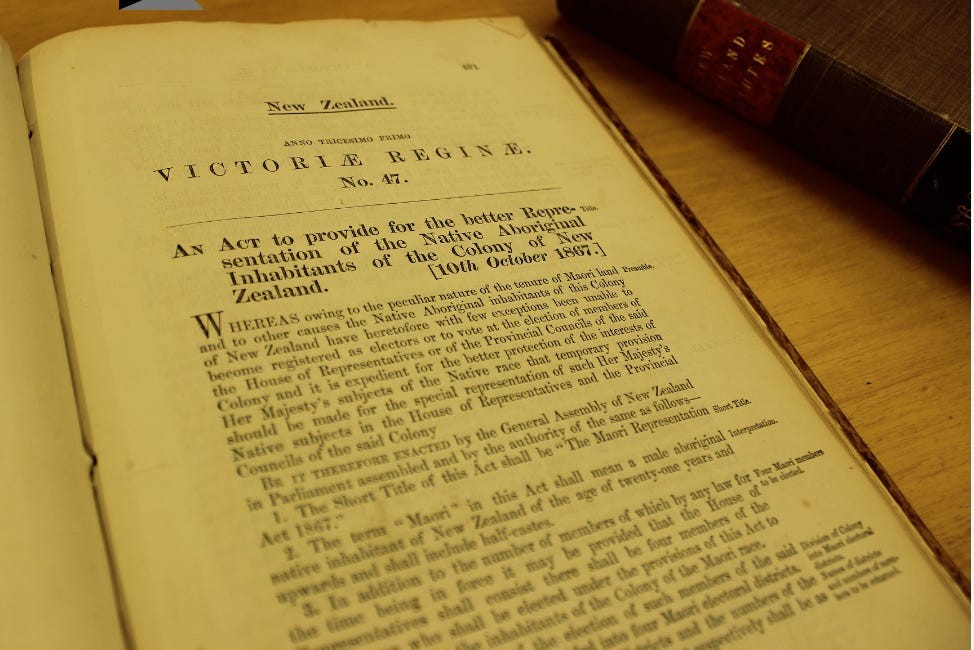
Race-specific Māori representation in New Zealand’s Parliament began with the Māori Representation Act 1867. Non-Māori New Zealanders wanted to bring Māori into the national political fold.
Read full story
NZ First leader Winston Peters has announced that NZ First will campaign, in the run-up to the upcoming November 2026 general election, in favour of a binding referendum on whether the Māori seats should be abolished. Every now and again, a picture really does paint a thousand words (that’s really is New Zealand’s Prime Minister, on Peters’ left):
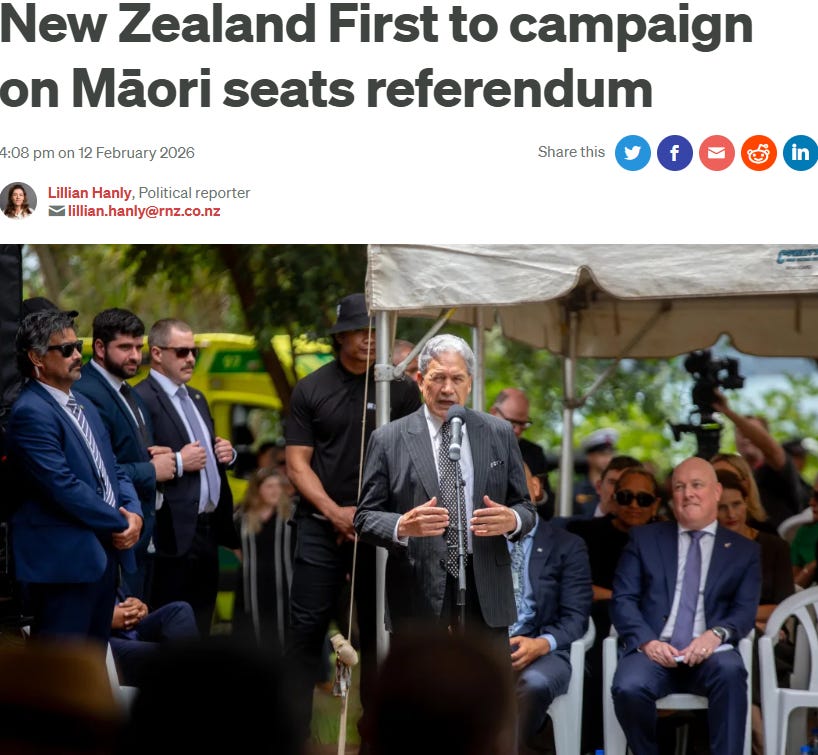
A binding referendum on the Māori seats would be a clever and decisive beast. Parliament would pass legislation to abolish the Māori seats, with the enacted Act made expressly conditional on a majority of New Zealanders, in a referendum, approving the abolition. If New Zealanders approve abolition then BOOM…the legislation would come into force and Māori seats would automatically be gone. Peters says he wants to see no Māori seats feature in the 2029 election.
ACT’s position is more forthright than NZ First’s. ACT stance is that, ideally, Parliament should simply pass legislation abolishing the Māori seats, as soon as is reasonably possible. If Act had its way, the current Government would enact legislation abolishing the Māori seats before the next election, such that the next election would be decided without race-based Parliamentary representation. ACT’s position is instinctively appealing. Be done with the Māori seats and ride out the hikois and other bleeding heart bleating.
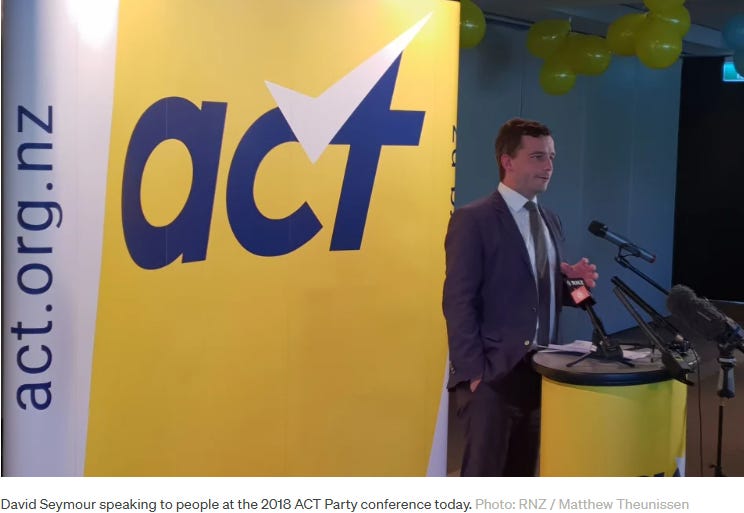
However, as I see it, there are two downsides to abolition without the mandate of a referendum.
First, abolition without the support of a public referendum would increase the chances of a future Government, armed with a Parliamentary majority, restoring the Māori seats i.e., New Zealand could find itself in a State of constitutional ping pong. A favourable referendum would significantly reduce that prospect. Grassroots New Zealanders will have spoken.
Secondly, a public referendum would reduce the danger of New Zealand’s activist judiciary over-ruling abolition of the Māori seats. Fifty years ago, there’d have been no such prospect. Nowadays, anti-democratic judicial over-reach is a significant risk to abolition of the Māori seats. And we’re not talking the woeful Waitangi Tribunal, which would – as surely as night follows day – rule that abolition breaches the Treaty of Waitangi, or the mercurial Treaty Principles or…whatever. We’re talking a constitutional crisis in which the Courts assert constitutional supremacy over our democratically elected Parliament.
Stance on the Māori seats – should they stay or should they go – is a determinative litmus test on where a political party stands on perpetuating a racialized New Zealand political system. Predictably, the Māori Party, together with Labour and the Greens, favours retention of the Māori seats. Turkeys don’t vote for Christmas, and the Māori Party MPs are pure blood turkeys.
So, where does the National Party stand on this defining issue? I found myself searching chicken entrails for clues on where the Nats stand on the Māori seats. And I thought I’d found just such a hint.
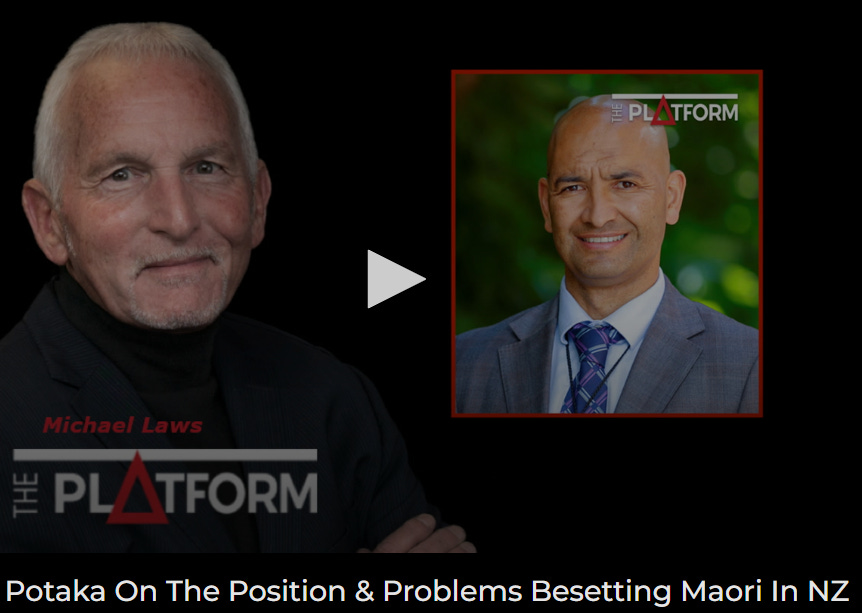
On 27 February, Michael Laws interviewed the National Party’s Tama Potaka on The Platform. Tama is the current Minister for Māori Development. Listening to the interview, I thought Mr Potaka had intimated that he and the Nats are committed to differential civil and political rights for those with Māori ancestry – which would militate in favour of the Nats actively favoring retention of the Māori seats. Being a proud Platform Plus subscriber, I listened to a recording of that interview and found, to my surprise, that I’d completely misinterpreted what Potaka had said. In fact, Potaka had expressly come down on the side of equality of opportunity, rather than the neo-Marxist/post-modernist constructs of equality of outcome/social justice/equity. Here’s a transcript of the relevant exchange:
Laws: “The concept of equal citizenship…Does equality and equity mean the same thing, in your book?”
Potaka: “No and I think that there are some differences. There might be some overlaps. But we’re are not a Government or party where we think everyone should be the same. We’re not and we won’t be in the near future, as the National Party. And…in my own world view I don’t think everyone should be the same”.
I had initially interpreted Potaka’s everyone-is-not-the-same view as an endorsement of the notion that individuals with Māori ancestry should enjoy greater civil and political rights that non-Māori (which would include race based Parliamentary representation). But of course, that’s not what he said. Potaka was simply favoring equality of opportunity over equality of outcome – a debate I’ve covered in a previous Substack.
OPPORTUNITY V. OUTCOME
John McLean 6 July 2023
To borrow from the Sesame Street jingle…One of these equalities is not like the other, which one is different, do you know? This piece is a simple refresher, and a few thoughts, on two distinctly different notions of optimal societal equality.
Read full story
Which goes to show how hard it is to parse what people are really saying and meaning, in the Culture Wars (which are v. real, BTW).
Prime Minister Luxon and his National Party caucus have purported to take no position on the Māori seats. But by taking no position, National is of course taking a position; that the status quo (race-based Māori seats) should remain.
Why, then, would National favour retention of the Māori seats, when a clear majority of National’s supporters favours abolishing them? I don’t know. Perhaps Luxon thinks National will attract Labour voters. Fat chance. With its suicidal empathy for “Māori” and pathological desire to be liked by everyone, National could well be committing electoral suicide and committing New Zealand to becoming New Venezuela.
The Māori seats may well prove decisive in the upcoming general election. Decisive in the sense that, on current settings, results in the Māori seats may well catapult a Labour/Māori Party/Greens coalition into power.
If the Māori electorates are to be retained, then New Zealand is vitally in need of legislation defining who qualifies as Māori for the purposes of being entitled to enroll on the Māori roll. Currently, the statutory test for entitlement to enroll on the Māori roll (descent from a person of the Māori race) is decided by self-identification. Electoral rights simply cannot be left to depend of subjective feels. I’ve previously covered Who is Māori?
WHO IS MĀORI?
John McLean 15 December 2023

It’s not clear why the question “Who is Māori?” is not allowed to be asked in politically correct circles. Perhaps it’s because the question might be construed to cast aspersions on the significance or strength of individuals’ Māori ancestries or “identities”. Perhaps the answer to “Who is Māori?” is too tricky to find or contemplate. Or, in racially ch…
Read full story
The latest Taxpayer Union-Curia poll, out today, has National on 28% support, down from 31% in T U-C poll at the beginning of February 2026. National’s failure to come out against the Māori seats, and otherwise to take courageous, principled positions, threatens to sell the once-proud political party, and New Zealand, down the road to oblivion.
John McLean is a citizen typist and enthusiastic amateur who blogs at John's Substack where this article was sourced


3 comments:
Great article. " A failed state stumbling down the road to oblivion.... " chills the blood.
Thrilling for the woke as they would preside over the decline.
But do real, adult, modern NZers want this?
On the failures of the UK Conservatives, Kemi Badenoch said they talked Right but governed Left. The same could be said of the Nats here.
On the 'basis" of data presented, in above article, I "see it", that NZ has two options come November!
Option 1 -
is to vote to retain current Govt set up
Option 2 -
to re vote Labour back into power.
Now having spent considerable time with teas leaves, pondering the message being 'broadcast' - which is " Luxon is a lame duck" I can see only one thing that NZ could consider - that is we offer the role of PM to -
- Justin Trudeau
- Pauline Hanson
- Barack Obama
- Boris Johnson
- Emanuel Macron (he might like our South Seas environment - as he is very much liked, in France, like our Luxon, here in NZ)
So what do you think fellow readers.
Post a Comment
Thank you for joining the discussion. Breaking Views welcomes respectful contributions that enrich the debate. Please ensure your comments are not defamatory, derogatory or disruptive. We appreciate your cooperation.