

Note: I was a vegetarian for 10 years and previously worked at the SPCA. I am a believer in high animal welfare standards and think that many animal welfare groups do a great deal of good work. Many of them are a bit nuts though.
There I was, scrolling the apps, when a familiar Kiwi farmer’s face appeared with a message that sounded quite good. I halted in my tracks and bestowed a view on the video’s tally. The gist was that our imported farming products should live up to our national animal welfare standards. Fair enough, right?
Well, maybe if I was still the younger, more naive Ani who did not eat a bite of meat for a decade and worked at the SPCA. Alas, now I am a meat-eater and have a better grasp of how the New Zealand economy works. It is unfortunate how a bit of knowledge can destroy one’s wishful convictions.
The “Fair for Farmers” campaign appears to be farmer-led, but it is run by Animal Policy International. It presents itself as a common-sense push to protect Kiwi farmers from unfair offshore competition. After all, why should New Zealand farmers be held to higher animal welfare standards than their overseas competitors? Why should we allow imports produced under conditions that would be illegal here?
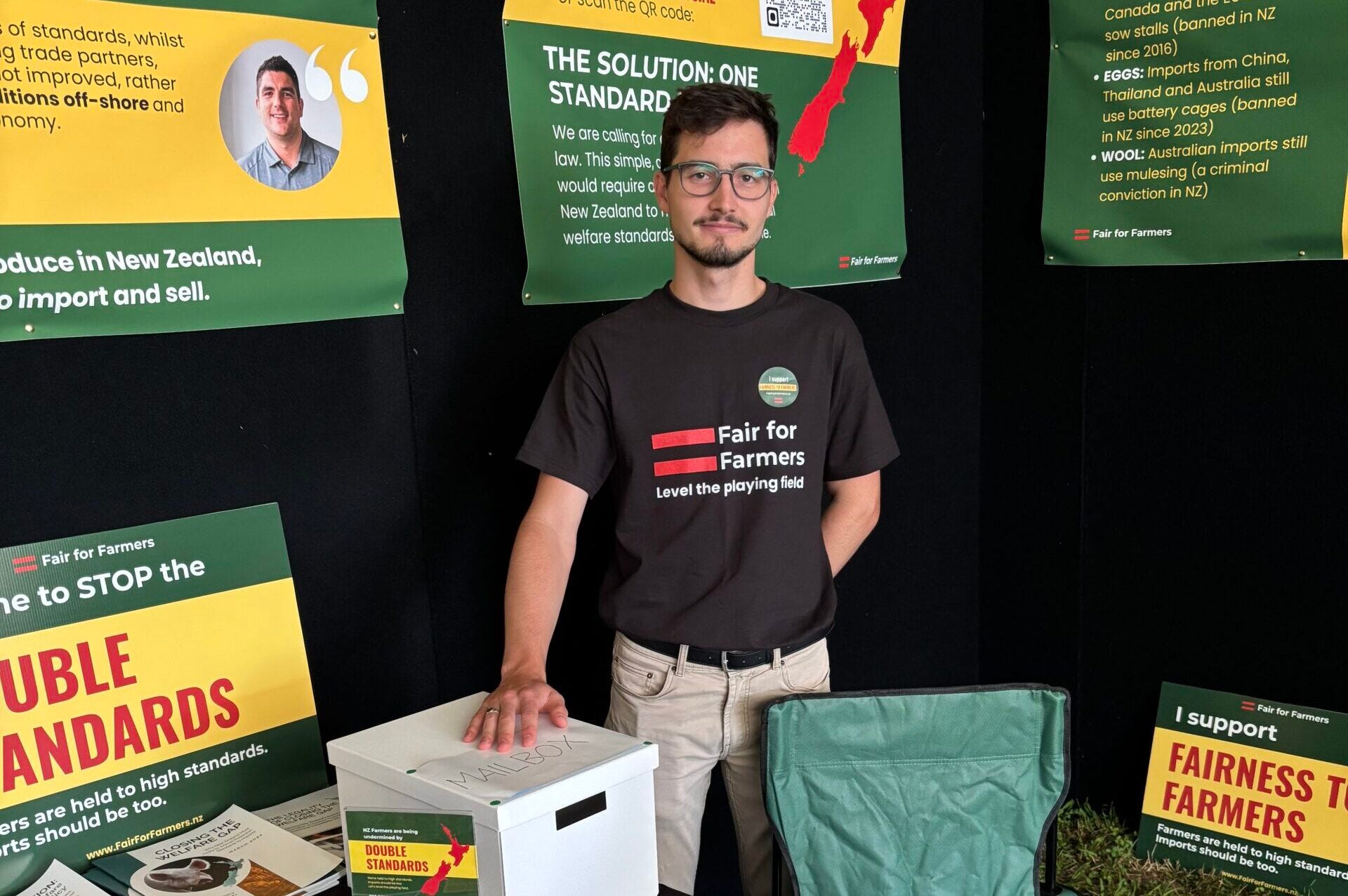
Fair for Farmers spokesman Rainer Kravets at the
Northland Field Days. Photo: Hugh Stringleman
The message resonates because it contains some truth and feels fair. But when you follow the logic through to its conclusion and examine the origins of the policy being promoted it is clear that this campaign risks turning New Zealand farmers into unwitting foot soldiers for a broader agenda that is fundamentally hostile to the future of farming itself.
The intellectual foundation for much of this argument can be found in the report Closing the Welfare Gap, produced by Animal Policy International alongside advocacy groups including SPCA New Zealand and the New Zealand Animal Law Association. The report lays out a detailed case for restricting imports of animal products that do not meet New Zealand’s domestic welfare standards. It argues that New Zealand is effectively undermining its own farmers by allowing in products produced using methods that are illegal here, and that this creates both a moral inconsistency and a competitive disadvantage.
The report leans into pro-farming framing, explicitly stating that low-welfare imports “undermine the standards that we are holding New Zealand farmers to” and negatively impact local industries, particularly pork. It cites figures showing that around two-thirds of pork consumed in New Zealand is imported, reinforcing the sense that local producers are being squeezed out by cheaper, lower-standard products.
But the same report is equally clear that the objective is not simply to level the playing field for New Zealand farmers, it is to reshape New Zealand’s approach to agricultural trade. It advocates for New Zealand to apply its domestic standards to all imports, effectively using trade policy as a tool to force overseas producers to adopt higher welfare practices.
Despite claims that the impact on trade will be “minimal”, the ambition of Animal Policy International is not a narrow fix to a trade imbalance. It is part of a broader strategy to globalise animal welfare standards through market access restrictions. And the risks to an economy like ours that relies on the primary sector would be enormous.
New Zealand is a small country with massive agricultural reliance. We export around 90% of everything we produce, and those export dollars don’t just underpin the rural economy, they underpin the entire economy. Our prosperity depends on access to international markets. That reality has underpinned our farming sector for generations, and it’s the lens through which any proposed policy change must be judged.
Banning imports based on production methods, like differing animal welfare standards, may feel like a domestic market decision, but in practice it is very easily interpreted as a non-tariff barrier to trade. And if we go down that road, we shouldn’t be surprised when other countries respond in kind.
Major markets like the United Kingdom, the European Union, and the United States could well take retaliatory measures that directly affect our meat and dairy exports. If we are demanding other countries meet New Zealand-specific standards to access our market of just five million people, it is entirely reasonable to expect that they will begin imposing their own standards in return.
Our farming systems are different. Not always necessarily worse or better, but different. We operate in entirely different climates and environments. These factors alone have a significant impact on the way we farm compared to other parts of the world. So if we imagine a world where production methods become the basis for trade restrictions, “different” could become leverage in trade negotiations or used as a protectionist barrier. What we see, in New Zealand, as efficient, pasture-based production could easily be reframed by others as falling short of their preferred standards.
For example, European regulators could refuse access for New Zealand dairy products on the basis that our dairy systems produce surplus calves. British authorities could take issue with the way we run our outdoor lambing systems. The UK branch of Animal Policy International takes issue mostly with Australian mulesing practices, but they also note that New Zealand permits tail docking and castration which a big red flags for the apparently pro-farming organisation.
Suddenly, what started as a well-meaning attempt to support local pork and poultry farmers turns into a much bigger problem for the sectors that actually drive our export economy. It is a sure fire way to land us in trade conflict that could decimate our primary industries. It takes what is a protectionist argument and repackages it as a moral one. In substance, it’s a classic non-tariff barrier argument disguised in ethical language.
Farmers are being told this is about fairness, about levelling the playing field. But the actual likely outcome is a shrinking playing field. Trade barriers invite retaliation, retaliation constrains exports, and constrained exports hits our economy like a tonne of bricks.
Importantly, none of this troubles the organisations pushing this framework. They are not focused on the long-term viability of New Zealand farming. Their objective, as outlined in Closing the Welfare Gap, is to use trade policy as a lever to drive global changes in animal production systems. They want to sound noble and palatable to farmers, but align far more closely with an agenda of reducing animal agriculture than supporting it. This is not a grassroots New Zealand animal charity, it’s plugged into a global ideological and funding network.
Animal Policy International’s organisational footprint is unusually scattered for a group that presents itself as a single advocacy body. Publicly available information shows a multi-jurisdictional structure where fundraising appears to be conducted via a United States–based fiscal sponsor, but its materials reference a New Zealand registered charity, the Animal Policy NZ Trust. There is also an Estonia-registered non-profit association (MTÜ) and the organisation lists a London mailing address in the United Kingdom. Each of these entities sits within a different legal and regulatory regime, with different disclosure and reporting requirements, yet they are presented under a single brand. While international NGOs sometimes operate across borders, the combination of US fiscal sponsorship, a NZ charitable trust, an Estonian MTÜ, and a UK correspondence address creates a layered structure that can make governance lines, financial flows, and accountability less transparent.
The organisation appears to act as a kind of astroturf; a non-threatening face advocating for more incremental, less “scary” change. For example, Animal Policy International’s website lists Stray Dog Institute among its supporters.
On Stray Dog Institute’s own site, its “Grantmaking” page describes a philanthropic strategy focused on “food systems transformation” and explains how it handles affiliated entities. Importantly for tracing financial pathways, it set up the Quinn Foundation which “makes grants on behalf of Stray Dog Institute” in the farmed-animal/food-systems space which obscures the SDI’s involvement.
Stray Dog Institute is funded by its founders, Chuck Laue and Jennifer Laue. They are both heavily involved in many animal welfare projects and Jennifer’s biography on the website states that she is “deeply committed to veganism and building the movement for food systems transformation.” Stray Dog Institute’s public-facing mission statement explicitly echoes this, positioning the organisation as aiming for a plant-based and alternative-protein transition. It further states that its “allies” encourage “plant-forward eating,” “oppose industrial animal agriculture,” and “advance alternatives to animal-based food systems.” The same “Stray Dog” family includes a venture-capital vehicle active in alternative proteins.
Animal Policy International also received funding from Tiny Beam Fund, an incorporated charity based in Massachusetts, USA, which has the stated aim to:
The message resonates because it contains some truth and feels fair. But when you follow the logic through to its conclusion and examine the origins of the policy being promoted it is clear that this campaign risks turning New Zealand farmers into unwitting foot soldiers for a broader agenda that is fundamentally hostile to the future of farming itself.
The intellectual foundation for much of this argument can be found in the report Closing the Welfare Gap, produced by Animal Policy International alongside advocacy groups including SPCA New Zealand and the New Zealand Animal Law Association. The report lays out a detailed case for restricting imports of animal products that do not meet New Zealand’s domestic welfare standards. It argues that New Zealand is effectively undermining its own farmers by allowing in products produced using methods that are illegal here, and that this creates both a moral inconsistency and a competitive disadvantage.
The report leans into pro-farming framing, explicitly stating that low-welfare imports “undermine the standards that we are holding New Zealand farmers to” and negatively impact local industries, particularly pork. It cites figures showing that around two-thirds of pork consumed in New Zealand is imported, reinforcing the sense that local producers are being squeezed out by cheaper, lower-standard products.
But the same report is equally clear that the objective is not simply to level the playing field for New Zealand farmers, it is to reshape New Zealand’s approach to agricultural trade. It advocates for New Zealand to apply its domestic standards to all imports, effectively using trade policy as a tool to force overseas producers to adopt higher welfare practices.
Despite claims that the impact on trade will be “minimal”, the ambition of Animal Policy International is not a narrow fix to a trade imbalance. It is part of a broader strategy to globalise animal welfare standards through market access restrictions. And the risks to an economy like ours that relies on the primary sector would be enormous.
New Zealand is a small country with massive agricultural reliance. We export around 90% of everything we produce, and those export dollars don’t just underpin the rural economy, they underpin the entire economy. Our prosperity depends on access to international markets. That reality has underpinned our farming sector for generations, and it’s the lens through which any proposed policy change must be judged.
Banning imports based on production methods, like differing animal welfare standards, may feel like a domestic market decision, but in practice it is very easily interpreted as a non-tariff barrier to trade. And if we go down that road, we shouldn’t be surprised when other countries respond in kind.
Major markets like the United Kingdom, the European Union, and the United States could well take retaliatory measures that directly affect our meat and dairy exports. If we are demanding other countries meet New Zealand-specific standards to access our market of just five million people, it is entirely reasonable to expect that they will begin imposing their own standards in return.
Our farming systems are different. Not always necessarily worse or better, but different. We operate in entirely different climates and environments. These factors alone have a significant impact on the way we farm compared to other parts of the world. So if we imagine a world where production methods become the basis for trade restrictions, “different” could become leverage in trade negotiations or used as a protectionist barrier. What we see, in New Zealand, as efficient, pasture-based production could easily be reframed by others as falling short of their preferred standards.
For example, European regulators could refuse access for New Zealand dairy products on the basis that our dairy systems produce surplus calves. British authorities could take issue with the way we run our outdoor lambing systems. The UK branch of Animal Policy International takes issue mostly with Australian mulesing practices, but they also note that New Zealand permits tail docking and castration which a big red flags for the apparently pro-farming organisation.
Suddenly, what started as a well-meaning attempt to support local pork and poultry farmers turns into a much bigger problem for the sectors that actually drive our export economy. It is a sure fire way to land us in trade conflict that could decimate our primary industries. It takes what is a protectionist argument and repackages it as a moral one. In substance, it’s a classic non-tariff barrier argument disguised in ethical language.
Farmers are being told this is about fairness, about levelling the playing field. But the actual likely outcome is a shrinking playing field. Trade barriers invite retaliation, retaliation constrains exports, and constrained exports hits our economy like a tonne of bricks.
Importantly, none of this troubles the organisations pushing this framework. They are not focused on the long-term viability of New Zealand farming. Their objective, as outlined in Closing the Welfare Gap, is to use trade policy as a lever to drive global changes in animal production systems. They want to sound noble and palatable to farmers, but align far more closely with an agenda of reducing animal agriculture than supporting it. This is not a grassroots New Zealand animal charity, it’s plugged into a global ideological and funding network.
Animal Policy International’s organisational footprint is unusually scattered for a group that presents itself as a single advocacy body. Publicly available information shows a multi-jurisdictional structure where fundraising appears to be conducted via a United States–based fiscal sponsor, but its materials reference a New Zealand registered charity, the Animal Policy NZ Trust. There is also an Estonia-registered non-profit association (MTÜ) and the organisation lists a London mailing address in the United Kingdom. Each of these entities sits within a different legal and regulatory regime, with different disclosure and reporting requirements, yet they are presented under a single brand. While international NGOs sometimes operate across borders, the combination of US fiscal sponsorship, a NZ charitable trust, an Estonian MTÜ, and a UK correspondence address creates a layered structure that can make governance lines, financial flows, and accountability less transparent.
The organisation appears to act as a kind of astroturf; a non-threatening face advocating for more incremental, less “scary” change. For example, Animal Policy International’s website lists Stray Dog Institute among its supporters.
On Stray Dog Institute’s own site, its “Grantmaking” page describes a philanthropic strategy focused on “food systems transformation” and explains how it handles affiliated entities. Importantly for tracing financial pathways, it set up the Quinn Foundation which “makes grants on behalf of Stray Dog Institute” in the farmed-animal/food-systems space which obscures the SDI’s involvement.
Stray Dog Institute is funded by its founders, Chuck Laue and Jennifer Laue. They are both heavily involved in many animal welfare projects and Jennifer’s biography on the website states that she is “deeply committed to veganism and building the movement for food systems transformation.” Stray Dog Institute’s public-facing mission statement explicitly echoes this, positioning the organisation as aiming for a plant-based and alternative-protein transition. It further states that its “allies” encourage “plant-forward eating,” “oppose industrial animal agriculture,” and “advance alternatives to animal-based food systems.” The same “Stray Dog” family includes a venture-capital vehicle active in alternative proteins.
Animal Policy International also received funding from Tiny Beam Fund, an incorporated charity based in Massachusetts, USA, which has the stated aim to:
“Help academic researchers and front-line persons gain a deeper understanding of the complex negative impacts of industrial food animal production.”
It stipulates that the grants it issues must relate to work, activities, and purpose with a “focus on understanding and tackling drivers and adverse effects of large-scale, industrial food animal production, especially concerning low- and middle-income countries.” And one of the key objectives the funder looks for in organisations seeking funding is making “the adverse effects of industrial animal agriculture (particularly concerning LMICs) more visible, relevant, and salient.” On its website, Tiny Beam Fund lists the 2023 Animal Policy International grant as “using New Zealand as a case study”.
Funding has also come from Effektiv Spenden which is a Germany-based donation platform tied closely to the Effective Altruism (EA) movement from which API receives funding too. Within the EA movement animal welfare funding is heavily skewed toward reducing animal agriculture including corporate pressure campaigns, policy advocacy, and alternative protein development. Effektiv Spenden typically routes animal welfare money to organisations focused on factory farming, lobbying for regulatory changes, and protein transition strategies (to plant-based and lab-meat). It is part of a highly coordinated, ideologically aligned funding ecosystem that channels money into food system changes and massive long-term structural shifts.
Their funding is, however, less interesting than the biographies of the people involved in the organisation. Two of the people named officers of the charity on the New Zealand charities register, co-Executive Director Mandy Carter and Public Affairs Manager Ramona (Mona) Oliver, formerly worked at SAFE (Save Animals From Exploitation). The charity is explicitly vegan and has been at the forefront of anti-farming activism in New Zealand including undercover operations.
A simple internet search turns up public comments from Carter that reflect perhaps her true positions on farming:
“The dairy industry causes widespread animal suffering, from the separation of mother cows from their young babies, to the brutal treatment of these vulnerable young animals on their way to the slaughterhouse,” says Mandy Carter, SAFE head of campaigns. “Since MPI is the body charged with promoting primary industries, it has an obvious conflict of interest when it comes to protecting animal welfare. We urgently need an independent voice for animals to ensure that the needs of animals are prioritised.”
No animal will ever feel the terror of the slaughterhouse for my sake.
There are plenty of good reasons to be vegetarian or vegan: It’s tasty, it’s cheap, it’s easy, it’s good for you - and for beautiful New Zealand, but for me, the one true reason will always be: for the animals.
Carter describes herself as having been vegetarian from age 11 and vegan for nearly two decades now. She was the Head of Campaigns at SAFE and wrote regularly for the New Zealand Herald on animal welfare matters. In addition to her previous work at SAFE, Mona Oliver has also worked on four elections campaigns for the Green Party.
The other co-Executive Director, Rainer Kravets, previously served as Program Manager for the Food Innovation Summit 2022 which was the largest alternative protein conference in the Nordic region. Researcher Helen Willis also works for the Ministry for the Environment in New Zealand.
One of the organisations advisors, Scott Weathers, is an American “Plant-Based Politician and Public Health Advocate”. He previously worked at the Good Food Institute, focused on “supporting the growth of the emerging alternative protein industry.” Another advisor Olga Kikou is described as founder/director of “Animal Advocacy & Food Transition,” with a mission to “accelerate the shift towards more plant-based food systems.”
And another, Elena Artico, is the Founder and Director of Animal Advocacy And Food Transition which states on the homepage of its website:
Animal Advocacy & Food Transition (AAFT) is a non-profit organization working at the European level to end the systemic exploitation of farmed animals and challenge the industrial food system that enables it
We believe that animal suffering must not be managed or minimized – it must be ended.
She also previously served as Global Head of Campaigns at Compassion in World Farming (CIWF) which is committed to “radically changing our food systems to reduce reliance on animal protein”.
Many of the others involved have expressed dedication to veganism and opposition to farming in online writing. It is not possible to reconcile their affiliations, public statements, and previous work with a pro-farming or even tolerant-of-farming stance.
If you take their ideology and funding at face value, it’s not unreasonable to see this as more than just a blind spot on trade risk. You’ve got an organisation led by committed vegan activists, backed by networks explicitly focused on “food system transition,” advocating for policies that would make it harder to produce, import, and ultimately consume animal products. In that context, the lack of concern about trade retaliation could be read as less like an oversight and more like indifference, or even an intended consequence, because the pressure those policies would place on animal agriculture is consistent with their broader goal. They don’t need to openly argue for dismantling primary industries if the policies they promote would gradually do that job anyway.
Farmers supporting Animal Policy International are not wrong to be frustrated that imported products might not be farmed to the same high standards we require here. They are not wrong to want a fair go. But they should be aware that they are being pointed toward a solution that ultimately serves a different set of interests. By backing policies that restrict trade based on production methods, they risk legitimising a framework that could just as easily be used against them.
These farmers are not villains, but they do risk becoming “useful idiots” for anti-farming activists who have got very creative in their methods. They campaign in ways that blends genuine farmer concerns with a broader activist agenda and collapses a complex trade issue into a moral one.
If the goal is to support local pork and poultry farmers, and this absolutely should be our goal, then there are far more practical and lower risk ways to do it. A big part of the solution lies in better domestic marketing and consumer education. We need to incentivise and encourage buying New Zealand-farmed products, not ban imports and risk trade retaliation. Empowering consumers to back New Zealand producers voluntarily, is key.
Most Kiwi shoppers, if they understood why they were paying an extra dollar or two for local product, would likely make that choice. People do care about animal welfare and want to support local farmers. But they need clear, visible information to act on those values.
Buy local.
Ani O'Brien comes from a digital marketing background, she has been heavily involved in women's rights advocacy and is a founding council member of the Free Speech Union. This article was originally published on Ani's Substack Site and is published here with kind permission.


5 comments:
Why doesn’t all food have a QR code so the consumer can see the origin of the food and welfare standards etc. Then the consumer can make a choice. However, at the moment the most important thing for most people is the price.
That kind of mislabelling is getting only more common these days. Have you heard of the Taxpayers Union in New Zealand? It isn’t a union, and it doesn’t represent even a reasonable proportion of taxpayers. It’s like 1984 doublespeak.
What about the Centre for Political Research? Who funds them? Are they independent of influence of special interest group money?
Anon 1036, the answers to your questions is in here: https://breakingviewsnz.blogspot.com/2026/01/muriel-newman-personal-message-as-we.html
MOD, that is a page asking for donations, not a page showing where ALL the money comes from.
Post a Comment
Thank you for joining the discussion. Breaking Views welcomes respectful contributions that enrich the debate. Please ensure your comments are not defamatory, derogatory or disruptive. We appreciate your cooperation.