

This saga begins with a cringeworthy cliche scandal which morphs into a bigger classic case of rotten nepotism and self-interest. Then a second scandal pops up, and then, in the process of mopping these scandals up, the whole thing becomes an almost comedic additional problem.
Let’s start with the original scandal. Stuff reported on this situation in late February 2025, saying that in mid-December 2024, several ACC staff lodged complaints alleging unwanted physical contact by John Bennett, Deputy Chief Executive System Commissioning and Performance. Then there was a topless Zoom call. ACC says Bennett didn’t know his camera was on, that he quickly put a shirt on, that it was an innocent mistake.

John Bennett. Photo: Stuff
In any organisation that takes misconduct seriously, this would trigger an investigation that is transparent, documented, and leads somewhere. Instead, ACC declared the matter “addressed,” offered no findings, and immediately moved to solve its internal problem the way so many Crown entities do: by exporting it.
Bennett wasn’t suspended. Instead, ACC approved a secondment to Health NZ, effectively handing a live HR risk to another public agency already under structural pressure. It was the bureaucratic version of pass the parcel, but the parcel is a grenade with the pin pulled out.
On March 8th, Stuff published an astonishing account in which Bennett attempted to explain away the physical contact complaints. In doing so he revealed exactly the kind of attitude that should have disqualified him from senior leadership in the first place. He described the complainant as a “really vexatious person”, insisted the concern was “a f***ing classic” and “a nonsense”, and dismissed it on cultural grounds: “Loads of people, loads of us hug… We’re f***ing Europeans, you know what I mean?”
His defence of his behaviour was a whole bunch of minimisation. He claimed the issue was simply that one staff member “didn’t like a lot of the Māori hugs” and “didn’t allow a lot of hongis”, saying the encounters were just “a back-slap hug” and “none of that sh*t” people might interpret as inappropriate. He described the matter as informal, solved with a “cultural competence committee”, and insisted everyone was “really happy” afterwards. In other words, the classic “it was nothing”, “they overreacted”, “this is normal where I come from” trifecta.
He took the same dismissive tone about the topless Zoom call, blaming a friend’s camera and saying he was just sitting in board shorts when unexpectedly put on screen. The pattern is clear that nothing was his fault, any concern was petty or malicious, and everything was already “dealt with”.
The problem for Bennett, and for ACC, is that he said all of this directly to a journalist. Within hours of the questions landing, ACC Chief Executive Megan Main abruptly changed her tune and after previously saying the matter had already been addressed and required no disclosure to Health NZ, Main now announced that ACC was “investigating the issues raised”.
In a follow-up article on March 13th, Paula Penfold reported for Stuff that Bennett “will be stepping down from his role at ACC effective immediately”. In this article, Penfold introduces a second disgraced ACC deputy, but before we move on to this we need to cover how months later, things got even worse for Bennett.
Stuff published another update in May, informing us that Bennett wasn’t just a walking HR headache, he was also at the centre of a massive conflict-of-interest and procurement failure that ACC has now admitted it mishandled. This is the nepotistic, self-interested bit.
In 86 pages of ACC documents obtained by Stuff under the OIA and buried inside the bureaucratic sludge was another rotten tale. The new documents show that, during Bennett’s brief tenure, ACC failed to properly manage multiple conflicts of interest, particularly in connection with a UK company called MBI Health, a business Bennett co-founded in 2012 and left in 2020, but with whose co-founder, Barry Mulholland, he still shared two ongoing directorships.
While Bennett was overseeing key parts of ACC’s System Commissioning and Performance function, he approved or influenced several contracts awarded without open tender. The most significant was a PwC consultancy contract initially worth $97,000, which ballooned through variations to $942,000. PwC had proposed subcontracting part of the work to MBI Health with Barry Mulholland listed as “nominated personnel”.
One ACC staff member noted in writing that the lack of competitive tendering could lead to complaints from other suppliers, but that ACC would “accept this risk”.
When conflict-of-interest concerns surfaced, Bennett initially stated he had none. It was only in early January 2025 that he emailed internally to “clarify a perceived conflict,” acknowledging his past involvement with MBI, but he did not disclose his ongoing business ties with Mulholland, nor did he disclose that he had previously attempted to directly contract MBI for ACC work. These omissions were flagged internally as “significant” risks, with one senior staff member alerting ACC’s head of procurement that the contract’s nearly $1 million value, its closed-sourcing, and Bennett’s connections created clear “potential public perception” problems.
ACC’s head of procurement agreed the situation represented a “perceived conflict,” and Bennett was asked to complete a formal conflict declaration, which he did, but only after ACC’s chief executive, Megan Main, had been looped in. Despite the red flags, Main signed off the contract on the same day Bennett submitted his belated conflict form. A well-placed source who reviewed the documents told Stuff that had Bennett fully disclosed his ties, the conflict would “likely have been assessed as actual,” requiring his recusal or independent oversight, and questioned how such a high-value contract could have bypassed tender requirements without additional scrutiny.
ACC has now admitted its processes “did not meet the expected standard” and confirmed it has ordered a review of its conflict-management systems. However, the review will be led internally by ACC itself, and no timeframe or terms of reference have been released.
The article also covered Bennett’s secondment to Health NZ and “whether they were aware of Bennett’s historic connection with MBI Health and his ongoing connection with Mulholland.” Health NZ initially told Stuff that Bennett had assured them he had “no conflicts of interest” in his seconded role, emphasising that he held no procurement or financial delegation and wasn’t involved in commercial decisions. But when Stuff pressed further, asking whether Health NZ had independently checked for conflicts, knew about Bennett’s past involvement with MBI Health, or was aware he still shared companies with MBI co-founder Barry Mulholland, something changed.
A week later, Health NZ confirmed that MBI Health had been awarded a $2 million, non-tendered contract, meaning no other provider was given the chance to bid. Health NZ initially defended the closed process by claiming MBI was the “only known provider” capable of doing the work. This was a justification other consultants described as “complete rubbish.” The backlash forced escalation and both Health Minister Simeon Brown and Health NZ’s acting chief executive ordered a formal review into how the $2 million contract was awarded.
Anyway, back to ACC and our second disgraced deputy.
ACC’s Deputy Chief Executive Māori, Rēnata Blair, Paula Penfold revealed, was also now under investigation after allegations of “drunken and inappropriate behaviour” at a work function on Waiheke Island and further unspecified allegations related to his behaviour at Te Matatini.
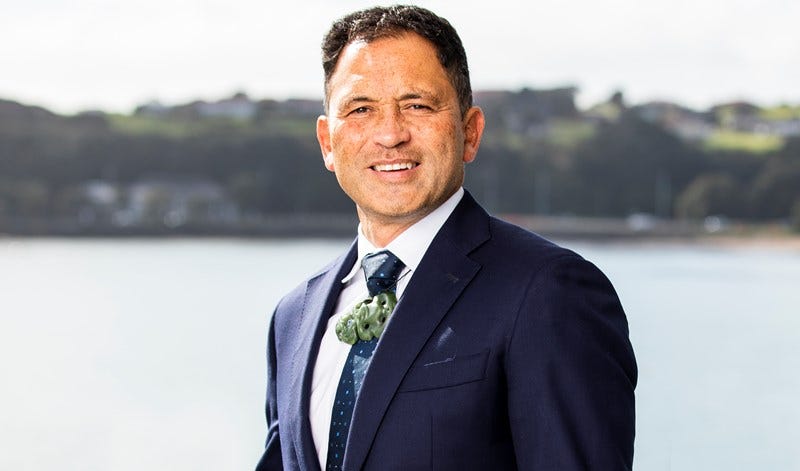
Rēnata Blair.
As an aside, someone else tried to find out more about the event on Waiheke Island via an OIA request to ACC. Demonstrating how little importance they place on being transparent to the people who pay the taxes that fund these shindigs, ACC responded with:

John Bennett. Photo: Stuff
In any organisation that takes misconduct seriously, this would trigger an investigation that is transparent, documented, and leads somewhere. Instead, ACC declared the matter “addressed,” offered no findings, and immediately moved to solve its internal problem the way so many Crown entities do: by exporting it.
Bennett wasn’t suspended. Instead, ACC approved a secondment to Health NZ, effectively handing a live HR risk to another public agency already under structural pressure. It was the bureaucratic version of pass the parcel, but the parcel is a grenade with the pin pulled out.
On March 8th, Stuff published an astonishing account in which Bennett attempted to explain away the physical contact complaints. In doing so he revealed exactly the kind of attitude that should have disqualified him from senior leadership in the first place. He described the complainant as a “really vexatious person”, insisted the concern was “a f***ing classic” and “a nonsense”, and dismissed it on cultural grounds: “Loads of people, loads of us hug… We’re f***ing Europeans, you know what I mean?”
His defence of his behaviour was a whole bunch of minimisation. He claimed the issue was simply that one staff member “didn’t like a lot of the Māori hugs” and “didn’t allow a lot of hongis”, saying the encounters were just “a back-slap hug” and “none of that sh*t” people might interpret as inappropriate. He described the matter as informal, solved with a “cultural competence committee”, and insisted everyone was “really happy” afterwards. In other words, the classic “it was nothing”, “they overreacted”, “this is normal where I come from” trifecta.
He took the same dismissive tone about the topless Zoom call, blaming a friend’s camera and saying he was just sitting in board shorts when unexpectedly put on screen. The pattern is clear that nothing was his fault, any concern was petty or malicious, and everything was already “dealt with”.
The problem for Bennett, and for ACC, is that he said all of this directly to a journalist. Within hours of the questions landing, ACC Chief Executive Megan Main abruptly changed her tune and after previously saying the matter had already been addressed and required no disclosure to Health NZ, Main now announced that ACC was “investigating the issues raised”.
In a follow-up article on March 13th, Paula Penfold reported for Stuff that Bennett “will be stepping down from his role at ACC effective immediately”. In this article, Penfold introduces a second disgraced ACC deputy, but before we move on to this we need to cover how months later, things got even worse for Bennett.
Stuff published another update in May, informing us that Bennett wasn’t just a walking HR headache, he was also at the centre of a massive conflict-of-interest and procurement failure that ACC has now admitted it mishandled. This is the nepotistic, self-interested bit.
In 86 pages of ACC documents obtained by Stuff under the OIA and buried inside the bureaucratic sludge was another rotten tale. The new documents show that, during Bennett’s brief tenure, ACC failed to properly manage multiple conflicts of interest, particularly in connection with a UK company called MBI Health, a business Bennett co-founded in 2012 and left in 2020, but with whose co-founder, Barry Mulholland, he still shared two ongoing directorships.
While Bennett was overseeing key parts of ACC’s System Commissioning and Performance function, he approved or influenced several contracts awarded without open tender. The most significant was a PwC consultancy contract initially worth $97,000, which ballooned through variations to $942,000. PwC had proposed subcontracting part of the work to MBI Health with Barry Mulholland listed as “nominated personnel”.
One ACC staff member noted in writing that the lack of competitive tendering could lead to complaints from other suppliers, but that ACC would “accept this risk”.
When conflict-of-interest concerns surfaced, Bennett initially stated he had none. It was only in early January 2025 that he emailed internally to “clarify a perceived conflict,” acknowledging his past involvement with MBI, but he did not disclose his ongoing business ties with Mulholland, nor did he disclose that he had previously attempted to directly contract MBI for ACC work. These omissions were flagged internally as “significant” risks, with one senior staff member alerting ACC’s head of procurement that the contract’s nearly $1 million value, its closed-sourcing, and Bennett’s connections created clear “potential public perception” problems.
ACC’s head of procurement agreed the situation represented a “perceived conflict,” and Bennett was asked to complete a formal conflict declaration, which he did, but only after ACC’s chief executive, Megan Main, had been looped in. Despite the red flags, Main signed off the contract on the same day Bennett submitted his belated conflict form. A well-placed source who reviewed the documents told Stuff that had Bennett fully disclosed his ties, the conflict would “likely have been assessed as actual,” requiring his recusal or independent oversight, and questioned how such a high-value contract could have bypassed tender requirements without additional scrutiny.
ACC has now admitted its processes “did not meet the expected standard” and confirmed it has ordered a review of its conflict-management systems. However, the review will be led internally by ACC itself, and no timeframe or terms of reference have been released.
The article also covered Bennett’s secondment to Health NZ and “whether they were aware of Bennett’s historic connection with MBI Health and his ongoing connection with Mulholland.” Health NZ initially told Stuff that Bennett had assured them he had “no conflicts of interest” in his seconded role, emphasising that he held no procurement or financial delegation and wasn’t involved in commercial decisions. But when Stuff pressed further, asking whether Health NZ had independently checked for conflicts, knew about Bennett’s past involvement with MBI Health, or was aware he still shared companies with MBI co-founder Barry Mulholland, something changed.
A week later, Health NZ confirmed that MBI Health had been awarded a $2 million, non-tendered contract, meaning no other provider was given the chance to bid. Health NZ initially defended the closed process by claiming MBI was the “only known provider” capable of doing the work. This was a justification other consultants described as “complete rubbish.” The backlash forced escalation and both Health Minister Simeon Brown and Health NZ’s acting chief executive ordered a formal review into how the $2 million contract was awarded.
Anyway, back to ACC and our second disgraced deputy.
ACC’s Deputy Chief Executive Māori, Rēnata Blair, Paula Penfold revealed, was also now under investigation after allegations of “drunken and inappropriate behaviour” at a work function on Waiheke Island and further unspecified allegations related to his behaviour at Te Matatini.
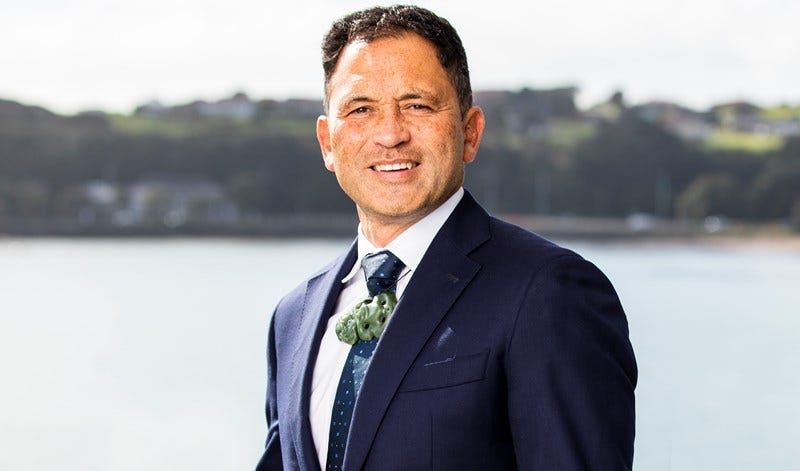
Rēnata Blair.
As an aside, someone else tried to find out more about the event on Waiheke Island via an OIA request to ACC. Demonstrating how little importance they place on being transparent to the people who pay the taxes that fund these shindigs, ACC responded with:
“We are refusing to provide the information requested as it is subject to an obligation of confidence and the release of the information would be likely to prejudice the future supply...”
Regardless of exactly what kind of events ACC holds on Waiheke Island at which its senior executives get drunk, Mr Blair managed to get himself into trouble. ACC’s senior leadership responded in accordance with the theoretical textbook on public sector damage control when passing on the grenade is not an option. Rēnata Blair was put on leave while an “investigation” was conducted.
By the next Stuff article on April 11th, Blair was “no longer employed” by ACC and they refused to say more than that as it is an employment related matter “we are unable to comment further”. Not dismissed, fired, resigned. Just… no longer there as though senior executives vanish by natural evaporation.
The Bennett case is the overture. Blair is the crescendo. But the attempted clean up is the finale. Together, they reveal in ACC another institution whose first instinct is not truth or accountability, but containment. It is this part of the saga that hasn’t been reported on in the media. ACC appears to be an institution that has extraordinarily bad luck when it comes to the men they appoint to important roles.
ACC’s Big Solution: commission an “Independent Culture Review”
After Stuff’s reporting on Bennett and Blair, the ACC Board did what every panicked Crown entity does when caught out: it ordered an independent review.
The terms of reference, dated 20 March 2025, promised to examine whether ACC provided “a positive, inclusive and safe workplace” and, crucially, whether it had “robust systems, practices and processes for responding to staff concerns about inappropriate conduct and behaviour”.
The ACC Board appointed two external reviewers to give the appearance of independence and gravitas: Doug Craig, a consultant from RDC Group known for his organisational culture and HR advisory work and Pip Muir, a senior employment lawyer and partner at Simpson Grierson with a reputation for navigating high-stakes workplace investigations inside large institutions. On paper, they were meant to provide balance with Craig bringing the “culture specialist” lens and Muir supplying legal and procedural rigour. Craig was the face of the review, conducting the bulk of staff interviews and shaping its early direction. Muir was the legal backbone.
The official line to media and the public was that the review would be rigorous. All staff could speak in confidence and the findings would be made public. ACC was going to prove it could police itself.
Then something happened that makes this all sound like a Monty Python sketch and probably made the ACC Board feel like they were cursed. You see, the culture reviewer, became the culture reviewed…
In an OIA response dated 4 September 2025, acting ACC chair Jan Dawson admits that four ACC staff made confidential approaches to the Board in early June, raising concerns about the culture review itself. In her brief statement accompanying the OIA she said:
“The Board received confidential approaches from four ACC staff expressing concerns about the review process. The alleged concerns centred on the interview approach adopted by Mr Craig in some meetings.”
In the midst of publicly selling a process designed to clean up ACC’s image following the scandals of Bennett and Blair and give staff a safe way to talk about inappropriate behaviour, multiple staff members were so uncomfortable with the reviewer’s own behaviour they went privately directly to the board.

Doug Craig.
The actual nature of the behaviour that made these staff members so uncomfortable is undisclosed. But, proving nothing at all had changed since the two deputy’s misbehaved, ACC went into containment mode. Acting chair Dawson says they “considered the alleged concerns and agreed steps with the two reviewers to ensure that the independent review could be completed appropriately”.
Your guess is as good as mine as to what those “steps” were because Dawson’s OIA letter then jumps to advising:
“Approximately two weeks later, Mr Craig separately resigned from his role as a reviewer for health reasons.”
They think we are all idiots. That we are incapable of putting together the two events: the complaints and the resignation. It would be a mighty big coincidence to be struck down so ill you need to quit a lucrative review contract just two weeks after four staff members complain about your behaviour.
The OIA release includes the full email trail between then acting ACC chair David Hunt (yes, another one), Doug Craig, and the Board.
On 26 June 2025, Craig emails Hunt:
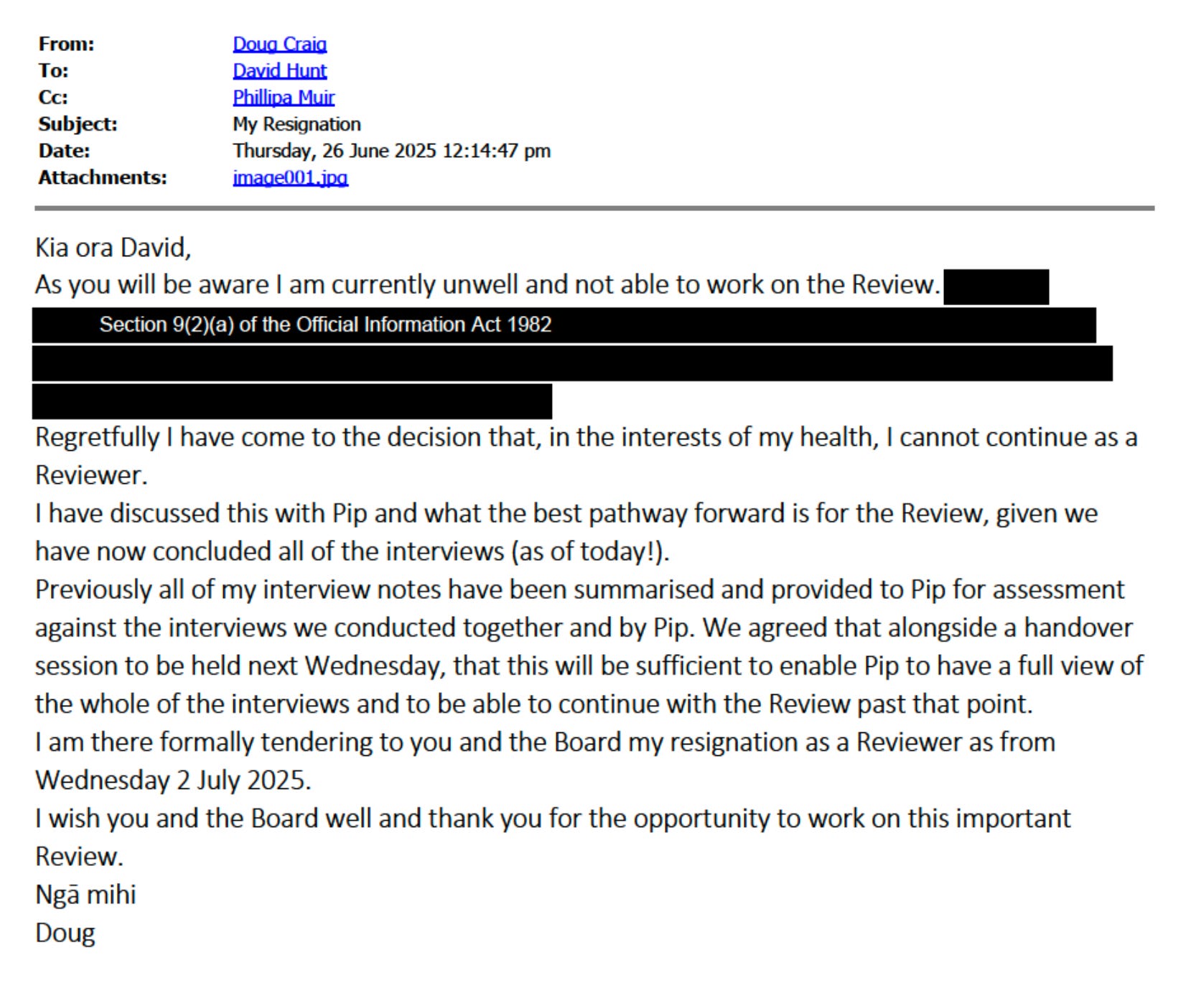
Click to view
He says he is “currently unwell and not able to work on the Review” and that, “in the interests of his health”, he has decided he cannot continue as a reviewer. He notes that all interviews are now complete and outlines a handover plan to Muir.
This is the story ACC wants on the record. They want the image of an overworked consultant, feeling crook, graciously stepping aside.
Hunt replies the same day, accepting the resignation and, crucially, spelling out the communications strategy:
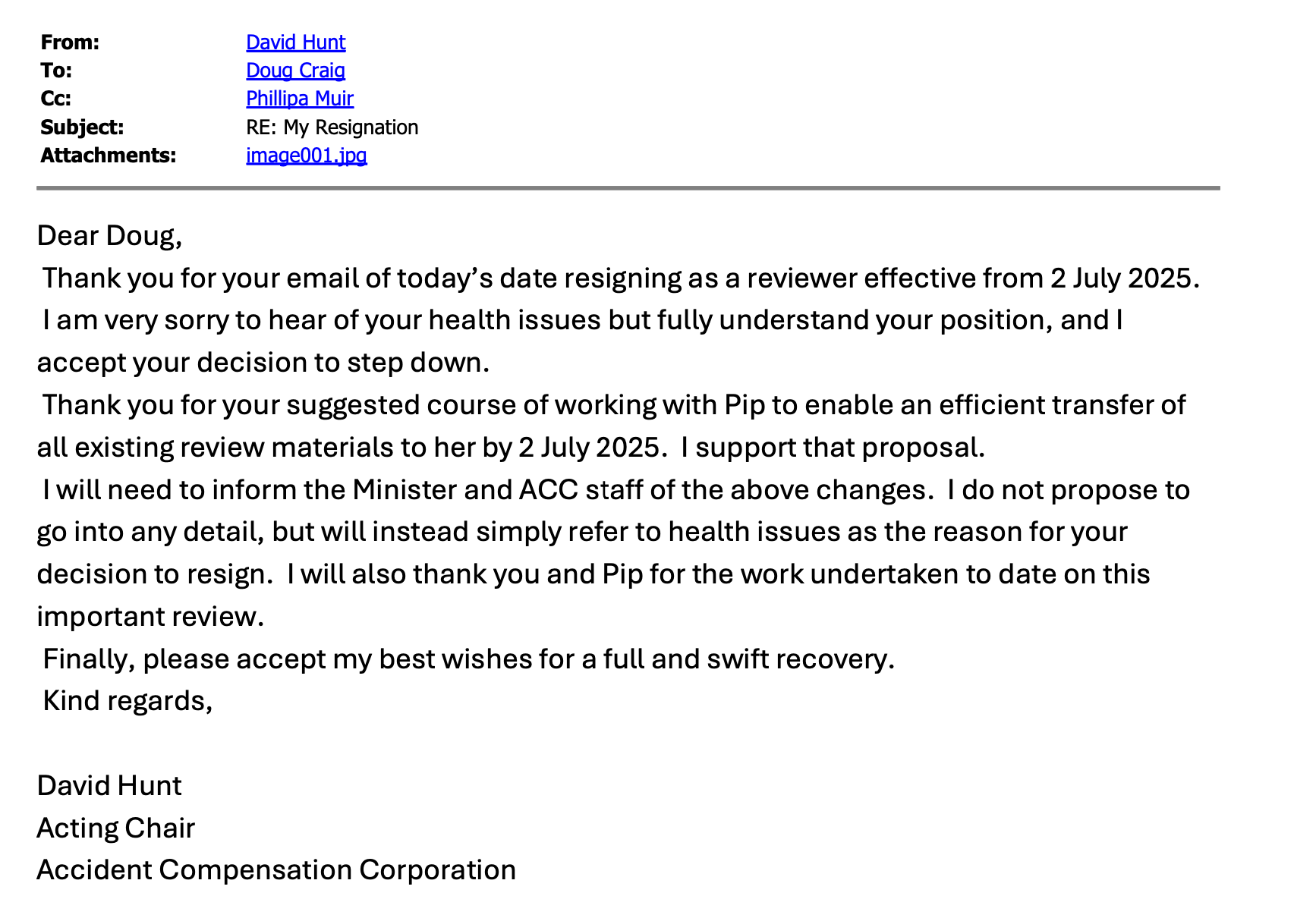
Click to view
He tells Craig he will “not propose to go into any detail” but will “simply refer to health issues as the reason” for his resignation when informing the Minister and staff.
This is a deliberate decision at chair level to strip out the uncomfortable context of staff complaints about Craig’s behaviour and attribute the departure solely to “health issues”.
Hunt then forwards the exchange to the Board:
“Please see below the email exchange between me and Doug Craig… I will then be in contact with the Minister (likely later today). I will then let Megan and the team know (likely tomorrow).”
No mention to the Board that he intends to gloss over the complaints when speaking to staff. But he has forwarded them the same emails I have shared above and they are aware of the four complaints. They know exactly what’s being left out.
The next day, ACC’s governance team sent Craig a formal letter confirming the consultancy order would terminate “by mutual agreement from 2 July 2025” and instructing him to hand all material to Muir.
And then comes the all-staff email. The undeniable evidence of containment and obfuscation that shows that the whole review was a farce anyway because ACC had no intention of handling inappropriate behaviour any differently. They were as quick to cover over the truth and move the problem along as they were with John Bennett.
Sent on 27 June, under the heading “Update on the Independent Culture Review”, it thanks staff for their “strong engagement”, notes that interviews have wrapped up, and then breezily announces:
“Doug has advised that he will be stepping down next week for health reasons and therefore Pip Muir… will complete the review from this point.”
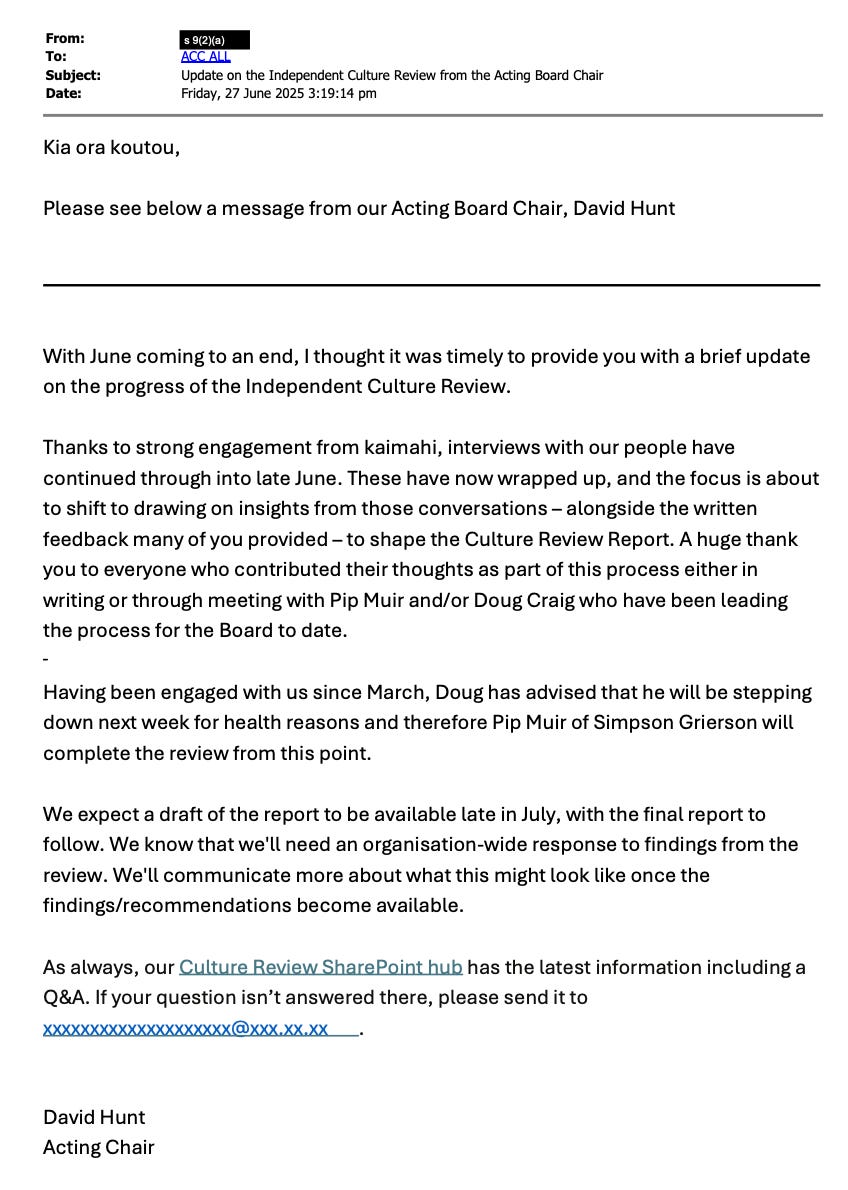
Click to view
Not a word about the four staff who went to the Board. Not a hint that the “safe” process had itself generated behavioural complaints. The chair just felt it was “timely” to have a wee update.
It’s a closed loop. The official record, internal and external, mirrors the sanitised version the board has created. The only reason we know any of this is because someone, called DC, used the FYI website and the Official Information Act and forced ACC to hand over the correspondence. Not because the Board volunteered it and not because the media dug it up. In fact, since the Stuff articles mentioned earlier, I haven’t been able to find any reporting on these matters.
The Culture Review: rot diagnosing rot
Despite the shambolic process, the culture review continued under Pip Muir’s stewardship. The final culture review report was published in August and trumpeted by ACC in September. The report describes ACC as a “gossipy” organisation with inconsistent leadership behaviour and recruitment practices an internal audit had already labelled “very high risk”.
Muir found that ACC “is not ‘toxic’ however, ACC’s current workplace culture is not positive overall”. I snorted English Breakfast tea down my pyjamas reading that line. Muir is desperately, desperately, trying to avoid putting in writing what is evidently the truth and, in doing so, she has told us in a back-to-front way that ACC is, in fact, toxic.
The executive summary sets out, in classic lawyerly understatement that staff experiences are “mixed” and depend heavily on their manager. Well, duh. She says there has been a “lack of past accountability” which has undermined trust and HR processes for dealing with poor behaviour are weak and viewed cynically. And explains that policies on inappropriate conduct and bullying are incomplete and often not followed.
The report even acknowledges that ACC has struggled to respond effectively to “recent issues and allegations” about executive conduct. This is a diplomatic reference to Bennett and Blair. It doesn’t say, because it couldn’t without blowing up its own process, that during the review itself, staff concerns about the reviewer’s behaviour were minimised, the reviewer stayed on to finish the interviews, and his exit was publicly framed as a simple health matter.
“Accountability”ACC-style is something that happens to other people, in abstract recommendations about future policy. It is never allowed to land on the people making decisions right now.
The performance of institutional rot
One of the defining markers of rot inside New Zealand’s public institutions is the language. The deliberate, bloodless phrasing designed to drain accountability from events that should carry real consequences. At ACC, this shows up in the way senior executives simply cease to exist within the organisation. Rēnata Blair doesn’t get fired; he becomes “no longer employed.” Doug Craig’s behaviour isn’t addressed, instead, the Board and chair discuss gentle “steps” to “ensure the review can be completed appropriately.” It is accountability that has been baby-proofed, no sharp edges, nothing you can pick up and examine, nothing that could imply responsibility.
The second technique is the weaponisation of health as a reputational shield. Hunt’s email to Craig is brazenly clear: when informing the Minister and ACC staff of Craig’s resignation, he will “simply refer to health issues” and “not go into any detail.” Health can, of course, be a genuine reason for stepping back. But in the public sector it has also become the all-purpose cloth draped over misconduct, conflict, or complaint. It creates an immediate barrier to scrutiny. No journalist, no staff member, and no Minister wants to look like they’re interrogating someone’s wellbeing. And so departures that are fundamentally about behaviour are sanitised into something sympathetic and unchallengeable.
Then comes the most elaborate performance of all: reviews as theatre rather than accountability. The culture review’s terms of reference talk earnestly about assessing “robust systems” for dealing with inappropriate behaviour and staff concerns. Yet when staff raised concerns about the reviewer’s own conduct, ACC’s response was not to activate these supposedly robust systems, but to fall back into the familiar pattern of private conversations, euphemised departures, and the swift reassertion of institutional control. No room for disruption or transparency, and no meaningful pause to consider what it means when a review intended to restore trust becomes compromised from within.
But ACC still gets the credit. It gets to announce that it commissioned an independent review, listened to hundreds of staff, and is now “implementing recommendations.” The Board ticks its governance box. MBIE and Treasury tick theirs. The Minister gets to say he’s satisfied that the process has run its course. And the underlying instinct to protect the institution first and tell the public as little as possible, remains safely unexamined, untouched, and uninterrupted.
Where is the media?
To their credit, Stuff did the original work exposing the allegations against Bennett and Blair and the broader culture concerns at ACC. Paula Penfold’s reporting on John Bennett was extensive and high quality.
But once the magic words “independent review” were invoked, most of the gallery seemed content to move on. By the time the final report dropped, coverage was reduced to “ACC culture ‘gossipy’, hiring practices high-risk,” a couple of quotes, some soothing statements from ACC, and no serious digging into how the review itself had unfolded. Doug Craig’s name has been disappeared from reporting.
There are still glaring, uncomfortable questions hanging over the conduct of Bennett, Blair, and Craig; questions ACC has never answered, and which the media has not asked. What, precisely, were the allegations about Blair’s behaviour at Waiheke and Te Matatini? We know they were serious enough to trigger an internal investigation and for Blair to be “no longer employed” by ACC, yet no findings have ever been released. Was there even a formal report? If so, who carried it out, what evidence did they consider, and what did they conclude? And most crucially: was Blair dismissed, did he resign under pressure, or was a settlement quietly arranged to make the problem disappear?
The same fog obscures Craig’s departure. Staff made complaints about his “interview approach” during the culture review, but what behaviour, exactly, caused them to approach the Board? Why did ACC permit Craig to continue interviewing staff even after concerns were raised? And why did the acting chair make a deliberate decision to tell staff and the Minister only that Craig had health issues, when he had full knowledge of the complaints? This was a calculated communications strategy.
These are not minor procedural footnotes. They cut directly to the core of whether ACC, and more broadly, New Zealand’s public service, has the capacity or willingness to conduct honest self-scrutiny. Because if an agency cannot be transparent about misconduct at the top, cannot tell the truth about its own review process, and cannot even describe executive departures without resorting to euphemism, then the rot has set in.
Ani O'Brien comes from a digital marketing background, she has been heavily involved in women's rights advocacy and is a founding council member of the Free Speech Union. This article was originally published on Ani's Substack Site and is published here with kind permission.


5 comments:
One wonders if the appointment to managerial roles were a matter of DEI?
= Public Service.
Ani. Thank you for your excellant expose of what is the current Wellington bureaucracy! A Public Service so wedded to virtue signalling, so warped in promoting an unwanted maorification of New Zealand, so defiant and resistant to Ministarial direction.
The Bennetts, Blairs, Craigs and Muirs are just so symptomatic of the rot that exists in that town. And what a great example of that rot - ACC having in their employ a Deputy Chief Executive Maori ! A what? What on earth does a DCE Maori do that is deemed necessary and different from all other ethnicities existing and employed within the organisation!? All such woke nonsense should be carved out of the Public Service now, today.
Steve Ellis
A study in how a small elite run things... A consultanting class and an elite public service class. All known to each other spinning fairy tales ti cover their dodgy ways....
To assign a particular ethnic label to any post is a clear statement of its importance in terms of i) specificity and ii) possible privilege and superiority. This is now so common that the separatist character of NZ can be in no doubt. NZ is now a deeply divided country.
But the major problem is that it will quickly become a destroyed country - if another Left government is ever elected. NZers - through their apathy - have condemned themselves to living on a knife edge.
Post a Comment
Thank you for joining the discussion. Breaking Views welcomes respectful contributions that enrich the debate. Please ensure your comments are not defamatory, derogatory or disruptive. We appreciate your cooperation.