

ANNOUNCED TODAY : GENERAL ELECTION 2026 IS ON SATURDAY 7 NOVEMBER
Chris Hipkins’ caucus-retreat speech was intended to signal renewal, momentum, and hope. Instead it revealed a Labour Party still unwilling to take responsibility for the impact of its time in government and one willing to engage in historical revisionism. Hipkins’ speech was not a forward-looking address about what Labour would do differently. It was an exercise in proportioning blame, deflection, and narrative laundering.
Yesterday, Luxon’s State of the Nation speech deliberately avoided mentioning Labour at all. It was not widely regarded to be a particularly impactful speech, but it was focused on the future, on the Government’s programme, and on where New Zealand is heading. Hipkins went the other way entirely with a speech in full attack mode.
Hipkins claimed New Zealanders are “looking for hope” and are instead being fed “negativity” and “doom and gloom” by the current Government. That argument felt clunky given the Prime Minister had just delivered a positive (if boring) speech the day before while Hipkins’ speech was almost entirely devoted to attacking political opponents. His attempt to position himself and his party as the hope of New Zealand ignores the fact that Labour spent six years promising transformation, delivered disorder, and then spent the next two years insisting none of it was their fault.
Hipkins claimed New Zealanders are “looking for hope” and are instead being fed “negativity” and “doom and gloom” by the current Government. That argument felt clunky given the Prime Minister had just delivered a positive (if boring) speech the day before while Hipkins’ speech was almost entirely devoted to attacking political opponents. His attempt to position himself and his party as the hope of New Zealand ignores the fact that Labour spent six years promising transformation, delivered disorder, and then spent the next two years insisting none of it was their fault.

Chris Hipkins delivers speech at caucus retreat
This is particularly obvious in Hipkins’ rhetoric on migration. He implored that we need to “give young New Zealanders a reason to stay” and warned that people are “looking for opportunity elsewhere”. This is extraordinary coming from the leader of the government under which net migration surged, youth outflows accelerated, and skilled workers left in droves. Those departures coincided with record housing unaffordability, collapsing productivity, and a cost of living crisis driven not just by global shocks but by Labour’s domestic policy choices. Labour cannot credibly cast itself as the party that kept talent at home when its own decisions made it harder to build, invest, hire, or get ahead.
More damning still is the fact that as Prime Minister, Hipkins personally helped make it easier for New Zealanders to move to Australia. He stood alongside Anthony Albanese and proudly announced changes that removed barriers for Kiwis to live, work, and access pathways to citizenship in Australia. It was sold as a diplomatic win, and in a narrow sense it was. The omission is politically convenient, but it materially weakens the credibility of his claim. If today’s exodus is an “absolute indictment”, Hipkins needs to explain why he chose to reduce the barriers to leaving for Australia instead of fixing the conditions that made leaving attractive in the first place.
The most dishonest section of the speech was Hipkins’ attempt to pin the structural deficit on the current Government. He claimed it was “created” by National, that Nicola Willis did not inherit it, and that Labour had New Zealand on a clear pathway back to surplus. This is simply false. When the Government changed, inflation was still well above target, operating deficits were locked into the forward years, debt was structurally elevated, and spending commitments vastly exceeded sustainable revenue. Labour’s so-called pathway to surplus relied on heroic assumptions and growth forecasts that collapsed on contact with reality. To claim that a few months of fiscal restraint caused years of accumulated deficit is not just economically incorrect; it requires a wholesale misrepresentation of the fiscal record. This is the point at which political framing crosses into outright dishonesty. To date, these claims remain largely unchallenged in mainstream coverage.
Hipkins characterises the Government’s response to the state of the books as “slash and burn”. In truth, ending wasteful spending probably does feel harsh if your political identity is built on spending announcements. But restoring fiscal credibility is not doom and gloom. It is one of the very minimum requirements of governing.
From 2017 to 2023, Labour presided over the largest expansion of public spending in modern New Zealand history, a massive growth in the size of the public service, zero productivity growth, collapsing business confidence, and inflation that peaked above 7% by the time the Government changed. It was credit-card governance, turbo-charged by Labour’s Finance Minister Grant Robertson, whose budgets treated borrowing as a substitute for discipline.
If Hipkins and his speech writers had not decided to take the path of rewriting history, we might not need to relitigate the poor decisions of 2017-2023 so much. But since they have put the blame game on the table, it is imperative that New Zealanders get an accurate picture.
Hipkins is relying on familiar villains in landlords and tobacco companies to cast shadowy aspersions on the ethics of the Government. On housing, his rhetoric is disconnected from current market data. It is thanks, in part to the changes around interest deductibility (which Hipkins calls tax breaks for landlords) and a cooling market, that rents have actually gone down in many parts of the country.
On tobacco, the anger is just as cynical. Smoking rates are still falling. The real dispute is that the Government has chosen a different approach to reducing harm and one that does not allow public policy to be dictated by a small group of Otago academics with significant institutional and career incentives tied to a single model. Labour’s fury is about losing control of the policy levers, not about failed outcomes.
The big bold solutions proposed by the man presenting himself as our alternative, focused on the few policy announcements he made toward the end of 2025. These included the three GP visits he insists on calling “free” when really our taxes would pay for them and which will drive our primary health sector into a crisis. And, of course, his ‘Claytons’ Capital Gains Tax that he hopes will appeal to the harder left voters who will not look at the detail without scaring the middle New Zealand vote.
Hipkins also clearly believes that job creation is the Government’s job and this Government is failing to do it. What the speech does not acknowledge is that every job the Government “creates” must be paid for by taxpayers, indefinitely. The current Government’s strategy of stimulating the private sector to create jobs means employment growth does not come with a permanent bill attached. Hipkins is not shy in demonstrating he is offering a more interventionist model. His vision is for bigger government, more state direction, and more public payrolls. It is the same approach that delivered brief sugar hits followed by an immense inflation-fuelled hangover last time they were in charge.
What the speech emphatically tells New Zealanders is that Chris Hipkins and Labour will not be taking the “kindness” approach to campaigning for the election. The gloves are off and Hipkins is kicking things off by placing narrative ahead of accuracy. His personal attacks on Luxon were pretty dated and will need updating as he once again dusted off the years-old, out of context quotes about “bottom feeders” and a “wet, whiny, miserable country”. Both quotes were spliced from comments delivered before the last election. If after two years in Opposition Hipkins has nothing more than old out of context quotes he is in big trouble.
This was not a renewal speech. It was a calculated attempt at poisoning the narrative from the get-go so that National has to defend itself against lies as well as their own record. Hipkins is asking voters to forget six years of mismanagement, forgive a historic spending binge, and believe that the party responsible for the damage is somehow the solution. Hope is not rhetoric alone. It is built on credibility. And until Labour tells the truth about its own record, New Zealanders will view them with suspicion.
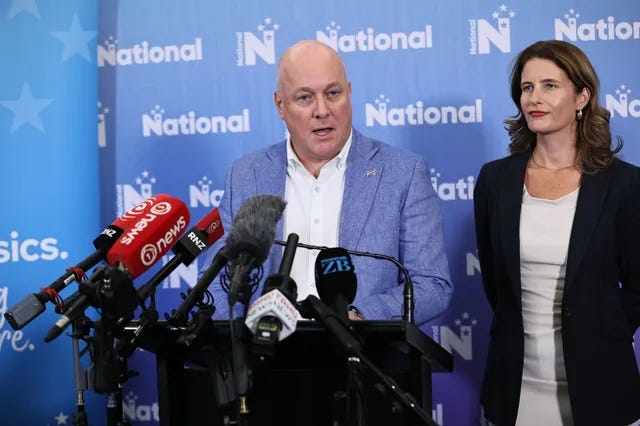
Source: Chris Skelton/Stuff
Christopher Luxon got another crack at his State of the Nation speech as he announced the election date this afternoon. And this speech packed more of a punch than his last. The Prime Minister also used it as an opportunity to deliver a rebuttal to Hipkins’ attacks this morning and the broader attempt to rewrite the last two years.
Luxon confirmed the election would be held on 7 November and framed the coming contest around the proposition that New Zealanders should stay the course. His message framed his party as disciplined, deliberate, and anchored in outcomes rather than grievance.
He directly challenged the economic dishonesty that underpinned Hipkins’ address, pointing out that under his Government, interest rates have been cut nine times; a material relief to households. He also highlighted markedly improved crime statistics and clear improvements in education performance, areas where his Government has undoubtedly excelled.
The Prime Minister characterised his Government as stable and strong in an increasingly volatile world, contrasting it with Labour’s appetite for constant intervention, spending escalation, and moral panics. His speech returned repeatedly to fundamentals of safer streets, world-class education, housing supply, infrastructure, and roads. Most notably, he renewed his promise that if you work hard and make good choices, you deserve to get ahead in New Zealand.
Unlike his understated State of the Nation speech yesterday, Luxon did not shy away from drawing a clear line between his Government and Labour. He described Hipkins and the broader left bloc as a force that would “send New Zealand backwards”, arguing they remain fixated on punishment rather than progress. He characterised Labour as reflexively committed to taxing New Zealanders more and more in order to spend more and more, with little regard for productivity or long term sustainability. And he explicitly tied Labour’s credibility problem to its own record, referring to the “ungodly mess” the country was left in when National took office.
In contrast to the negative politics of Hipkins’ speech, Luxon’s tone was overall optimistic. He described New Zealand as “the best country on planet Earth” and argued that global leaders envy its potential. The Prime Minister has struggled to connect with Kiwis as well as previous National leaders like John Key, but for all his corporate speak his belief in New Zealand’s future prospects feels genuine. He has confidence that the ground work laid in the first two years of this term will see progress in the third.
He emphasised that two years is not a very long time and his Government has achieved a great deal in that time. They have just under a year to go until the election and he is promises we will see the fruits of their hard work coming through.
Taken together, the two speeches revealed the real shape of the coming election. Hipkins is running a campaign rooted in historical revisionism, recycled outrage, and an ever-expanding role for the state. Luxon is running on continuity, restraint, and the argument that New Zealand is finally turning a corner after years of mismanagement. One is asking voters to forget the past. The other is asking them not to risk repeating it.
Ani O'Brien comes from a digital marketing background, she has been heavily involved in women's rights advocacy and is a founding council member of the Free Speech Union. This article was originally published on Ani's Substack Site and is published here with kind permission.


10 comments:
In a single column Ani does the job an entire industry should have been doing — put a searing light on two fearsomely uncharismatic leaders as if she had borrowed the floodlights from the MCG.
No fireworks. No sanctimony. Just performing an autopsy on two men who want to run the country.
Her motive was to convince readers to look properly at what they are seeing.
And this is where Ani indicted the rest of mainstream media.
While she was surgically comparing leaders, much of the press was still running profile pieces and reactive snippets: Luxon-as-CEO explainers, Hipkins-as-decent-bloke features, policy announcements reported like press releases with timestamps attached.
One resorted, as usual, to his brand of ideological ventriloquism — heavy on grievance and moral certainty, light on evidence.
Collectively, they told their segment of readers who was up, who was down, who had offended whom — but not what it all added up to.
The failure wasn’t ideological so much as structural. Instead of interrogation, they amplified what they thought their readers should know.
Using their now standard approach of ideological stenography, Luxon and Hipkins became third-rate characters in an ongoing soap opera, not as decision-makers shaping the country’s trajectory.
Readers were left to assemble meaning from fragments. They were being handed bricks and asked to imagine the house.
Ani does the opposite. She stepped back, drew the lines, and trusted readers with a grown-up conclusion: that New Zealand’s problem is not which of these two men wins the argument, but why neither seems willing to have one.
Good journalism doesn’t just report movement; it explains direction. In this case, one columnist managed to do what a crowded media ecosystem could not: slow the picture down, sharpen the focus, and ask the only question that really matters — if this is leadership, why does it feel so bloodless?
—PB
As a Western Nation, built on the former standards of The British Empire and the Parliament being the 'copy' of Westminster, thereby instigated the 2 tier Party system, that prevailed for many Years.
New Zealand, stepped to the left and created MMP that allowed Minor Political Parties to "come out of the closet", attempt to establish themselves as credible entities (for those reading this comment, the list of such parties is very long) and using the 'mantra' of MMP, sought to gain seats via standing Constituencies and if successful "bring their friends to fill the Benches within the House".
Sadly, even with MMP, NZ still had that 'class distinction' of voting for a 2 party system.
This continued voting pattern being a family led factor, based on who Daddy worked for.
At election time, you followed Dad's lead.
The exception was The Unions, who in their 'day' had formidable 'sway' over the membership and "directed' the voting accordingly.
It is only of recent Years has this changed, with the younger generation stepping to the 'right' and applying their vote to Parties (e.g. Democratic Party, The Values Party, The Alliance Party, McGillicudy Serious Party, The Greens) that "they thought" would support their endeavors, views etc.
If you look at NZ General Elections, you will always see, historical voting occur for the 2 party system.
Even now, our MSM still relate to 2 Parties in media commentary.
The 7th November 2026 - watch the "swing" toward Labour on that basis of above, NZ First & ACT making gains, National (just might) relegated to Opposition (again).
Why - sadly the 'mood' with the NZ Public, is "not with National".
You only have to read commentary both here on on YouTube under NZ Posted Videos.
The British system is not typical of Western nations. The upper house is not filled through the popular vote - when the Brits say someone was 'voted into' the House of Lords, what they mean is that the hereditary peers (of whom there are currently 85) voted that person in when a seat became vacant. The British parliamentary system is based on hereditary class - not something that would go down in a more egalitarian society such as NZ. (As a pertinent aside, a bill before Parliament may soon see the end of the hereditary peer system.) Also, the legislature and the executive are closely linked to one another.
The norm in Western countries is a 'Napoleonic' system of governance in which there is a Constitution, an upper house that is voted in by the people or by lower-level political entities such as regional councils, and a strict separation of powers between the legislature and the executive.
As a personal observation, while living in Lebanon for 17 years we often had 'no government' for many months on end but the country, which operates according to the Napoleonic model, continued running because running a country is up to the executive, principally the Ministries, in that system. In fact, it was often quipped that the country ran better without politicians sticking their noses into the operation of the Ministries.
The problem with the European system of electing representatives for the lower house is the abundance of parties, which in practice means that all governments are coalition governments. This tends to steer the system towards half-hearted action or inaction because of the fear of coalition partners getting the huff and withdrawing from the coalition, which means the government falls.
Rather than jettisoning MMP, perhaps NZ should revisit the 5% threshold.
Maybe we should ask Trump to invade new zealand to save us. Imagine how wealthy and stable we would become. All earning usd so that we can travel really cheaply. Trump ripping up the treaty of waitangi on tv1 news and draining the grifting swamp. It would be fabulous. We would have a stable country that idiots like hipkins could not ruin.
Anon 1.49
We don't need a Trump, we just need a reasonable person with enough sense to call a halt to this destruction of democracy.
Luxon is not the person.
We need a National Party to realize the mess we are in and the future of NZ under the control of likes of Tamahere, Jackson et al, and direct Luxon or his replacement to restore equal voting, and no privileges based on hermitage.
As usual, a very astute observation PB.
Barend - you seem to be a reasonably knowledgeable chap. Did you know there's a hereditary peer (a Viscount, no less) living in NZ, who has never actually sat in the House of Lords?
No, I didn't, Hugh.
Nota bene I am fervently opposed to the existence of the aristocracy and monarchy. I am a staunch meritocrat.
Bread and circuses, well, three yearly circuses are no way to run a country these days. Until we create a system that puts competent people in charge for individually limited terms we will remain on a downhill, and steepening slope. Oh, by the way, the slope ends with a very long drop onto sharp rocks at the bottom.
Ani always writes well, but this piece is nothing new. Labour all bad, Nats 90% good. Read it before and will read it again in coming months. Or not read it, as too predictable. Smarter version of Hosking.
Post a Comment
Thank you for joining the discussion. Breaking Views welcomes respectful contributions that enrich the debate. Please ensure your comments are not defamatory, derogatory or disruptive. We appreciate your cooperation.