

Another piece about that class of people who seem to sit at the centre of far too many of our institutional and cultural failures. I still struggle to know exactly what to call them. Over the years I’ve tried on labels like the laptop class, the lanyard wearers, the chattering classes, and the woke elite. None of them quite capture the whole phenomenon, but everyone knows roughly who is being described. These are the people who dominate our cultural power centres: media, academia, politics, and the bureaucracy. Sometimes I also include HR departments in ‘big corporates’ as they tend to mimic the social behaviours. They are overwhelmingly educated, urban, comfortably middle class or wealthier, socially liberal to the point of dogma, and deeply wedded to a set of ideological commitments that usually travel under the banner of “wokeness”.
What makes this group so powerful is not just where they sit, but how they reinforce each other. Ideas are generated in academia, often in the form of postmodern or identitarian theories that are incubated in journals through a kind of incestuous peer-validation process (read Cynical Theories!). Those ideas are then picked up by bureaucrats and policy advisers, translated into frameworks, guidelines, and public service orthodoxy. The media reports on these frameworks as settled truth, not as contestable ideology, and treats dissent not merely as incorrect, but as dangerous, immoral, and malignant. NGOs then cite the media and the academic literature to pressure politicians, who are browbeaten into adopting policies they often barely understand, let alone genuinely believe in. Around and around it goes, a closed loop of self-referencing authority that presents itself as consensus.
This class is also remarkably insulated from the material consequences of the world they largely shape. During Covid, they stayed home on their laptops, having Friday drinks via Zoom and daily mental health check ins, while delivery drivers, cleaners, supermarket workers, and tradies absorbed the risk and impacts. Their jobs are stable, credentialised, and protected. They do not live with the same precariousness as the working class. Now, long after we have tried to memory-hole the trauma of Covid, they resist returning to offices with a fervour usually reserved for civil rights struggles. For all their lecturing about privilege, they are its clearest modern expression. And they have used that privilege to drive cancel culture, to socially punish dissenters, to enforce DEI regimes, identity politics, and ever-narrowing boundaries around acceptable thought and speech.
They increasingly behave as if their views are not merely opinions but institutional defaults and disagreeing with them is treated as a threat to public safety. They do not see themselves as one interest group among many, but as educators of a backward population. The rest of society is framed as ignorant, unenlightened, bigoted, you know, “deplorables” who must be coerced, shamed, or forced into compliance. Sneering contempt for “ordinary people” sits just below the surface, occasionally breaking through in moments of frustration or moral panic. Disagreement is not engaged with, it is pathologised and to dissent is not to be wrong, but to be racist, transphobic, anti-science, or morally defective.
One of the more useful labels I’ve seen applied to this group comes from academia itself in a kind of almost self-aware anaylsis. That is “WEIRD” which stands for “Western, Educated, Industrialised, Rich, and Democratic”. Originally coined to describe the demographic skew in psychological research samples, it turns out to be an eerily good descriptor of the people whose opinions now dominate our institutions. These are societies, and more specifically, sub-cultures within them, that have unusual psychological and moral priors compared to the global majority. Increasingly, even academics are acknowledging that what gets presented as “what people think” is often just what WEIRD respondents think, eg people with the time, resources, confidence, and sense of entitlement to participate in surveys, panels, consultations, and advisory groups.
My view, stated plainly, is that this power becomes dangerous when it turns into hostility toward the population these institutions are meant to serve. Their default posture is suspicion toward the general public, Western culture, and the historical inheritance that underpins liberal societies. Western failures are treated as defining, Western achievements are minimised or dismissed as morally compromised. Narratives that frame the West as uniquely bad, particularly those that centre guilt, identity, and power, are welcomed and amplified, especially when they can be presented as “speaking truth to power”.
This does not function as healthy, corrective self-criticism. By persistently delegitimising our civilisational foundations, these institutions weaken the shared cultural confidence and trust on which liberal democracy depends. The result is institutional self-sabotage and a steady hollowing-out of the norms, assumptions, and loyalties that allow pluralistic societies to govern ourselves at all.
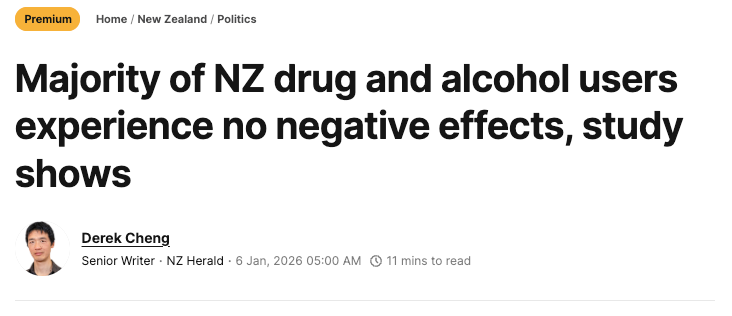
To illustrate what I mean about the collusive nature of idea laundering by the WEIRD class that underpins this, I am going to take you through an article that was in the New Zealand Herald yesterday.
Click to view
Whether or not they are conscious of how inauthentic their faux-balance reporting comes across or not, the NZ Herald is increasingly indulging in this particular genre of journalism that announces itself as careful, evidence-based, and nuanced, while quietly smuggling a very strong conclusion through the back door. Derek Cheng’s NZ Herald feature on the New Zealand Drug Trends Survey belongs squarely in that category.
The article is not sloppy or sensationalist. And it is full of caveats, quotes, and methodological acknowledgements. But, by the time a reader reaches the end, they have been thoroughly ushered toward the clear conclusion that they are meant to takeaway. In this case it is that most drug use is not especially harmful, that public concern is exaggerated, and that our drug laws are therefore misaligned with reality.
It is more subtle than the outright bias that has seen trust in journalism and media plummet in New Zealand and beyond. It is as if they have recognised that New Zealanders want balance and want to see their views reflected, but instead of providing that, they have come up with a way to try and pretend to show it while still indoctrinating us with the “correct” views.

Click images to view
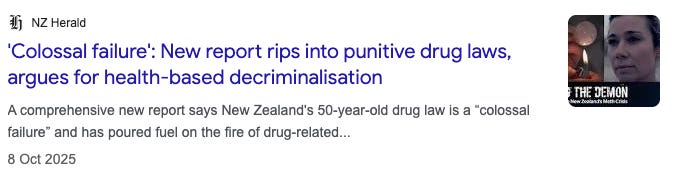
In this article, Derek Cheng’s headline does not mess about. It tells the reader from the outset what they should conclude: “Majority of NZ drug and alcohol users experience no negative effects.” Only later do we discover that “no negative effects” actually means no self-reported harms, over a six month window, among people who already use drugs, measured against a narrow list of outcomes that largely exclude long term, cumulative, neurological, or third-party harm.
This is media laundering of an academic report “shared exclusively with the Herald” that has drawn ideological conclusions from research deliberately crafted to produce the type of data that supports their hypothesis.
The data comes from the New Zealand Drug Trends Survey, an anonymous online survey run by Massey University’s Shore and Whāriki Research Centre. Seeing as it cannot capture harms like cancer, addiction trajectories, psychosis onset, cognitive decline, family violence, child neglect, instances of suicide, incidental injuries, or long term health deterioration, I do not see how it is measuring “how harmful drugs are” in any meaningful public policy sense. It is kind of measuring whether people felt noticeably bad recently which is a very different thing.
This class is also remarkably insulated from the material consequences of the world they largely shape. During Covid, they stayed home on their laptops, having Friday drinks via Zoom and daily mental health check ins, while delivery drivers, cleaners, supermarket workers, and tradies absorbed the risk and impacts. Their jobs are stable, credentialised, and protected. They do not live with the same precariousness as the working class. Now, long after we have tried to memory-hole the trauma of Covid, they resist returning to offices with a fervour usually reserved for civil rights struggles. For all their lecturing about privilege, they are its clearest modern expression. And they have used that privilege to drive cancel culture, to socially punish dissenters, to enforce DEI regimes, identity politics, and ever-narrowing boundaries around acceptable thought and speech.
They increasingly behave as if their views are not merely opinions but institutional defaults and disagreeing with them is treated as a threat to public safety. They do not see themselves as one interest group among many, but as educators of a backward population. The rest of society is framed as ignorant, unenlightened, bigoted, you know, “deplorables” who must be coerced, shamed, or forced into compliance. Sneering contempt for “ordinary people” sits just below the surface, occasionally breaking through in moments of frustration or moral panic. Disagreement is not engaged with, it is pathologised and to dissent is not to be wrong, but to be racist, transphobic, anti-science, or morally defective.
One of the more useful labels I’ve seen applied to this group comes from academia itself in a kind of almost self-aware anaylsis. That is “WEIRD” which stands for “Western, Educated, Industrialised, Rich, and Democratic”. Originally coined to describe the demographic skew in psychological research samples, it turns out to be an eerily good descriptor of the people whose opinions now dominate our institutions. These are societies, and more specifically, sub-cultures within them, that have unusual psychological and moral priors compared to the global majority. Increasingly, even academics are acknowledging that what gets presented as “what people think” is often just what WEIRD respondents think, eg people with the time, resources, confidence, and sense of entitlement to participate in surveys, panels, consultations, and advisory groups.
My view, stated plainly, is that this power becomes dangerous when it turns into hostility toward the population these institutions are meant to serve. Their default posture is suspicion toward the general public, Western culture, and the historical inheritance that underpins liberal societies. Western failures are treated as defining, Western achievements are minimised or dismissed as morally compromised. Narratives that frame the West as uniquely bad, particularly those that centre guilt, identity, and power, are welcomed and amplified, especially when they can be presented as “speaking truth to power”.
This does not function as healthy, corrective self-criticism. By persistently delegitimising our civilisational foundations, these institutions weaken the shared cultural confidence and trust on which liberal democracy depends. The result is institutional self-sabotage and a steady hollowing-out of the norms, assumptions, and loyalties that allow pluralistic societies to govern ourselves at all.
To illustrate what I mean about the collusive nature of idea laundering by the WEIRD class that underpins this, I am going to take you through an article that was in the New Zealand Herald yesterday.
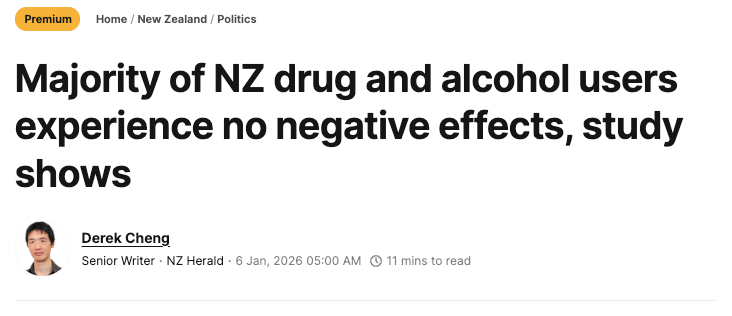
Drug law reform, specifically the push for decriminalisation or legalisation, has become something of a pet issue for the WEIRD class. Framed in the soothing language of compassion and public health, the mantra is always that drugs should be “treated as a health issue, not a criminal one”. But this framing obscures who bears the costs of these experiments. The people most enthusiastic about decriminalisation are rarely those living with open-air drug markets, violent addicts, property crime, or collapsing neighbourhoods. They are professionals, academics, journalists, and policy advisers whose exposure to drugs is largely recreational, abstract, or mediated through reports and conferences.
By contrast, the working and lower classes, who are far more likely to live in communities where addiction translates into real, daily harm, tend to be far more pragmatic about how we deal with drugs and far less ideological. They are often perfectly content for drugs to remain illegal precisely because they understand, from experience, that “health-based” approaches do not magically neutralise the social damage of widespread drug use. However, the preferences of the WEIRD class are elevated as enlightened and humane, while the instincts of those who actually suffer the consequences are dismissed as punitive, ignorant, or morally suspect.
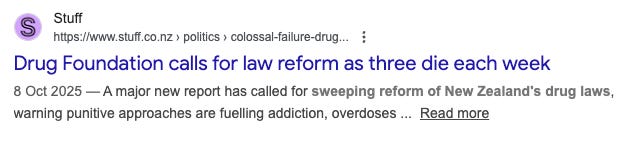
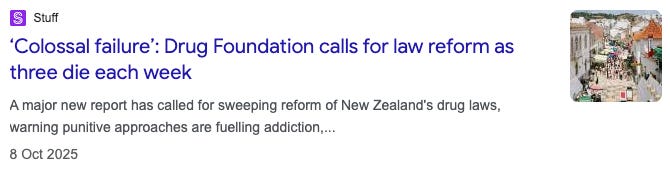
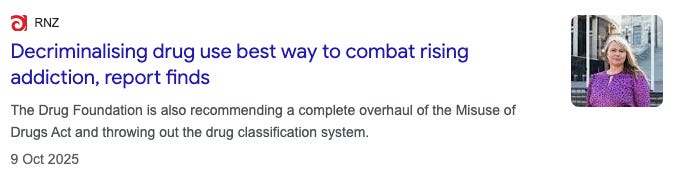
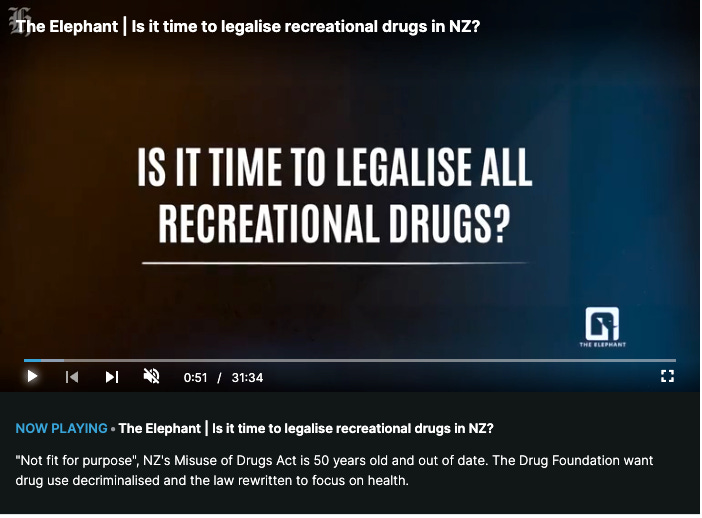
Let’s look at how the New Zealand Herald launders the promotion of drug legalisation for Massey University’s Professor Chris Wilkins, the NZ Drug Foundation, and the Helen Clark Foundation, through reporting and its faux-balanced podcast The Elephant. As an aside I find the way they have tried to trick us into thinking The Elephant “shows both sides” very disingenuous and insulting. Yes, they platform people from both sides of a debate, but across several topics they have demonstrated that they always frame up their winner and often mismatch their guests by avoiding getting anyone too proficient or palatable at arguing the “unacceptable” points.
By contrast, the working and lower classes, who are far more likely to live in communities where addiction translates into real, daily harm, tend to be far more pragmatic about how we deal with drugs and far less ideological. They are often perfectly content for drugs to remain illegal precisely because they understand, from experience, that “health-based” approaches do not magically neutralise the social damage of widespread drug use. However, the preferences of the WEIRD class are elevated as enlightened and humane, while the instincts of those who actually suffer the consequences are dismissed as punitive, ignorant, or morally suspect.
Let’s look at how the New Zealand Herald launders the promotion of drug legalisation for Massey University’s Professor Chris Wilkins, the NZ Drug Foundation, and the Helen Clark Foundation, through reporting and its faux-balanced podcast The Elephant. As an aside I find the way they have tried to trick us into thinking The Elephant “shows both sides” very disingenuous and insulting. Yes, they platform people from both sides of a debate, but across several topics they have demonstrated that they always frame up their winner and often mismatch their guests by avoiding getting anyone too proficient or palatable at arguing the “unacceptable” points.
Click to view
Whether or not they are conscious of how inauthentic their faux-balance reporting comes across or not, the NZ Herald is increasingly indulging in this particular genre of journalism that announces itself as careful, evidence-based, and nuanced, while quietly smuggling a very strong conclusion through the back door. Derek Cheng’s NZ Herald feature on the New Zealand Drug Trends Survey belongs squarely in that category.
The article is not sloppy or sensationalist. And it is full of caveats, quotes, and methodological acknowledgements. But, by the time a reader reaches the end, they have been thoroughly ushered toward the clear conclusion that they are meant to takeaway. In this case it is that most drug use is not especially harmful, that public concern is exaggerated, and that our drug laws are therefore misaligned with reality.
It is more subtle than the outright bias that has seen trust in journalism and media plummet in New Zealand and beyond. It is as if they have recognised that New Zealanders want balance and want to see their views reflected, but instead of providing that, they have come up with a way to try and pretend to show it while still indoctrinating us with the “correct” views.

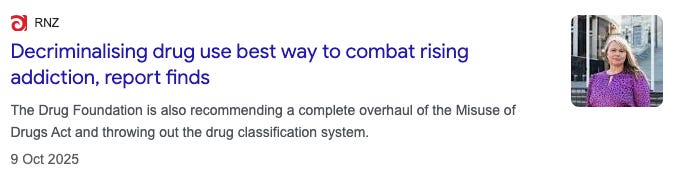
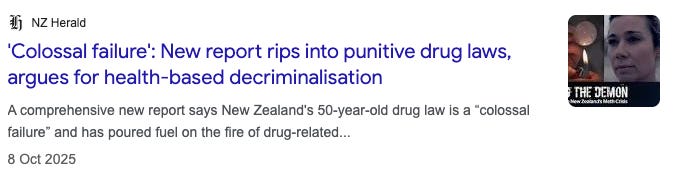
Click images to view
In this article, Derek Cheng’s headline does not mess about. It tells the reader from the outset what they should conclude: “Majority of NZ drug and alcohol users experience no negative effects.” Only later do we discover that “no negative effects” actually means no self-reported harms, over a six month window, among people who already use drugs, measured against a narrow list of outcomes that largely exclude long term, cumulative, neurological, or third-party harm.
This is media laundering of an academic report “shared exclusively with the Herald” that has drawn ideological conclusions from research deliberately crafted to produce the type of data that supports their hypothesis.
The data comes from the New Zealand Drug Trends Survey, an anonymous online survey run by Massey University’s Shore and Whāriki Research Centre. Seeing as it cannot capture harms like cancer, addiction trajectories, psychosis onset, cognitive decline, family violence, child neglect, instances of suicide, incidental injuries, or long term health deterioration, I do not see how it is measuring “how harmful drugs are” in any meaningful public policy sense. It is kind of measuring whether people felt noticeably bad recently which is a very different thing.
“The results show – and advocates for drug law reform have repeatedly said – the Misuse of Drugs Act does not align well with the level of harm associated with particular substances.”
Do they really show that though? Or is the journalist taking an incredibly big leap based on conferring absolute trust in the expertise of fellow members of the WEIRD class who share his approximate sociocultural outlook on life? He certainly seems to have accepted the assertions and conclusions wholesale despite the caveats he has dutifully included in the article. From start to finish the article is laden with generalised assumptions that his worldview is correct. Look at this sentence for example:
“It’s generally understood a lot of recreational alcohol or drug use isn’t harmful, but this is the first time in New Zealand – and perhaps globally – it has been quantified.”
Is it generally accepted that recreational alcohol and drug use isn’t harmful? We actually had a referendum not that long ago about legalising recreational cannabis use and it failed to pass. Now, it was a close call, but to say something is generally understood or agreed upon one would expect a high degree of consensus… like at least a majority.
It is also a bit confusing as while the WEIRD class really want to legalise recreational drug use, they are often quite puritanical about alcohol so lumping them together seems odd. Drug reform is a key issue for them, but then they appear to be constantly advocating for restrictions on the sale and consumption of alcohol.
Note: I voted for legalisation in the referendum. Nowadays I am not sure that I would because although I do think we would have more success treating drug addiction as a health issue, that requires massive investment and overhaul of our systems that simply won’t happen.
Cheng’s article, along with the research he is writing about, falls into what might best be described as the “self-report trap”. Again and again, it treats the absence of reported harm as if it were meaningful evidence of low risk. A failure to perceive or admit harm is not the same thing as an absence of harm, particularly when the behaviour in question is already known to distort perception and judgement.
We see this pattern of denial regularly in regards to health and behavioural matters. Smokers routinely report no harm, right up until the cancer diagnosis. Heavy drinkers often insist they are fine, functioning, unaffected. Self-assessment is a notoriously poor tool for identifying slow, cumulative damage.
This problem is especially acute with substances that impair insight and judgement, normalise dysfunction, and dull a person’s capacity to recognise deterioration as it occurs. Much of the damage caused by substance use is also externalised onto others like family members, children, neighbours, employers, and victims of crime. The Herald article briefly concedes that chronic and downstream harms are not captured by self-reporting, but then proceeds as if this were a minor inconvenience rather than a fundamental limitation on what the evidence can tell us.
Alcohol provides the clearest parallel. While legal (but restricted), the point is that most drinkers would likely self-report that they experience no negative effects in any given six month window. But the serious and comprehensive research contradicts this. An independent review commissioned to inform the alcohol levy, drawing on analysis by the Public Health Agency and the New Zealand Institute of Economic Research (NZIER), estimated the total annual cost of alcohol harm was $9.1 billion. Using disability-adjusted life years, the report attributed $4.8 billion to Fetal Alcohol Spectrum Disorder, $1.2 billion to alcohol use disorder, $2.1 billion to road crashes involving alcohol, and around $4billion in lost productivity from absenteeism, crime, and lifelong impairment. There were also substantial social costs tied directly to violence and neglect like $281million from intimate partner violence and $74 million from child maltreatment associated with hazardous drinking, alongside $810 million in health and ACC spending. Many of these categories overlap, which is kind of the point. Alcohol harm accumulates across decades, families, workplaces, and public systems, long after the hangover has passed. And, as the numbers above indicate, some of the immense harm caused by alcohol use occurs on a societal level in terms of the costs we all bear.
Another report, the Estimated alcohol-attributable health burden in Aotearoa New Zealand, found that in 2018, in total, alcohol was attributable for an estimated 901 deaths, 1,250 cancers, 29,282 hospitalisations, and 128,963 ACC claims. The report concludes:
Alcohol causes a substantial preventable health burden via a range of disease and injury conditions. The health burden from alcohol is disproportionately borne by Māori and males. Cancers, injuries and conditions that are wholly attributable to alcohol use (e.g. alcoholic gastritis and alcohol use disorders – contained in the ‘other’ category) contribute the majority of alcohol-attributable mortality and morbidity.
A further flaw is what could be called ‘advocacy without counterweight’. The article relies heavily on the study’s own authors and on people already committed to drug-law reform, while failing to include any serious engagement with countervailing expertise. There is no meaningful input from addiction psychiatrists, neurologists, emergency clinicians, police, victims of crime, or researchers who work with long term public health data. The result is not balance but amplification of a closed conversation in which the same assumptions circulate unchallenged.
The strongest evidence about drug-related harm does not come from self-report surveys at all. It is more likely to come from long cohort studies that track people over time, from hospital admission and emergency department data, to neuroimaging that shows structural and functional brain changes, to interactions with the criminal justice system, to psychiatric outcome tracking, and hard mortality and morbidity statistics. This body of evidence is large, consistent across jurisdictions, and deeply inconvenient to reform narratives that rely on minimisation of risk.
One such comprehensive, government-commissioned measure of drug harm report, that thoroughly contradicts the conclusions of the article is the Illicit Drug Harm Index 2023. It does not ask users whether they felt or perceived harm in the last six months. It measures actual harm like premature death, loss of quality of life, hospitalisation, crime, and wider social costs. On that basis, illicit drugs impose nearly $2billion a year in measurable harm in New Zealand, with methamphetamine and cannabis accounting for the largest share. This harm exists regardless of whether individual users perceive it or not. In other words, a majority of users reporting “no negative effects” does not negate the reality that drugs are killing people, damaging health, and imposing enormous costs on families, communities, and the public purse.
In 2021, there were 177 drug-related deaths in New Zealand. The same year there were 318 road deaths. So drug deaths are more than half the annual road toll, yet road safety is treated as a national priority with constant enforcement, advertising, and legislative change. If the Herald published an article claiming New Zealanders experience no negative affects driving they would be laughed out of town because we all know crashes happen regularly and people die on the roads.
Instead of grappling with that literature, the Herald article offers the reader a series of reassurances that MDMA is “lower risk”, that meth-related violence is exaggerated, and that stigma conveniently explains away gaps and distortions in reporting. By failing to test the assumptions of the academics and advocates by presenting credible alternative data, the article becomes systematically biased.
This is not really an article about data at all. It is an article about policy alignment and making drug law reform feel sensible, overdue, and, above all, low-risk. The data is not interrogated so much as it is deployed, selected and framed in a way that nudges the reader toward a preferred conclusion.
Don’t get me wrong, there is nothing illegitimate about advocating for reform. Policy arguments are a normal and necessary part of public debate. But foregrounding a study that captures only the narrowest slice of harm, while relegating everything else to footnotes or silence, is not balance. It is manipulative persuasion by omission of other information. When only the evidence that reassures is given narrative weight, the outcome is predetermined.
A genuinely balanced piece would have included something along the following lines:
Most people who use drugs do not report short term negative effects. However, this tells us very little about long term health outcomes, addiction risk, neurological injury, or harm to others, all of which remain substantial and well-documented.
The article is careful with its facts, but careless with its implications. Caveats are used as insulation, or as an insurance policy, rather than as warnings. And readers are invited to go from “no harm reported” to “no harm worth worrying about”. That is not how evidence functions, and it is not how responsible journalism should frame issues where public health, law, and long term social consequences are at stake. Nuance is not achieved by sprinkling footnotes over a predetermined narrative.
What this case study ultimately shows is not just a flawed article or an over-confident academic paper, but a system doing exactly what it has been trained to do. This is how the WEIRD class launders its preferences into public “truth”. An idea emerges from a narrow social milieu, is validated by people who look, think, live, and vote alike, translated into policy-friendly language by bureaucrats and NGOs, and then softened and normalised by media outlets that share the same cultural instincts. By the time it reaches the public, it no longer looks like ideology at all. It looks like common sense. Consensus.
This is a complete power asymmetry. One class gets to generate ideas, validate them, amplify them, and enforce them, while dismissing resistance as ignorance or malice. The general population is perpetually fed the beliefs and “truths” of the privileged class because they do not have the institutional and cultural power to assert their own.
Ani O'Brien comes from a digital marketing background, she has been heavily involved in women's rights advocacy and is a founding council member of the Free Speech Union. This article was originally published on Ani's Substack Site and is published here with kind permission.


10 comments:
Drugs are the scourge of society, especially used in conjunction with alcohol. The media conveniently not reporting the percentage of harmful incidents where both are involved.
Never forget: behind their " empathetic" facade, the woke champagne socialists are arch- bullies. No disagreement with their views is permitted.
Probably you should stick to the term ‘woke’ for these uppity lefties. The label ‘WEIRD’ is much more inclusive, so inclusive that any conservative who’s from a Western, educated, industrialised, rich, and Democratic culture also counts as WEIRD. People can be happy to be called WEIRD, especially the Hobson’s Pledge sort of people who champion equal representation in our democracy. That very position is central part of the WEIRD heritage.
They're a WEiRD mob. Well identified.
I'm a dissenter.
These weirdos should be the target of Jones et al instead of obliterating a democratically elected group who have been manipulated by the WEIRD mob.
Sitting down on the farm allows one to view the mob from a distance , out of their clutches.
I must be the enemy.
I
You are truly gifted Ani, and we, the public, are very lucky to have you doing the job that our Fourth Estate seems incapable of embracing, let alone achieving.
Thank you for your remarkable efforts.
WHAT? Anonymous of 7.32am. "the Hobsons Pledge sort of people who champion equal representation in our democracy" ? WEIRD?
Having two family members with severe drug problems, one from cannabis the other from heroin, there is no doubt of the dangers from these drugs and any academic or journalist who thinks otherwise needs to be slapped around the head until they see sense.
Ani, I love your ideas. I just wish you'd get and editor to help you make them more succinct and shorter
To 9:43am:
Yes, WEIRD is not pejorative. WEIRD stands for ‘Western, Educated, Industrialised, Rich, and Democratic’. It’s described in Joseph Henrich’s 2020 book: The WEIRDest People in the World: How the West Became Psychologically Peculiar and Particularly Prosperous. Henrich traces this through the Middle Ages. A fun book. Nothing to be ashamed of being WEIRD. I’d rather be WEIRD than not.
I think Ani's articles are amazing. Even though long the ideas are succinct and telling.
Unfortunately "the march" is nearly completed through the institutions. It started 50 years ago and the young are gone but for the turning of the ship at a high level of influence, whatever that might be.
I worked for a local body for 18 years during "the March" and it was jaw dropping to experience the entitlement, privilege and snobbery openly exhibited by the university educated executive and management.
I would have voted for drug liberalization until I read about the business model for cannabis. It was obviously being done to benefit big business and the little people would once again be victims of mayhem and misery. It would have been rinse and repeat on alcohol's vice-like control of policy and politicians.
Post a Comment
Thank you for joining the discussion. Breaking Views welcomes respectful contributions that enrich the debate. Please ensure your comments are not defamatory, derogatory or disruptive. We appreciate your cooperation.