

New Zealand might be slow out of the gate in the new year, but the United States hit 2026 like a tonne of bricks being towed by a 747.
This week was dominated by an extraordinary and dramatic military operation in Venezuela which resulted in the capture and transfer of Nicolás Maduro to US custody, with Trump declaring control over Venezuela’s governance. Click here to read what I wrote about Venezuela earlier in the week.
Simultaneously Trump has reignited his long-standing ambition to acquire Greenland, with the White House suggesting a range of options to bring the semi-autonomous Danish territory under US control. Click here to read what I wrote about Greenland a few days ago.
Then US forces also seized a Russian-flagged oil tanker in the North Atlantic. The vessel had been trying to evade a US maritime blockade and had previously changed its flag and name. Another sanctioned tanker was also seized near the Caribbean Sea as part of the same operation. The operation was reportedly watched by Russian naval assets, including a submarine in the vicinity, though no direct confrontation occurred. Russia is accusing the US of piracy.
On the domestic front, Trump unveiled aggressive and unconventional housing proposals this week. He announced plans for the government to purchase US$200 billion in mortgage bonds intended to lower mortgage rates and improve home affordability in a sort of direct market intervention that resembles quantitative easing. At the same time, he pushed a policy to ban large institutional investors (like Wall Street firms and private-equity landlords) from buying single-family homes, framing it as a restoration of the “American Dream” of homeownership. These moves signal a more interventionist turn in housing policy, even as critics question both feasibility and long-term market impact. These are acts that should have the leftists dancing in the streets…
Then US forces also seized a Russian-flagged oil tanker in the North Atlantic. The vessel had been trying to evade a US maritime blockade and had previously changed its flag and name. Another sanctioned tanker was also seized near the Caribbean Sea as part of the same operation. The operation was reportedly watched by Russian naval assets, including a submarine in the vicinity, though no direct confrontation occurred. Russia is accusing the US of piracy.
On the domestic front, Trump unveiled aggressive and unconventional housing proposals this week. He announced plans for the government to purchase US$200 billion in mortgage bonds intended to lower mortgage rates and improve home affordability in a sort of direct market intervention that resembles quantitative easing. At the same time, he pushed a policy to ban large institutional investors (like Wall Street firms and private-equity landlords) from buying single-family homes, framing it as a restoration of the “American Dream” of homeownership. These moves signal a more interventionist turn in housing policy, even as critics question both feasibility and long-term market impact. These are acts that should have the leftists dancing in the streets…
Iran is on a knife’s edge and the people are turning to Trump
Mass demonstrations over Iran’s economic collapse continued to spread this week. Protesters took to the streets with security forces responding harshly. Reports indicate dozens of deaths and thousands of arrests as clashes intensified, making this among the largest waves of unrest in recent years.
The son of the last Shah of Iran, Reza Pahlavi, who lives in exile, has increasingly positioned himself as a symbolic rallying point for regime change. This week, he issued a direct public call urging Iranians to abandon the Islamic Republic. Within hours of that message gaining traction online, protests intensified, followed almost immediately by sweeping internet blackouts. There are claims that Elon Musk is getting some Starlink devices into the country though.
There have been reports that Reza Pahlavi is set to meet with Donald Trump at Mar-a-Lago in Florida. Videos have appeared online of Iranians ‘renaming’ street signs after Donald Trump and people chanting the words that Elon Musk tweeted to the Ayatollah which mean "what a vain hope".

Click to view
Trump and his administration aren’t shying away from the fact that they will take action and after Venezuela few are doubting they will do it. Senator Lindsay Graham said on Fox News’s Hannity:
“To the people of Iran: We stand with you tonight. We stand for you taking back your country from the Ayatollah, a religious Nazi who kills you and terrorizes the world.”
“And to the Ayatollah: You need to understand, if you keep killing your people who are demanding a better life, Donald J. Trump is gonna kill you.”
All hail Marco Aurelius! Trump’s busiest general
This week has cemented Marco Rubio as the Trump administration’s indispensable fix-it man. Dubbed “Lil’ Marco” by the President back in 2016, he is now indispensable. He has effectively become the administration’s operational general translating presidential intent into action, managing allies who are nervous, and adversaries who are suddenly paying attention.
On Venezuela, he has been the point person reassuring partners that the post-Maduro reality is being shaped deliberately, not impulsively. On Iran, he has walked the tightrope between explicit warning and plausible restraint. On the Russian shipping seizures, Rubio’s State Department has had to simultaneously assert legal justification, deter escalation, and calm allies who understand exactly how close this is to a maritime red line. In Minnesota, where foreign policy, immigration, and internal security have collided in uncomfortable ways, Rubio has been deployed as the administration’s credible voice. But this is all classic Rubio territory. He is fluent in sanctions law, comfortable with coercive diplomacy, and unfazed by international outrage cycles. The fact that he speaks Spanish helps too.
Domestically, his profile has spiked in a very different way. Rubio has unexpectedly become an internet meme, half-admired, half-ironised. Clips of him calmly dismantling hostile questions, issuing clipped warnings, or methodically laying out US positions have gone viral. As have an image of him sitting in the Oval Office in a variety of AI costumes eg Governor of Minnesota, Shah of Iran, President of Venezuela, and leader of Greenland. Rubio is playing along and tweeted out that he wanted to quash the rumours and that he “will not be a candidate for the currently vacant HC and GM positions with the Miami Dolphins.”

IRD does some paywall dodging and ends up in hot water
There is something exquisitely ‘New Zealand’ about Inland Revenue, the state’s tireless hunter of under the table cash jobs, forgotten student loan interest, and accidental side-hustles, getting caught doing a bit of casual ‘subscription optimisation’.
The cheeky public servants cancelled all but one of their 220 subscriptions to the National Business Review back in early 2024. Why should they pay when they could, after all, simply use the one login, copy and paste the article into an email, and send it to 600 staff? I imagine if someone got similarly creative with their taxes the good folk at IRD arrive like a calculator-wielding Angel of Death.
Someone in the internal communications department must have been channelling Steven Joyce who once famously quipped “We think it’s, um, pretty legal…” in response to queries about National’s use of the song that sounded suspiciously like an Eminem hit.
The National Business Review is quite rightly “appalled”. I mean, we all feel robbed by IRD, but they literally were!
But wait, it gets better! The pièce de résistance is that a group subscription of the size IRD was helping themselves to is worth about $36,000 for four months and IRD offered NBR a mere, wait for it, $12,500 to compensate for stealing it since April 2024. Roughly the fiscal equivalent of slipping a $20 note onto the table and saying, “Let’s call it square.” Well I say let’s all “offer” to pay just 10% tax on our next pay cheque because apparently IRD thinks that’s how things work.
Embarrassingly, the department now appears to have thrown a big ol’ wobbly because they can no longer copy the paywalled articles and email them around the office. They have declared they will not be subscribing at all now! If only we could do the same with our taxes.
A small health course correction by the government makes getting medicine cheaper
One of the quieter, but more genuinely useful, policy adjustments this week came out of Health, where the Government has sensibly reworked its prescription co-payment changes. Instead of charging patients a $5 fee every three months on the new 12 month prescriptions, it has landed on a single $5 co-payment for the year. That sounds small, but for people managing long-term conditions it removes a repeated financial and psychological barrier.
The new process allows for those taking long term medicines to get a year long prescription from their doctor so they don’t have to go back every three months (and pay for the visit). There are exceptions obviously as some medicine requires closer monitoring. Pharmacies will still only dispense up to three months at a time, but now you will only be charged $5 the first time you collect your medicines, not every time.
The policy now better matches its stated purpose of reducing costs for medicines while also simplifying administration for Health NZ and pharmacies. It carries an estimated $6–23 million annual cost to the taxpayer, but it also improves medication adherence, reduces system friction, and lowers the risk of downstream health blowouts that cost far more.
Credit where it’s due Health Minister Simeon Brown and Cabinet realised their new initiative wasn’t quite going to deliver what they were after so they fixed it promptly.
Private company, public panic: The Manage My Health data breach
In less happy Health news… Manage My Health, a private company selling its patient portal software to GP practices, primary health organisations, and other health providers, has majorly mishandled a large scale data hacking scandal.
Manage My Health holds records for roughly 1.8 million New Zealanders and has confirmed that around 120,000 patients’ documents were accessed including discharge summaries, referrals, and patient-uploaded health information. Some of that data relates to sexual assault, abuse histories, and highly sensitive medical conditions.
What has driven anger, rather than mere concern, is the response. Patients were told to wait for notifications that arrived late, inconsistently, or not at all. Some were initially reassured their data was safe, only to be told days later that it wasn’t. Others rushed online to change passwords, only to find the platform crashing under demand. And GPs were told how many of their patients were affected, but not which ones.
The Royal New Zealand College of General Practitioners and the General Practice Owners Association have both criticised the rollout of information. Meanwhile, NetSafe has warned people to treat emails containing personal details with extreme suspicion, given the risk of targeted scams using stolen data.
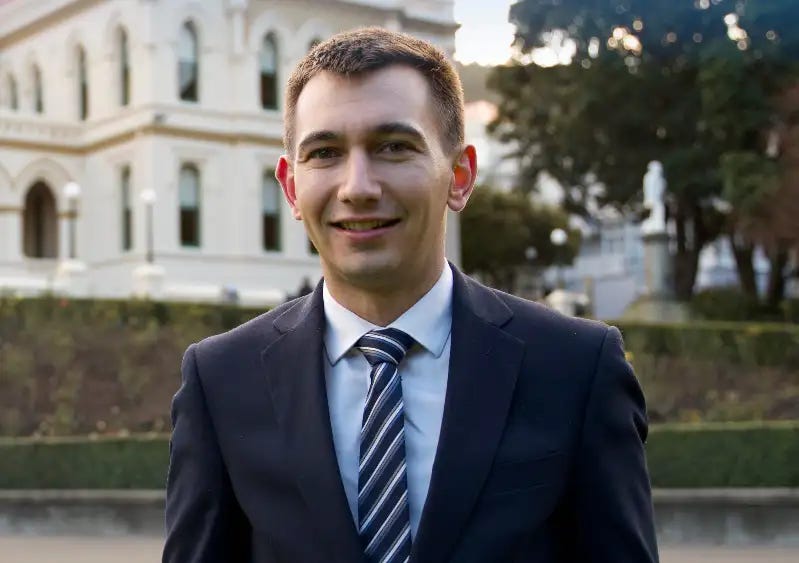
Chief Executive Vino Ramayah, has acknowledged the commercial health IT company “dropped the ball”, confirmed the hackers accessed the system using a valid password, and said he is open to stepping down. A High Court injunction is now in place to prevent dissemination of the stolen files in an attempt at containment.
Despite the fact that the issue is private, not public, in nature, Health Minister Simeon Brown has ordered an urgent review into the breach citing the sheer number of Kiwis’ data that has been compromised and the sensitive nature of it.
Antifa attack Berlin and the media don’t notice
A left-wing extremist arson attack on critical energy infrastructure in the German capital has knocked out power and heating to tens of thousands of people in the dead of winter. The sabotage on the high-voltage lines over the Teltow Canal near the Lichterfelde plant was deliberate destruction, claimed by the radical Vulkangruppe, and it has had real, human consequences.
Overnight last weekend, around 45,000 households and more than 2,000 businesses were plunged into darkness and sub-zero cold, losing electricity, heat and mobile communications as Berlin grappled with its longest outage since World War II. Hospitals, care homes and emergency services were put under enormous strain as freezing temperatures became life threatening. And now Berlin police Vice President Marco Langner has announced that an 83 year old woman was found dead in her apartment as a result.
Vulkangruppe’s manifesto couches their destruction as some kind of protest against fossil fuels and AI, but the result was widespread suffering by vulnerable people. Ordinary Berliners are paying the price while extremists shield themselves behind ideological rhetoric and the global media aren’t interested because they are left wing extremists.
West Midlands Police banned the Jews and then manufactured a justification
West Midlands Police’s decision to ban Maccabi Tel Aviv supporters from attending a Europa League match at Villa Park, supposedly on public-safety grounds, has become mired in controversy as evidence shows police misrepresented and selectively withheld information to frame Israeli fans as a threat. The ban was justified by claims about alleged violent behaviour by Maccabi supporters at a previous match in Amsterdam.
That justification has since unravelled. Under questioning by MPs, including at the Home Affairs Committee, it emerged that parts of the intelligence case were compiled after the decision to ban the fans had already been taken.
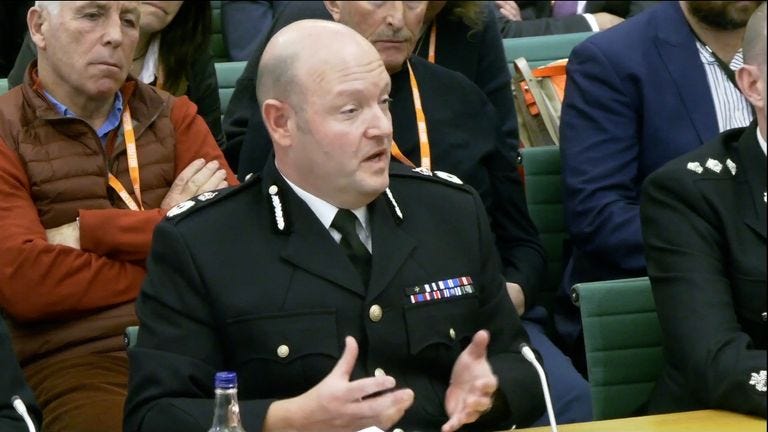
Chief Constable Craig Guildford
More fundamentally, the version of events relied upon by West Midlands Police does not match what Dutch police have reported. UK police briefings portrayed large-scale, organised violence by Israeli supporters, including claims that they targeted Muslim communities. Dutch police records do not support this. Maccabi fans were not classified as high-risk, claims of mass targeting were not corroborated, and Dutch authorities instead documented a chaotic situation in which Israeli supporters were themselves attacked.
West Midlands Police claimed Israeli fans had “received military training”, which Dutch police deny. They described a “co-ordinated march” suggestive of riot behaviour while Dutch authorities described a routine fan walk. They referenced people being thrown into a river, implying Israeli responsibility, despite the only confirmed victim being Israeli. Dutch reports also explicitly referred to a “Jew hunt” and attacks on Jewish targets, language entirely absent from West Midlands Police accounts.
According to The Times, the original safety concern was not Maccabi fans at all, but “high confidence intelligence” that elements of the local West Midlands (Muslim) community were discussing arming themselves. Rather than confront that threat directly, police shifted responsibility onto visiting Israelis and claimed the Jewish community supported the ban.
Jehovah’s Witness Conference draws a crowd to Auckland
Driving to work on Monday I saw crowds of tourists gathering around the front of the Ferry Building. They were very excited and all carrying tote bags with the “JW.org” on them. They looked like the United Nations had come to town. Every colour, creed, shape, and size. So naturally I typed in the web address as soon as I got to work and found out that the Jehovah’s Witnesses are here!
The numbers have continued to swell throughout the week and Auckland is set to be unusually full this weekend. Around 20,000 people have descended on the city for a major international convention hosted by Jehovah’s Witnesses at Eden Park. Hotels across the city are reportedly at near capacity with roughly 3,500–5,000 overseas delegates from around 20 countries.
The event is forecast to deliver more than $20 million to the local economy, according to Tātaki Auckland Unlimited. That’s not just accommodation revenue; delegates spend on food, transport, attractions, and many will travel further afield while they’re here. This is fantastic news for our biggest city and demonstrates that on top of sports events and concerts we have the opportunity to host other diverse kinds of events to generate some revenue.
I will not be attending, but I was interested to learn that the convention is free, open to the public. They deliberately have no ticketing, no collections, and no data capture so that there are fewer barriers to people attending. Hope the weather is good for all of our visitors!
Submissions are open for the Planning Bill and Natural Environments Bill (RMA replacements). You have until 13 February to have your say! Click here to submit.
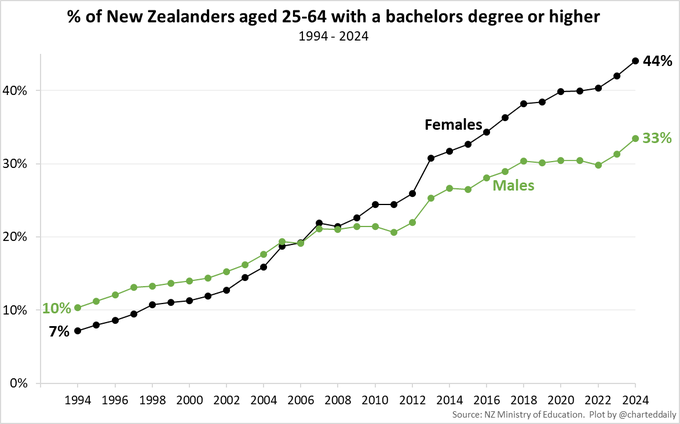
Chart of the Week from Charted Daily:
Questions I would love to discuss:
1. Women have gone from 3% behind men to 11% ahead, do we need to do some affirmative action to ensure men don’t continue to fall behind?
2. Do we really need a third to nearly half of New Zealanders to have bachelors degrees?
3. What do we do about the increasing number of New Zealanders who are getting themselves into substantial debt putting themselves through university only to find that the market is saturated with people with similar qualifications and to set yourself apart you have to now do a masters or MBA or PhD?
Click to view
In short - other stuff that happened:
- Rest in Peace former Invercargill Mayor Tim Shadbolt who died this week aged 78.
- Passengers were stranded on a Bluebridge Cook Strait Ferry for 14 hours overnight due to “issues with the ships ramp”. They disembarked finally at 10.20am Friday.
- American activist and poet Renee Good was shot dead by police after running over an ICE officer with her SUV as part of attempts to prevent them from carrying out their duties. Left wing media are turning her into a martyr.
- The United Arab Emirates is restricting their nationals from enrolling at British universities over fears that UK campuses are being radicalised by radical Islamist groups.
- Newly sworn in New York Mayor Zohran Mamdani has promised to make Football World Cup tickets cheaper despite the fact that there aren’t any games to be played in New York.
- Health Secretary Robert F Kennedy Jr has turned the nutritional food pyramid upside down to emphasise the importance of protein and fats while encouraging Americans to cut back on sugar and processed foods.
- Despite his 2020 application being rejected after vetting flagged a 2017 allegation of child rape, PC Cliff Mitchell was admitted to the Metropolitan Police after a panel overturned the decision in an effort to boost ethnic minority recruitment. He later carried out a campaign of rape against two victims, including a child under 13, and is one of 131 Met officers who were improperly vetted and went on to commit serious crimes or misconduct.
- Tennis fans were reportedly asked to turn Croatian football shirts inside out at the ASB Classic in Auckland, but other flags were seen around and there was no policy actually stating that was a rule.
- Several councils are warning in reports that upcoming infrastructure requirements will breach prudential limits, setting up either rates shocks or central government intervention later in 2026.
- Tim Walz has pulled out of his re-election bid following mounting scrutiny over massive fraud schemes in Minnesota’s public programmes. Independent journalist Nick Shirley uncovered billions of dollars being misspent or siphoned off under Walz’s watch.
- Donald Trump announced a sweeping withdrawal of the United States from a long list of international organisations and treaty frameworks, framing the move as reclaiming sovereignty and cutting what he called “one-sided obligations.”
- Ten people have been convicted of cyberbullying after spreading false and defamatory claims about Brigitte Macron in a sustained online harassment campaign. The Macrons are separately suing Candice Owens for slander in the United States.
- The UN Security Council met urgently about US actions in Venezuela cheered by Somalia (current President of the council) the call for the meeting came from Colombia who thanked China and Russia for their support.
You may have see some internet kerfuffle a couple of months back about an article called The Great Feminization by Helen Andrews. Well, now Philosopher of Biology Nathan Cofnas has written a response of sorts.
Helen Andrews and Nathan Cofnas are circling the same beast, “the Great Awokening”, institutional conformity, the tyranny of “safety,” and the way elite workplaces and universities now behave like anxious group chats with compliance departments. But they disagree, sharply, on what caused it. Andrews’ “Great Feminization” thesis says wokeness is basically what happens when women become the majority in institutions that used to be male-coded. This, she says, causes norms to shift toward empathy over argument, cohesion over conflict, feelings over procedure, and cancellation becomes the preferred enforcement mechanism.
Cofnas is effectively arguing that she’s correctly describing what wokeness feels and looks like in practice eg the tone, the enforcement style, the social dynamics, the emphasis on safety and cohesion, but misidentifying what actually drives it.
I highly recommend you read both because they’re useful in different ways. Andrews is strong on the institutional descriptions like the kinds of workplaces we now live inside, the behavioural incentives, the demographic tipping points, and what happens when rule-bound professions start privileging sympathy and narrative. Cofnas is strong on the historical and intellectual scaffolding and he reminds you that “cancellation” is not a new female pathology but a perennial feature of human societies. He forces you to confront the uncomfortable possibility that wokeness survives because its core premises remain largely unchallenged even by many of its supposed enemies. Read Andrews for the diagnosis and Cofnas for the argument about what it is, where it came from, and what would actually kill it.
Ani O'Brien comes from a digital marketing background, she has been heavily involved in women's rights advocacy and is a founding council member of the Free Speech Union. This article was originally published on Ani's Substack Site and is published here with kind permission.


5 comments:
Terrific read. Thank you. May your articles long continue!
It's not so much a matter of how many graduates we produce but what fields they are in and how graduate production meshes with labour market openings. There may be a graduate surplus overall but there remains a shortfall in areas such as healthcare and engineering. Skill shortages also arise in technical and trades areas which suggests that some students going to university should consider polytech instead. The further and higher education sectors need to be reappraised with reference to what the national economy needs. One thing we certainly need less of is university degrees in ideological claptrap. I would strongly advise students and their parents and advisers to consider doing something useful instead.
Read the article by Helen Andrews, its absolutely bang on. I'm no longer in the workplace, but I watched this happen for years. As she says, it needs to be reversed.
Barend... It appears NZ will get lots of 'doctors and engineers'... soon.
True, Anon 1229, only many of them will be in transit here for a couple of years until they can buy a 1-way ticket to Aus.
Meantimes they can take the place of NZ-trained personnel who left NZ already for better jobs outside.
Yep, all is well..........
Post a Comment
Thank you for joining the discussion. Breaking Views welcomes respectful contributions that enrich the debate. Please ensure your comments are not defamatory, derogatory or disruptive. We appreciate your cooperation.