

Iran’s internal crisis has moved into a phase of mass repression, with the regime responding to a nationwide uprising with lethal force and information blackouts. Human rights groups now estimate the death toll at more than 3,000. New Zealand has temporarily closed its embassy in Iran, relocating operations to Turkey.
The response from Western countries remains largely united in condemnation of the Islamic Regime, but next steps are uncertain. There are now signs of backchannel diplomacy aimed at stabilising the regime rather than confronting it. Reporting suggests Trump envoy Steve Witkoff has opened talks with Iranian officials. This risks handing the mullahs breathing room just as their grip is slipping and devastating the Iranian people who have been begging Trump to intervene. Anxiety is reasonable given memories of past revolutions abandoned once great powers decided “stability” mattered more than regime change. For Iranians risking their lives in the streets, the fear is that the outside world will once again choose negotiation over justice and leave them to face the hangman alone.

🇦🇺 Cowardice, chaos, and a Festival that cancelled itself
The collapse of Adelaide Writers’ Week this week was the predictable outcome of institutional cowardice colliding with activist pressure and appalling governance. The decision by the Adelaide Festival board to disinvite Randa Abdel-Fattah, against the express wishes of the now-resigned festival director Louise Adler, triggered a mass boycott by more than 180 writers and speakers (including Jacinda Ardern and Zadie Smith), rendering the event unviable. The board’s original justification, was that it would not be “culturally sensitive” to include Abdel-Fattah after the Bondi terror attack, given she has publicly celebrated the October 7th massacres in Israel. Within days, the board reversed itself, issued an “unreserved” apology, resigned en masse, and cancelled the festival anyway.
What’s been largely memory-holed, however, is that this moral panic didn’t arise in a vacuum. In recent years, Jewish writers at Australian literary festivals have themselves been subjected to sustained cancellation campaigns, disinvitations, and hostile pressure over their views or perceived insufficient denunciations of Israel. This is not a sector courageously standing up for free expression; it’s one erratically applying different standards to different groups.
Winston puts RBNZ Governor on notice
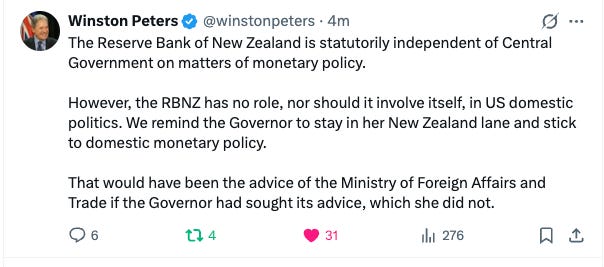
Winston Peters delivered a characteristically blunt rebuke this week, telling new Reserve Bank of New Zealand governor Anna Breman to “stay in her New Zealand lane” after she signed an international letter backing Chair of the Federal Reserve of the United States Jerome Powell amid political tensions with the President of the United States. Peters said that while the RBNZ is independent on domestic monetary policy, it has no mandate whatsoever to involve itself in US domestic politics, and certainly not without consulting the Foreign Minister. Peters’ intervention was less about America than about reasserting a basic principle that New Zealand’s public institutions should be focused on New Zealand, not meddling in the culture wars or power struggles of Washington.
Click to view
New Zealand’s economy is quietly turning a corner
There are signs that the New Zealand economy is turning a corner, with hard data beginning to support an improved outlook on growth and cost of living pressures. Manufacturing activity surged to a 4 year high in December, firmly in expansion territory.
Business confidence has also surged to levels not seen in three decades. The latest ANZ Business Outlook survey shows confidence jumping to a net 74%, with firms overwhelmingly expecting better conditions ahead, while the “own activity” measure rose to 61%, also a 30 year high. As ANZ chief economist Sharon Zollner noted, the breadth of the improvement points to GDP growth “heading north rapidly.”
At the same time, pressure is easing in one of the biggest drivers of household stress: housing costs. The rental market, particularly in Wellington, is now clearly tilting in favour of tenants as supply increases and demand softens. Average rents are falling nationally, with Wellington down more than 8% year on year, and listings up nearly 20%. It doesn’t mean housing is suddenly cheap, but it does mean bargaining power is starting to rebalance.
Labour wants to tax our streaming subs to fund content we didn’t ask for
Labour’s proposed “Netflix tax” would slap a levy on streaming services like Netflix, Disney+, and Amazon Prime. Surely, Hipkins does not think those companies will be willing to absorb that extra cost out of the goodness of their hearts? Is he really naive enough to think they won’t pass it straight on to Kiwi subscribers? Just as households are finally getting some breathing room on housing and bills, Labour wants to hike the cost of entertainment so it can shovel money into its preferred pet screen projects. You know, Celebrity Treasure Island, Jacinda Ardern and Chloe Swarbrick documentaries, “public interest” journalism, te reo programming only 4% of us can understand, and other content most New Zealanders would never choose to fund. If people want local content, they can already support it by watching it.
Why is the Harbour Bridge ‘unsafe’ only when Brian Tamaki shows up?
Brian Tamaki and his activist groups have emerged in January promoting an anti-immigration protest march across the Auckland Harbour Bridge. The New Zealand Transport Agency, backed by police, has refused permission on the basis of serious risks to public safety and the bridge’s structural integrity. Given they have happily facilitated marches across the bridge for other causes such as Toitū Te Tiriti and anti-Israel protests, this is a brand new problem and an alarming one. If the bridge cannot withstand the feet of Destiny’s Church and Freedom and Rights Coalition protestors, should it not be shut immediately for repairs? It will also be interesting to see if the bridge’s “structural” problems magically disappear when a group favoured by Police and NZTA staffers wants to march. In any case, Tamaki and his allies appear prepared to ignore the order not to march anyway, with police intelligence assessing a high likelihood of rogue action regardless.
In other Tamaki news, groups linked to him and Destiny Church disrupted another Sikh parade in Tauranga, waving “This is New Zealand, not India” banners and alleging the religious procession is an existential threat to the “Kiwi way of life”.
Govt crack down on energy market with tough penalties for misbehaving power companies
The Government has moved to significantly harden its stance on electricity market misconduct, with Minister Simon Watts announcing an increase in penalties designed to give the Electricity Authority real enforcement muscle. From next year, maximum fines for power companies that breach market rules will jump from $2million to the highest of $10million, 10% of turnover, or three times the profit gained from wrongdoing. This is a deliberately uncapped regime intended to function as a genuine deterrent rather than a cost of doing business. The changes follow repeated concerns about weak compliance, opaque behaviour by gentailers, and the Authority’s inability to compel information. Alongside instant infringement fines for minor breaches and expanded information-gathering powers, the reforms reflect growing political recognition that high power prices, limited competition, and regulatory toothlessness have left households and businesses paying the price and that restoring confidence in the electricity market will require penalties that actually hurt.
NZ Police leadership continues to fall after IPCA McSkimming report
The fallout from the Independent Police Conduct Authority report into Jevon McSkimming continues to claim senior careers, with Angela Brazier, identified as “Ms G” in the report, now confirming her retirement as executive director of the Firearms Safety Authority. Brazier has strongly rejected the IPCA’s findings, describing them as inaccurate and saying she has been unfairly targeted and left publicly unsupported by police leadership, despite internal reviews finding no substantiated wrongdoing. Her exit follows the earlier resignations/retirements of Andrew Coster, Tania Kura, Paul Basham, and Chris de Wattignar. With Brazier signalling possible legal action and Coster now spotted quietly meeting Public Service Commissioner Brian Roche at a cafe, the McSkimming scandal is far from concluded. Why the Public Service Commissioner is publicly hanging out with the disgraced top cop raises the awful prospect of Coster managing to dust himself off and fail upwards again.
🇺🇸 Will the Clintons prove they are above the law again?
The decision by Bill and Hillary Clinton to defy a duly authorised, bipartisan congressional subpoena in the Jeffrey Epstein investigation is extraordinary because others who have taken the same course of action have routinely ended up fined, jailed, or both. Figures such as Steve Bannon and Peter Navarro were sentenced to prison for refusing subpoenas. Others have been bankrupted or detained until compliant. And yet the Clintons have brazenly refused to attend, submitting a lengthy letter framing the inquiry as a partisan witch hunt. This a weak response from the couple as both Republicans and Democrats have publicly demanded transparency around Epstein.
Click to view
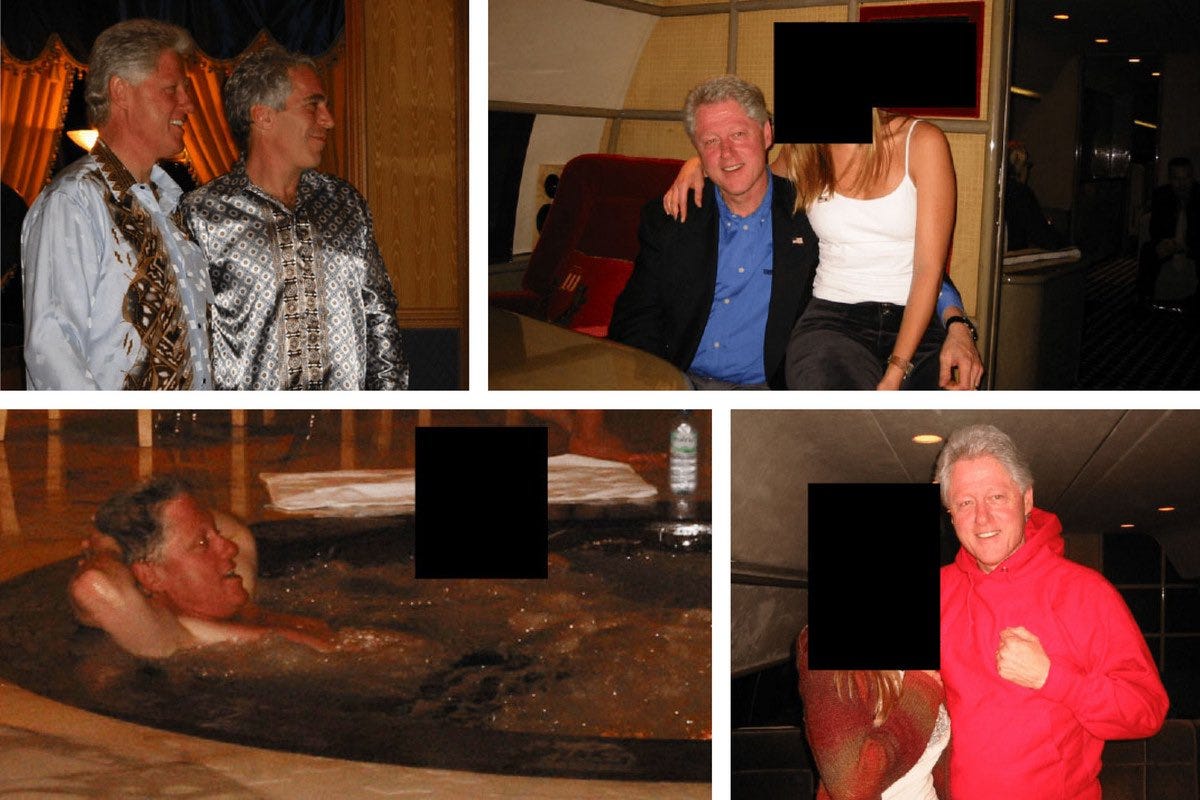
Bill Clinton is one of the most frequently photographed and documented political figures in the Epstein files, with multiple flights on Epstein’s jet and long-standing personal proximity that has never been adequately explained. When this history is combined with Bill Clinton’s record of inappropriate sexual conduct and abuse of power, it is not conspiratorial or partisan to seek answers. What remains an open question is whether anything will actually be done. The Clintons are arguably the most powerful political couple on earth, embedded in global institutions, donor networks, media, and political infrastructure, widely believed to have the dirt on half of Washington.
🇬🇧 Britain is losing control at home and abroad
Let’s start with China and its planned London “super-embassy”. Unredacted building plans show a concealed underground room positioned right alongside the fibre-optic cables that carry a huge chunk of London’s financial and internet traffic. And yet the Government is still expected to wave it through ahead of Keir Starmer’s China trip. Inviting a strategic rival to set up camp next to the City’s nervous system feels like a terrible idea.
At the same time, Britain’s domestic politics is being yanked around by international pressures and imported problems. There’s a fresh flare-up over migration and crime, with FOI-based reporting that foreign nationals are wildly overrepresented in arrests for theft of passenger property and other crime on the rail network. Then there’s the human rights law trench warfare inside the government with Attorney General Lord Richard Hermer under fire over a “substantial” compensation payment to Guantanamo detainee Abu Zubaydah (whom he previously represented).
Because they don’t have enough dramas on their plate, Parliament is also hauling X/Meta/TikTok in over foreign disinformation, Ofcom is investigating X under the Online Safety Act, and the US is openly warning of consequences if the UK escalates to a ban of X.
But wait there’s more, the Lords have voted to “regret” the absurd Chagos deal to handover the archipelago to Mauritius, voluntarily shrinking its own strategic footprint in the Indian Ocean. One gets the sense the UK government can’t tell where diplomacy ends and self-harm begins.
🇬🇱 Greenland isn’t for sale, but everyone is negotiating anyway
The Greenland situation has now hardened from speculative rhetoric into a live diplomatic and security standoff. President Trump has doubled down on the argument that Greenland is indispensable to US national security, particularly as Arctic routes, missile-early-warning infrastructure, and rare-earth supply chains become more contested by China and Russia. US officials insist the newly announced “working group” with Denmark and Greenland is about acquisition pathways, not abstract dialogue, but this claim is flatly rejected by Denmark and Greenland.
On the ground, the crisis has escalated. Denmark has requested and received symbolic but politically significant NATO support, with small (teeny tiny) European military contingents arriving in Nuuk for joint Arctic exercises. Greenlandic leaders have reiterated that they actually do not want independence if it risks exposing the island to Russian or Chinese leverage. Even so, Greenland’s Foreign Minister Vivian Motzfeldt was reduced to tears on live television after robust White House talks.
Greenlandic politicians have previously explored infrastructure cooperation with China which continues to signal interest in Arctic access. This is exactly the concern of the US; a territory of enormous military consequence governed by a very small political class, potentially drifting toward independence without the capacity to resist great-power pressure. Well, other great-power pressure. Whether Trump ultimately forces a deal, secures a formalised US-led security compact, or triggers congressional limits on executive action, the status quo is already gone. Greenland is now openly recognised as a frontline asset in great-power competition, no longer a peripheral Danish concern.
🇬🇧 Jenrick jumps ship and the Right splinters further in Britain
Robert Jenrick’s defection to Reform UK has finally formalised what Westminster had been gossiping about for months. After Conservative Party Leader Kemi Badenoch dramatically removed the Tory whip over what she described as “clear, irrefutable evidence” of secret talks with Reform, Jenrick moved swiftly to the Farage camp, recasting himself as a principled conservative expelled for ideological dissent rather than opportunism. Badenoch’s strategy to force Jenrick’s hand has been praised by some as a calculated gambit that called Nigel Farage’s bluff and stripped Jenrick of the ability to defect on his own terms. Others say by sacking him publicly, Badenoch may have gifted Reform exactly the narrative it wanted. Either way, Jenrick’s jump confirms that the next phase of conservative politics will be fought less over policy differences than over who gets to inherit the voters who no longer believe the Conservative Party can win.
Labour’s ‘World-Leading’ Climate Deal with BlackRock just collapsed
BlackRock’s quiet retreat from its much-hyped New Zealand climate infrastructure deal has shown then-Prime Minister Chris Hipkins was, in hindsight, lobbing a naive political Hail Mary. In 2023, Hipkins proudly touted the partnership with BlackRock as proof that his Government’s climate credentials had captured the attention of the world’s biggest capital pools. In reality, it was a classic case of Labour holding press conferences rather than producing actual policy. The deal was long on symbolism and short on commercial substance, relying on optimistic assumptions about regulatory certainty, political stability, and guaranteed returns. BlackRock didn’t “betray” New Zealand. It behaved predictably, doing what global capital always does when the numbers stop stacking up, it walked. The embarrassment sits squarely with Hipkins and Labour, who oversold foreign validation as a substitute for serious domestic energy reform.
🇦🇺 Establishment shocked to learn their darling transactivist author is a pedo
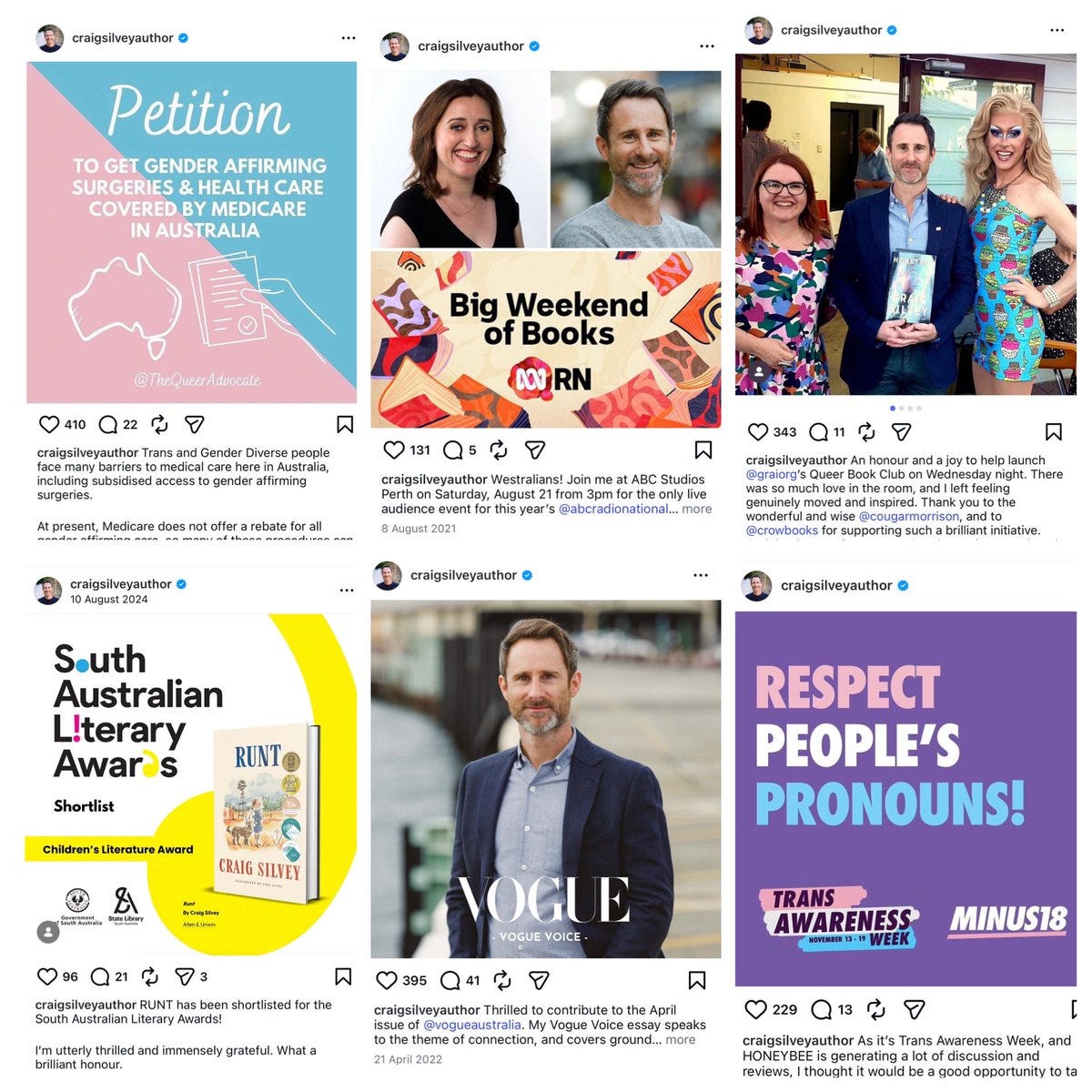
Australian children’s author Craig Silvey has been charged with possession and distribution of child exploitation material. This has sent shockwaves through Australia’s literary and media establishment and prompted uncomfortable questions about how warning signs were ignored. Silvey has for years been a celebrated progressive cultural figure, a fixture of the Australian Broadcasting Corporation ecosystem, published by Allen & Unwin and Penguin Random House, and publicly aligned with a suite of activist causes centred on children, gender, and sexuality. His social media presence and public advocacy, including involvement in “queer” youth initiatives, support for drag events, enforcement of ideological language norms, and promotion of controversial ideas around children’s identity and autonomy, attracted praise in progressive circles but also concern from thoe who argued that boundaries around childhood were being steadily eroded. One of his most lauded novels, promoted heavily by public broadcasters, centres on a suicidal boy forming a close bond with an older suicidal man, a premise some readers flagged as deeply troubling. The WA and NSW education departments have both announced the immediate removal of Silvey’s books from school curricula.
Click to view
Chart of the Week:

Click to view
In short - other stuff that happened:
- A van driven by a 7 year old with a 9 year old passenger crashed on the West Coast narrowly missing a tree. Both children escaped with only minor injuries.
- Benjamin Harry Timmins, 60, was found dead from a gunshot wound at Waitārere Beach, while a woman, 46, and young men aged 21 and 17 remain in critical condition with gunshot injuries; reports suggest a suspected attempted family annihilation.
- Graham Dickason, the father of Liané, Maya and Karla who were murdered by their mother, has remarried in South Africa and returned to medical practice. His ex-wife Lauren Dickason was found guilty in 2023 and is serving an 18-year sentence.
- Foreign Minister Winston Peters has confirmed he underwent an operation just before Christmas and is recovering well.
- 🇬🇧 Dual British–New Zealand citizens will soon be barred from boarding UK-bound flights unless they hold a valid British passport, a change taking effect from 25 February 2026.
- Police were called after complaints of “unacceptable behaviour” by a senior male public servant following a Disability Support Services Christmas function, but found no criminal offending; the Ministry of Social Development confirmed the employee has since resigned.
- Auckland filmmaker Rajneel Singh has been jailed for 3 years and 3months after he plead guilty to two representative counts of possessing and distributing CSAM.
- Parole has been declined for the 7th time for Jahche Broughton, who murdered Scottish tourist Karen Aim with a baseball bat in Taupō in 2008, with the Parole Board again finding he poses a high risk of violent reoffending.
- Graham Bloxham has been charged under the Harmful Digital Communications Act over alleged posts on the Wellington Live Facebook page. He claims the content was posted by others, and says he will fight “extreme censorship” in court next week.
- Michael Paul Graham, 21, has been sentenced to 11 months’ home detention after admitting to possessing more than 4,000 CSAM files and exporting 20 images of child sexual abuse, with prison avoided due to youth, autism spectrum diagnosis, and mitigating factors.
- 🇺🇸 The US Supreme Court appears poised to uphold state laws banning male (transgender) athletes from female sports teams. A ruling is expected by June.
- 🇼🇸 A Samoan chief has questioned whether New Zealand’s NZ$6 million compensation over the sinking of HMNZS Manawanui should be distributed at all, saying the payment is inadequate.
- 🇦🇺 Former PM Kevin Rudd will step down a year early as Australia’s ambassador to the US after being appointed global president of the Asia Society, with PM Albanese praising his service amid speculation that tensions with Trump hastened his departure.
- 🇺🇸 President Trump says his administration will require all new AI data centres to fund their own power generation, insisting Americans should not face higher electricity bills to subsidise Big Tech’s energy use.
- 🇬🇧 A Scottish daycare worker and drag queen has appeared in court charged with child sex offences. Craig Baxter, 32, was sacked from his job following his arrest and has been released on bail.
- 🇬🇧 Saima Akhtar, the DEI lead at Bristol Brunel Academy has been exposed for praising Hamas terrorists as “heroes,” after she pressured the school cancelled a visit by Jewish MP Damien Egan.
- 🇺🇸 Twitter and Pinterest’s founders are teaming up on a new app pitched as a healthier alternative to today’s algorithm-driven social media model.
- 🇺🇸 The United States has imposed terrorist designations against the Lebanese, Jordanian, and Egyptian chapters of the Muslim Brotherhood.
- 🇬🇧 Waltham Forest Council has been slammed after fining a roofer £300 for carrying empty crisp packets and sandwich wrappers in his work van, on the grounds that he lacked a licence to transport “controlled waste”.
1. Daniel Hannan has penned a sharp, historically grounded defence of free expression that connects Britain’s growing speech restrictions to a broader slide into managed democracy. It’s well worth reading for its explanation of why a “Grok panic” could become a pretext for something far more dangerous.
2. This Fortune piece is a sobering, well-reported look at collapsing literacy, and I strongly recommend it to anyone wondering why universities, workplaces, and public discourse feel increasingly brittle and incoherent. It covers the growing numbers of Gen Z students arriving at university unable to read and comprehend even basic sentences, forcing professors to radically adapt teaching methods and, in some cases, lower expectations.
3. Roger Partridge applies Rob Henderson’s idea of “luxury beliefs” to New Zealand policy, arguing that many fashionable, morally flattering positions are embraced by the comfortable precisely because they impose little cost on them while loading real economic and social burdens onto others. It’s a clear, grounded essay that cuts through abstractions and forces readers to ask: who actually pays for this belief?
I also wrote on this topic this week. Click here to read.
Ani O'Brien comes from a digital marketing background, she has been heavily involved in women's rights advocacy and is a founding council member of the Free Speech Union. This article was originally published on Ani's Substack Site and is published here with kind permission.


6 comments:
Could "collapsing literacy" explain the high base level of support for the Greens?
Hang on a minute. I just saw your brief note about dual British/NZ citizens not being allowed on a UK bound flight unless they have a valid UK passport…..so are you saying that they are allowing hundreds of illegal immigrants enter the UK each month and give them free food, housing, pocket money, yet a British born UK citizen cannot enter the UK legally using a NZ passport? Instead, we need to add hundreds of pounds to the cost of travelling back to our own country by having to pay for a second passport (with extra for a rush job if wanting to travel in March). So in the good old UK, illegal immigrants are more welcome than their own citizens. What a joke
On the bit about dual nationals having to use their UK passport to enter the UK from Feb '25, it has been the situation for a while that US dual nationals must use a US passport to enter the USA and the AU border force advises that AU dual nationals "should" also use their AU passport to enter/leave Australia. If one has the privilege of dual nationality it is fair enough for Countries to expect that person to maintain both passports for any number of valid reasons.
The Auckland Harbour Bridge is a working motorway not a pedestrian thoroughfare. It should not be the target of any type of public demonstration – cultural, religious, political, anything. Full stop. Would the Wellington or Auckland train services allow a bunch of boneheads to walk their demonstration along the tracks?
New Zealand generally is overly tolerant, and excessively so, in allowing demonstrations of all kinds to disrupt the flow of everyday life. Recall the occupation of Parliament grounds – early 2022.
This week’s “Weekend Australian” newspaper has half a dozen or so write-ups on the subject of the Adelaide Writers Week fiasco. There is so much more to this story than what is available in the NZ media.
By all means let protesters walk the bridge just keep the traffic moving, particularly the trucks.
I will have to give up on Ani. There are only so many hours in the day. Even after the Herald abandoned. How does she find time to mug up and write thoughtfully about so much?
Post a Comment
Thank you for joining the discussion. Breaking Views welcomes respectful contributions that enrich the debate. Please ensure your comments are not defamatory, derogatory or disruptive. We appreciate your cooperation.