

I recently had an unexpected visit to Auckland’s emergency department, followed by a longer stay in hospital. It seems I may have brought back more than memories from a recent overseas trip.
Before anyone panics, I should immediately add that I’m now fully recovered and pose no risk to anyone. If that weren’t the case, I’d probably still be locked away in the isolation room where my hospital journey began.
For a few days, however, doctors were working through a range of possibilities. One potential explanation was linked to a monkey bite I received in Morocco.
Yes, you read that correctly. I was bitten by a monkey.
It turns out, the monkey bite was not the cause but I will say, it was a cute monkey. Unfortunately, while perched on my arm, a nearby noise startled it and it promptly sank three remarkably sharp teeth into my finger.
Yes, you read that correctly. I was bitten by a monkey.
It turns out, the monkey bite was not the cause but I will say, it was a cute monkey. Unfortunately, while perched on my arm, a nearby noise startled it and it promptly sank three remarkably sharp teeth into my finger.
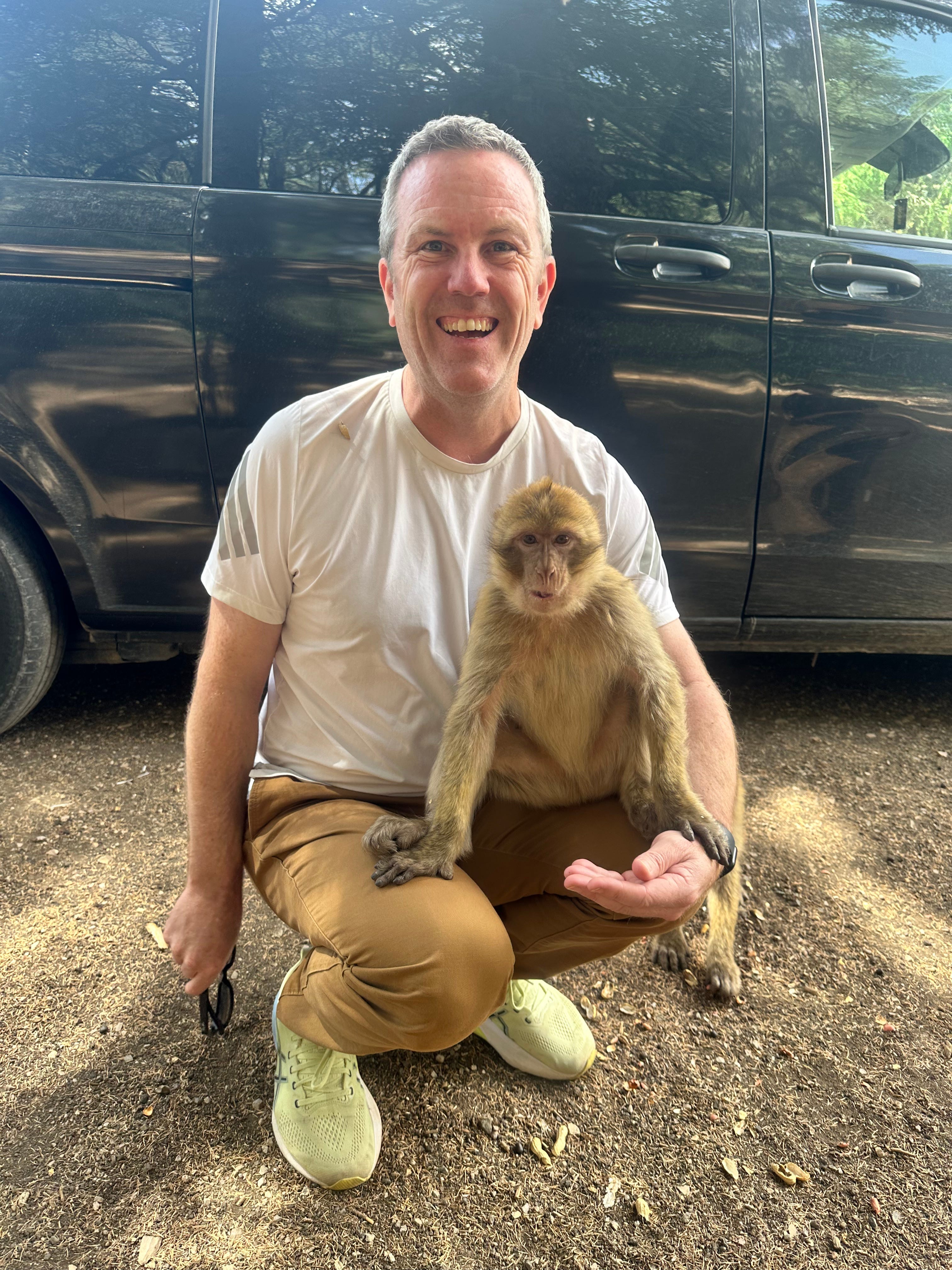
As I say, a cute monkey and bite aside, still a fun experience
(and not it turns out, the cause of my ED visit)
I won’t bore you with the full medical saga, but I will say this: the healthcare I received in New Zealand was exceptional.
I already knew our system contained outstanding people. Family and friends have benefited from that care over the years. Personally, though, I haven’t required significant hospital treatment for around three decades, and the last time was back in my Fiji days.
Like many people, I spent far longer than I would have liked waiting in ED. Several hours under fluorescent lighting is not ideal when one of your symptoms involves sensitivity to light. Yet from the orderlies to the nurses, the doctors to the cleaners, every person I encountered was professional, kind, knowledgeable, and committed to helping people get well.
One doctor described the system to me in simple terms: “Patients getting better, happy doctors, and very hard-working nurses.”
As I recovered, I found myself reading commentary about healthcare, cultural competency, and the government’s decision to refocus organisations such as the Nursing Council and Medical Council on their core professional responsibilities rather than broader social and political agendas.
Predictably, unions and progressive activists have reacted strongly. They argue that cultural competency is essential to effective healthcare. Alongside that sits the related claim that indigenous knowledge has a distinct and important place within modern medicine.
I was already deeply skeptical of these claims, and my recent experience has added to this.
Throughout my stay I encountered staff from a wide range of backgrounds, cultures, ethnicities, and nationalities. They were trained professionals who were doing an amazing job looking after me as a human being who was suffering and needed help.
At no point did anyone ask about my cultural needs. Nobody conducted a cultural assessment. Nobody sought to explore whether my treatment should be adjusted according to my ancestry, identity, religion, or worldview.
They simply treated me as a human being.
Now, some will argue that this very behaviour demonstrates the success of cultural competency training. I disagree. What I observed was something far more fundamental. Human beings treating another human being with dignity, respect, and care.
Indeed, any attempt to claim certainty about my cultural background based purely on my appearance would today be regarded as highly problematic. We are repeatedly told that assumptions based on race or ethnicity are dangerous. Yet much of the cultural competency industry depends upon exactly such thinking.
My conclusion is straightforward: cultural competency has become an industry - and industry creates incentives.
Training programmes must be developed. Consultants must be hired. Courses must be taught. Research papers must be written. Frameworks must be designed. Entire careers become dependent upon maintaining the idea that these concepts are indispensable. And of course, the people working within this system naturally have an interest in arguing that it should continue expanding.
Much of this activity is taxpayer funded; funds I’d argue could be much better deployed in the health system.
The same dynamic is increasingly evident in discussions surrounding indigenous knowledge.
I reject the notion that knowledge belongs to tribes, cultures, or racial groups. Increasingly, we are encouraged to view knowledge through identity categories: indigenous knowledge, Western knowledge, Māori knowledge, European knowledge.
This framing is false.
The medical treatment I received was scientific. Every diagnosis, test, procedure, and treatment rested upon knowledge that had been accumulated, tested, challenged, refined, and passed from one generation to the next. Being scientific, it didn’t care who I was nor was it considering my identity. Medical procedures succeed because they are grounded in evidence, not identity.
One moment during my stay brought this reality into clear focus.
Among the many tests I had the ‘pleasure’ of experiencing was a lumbar puncture.
While heavily medicated, I remained sufficiently compos mentis to listen as a senior doctor guided a junior colleague through the procedure. Their communication was calm, precise, and deeply professional.
The needle was to be inserted below the spinal cord, in a soft spot between two vertebrae. The angle mattered. The pressure mattered. The positioning mattered.
The senior doctor explained that the junior would know he had reached the correct location when he heard two subtle pops. In my case, the pops were replaced by a rather violent and involuntary kick from my left leg.
What struck me was not merely the technical skill involved, but the knowledge itself. This procedure represented centuries of accumulated learning. Observation, experimentation, refinement, and teaching. Knowledge passed from one generation of doctors to another.
Nothing about it was Western.
Nothing about it was indigenous.
It was simply knowledge.
Human knowledge.
The attempt to divide knowledge into competing cultural categories is, in my view, an ideological project rather than an intellectual one. It seeks to create parallel systems of authority and expertise. As with cultural competency, entire structures of funding, prestige, and influence emerge around maintaining those distinctions.
Too often these claims are insulated from scrutiny. Question their scientific relevance and accusations quickly follow. Doubt becomes heresy. Debate becomes offence.
The nurses, doctors, orderlies, cleaners, and support staff who looked after me were outstanding. Their professionalism, compassion, and expertise were evident every day. But what I experienced was not due to the relevance of any cultural theory. It was the success of learned excellence and humanity.
A final point, as I am sure everyone wants to see more money put into the health system. I would suggest that all the monies devoted to these bureaucratic industries, cultural frameworks, and other ideological programmes would be better spent supporting the people who actually deliver care.
The people who helped me recently used the only skills needed – medical knowledge, practical skill, and the desire to help another human being. For that, I am grateful.
Simon O'Connor a former National MP graduated from the University of Auckland with a Bachelor of Arts in Geography and Political Studies . Simon blogs at On Point - where this article was sourced.


4 comments:
Quite simple isn't it?
Excellent article, Simon.
You have very clearly illustrated the true situation of health/medical care. Culture has nothing to do with it. It is a caring human, science based profession.
The imposition of compulsory "cultural" aspects is simply WRONG.
I know. I had 50+ years as a practicing pharmacist. The most important thing is to treat the patient as an individual human being.
And yet a doctor can't be re-registered until he has completed an " unconscious bias" course.
That's a course in ensuring Maori are treated as special, given priority, and whatever fictitious cultural needs are fulfilled.
Wouldn't happen anywhere else in the world except NZ.
Excellent article, based on the writer's experience.
Illness or disease is a great leveller - it affects all humans irrespective of race or culture.
No amount of ideological posturing will change that.
Post a Comment
Thank you for joining the discussion. Breaking Views welcomes respectful contributions that enrich the debate. Please ensure your comments are not defamatory, derogatory or disruptive. We appreciate your cooperation.