

This is my final Substack of a series I’ve published on the Financial Markets Authority doing nothing about behemoth dairy co-operative Fonterra deliberately cooking its financial books.
I’ve catalogued Fonterra’s gross financial reporting misconduct, and my protracted attempts to use the Official Information Act (OIA) to find out why the FMA let Fonterra off, scot-free.
Here’s my last Substack on this - which obviously turned out not to be my “last fandango” on this vexed affair (you can track back to find my earlier relevant Substacks):
MY LAST FANDANGO IN AN OFFICIAL INFORMATION ACT FIASCO
John McLean 8 September 2025
MY LAST FANDANGO IN AN OFFICIAL INFORMATION ACT FIASCO
John McLean 8 September 2025
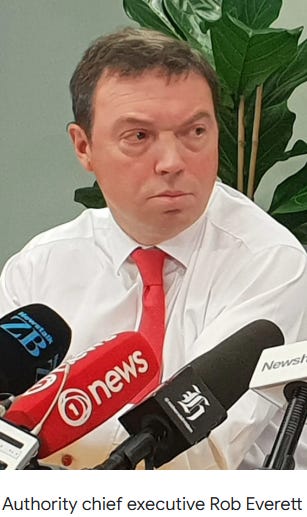
This Substack has its genesis a decade ago. From 2015 to 2017, Fonterra deliberately cooked its financial books in order to hide bad investments and artificially inflate its net worth and share price. These shifty shenanigans, in which Fonterra’s auditors PricewaterhouseCoopers were complicit, meant that dairy farmers who purchased their mandatory Fonte…
Read full story
Please bear with me, Dear Readers. My meagre morsels can’t be as boring as the PwC accountants who conspired with Fonterra to produce Fonterra’s multi-year fraudulent financial statements. (Those accountants are the only individuals who suffered consequences for their conduct. They were censured by the beanies’ professional industry body.)
But Cheer Up! We all now have a fine example of, and insight into, how the Blob coagulates to protect itself.
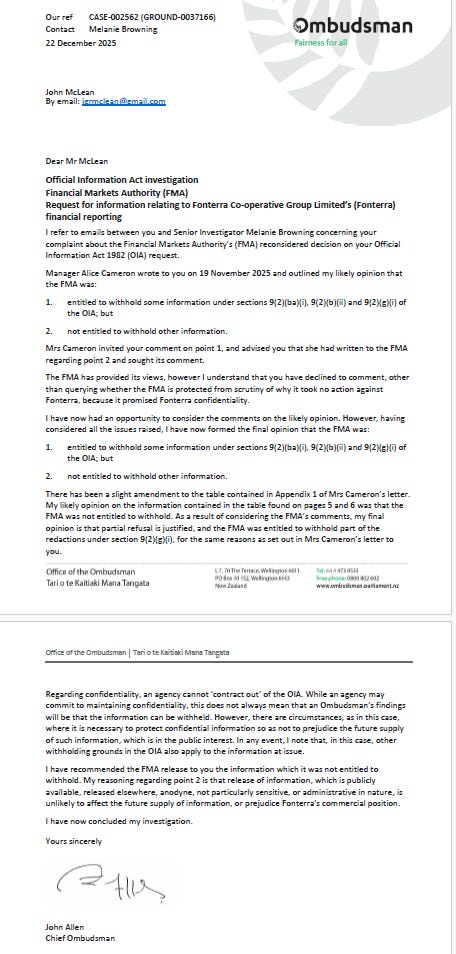
Chief Government Ombudsman John Allen has, at long last, responded to my complaint to the Office of the Great Omb. I complained to the Omb. about the FMA’s brazen refusal to lawfully respond to my request for information on why the FMA took no action against Fonterra for its frightful financial falsifications.
In the interests of fairness and providing a level of transparency that neither Fonterra nor the FMA nor the Ombudsman is remotely capable of, I reproduce the Ombudsman’s response in full below:
Click to view
The paragraph I invite readers to focus on is the one beginning “Regarding confidentiality…”, at the top of page 2. Omb. J.A. starts with a patronizing and pointless statement that “an agency cannot ‘contract out’ of the OIA”. It’s as if he thinks I’m laboring under some misapprehension that agencies can indeed contract out of the OIA. But in truth, agencies do indeed, in effect, contract out of the OIA – by simply, and without jeopardy or repercussions, not responding lawfully to OIA requests for information.
J.A. Omb.’s references to “confidentiality” relate to a statutory excuse to withhold requested information - as contained in section 9 of the OIA. The confidentiality excuse applies:
“if, and only if, the withholding of the information is necessary to…protect information which is subject to an obligation of confidence…where the making available of the information…would be likely to prejudice the supply of similar information, or information from the same source, and it is in the public interest that such information should continue to be supplied”.
Section 9 expressly provides that the confidentiality excuse applies (“good reason for withholding official information exists”):
“unless, in the circumstances of the particular case, the withholding of that information is outweighed by other considerations which render it desirable, in the public interest, to make that information available”.
The confidentiality excuse can therefore only legitimately be applied to the Fonterra Fiasco if:
- withholding information about why the FMA took no action against Fonterra would be likely to prejudice the supply of similar information, or information from the same source (Fonterra); and
- withholding that information is not outweighed by other considerations which render it desirable, in the public interest, to make that information available
Click to view
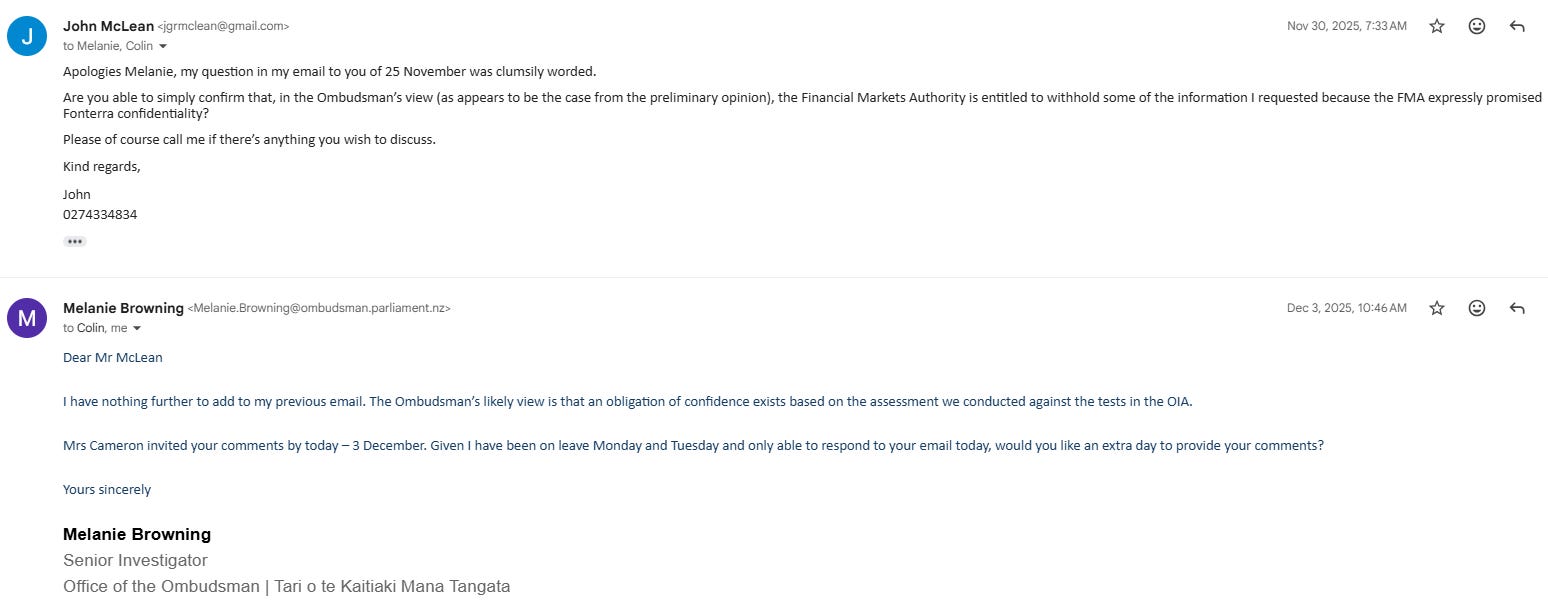
There’s a blatant, fatal flaw in the Omb.’s reason for allowing the FMA to conceal information that would reveal why the FMA did nothing about Fonterra’s egregious malfeasance - the ostensible reason being that disclosing would “prejudice the future supply of such information”. The Omb.’s fallacious reasoning is that entities under FMA investigation will refuse to supply information to the FMA, for fear of the information becoming available from the FMA as a result of OIA requests.
The flaw in the Omb.’s reasoning is that the Financial Markets Authority Act 2011 (s25) contains broad powers for the FMA to require entities that it’s investigating to supply information and documents. It follows that no disclosure by the FMA of OIA-requested official information could possibly prejudice the future supply of information from entities under FMA investigation - because the FMA can always exercise its statutory powers to obtain information. (Why the FMA didn’t exercise its statutory powers to compel production of information about Fonterra’s fiddling of the figures is itself a suspicious mystery.)
John Allen’s revealing paragraph ends with the glib sentence, “In any event, I note that, in this case, other withholding grounds in the OIA also apply to the information at issue”. What “other withholding grounds”, exactly? (Beware any sentence that kicks off with, “In any event, I note that, in this case…”.)
In a belated attempt to appease, the Mighty Omb. ends with a throw away paragraph that he’s recommended that the FMA release of some trifling information (the Omb.’s powers are only recommendatory). He then announces he’s concluded his investigation.
And so there we have it. The general public, and the plethora of cow-cockies who brought Fonterra shares at an over-value as a result of the Fonterra’s book cooking, remain in the dark as to why – apart from general gutlessness and ineptitude - the FMA did nothing.

But our general impressions and instincts are correct. The Office of Ombudsman ought to be occupied by a fearless champion of Governmental transparency and public access to information about what our elected leaders and public “servants” are doing. But instead, in John Allen, as with all his predecessor Ombudsmen in living memory, we have an insipid preserver of opacity and protector of his fellow Blobarians. This is all simply terrible for the New Zealand Polity, and for New Zealanders in general.
I finished the below Substack with the following paragraph, and I’ve now done my bit. Over and out, on this topic. There are so many more fish to fry.
Let me put my stake in the ground, Mr John Allen. If you, as Chief Ombudsman, don’t force the Financial Markets Authority to comply with the law and tell the public why the FMA took no action against Fonterra and those who conspired to cook Fonterra’s curdled books, I’ll do my damnedest to drag you into the cold light of day, for public consumption by the diddled cow-cockies.
PUBLIC “SERVICE” ZOMBIE APOCALYSPE
John McLean 7 June 2025

New Zealand’s Official Information Act (OIA) produces precious little good. The OIA is not fundamentally flawed, but OIA requests are routinely and unlawfully declined, delayed and redacted. The Blob Club hides in the dark and covers for itself.
Read full story
John McLean is a citizen typist and enthusiastic amateur who blogs at John's Substack where this article was sourced


No comments:
Post a Comment
Thank you for joining the discussion. Breaking Views welcomes respectful contributions that enrich the debate. Please ensure your comments are not defamatory, derogatory or disruptive. We appreciate your cooperation.