

What was once worn by warriors, rangatira, and people of genuine standing within Māori society has been stripped of its mana and turned into little more than a performative accessory. A shortcut to unearned authority. A visual demand for respect without the substance to back it up. A virtue-signalling barcode.
Take Marise Martin.
She proudly wore a moko kauae while stealing nearly $20,000 in gift cards from her workplace. She then went on to defraud a children’s rugby team she managed, collecting money for a trip and spending part of it on herself. Parents spoke openly about the betrayal. One said she never would have sent money had she known about Martin’s past.
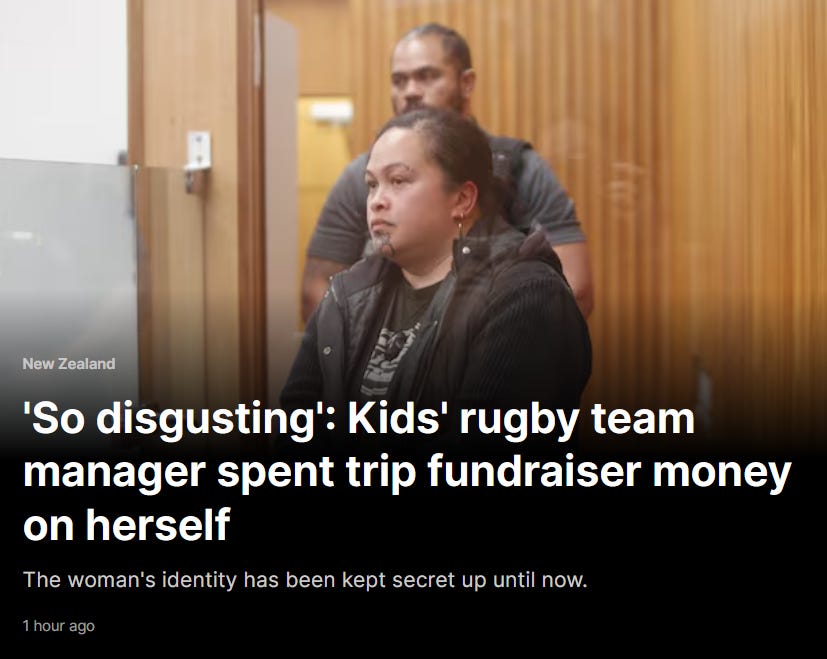
She was convicted earlier this year. Her name was hidden for months under suppression, opposed by mainstream media, until it finally lapsed in December.
That moko kauae did not represent integrity, leadership, or responsibility. It represented nothing. In fact, it actively misled people into trusting someone they otherwise might not have.
This is the uncomfortable part. People wearing moko kauae or full facial ta moko now routinely expect automatic deference. Elder status. Moral authority. Cultural immunity from scrutiny. However, when every man and his kuri is getting one, it stops being a marker of earned standing and becomes a virtue-signalling barcode.
I remember seeing Eru Kapa-Kingi appear on a Māori current affairs show October 2024, sitting beside Hone Harawira. Clean face. Gold jewellery. Talking big about a planned hikoi to Wellington to oppose the Treaty Principles Bill.
Three weeks later, his entire face was tattooed.
Three weeks.
Eru Kapa-Kingi
Matua Kahurangi 2 June 2025
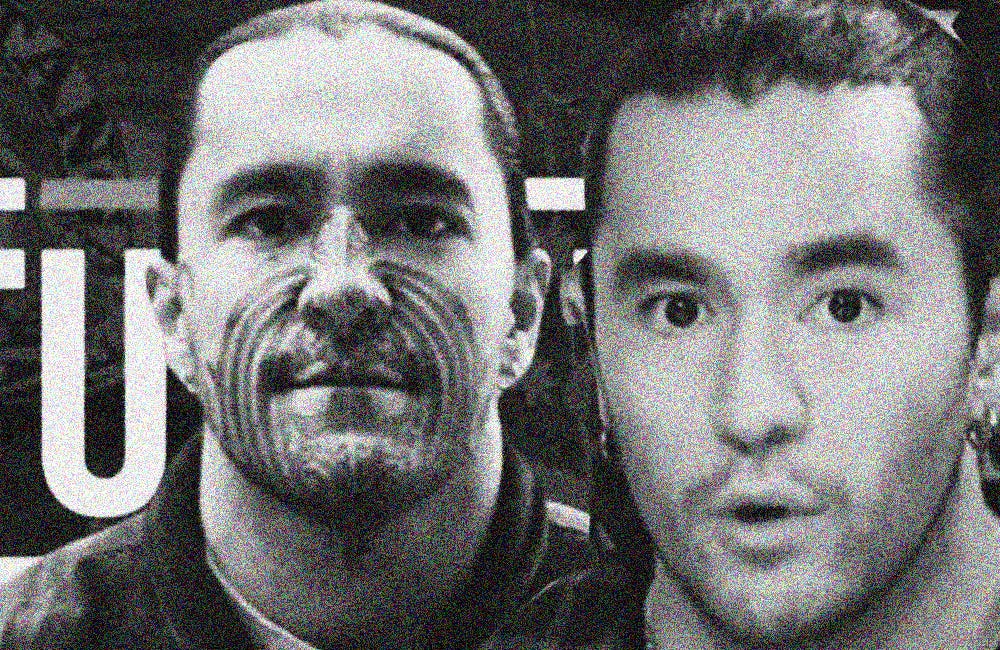
Twelve months ago, few New Zealanders had heard of Eru Kapa-Kingi. Now, he is suddenly everywhere. He made headlines this week for publicly challenging ACT Party leader David Seymour to a fight, in response to Seymour allegedly calling his mother, Te Pāti Māori MP Mariameno Kapa-Kingi, an “idiot”. The reaction was theatrical, if not juvenile. For someon…
Read full story
No long service. No visible journey. No years of leadership or sacrifice. He had not even marched yet. But suddenly, full facial moko, applied with modern electric tattoo equipment he can thank colonisation for providing. The end result looked less like ancestral gravitas and more like a pumpkin etched onto his face.
I always thought ta moko was something you earned. Apparently now it is something you schedule with your local tattooist.
Then there is Matua Bill on social media. Full ta moko. Tears on camera. Poverty monologues. Pre-Googled inspirational quotes delivered with solemn music. He talks about “our people” suffering on the whenua, by which he means Māori exclusively. Then, the very same day, he promotes an offshore casino for a paid sponsorship.
We all know what gambling does in this country. It destroys families across every ethnicity. It hits Māori communities hard, with benefit money going straight into pokies on payday, chasing a miracle that never comes. Yet there he is, face tattooed in supposed cultural authority, selling the very poison he claims to oppose.
This is why the symbolism has collapsed.
When moko kauae is worn by thieves.
When ta moko is acquired between media appearances.
When cultural authority is monetised, weaponised, and contradicted by behaviour.
The meaning drains away.
So yes, after reading about Marise Martin, I will say it again. The moko kauae has lost its mana (prestige). It is no longer a marker of honour or responsibility. Too often now, it is just a barcode. A signal designed to scan as virtue, while hiding what is actually underneath.
Matua Kahurangi is just a bloke sharing thoughts on New Zealand and the world beyond. No fluff, just honest takes. He blogs on https://matuakahurangi.com/ where this article was sourced.


8 comments:
In lore Moko kauae is associated with women of mana and experience, and carries (if you like) information about whakapapa, responsibilities, and leadership roles.....
Sadly these concepts (like many born agains) are challenged and scholars and leaders (now) state that moko kauae is the 'right' of all maori women as long as they prove some modicum of genealogy.
Clearly this is where the 'mana' of the moko breaks down.
Even worse it seems that these same people believe that the lore once followed with dignity where you needed to be a certain age, te reo fluent, or have served your community at personal time expense before you are granted the right to a moko kauae are now called 'colonial myths' that have discouraged women from getting one.....
It is a disconnect in the aspect that tikanga and te ao maori et al should be followed, but it seems only when it suits.....
Was it ever a mark honour or responsibility? It was a mark showing hierarchy and status but a brigand, a murderer and cannibal could be a chief and have ta moko. Yet such men abused their power and debased, enslaved and murdered others. It is a mark tribalism. It is not the mark of free men, which is why most abandoned it with the adoption of Christianity.
Did he check whether the tattoo ink was one of the proven carcinogenic ones ?
Will he demand instant pakeha treatment if it all goes wrong ?
A moko openly states "I am resolutely pro maori and will stoop to anything to favour our people and myself before NZ and NZers in general". Whilst nowadays one has to assume this with all trace maori, the warning sign is nevertheless useful. For some it is also a device to reduce the risk of the inconvenience of employment.
There should be a maori surcharge tax to cover removal from those who have matured.
It seems that every man and his dog, including his women seem to need to scribble all over their epidermis. What might have set someone apart as odd or eccentric, now is a 'fashion' accessary to the point where I have caustically, and sarcastically said; 'stand out in the crowd, get a tattoo'. Perhaps the less secure the scrawled-upon, the greater the area covered in ink and, to show off the scribbles, the less clothes are worn lest the 'investment' is obscured. If the ink doesn't cut their lives short, the aged wrinkled skin won't do the markings any favours as deepening skin folds distort lines. Their lymph glands will also be dark blue. Apart from the above, words fail me.
If smoked heads ever become 'tourist tack' again...................
I'm not of Maori descent, though there are Maori in my extended family.
Long years ago in the early 1950s, when I was very young, a Maori classmate lived with his grandmother.
They went to the same church, and we'd see them every Sunday. She was a tiny little old lady, with a chin tattoo.
I was telling this story to a young relative who, knowing the history of such tattoos, remarked that she must have been a woman of rank and prestige, since in the old days, it was only such people who were permitted to have them.
It's a regrettable fact of modern life that the meaning of such face marking has become debased, such that nowadays, almost every young woman of Maori descent has one. It has instead become a market of identity, rather than of merit, as it once was.
As a small boy in a rural town I recall elderly maori women sitting outside the Post Office. Many had moko, but these appeared as random smudges not patterns. They could not all have been chieftenesses (or even the princess' from whom near all maori claim to whakapapa).. I suppose as age will now get removal on the state and a new one from a charity grant.
Post a Comment
Thank you for joining the discussion. Breaking Views welcomes respectful contributions that enrich the debate. Please ensure your comments are not defamatory, derogatory or disruptive. We appreciate your cooperation.