

When a city pumps tens of millions of litres of raw sewage into the sea day after day, the public is entitled to anger. There is human waste in the sea and on the shore, beaches are closed in peak season, businesses hammered, and ratepayers are wondering how their rates keep going up but the capital city can’t keep its basic infrastructure functioning. They are allowed to be proper mad.
And, when sh*t goes down, so to speak, people want answers and accountability. The equation becomes brutally simple. Something has gone wrong, someone must be responsible, and we want a solution.
What actually went wrong at Moa Point, in technical terms, is to be formally established by the Crown Review Team, but the outline of the failure is pretty clear. On 4 February, the Moa Point Wastewater Treatment Plant suffered a major breakdown after significant flooding within the facility. Large parts of the plant were inundated, damaging critical equipment and forcing the shutdown of core treatment functions. Wastewater that would normally undergo full treatment before discharge could no longer be processed as designed.
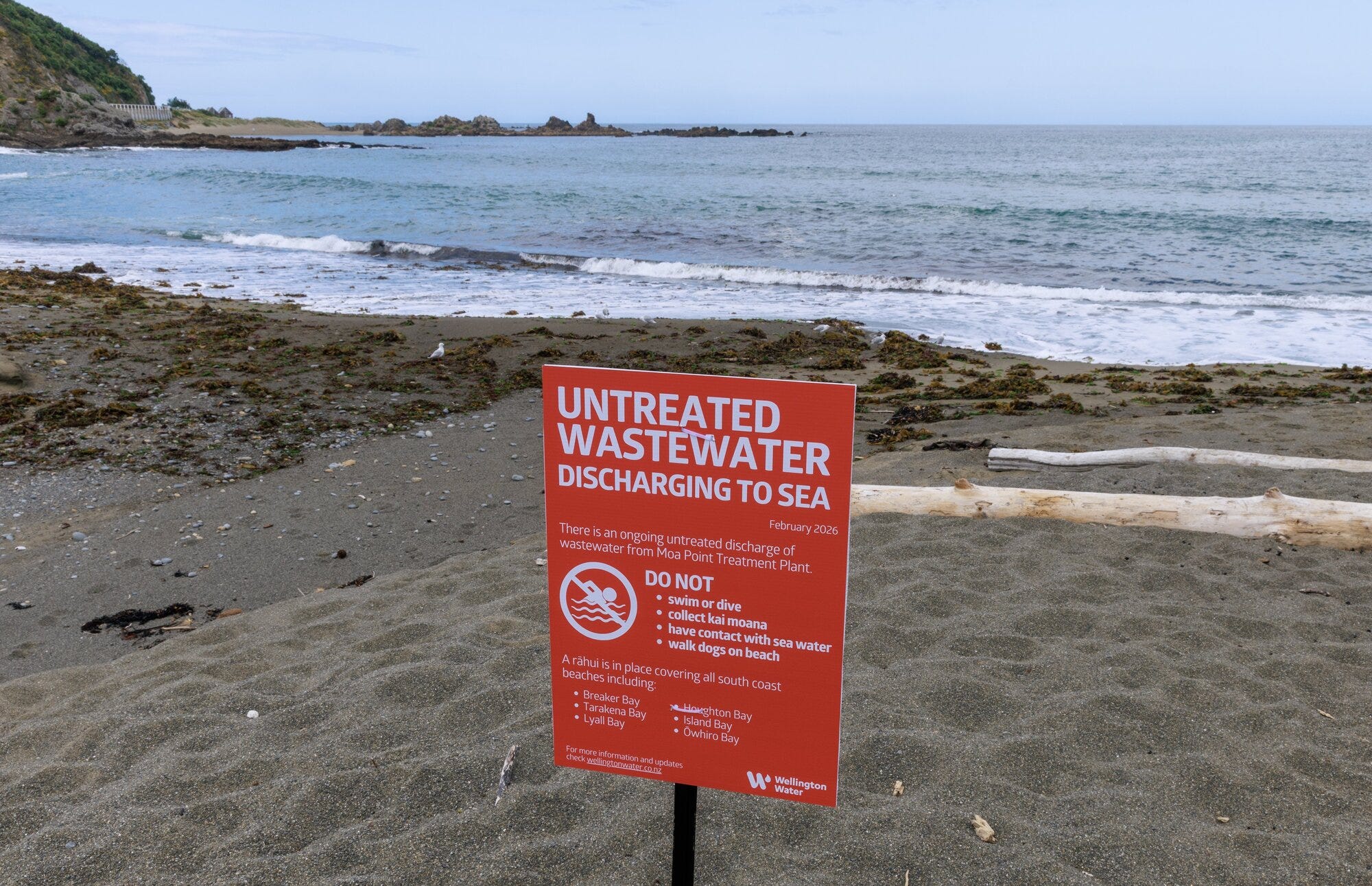
The plant continued to send screened wastewater through the long 1.8km outfall pipe into Cook Strait, but its capacity was constrained. When storm conditions increased inflows, excess volumes were diverted through the shorter outfall pipe, resulting in the discharge of untreated, unscreened wastewater into coastal waters.
Predictably, the people of Wellington are spitting tacks. They are sick of water infrastructure failing and they know that longterm failure to invest in upgrades and replacements is the most fundamental problem. It is frustrating because there is no one and everyone to blame. Who takes accountability for decades of repeated bad decisions?
In response to the scale of the failure, the Government moved quickly to establish an independent Crown Review Team to investigate what went wrong at Moa Point. This is a technical review, appointed to both Wellington City Council and Wellington Water, with expertise in engineering, commercial oversight and legal accountability. Rather than a political showcase kind of review, it is hopefully more boring and useful. The stated aim is to determine the root causes of the breakdown and provide clear, actionable recommendations to prevent it happening again.
However, as humans we seem not to have outgrown our insatiable need for blood in these situations. Someone must pay when we are wronged and no one knows that more than politicians and those operating in high-profile roles in the political world. They know the day may come where they are called on to fall upon their sword.
That day came for Nick Leggett who resigned as chair of Wellington Water, stating that leadership carries responsibility and that public trust cannot be restored by words alone. He did not claim personal fault for the mechanical failure, but he recognised that when an institution presides over a crisis of this magnitude, its leadership must absorb some of the impact.
At the same time as this played out we also had front row seats to a case study of what I consider to be a truly toxic and overplayed strategy for dodging accountability.
First of all, let me lay out the caveats. Racism and sexism are real. Duh. Anyone who pretends otherwise is either living in blissful ignorance or dishonest. People in public life can and do face abuse that is personal, degrading and rooted in prejudice rather than performance. That should be called out clearly and condemned without hesitation and I certainly do my best to call it out when I see it. However, when accusations of racism or sexism are deployed as political weapons stretched to cover ordinary scrutiny, policy disagreement, or anger at institutional failure, they become cynical shields. Used that way, they do not protect vulnerable people; they protect power.
Click to view
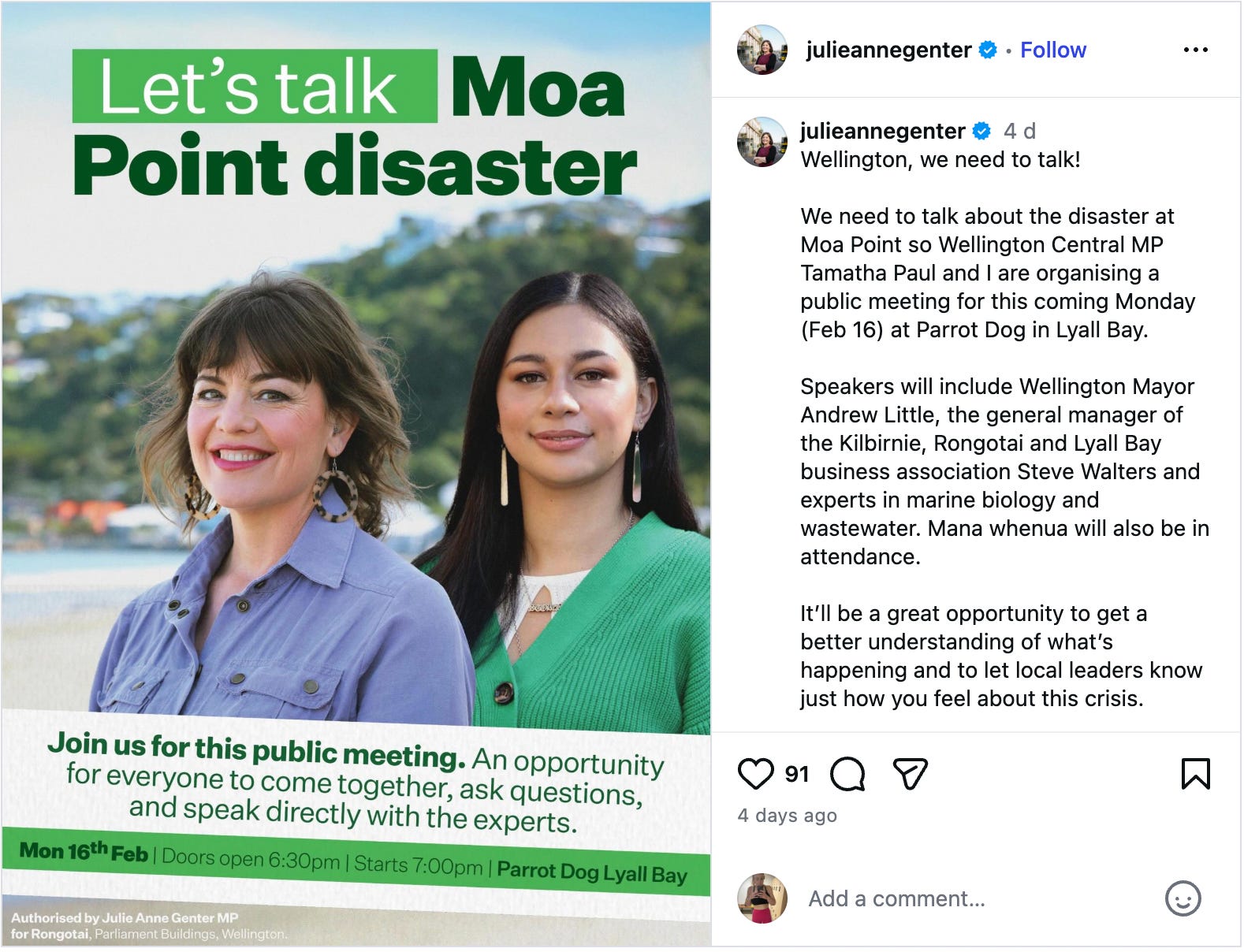
On Monday, Green MP Tamatha Paul faced some hostility at a public meeting organised by fellow Green MP Julie Anne Genter for the community affected by the Moa Point failure. This is because in the context of decades of underfunding and no one being around to be accountable, it was pointed out that when she was a Wellington City Councillor Paul succeeded in convincing the rest of the Council to adopt her plan which prioritised cycleways over water infrastructure.
I’m not sure who dug the nugget of information out so I cannot credit them, but I found the video of the 27 May 2021 Wellington City Council meeting in which the council voted on investment options as part of the Long-Term Plan. There were lots of things being discussed as it was the final voting day for the various moving parts that made up their budgeting for the next decade. For some of the big ticket items, tiered options were presented to councillors along with the officials’ recommendations and the mayor’s preference. These options outlined various different degrees of investment as well as timelines. Both cycleways and water infrastructure were big issues. Council officials favoured “Water Option 3”, which included a $391 million wastewater renewals programme to reduce sewage pollution, and “Cycleways Option 3,” a $120 million cycling network.
However, then-Green councillor Tamatha Paul moved an amendment to adopt “Cycleways Option 4,” nearly doubling cycleway spending to $226 million. The Council then rejected “Water Option 3,” effectively keeping wastewater investment at a slower, less front-loaded level, and the consequences are now floating in the harbour. The amendment was not a spur of the moment declaration, Paul lobbied her councillors aggressively and fought for the outcome. In the meeting almost every councillor acknowledges that it was Paul’s dogged persistence over some time that got them to change their mind and opt to prioritise cycleways.
It was very much understood by everyone that this was a meeting in which decisions were about prioritisation. In the impassioned speeches more than once councillors referred to something along the lines of being on the right side of history. They spoke glowingly, optimistically, about climate justice in a way that would have you think these cycleways were going to somehow magically nullify the carbon emissions of China.
A young submitter had proposed calling the cycleway network the “Kids Freedom Network” and the phrase was picked up and repeated by some councillors during debate. It was rhetorically powerful allowing them to frame the cycleway programme around children’s independence and safety rather than transport infrastructure.
It certainly was more emotive and exciting than dealing with where Wellingtonians’ poos and wees go.
Time for another caveat. Tamatha Paul is not responsible for the failures at Moa Point. However, she is responsible for her actions and decisions as an elected representative, first as a councillor and now as an MP. What follows from that is not a claim of mechanical causation, but of political responsibility.
No one is arguing that Tamatha Paul personally flooded the Moa Point plant or that a cycleway line item in a 2021 Long-Term Plan directly ruptured an outfall pipe in 2026. Infrastructure failure is simply not that linear. But budgeting is about tradeoffs and councils do not operate in a world of infinite money. When large sums are accelerated into one programme, something else moves more slowly or is halted. That was understood in the chamber at the time and it was debated as a key question of prioritisation. Officials recommended a more front-loaded wastewater renewals package. Councillors, led and persuaded by Paul, chose differently.
In a city long criticised for underinvestment in core water infrastructure, she convinced her fellow councillors to continue to delay, among other things, crucial work on water infrastructure to prioritise cycleways.
Unlike, Nick Leggett, Tamatha Paul has not taken accountability for her role in Moa Point. She genuinely seems to think that they were sitting around the council table playing with monopoly money back in 2021. Or she thinks she should be shielded from accountability because there are others who should also be held accountable but are not. That is not how this works.
Speaking to media after the meeting on Monday, Paul sought to paint herself as the victim facing a horde of unreasonable bigots:
“This is the reality, Tory Whānau is not in town anymore, so I’m public enemy number one to disinformation spreaders and to racists, and they would love to blame a generational crisis on someone who wasn’t even born when the Moa Point facility plant was built.”
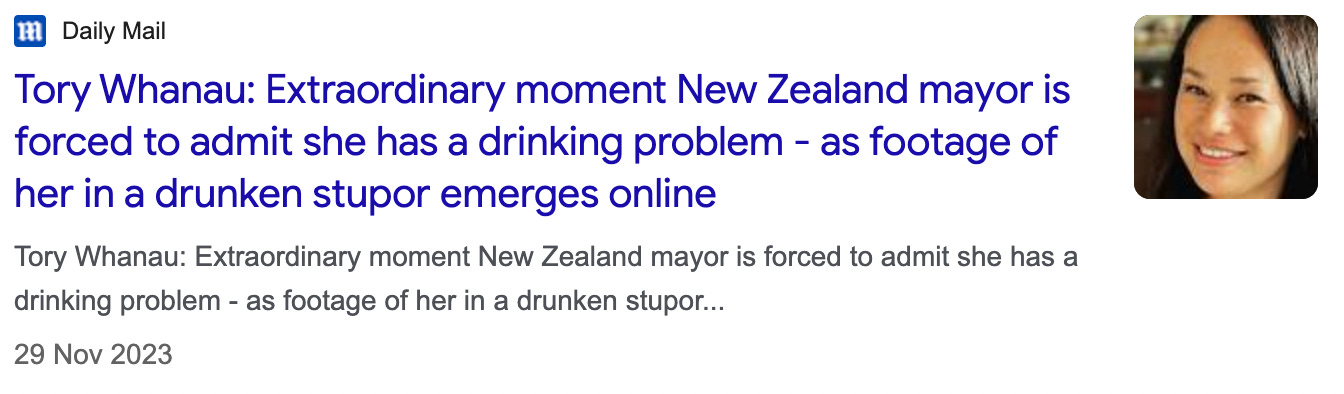
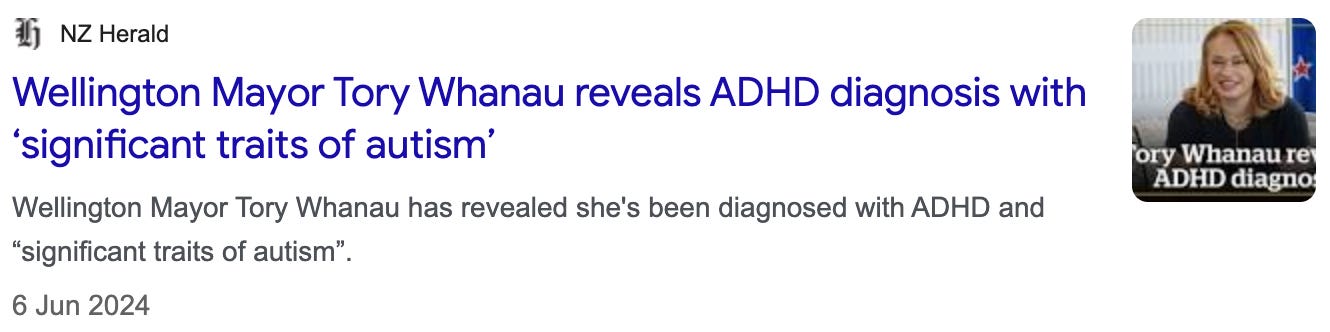
To this I say a giant “NOPE.” Tory Whanau’s tenure is another example of how criticism is reframed as prejudice when it is far more prosaic. Her controversies were not about her ethnicity; they were about her conduct. Skipping out on a restaurant bill and invoking a “don’t you know who I am” defence, publicly acknowledging alcoholism while continuing to be seen drinking, announcing diagnoses of ADHD and autism in ways that blurred the line between explanation and excuse, and stating she could not handle meetings longer than half an hour… these are behavioural and leadership issues. Any white, male politician who did the same would have been met with exactly the same derision, scepticism and loss of confidence. Can you imagine new Wellington Mayor Andrew Little getting away with the same? Voters expect basic standards of professionalism and personal responsibility from those entrusted with executive authority. When those standards appear to slip, or cascade dramatically from a height, criticism follows.
The Tory Whanau thing baffles me because she can directly be compared to two highly successful young Māori mayors in Rotorua’s Tania Tapsell and Far North’s Moko Tepania. They were both reelected at the past election when Whanau failed to even win a Māori ward seat in which her only opponents were also Māori. If it were truly about her being Māori, both Tapsell and Tepania would also be copping it too. The difference is in performance and conduct.
I wrote about Tory Whanau’s decline at the time for Newstalk ZB.
Click to view
Click to view
Likewise, the questions being asked about Moa Point are not about Paul’s identity. They are about her record and about whether the political energy poured into climate-symbolic projects came at the expense of less glamorous but much more essential infrastructure. They are about whether the council, collectively, misread the urgency of water renewals while celebrating being “on the right side of history.”
Tory Whanau wasn’t the only Māori woman Paul invoked in her amped up post-meeting debrief with media. She also said:
“I just want people to remember the overload of disinformation and racism that came out towards Nanaia Mahuta when she tried to lead Three Waters reforms which would’ve solved an issue like this, and all of the vitriol that whānau faced, and to know that there are Indigenous leaders in our country who are women who try to fix these issues and are instead met with lies and disinformation and targeted hate campaigns. You will never get good leaders in this country if that’s the way you treat women.”
Opposition to Three Waters was not reducible to racism or misogyny. Yes, it was driven by substantive concerns about cogovernance structures, but also about asset transfer, democratic accountability, and the scale of centralisation. Many, many New Zealanders objected to that reform package and turned out to rallies to express it. To characterise that level of resistance as primarily “disinformation and racism” is to flatten a complex political debate into a good versus evil scenario in which a sizeable proportion of the electorate is evil.
Criticism of Nanaia Mahuta as Foreign Minister stemmed from the fact that she hated travelling and made no secret of it. Yes, COVID-19 would have curtailed her travel somewhat, but I count around 12 countries visited during her 2020-2023 tenure while current Foreign Minister Winston Peters is sitting at around 51 countries (78 if you count repeats) for 2023-present. Again, this is a performance issue. And Winston Peters is also Māori and widely considered our best Foreign Minister ever, so where is the racism on that one?
As for her whānau, well when you become one of the most powerful people in the country there is quite rightly more interest in your family and how they may be benefiting from Government contracts. Cranmer’s Substack and I dug out and reported on the original information about how Nanaia Mahuta’s husband and sister (among others) were making a significant amount of money from Government contracts. We showed how ill-qualified her husband was to deliver such contracts and demonstrated a powerful network of roles held by her family members. We were called racist and sneered at by the mainstream media types. I spoke to several journalists, providing them with irrefutable OIAs and they said they would not touch the issue because it would become about race. Who benefits from that? If the mainstream media had don their job Nanaia Mahuta would have faced actual scrutiny, but instead people like Paul can look back and say it was just a few racists picking on her.
Invoking “racism” in these kinds of contexts does not protect vulnerable people it protects people in power.
Saying that Indigenous women leaders are uniquely targeted when they “try to fix these issues” shifts the frame away from present responsibility and toward the familiar shiny distraction of historical grievance. It isa deliberate attempt to sidestep the core democratic questions of were the right decisions made, and who is accountable for them?
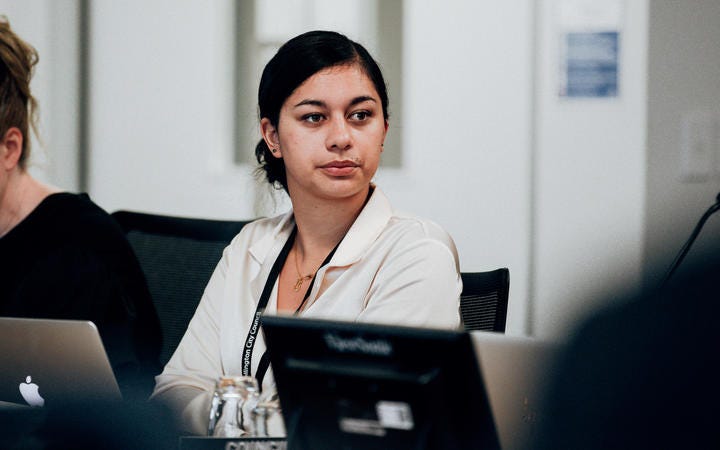
Tamatha Paul carried on for some time in her tirade against the awful racist bigots who showed up to a public meeting about wastewater on Monday. She seemed to have experienced a narcissistic injury rather than listened to constituents:
“I won’t let them win. I will continue to provide opportunities like that. I’ll continue to provide opportunities for truth like tonight because I know that I’m fighting against misinformation, which is all rooted in racism. Women don’t want to take up roles of leadership because of this reason that aggressive men show up. Even though they are the minority, they show up, they throw their weight around, they scream and throw their toys, and they completely ruin it for everybody else. But what I want them to know is they will not scare me, and they will not stop me from representing my community.”
This isn’t a Marvel origin story. It’s a sewage disaster.
The language of “I won’t let them win” and “they will not scare me” frames this as a personal battle between a courageous heroine and shadowy villains. But the public meeting was not about defeating Tamatha Paul. It was about untreated wastewater pouring into the ocean. It was about infrastructure, governance, and accountability. When elected representatives centre themselves in the drama, and cast critics as antagonists, they mistake scrutiny for persecution. You are not the protagonist in a saga about racism and disinformation, Ms Paul. You are one of many decision makers in a city grappling with systemic failure.
Additionally, describing angry constituents as “aggressive men” who “throw their toys” may feel cathartic, but it avoids the substance of what brought people into the room in the first place. Citizens demanding answers about broken infrastructure are not characters in a narrative arc. They are ratepayers, business owners, and residents watching sewage float in their harbour.
Of course there was some misinformation at the meeting. There always is. Of course there were loud, aggressive voices. There always are. And some people may have behaved in ways that were racist or sexist. That should be identified and condemned specifically.
But Tamatha Paul can rest assured that she is not the first politician to be drowned out by an unhappy crowd. Māori and non-Māori politicians have endured hostile meetings since forever. ‘Tis part of the gig, in fact. Barry from Breaker Bay booing Paul off the stage is likely not evidence of Barry’s racism so much as it is his frustration, exhaustion, and anger at the excrement, sanitary items, and condoms littering his local beach.
And the existence of some bad actors does not invalidate the broader public’s grievance. A packed room demanding answers about sewage in the sea is not a hate campaign and Paul is displaying some extraordinary ‘Main Character Energy’ by kicking off about herself rather than addressing their concerns and experiences. Civic participation is messy, uncomfortable, and can be heated. As they say, if you can’t stand the heat, get out of the kitchen.
What makes Nick Leggett’s resignation so stark in contrast is not that he personally broke a pipe. He didn’t. It’s that he understood something fundamental that Paul clearly does not; that leadership carries responsibility for institutional failure.
Correlation is not causation, but governance is cumulative. Decisions compound over time and when an elected official has been central to shaping those decisions, it is entirely legitimate for the public to ask how those choices stack up in hindsight. Paul is not responsible for a specific valve, pipe, or flood event. She is responsible for the positions she advocated, the amendments she moved, and the prioritisation she helped secure. That is the level at which accountability properly sits. And insisting on that level of accountability is not racism. It is politics.
Ani O'Brien comes from a digital marketing background, she has been heavily involved in women's rights advocacy and is a founding council member of the Free Speech Union. This article was originally published on Ani's Substack Site and is published here with kind permission.


6 comments:
It's always noticeable that allegations of racism only get made when there's criticism of left wing politicians. I've never heard if anyone being accused of racism for criticizing Winston Peters, or Shane Reti or Karen Chhour. It's a form of left wing control. Funnily enough, those who try to hide behind this "racism shield" are the people trying to turn NZ into an apartheid country.
"Playing with monopoly money'
Exactly. The left in particular and young, have no idea where money comes from and think it's fine to throw it around willy nilly.
Vote the wrong people on Councils and this is the result.
That’s as maybe, but what about climate change, is it anthropogenic or not?
Tamatha Paul. I wonder how many people who "link in" to this web site, and since the waste water woes have occurred, have read the 'many' (2 that come to mind) printed articles that appeared here, and "may be"?? in The Post, or possibly NZ Herald(?) re the data as presented in this article.
With a 're-look' at articles here -
- one suggested that Ms. Paul "was not to blame"
- the other placed before us the same data that Ani has.
In re-reading the first 2, then Ani's I am inclined to put into words "entitlement".
That is Ms Paul is of an age, in current era whereby young women, of her age - and above, has this thought of grandeur, that what ever happens -
- "It is not my fault".
- "Others are to blame"
- " I have been misunderstood"
- " I did not say that".
I use YouTube as a source of education, entertainment and news from around the world and in the context of my comments above, I recall an incident (capture on a cell phone and posted to YouTube) of a young lady on an Internal Airline, in America.
The incident occurred pre take off, in the cabin, and said young lady was spoken to by Cabin Crew - to which she "rebelled", the vocal comments insulting, to which security staff were called and removed her, still "venting steam" - about entitlement.
The posted comments showed total distain for her actions, and the fact that she 'could of placed" others in that cabin at risk, was not lost on those making the comments.
The word "entitled" appeared many times.
So, for Ms. Paul, me thinks that the same label will be applied, and her past & recent actions will rebound on her, hopefully on the 7th November 2026.
What’s happening here is simply an outcome of democracy. No to Three Waters, Yes ti sewage on the beaches. It doesn’t get much simpler than that
"when storm conditions increased inflow " is the suggestion under the first photo of this article. Is this confirming that the Moa Creek sewage system was treating stormwater as well as sewage, and stormwater was wrongly directed into the sewage pipes instead of stormwater pipes. That needs to be addressed because storms and stormwater should not increase the sewage supply from a decreasing population in Wellington.
Post a Comment
Thank you for joining the discussion. Breaking Views welcomes respectful contributions that enrich the debate. Please ensure your comments are not defamatory, derogatory or disruptive. We appreciate your cooperation.