

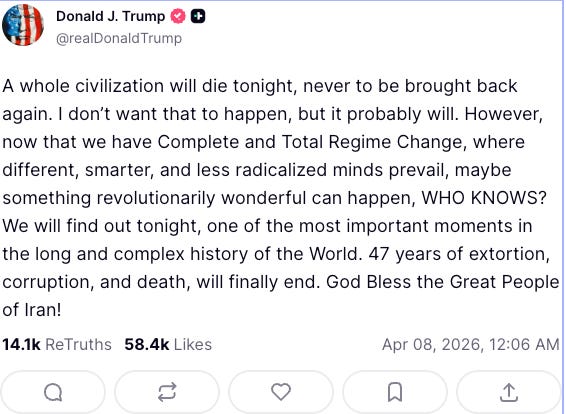
Before going any further, it is worth being clear about what has actually happened…
The Strait of Hormuz is the narrow maritime corridor through which roughly a fifth of the world’s oil flows and it has been effectively choked by Iran causing the current fuel crisis. Now, following Donald Trump’s escalating rhetoric, a fragile two week ceasefire has been announced, shipping is to resume, and we will all watch oil prices hoping they retreat quickly.
This is a very fragile, tentative de-escalation. A precarious and temporary release of pressure allowing for more time for Trump to strong arm the Iranian regime into submission and for them to attempt to wriggle out of it. It is not a win, but it is a reprieve, and it remains to be seen if it is a step toward whatever comes next.
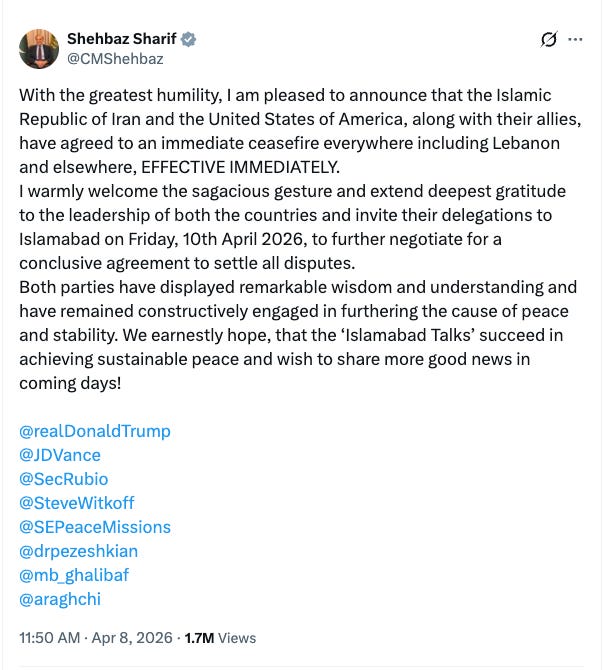
Prime Minister of Islamic Republic of Pakistan
The well to-do middle classes and establishment elite all over the West are horrified by the language President Trump uses, the warrior gung-ho schtick of his Defence Secretary Pete Hegseth, and the wholesale rejection of globalism. A visceral reaction to this is natural as it runs counter to the culture of (the pretence) peace that we have grown up with. But that peace, if it ever truly existed, is gone now.
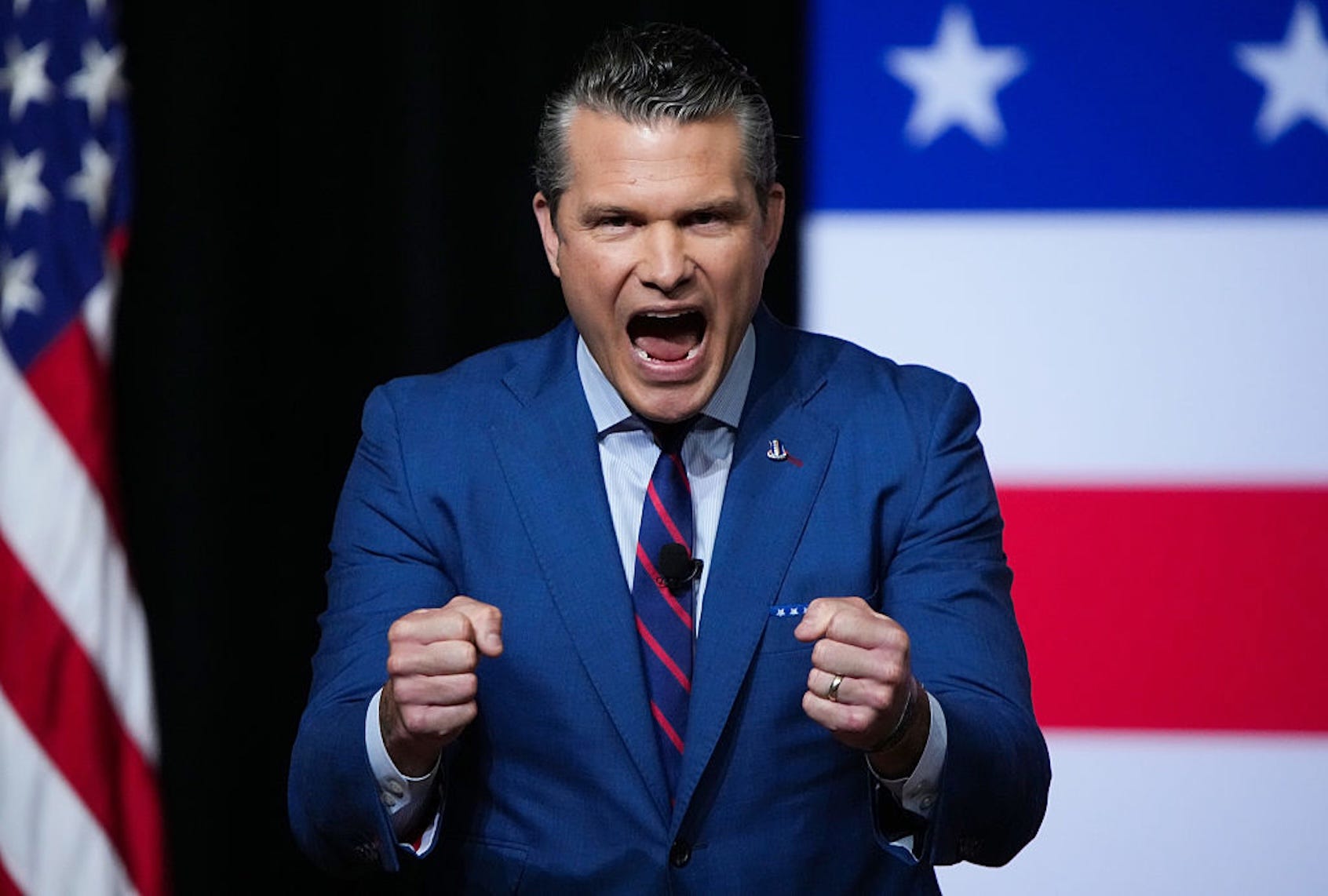
Defence Secretary Pete Hegseth (Andrew Harnik/Getty Images)
The West has been sleepwalking toward its own demise. China’s rapid economic dominance has gone unchallenged and the spread of Islamist ideology and terror has been largely accepted as some kind of tax on living in diverse societies. Authoritarians, dictators, and despots have been unafraid of the West and global bodies and so have acted confidently to expand their interests. Russia has invaded Ukraine, Iranian proxies have attacked Israel, and China has advanced its dominance in the South China Sea and Pacific.
Anti-interventionists might say “so what? They can do their anti-liberal, authoritarian thing over there and we will have liberal democracy over here.” But apart from domestic policy having allowed anti-liberal and anti-West ideologies to embed in the West itself, one only needs to listen to what our adversaries say openly to understand that staying in our own lanes is not an option. A simple search of speeches by the leaders of these regimes will turn up example after example of cries for the death of America and the West. They are explicit in their intentions for world dominance.
With all of our liberal tolerance and “can’t we all get along” attitude, we are headed toward civilisational suicide. We will be rearranging the deck chairs on the Titanic when the ship goes down. We can’t all get along because the other side is willing to martyr themselves to take us out.
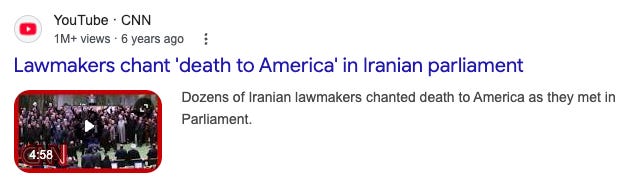
The West needs a reality check. War is at our door whether we like it or not. It is not necessarily a war over territory (although in some places it is) it is the ultimate culture war. A war over ideology and religion. For non-religious Westerners it might feel like they have no skin in the game, but living under Christianity with its claws removed is very different to Islamist rule. This is about our liberal, tolerant way of life being superseded with a belief system that subjugates women, slaughters homosexuals, and promotes sectarian violence.
If you pearl clutch about the abortion law changes in the US that are largely not happening anyway, it is inconceivable to be unworried about the much larger threat to women’s autonomy globally. Try protesting about women’s rights in Iran, Syria, or Afghanistan and see what happens.
A combination of naivety, distance from the wars against fascism of the 20th Century, and generations of anti-Western indoctrination have resulted in apathetic populations who are not only unwilling to defend our freedoms, but cannot even comprehend that they are worth fighting for. Winston Churchill must be turning in his grave watching Britain right now.
Yes, war is brutal, expensive, messy, and should be avoided. But not having the stomach for war will not prevent it coming. China, Russia, Iran… they have ignored the West’s words. Our global bodies have been so weak as to give them spots on peace councils and committees. Make no mistake the reason China has not swept through the south seas, Iran hasn’t dropped nukes on everyone, and Russia hasn’t captured all of Eastern Europe is not because we have negotiated nicely with them. It is because the threat of America’s military might has stood behind those conversations.
Westerners have tricked ourselves into thinking we live in times of dignified peace and diplomacy, but without violence none of it would have held. Throughout the entirety of our history as a species it has always been violence and the threat of violence that has been the ultimate currency. That is why anti-Americanism and derision of their military by the educated classes here and elsewhere in the West are such an insult. Like trustfund nepo babies who live off mummy and daddy and then play pretend communist for a while. Our freedoms have depended on American guns this whole time. It is an unpalatable truth.
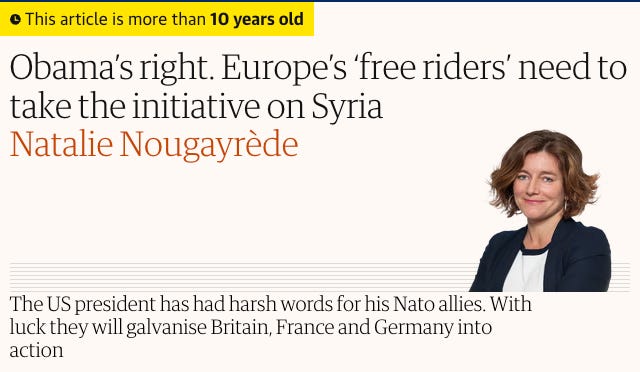
This does not mean we cannot criticise America and Donald Trump, or Barack Obama, or whoever comes next. But American frustration with Europe has been building for years, and it is now being expressed with increasing bluntness. From Barack Obama warning of “free riders” within NATO, to Donald Trump openly castigating allies for failing to meet defence spending commitments, to Joe Biden urging burden-sharing, successive presidents have warned that European states are failing to meet their defence obligations, allowing their military capabilities to erode while relying on the United States to guarantee their security. They were ignored and now much of Europe is in the awkward situation of wanting to oppose what Trump is doing while being reluctantly aware of how reliant they are on his country. The lesson is (and we are learning this on multiple fronts at the moment) that nation states must ensure their own sovereignty as much as possible.
Of course, scale plays a role in how independent a state can be. New Zealand will always need to rely on bigger, wealthier, better militarily resourced countries to an extent. But (not-so-)Great Britain and much of Europe have learned a harsh lesson. They have allowed their militaries to be underfunded and dysfunctional. Had they not effectively disarmed they could actually engage in discussions with the US about strategy for dealing with common threats, but as lame ducks they don’t really have a leg to stand on. From Washington’s perspective, this is not simply a matter of fairness. It is a question of credibility. An alliance in which one member consistently carries the burden is inherently unstable. The current crisis has sharpened that perception, revealing a Europe that can call for de-escalation but lacks the capacity to enforce it.
Nowhere are these failures more visible than in Iran.
It is important to understand, as I outlined above, that this is not simply another regional flare-up centred on Iran. The immediate conflict has roots in years of shadow warfare between Iran and Israel, proxy terrorist militias, cyber operations, and targeted strikes that, until recently, stopped short of direct confrontation.
The threshold was crossed on October the 7th 2023 and then escalated when US and Israeli forces engaged in strikes a matter of weeks ago. They have moved beyond military targets into critical infrastructure, degrading Iran’s economic capacity as well as its strategic position. Reports indicate widespread disruption to industrial production, including severe damage to steel output and transport networks.
At the centre of this escalation sits the failure of the West to prevent the collapse of any durable framework for managing Iran’s nuclear ambitions. Iran’s nuclear program, once constrained by the 2015 Joint Comprehensive Plan of Action (JCPOA), has advanced significantly since the United States withdrew from the agreement in 2018. Under the deal negotiated by Barack Obama, Iran agreed to strict limits on uranium enrichment, international inspections, and caps on its nuclear stockpile in exchange for sanctions relief. At the time, the agreement was presented as a diplomatic breakthrough that would prevent Iran from obtaining a nuclear weapon while avoiding another destabilising war in the Middle East.
But there was a flaw in Obama’s approach in that it prioritised temporary restraint over permanent resolution, embedding sunset clauses that effectively legitimised Iran’s long-term nuclear ambitions rather than eliminating them. Additionally, as part of the deal Iran received access to tens of billions of dollars in unfrozen assets and sanctions relief, injecting substantial resources back into a regime that continued to fund regional proxy terror groups and expand its influence across Iraq, Syria, Lebanon, and Yemen. The US administration framed this as a pragmatic compromise. In reality, it amounted to a high-stakes gamble that economic integration would moderate Iran’s behaviour.
That gamble did not pay off. Even within the framework of the JCPOA, Iran continued to test the boundaries of compliance while advancing its missile program and entrenching its regional footprint. The deal constrained one dimension of Iran’s power while enabling others. The result was not a stable equilibrium, but a delayed confrontation.
Even Hillary Clinton expressed misgivings on the Iran deal. She publicly defended it and even intervened at key moments to protect the diplomatic process, warning that additional sanctions could fracture the international coalition that had been painstakingly built and weaken pressure on Tehran. But her support came with a clear-eyed scepticism that set her apart from the more optimistic framing of the Obama administration.
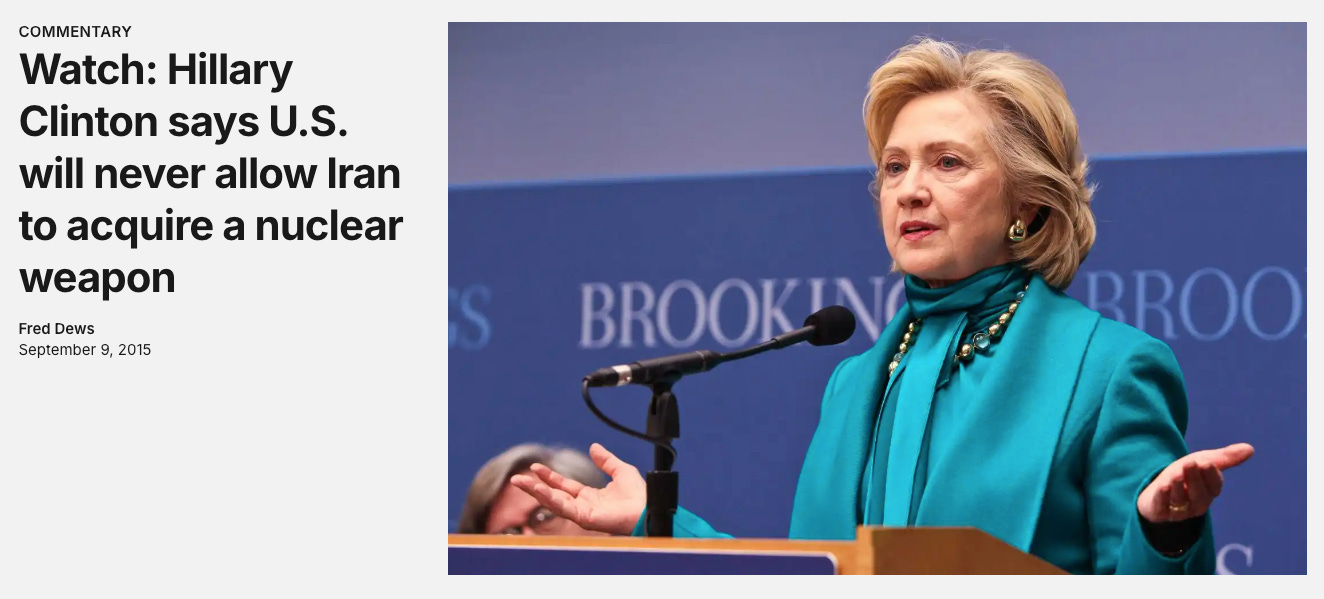
In a major policy speech, Clinton cautioned that the Iran agreement “isn’t the start of some larger diplomatic opening” and should not be expected to fundamentally change Iran’s behaviour, adopting the deliberately blunt doctrine of “distrust and verify”. Where Obama tended to isolate the nuclear issue and treat the deal as a stabilising breakthrough, Clinton framed Iran as a persistent strategic adversary that would continue to sponsor proxies, challenge regional order, and require sustained military, economic, and diplomatic pressure. In this, her assessment of Iran has more in common with Donald Trump’s although their approach differs. Chuck Schumer, John McCain, Lindsey Graham, and the Brookings Institute have also conveyed similar understandings of the situation. It could be considered the mainstream bipartisan strategic consensus.
It was understanding of the fragility and volatility of the situation that informed the decision by Donald Trump to withdraw from the agreement in 2018. The Trump administration argued that the JCPOA was fundamentally flawed, too narrow in scope, too lenient in its enforcement, and incapable of preventing Iran from becoming a nuclear state. Withdrawal was framed as a rejection of the broader philosophy that had produced the deal. In its place came a strategy of “maximum pressure” by reimposing sanctions, isolating Iran economically, and attempting to force a renegotiation on far more restrictive terms.
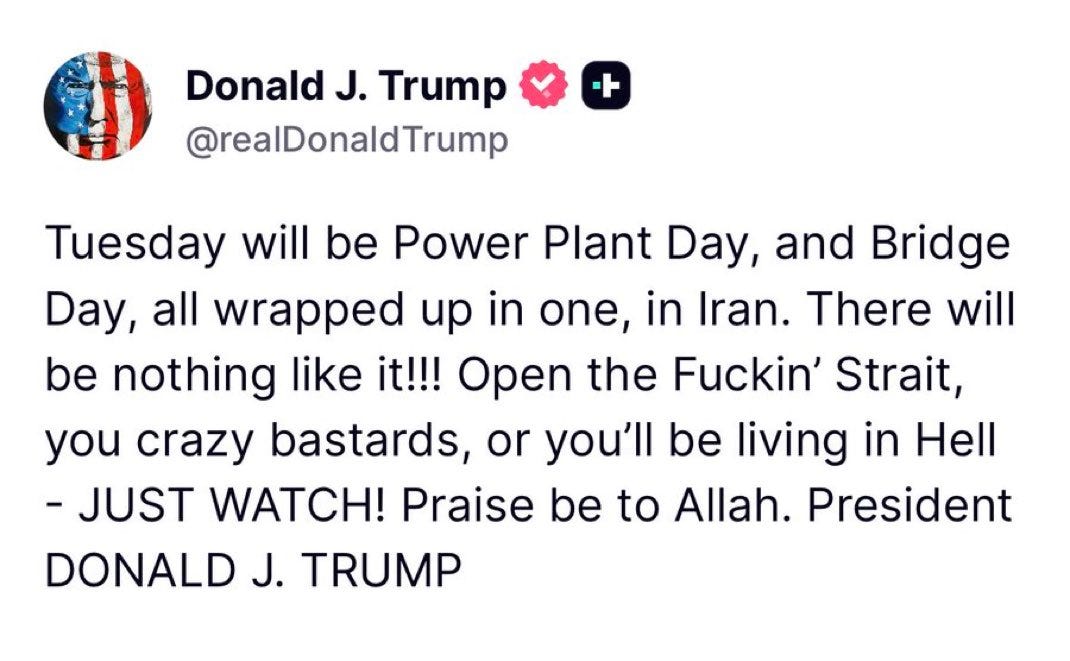
His recent statements in which he threatens to dismantle Iran’s infrastructure and warns of consequences severe enough to cripple the country are not aberrations in this sense. They are consistent with a worldview that prioritises coercion over negotiation. The two week ceasefire is not the product of careful diplomacy or mutual concession, but of an ultimatum: reopen the “f**kin’ Strait” of Hormuz or face escalation. That it succeeded in the immediate term does not prove that it will succeed in the long term, but it does show that there is some logic to dealing with these adversaries in terms they understand: violence.
But Iran is not the whole story.
The deeper logic of American strategy is clearer when viewed through a wider lens that captures competition with China. The Middle East is critical for global energy flows, and while the United States is less dependent on those flows than it once was, China is not. A significant share of its energy imports passes through the Strait of Hormuz. Disruption there has had immediate consequences for Beijing.
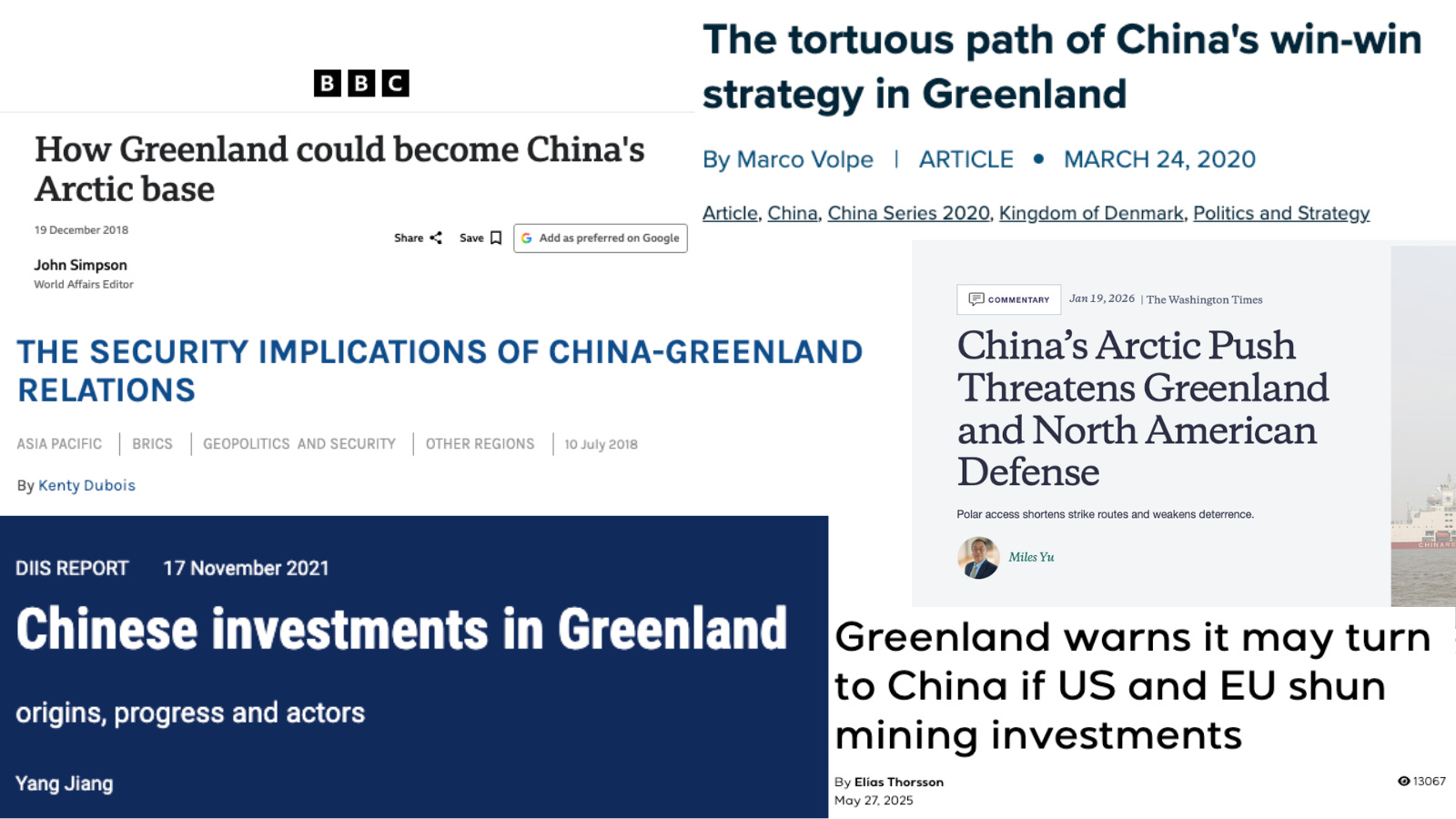
China has been steadily expanding its presence in the region, deepening ties with Gulf states while also extending its influence into Latin America. Venezuela’s vast oil reserves and economic dependence created an opening for Chinese investment and leverage while Cuba’s proximity to the US gave China intelligence and surveillance opportunities. In the Arctic, Trump’s interest in Greenland reflects a recognition of China and Russia’s interest in the region as melting ice opens new trade routes and exposes untapped resources. See the bigger picture forming? The media has preferred to report as if America’s moves are a matter of isolated, scattergun chaos. But they form part of a broader strategy for managing a network of economic and strategic relationships that challenge American influence across the world.
The US has been creating strategic compression. Pressure in one region cannot be separated from developments in another. America has unleashed an integrated framework that aims to contain Iran, secure energy routes, counter Chinese expansion, and reassert influence in areas that have drifted away from American orbit. This is a unified approach built on leverage not a series of disconnected policies. It prioritises leverage over stability and immediate outcomes over longterm certainty. It assumes that adversaries can be compelled into submission through sustained economic and military pressure, and that escalation can be carefully managed rather than spiralling beyond control. It assumes this.
The problem is that this strategy operates within a system that is increasingly unwilling or unable to absorb it. The institutions that once mediated conflict, the United Nations, multilateral trade frameworks, and broader diplomatic structures, have weakened significantly. Trust in these global institutions has been shot to bits. The United Nations rendered itself irrelevant by playing politics in a way that rewarded human rights abusers while punishing or sidelining Western powers. Without global mechanisms, the threat of conflict lacks the buffer it has had in the second half of the 20th century. Conflict is being managed directly through power, and power is being exercised more aggressively.
For decades, American strategy was built on a combination of containment, alliance management, and incremental pressure. Even when flawed, it operated within a framework that prioritised stability and predictability. The current approach represents a clean break from that tradition. Under Donald Trump, the United States is no longer attempting to manage adversaries within a stable system. It is attempting to force outcomes in an unstable one. The shift from deterrence to coercion, from alliances to conditional partnerships, and from containment to confrontation marks a fundamental transformation in how power is exercised.
This new approach can certainly generate pressure, but can it produce sustainable outcomes before that pressure triggers consequences that no one can fully control?
We will have to see if the reopening of the Strait of Hormuz and the announcement of a ceasefire will have any lasting impact on the conflict. Because escalation has its limits and sets a trajectory where the only direction left is further escalation.
Ani O'Brien comes from a digital marketing background, she has been heavily involved in women's rights advocacy and is a founding council member of the Free Speech Union. This article was originally published on Ani's Substack Site and is published here with kind permission.


32 comments:
“War is at our door whether we like it or not” is a bizarre statement. It appears that the West is starting wars (assuming the USA still counts as The West). NZ is feeling the impact due in no small part to the government selling off key energy infrastructure to private companies who only want a profit.
Hang on a moment Ani, Trump campaigned on no new wars.
“pearl clutch about the abortion law changes in the US that are largely not happening anyway” - they are absolutely happening and anyone who isn’t ignorant knows this. And no one is pearl clutching, they’re calling out backward steps for women’s autonomy. A christofascist state is still a fascist state.
China will be loving seeing US burning through its munitions stockpile and burning through established relationships with its allies. America is playing into Chinas hands.
At least petrol wasn’t so expensive under pretend peace.
“This kind of rhetoric is not something we are used to from Western leaders. In the West we do diplomacy and handshakes and express disapproval.”
Given the response from FNDC Mayor Moko Tepania to Duncan Garner, we in New Zealand are in no position to criticize the language of Donald Trump.
https://www.youtube.com/watch?v=OYw8W9g6aps
China and Russia tend to be posited as a united anti-Western front. This is a hangover from the Cold War, which ended 36 years ago with the dissolution of the Soviet Union.
There is a growing trend in Europe towards building bridges with Moscow. As a broad generalisation, Eastern European countries no longer see Russia as a threat and are working towards closer ties with Moscow, while Western European countries, while still regarding Russia as a threat, are increasingly inclined towards dialogue with Moscow.
Even during most of the Cold War, Moscow and Beijing were not exactly great chums - they 'divorced' in 1960. Today, the two really have nothing in common except for being painted black as the bad guys by the West (but not all the West, as noted above).
It is my contention that Russia's rightful place in the world is as a member of Europe, not as the odd man out in a China-North Korea axis. I am of the opinion (speaking as a European) that we need to work on this. When I saw 'we' I am referring to us Europeans. I am of the opinion that the US and NATO have long become liabilities, and that we should scrap the latter as being a Cold War relic that became irrelevant in 1991, and give the cold shoulder to the warmongers in Washington.
All this would leave Beijing and Pyongyang looking at one another and asking, "What do we do now?" knowing that their hegemonistic ambitions have been shattered.
Barrie Davis says, “Given the response from FNDC Mayor Moko Tepania to Duncan Garner, we in New Zealand are in no position to criticize the language of Donald Trump.” Really? So how come a comment of the FNDC mayor disqualifies me from condemning the appalling rhetoric of Donald Trump?
Interesting Barend, although you do sound as if you support the Trump approach to solving most. Wars - albeit the Ukraine, Lebanon and Iran ones as yet unresolved.
In other words, responding to Putin’s aggression in a way that allows him to end this war while saving face is a more constructive way of building future defence alliances than pushing him further into the Chinese camp.
Having opponents inside the tent pissing out when negotiating rather than the other way round has always been part of The Trump strategy for ending wars.
Negotiated settlements have always been a preferred option - just look at the current Iran War. He knows a lasting solution will only emerge when both sides feel they have been left with options that will lead to recovery.
But this latest episode has only reinforced the fact that Trump is damned whatever he does.
His detractors just want him to fail - they hate him that much.
I wasn't thinking at all about Trump, Clive - I want the Yanks out of European affairs and out of the Middle East. That's Turkey's and Russia's back yard. Let them sort it out in consultation with Europe. After all, Putin's aggression (as you call it) was brought on by US-dominated NATO encroaching on Russia's borders.
No US meddling would have seen no Ukraine war and probably no Iran war either.
Barend
Your last comment expresses a desire for the US. to be out of European affairs for good.
My guess is that Trump is about to grant your wish and it will happen because NATO has failed to honour its commitments to the Alliance while expecting the US to carry all the load.
No sane person would expect that of supposedly equal partners. So, don’t be surprised if NATO collapses under the weight of its own duplicity and betrayal .
Ewan McGregor: Nothing, so long as you say the same about Moko Tepania. Actually, more so, because we should get our own glass house in order before we throw stones. I look forward to reading the same contempt as has been directed at President Trump.
Re Barend V’s last comment, “I want the Yanks out of European affairs…”; History shows that the U S entry into what were European wars in 1917 and 1941 on the side of democracies and against the aggressors came at a desperate time and was vital to eventual victory and peace, in the latter case for 80 years. NATO was formed in 1949 with the intent of avoiding repetitions of World Wars 1 and 2. It has succeeded, with the U S, with all its wealth, providing the horsepower.
Ukraine is a sovereign country and had every right to join NATO, if accepted. The fact that it bordered Russia was irrelevant. Two ex-USSR countries have borders with Russia have been members for about 15 years, and Finland, with 1300 kms of boarder with Russia is now a member. So how can you say “NATO encroach[ed] on Russia's borders”? The fact is that Putin coveted Ukraine as part of a greater Russian empire, and had it been a NATO member his invasion of it would have obligated the response of all NATO countries as if he had invaded all of them.
Barrie Davis, you appear to be saying that a condition of making critical comment of Donald Trump is that I do the same with the mayor in the Far North. But Geez, I’d never heard of the guy, let alone of what he said. So, no deal there.
Ewan, it was likely thanks to the Yanks that half of Europe was handed on a silver platter to the Soviets. Without them involved, there would highly likely have been a peace deal by late 1943/early 1944.
You say the fact that Ukraine borders Russia is irrelevant......... the Russians don't think so. I can send links to maps that show how Moscow sees the cancerous growth of NATO from 1946 to the present day. No Yanks = no NATO = no Ukraine war.
You are still in the grips of the Cold War mindset - the Cold War that came about because (to labour the point) the US entry to the European theatre in 1941 made the Soviets the real winners in the 'hot' war by creating a Western front.
Ewan, does that perhaps point to a general problem? New Zealand Government, local and national, is being taken over from the inside and you say you have never heard of the guy who is moving that forward with a foot in the door.
Yet you know enough about Donald Trump to denigrate his language. (For my part, I can understand why he might be angry.)
I expect that the authorities will do their best to ignore what is happening in the Far North, even if I don't know why.
I suggest to leave President Trump alone and concentrate on what is happening at home, before it is too late.
Maybe New Zealanders generally need to be more aware of what is presently happening to our country.
Barend, I totally disagree with your first paragraph. If it hadn’t been for American power the D-Day landings could not have succeeded. Indeed, would not have even been attempted and at least western Europe been liberated. What, then, would have stopped the Red Army marching to the Atlantic coast? How would what became free Europe faired under Moscow communist rule? The impoverish eastern Europe through to the collapse of the Soviet Union is the answer.
And let’s not forget the U S ‘Marshall Plan’ that fed starving Europe immediately following VE day, no country more so than your homeland. How did Churchill describe it? ‘The most unsordid act in history’. Something like that.
Ewan, without 'American power' the outcome of the war would have been very different. As early as mid-1943 some wise heads were looking seriously at a peace deal with Britain so that the German armed forces could devote their entire energy to destroying the Soviets. Without 'American power' not only would there not have been a D-Day but the German military-industrial machine would not have been bombed to the point of obliteration. I am quite convinced that the Wehrmacht could have totally destroyed the Red Army.
Lord Haw-Haw had it pretty right - check out his gallows speech.
Barend, you say that the German military-industrial machine was bombed to the point of obliteration. Actually, it wasn’t. Severely disrupted, yes, but actually German munitions production was miraculously increased right up to the point of it being overrun by allied armies. This was confirmed by the immediate post-war ‘Strategic Bombing Survey’ which threw doubts on the results of the absolutely massive cost in wealth and blood of the strategic bombing of Germany by the allies. It found two things; one was that it confirmed that German armament production actually increased, and two, that in spite of the catastrophic destruction of cities, it, if anything hardened the resolve of the Germans to continue the fight (as it has with the North Vietnamese, and now the Iranians). It was boots on the ground that brought about the downfall of Germany. Fortunately, those boots were Anglo-American as far as western Europe was concerned, not Russian.
Barend, I’ve always found your comments well informed and agreeable, but not in this case. (And Lord Haw Haw is not my go-to authority here.)
Ewan: Thank you for your comments. I am so glad that we can discuss this complex issue civilly.
So do you not agree with the hypothesis that Germany would not have lost the war had the US not stuck its oar in?
I won't say 'won the war' as it would have been a peace treaty that would have seen Germany leaving the countries it had occupied with nothing to show for the exercise. Except, perhaps, the Waffen-SS, the pan-European volunteer army that was joined by young men all over Europe who wanted to stop communism from taking over the continent. And I am quite sure that with the Third Reich largely intact and no invading allies from across the English Channel to worry about, that is what they would have done.
I'm sorry if you find my comments on this topic disagreeable. However, as the old sayings go, the victors write the history books, and the first casualty of war is the truth.
Had the Soviet Union been liquidated, it would have saved not only Eastern Europe from half a century of brutal vassaldom but would have saved us all a lot of bother in the form of proxy wars (e.g. Vietnam) and various other hassles (e.g. Cuban missile crisis).
Lord Haw-Haw may not be your cup of tea but he was one of the ones who subsequent history showed to have had it right. I think I have too.
BTW the loss of production due to allied bombing was 20-30% but the infrastructure was so badly damaged that it was nigh impossible to move weapons, tanks, fuel and so on around, especially after the Luftwaffe (which was overextended owing to the Russian campaign) no longer had air superiority.
This not a even just a cultural war it is a religious one . Extreme Islam with jihad wants to take over the world because the Quran says that is what Muslims need to aspire to. So this is Judeo -Christianity vs Islam .However the West is being attacked from the inside and self destructing as well by Marxists and Islamists. America still has a larger remnant of Christianity than Europe and that is what contributes to a part of Trump's support for supporting Israel. There is much apocalyptic literature about prophetic events that will occur in the Middle East , which are Christian as well as Judeo and Jerusalem is central to these. Hence America has more than cultural investment in Israel but also deeply held religious ones eg concerning the Messiah. To ignore this aspect is to ignore a significant aspect , as secular writers do.
Well, okay Barend, we can re-write history until the cows come home, but that of the first half of the 1940s is forever. Whatever we think of Stalin and the Soviet Union he led for over three decades, it was on our side in WW2, and thankfully for that. Churchill wrote of his great sense of relief when he was awakened to the news that Hitler had turned his formidable army eastward. Churchill, who had been an opponent of the USSR from the start, said that if Hitler invaded hell, he would strike an alliance with the devil. Actually, at the time of the Munich agreement he was highly critical of Chamberlain for spurning the Soviets, whose support may have been critical in staying Hitler’s hand at the critical time.
The fact is that for the western allies to have come to terms with Germany, allowing it to focus its aggression on Russia, would have been a callosal act of dishonour.
Thanks for your rebuttal, Barend, but I feel no need to modify my comments.
We shall have to agree to disagree, Ewan.
All over Europe, people were concerned about the communist threat, and a great many supported the National Socialist cause (in some cases it was a quiet majority). A quarter million young non-German men joined the Waffen-SS to help defeat the monster coming in from the east. I will continue to honour their memory.
Re: Anon 1106, I watched a BBC clip about the influence the religious right has on Washington's Middle East policy, specifically the current war with Iran, and it scared the pants off me. To think that the fate of humanity may depend on a bunch of deluded sociopaths who worship a Bronze Age tribal deity and practise some sort of fortune-telling based on ancient texts should be enough to scare the living daylights out of any sane person. Between that lot and the Iranian soothsayers, it's a toss-up which is the more rational. It reminds me of something Christopher Hitchens once said: "[P]eople of faith are in their different ways planning your and my destruction ..."
It takes one to know one Barend. So don’t pretend to understand the logic behind decisions made by those whose beliefs you don’t share .
Hitchens would say that in defence of his own atheistic existence wouldn’t he and your response to people of faith appears similarly arrogant.
“People of faith” look at the world and recognise a creative power which provides answers to their questions about the origin of the species - they accept that mankind alone is responsible for the problems we face here on earth and our own survival is dependant on a reconciliation with nature in all its forms.
In other words - we are the source of both our own destruction or survival.
In that context, our behaviour dealing with each other will determine how it all ends - my guess is that this current war is just another round of the battle between good and evil .
It becomes a personal choice as to which side you choose. When and how it all ends is beyond me.
If that sounds like a humble confession of inadequacy then l am content in accepting the consequences.
If you decide to back your own opinions about where this is heading then that is your choice but don’t sneer at those who rely on a greater power. They might just be right.
Anon of 11.06 puts the finger on the acute danger for all humankind as jihad becomes the motivating force for the Islamic millions invading Europe and more recently the rest of the world. The 'Christian' world has become contemptibly antisemitic when it is only tiny but intelligent Israel that is holding the line.
On the contrary, understanding the [il]logic of the deluded is critically important in order to be able to counter their inanities.
There is little more dangerous than such characters having the ability to press the proverbial red button and send us all to the doom that they so hanker for in the name of their so-called 'greater power'.
"They just might be right", huh. So might Mormons, Zoroastrians, Hindus, etc etc, be. That's the trouble with Pascal's Wager: you would have to join every tinpot sect that claims to be "the one" to take out your posthumous life insurance policy. That would take decades so better get cracking.
Your world view totally clouds your perspective Barend. You so hate an identity you don't believe in. I could be very annoying and say God still loves you because you are made in his image.
Prove is in , and be thankful for that ,you live in Western Civilization, founded onJudeo -Christian values, that tolerates you and your beliefs.Its all about freewill .If your abode was certain Islamic states you would be given the death penalty for blasphemy as well as apostasy. If you were a woman you would be even more restricted including in what you wear and subservience to your husband .
The religious right are more sane than the crazy Mullahs in Iran. A deeper study of theology reveals that Muslim Allah does not share a very large number of characteristics of the Hebrew God. The Hebrew bible has an abundance of very specific prophecies that have proved accurate. Aggressive atheists like Hitchens have antagonized even many atheists because of their very aggressive fairly irrational anti - Christian rants.
Barend
The irony of your arrogant, cynical approach to reality appears to have escaped you.
The crazies you talk about are the ones who are being prevented from realising their despotic objectives - and by whom!
The hopes of the free world are thankfully in the hands of those (many of whom profess to be “people of faith) who pursue pragmatic solutions
based on diplomatic honesty and military strength - a tried and proven system that has served us well for centuries.
Clive, you really are hopelessly out of touch, mate. Both Islam and Christianity have eschatological (yes, do look that word up) doctrines and they are remarkably alike - they both involve an all-out war between the goodies and the baddies with the former emerging victorious (of course). Now note the word 'both', Clive. There are numerous fundamentalist sects in the US (and outside) who advocate this barbaric scenario and are actually dying for it to happen (pardon the pun). "And by whom?" you ask? Answer: by people influenced by their own brand of eschatology. Six of one, half a dozen of the other.
Anon 1116: I lived for many years in a Muslim-majority country and had good relations with Muslims. The 'ordinary' Muslim is not a fanatic, and it is so often [conveniently] overlooked that Islam recognises the other two major Abrahamic religions and allows them to worship and indeed apply their own laws in civil matters such as marriage and inheritance.
Let's just say fanatics are fanatics be they Muslim or Christian. I wouldn't like to live under fanatics, whatever the brand.
I'm not sure whether I agree that the "[Christian] religious right are more sane than the crazy Mullahs in Iran." The case for the Jewish claim to Palestine and the case for the Muslim claim to Palestine are hard to distinguish between as they both rely on a promise reportedly given by a god. The Muslim god was derived from the Jewish one (where else?!) but the god concept is strongly affected by culture and so of course there will be differences. Gods always look like the people who created them. I don't hate them (that would be silly, as you point out) but I do hate people who use their god to impose their warped will on the rest of us. However, that is neither here nor there in the context of this discussion, which is about eschatological doctrines and their influence on geopolitical affairs.
We part company at the juncture of 'prophecies' coming true as anyone can make ramblings in an ancient manuscript mean anything they like, hence we find the same 'prophecy' being applied over time to numerous historical events.
I believe it is valuable not to openly ridicule people in their beliefs and also not conducive to good debate ,but unfortunately Barend you have absorbed the techniques of the new atheists who seem to think it is beneficial and a duty to their cause to knock out Christianity to do just that. There are many annoying Christians and similarly annoying atheists but also commendable Christians like Martin Luther King and William Wilberforce who have contributed to society which your world view appears to prevent you from ever being able to acknowledge. I would categorize that as unbalanced.
I am perfectly familiar with the word eschatological.To me your perspective of biblical prophesy is shallow. Muslims have a dilemna. The Quran actually proclaims the bible is the infallible and incorruptible word of God but they currently deny the resurrection Historically Muhammad mistakenly believed Jews and Christians would automatically accept Muhammad as the final prophet of their Allah but they didn't.
Anon 331 (or is that 'Clive 2'?), one thing I have learned in my 71 years on Earth is that there are decent people everywhere and there are ratbags everywhere, and that there appears to be no association between those and what religion they profess. You are trying to stereotype me but you have little clue as to what makes me tick, so drop the amateur psychoanalysis.
I enjoyed studying literary analysis during my Religion studies for my BA. It is indeed a Herculean task to make sense of manuscripts written in languages that may be extinct or have changed so much that they might as well be. The social, cultural and political contexts of those writings have to be taken into account, which requires an in-depth knowledge of them. I have come across scholars who have spent their academic lives on just a few books of the Tanakh and I greatly respect those people. They tell us a great deal about 'prophecies', mainly that they are not what an uninformed reader many centuries down the track makes them out to be. I'll leave it to the reader to decide whose perspective is 'shallow'.
Post a Comment
Thank you for joining the discussion. Breaking Views welcomes respectful contributions that enrich the debate. Please ensure your comments are not defamatory, derogatory or disruptive. We appreciate your cooperation.