

Disclosure: Prior to working in Parliament I worked at the Department of Conservation for about two years in the digital team.
The Conservation Amendment Bill has become one of the Coalition Government’s biggest political headaches of the year. Over the past fortnight New Zealanders have been told the Coalition is planning to sell off conservation land, open national parks to commercial development, and fundamentally rewrite the purpose of the Department of Conservation. These messages exploded onto social media and spread like wildfire. The Coalition, meanwhile, has accused its critics of scaremongering, insisting it only ever intended to tidy up a handful of low value properties and modernise a conservation system that has become bogged down in bureaucracy.
Then, after spending weeks arguing everyone had misunderstood the legislation, Conservation Minister Tama Potaka abruptly announced he would remove the Bill’s most controversial provisions altogether. Governments do not usually scrap central parts of legislation they have spent weeks defending unless something has gone badly wrong. Or the political cost has become too high and they make the call to fold.
As is often the case, the truth sits somewhere between the competing narratives. The Bill is neither the wholesale privatisation programme some campaigners have portrayed, nor quite the routine administrative tidy up ministers initially claimed. It contains a mixture of practical reforms, genuine philosophical shifts, and some drafting that created political problems entirely of the Government’s own making.
As is often the case, the truth sits somewhere between the competing narratives. The Bill is neither the wholesale privatisation programme some campaigners have portrayed, nor quite the routine administrative tidy up ministers initially claimed. It contains a mixture of practical reforms, genuine philosophical shifts, and some drafting that created political problems entirely of the Government’s own making.
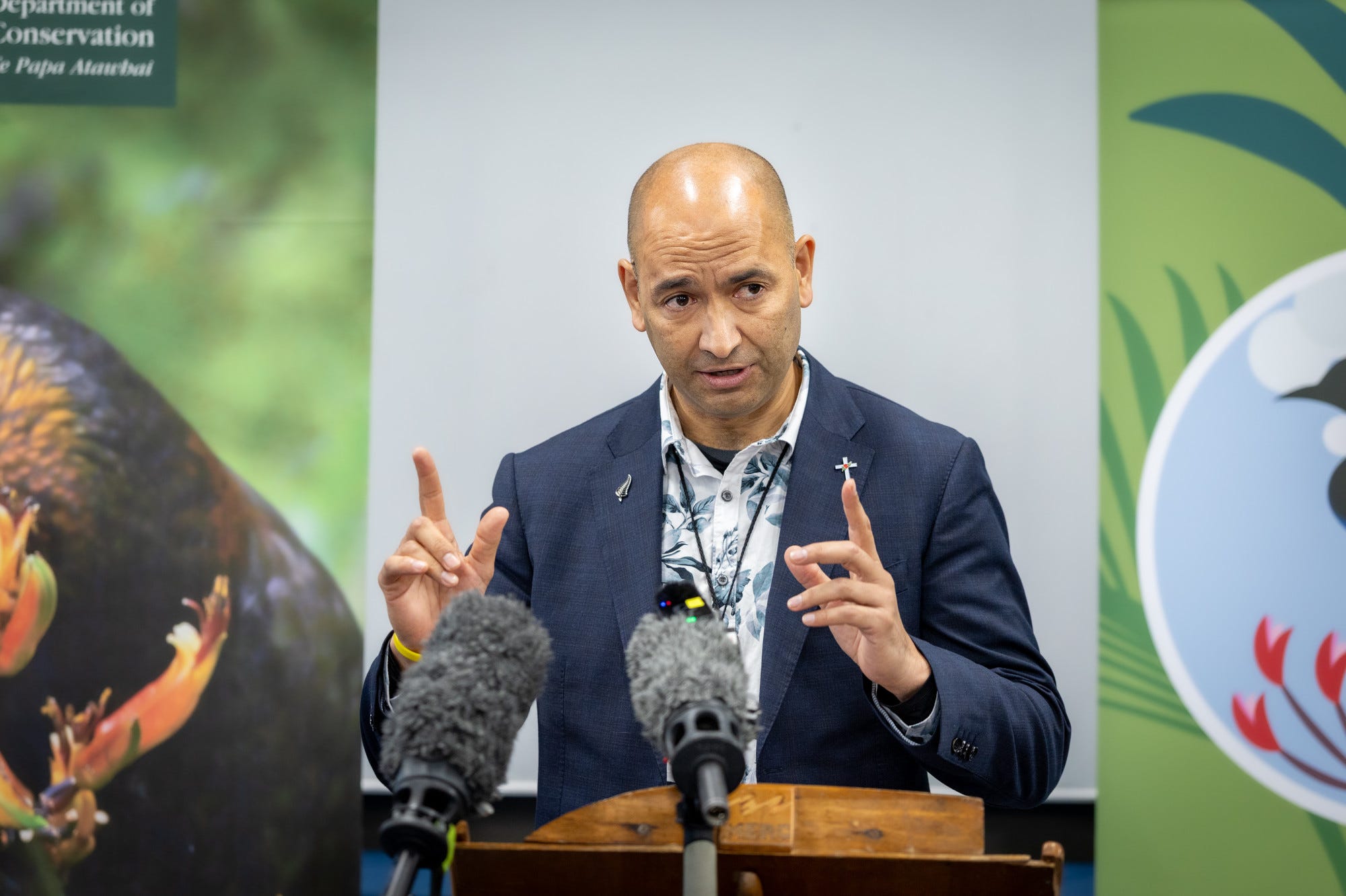
Conservation Minister Tama Potaka. Photo / Michael Craig
Much of the legislation is pretty uncontroversial. The Conservation Act is nearly 40 years old and has accumulated layer upon layer of policy statements, management plans, concession processes, and consultation requirements. Almost everyone involved with the conservation system, whether environmental groups, tourism operators, or the Department of Conservation itself, accepts it has become slow, fragmented, and unnecessarily complex. The Bill attempts to simplify that system by introducing a single National Conservation Policy Statement, streamlining concession processes, creating categories of low risk activities that can be preapproved, and allowing international visitor levies at popular sites to generate additional funding for conservation. Those changes formed the backbone of the Coalition’s case that the legislation was about modernising an outdated framework rather than weakening environmental protections.
Then came the parts everyone started fighting about.
One of its most significant changes was philosophical rather than procedural. Since 1987, the Conservation Act has been built around a relatively simple principle that the Department of Conservation exists to conserve New Zealand’s natural and historic heritage. Recreation, tourism, and commercial activities have always been permitted where they are consistent with conservation, but conservation itself has remained the overriding purpose. Hence the name.
The Bill proposed adding a new statutory function requiring DOC to recognise the economic opportunities arising from conservation land and to enable that use and development “to the greatest extent practicable” under the Act. Those 5 words did an extraordinary amount of political damage. Supporters argued this merely reflected the reality that economic activity already occurs across the conservation estate. Critics, however, argued the wording represented a fundamental change in emphasis. Rather than asking whether commercial activity was compatible with conservation, they feared the Department would increasingly be expected to actively facilitate economic development wherever it could.
Whether that concern proves justified is impossible to know. Laws are interpreted over decades by different ministers, officials, and courts. But the change was significant enough that many organisations viewed it as altering the Department’s core purpose rather than simply updating its language.
The second controversy, and the one at the heart of the backlash, centred on the rules governing the disposal and exchange of conservation land. This is where much of the public debate became confused and was the focus of much of the social media furore.
Contrary to the impression created (intentionally or unintentionally) by opponents of the Bill, conservation land can already be sold under existing law. Stewardship land may currently be disposed of where it has been assessed as having no or very low conservation value. So ministers argued they simply wanted a clearer, more consistent framework that would allow obviously unsuitable properties, such as abandoned buildings, isolated sections or surplus land, to be dealt with more efficiently so resources could be spent elsewhere more usefully.

Forest & Bird and other environmental and activist organisations looked at exactly the same provisions and reached a very different conclusion. Under the proposed legislation, thye pointed out, many more categories of conservation land would become legally eligible for consideration. National parks and several other highly protected classifications would remain excluded, but roughly 5 million hectares of the conservation estate would technically fall within the new framework. Forest & Bird illustrated this with maps showing approximately 60% of New Zealand’s conservation land potentially affected.
Ministers then accused them of misleading the public. Conservation Minister Tama Potaka repeatedly insisted there was no intention of selling 60% of the conservation estate and described suggestions to the contrary as fantasy. He pointed to examples such as the MetService building in Wellington, unused bowling greens, or derelict DOC houses as the sort of “bits and bobs” the legislation was actually intended to cover.
The difficulty for the Coalition was that they spent weeks defending themselves against a charge different to the one being levelled at them. Ministers were defending their intentions, whereas environmental groups were criticising the legal powers the bill would create. Those are not the same thing because while it is reasonable to believe that Potaka is being honest when he describes his and Cabinet’s intentions, that does not mean a future Government will not take the legal powers and use them differently. There is certainly no evidence this Government was secretly preparing a programme of widespread privatisation. But legislation does not disappear when ministers retire. Opponents may not have been primarily worried about what Tama Potaka intended to do in 2026. They were asking what a future conservation minister could legally do in 2036 or 2048.
The misalignment in perspectives proved fatal to the Coalition’s communications strategy because once the debate shifted away from ministerial assurances and towards what the legislation actually authorised, the Coalition found itself relying heavily on asking for public trust. New Zealanders were effectively being asked to accept that although Parliament would be granting more extensive statutory powers, no future government would ever choose to exercise them more aggressively than the current one intended.
The political damage became apparent remarkably quickly. Polling commissioned by Forest & Bird found almost two-thirds of voters opposed allowing conservation land to be sold, while nearly half said they would be less likely to vote for a political party supporting such a policy. Regardless of whether one accepts every aspect of Forest & Bird’s campaign, those numbers represented a flashing neon warning sign for National and its partners in an election year.
Eventually, Tama Potaka acknowledged the legislation had left many New Zealanders with the wrong impression and announced the disposal and exchange provisions would be removed altogether. This was a significant backdown. Ministers do not usually delete provisions they have spent weeks insisting were harmless unless they have concluded the political cost of keeping them outweighs any policy benefit.
Whether removing the disposal provisions settled the political argument remains to be seen, but it certainly did not settle the policy argument. The philosophical debate surrounding the Conservation Amendment Bill remains exactly where it was before Tama Potaka’s u-turn announcement.
The land sale provisions generated the headlines, but they were never the only source of concern. Many environmental organisations have continued calling for the Bill to be withdrawn entirely because they believe the more fundamental issue is the Government’s attempt to redefine the role of the Department of Conservation itself.
That centres on the proposed requirement I mentioned earlier for DOC to recognise economic opportunities and enable the use and development of conservation land “to the greatest extent practicable”. This remains, in the eyes of the environmental and activist groups, a profound shift in purpose. In their view, conservation exists precisely because some land should not be managed primarily according to its economic potential. Once Parliament directs the Department responsible for protecting conservation land to actively pursue commercial opportunities, they argue the entire culture of conservation decision making wll inevitably change.
Naturally, the Coalition strongly rejects that interpretation. Ministers point out that commercial activity has existed on conservation land for decades operating through concession processes. The Bill, they say, simply recognises that conservation and economic development are not inherently incompatible. Tourism, for example, already contributes billions of dollars to the economy while providing much of the political and financial support that conservation relies upon.
They aren’t wrong about that. It is true that New Zealand has never maintained a strict separation between conservation and commerce. DOC already manages thousands of commercial concessions many of them with iwi. The question has never been whether economic activity should occur, but where the balance should sit when conservation and commercial interests come into conflict. That balance is at the heart of this battle.
Supporters see the legislation as moving from an unnecessarily restrictive system towards a more balanced one. Opponents see exactly the same wording as moving from conservation with limited commercial activity to commercial activity constrained only by minimum conservation requirements.
People can disagree about which interpretation is more accurate, but on this matter it would be a mistake to dismiss the disagreement as simply one side spreading misinformation. Statutory language must be precise and Parliament routinely spends months debating individual words because those words shape how legislation is interpreted for decades. So critics are not irrational for paying close attention to the language in the Bill.
There are lots of political lessons to be learned from this saga. Obviously some of them relate to the drafting of the Bill, but there are also significant things to learn from the way the Potaka handled communications first around the Bill and then around the backlash.
The Coalition Government consistently argued that Forest & Bird’s maps were misleading because they implied land would actually be sold. Strictly speaking, they had a point because the maps did show land that would become legally eligible for disposal rather than land literally scheduled for disposal.
But in politics you are rarely rewarded for technical accuracy over simple messaging that can quickly shape public perception. And Forest & Bird appear to have understood something Cabinet initially failed to appreciate. Very, very few New Zealanders were going to spend their evenings reading the Conservation Amendment Bill or comparing different statutory frameworks. If they engaged with the topic at all they were going to simplify their questions down to something like: “Could this law make it easier for conservation land to be sold?” Lawyers read statutes. Voters read headlines.
And the honest answer, when boiled down, was yes. Whether ministers intended to use those powers extensively is beside the point because laws create powers and governments change.
Ministers found themselves trapped defending the Bill against much more effective communications armed only with a promise of good intentions. Every time Potaka insisted there was “no plan” to sell conservation land, critics simply replied that plans can change. Every time he talked about abandoned houses or unused bowling greens, they responded that the bill itself was not confined to abandoned houses or unused bowling greens. Potaka kept arguing about intentions while opponents kept arguing about legal capability.
The politics became even more complicated because of the Coalition’s own internal dynamics. Shane Jones entered the chat.

National has generally attempted to position itself as environmentally responsible while arguing conservation and economic growth can coexist. They supported a lot of Labour’s climate measures from Opposition and are sensitive to accusations of being anti-environmental or climate deniers. Potaka himself has consistently spoken about biodiversity, predator control, and kaitiakitanga. His political instincts also appear considerably more cautious than some of his colleagues.
New Zealand First, by contrast, has been far more explicit that conservation land should contribute more directly to economic development. Minister Shane Jones has never hidden his belief that New Zealand underutilises its natural resources and that conservation policy too often frustrates regional economic growth. Shortly after Potaka announced the disposal provisions would be removed, Jones made clear he still believed conservation land should generate greater economic returns and that his party would continue pursuing that objective.
This divergence of messaging served to prove exactly the point the opponents of the Bill were making about the powers being dangerous in someone else’s hands. The Coalition itself could not even present an entirely united position on how conservation land should be managed. Perhaps after the election the Conservation Minister might be Shane Jones they wondered in horror.
Labour and the Greens naturally saw an opportunity in all of this. Labour, pointed to the Bill as another example of the Coalition Government prioritising commercial interests over environmental protection notwithstanding eventually retreating under pressure. For the Greens, it fitted neatly into a much broader narrative linking fast-track approvals, mining policy, resource management reform, and conservation law into what they describe as a systematic weakening of environmental protections.
Environmental organisations also understood the politics well. Conservation has historically proven one of the few issues capable of mobilising voters well beyond traditional environmental constituencies. Polling shows opposition to making conservation land easier to sell extended well beyond Green voters and into the Coalition’s own support base. And with that laid bare, the political risk changed overnight.
The Government likely attempted too much in one bill. Modernising concession processes, simplifying planning documents, and introducing visitor levies were all capable of being debated on their individual merits. By combining those reforms with significant changes to DOC’s statutory purpose and broader disposal powers, ministers allowed every aspect of the legislation to become viewed through the lens of conservation land sales. It also has put at risk the changes that would have been easier to get through as pressure remains to hit pause on the Bill entirely.
Perhaps the biggest loser in all of this is not the Conservation Amendment Bill itself, but the National’s reputation. Christopher Luxon has worked hard to cultivate an image of a government that is disciplined, managerial, and focused on execution rather than ideology. Whether or not one agrees with its policies, the Coalition has generally tried to project competence and overall been successful in it. This episode punctures that image. Spending weeks insisting critics have fundamentally misunderstood a bill, only to remove the very provisions everyone was supposedly misunderstanding was an own goal. In my view it appears that ministers underestimated the political implications of what they were proposing and approached the communications and political battle very naievely.
There certainly are good ideas in this bill. The Coalition Government understand the economic challenges that New Zealand faces and display a confidence-inspiring determination to up our productivity, make us a more attractive place to do business, and generally turn the economy around. The Opposition may have won in forcing the u-turn, but they also demonstrated again that they are willing to put a lot of things before the wellbeing of our economy. They do not seem to grasp how dire things are and appear incapable of understanding that everything is tied to the economy. They frame the Government as uncaring and cold because of their focus on it, but without the ability to pay our bills we will have no welfare system, no public services, no ability to step in when disaster strikes. A healthy economy means jobs, higher wages, opportunities. We cannot keep pretending the economy is somehow separate from everything else people care about. Labour would be wise to stop sneering at the Government’s focus on these things.
It is important to acknowledge also that while the Coalition’s accusations of misinformation were not entirely fair, some of the messaging from the NGOs and Opposition parties stretched well beyond what the legislation actually established. Forest & Bird’s maps showing 60% of New Zealand’s conservation estate generated enormous attention, but they did also blur that distinction between land that could legally become eligible for disposal and land that was to be sold. Greenpeace’s warnings of shopping malls and open-cast mines replacing wilderness likewise relied on projecting seriously hyperbolic worst case scenarios that were highly unlikely to ever eventuate.
Campaign organisations across politics do this because it works. Political advocacy has never rewarded nuance, but there are ethical lines that arguably were crossed in this situation. It is fair game to point out possible outcomes, but scaremongering is unfair to the unsuspecting New Zealand public. Social media campaigns that exaggerate the risk and amplify anxieties based on outcomes that are all but impossible are irresponsible and Machiavellian.
It will be difficult to convince people that the opponents of the Bill behaved badly, however, as their tactics were extraordinarily effective. Environmental groups successfully condensed what initially appeared to be a highly technical piece of legislation into a much simpler issue that resonated emotionally with voters. They understood that emotion beats constitutional law every single time.
One of the biggest criticisms I have for National in all of this is that it should have seen this coming. The party has been here before. In 2010, John Key’s Government proposed opening parts of Schedule 4 conservation land to mining exploration. The public backlash was immediate and overwhelming with tens of thousands marching in protest. Not unlike what has happened sixteen years later in 2026, the proposal was abandoned, and National retreated. A National-led government has once again discovered that conservation occupies a unique place in the New Zealand political psyche.
That does not mean the environmental campaign was completely correct, nor that conservation law should never change. It simply means conservation carries a symbolic importance that governments ignore at their peril. It is a political lesson and a lesson on the importance of a thorough comms plan.
The episode also illustrates the delicate balancing act National faces within its coalition. As we draw nearer to the election the gloves are coming off and the coalition appears to have agreed that all is fair in love, war, and trying to win the largest slice of the coalition vote.
National may hold the finance portfolio and be the biggest party, but many of the Coalition’s economic reforms are being driven by New Zealand First and ACT, by virtue of them being considerably more comfortable than National in arguing that environmental regulation often impedes economic growth. Shane Jones has been consistently unapologetic about wanting greater economic use of conservation land, particularly where mining and regional development are concerned. He has not be afraid to admit that sometimes “Freddy the frog” is not the first consideration. National, by contrast, must appeal simultaneously to economically liberal voters, environmentally conscious suburban voters, and traditional rural conservatives. Those constituencies do not always pull in the same direction! The ol’ National Party broadchurch can really hamstring them. The Conservation Amendment Bill exposed all of these tensions publicly.
The immediate political damage is probably containable. Removing the disposal provisions has taken much of the heat out of the debate and denied opponents their most potent line of attack. Unless further controversies emerge, the issue is unlikely to dominate the remainder of the election campaign. The Bill’s opponents have been telling everyone that the disposal aspects were the biggest threat to the conservation estate ever and now they will need to pivot to say “oh and this other part of the Bill is also the worst thing ever”. They will try and they may well be successful in again simplifying the message, but it is a tough ask. New Zealanders feel like they have had a victory in forcing the backdown. Now their attention is elsewhere.
The longer term consequences are potentially more significant. While there are definitely lessons to learn, Governments often learn the wrong ones from political controversies. National could conclude that conservation reform is simply too politically dangerous to attempt. That would be unfortunate because many aspects of the current system genuinely do require modernisation. Likewise, the Opposition and environmental organisations may conclude that maximalist campaigns are always rewarded, making compromise much harder in future debates. Unfortunately, that is probably the likely outcome.
The better lesson is a simpler one. If ministers want to make significant philosophical changes to legislation, they need to explain clearly why those changes are necessary and what limits will remain. Vague assurances that ministers have no intention of using new powers aggressively are not enough. People are entitled to ask what future governments might do with the same legislation.
Controversial reform can be vital and sometimes it requires educating the public on the benefits of such action. It appears there was little planning on how to gain social license for the changes in this Bill and that is what they should do differently next time. It is a huge error to not be prepared for the inevitable pushback from opponents.
The irony of all of this is that the select committee process has worked almost exactly as it was designed to, even if ministers would prefer their bills to sail through. A controversial bill was introduced and thousands of New Zealanders engaged with it. Interest groups highlighted provisions they believed were problematic and the Government listened, at least in part, and amended its position before the legislation progressed further. Funnily enough, that is not evidence of a broken democratic system, but of one functioning as intended.
Whether the remaining provisions strike the right balance between conservation and economic development will continue to be debated. But one thing is already clear. Whatever else the Conservation Amendment Bill achieves, it has reminded every political party: mess with conservation estate at your own risk.
Ani O'Brien comes from a digital marketing background, she has been heavily involved in women's rights advocacy and is a founding council member of the Free Speech Union. This article was originally published on Ani's Substack Site and is published here with kind permission.


6 comments:
They lost the argument because they wrote bad legislation. They’re not the party of competency.
Potaka is viewed as untrustworthy and an advocate of co-governance. National is not now nor has it ever been a party interested in protecting the environment.
"The Opposition may have won in forcing the u-turn, but they also demonstrated again that they are willing to put a lot of things before the wellbeing of our economy."
Trashing the environment = no economy.
I'd put the environment before the economy every time.
Forest and Bird did a poll that found two thirds of Kiwis opposed the idea. We’ll, well, well, what a surprise!
Thanks for another insightful analysis Ani. And you are right that the select committee process worked almost exactly as it was designed to. What the Government should have done was modify the wording to address the concerns, not remove the offending provisions entirely. But just a suggestion for you, which I notice has been echoed in a number responses to your posts recently. You missed a few words out of your punchline. It should have read "Lawyers read statutes and Ani O'Brien commentaries. Voters read headlines."
Anon is right, if we don’t have an environment we don’t have an economy. Such a fundamental. Don’t sell the goose that lays the golden egg, any kid who has read fairy tales can tell you that. Shame it didn’t translate to Dumbxon and Co.
Post a Comment
Thank you for joining the discussion. Breaking Views welcomes respectful contributions that enrich the debate. Please ensure your comments are not defamatory, derogatory or disruptive. We appreciate your cooperation.