

Political momentum is one of the most powerful forces in politics. Voters are heavily influenced by ‘social proof’ which is the psychological phenomenon where people copy the actions of others to validate their own behaviour. People want to support parties that appear viable and relevant. Therefore, a party that is constantly discussed in the media acquires a kind of legitimacy simply through repetition. People hear its leader interviewed, see its policies analysed, watch journalists speculate about its prospects, and begin to regard it as a serious political force. This creates a self-fulfilling prophecy where media attention generates awareness, awareness generates support (or opposition), support (or opposition) generates further media attention, and the party gains momentum.
On the other hand, a party that is ignored will struggle to break out of obscurity regardless of the quality of its ideas. So if two parties begin in the same position, both polling below 1%, but one receives regular favourable coverage while the other is largely iced out by the news, it would be surprising if their trajectories remained identical. The former benefits from a continual stream of free publicity and legitimacy, while the latter remains invisible to most voters.
In politics, momentum is often less about persuading people that a party is right than persuading them that it matters. Once voters believe a party is going somewhere, many are inclined to help push it along.
In politics, momentum is often less about persuading people that a party is right than persuading them that it matters. Once voters believe a party is going somewhere, many are inclined to help push it along.
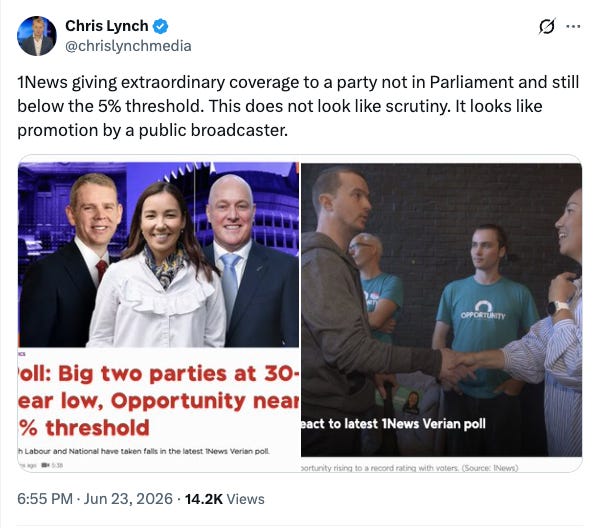
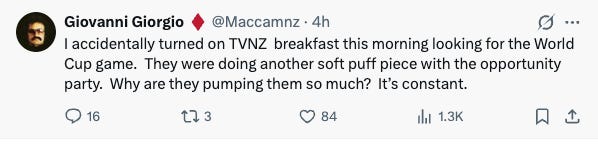
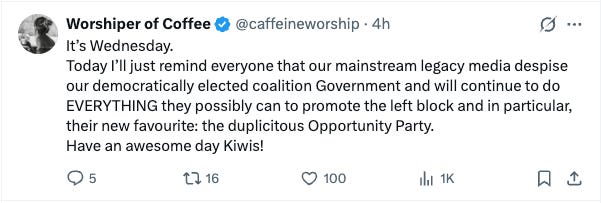
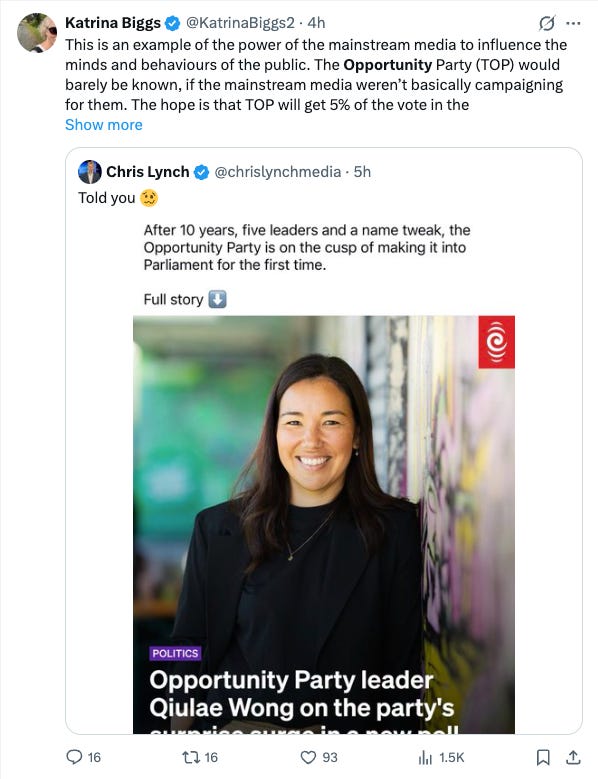
That is why I, and others such as independent journalist Chris Lynch, have expressed frustration at the incredible amount of coverage the Opportunity Party has received this year. Minor parties occasionally enjoy polling surges based on events like leadership changes or publicity stunts. Journalists would be negligent if they ignored smaller parties (as they do virtually all other the others), but the media have a peculiar enthusiasm for the possibility of an Opportunity Party breakthrough.
The extensive media coverage that has preceded Opportunity’s recent surge in the polls appeared to arrive out of nowhere given until recently, its numbers should have seen it dismissed as electorally irrelevant. And perhaps this would not be notable except that New Zealand has seen a number of minor parties spend years hovering in the same 1-3% range without attracting anything like the same level of sustained coverage. The New Conservatives (previously the Conservative Party) are perhaps the most obvious example. Despite polling in a similar range to Opportunity for much of their existence, they have consistently struggled to secure any serious mainstream attention and are treated as a fringe movement rather than a plausible parliamentary contender. This is with the exception of the extensive coverage more than a decade ago of then-leader Colin Craig’s personal matters.
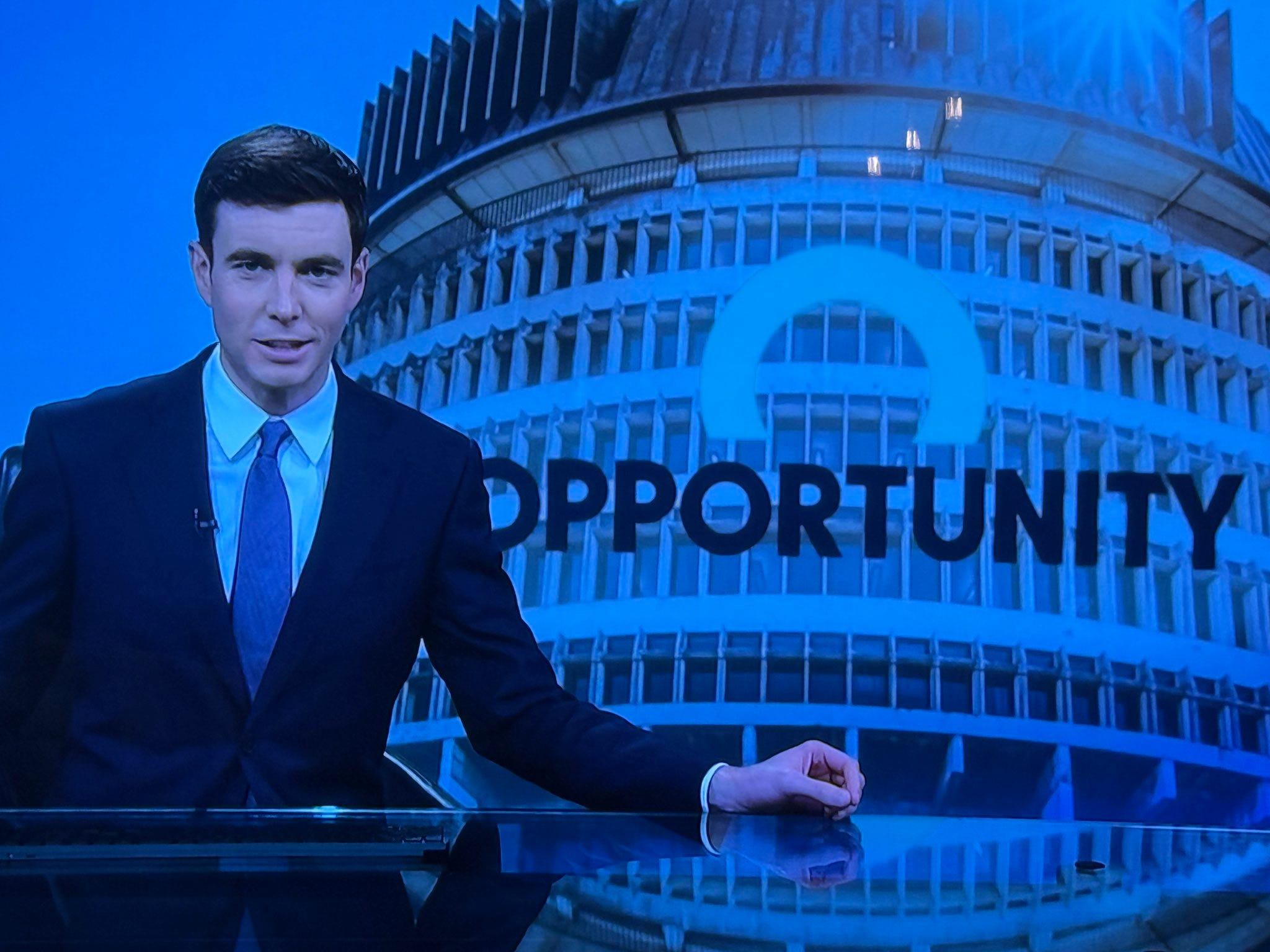
Part of the reason for this selective coverage likely lies in the demographics and cultural positioning of the people working in the media. Opportunity’s support base is concentrated among urban, university-educated professionals which is a demographic that overlaps significantly with the social and educational background of many journalists, editors, and political commentators. By contrast, the New Conservatives draw support from religious voters, social conservatives, and provincial communities that at this point are practically extinct in New Zealand’s media institutions.
Bias need not be conscious or coordinated. People are naturally more interested in political movements they understand, encounter in their social circles, or regard as being within the bounds of respectable debate. However, journalists and editors do have a responsibility to monitor their own biases and actively pursue balance, and in this they fail miserably. In this case the result is that Opportunity is often discussed as an intriguing political option, while conservative minor parties are framed through the lens of culture wars, controversy, or protest politics.
Narrative is a huge part of this too. Political journalism and the way we engage with politics is driven as much by stories as by statistics and policy. More probably. For years, Opportunity has offered a compelling storyline as a policy-heavy, technocratic party that many commentators believe deserves greater success than it has achieved. Fourth time lucky, the possibility that Opportunity might finally break through after taking a run at three elections is an attractive political story.
Click to view
Click to view
There is a saying that ‘all publicity is good publicity’ and there is a reason that is an enduring phrase. Negative publicity can indeed be better than no publicity especially if people who distrust the media perceive the coverage as unfair. However, there is definitely some negative reporting everyone wants to avoid, and luckily for Opportunity it doesn’t have to worry about that. The type of coverage it is receiving is stellar. Uncritical. Top notch. The kind of stuff you can’t even pay for.
Even when the party were barely polling above 1% journalists were discussing coalition scenarios, analysing its voter base, profiling its leadership, and debating whether it can cross the 5% threshold. Did we see this modelling for any other 1% party? Under MMP, ‘social proof’ and perceptions of viability are enormously important. Many voters are reluctant to support a minor party they believe has no chance of entering Parliament. But, once media coverage begins to signal that a party is a serious contender, that perception can change rapidly.
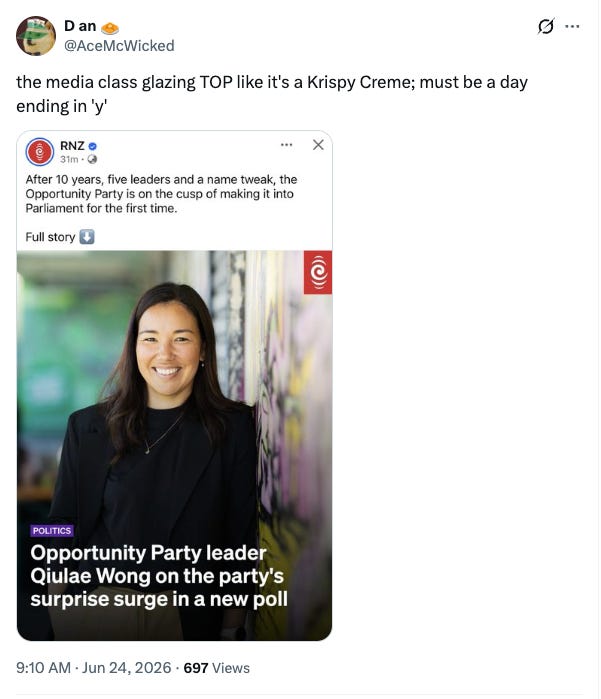
TOP/Opportunity Party has existed for very nearly a decade and during that time it has failed to enter Parliament, failed to win an electorate seat, cycled through five leaders, rebranded itself repeatedly, and spent most of its existence hovering somewhere between political irrelevance and political obscurity. Where are the reflective pieces about why its core proposition has failed to resonate with voters? Instead, with every minuscule increase in support another round of speculation that this is finally the moment when New Zealand voters will recognise the party’s latent genius seems to be triggered.
Reading some of the coverage this year, one gets the impression not merely that Opportunity might enter Parliament, but that its arrival is something we should all be thrilled about. Never mind that some of its most high profile policies could be more fairly classified far-left than many of the conservative-lite policies of the New Conservatives could be classified as far-right. Opportunity are long-term advocates for a universal basic income, are proposing a Land Value Tax, and have recently called for public transport to be entirely free. And yet, they are being sold as centrist and an option for the centre-right (when it suits).
Rather than examining the Opportunity Party’s policies in the same way political journalists should examine those of any party seeking parliamentary representation, the media has focused its attention on simply the prospect of the party’s success. Readers have been treated to stories asking whether Opportunity is the election’s “dark horse”, whether it could become a “kingmaker”, whether leader Qiulae Wong has “discovered the formula” previous leaders missed, and whether this might finally be the year the party “breaks through”. Is it not unsurprising that after so many articles explaining that Opportunity is on the verge of something significant, some readers may eventually conclude that Opportunity must indeed be on the verge of something significant?
The lack of critical analysis is particularly obvious when one looks at how the party’s ideological positioning is discussed. The Opportunity Party is routinely described as “centrist”, so much that the label has now acquired the status of an established fact. Journalists apparently haven’t felt any obligation to explain why the label applies or whether it accurately reflects the party’s policy platform. Opportunity says it is centrist. Therefore Opportunity is centrist.
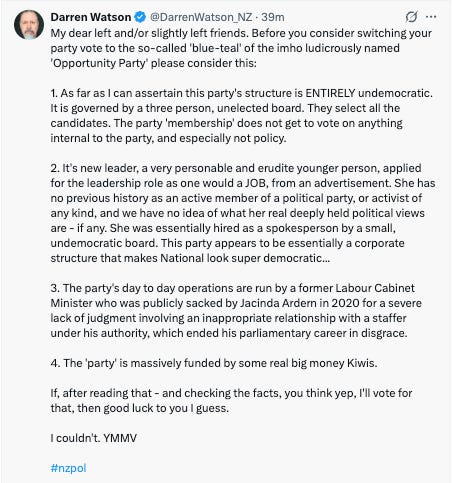
Journalists have not grappled with the fact that this unlikely to be true while the party is calling for socialised public transport, proposing universal pocket money for all, sneering at women’s rights, and running a roster full of Green-esque candidates. Its General Manager is former Labour minister, and business partner of Toni Grace (Chris Hipkins’ fiance), Iain Lees-Galloway. And one of the authors of He Puapua is a key candidate for the party goodness sake.

Iain Lees-Galloway and Toni Grace. Photo: David Unwin / Stuff
This is the document that advocates a profound constitutional transformation based on Māori self-determination and separate spheres of authority, drawing heavily on the Matike Mai framework. It advocates for an order radically different from the one New Zealanders currently recognise, including separate Māori governance institutions and significantly expanded Māori authority over public decision-making. It also calls for substantially expanded Māori rights and authority over land, freshwater, coastal resources, and other natural resources.
They want us to believe that the author of He Puapua can form a coalition with David Seymour and Winston Peters. The Opportunity Party, readers are told, could work with National. The Opportunity Party could work with Labour. The Opportunity Party could work with anyone. It is the Switzerland of New Zealand politics.
Well, I call bulldust (to borrow a Winstonism). Opportunity will not be in a centre-right coalition. The whole purpose of this “centrist” schtick is to trick any environmentally-minded National voters to switch their votes to Opportunity. When push comes to shove they can only work with the left and the media know it because this week’s poll 1News poll was reported as a win for the left bloc and, low and behold, Opportunity’s numbers were included that bloc creating the sufficient boost.

The difficulty is that while you can trade on flashy branding and sleight of hand in an election, coalition negotiations are ultimately where it becomes about policy. When the chips have fallen and negotiations begin, Opportunity will have to sell their policies like everyone else to potential partners.
National and ACT generally campaign on lower taxes, reducing regulation, constraining government spending and limiting the growth of the state. Opportunity’s flagship proposals involve new taxes, substantial redistribution, and a much more activist role for government in directing economic outcomes. These are major points of disagreement that reflect fundamentally different assumptions about how society should be organised. None of this means cooperation would be impossible. MMP regularly produces strange political marriages. But it does suggest the matter deserves more scrutiny than simply accepting Opportunity’s preferred self-description and moving on. I realise that Qiulae Wong suffers from the delusion that humans can change sex, but I hope she realises she cannot identify her way into Parliament.
New Zealanders would no doubt benefit from examining Opportunity’s major policy proposals as well. They might find them appealing or appalling, but they should have the information to make that choice. Take the land tax, for example. Whatever one’s view of the idea, a tax of that scale would represent one of the most significant changes to New Zealand’s tax system in decades. It would affect homeowners, investors, retirees, businesses and local property markets. It would create winners and losers, and provoke fierce arguments about wealth, incentives, fairness, and property rights. It is the kind of proposal that political journalists are normally expected to pull apart from every conceivable angle.
Click to view - caption...
Instead we get another profile of Qiulae Wong with about as much useful information as a Woman’s Day puff piece. If we are exposed to any of her policies they are delivered more like an intriguing TED Talk rather than focused on the practical and political consequences of implementation. One is often left with the impression that the primary question is simply whether the idea is clever rather than whether voters would accept it, if it would work as intended, and who would bear the costs.
When parties on the centre-right propose structural reforms, journalists tend to move rapidly from the advocates’ claims to the objections. Stakeholders who can be relied upon to smackdown anything National, Act, or New Zealand First propose are interviewed. Critics on speed dial are consulted. Economists are asked to get out the fine toothed comb, and every teeny tiny grammatical error gets the third degree. I personally have no problem with this level of scrutiny… so long as it is applied consistently across the political parties.
None of this is a conspiracy. Conspiracy is almost always the least persuasive explanation because it attributes to journalists a level of coordination they rarely display. As I said earlier, a much simpler explanation is that the Opportunity Party is, in many respects, exactly the kind of party that appeals to a large portion of the professional class from which modern journalism is drawn. It is urban, socially progressive, highly educated, technocratic, and fond of describing itself as “evidence-based”. For a lot of journalists, Opportunity feels like the party they'd invent if they were allowed to design one themselves. It offers reform without populism, idealism without revolution, and progressivism without some of the more eccentric features that have made the Greens difficult for many voters to embrace. Journalists do not need to consciously favour Opportunity for this affinity to shape the tone of their coverage. They may not notice at all.
Click to view
This kind of unconscious familiarity bias means some political parties are primarily covered through the lens of controversy, conflict, and risk while others are covered through the lens of possibility, potential, and promise. These framings, narratives, and outlooks do not merely describe political reality, they construct it.
If Opportunity is genuinely on the verge of entering Parliament, none of this should worry its supporters. Serious political parties are supposed to be capable of enduring hostile questioning. They are supposed to have their assumptions challenged and their policies tested. That is not a barrier to political legitimacy. In fact, it should be one of the things that creates legitimacy in the first place. That’s why it sometimes feels as though sections of the media have skipped directly to imagining Opportunity’s success before completing the more mundane task of interrogating whether its ideas deserve it.
After ten years of false starts, leadership changes, relaunches, and electoral disappointments, this may be the election that sees Opportunity finally make it into Parliament. If they do, I have zero doubt that they will align with Greens, Labour, and the fragments remaining of Te Pāti Māori. They are a more palatable and polished Green Party with better business acumen and an honest media would reflect that so that voters who are inclined toward that kind of politics are informed they have options. Instead I suspect we will be served more of the promotional slop that desperately tries to create an alternative kingmaker because the media loathe the influence of New Zealand First.
Ani O'Brien comes from a digital marketing background, she has been heavily involved in women's rights advocacy and is a founding council member of the Free Speech Union. This article was originally published on Ani's Substack Site and is published here with kind permission.


13 comments:
The woke political movement aka progressives, not to be confused with a genuine workers traditional left Labour type party of yesteryear, do politics far better than the alternatives. They tirelessly, like rust, never stop angling and manipulating and lying.
Knowing the hateful racists in TPM were politically radioactive, (but embraced by Labour Green), a new tactic was called for. Enter Ian Lees Galloway and TOP.
TOP are the Hezbollah to Iran, a proxy professional females version of Labour and the Greens, a friendlier innocent face promulgating the blue eyed rainbows and unicorns delusion that the other two do without the abysmal track record of Labour's incompetence or the sheer madness of the increasingly Marxist Greens.
It's seriously smart politics. Ian Lee's Galloway is not there by accident, he's there to ensure the religious causes that bind the woke together, of climate catastrophe, kindness to crime, massive interference in ordinary people's lives, trans rights, no gender, intersectionality, Maori everything, anti car, anti business nirvana can flourish.
The make on this overpriced university grads EV is nothing more than badge engineering.
And facing off this genuine threat to the future of NZ, dividing Aotearoa into segregated unequal races and ending democracy is an 80 year old man, ACT who by association to National are losing the room and a Labour lite National led by the wrong person who is so hopelessly far out of his depth, that the political disintegration is as excruciating to watch as any unfolding airliner crash ever was.
Between the progressives political nous and Christopher Luxon, the woke are becoming odds on to win in 2026.
And do not forget TPM who will be quietly there with them all the way.
It seems that the nz people are being played. I smell a giant rat. There are lot of red flags. The first one is that labour has no policies except the free stuff that is not free. Second, ardern is selling her house in nz before the elections take place. Third, the greens moved their wealth tax from 2 million to 10 million to avoid losing votes. This was announced around the same time as the rise of the opportunity party with a polished PR jacinda-type leader who wants a wealth tax on your family home. None of them talk about the maori stuff to the public, but all of them have full on he puapua plans if you look up their websites.
Mmp means give and take on policy hipkins will say. My opinion is that they are all one in the same party.
I notice more and more Top articles on msm, all with a positive spin portraying them as centrist, which is how the party wants to spin it. Pro-LabGreenTPM see 5pc for Top as a way to remove the government. If Top was a party deemed a new ''far right'' there would be articles and opinion pieces spun as cause for concern and warning bells and opinions interwoven from monitors of the ''far right''. Top will appeal to those who may not own a house or land and may be young who feel like hitting out at someone to blame...I have nothing so stuff you. You say you worked for it, don't give me that bull you screwed everyone over.
It doesn’t surprise me that our corrupt and left leaning MSM is working the room promoting this far left party.
Interesting development in Australia along different lines but reflects the trendy liberals...we have many Nats like this which is why Luxon will not move formly on Maori radical issues:
A ''new'' party...touchy, feely, like Top to dent the socalled ''right'' (actually centre) vote
Quote
Two independent Australian MPs have banded together to launch a new centrist political party which they say is a response to an increasingly divisive landscape.
The Community Strong Australia party - launched in Canberra on Thursday - will offer "unity over division and reason over rage", will have no leader and will allow members to vote freely, rather than along party lines.
Its two members - Sydney MPs Zali Steggall and Allegra Spender - are from a group of independent MPs known as "teals" who share socially liberal values and want greater climate action.
The party will offer an "alternate political force" to the current two-party system in Australia, the pair said.
Two days ago the New Zealand Herald refused to publish a comment I made on a story they ran on TOP. They clearly took issue at my observation that the redistributionist taxation policies of TOP were Marxist and therefore dangerous. The Marxist bit was a fact, widely commented on elsewhere. The dangerous bit was certainly opinion, but surely that's the whole point of making comments. What else is the Herald suppressing? What are they afraid of?
Well said Pete.
Has anybody done any digging into Qiulae Wong's background yet?
Darren Watson's included contribution was interesting from the viewpoint of the required "legals" for a political party public operation.
Surely this viewpoint has to be absolutely defined by an Electoral commission expert or similar as correct or not before this TEAL waste of votes is further enabled to continue.
We don't want/need a repeat of the Te Pati sham.
TOP are a breath of fresh air and a policy based party. Glad to have them here. You can tell the right wing are scared whenever they go after the media, huh?
What a banal comment Anon 12.52. I darsay the Nazis were a policy based party too. So which of TOPS policies do you approve of and why?
Jones Boy I’m not answering to your demands. Who do you think you are? You won’t even put your real name. Are you a leftist plant, mayhap?
Jonesy a LEFTIST plant?!? :-))
Well he can’t be a real person. No one but a comic book villain writes like that.
Post a Comment
Thank you for joining the discussion. Breaking Views welcomes respectful contributions that enrich the debate. Please ensure your comments are not defamatory, derogatory or disruptive. We appreciate your cooperation.