

In a week full of controversy, Green candidate for Waiariki, Tania Waikato, drew attention by posting photographs of scantily clad Māori men and women (including herself) alongside information about enrolling and switching electoral rolls. She calls it the “bikini baddies and buff bros” campaign, the media calls it a thirst trap, and I call it a red flag for the Green Party. I am not sure they have room for an ego of Waikato’s size in their caucus.

The Greens’ response to Waikato’s approach was tentative with Marama Davidson saying it was “not my cup of tea” and Chlöe Swarbrick calling it unconventional but accepting that politics now operates in a “brave new world”. Shane Jones naturally spotted the double standard with Labour and the Greens having spent the previous week denouncing his “kneepads” remark, yet a Green candidate is now explicitly using sexualised imagery as an electoral tool.
Waikato’s campaign was not even the Greens’ only brand-related drama. Tamatha Paul had to remove her “Tametallica” campaign range after questions were raised about its resemblance to Metallica’s logo. Chlöe Swarbrick had already modelled the shirt at Paul’s campaign launch before it disappeared from the website, along with Edmonds Cookbook-inspired material.
On policy, Winston Peters announced that New Zealand First wants to restore employment to the Reserve Bank’s mandate, describing its removal under the current Government as a “dead rat” the party had been forced to swallow. National believes the Reserve Bank should have one clear job of controlling inflation. But Labour’s finance spokesperson Barbara Edmonds said the party was seriously considering restoring the dual mandate too.
The media’s favourite party, Opportunity, was ruled out as a coaltion partner by National and Chris Hipkins then declared there was “no way” Labour would support Opportunity’s tax policy either, but he stopped short of ruling out working with the party altogether.
Opportunity responded by releasing a candidate list of 40 people and continuing to insist it could work across the political spectrum. It clearly wants to present itself as a centrist, but its flagship policies have turned off both sides of politics.
National’s proposal to make paid parental leave more flexible is one of the campaign’s more sensible policies. Rather than increasing spending, it simply allows parents to divide the existing entitlement in the way that best suits their family.
Former National MP Harete Hipango-Brownlie, is campaigning for New Zealand First and calling on conservative Māori to “come out in strength and force”. She accused National of abandoning its core values and becoming globalist.
Far North Councillor Davina Smolders will stand as an ACT Party list-only candidate, bringing her advocacy for local democracy, property rights, and free expression from local government into the national political arena.
Offence, outrage, and Winston Peters
During some parliamentary sparring with Green MP Lawrence Xu-Nan, Winston Peters said “I know you just came here five minutes ago. Go back to your own country.”
Labour and the Greens have called for Peters to be sacked as Foreign Minister. National campaign chair Simeon Brown called the remark racist, while Christopher Luxon initially described it as attention-seeking before later agreeing it had caused huge offence. Peters dismissed the criticism and insisted he had been defending New Zealand democracy.
While the remarks no doubt did offend a number of New Zealanders, the outrage machine is pretty disingenuous when it couldn’t be bothered spluttering to life when in the not so distant past other MPs have engaged in similar behaviour. Just the other day Tamatha Paul gave a speech that was full of contempt and derision for the English language callling it a “bastard”. Her Green Party co-leader also infamously blamed all violent crime on “white cis men”. While former Te Pāti Māori MP Mariamenno Kapa Kingi openly denegrates white New Zealanders in the House and Takuta Ferris took to social media to complain that “ethnics” were campaigning for Labour in the Tamaki Makaurau byelection. He pointed out the Indians and Asians in Labour’s photos and said the main parties were using multiculturalism against Māori. A bit further back Labour has the notorious “Chinese sounding names” saga blackening their scorecard.
Polls: New Zealand’s astonishingly short memory
A leaked Taxpayers’ Union-Curia electorate poll this week shows Chlöe Swarbrick is in real danger of losing Auckland Central.
The poll covered about 400 voters over the past week. Once undecided voters are excluded, National’s Candace Kinser leads on 30%, Swarbrick sits on 25%, and Labour’s Naisi Chen is only one point behind her on 24%. The raw figures contain a sizeable 22% undecided vote.
The Greens will inevitably respond by warning Labour supporters that voting for Naisi Chen risks National coming through the middle. But Labour voters may ask themselves why they should continue donating an electorate to the leader of a rival party, when they believe they have a credible candidate of their own.
I suspect we'll be hearing a lot more about Auckland Central before November.
The more consequential polling this week, however, came from Ipsos. Apparently three years is now sufficient time for national amnesia to set in.
The July Issues Monitor surveyed 1002 New Zealanders and asked them to identify the country’s most important problems and which parties they considered best able to manage them.
The cost of living remained the dominant concern, selected by 62% of respondents. Healthcare and hospitals followed on 38%, the economy on 34%, housing on 22%, and unemployment on 20%. Labour was judged the party most capable of managing all five.
National will be very concerned to see Labour overtake them on the economy. Labour rose from 28% in May to 34% in July, while National fell from 33% to 30%. Labour was considered best placed on 15 of the top 20 issues and National led outright on only crime and law and order.
The Government is clearly failing to persuade people that conditions are improving, and in politics perception becomes reality. But Labour being seen as the answer to the economic damage is an extraordinary triumph of short term memory over lived experience.
Remember, Labour presided over an explosion in government spending, entrenched enormous structural deficits, helped fuel domestic inflation, expanded the bureaucracy, buried businesses under regulation, and left the incoming Government with deteriorating books and public services that somehow consumed more money while delivering less.
Labour will say it was dealing with a pandemic and global inflation. Fair enough. But so was everyone else.
Equally, National can't dine out forever on blaming Labour. Governments are elected to fix problems, not merely conduct guided tours of the wreckage. After nearly three years, voters expect visible results. National has failed to make the contrast vivid enough.
New Zealanders have notoriously short political memories. We tire of one government, replace it, become frustrated that the clean up is slow, and then begin romanticising the people responsible for the original mess.
When a union becomes an election campaign
The Public Service Association is openly campaigning to remove the Government.
There is zero subtlty about its slogan. It isn’t “protect public services”, “defend fair pay”, or “stop the cuts”. It is literally “change the Government”. The postcards they printed with this message on them reportedly carried the promoter statement required for election advertising, were distributed through public service workplaces, and urged voters to throw out the elected administration on 7 November.
In response, Public Service Commissioner Sir Brian Roche says this is plainly inconsistent with the political neutrality expected inside government agencies.
The PSA insists the campaign is an exercise of free expression and up to a point, it is. Public servants do not surrender their political rights when they accept a government salary. They may join political parties, attend rallies, criticise ministers, campaign in their private capacity, and vote however they please. A union is also entitled to tell its members that government policy threatens their jobs, wages, or conditions. It may email them, hold meetings, produce analysis and encourage them to participate politically in their own time.
But none of that is the same as turning public hospitals, ministries, and service centres into campaign distribution networks. A patient arriving at a hospital for treatment should not be confronted with material telling them to vote out the Government. A member of the public entering a government department should not encounter election slogans displayed in a building funded by taxpayers of every political persuasion.
The distinction ain’t complicated. Communicating privately with members is legitimate union activity. Bombarding members of the public who are trying to access government services isn’t.
The PSA appears to understand this distinction when forced to confront it. Its revised advice tells members that postcards should not be displayed anywhere open to the public. Members are also told not to use workplace resources for election activity and to conceal work identification when attending rallies.
There are also important questions about how far the PSA has departed from industrial representation into party-political activism. Its national secretary has now stated explicitly that the union wants “to change the Government to one that properly values a public service” and is urging voters to do so at the election.
Campaigns are expensive and the PSA is engaged in a considerable one. How much of their union dues are being spent on election advertising, campaign design, printing, organisers, legal advice, political communications, and staff time devoted to removing the Government? Compare that to how much is being spent representing individual members in disciplinary cases, negotiating pay, protecting employment rights, and resolving workplace grievances? Are members able to opt out of financing electoral campaigning?
Unions have always engaged in politics because employment law, public spending, and workplace regulation are political decisions. But there is a difference between advocating for policies and functioning as an undeclared campaign arm for the the Labour Party.
The biggest employment law shake up in years
The Employment Leave Bill has passed its third reading and will replace the Holidays Act 2003. Most provisions will take effect two years after Royal Assent, with employers given a further year to update employment agreements. However, some parental leave changes will begin on 1 July 2027.
Under the new legislation, annual and sick leave will accrue in hours from the first day of employment at 0.0769 hours for each standard hour worked, equivalent to four weeks a year for someone with stable hours. Sick leave will accrue at 0.0385 hours per standard hour, up to a maximum balance of 160 hours. But bereavement and family violence leave will also be available from the first day of work.
Part time workers will receive sick leave in proportion to their standard hours rather than the current flat entitlement of 10 days a year. A worker on 20 hours a week will accrue about 40 hours of sick leave annually, while a worker on 40 hours will accrue about 80 hours.
Employees will also be able to request payment for up to 25% of their annual leave balance each year.
The plot thickens at the FMA
The drama at the Financial Markets Authority now looks a lot worse than a simple dispute over political neutrality. Former chair Craig Stobo was subjected to an expansive investigation after three board members went to the minister with a collection of allegations. The review examined rumours about an allegedly inappropriate relationship with a former staff member, his self-funded trip to Estonia, travel requests, a potential conflict involving a mortgage company, media commentary, and his personal submission supporting the Treaty Principles Bill. But most of the allegations went absolutely nowhere.
Wendy Aldred KC found no evidence of an inappropriate relationship between Stobo and former FMA employee Kyla Bottriell. She found no evidence that he had directed or approved coercion of another staff member. His travel applications were not inappropriate and he had properly disclosed his Indi directorship. But in the end, the report ultimately concluded that his political commentary was sufficient on its own to justify his removal.
The process itself was a bit of a shambles as when the investigation began, there was no formal written complaint or record of the board’s concerns. They had been communicated verbally and expressed broadly. Aldred had to request a written summary setting out what Stobo was actually accused of.
Stobo’s public comments were supportive of the coalition and critical of the previous Labour Government and this was portrayed as a political neutrality issue. But the treatment of his Treaty Principles Bill submission went further with the report finding that his personal submission contradicted the FMA’s board-approved Māori strategy and was therefore made “at the expense of the FMA’s interests”.
It is largely accepted that Stobo had ruffled feathers by being an unusually hands on chair and pushing to improve the regulator’s performance and after internal opposition emerged, virtually every available line of attack was assembled to take him down.
The most serious rumour about an alleged affair was comprehensively rejected and Kyla Bottriell has said false and damaging claims about her were allowed to circulate within the FMA and reach the media. She said she had raised concerns through proper channels about the regulator’s culture, internal rumour spreading, leaking and lack of accountability. Those issues remained unaddressed.
Now the person at the centre of the FMA’s executive leadership is herself on leave. Chief executive Samantha Barrass has stepped aside while the board urgently considers allegations about bullying, psychological safety, and wider cultural problems. Multiple current and former employees have reportedly raised concerns with the Government’s Chief Victim Adviser Ruth Money, who escalated them to the relevant authorities.
Former employees have alleged bullying involving some of the organisation’s most senior staff, a culture of fear, retaliation against people who spoke up and reliance on non-disclosure agreements to keep dissatisfied employees quiet. During the year to June 2025, 77 employees left, including ten senior leaders.
The FMA demanded that Craig Stobo be judged against exacting standards of conduct, institutional loyalty, and public confidence. Those same standards must now be applied to the people who judged him.
🇪🇸 Europe's border crisis explodes
In the space of roughly 24 hours, between 49,000 and 60,000 (numbers changing rapidly) people crossed illegally from Morocco into the Spanish enclave of Ceuta. For a city of just 84,000 residents, the influx was almost unmanagable and Spain deployed the military. Spain’s own pro-mass migration Prime Minister, Pedro Sánchez, described the crossing as “an attack” on Spain’s territorial integrity. European leaders have also demanded emergency action.
The images of the invasion are all over X but largely missing from legacy media. They expose the uncomfortable truth that these are not refugees fleeing an active war zone. The overwhelming majority of those making the crossing were young Moroccan men seeking entry into the European Union. It was a mass illegal border crossing into Europe.
Once people gain access to the European Union migrant system, they are not only welcomed in, but also aided to get where they want to go. the consequences are no longer confined to Spain. European Commission President Ursula von der Leyen said that Europe “cannot allow anyone to come to our Union without abiding by our rules.”
🇬🇧 Three women do not simply have simultaneous heart attacks
Moving to the migrant crisis set in the English channel, three women were found unconscious on an overcrowded Channel boat. All three died and the narrative being reported ias that they had all suffered heart attacks. That explanation is basically a statistical impossibility. The probability would be roughly one in three quintillion.
The more credible possibilities are that they may have been crushed or suffocated in an overcrowded dinghy, have inhaled something toxic, been trapped beneath other passengers, suffered severe hypoxia, or been exposed to extreme physical violence. And because all three dead passengers were women on a vessel overwhelmingly occupied by men, controlled by criminal smugglers, and because these things have happened before, sexual assault and homicide must be considered. There is already extensive evidence that women moving along illegal migration routes are raped, trafficked, assaulted, and coerced.
Astonishingly, the rest of the passengers on the boat reportedly declined assistance and the boat was permitted to continue towards Britain. Around 75 people were subsequently taken to Dover, where authorities said they would be questioned and the vessel examined.
Has Simeon Brown personally offended Andrea Vance?
Did Simeon Brown accidentally reverse over Andrea Vance’s pot plants? Insult her mother? Because at this point it feels less like she is trying to complete a side quest to destroy the Health minister.
Over the space of a week we’ve had article after article after article devoted to Simeon Brown’s ministerial appointments. What makes it particularly entertaining is the standard apparently being applied. Every acquaintance, meeting, previous employer, shared office, coffee, phone call, or passing interaction is presented as another piece of the great conspiracy board connecting Simeon Brown to... people who generally agree with government policy.
None of this is to say ministers shouldn’t be scrutinised. Of course they should. But scrutiny should apply a consistent standard and if appointing someone who shares your governing philosophy is scandalous today, then where were the front pages cataloguing Labour’s appointments of former ministers, union leaders, ideological allies, and activists to Crown boards over the previous six years?
The latest instalment centres on Sharon Brownie, the Government’s Nursing Council chair, and a three year old Kenyan employment judgment in which she was found to have privately compared her executive assistant to a bullfrog. Yes. A bullfrog.
Apparently this was worthy of another front-page political exposé. At this rate, I fully expect tomorrow’s exclusive to reveal that one of Simeon Brown’s appointees once failed to return a library book in 1998 or accidentally called someone “mate” in a passive aggressive tone.

Behind the curtain of a NZ media scandal
Ani O’Brien 30 Jul
Read full story
🇺🇸 COVID isn't finished with politics
COVID returned to the political agenda this week both here and in the United States, but in very different ways. Here at home, the Coalition Government formally responded to the Royal Commission into New Zealand’s COVID-19 response, accepting all 63 recommendations either in full, in principle, or in part. The most significant change is a commitment that, in any future pandemic, the official advice underpinning major decisions affecting New Zealanders’ rights must be proactively released within five working days. That may sound like an administrative tweak, but it represents a profound philosophical shift. The new approach recognises that transparency isn’t an optional extra during emergencies. It is essential to maintaining public trust.
The Government also accepted recommendations that emergency financial support should be “timely, temporary and targeted”, reflecting criticism that much of the COVID Response and Recovery Fund extended well beyond immediate pandemic needs.
While New Zealand debates how to improve future decision making, the United States has been interrogating its COVID Tsar. Dr Anthony Fauci appeared before a Senate committee this week after being subpoenaed by Senator Rand Paul. Rather than answering questions, Fauci invoked his Fifth Amendment right against self-incrimination throughout the hearing on the advice of his lawyers. His decision followed the release of more than 1,100 pages of Fauci’s work diary, which, according to Health Secretary Robert F. Kennedy Jr., consisted of government records created on a government computer during official duties rather than private personal journals
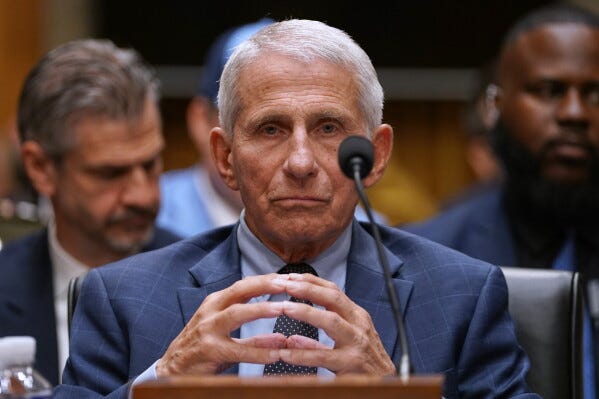
The diaries paint a more personal picture of a man who had become one of the most recognisable public officials in the world. While recording daily death tolls and case numbers, Fauci frequently reflected on his media profile. He described front page profiles in The Washington Post as “very flattering”, wrote that his national and international fame was “explosive and really unimaginable”, and claimed it was “not hyperbole” to say he had become “the most famous and talked about person in the country and one of the most recognisable people in the world.” In another entry, written while cases continued to soar, he noted that “the press is going wild with me” before listing major newspaper profiles and television appearances. These observations sit uncomfortably alongside pages recording mounting death tolls.
When will New Zealand take sexual offending seriously?
I cannot stomach the judicial leniency shown to sexual predators in New Zealander any longer. We cannot go on tolerating the indifference to victims’ suffering and the mollycoddling of sexual criminals by the judiciary.
Open Justice reported this week that a Waikato father recorded himself sexually abusing his 5 year old daughter, produced further material from the recordings, and offered to create more for an overseas contact. Police also found hundreds of images and dozens of videos on his phone. His sentence was just 3 years and 10 months in prison after discounts reduced it from a starting point of 5 and a half years. He will likely not serve even close to all of that sentence.
Another example is Michael Sullivan who possessed thousands of child exploitation images, including material involving toddlers and infants and received 12 months of home detention and 100 hours of community work.
The notorious case from a few years ago was Jayden Meyer who was convicted of raping 4 15 year old girls and sexually violating another. A psychologist assessed him as presenting a medium risk of reoffending and said he continued to minimise the harm he had caused. He outrageously received 9 months of home detention.
The High Court later described that sentence as manifestly inadequate and said the process had undermined public confidence. Yet an appeal to change it was declined. Meyer was subsequently convicted of sexually violating another 15 year old girl on the night he was released on bail for the earlier offending.
Then there is Laken Maree Rose, who is a man repeatedly refered to as a woman by our media and convicted of extensive sexual offending against girls aged as young as three. The original judge described the case as almost unprecedented in scale and gravity. However, the Court of Appeal reduced Rose’s sentence by six years, from 19 years and five months to 13 years and five months, and removed the minimum non-parole period.
Sentencing judgments carefully examine the offender’s age, mental health, upbringing, remorse, guilty plea, rehabilitation prospects, coercion, and personal hardship. And while the damage to victims is acknowledged, sometimes movingly, it appears wholly disconnected from the sentencing process.
Rehabilitation is important. I am certainly not disputing that. But it's only one purpose of sentencing. The law is also meant to provide accountability, denunciation, deterrence, and protection of the community.
New Zealand has a sexual violence problem. It also has a sentencing credibility problem. The public is repeatedly told that these offences are among the most serious imaginable, only to watch courts work methodically backwards from that conclusion through discounts until the punishment is a slap on the wrist. New Zealand sex offenders can get home detention for crimes that would land them a life sentence in the United States.
In short - other stuff that happened
- Officials have discovered a further $6 million in costs linked to MBIE’s failed Biometric Capability Upgrade, taking known spending beyond the previously disclosed $33 million. MBIE says it still cannot confirm the project’s full cost and has commissioned an independent financial audit.
- 🇺🇸 Donald Trump announced that Hamas has agreed in principle to a phased ceasefire plan that includes disarmament, the withdrawal of Israeli forces from Gaza, deployment of an international security force and the establishment of a technocratic Palestinian administration. Hamas officials described the agreement as the result of months of negotiations and key details, including the surrender of Hamas' heavy weapons and tunnel network, are yet to be completed.
- Parliament has passed the most significant overhaul of New Zealand's firearms laws in more than 40 years, creating an independent firearms regulator separate from Police, introducing tougher restrictions on gang members, new offences and penalties, and a range of changes aimed at simplifying compliance for licensed firearms owners.
- The Waitangi Tribunal has found the government's proposed reforms to Treaty clauses across 19 Acts would breach multiple Treaty principles, cause significant prejudice to Māori, and further damage the Māori–Crown relationship. Justice Minister Paul Goldsmith said the government does not accept the Tribunal's conclusions.
- Zoe Hobbs made history by winning New Zealand's first ever Commonwealth Games women's 100m gold, with an Oceania record and personal best of 10.93 seconds.
- Eliza McCartney won pole vault gold at the Commonwealth Games.
- Police have launched a Mass Allegation Investigation into alleged historical sexual abuse involving a 63 year old man, who has been charged with four counts of unlawful sexual connection with a male aged 12–16 and three counts of indecent assault relating to two other complainants. The alleged offending occurred in Christchurch between 1996–1998 and 2003–2005, and police believe there may be additional victims.
- The government has appointed Byron Pepper as Deputy Chair of the Reserve Bank Board for a 4 year term. Pepper has served on the Board since 2022 and chairs the Reserve Bank’s Financial Policy Committee.
- A 53 year old early childhood teacher has been charged with making an intimate visual recording after a recording device was discovered in a staff bathroom at a Mount Maunganui childcare centre. Police say no children appear in the recordings, but the teacher has agreed not to teach while the case proceeds and is due to reappear in the Tauranga District Court on 3 August.
- An SPCA investigation is underway into the death of a 3 year old spoodle at Dog Manners, an Auckland dog daycare, after the dog died from internal bleeding caused by significant blunt force trauma. Former employees have alleged repeated animal abuse by the owner and raised concerns about the deaths of three other dogs at the facility.
- The Crown has been given until 30 September to decide whether it will retry David Tamihere after the Supreme Court quashed his 1990 murder convictions for the deaths of Swedish tourists Heidi Paakkonen and Sven Urban Höglin.
- New Zealand added two more track cycling medals in Glasgow, with Devon Briggs winning gold in the men’s C1-C3 1000m time trial, while Sami Donnelly claimed silver in the women’s scratch race.
- David Liti claimed New Zealand's fifth gold medal of the Commonwealth Games, producing a dramatic final 223kg clean and jerk to finish with a Games record total of 389kg. The victory gives Liti a third consecutive Commonwealth Games medal.
The media's fascination with the Opportunity Party continues unashamedly. TOP continues to attract a remarkable amount of editorial attention and little of it can be described as critical. As journalist Chris Lynch wryly observed, one Herald interview with the party’s leader was followed up with a political panel featuring the deputy leader's own mother, well-known public relations consultant Deborah Pead. Pead denies involvement with the party, but deputy leader Daniel Eb has previously acknowledged Pead was involved in the party's early development. This could explain the cosy ecosystem of political reporting, commentary, and campaign promotion.

Click to view
Ani O'Brien comes from a digital marketing background, she has been heavily involved in women's rights advocacy and is a founding council member of the Free Speech Union. This article was originally published on Ani's Substack Site and is published here with kind permission.


11 comments:
Ani saying that it is totally fine and normal, to have an octogenarian foreign minister happily using the 100% non-racist phrase “go back to your own country”.
Excellent, as usual. Thank you for your weekly reports.
In the political sphere, Lian Danns article this Sunday in the NZ Herald is interesting, not for his analysis into Nationals woes, but for the sheer avoidance of why Luxon and National are tanking.
He solely blames the economy and yes its a factor, and had he of written this a decade back, he'd be right.
But he, like the legacy media, will not even think about race relations. They ignore it. Like a child walking through a room of people with their eyes closed pretending they aren't there, Dann did just that with Maorification. Never heard of it.
Nationals BAU with their mirroring of Labour's Maori first policy, apart from the most egregious obvious parts, is killing National politically.
Because National is so woke currently, they are being dragged kicking and screaming to change anything race related until it's too late.
Think non voting rights on councils, think ideological indoctrination in the Medical Council, etc, etc.
Only when the stench is so overwhelming does National belatedly, reluctantly and so half heartedly act. And it's cost them dearly.
Dann's article was surreal. A real demonstration of how deluded our old media are and how substantial problems are simply not spoken of or to be spoken of.
Is this why trust is so low in them?
Pete as a fellow politics wonk I’m sure you read the Ipsos survey results this week, and took into account the headline issues that the overwhelming majority of kiwis are concerned about. When you did, you would have seen the top five leap off the page - bear in mind, these cross economic, age, and political demographics:
1. Cost of Living
2. Healthcare
3. The economy
4. Housing
5. Unemployment
The coalition’s division policies including gutting over a dozen pieces of legislation of Treaty references (against advice spending to it providing only negative outcomes) has seen race relations move up to 13th most concerning.
And interestingly, the 1000-strong survey has Labour as the most trusted party to handle 15 of 20 top issues.
What did you think when you saw all of that, Pete?
My days were so much longer and less worrying before I discovered Ani. Does she find time to sleep?
@ 9:22 AM. Does Ipsos even ask the question on Maorification? Or even have a category for it? I very much doubt it. Its a taboo subject but I know Nat voters who went with them based on their policy platforms last election on race relations are resentful and going over you NZF. That is not in relation to the economy. Its a real issue. Just not a politically correct one.
@ 9.22. That a train wreck like Labour are seen more capable with the economy is in part reflective of Nationals inability to translate words into action, and for that I blame their fiddling while Rome burns timidity and the Trump factor.
But Labour are extreme incompetence in waiting.
I lived in the UK for many years. I lost count of the number of times I was told "Why dont you go back to your own country?" I dont think it was racist, they just didnt like anything that was different. PS Now that I have come back, I wish I hadnt!
Pete the survey didn’t cover made-up concepts, only real ones.
Anon 1203 why did you follow their orders? Were they bigger or stronger than you?
Anon 2-52pm. Only in your dreams
Post a Comment
Thank you for joining the discussion. Breaking Views welcomes respectful contributions that enrich the debate. Please ensure your comments are not defamatory, derogatory or disruptive. We appreciate your cooperation.