

Labour released its party list this week and the overwhelming impression is one of continuity rather than change. The top of the list is dominated by the same figures who led Labour through its last term in government. Chris Hipkins, Carmel Sepuloni, Barbara Edmonds, Willie Jackson, Megan Woods, Ayesha Verrall and Willow-Jean Prime all remain firmly entrenched. There are a few notable promotions in Vanushi Walters and Cushla Tangaere-Manuel, but voters looking for a dramatic changing of the guard will struggle to find one.
However, Superintendent Rakesh Naidoo’s placement at number 13 effectively guarantees him a seat and represents one of the boldest recruitment moves Labour has made in years. Chris Flatt, the long-serving head of the Dairy Workers Union, lands at number 20 and serves as a reminder of Labour’s traditional union roots. Number 26 is Sophie Handford whose background in climate activism and local government makes her look more like a Green Party candidate who wandered into the wrong conference.
Perhaps the most surprising ranking belongs to Craig Renney. The Council of Trade Unions economist has spent years building a profile as one of Labour’s most prominent economic voices and many expected him to get a fast-track into Parliament. Instead, he is all the way down at number 51, effectively being told that if he wants a seat he will need to win it himself.
Another person who has reason to feel aggrieved is Greg O’Connor who has disappeared from the list altogether. He compared Labour’s list selection process to choosing the Pope, suggesting the Vatican may actually be more transparent.
Read my full review of the Labour List here.
Perhaps the most surprising ranking belongs to Craig Renney. The Council of Trade Unions economist has spent years building a profile as one of Labour’s most prominent economic voices and many expected him to get a fast-track into Parliament. Instead, he is all the way down at number 51, effectively being told that if he wants a seat he will need to win it himself.
Another person who has reason to feel aggrieved is Greg O’Connor who has disappeared from the list altogether. He compared Labour’s list selection process to choosing the Pope, suggesting the Vatican may actually be more transparent.
Read my full review of the Labour List here.
Rakesh Naidoo kept candidacy a secret
The most serious controversy from Labour’s list was not a ranking as such, but the decision by Superintendent Rakesh Naidoo to keep his candidacy secret from the NZ Police. The rules are clear. Employees intending to seek election must advise their District Commander or Director “at the earliest opportunity”. Employees at or above the level of Director or District Commander must advise the Commissioner. Naidoo is a very senior police officer as New Zealand Police’s Ethnic, Iwi and Communities National Partnerships Manager, with access to sensitive briefings and regular contact with ministers.
Chris Hipkins has since admitted Labour had been talking to Naidoo for several months, but says the formal selection process was deliberately shortened so Naidoo could make a final decision late in the piece. That is supposed to be reassuring, but it is not. It actually makes it sound very much like Labour and Naidoo thought they’d found a clever little workaround so he could avoid having to tell Police until the last possible moment.
The rule says “earliest opportunity”, not “once the list ranking is confirmed”, or “once Chris Hipkins has decided the timing is convenient”. The whole point of early disclosure is to allow Police to manage conflicts before they become a problem. Had Naidoo told the Commissioner when serious conversations began, Police could have adjusted his duties, limited his access to sensitive material, and protected both his right to stand and the political neutrality of the force.
Instead, the Police Commissioner and Police Minister were blindsided. Mark Mitchell says Naidoo had recently been in sensitive briefings on public safety and government policy, and had attended events with him the day before Labour’s announcement. As a result, Commissioner Richard Chambers has ordered a review to ensure there was no sharing of privileged information. In response, Chris Hipkins has accused him of not being a good employer.
This is not about whether Naidoo is entitled or fit to stand for Parliament. With the exception of the handling of this situation he seems to be very well regarded. But public confidence in Police neutrality is very important, and senior officers are held to a higher standard for a reason.
The BSA picks its final hill
In what may be one of its last acts, the Broadcasting Standards Authority has decided to insert itself directly into one more contentious issue. The BSA upheld a complaint against Newstalk ZB over an exchange between Barry Soper and Heather du Plessis-Allan about former Green MP Benjamin Doyle around 9 months ago. The Authority found the comments breached discrimination and denigration standards and, more significantly, the industry body decided that non-binary people are a protected section of the community under the broadcasting discrimination standard.
Soper’s comments were pretty benign. He just rattled off a bunch of pronouns including “it”. It is ridiculous that he should be punished for struggling to use counterintuitive pronouns live on air. Doyle is a man. He is a father. He looks like a bloke, but sometimes wears a skirt or a lacy collar. A decade ago, nobody had heard of non-binary identities. The prevailing view was that men and women could behave however they liked without ceasing to be men and women.
In any case, Soper’s wife chastised him saying he was “literally just being a boomer right now” and accusing him of having a “senior moment”. But this was not sufficient for the BSA, the unelected broadcasting regulator decided, in its dying days, to wade in boots and all into the fraught and contested legal and political space of gender identity.
In defending its broadcasters, NZME correctly argued that gender identity is not expressly covered by the Human Rights Act’s prohibited grounds. However, the BSA decided otherwise, relying on interpretations from the Human Rights Commission and a dated Crown Law opinion rather than a clear ruling from Parliament or the courts. How convenient.
In news that is totally unrelated, Heather du Plessis-Allan has been one of the more prominent media voices arguing the BSA has outlived its usefulness. She called it “a relic of a bygone era”, criticised its attempted expansion into online broadcasting, and welcomed Paul Goldsmith’s move to scrap it. Now, quite coincidentally of course, the BSA has ordered Newstalk ZB to broadcast a statement censuring her show, on a Friday, during drive time, with the wording approved by the Authority first. She should refuse.
Nothing to see here. Just a dying regulator, using its remaining time on earth to police speech, expand the reach of identity politics, and remind everyone why it is being abolished.
Election 2026: minor parties are running the conversation
Election year moved up a gear this week, with Labour finally coughing up a policy, New Zealand First sharpening its elbows, and the latest Taxpayers’ Union-Curia poll showing the Government still holding on to power.
Labour’s big offering was a public transport fare cap of $20 a week in Auckland, Wellington and Christchurch, and $10 elsewhere. It is being sold as cost-of-living relief, but it is really another taxpayer-funded treat for a narrow group of mostly urban public transport users. Even Hipkins admitted at Fieldays that the policy “won’t help farmers”, which was at least honest. Read more about Labour’s transport policy.
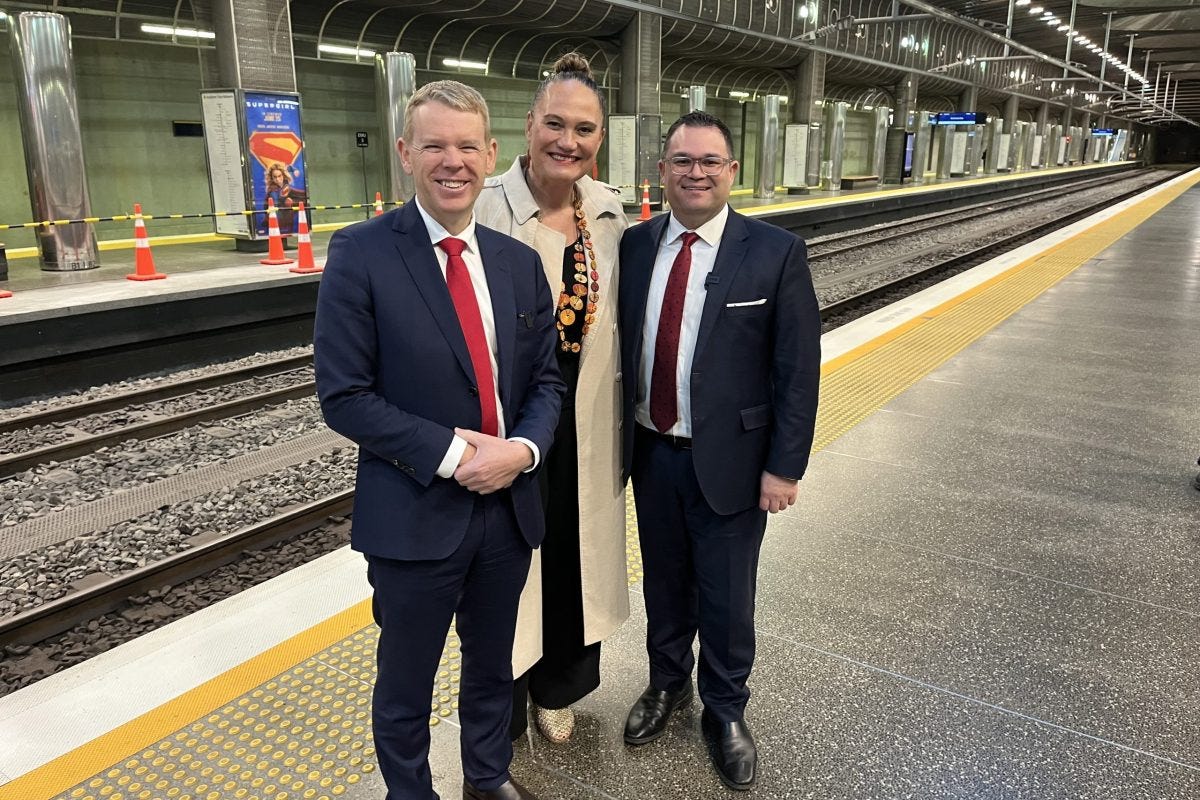
Photo credit: Tim Murphy
The polling remains tight with Labour sitting just ahead of National, but the current coalition would still scrape back with 62 seats to the opposition bloc’s 58. In the preferred Prime Minister numbers Luxon and Hipkins both dropped, while Winston Peters climbed to 12.8%, only 6 points behind Luxon.
Peters’ performance at Fieldays pulled no punches. He attacked National over climate targets, questioned the Government’s rates cap policy, and openly talked about pulling New Zealand out of the Paris Agreement. His message to farmers was clear as can be that although they might habitually vote National, if they want someone to actually fight for them, they should take out a bit of Winston-shaped insurance.
National had fun pointing to the empty patch of grass where Labour’s Fieldays stall was reportedly meant to be, while Hipkins insisted Labour had deliberately chosen to walk around rather than sit behind a table. Maybe… But announcing an urban public transport subsidy in Fieldays week, then admitting it will not help farmers, was not a particularly bright move.
All said and done, the election is not going to be the traditional National vs Labour contest. They may still be the largest parties, but both are under pressure from minor parties. Winston, Seymour, Swarbrick, and even TOP are making life very difficult for the legacy parties.
A sad farewell to Mark Cameron
ACT MP Mark Cameron has announced he will not return to Parliament after the election. Cameron has kidney failure and is now on dialysis three days a week. He had hoped to return to Parliament after a kidney transplant, but heart failure late last year took him off the donor list and left him, in his own words, in a “purgatory of unknown”.
Mark Cameron arrived in Parliament as a Northland farmer and remained, very obviously, a Northland farmer. He spoke plainly, cared deeply about rural New Zealand, and never seemed especially interested in smoothing off his edges for Wellington. Good job.
His advocacy for rural mental health after losing his son to suicide in 2024 has been admirable. He has continued to speak about the isolation of rural men, the long hours, the distance from help, and the need for mental health spending to actually reach the communities that need it.
I wish him and his family peace, strength, and better days ahead.
The problem with calling everyone fringe
One of the more amusing pieces of election coverage this week was Newsroom’s profile of NZ First candidate Elliot Ikilei. The article repeatedly frames his views as “fringe” and claims New Zealand First are aligned with figures such as Donald Trump, Nigel Farage and Pauline Hanson and this is evidence of political extremism.
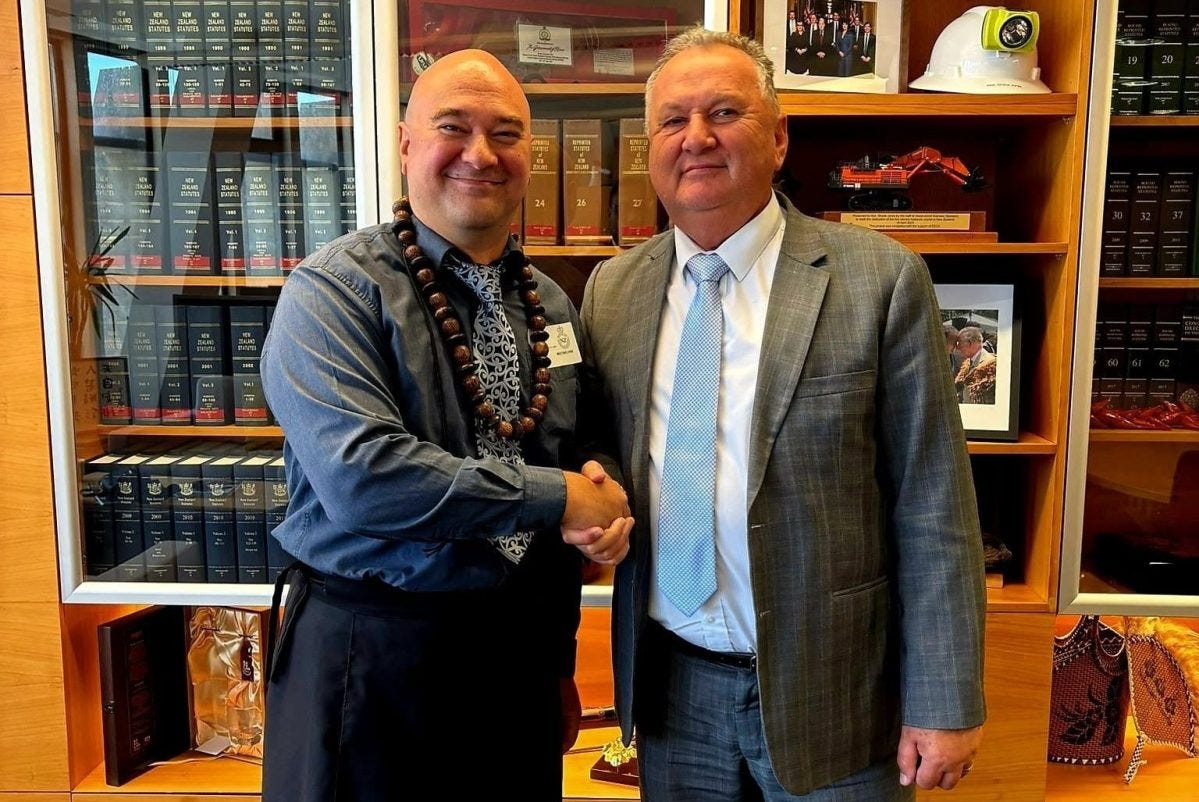
There is just one problem with that analysis… these are not fringe political figures.
Now you may personally not like them, but Donald Trump won both the presidency and the popular vote, Nigel Farage’s Reform UK is currently leading in many British polls, and Pauline Hanson’s One Nation is leading polls in Australia. Whatever you think of these politicians, describing them as fringe requires ignoring the fact that they are popular and growing.
This is a case where a particular set of views was declared beyond the pale by journalists, academics, and professional political commentators, only for millions of ordinary voters to turn up and support them anyway. Rather than questioning whether they might have misunderstood public sentiment, the conclusion is often that the voters themselves have somehow gone wrong. They are all racist, deplorable, fringe, far right, extremist, phobics.
The article’s tone drips with disapproval. Readers are told to sneer at criticism of gender ideology, race-based policies, mass immigration, globalisation and climate alarmism as unacceptable obsessions. Yet these are precisely the issues driving political realignment across much of the Western world. Voters are increasingly rejecting the consensus that the media would like to uphold.
What comes across most strongly in the article is not concern about populism but discomfort with democracy playing out against their interests. Their core belief seems to be that sensible, educated people have already settled these questions and that anyone disagreeing must be misinformed, manipulated, or angry.
It is not notable that a candidate for NZ First supports successful parties and politicians from overseas. But it is incredible that large sections of the political and media establishment still seem incapable of not hating the wider populous.
🇬🇧 Belfast, beheading, and the media’s favourite villain
The attack was genuinely shocking, the reaction not so much. Video footage appeared online showing a Sudanese refugee repeatedly stabbing a local Belfast man in the head, face and neck in what numerous witnesses described as an attempted beheading. The victim, Stephen Ogilvie, suffered catastrophic injuries, including the loss of an eye. His assailant arrived in the United Kingdom in 2023 after travelling through multiple countries and had been granted refugee status and leave to remain until 2028.
Reasonable people can disagree about immigration levels, asylum policy, and exact border controls. But it should not be controversial for ordinary citizens to be horrified when somebody who was allowed into their country as a refugee commits an act of such extreme violence. Yet almost immediately, much of the discussion shifted away from the victim and the brutal attack, and towards the familiar bogeyman… the “far right”.
Of course I do not condone riots and innocent people should not have their homes attacked, businesses vandalised, nor should families be terrorised because of their ethnicity or nationality. But it is unbelievable how quickly many journalists, politicians and commentators seemed more interested in calling the riots far right than in understanding the anger that preceded them.
Reading coverage from outlets such as RNZ, the BBC and others, one could be forgiven for thinking that the central story was not a refugee butchering a man in the street. No no no, the central story was that people reacted badly to it.
But people are not angry because Tommy Robinson told them to be angry. They are angry because they can see what is happening around them and they are sick of being told that concerns about immigration are irrational and racist. Most people are perfectly capable of distinguishing between law-abiding migrants who contribute positively to society and individuals who abuse the opportunities they have been given by committing serious violent and sexual crimes.
🇬🇧 UK Labour's Defence Crisis
If the Belfast riots exposed a crisis of public confidence, the resignations from the top of Britain’s defence establishment revealed a crisis of confidence within government itself. This week Defence Secretary John Healey resigned, followed by Armed Forces Minister Al Carns and Defence PPS Pamela Nash. These departures were accompanied by remarkably blunt letters accusing the Government of failing to take national security seriously enough.
Healey’s resignation letter argued that Britain faces its most dangerous security environment in decades yet the Government has failed to provide the resources necessary to meet the challenge. He warned that the Defence Investment Plan “falls well short of what is required for defence and the country at this dangerous time” and accused the Prime Minister of being unable to commit the funding needed to protect the nation.
Decorated former Royal Marine Al Carns wrote that Britain was asking its Armed Forces to operate in a more dangerous world on a budget designed for a calmer one. “A serious country funds its defence to meet the threat it actually faces, not the threat it wishes it faced,” he said.
In all three resignation letters are further frustrations about drift, indecision, and a government that appears incapable of courage and action. Carns spoke of public confidence weakening, politics becoming performative, and working people feeling increasingly insecure about the future. Pamela Nash pointed to Labour’s recent electoral setbacks and warned that government successes were being drowned out by mistakes and a failure to be bold.
Journalist Robert Peston described Healey’s departure as potentially the most serious crisis of Starmer’s premiership because it combined two devastating accusations at once. First, that the Prime Minister is failing to keep the country safe and, second, that he lacked the authority to impose difficult decisions on his own Cabinet. The implication was that if a Prime Minister cannot persuade colleagues to find savings for what his Defence Secretary considers a national security necessity, how much authority does he really possess?
Need for speed: Speedy Gonzales Davidson
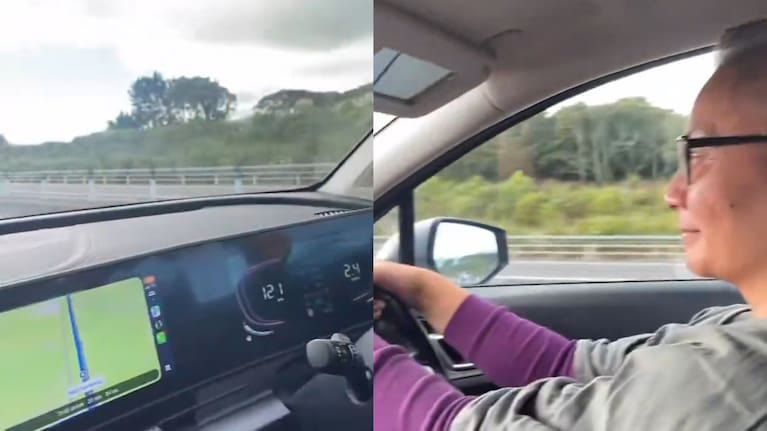
Greens co-leader Marama Davidson was accidentally dobbed in for speeding this week by her own colleague. Davidson apologised after fellow Green MP Hūhana Lyndon posted an Instagram video of the pair driving to a tangi (funeral). Unfortunately for Davidson, the video helpfully included the dashboard, revealing she was travelling at 121km/h on the Kāpiti Expressway. The footage was later deleted, but by then the internet had already done its thing.
Being caught doing 11km/h over the limit is hardly the crime of the century and she owned the mistake, apologised promptly, and moved on. However, it is a tad awkward given how fiercely the Greens have opposed the Government’s moves to reverse some of Labour’s blanket speed limit reductions. The party has repeatedly accused the Government of putting lives at risk by raising speed limits.
QEII funding gets the political treatment and everyone wants credit
Fieldays week kicked off with an announcement from National that they will permanently double funding for the QEII National Trust from around $4.2 million to $8.5 million a year if re-elected. For nearly 50 years the Trust has worked with private landowners to place covenants over native bush, wetlands, dunes and other ecologically significant areas, protecting them in perpetuity while allowing the land to remain in private ownership. More than 5,000 covenants now protect around 180,000 hectares across the country.
Every government dollar invested through QEII is matched many times over by landowners themselves through fencing, pest control, planting, weed management and ongoing maintenance. The Prime Minister says as far as conservation policies go, it is hard to find one that delivers better value for money.
The announcement also triggered another outbreak of political credit-claiming. ACT had a press release out the door before Luxon had finished speaking, explaining that this was really Mark Cameron’s idea all along and that National had nicked an ACT policy. To be fair, Cameron has been a champion of voluntary conservation and private property-based environmental protection. There were also rumours that Labour was preparing a similar QEII funding commitment of its own, but National managed to get there first.
🇬🇧 The mysterious case of John Edwards
Former New Zealand Privacy Commissioner John Edwards has been stripped of his responsibilities as UK Information Commissioner while a workplace investigation is underway. But the details remain unclear. Edwards first “voluntarily” stepped aside in February over what he described as HR matters. The ICO has since said an investigation found there is a “case to answer”, and he has now been cut off from his duties while the process continues. He reportedly remains on his £200,000 salary.
New Zealanders who remember Edwards’ time as Privacy Commissioner here will not be entirely shocked by drama following him around. He cultivated a reputation as an outspoken, combative regulator, particularly online. He called Facebook “morally bankrupt pathological liars”, accused it of enabling genocide, and then later deleted the comments. The Ardern Government reportedly asked him to dial down the rhetoric.
But anyone who was on Twitter in the earlier days will also remember Edwards as an aggressive participant in the gender identity debate. He had a trans-identifying child and used his privileged position as Privacy Commissioner to weigh in publicly on one of the most contested political issues in the country. In 2019 he wrote a Spinoff article arguing that transgender self-identification was a human right, defending the ability to change one’s sex on official documents by statutory declaration, and dismissing many women’s concerns about single-sex spaces.
Official Information Act material shows the article was handled through his Privacy Commission office, discussed with staff, edited, pitched to media, and then internally defended with talking points once the backlash arrived. He was supposed to be an independent statutory officer, not a taxpayer-funded activist columnist using the authority of his office to intervene in political issues outside his remit.
None of that tells us what has happened in the UK. Everyone is remaining tight lipped. But it does place this latest controversy in context. Edwards has long blurred the line between regulator and campaigner, public servant and online combatant.
In short - other stuff that happened
- Chris Hipkins defended using an MP superannuation scheme (subsidised by taxpayers at $2.50 for every dollar he contributes) to help pay off the mortgage on his beach house, insisting that “ultimately, it’s my money”. The Labour leader also argued there was nothing inconsistent about channelling retirement savings into beachfront property while simultaneously warning New Zealanders that too much capital is tied up in housing.
- A former male Olympian has resigned from North Harbour Hockey after an independent review into allegations of inappropriate relationships with female players, while another male worker faces court on multiple indecent assault charges involving two young women.
- Midwife Corrina Parata has been suspended for a year after admitting she diverted more than $100,000 in maternity funding intended for her employer into her own accounts, claiming she had convinced herself she could build an alternative maternity service on the East Coast.
- After spending 18 months fighting to keep his identity secret, multimillionaire entrepreneur Adam Harris has been named as the businessman acquitted of family violence and strangulation charges. Harris argued publicity could damage both his business and his identical twin brother’s reputation.
- Antonia Watson is stepping down as ANZ New Zealand chief executive after nearly seven years in the top job, kissing goodbye a $3.08 million pay packet. She'll hand the reins to chief risk officer Ben Kelleher.
- 🇦🇺 One of Australia’s most wanted fugitives has been arrested on a Greek farm after spending 27 years hiding from a murder charge linked to a fatal Sydney nightclub stabbing in 1999. James Dalamangas lived under an alias for nearly two decades before a routine police check unravelled the quiet life he’d built.
- The Government is preparing a crackdown on Run It Straight after officials warned that a game involving two people sprinting headfirst into each other for prize money might have "fatal consequences" and carries concussion risks comparable to car crashes.
- A Wellington commuter train managed to miss the station, take the wrong track, and plough into a concrete stop block, leaving six people injured and the Johnsonville Line shut for a week. Investigators are trawling through CCTV, train data and witness accounts to work out how a routine journey ended with a derailed carriage.
- Police say a year-long operation targeting a Tribesmen and Head Hunters-linked meth network has led to 14 arrests, 34 search warrants, the seizure of drugs, cash and 9 firearms, and the discovery of a loaded pistol hidden in a backpack in a child’s bedroom. Investigators also claim gang members were deliberately getting single mothers addicted to meth before pressuring them into dealing, describing the practice as a way to “entrap and enslave” vulnerable people.
- 🇪🇸 Spain’s socialist government has found itself starring in a political thriller after a party operative nicknamed “the plumber” was accused of offering jobs, cash and favours to prosecutors and witnesses in exchange for dirt on investigators probing Prime Minister Pedro Sánchez’s inner circle. Sánchez’s wife, brother, former ministers and party officials all tangled in separate corruption cases.
- Duncan Garner has admitted he "got it wrong" after being convicted of driving while suspended, telling the court he genuinely believed his 3 month demerit-point suspension had expired when police pulled him over in central Auckland. The veteran broadcaster was found to have resumed driving 12 days too early, resulting in a 6 month disqualification and a $300 donation to St John.
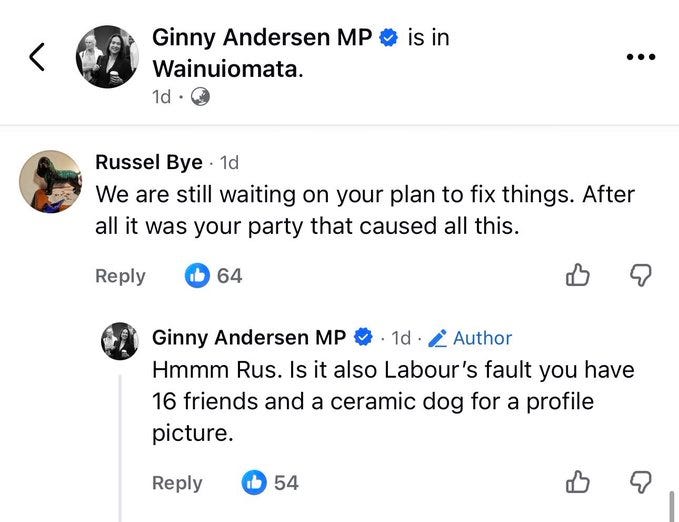
This response from Labour MP Ginny Andersen to someone on her Facebook page.
And, sticking with social media, the son of former President Joe Biden is waging the most surprising political comeback of 2026. Hunter Biden is becoming one of the funniest accounts on X.
Rather than pretending the last decade never happened, Biden has adopted the opposite strategy of acknowledging his scandals and beating his critics to the punchline. Accused of being a meth head, he points out he preferred crack. Told the cocaine found in the White House was his, he replies that he would never have forgotten his drugs. Told “you should be hung by your teeny tiny balls" Biden replied "I think there is ample evidence online that at least part of the statement is verifiably false." His X account is a mix of self-deprecation, shitposting, and recovery advocacy.
These days every public figure communicates through statements drafted by comms staff and lawyers, but Hunter Biden has reentered public life like a man who has stopped caring what people think. Helen Lewis wrote about his comeback for The Atlantic.
Ani O'Brien comes from a digital marketing background, she has been heavily involved in women's rights advocacy and is a founding council member of the Free Speech Union. This article was originally published on Ani's Substack Site and is published here with kind permission.


8 comments:
NZ's economy is running to a different beat to that of our Finance Ministers drum. She's trying to muddle along using a formula that suits the now ended get rich quick housing era of the Key administration. So, National to voters, are just a bit shit.
What is needed is an urgent reassessment of our strengths, weaknesses and an agreed plan out of the woods we are getting deeper into. What National offer is the failure of "steady as she goes". Bumping up taxes here there and everywhere is NOT answer Nicola.
Perhaps they'd do well to hand over to someone who has such ambitions if they can't think ahead!
So the leader of the Green's get to make an apology and the MSM gracefully accept it. Yet would they do the same if it was a member, let alone leader, of any of our far right parties. Like National, Act or NZ First are.
Wow, Peters really took the government to task last week! When those farmers find out that Peters is in government, they’re gonna be real upset.
Interesting summary here from Jordan Williams. I wonder what Ani would have to say - has she ever taken a different view from her employer? I guess if she did, she’d run the risk of being out of a job. We all need to terf food onto our tables, I suppose - even those of us who don’t contribute anything to society.
Elliot is being described as fringe because of facts: he is fringe. Over on the other side of the world his hero is about to do something amazing and historic: On the 250th birthday of the US he will surrender to Iran and all he has to show is a crappy deal much much worse than Obama’s.
With the drift towards Reform, One Nation, NZ First, and comparable parties in Western democracies, I think what we are seeing is a re-definition of who the traditional centre-right party is coming to represent. As we know, elections are determined by who appeals most to the swing voters in the middle. Effectively you have to win them over in order to form the Government, because everyone else can be relied upon to vote for the party that matches their ideology, regardless of any disillusionment they may feel at the time. And the swing voters are typically those above the poverty line who value empathy over proven governance skills, and are more swayed by politicians who are aesthetically pleasing and come across as "nice". National have no choice but to appeal to those sentiments, otherwise they will find themselves in opposition. And the one thing the swing voters are deeply uncomfortable about, is anything that stirs up violent conflict or protest. Consequently National can't afford to alienate radical Maori or any other faction that the mainstream media give prominence to. But that in turn alienates their traditional right-leaning supporters who aren't afraid to hold people accountable, and are incensed that their traditional party is now reticent to do so. So National are between a rock and a hard place, and it may well be that they end up being a minority party that caters exclusively to (in Ani's words) "The pilates mums of Amanda Luxon’s social class [who] are more likely to vote left while their husbands vote right". Meanwhile, parties like NZ First and ACT become the mainstream right-leaning parties. Interesting days.
I assume both the media and the Police have been deathly silent about any potential repercussions for Marama Davidson's 121 kph down the Kapiti Expressway. If that continues, I wonder how many alleged speed limit infringers will raise that as some kind of forlorn defence against the charges they face? If it's good for the goose ...
Anon 521pm you’re getting hysterical about a bit of speeding there fella. Have a cuppa tea, it’s not the end of the world.
Post a Comment
Thank you for joining the discussion. Breaking Views welcomes respectful contributions that enrich the debate. Please ensure your comments are not defamatory, derogatory or disruptive. We appreciate your cooperation.