

On Saturday afternoon in downtown Auckland, a crowd gathered for what its organisers called “political theatre”. It began as a mock trial and ended with the symbolic execution of New Zealand’s Foreign Minister. The event, organised by the Migrant Workers Association of Aotearoa (MWA), saw an effigy of Winston Peters wheeled towards a mock guillotine before a crowd baying for the spilling of his metaphoric blood. Association president Anupam Kaloti acted as prosecutor, judge, and master of ceremonies although she assured critics that it was “satire”.
As supporters chanted “Give him the chop!”, the mannequin’s head was severed. Afterwards Kaloti told the crowd “loud and clear, that’s our message” and urged “Christopher Luxon, sack Winston Peters. The people have decided.”
Metaphorical? Satire? Theatre? No harm intended? But the symbolic is very powerful. If it is not, they would not have spent days constructing a guillotine.
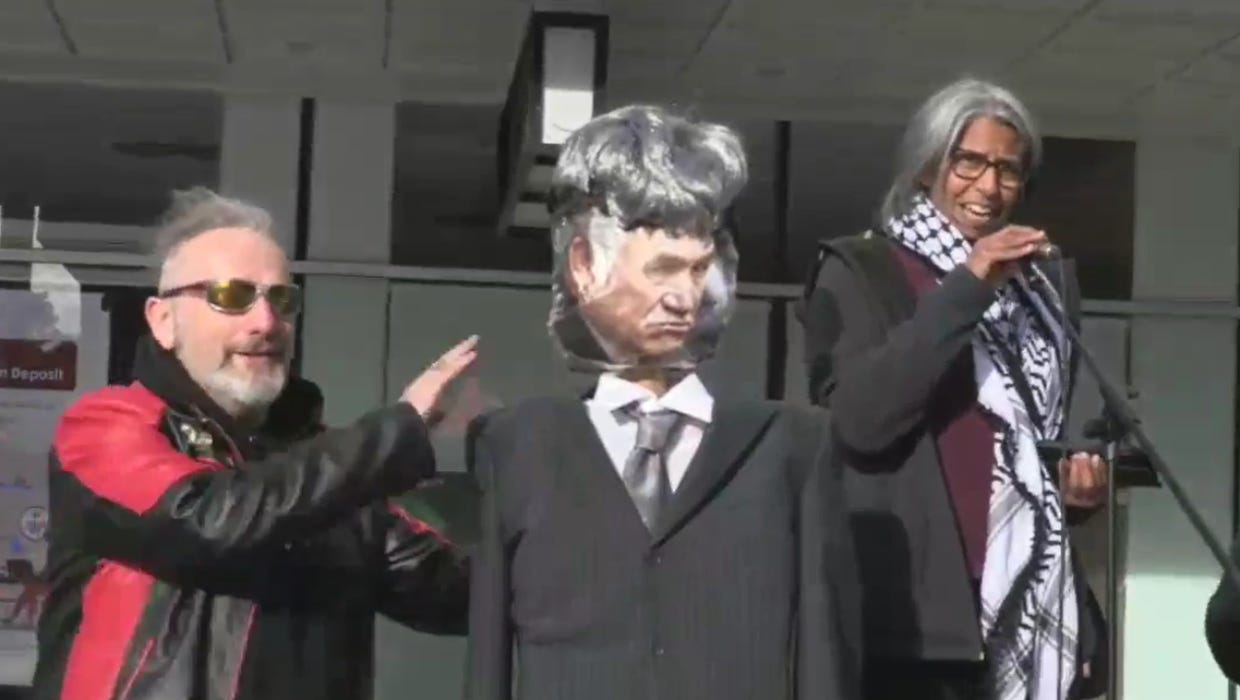
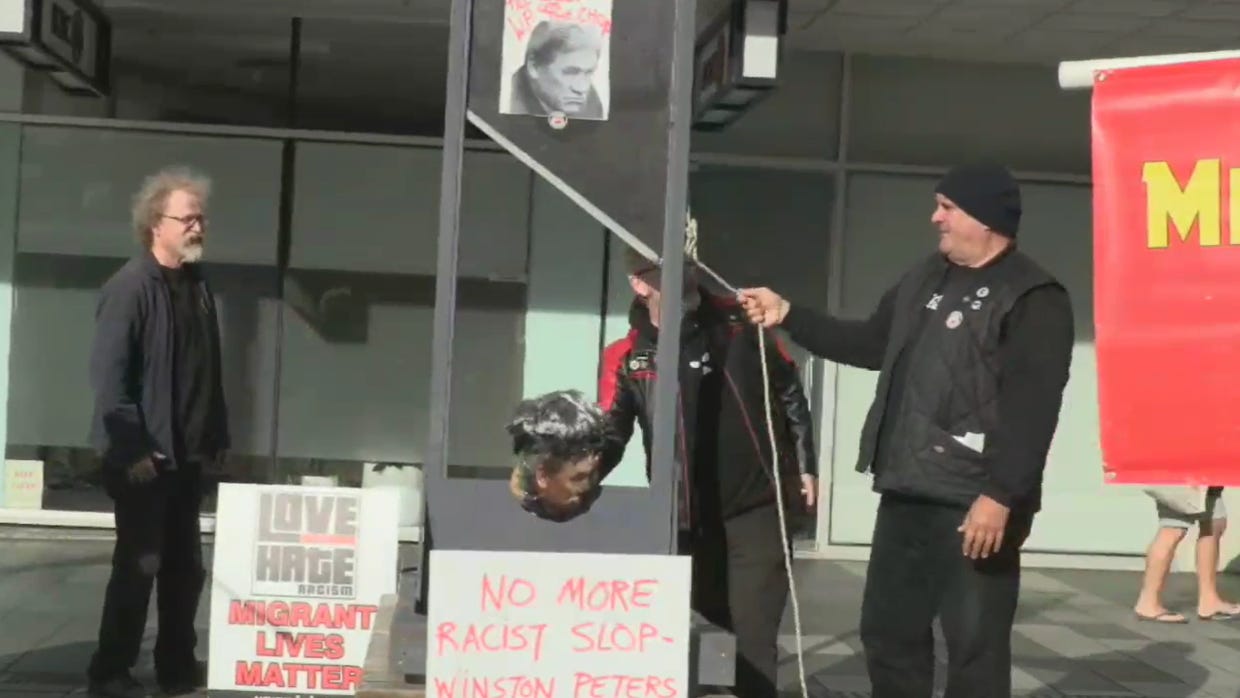
The ire of the MWA comes following Winston Peters comments to Green MP Lawrence Xu-Nan in Parliament in which he told him to “go back to his country”. Comments that received widespread condemnation from other parties in Parliament and the media. However, in a feat of absolute absurdist inversion, the MWA seem to believe that offensive speech is worse than beheading a mannequin with a politician’s face on it. The organisation’s hypocrisy was well and truly on show with organiser Joe Carolan declaring that even though they were staging a political execution, they are in fact opposed to the death penalty.
Now, bear with me, but I need to point some other hypocrisies; ones that I feel like I discuss way too much. I contemplated leaving this out of this piece because I am sick of talking about it, but a few months out from an election the behaviour of our media has massive consequences and should be called out.
So, let’s do the usual comparison… What would New Zealand’s political and media establishment have done if supporters of Winston Peters had wheeled an effigy of Chloe Swarbrick to a mock gallows? Or if ACT activists had staged the symbolic beheading of Chris Hipkins? Or if Hobson’s Pledge supporters had invited a crowd to vote on whether Te Pāti Māori MPs deserved “the chop” before theatrically removing an effigy’s head?
The answer is fairly obvious. There would have been days of headlines, editorials about political intimidation, demands for police investigations, and endless commentary about democratic norms and the dangers of inflammatory rhetoric. It would have been a media sh*tstorm and moral crisis that would stop just short of being declared a national emergency. Instead, the Peters mannequin’s beheading has thus far received limited coverage. I have only seen one article from Stuff and it does not manage to reach the outrage it expressed for offensive words last week.
It is an example of the utterly ideologically captured nature of news media in New Zealand.
Most New Zealanders would probably assume, from its name alone, that the Migrant Workers Association is a fairly conventional advocacy organisation helping exploited workers. It certainly performs that role to an extent. It has represented migrant workers in exploitation cases, advocated for stronger employment protections, and campaigned against labour abuse. But that is only part of the story. Spend even a short time examining the organisation’s public activity and it becomes abundantly clear that MWA is deeply embedded within a far left activist ecosystem comprising militant trade union organisers, Socialist Aotearoa, anti-capitalist campaigners, pro-Palestinian activists, anti-war coalitions, and politicians from the Green Party and Labour who have appeared alongside its campaigns.
The same names appear repeatedly alongside MWA at events and promoting shared causes. Unite Union, One Union, Socialist Aotearoa, Anupam “Anu” Kaloti, Joe Carolan, Mike Treen, Ricardo Menéndez March, Marja Lubeck, Sandra Grey, and Helen White. That does not mean every organisation is controlled by another, nor does it mean every Green MP endorses every position taken by Socialist Aotearoa. I have been the subject of far too many “Atlas” conspiracies to apply the same poor logic to the otherside. New Zealand is small and no matter what your politics there are likely to be a relatively small group of people taking on active and public roles. However, it does reveal an activist network that is more interconnected than many people might assume.
Carolan himself is not simply a union organiser. He has spent decades organising within Unite Union and co-founded Socialist Aotearoa, a revolutionary socialist organisation whose stated objective is replacing capitalism and building socialist organisation within trade unions. His own public interviews make that strategy explicit and earlier this year he argued that protests should be escalated into industrial action capable of bringing down the Government. He praised the idea of a coordinated “pink flu”, in which workers collectively call in sick, discussed general strikes, and declared that governments could be defeated without waiting for elections. “What Parliament does,” he argued, “the streets can undo.” Whether you or I agree with those views is beside the point. The point is that these are not simply employment advocates who occasionally wander into politics. Politics is central to everything they do.
Click to view
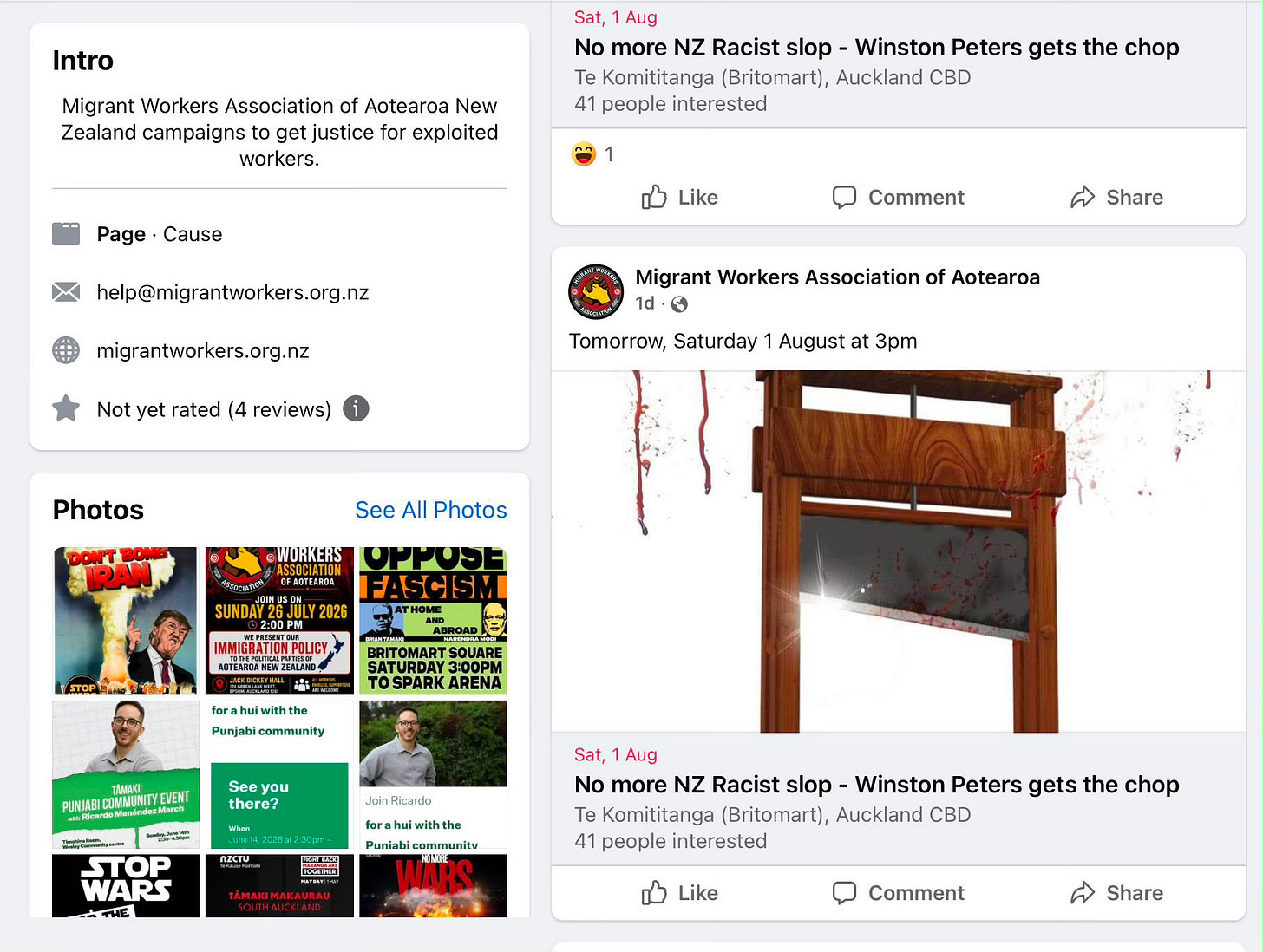
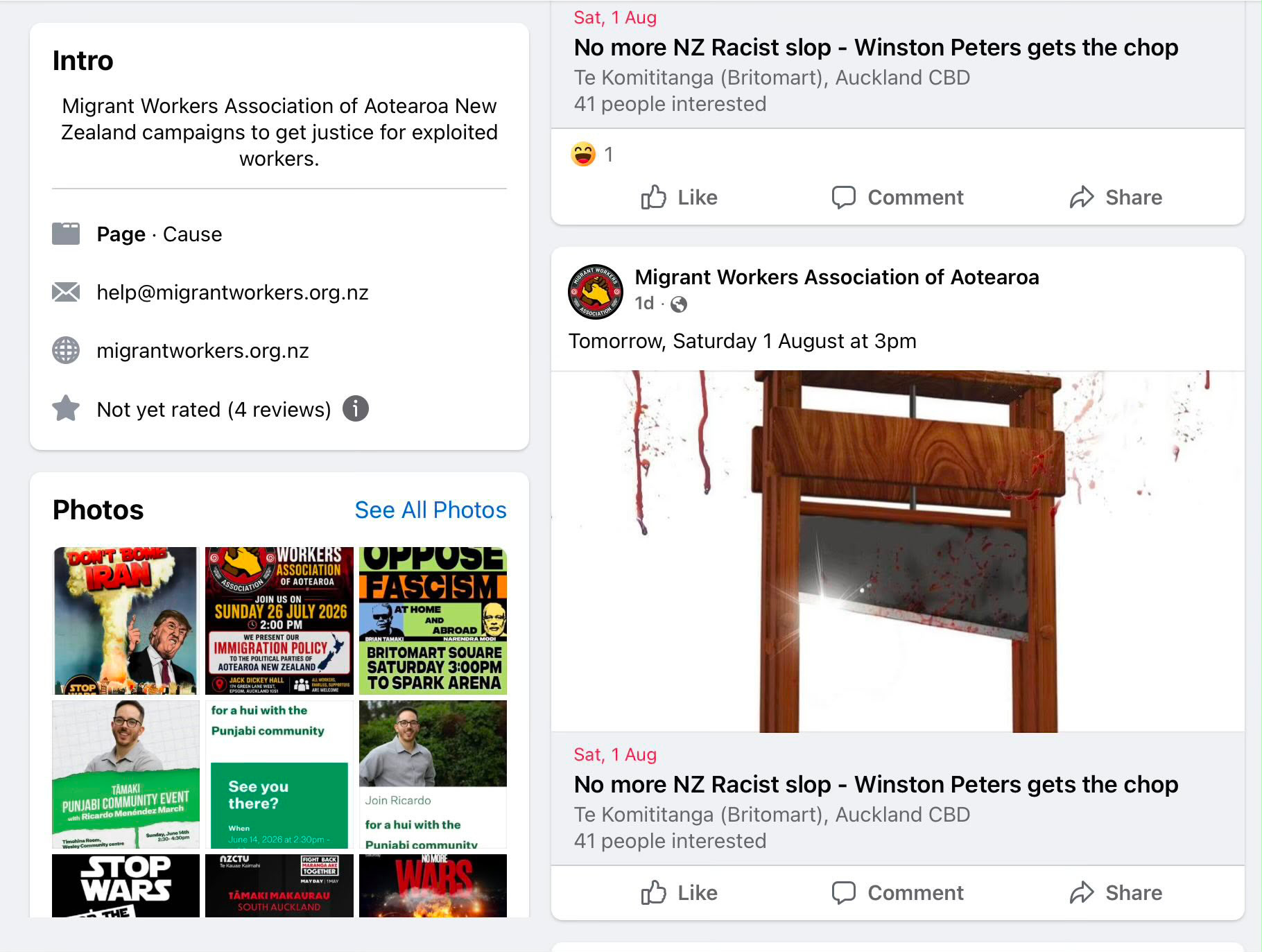
Perhaps the most politically significant parliamentary relationship appears to be with Green MP Ricardo Menéndez March. The Migrant Workers Association has repeatedly promoted his events to migrant communities and appeared alongside him on several panels. One recent example was a Punjabi community meeting featuring Menéndez March using official Green Party branding promoted on the MWA Facebook page. The promotional material stated it was authorised by the MP and funded through Parliamentary Service. That does not establish that Parliamentary Service funds the Migrant Workers Association itself, but it is arguably a bad look for parliamentary-funded Green Party material to be used by an organisation that stages political assassinations. Menéndez March has also repeatedly aligned himself with campaigns that overlap with MWA and if journalists are prepared to scrutinise political associations in other contexts, it is reasonable to ask for the same level of scrutiny here.
The relationship with Labour is slightly less friendly as the MWA has frequently criticised Labour governments for not going far enough on migration policy, yet Labour MPs have also appeared alongside its campaigns. Former Labour MP Marja Lubeck and current MP Helen White have participated in campaign events promoted through the same activist network.
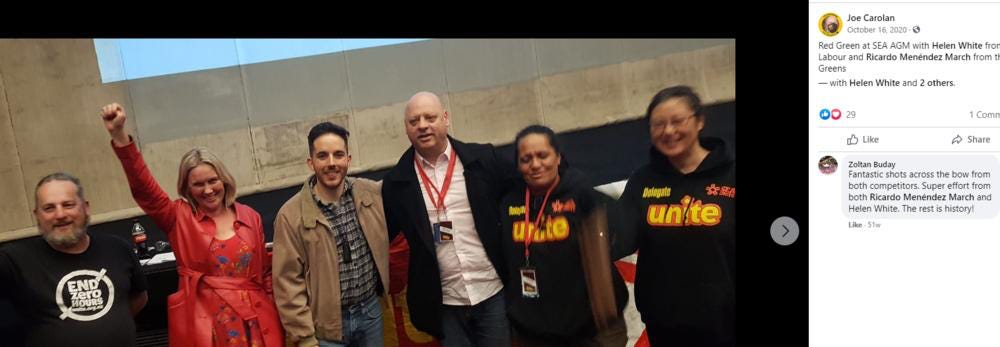
Joe Carolan, Labour MP Helen White,
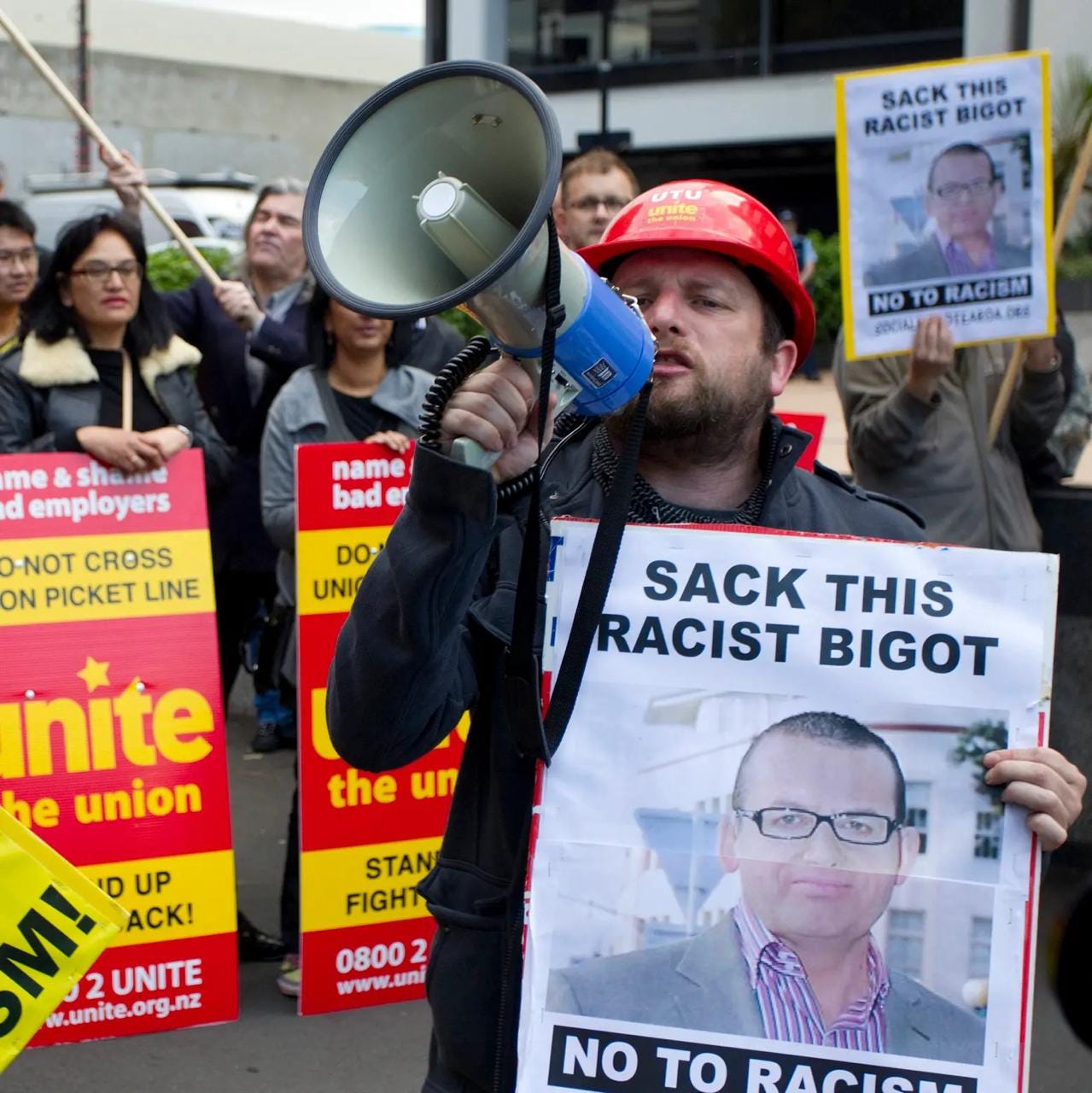
Joe Carolan in 2010.
Even those who were deeply offended by Winston Peters’ remarks to Xu-Nan can surely acknowledge that it is quite a leap from offensive words to cosplay beheadings. People are entitled to believe Peters’ comments were racist and they are entitled to demand his resignation, protest against him, or campaign against New Zealand First. All of these are routine features of democratic politics. Staging a mock execution of a political opponent is not routine and represents a seriously unhealthy form of political expression. It marks a troubling escalation in the violence of political rhetoric in New Zealand.
Guillotines have never been politically neutral props. MWA chose this method of execution precisely because it communicates a powerful historical image of revolution and uprising. This is far left extremism and should be thoroughly condemned by every political party. The Greens and Labour especially should denounce the stunt and call for calm. These are their supporters. Their activists. And given the increasing political violence we are seeing from the left across the world, left wing politicians should be leading by example and denouncing violence.
What is happening here in New Zealand sits within a much wider and deeply concerning international trend in which the activist far left have become increasingly comfortable flirting with violent imagery, revolutionary symbolism and, in some cases, outright political violence. Over the past few years, we have seen repeated examples of assassination attempts against Donald Trump, followed not with unequivocal condemnation but with jokes, celebration, or rationalisation online from the left. The murder of UnitedHealthcare chief executive Brian Thompson saw Luigi Mangione transformed into a folk hero by leftists on the internet who treated political murder as an understandable response to corporate grievance rather than an act of cold blooded violence. In Britain, Green Party leader Zack Polanski faced criticism after sharing an image featuring Nigel Farage being guillotined. Britain is also still grappling with the brutal killing of former Conservative minister and Reform UK spokesperson Ann Widdecombe. A far left activist with ties to Jeremy Corbyn’s new party has been charged with the murder and counter terrorism police are investigating terroristic motivations.
New Zealand has already had a warning that political hostility does not always stay confined to slogans and placards. In October last year, after days of increasingly heated protests over the Government’s stance on Palestinian statehood, Winston Peters’ Auckland home was targeted. A man smashed a window with a crowbar while Peters’ partner and a guest were inside, sending glass through the room and over the family’s dog. A 29 year old man was arrested and charged.
That incident should have been a line in the sand. Taking political protest to a politician’s private home and escalating to criminal damage crosses a fundamental democratic boundary. Home is where partners, children, and families live, and they should not be dragged into the political arena.
Across Western countries, slogans such as “globalise the intifada” have become commonplace at demonstrations despite the term’s association with waves of terrorist attacks that killed hundreds of civilians. The Green Party in particular has enthusiastically used the slogan here along with “from the river to the sea”. Chloe Swarbrick has spent the better part of this term of Government screaming into a microphone chants that are at best antisemitism-adjacent.
The irony is that many of the same activist networks are often the first to argue that words matter and political rhetoric creates dangerous social norms. They see Nazi and white supremacists symbology in a woman zipping up her jacket. Infact, the violence enacted against Posie Parker (and those of us attending to hear her) at Albert Park is another example of left wing political escalation. There may have been families and well-intended allies present down the back, but at the front activists tore apart barriers, assaulted elderly women, and surrounded Posie Parker. I genuinely thought they were going to kill her.
It is long past time we took left wing violence seriously. The constant death threats, violent messages, and hideous personal abuse I receive are not isolated incidents or the work of a few unhinged individuals. They are the predictable product of a political culture that wraps itself in the language of compassion while practising intimidation, dehumanisation, and narrative distortion as standard operating procedure. The “be kind” brigade has perfected the art of demanding endless empathy for their preferred causes while showing none toward those who dissent, and they treat threats and abuse directed at their opponents as somehow deserved.
This is not compassion or empathy. Calling something kind does not make it so, any more than declaring a man a woman makes him one, or rewriting history to fit a preferred ideology turns falsehood into fact. Twisting the narrative is not an occasional feature of leftist politics; it is fundamental to how it operates. Reality is subordinated to the story that must be told, and anyone who refuses to play along is marked as fair game for harassment, cancellation, or worse.
Saturday’s mock guillotine was not harmless theatre. Symbols of execution aimed at political opponents are never neutral, and treating them as such only when the perpetrators claim progressive motives is selective blindness. When homes are targeted, when violent imagery is excused, and when the volume of threats against people who hold mainstream views is routinely downplayed or ignored, the message is clear that some lives and some opinions are less protected than others.
A society that cannot bring itself to condemn political violence and intimidation with equal force, regardless of the ideology of the perpetrators, is not serious about democracy. The double standard that treats left wing aggression as either non-existent or somehow mitigated by good intentions has gone on long enough.
Ani O'Brien comes from a digital marketing background, she has been heavily involved in women's rights advocacy and is a founding council member of the Free Speech Union. This article was originally published on Ani's Substack Site and is published here with kind permission.
Metaphorical? Satire? Theatre? No harm intended? But the symbolic is very powerful. If it is not, they would not have spent days constructing a guillotine.
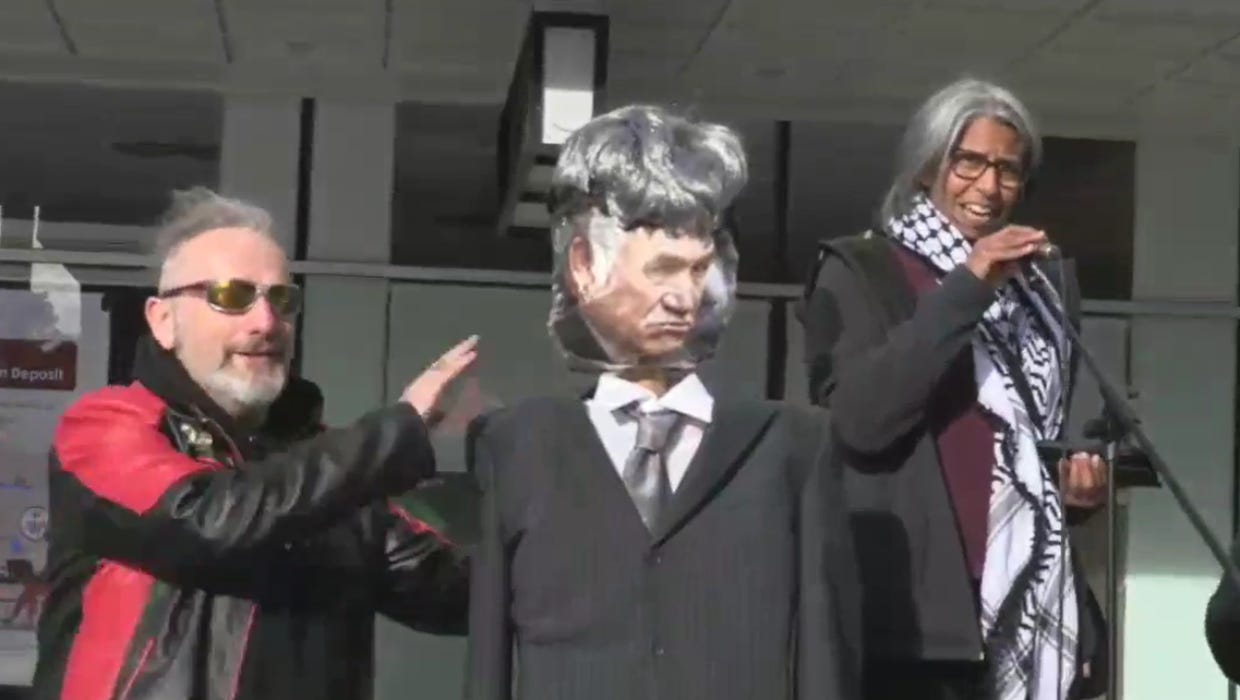
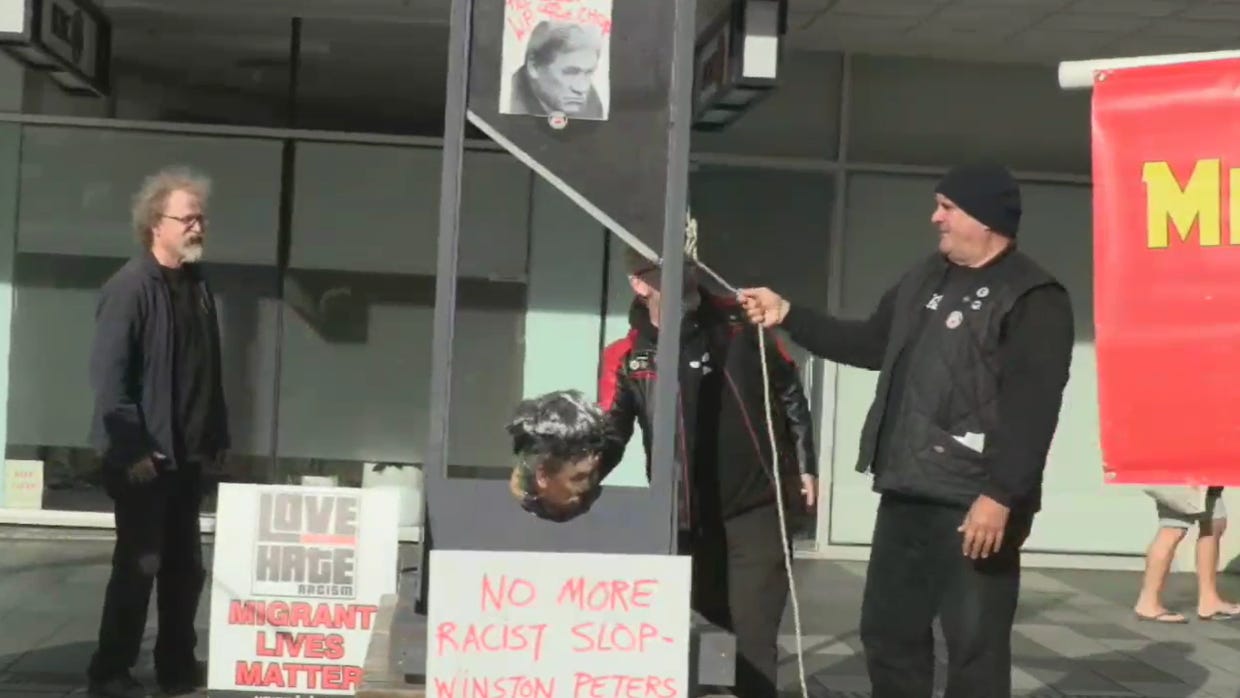
The ire of the MWA comes following Winston Peters comments to Green MP Lawrence Xu-Nan in Parliament in which he told him to “go back to his country”. Comments that received widespread condemnation from other parties in Parliament and the media. However, in a feat of absolute absurdist inversion, the MWA seem to believe that offensive speech is worse than beheading a mannequin with a politician’s face on it. The organisation’s hypocrisy was well and truly on show with organiser Joe Carolan declaring that even though they were staging a political execution, they are in fact opposed to the death penalty.
Now, bear with me, but I need to point some other hypocrisies; ones that I feel like I discuss way too much. I contemplated leaving this out of this piece because I am sick of talking about it, but a few months out from an election the behaviour of our media has massive consequences and should be called out.
So, let’s do the usual comparison… What would New Zealand’s political and media establishment have done if supporters of Winston Peters had wheeled an effigy of Chloe Swarbrick to a mock gallows? Or if ACT activists had staged the symbolic beheading of Chris Hipkins? Or if Hobson’s Pledge supporters had invited a crowd to vote on whether Te Pāti Māori MPs deserved “the chop” before theatrically removing an effigy’s head?
The answer is fairly obvious. There would have been days of headlines, editorials about political intimidation, demands for police investigations, and endless commentary about democratic norms and the dangers of inflammatory rhetoric. It would have been a media sh*tstorm and moral crisis that would stop just short of being declared a national emergency. Instead, the Peters mannequin’s beheading has thus far received limited coverage. I have only seen one article from Stuff and it does not manage to reach the outrage it expressed for offensive words last week.
It is an example of the utterly ideologically captured nature of news media in New Zealand.
Most New Zealanders would probably assume, from its name alone, that the Migrant Workers Association is a fairly conventional advocacy organisation helping exploited workers. It certainly performs that role to an extent. It has represented migrant workers in exploitation cases, advocated for stronger employment protections, and campaigned against labour abuse. But that is only part of the story. Spend even a short time examining the organisation’s public activity and it becomes abundantly clear that MWA is deeply embedded within a far left activist ecosystem comprising militant trade union organisers, Socialist Aotearoa, anti-capitalist campaigners, pro-Palestinian activists, anti-war coalitions, and politicians from the Green Party and Labour who have appeared alongside its campaigns.
The same names appear repeatedly alongside MWA at events and promoting shared causes. Unite Union, One Union, Socialist Aotearoa, Anupam “Anu” Kaloti, Joe Carolan, Mike Treen, Ricardo Menéndez March, Marja Lubeck, Sandra Grey, and Helen White. That does not mean every organisation is controlled by another, nor does it mean every Green MP endorses every position taken by Socialist Aotearoa. I have been the subject of far too many “Atlas” conspiracies to apply the same poor logic to the otherside. New Zealand is small and no matter what your politics there are likely to be a relatively small group of people taking on active and public roles. However, it does reveal an activist network that is more interconnected than many people might assume.
Carolan himself is not simply a union organiser. He has spent decades organising within Unite Union and co-founded Socialist Aotearoa, a revolutionary socialist organisation whose stated objective is replacing capitalism and building socialist organisation within trade unions. His own public interviews make that strategy explicit and earlier this year he argued that protests should be escalated into industrial action capable of bringing down the Government. He praised the idea of a coordinated “pink flu”, in which workers collectively call in sick, discussed general strikes, and declared that governments could be defeated without waiting for elections. “What Parliament does,” he argued, “the streets can undo.” Whether you or I agree with those views is beside the point. The point is that these are not simply employment advocates who occasionally wander into politics. Politics is central to everything they do.
Click to view
Perhaps the most politically significant parliamentary relationship appears to be with Green MP Ricardo Menéndez March. The Migrant Workers Association has repeatedly promoted his events to migrant communities and appeared alongside him on several panels. One recent example was a Punjabi community meeting featuring Menéndez March using official Green Party branding promoted on the MWA Facebook page. The promotional material stated it was authorised by the MP and funded through Parliamentary Service. That does not establish that Parliamentary Service funds the Migrant Workers Association itself, but it is arguably a bad look for parliamentary-funded Green Party material to be used by an organisation that stages political assassinations. Menéndez March has also repeatedly aligned himself with campaigns that overlap with MWA and if journalists are prepared to scrutinise political associations in other contexts, it is reasonable to ask for the same level of scrutiny here.
The relationship with Labour is slightly less friendly as the MWA has frequently criticised Labour governments for not going far enough on migration policy, yet Labour MPs have also appeared alongside its campaigns. Former Labour MP Marja Lubeck and current MP Helen White have participated in campaign events promoted through the same activist network.
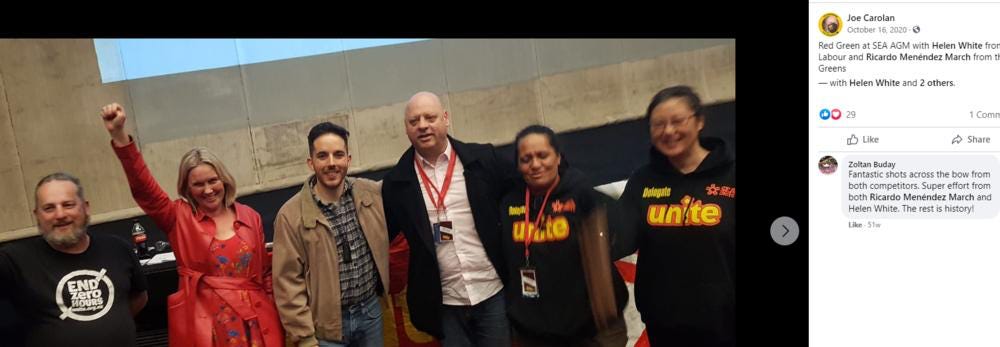
Joe Carolan, Labour MP Helen White,
Green MP Ricardo Menéndez March, and others.
The Migrant Workers Association is also a registered charity. Nothing prevents charities from advocating for policy change; in fact, it is common. Since the Supreme Court’s decision in Re Greenpeace, political advocacy is not, by itself, incompatible with charitable status where it genuinely advances a charitable purpose. But charities are not supposed to become vehicles for partisan political campaigning or electoral activism.
New Zealand has already seen one high profile example in Family First, which spent years fighting to retain its charitable status after regulators concluded its primary purposes had become political rather than charitable. It demonstrated that the Charities Registration Board is prepared to scrutinise organisations whose advocacy begins to blur into overt political campaigning and the Migrant Workers Association’s activities deserve similar scrutiny.
In recent years the association has campaigned on residency pathways, employer-tied visas, immigration raids, anti-racism initiatives, Palestine solidarity, anti-Coalition Government protests, events with Green politicians, and repeated collaborations with Socialist Aotearoa networks. The symbolic execution of a serving Cabinet minister surely is an irrefutable piece of evidence that they are politically motivated. If regulators were prepared to ask questions of Family First, they should be prepared to ask them consistently of any registered charity, regardless of where it sits on the political spectrum.
Just as an aside, while researching for this piece, I stumbled upon an article from 2010 about Joe Carolan leading protests demanding that then-broadcaster Paul Henry be sacked over comments about Governor-General Sir Anand Satyanand. Carolan acknowledged that unions do not usually campaign for workers to lose their jobs but argued Henry’s comments were intolerable. Again, offensive or unpleasant words are unacceptable, but symbolic behaedings are not? Sixteen years later, Carolan must be consumed with rage as both Peters and Henry campaign for their respective parties.
The Migrant Workers Association is also a registered charity. Nothing prevents charities from advocating for policy change; in fact, it is common. Since the Supreme Court’s decision in Re Greenpeace, political advocacy is not, by itself, incompatible with charitable status where it genuinely advances a charitable purpose. But charities are not supposed to become vehicles for partisan political campaigning or electoral activism.
New Zealand has already seen one high profile example in Family First, which spent years fighting to retain its charitable status after regulators concluded its primary purposes had become political rather than charitable. It demonstrated that the Charities Registration Board is prepared to scrutinise organisations whose advocacy begins to blur into overt political campaigning and the Migrant Workers Association’s activities deserve similar scrutiny.
In recent years the association has campaigned on residency pathways, employer-tied visas, immigration raids, anti-racism initiatives, Palestine solidarity, anti-Coalition Government protests, events with Green politicians, and repeated collaborations with Socialist Aotearoa networks. The symbolic execution of a serving Cabinet minister surely is an irrefutable piece of evidence that they are politically motivated. If regulators were prepared to ask questions of Family First, they should be prepared to ask them consistently of any registered charity, regardless of where it sits on the political spectrum.
Just as an aside, while researching for this piece, I stumbled upon an article from 2010 about Joe Carolan leading protests demanding that then-broadcaster Paul Henry be sacked over comments about Governor-General Sir Anand Satyanand. Carolan acknowledged that unions do not usually campaign for workers to lose their jobs but argued Henry’s comments were intolerable. Again, offensive or unpleasant words are unacceptable, but symbolic behaedings are not? Sixteen years later, Carolan must be consumed with rage as both Peters and Henry campaign for their respective parties.
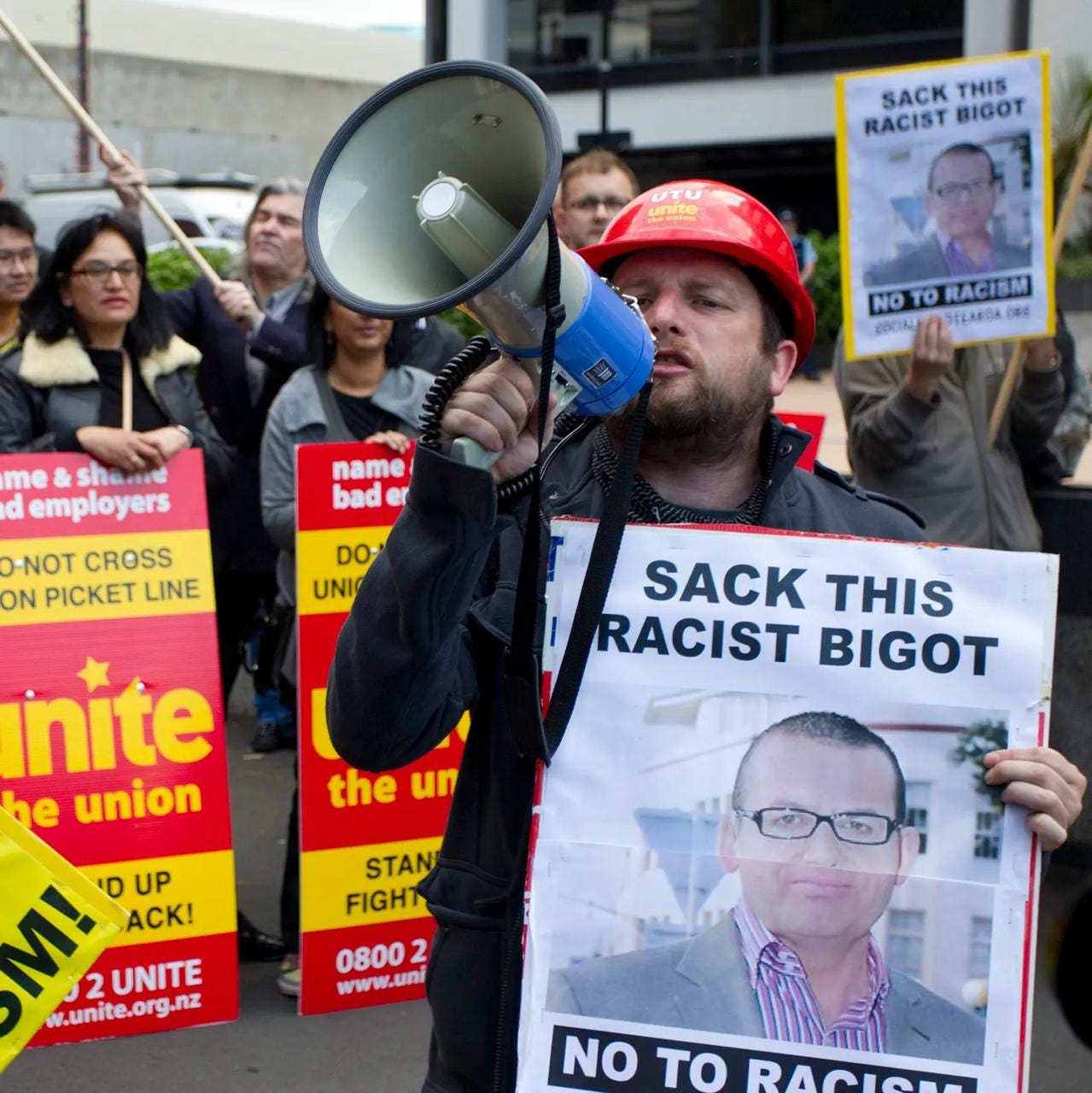
Joe Carolan in 2010.
Even those who were deeply offended by Winston Peters’ remarks to Xu-Nan can surely acknowledge that it is quite a leap from offensive words to cosplay beheadings. People are entitled to believe Peters’ comments were racist and they are entitled to demand his resignation, protest against him, or campaign against New Zealand First. All of these are routine features of democratic politics. Staging a mock execution of a political opponent is not routine and represents a seriously unhealthy form of political expression. It marks a troubling escalation in the violence of political rhetoric in New Zealand.
Guillotines have never been politically neutral props. MWA chose this method of execution precisely because it communicates a powerful historical image of revolution and uprising. This is far left extremism and should be thoroughly condemned by every political party. The Greens and Labour especially should denounce the stunt and call for calm. These are their supporters. Their activists. And given the increasing political violence we are seeing from the left across the world, left wing politicians should be leading by example and denouncing violence.
What is happening here in New Zealand sits within a much wider and deeply concerning international trend in which the activist far left have become increasingly comfortable flirting with violent imagery, revolutionary symbolism and, in some cases, outright political violence. Over the past few years, we have seen repeated examples of assassination attempts against Donald Trump, followed not with unequivocal condemnation but with jokes, celebration, or rationalisation online from the left. The murder of UnitedHealthcare chief executive Brian Thompson saw Luigi Mangione transformed into a folk hero by leftists on the internet who treated political murder as an understandable response to corporate grievance rather than an act of cold blooded violence. In Britain, Green Party leader Zack Polanski faced criticism after sharing an image featuring Nigel Farage being guillotined. Britain is also still grappling with the brutal killing of former Conservative minister and Reform UK spokesperson Ann Widdecombe. A far left activist with ties to Jeremy Corbyn’s new party has been charged with the murder and counter terrorism police are investigating terroristic motivations.
New Zealand has already had a warning that political hostility does not always stay confined to slogans and placards. In October last year, after days of increasingly heated protests over the Government’s stance on Palestinian statehood, Winston Peters’ Auckland home was targeted. A man smashed a window with a crowbar while Peters’ partner and a guest were inside, sending glass through the room and over the family’s dog. A 29 year old man was arrested and charged.
That incident should have been a line in the sand. Taking political protest to a politician’s private home and escalating to criminal damage crosses a fundamental democratic boundary. Home is where partners, children, and families live, and they should not be dragged into the political arena.
Across Western countries, slogans such as “globalise the intifada” have become commonplace at demonstrations despite the term’s association with waves of terrorist attacks that killed hundreds of civilians. The Green Party in particular has enthusiastically used the slogan here along with “from the river to the sea”. Chloe Swarbrick has spent the better part of this term of Government screaming into a microphone chants that are at best antisemitism-adjacent.
The irony is that many of the same activist networks are often the first to argue that words matter and political rhetoric creates dangerous social norms. They see Nazi and white supremacists symbology in a woman zipping up her jacket. Infact, the violence enacted against Posie Parker (and those of us attending to hear her) at Albert Park is another example of left wing political escalation. There may have been families and well-intended allies present down the back, but at the front activists tore apart barriers, assaulted elderly women, and surrounded Posie Parker. I genuinely thought they were going to kill her.
It is long past time we took left wing violence seriously. The constant death threats, violent messages, and hideous personal abuse I receive are not isolated incidents or the work of a few unhinged individuals. They are the predictable product of a political culture that wraps itself in the language of compassion while practising intimidation, dehumanisation, and narrative distortion as standard operating procedure. The “be kind” brigade has perfected the art of demanding endless empathy for their preferred causes while showing none toward those who dissent, and they treat threats and abuse directed at their opponents as somehow deserved.
This is not compassion or empathy. Calling something kind does not make it so, any more than declaring a man a woman makes him one, or rewriting history to fit a preferred ideology turns falsehood into fact. Twisting the narrative is not an occasional feature of leftist politics; it is fundamental to how it operates. Reality is subordinated to the story that must be told, and anyone who refuses to play along is marked as fair game for harassment, cancellation, or worse.
Saturday’s mock guillotine was not harmless theatre. Symbols of execution aimed at political opponents are never neutral, and treating them as such only when the perpetrators claim progressive motives is selective blindness. When homes are targeted, when violent imagery is excused, and when the volume of threats against people who hold mainstream views is routinely downplayed or ignored, the message is clear that some lives and some opinions are less protected than others.
A society that cannot bring itself to condemn political violence and intimidation with equal force, regardless of the ideology of the perpetrators, is not serious about democracy. The double standard that treats left wing aggression as either non-existent or somehow mitigated by good intentions has gone on long enough.
Ani O'Brien comes from a digital marketing background, she has been heavily involved in women's rights advocacy and is a founding council member of the Free Speech Union. This article was originally published on Ani's Substack Site and is published here with kind permission.


12 comments:
I'd like to see some migrant worker data. What % of nurses are migrants? Dairy owners? House painters? Plumbers? Uber divers? High school teachers? University lecturers? On the dole? Etc
Very sick people on the left.
A strong case for the elimination of a charitable status to be removed. The tax take is significant and the pet subsidized by tax payer projects would need to stand on their own feet, and those political parties also.
Like every barrel of apples it only takes one to make the whole thing rotten.
The same applies to political violence (left or right). If on person stakes a claim by using violence in the name of their ideology because of the rhetoric, the encouragement, the complicity and/or the media silence then it reflects not only the base from which it sprang but society as an apple barrel gone rotten.
IMO NZ is not too far from seeing real political violence and it won't be dildos at ten paces....
I think Peters was wrong and the Speaker was not doing his job. I have seen MPs being forced to withdraw and apologise for much less. Having said that, the mock execution was way over the top.
We are not aware of whether the left or right wing is better or worse on social media, but the left wing has a job of work to do if it is to dissociate itself from very nasty attacks on private individuals, as well as public figures.
Elements connected with the Labour Party and the Aotearoa Educators Collective have been especially unpleasant, to say the least, and no amount of lobbying to have damaging Facebook posts taken offline has achieved anything.
We are aware of private individuals who are being hurt. In the end, it is the Labour Party and the Aotearoa Educators Collective whose reputations will suffer the greatest damage if they are seen to support this kind of activity. So far, neither has responded to our requests to have the relevant Facebook posts taken down.
Ani, you forgot to call out the outrageous act of political violence perpetrated by the treaty activitists who vandalized the English (true) version of the treaty at Te Papa. The man with the grinder was not prosecuted because it "not in the public interest" that's our activitist judges for you.
I only know about this because I saw it here.
I think Peters' remarks were appalling for a foreign minster, but compared to what else is said in the House the response seemed well OTT to me.
This mock beheading following on from the attack on his private residence comes across to me as more to do with Winston Peters' opposition to unlimited immigration than protest about a guy shooting his mouth off in a situation where it's standard practice
"When homes are targeted..."
This is one of the reasons I began to use a nom de plume. Many years ago, I commented using my own name. But no more, after I was contacted by complete strangers. I have forthright views, and it takes a lot to intimidate me. But my family didn't like what was happening, so I reluctantly began using a nom. I wish it weren't necessary, but my name is distinctive and easily found. We live in a small street: the last thing we need is protesters turning up to do damage. As we've seen, don't think it can't happen.
I was, of course, appalled by the mock execution of Winston Peters. While I think he could have used a different turn of phrase, what he said wasn't racism. What people think and say isn't racism. That's the preserve of governments, which can institute legislation and societal arrangements which discriminate - either in favour of or against - distinct groups in society. The Maori electoral system is racist. By-Maori for-Maori services are also racist.
The issue of left wing violence is actually of long standing, though we in NZ haven't, until relatively recently, seen a great deal of it. See this link, which I was sent some years ago: https://status451.com/2017/01/20/days-of-rage/
That link concerns events in the US within my lifetime, though I was too young to know about the oldest of them. But I certainly remember events from the 1950s on. At the time, I was shocked by some of it, but not as shocked as I should have been. Looking back, I think that may have been because "decolonisation" in other parts of the world often involved violence: it was part of the zeitgeist of the post-WW2 world. That doesn't make it right, of course.
Given the context, I don't think Peter's comment was intentionally racist. I think the Green MP in question was out of line with his question and Mr Peters was not attacking his race explicitly, but rather the political system of the nation he was born in. I think that it wasn't a helpful thing to do, but the speaker should've disciplined the Green MP so Peter's didn't need to respond in the first place. The rest of this is political theatre so people are made to not feel safe. Fear is used to control the masses.
Public theatre of the anti-politician, anti-anything, variety has been with us world-wide for generations.
Recall the Trump hot air balloon in the shape of a baby wearing nappies.
Nearer to home last week we had the Australian comedian (so-called) who produced a skit depicting a grossly indecent act being performed on an effigy of business woman Gina Rinehart. The TV skit was broadcast by the ABC. That issue is heading towards legal action and it would not surprise if some high level media types lost their jobs.
Here we have had that tired old Shag/Marry/Kill gag trotted out on radio as if it was an NZ original. The gag was also used on the Australian Prime Minister recently.
Now we have the Guillotine gag being applied to Winston Peters. It should be seen for what it is – a pathetic low-rent attempt at satire/humour. At least the perpetrators did not replicate the indecent Gina Rinehart act.
As humour and satire (the two should be synonymous) the Trump balloon act would rate well ahead of anything else.
You don't have to agree with me, but I believe to avail of freedom of speech then every statement must be preceded with "You don't have to agree with me, but I believe..." Otherwise they should be chopped. Haha, satire not so funny now is it? Same for nutters thinking statements of violently sexually assaulting famous, laudable, Australian women is satire. You will know them by their fruit.
Once again I am left to lament that I may have to vote for the side I hate the least.
Post a Comment
Thank you for joining the discussion. Breaking Views welcomes respectful contributions that enrich the debate. Please ensure your comments are not defamatory, derogatory or disruptive. We appreciate your cooperation.